
Tivoli Access Manager (TAM) is an enterprise identity and access management (IAM) platform originally developed by IBM to provide centralized authentication, authorization, and access control for web and enterprise applications. In practice, TAM is most often encountered today as legacy infrastructure—still protecting critical systems, but increasingly difficult to operate securely in modern cloud and zero-trust environments.
For engineers, the real question is no longer “What is Tivoli Access Manager?” but rather: “How do we secure, operate, and eventually modernize systems that still depend on it?”
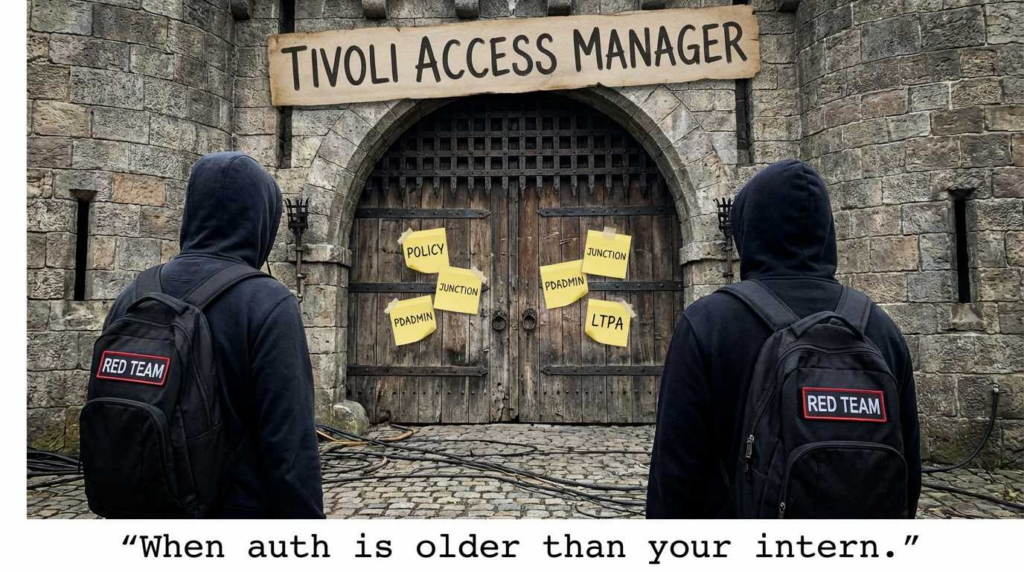
What Tivoli Access Manager Actually Does (At a Technical Level)
Tivoli Access Manager was designed to solve a core enterprise problem: centralized access control across heterogeneous systems.
Key capabilities include:
- Centralized authentication (often LDAP-backed)
- Authorization via protected object policies
- Web access management through reverse proxies
- Single Sign-On (SSO) across enterprise applications
- Policy enforcement points (PEPs) decoupled from applications
Architecturally, TAM reflects a pre-cloud, perimeter-centric security model—robust for its time, but increasingly strained today.
Core Architecture of Tivoli Access Manager
A typical TAM deployment includes:
Policy Server
- Central authority for authentication and authorization decisions
- Stores access policies and protected object definitions
- Communicates with directory services (LDAP)
WebSEAL (Reverse Proxy)
- Acts as a policy enforcement point
- Intercepts HTTP(S) requests
- Performs authentication and enforces access policies
Directory Services
- User and group storage (often IBM Directory Server or Active Directory)
- Foundation for identity resolution
Resource Managers
- Enforce access control for non-web resources
This separation of policy decision and policy enforcement was forward-thinking—and influenced later zero trust designs.

Why Tivoli Access Manager Still Exists in Production
Despite its age, TAM remains deployed because:
- It protects mission-critical legacy applications
- Replacing IAM systems is high-risk and politically sensitive
- Custom applications are tightly coupled to TAM APIs
- Compliance requirements discourage rapid change
In many enterprises, TAM is not a security choice—it’s technical debt with business constraints.
Security Risks and Operational Challenges with Tivoli Access Manager
Legacy Cryptography and Protocol Assumptions
Older TAM deployments may rely on:
- Outdated TLS configurations
- Long-lived session cookies
- Static trust assumptions between components
These assumptions conflict with modern zero trust principles.
Coarse-Grained Authorization Models
TAM policies often operate at:
- URL or resource path level
- Group-based authorization
This makes it difficult to enforce:
- Context-aware access
- Device posture checks
- Dynamic risk scoring
Limited Cloud and API-Native Support
TAM was not designed for:
- Ephemeral cloud workloads
- Microservices
- API-first authentication flows
- OAuth2 / OpenID Connect-native integrations
Bridging these gaps introduces complexity and risk.
Attack Example 1: Misconfigured WebSEAL Policy Exposure
A common failure mode involves overly permissive protected object policies.
text
/secure/* Policy: allow group "employees"
If:
- Group membership is broad
- External access paths are misclassified
- WebSEAL is internet-facing
Then sensitive internal resources may be exposed unintentionally.
Engineering insight: Most TAM incidents stem from policy drift, not exploitation of novel vulnerabilities.
Defense Example 1: Audit Effective Access, Not Just Defined Policies
Engineers should regularly validate effective access paths:
bash
#Enumerate protected object mappingspdadmin sec_master list /WebSEAL/example-webseal
Compare:
- Defined policies
- Actual reachable URLs
- Network exposure
This closes the gap between “policy as written” and “access as experienced.”
Attack Example 2: Credential Replay via Long-Lived Sessions
Older TAM deployments often rely on long-lived session cookies.
If stolen (via XSS, logs, or misconfigured headers), attackers may replay them without reauthentication.
http
Cookie: PD-S-SESSION-ID=abcdef123456
Without:
- Short session lifetimes
- Device binding
- Reauthentication triggers
Session replay becomes a real risk.
Defense Example 2: Harden Session Management
Recommended controls include:
- Aggressive session expiration
- TLS-only cookies
- HTTPOnly and Secure flags
- Reauthentication on privilege escalation
These mitigations reduce the blast radius even if legacy systems remain.
Integrating Tivoli Access Manager into a Zero Trust Model
TAM can participate in a zero trust strategy—but only as a constrained component, not the control plane.
Effective patterns include:
- Using TAM as a legacy authentication front-end
- Offloading modern auth (OIDC, MFA, device trust) upstream
- Limiting TAM’s role to authorization for legacy apps
This reduces risk while preserving business continuity.
Attack Example 3: Excessive Privilege Through Group Sprawl
IAM systems degrade over time due to unmanaged group growth.
text
Group: legacy-admins Members: 247
If group membership is not audited:
- Privileged access becomes invisible
- Insider risk increases
- Compliance evidence weakens
Defense Example 3: Continuous Access Review Automation
python
def check_group_size(group):
if group.member_count > 20:
alert("Excessive privileged group size")
This type of logic underpins modern IAM governance and should surround any TAM deployment.
Migration and Modernization: From Tivoli Access Manager to Modern IAM
IBM has positioned IBM Security Verify Access as the modern successor to Tivoli Access Manager, supporting:
- OAuth2 / OIDC
- Cloud and hybrid deployments
- Modern MFA and adaptive access
However, migration is never a lift-and-shift.
Successful modernization requires:
- Inventory of protected resources
- Mapping of authentication flows
- Refactoring application integrations
- Parallel operation and phased cutover
Skipping these steps leads to outages and security regressions.
Where Security Testing Fits in TAM Environments
Legacy IAM systems are rarely tested end-to-end.
Automated penetration testing platforms such as Penligent can help:
- Validate effective access paths
- Detect unintended exposure
- Provide evidence for modernization planning
Testing focuses on verification, not exploitation—confirming whether controls behave as intended.
Practical Checklist for Engineers Operating Tivoli Access Manager Today
- Audit protected objects and effective access paths
- Review group memberships and privilege creep
- Harden session handling and TLS settings
- Reduce external exposure of WebSEAL
- Plan gradual migration toward modern IAM
Treat TAM as critical infrastructure, not a “set and forget” system.
Conclusion
Tivoli Access Manager represents a generation of IAM systems that solved real enterprise problems—but under assumptions that no longer hold. For engineers, the challenge is balancing operational stability with security modernization. By auditing effective access, constraining legacy components, and planning structured migration, teams can reduce risk today while preparing for a zero-trust future.
 English
  German
  French
  Spanish
  Portuguese
  Japanese
  Korean
  Hindi
Hindi  Arabic
  Turkish
  Hebrew