
CVE-1999-0524 appears in vulnerability reports with a date that makes it look like a relic. Yet the finding still turns up on current servers, appliances, database nodes, and network devices. Its persistence is not evidence of an unpatched memory-corruption bug hiding for decades. It reflects a much simpler condition: an IPv4 host answers an ICMP Timestamp Request, allowing a remote system to learn timestamp information and, in some implementations, additional behavior useful for fingerprinting.
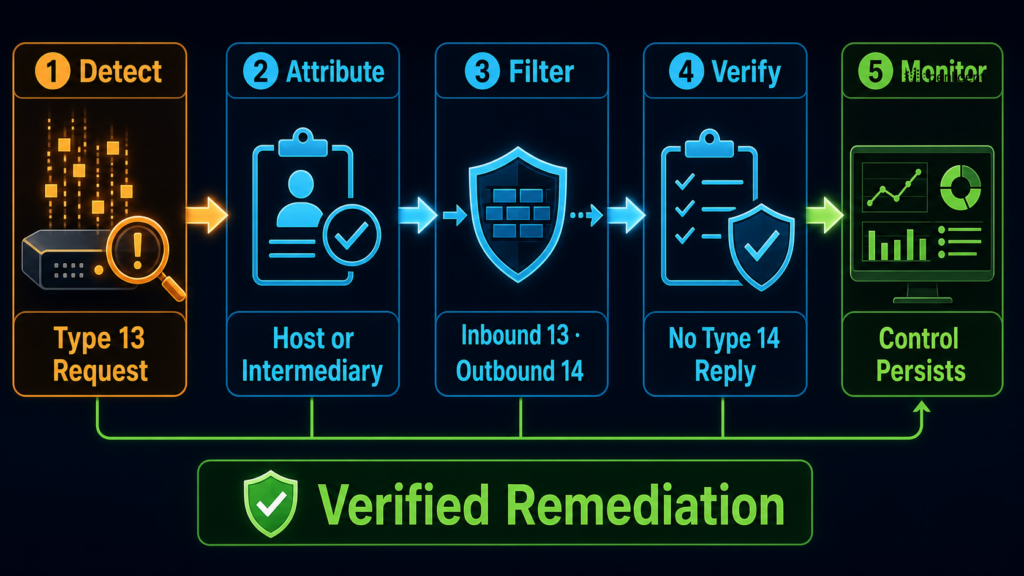
The distinction matters. Treating the finding as a critical product vulnerability leads to disruptive fixes, misleading risk statements, and arguments over nonexistent patch versions. Ignoring it without validation is also poor practice because unnecessary control-plane responses increase observable surface and can become one input to reconnaissance. The defensible response is to understand exactly what the host returns, decide whether the response is operationally required, filter only the unnecessary ICMP message types, and verify the result from the same network path used by the scanner.
What CVE-1999-0524 Actually Describes
The current NVD entry for CVE-1999-0524 retains a broad description: ICMP information, including netmask and timestamp information, is allowed from arbitrary hosts. The record does not provide a normal product-and-version matrix. It does not identify one vulnerable application, one vendor patch, one code commit, or one fixed build. That absence is fundamental to correct triage.
The finding commonly reported by modern scanners is narrower than the historical wording. A scanner sends an IPv4 ICMP Timestamp Request, type 13 and code 0. If the target returns a Timestamp Reply, type 14 and code 0, the scanner reports remote date or timestamp disclosure. The IANA ICMP registry is the authoritative registry for these type assignments. Address Mask Request and Reply are types 17 and 18, respectively, and should be treated as a related but separate test even though the old CVE description groups them together.
This is not remote code execution. The response does not by itself modify files, execute a command, bypass authentication, create a session, or grant privileges. It is an information exposure at the IP control layer. The practical impact depends on what is returned, where the response is reachable from, whether the clock value is accurate, and whether another vulnerable mechanism can make use of timing or fingerprint information.
The record has also changed over time. Old CVEs are sometimes enriched years later with new classifications or scoring data. A database score should therefore be read together with its vector, provenance, and assumptions rather than copied into a risk statement without analysis. The underlying observable for this issue remains straightforward: did a target under test answer an ICMP type 13 request with type 14, and what did the reply reveal?
A precise classification
| Question | Accurate answer |
|---|---|
| Is it an application vulnerability | Usually no; it is a host or network-stack behavior |
| Is one vendor or version universally affected | No product matrix is defined by the CVE record |
| Does a reply prove compromise | No |
| Does blocking ordinary ping fix it | Not necessarily; Echo uses types 8 and 0 |
| Is all ICMP dangerous | No; ICMP carries important error and diagnostic functions |
| Is remediation normally a software patch | Usually it is a firewall, ACL, or stack-configuration change |
| Can it support reconnaissance | Yes, as a low-value signal combined with other observations |
Security teams should record this classification before selecting a fix. It prevents a vulnerability-management ticket from demanding a nonexistent package upgrade and keeps the change focused on the actual exposure.
How ICMP Timestamp Messages Work
ICMP is part of IPv4’s control plane. It reports errors and supports diagnostic or informational exchanges. The original protocol definition, RFC 792, defines Timestamp and Timestamp Reply messages with a compact fixed-format header. The fields are:
| Field | Size | Purpose |
|---|---|---|
| Type | 8 bits | 13 for request, 14 for reply |
| Code | 8 bits | Zero for these messages |
| Checksum | 16 bits | Integrity check across the ICMP message |
| Identifier | 16 bits | Helps a requester match replies |
| Sequence number | 16 bits | Helps order or correlate requests |
| Originate timestamp | 32 bits | Time the sender last touched the request |
| Receive timestamp | 32 bits | Time the replying host first handled it |
| Transmit timestamp | 32 bits | Time the replying host last handled the reply |
RFC 792 specifies the standard value as milliseconds since midnight Universal Time. It also defines a signal for a nonstandard value: if a timestamp cannot be provided in the standard form, the high-order bit may be set. Consequently, scanner output may report a normal UTC-derived timestamp, a nonstandard timestamp, an endian anomaly, zero values, or a clock difference. These variations affect interpretation but not the basic fact that the target answered.
The later host requirements in RFC 1122 section 3.2.2.8 clarify an important point: a host may implement Timestamp and Timestamp Reply. In other words, the feature is optional. If the function is implemented, RFC 1122 describes how replies are formed and how standard values should be represented. That history explains why behavior differs across operating systems, versions, appliances, and intermediary devices. A response can come from a target kernel, a router, a load balancer, a firewall acting on behalf of an address, or a virtual network layer.
The packet exchange is simple:
- The tester creates an IPv4 packet whose protocol is ICMP.
- The ICMP payload has type 13, code 0, identifiers, and timestamp fields.
- A reachable implementation that provides the timestamp service processes the request.
- The responder reverses the IP addresses, changes the ICMP type to 14, recalculates the checksum, and returns timestamp fields.
- The tester correlates the identifier and sequence number and evaluates the returned values.
No TCP or UDP port is involved. Port-oriented firewall reviews can therefore miss the control. A security group that restricts TCP 22 and 443 says nothing by itself about ICMP type 13. Conversely, a device described as “not pingable” may still answer Timestamp Requests because ping normally uses Echo Request type 8 and Echo Reply type 0.

Timestamp arithmetic and uncertainty
Suppose a reply carries a receive timestamp of 43,200,000. Under the standard representation, this corresponds to 12:00:00 UTC because 43,200 seconds have elapsed since midnight. A tester can compare the value with its own UTC time and estimate an offset. Network transit time, processing delay, virtualization, rate limiting, packet capture location, and nonstandard byte ordering all introduce uncertainty. The result is not a precision time-synchronization measurement.
The three timestamps can also be used to reason about the exchange in the style of older clock-measurement methods, but a vulnerability scanner generally needs only the existence of a valid reply to raise the finding. Analysts should not claim that the exact local timezone, geographic location, NTP configuration, or operating-system clock source has been disclosed unless independent evidence supports those conclusions.
Why the Finding Still Appears
There are several reasons a 1999 identifier remains operationally relevant.
First, protocol features outlive application releases. A long-supported operating-system kernel, embedded appliance, hypervisor, or network device may continue to implement behavior standardized in the 1980s. The product can be fully patched and still answer type 13 because patch management and exposure reduction are different control objectives.
Second, network boundaries change. A timestamp service once reachable only on a management VLAN may become visible after a routing, firewall, cloud, or load-balancer change. The host behavior did not change, but the trust boundary did.
Third, vulnerability scanners prefer repeatable observables. A request followed by a reply is easy to test. It produces evidence that is more deterministic than a banner inference. That makes the check common even when its standalone severity is low.
Fourth, compliance workflows often retain old identifiers. A scan policy can map one network behavior to a CVE because the mapping is familiar, even when a modern engineering team would describe the issue as unnecessary ICMP information exposure. The age of the identifier does not make the observation false; it does mean the report needs context.
Finally, some systems require selected ICMP functions for health checks or troubleshooting and are configured too broadly. Broad “allow ICMP” rules are operationally convenient. They may permit timestamp, address-mask, redirect, echo, and error types together when only one or two are needed. Remediation is therefore often rule refinement rather than a binary choice between all ICMP and none.
Security Impact Without Exaggeration
The direct disclosure is limited. A reachable requester may learn that an IPv4 address responds to ICMP timestamp queries and may obtain a time value derived from the target. The information can contribute to reconnaissance in four ways.
Clock-offset observation
An accurate reply may expose approximate clock difference between the target and requester. Clock knowledge can matter when another system relies incorrectly on predictable time values, narrow replay windows, or weak time-seeded randomness. This CVE does not establish that such a second weakness exists. A report should state that timestamp information could assist another attack under additional prerequisites, not that a type 14 reply defeats authentication by itself.
Modern authentication protocols should use cryptographically strong randomness, explicit freshness mechanisms, and carefully validated time windows. If learning server time breaks a protocol, the protocol has a more serious design flaw that should be fixed directly. Filtering timestamp replies removes one input but does not repair weak token generation or replay protection.
Host discovery
A type 14 reply confirms that something at the address processed the request. This can reveal a live host even when Echo Requests are filtered. The result is one additional discovery channel among many. TCP responses, UDP errors, TLS certificates, DNS, routing behavior, and application banners may already reveal the asset. The value is greatest where defenders intentionally minimize all unauthenticated responses on a restricted management or high-security network.
Stack and device fingerprinting
Implementations can differ in byte order, high-bit handling, field values, timing, IP identifiers, TTL, and responses to malformed requests. Research has shown that ICMP timestamp behavior can support host characterization at Internet scale. The paper Sundials in the Shade measured millions of responding hosts and analyzed timestamp implementation behavior. That research supports the general fingerprinting concern, but it does not mean one reply uniquely identifies a product or version. Fingerprints are probabilistic and should be combined with other evidence.
Environmental correlation
Time differences may help an observer correlate devices, notice inconsistent clock configuration, or refine hypotheses about infrastructure. Defenders can derive similar value internally: unexpected timestamp behavior may reveal a forgotten appliance, inconsistent firewall policy, or a route around the intended inspection point. In this sense, the scan finding is also a control-validation signal.
What the finding does not prove
A timestamp reply does not prove that:
- the target is remotely exploitable;
- a time-based authentication protocol is enabled;
- a random-number generator is predictable;
- NTP is exposed or misconfigured;
- the returned clock is accurate;
- the operating system has a specific version;
- the endpoint will answer from every source network;
- address-mask requests are also enabled;
- the host is compromised.
These boundaries should appear in the vulnerability ticket. Clear negative findings are useful because they prevent threat narratives from expanding beyond the evidence.
Risk Triage for Real Environments
Risk is a function of exposure, information quality, asset sensitivity, compensating controls, and plausible chaining. The CVE label alone is insufficient.
| Condition | Risk effect | Recommended response |
|---|---|---|
| Internet-facing host returns an accurate timestamp | Increases unauthenticated observability | Filter types 13 and 14 at the edge and host where practical |
| Management-only host answers from trusted monitoring subnet | Limited exposure | Confirm business need and scope the allowlist |
| Reply is nonstandard or zero | Less useful time disclosure, still confirms behavior | Remove if unnecessary; document reduced information value |
| High-value authentication system also uses weak time-derived tokens | Plausible chain raises priority | Fix token design urgently and filter timestamp replies |
| Scanner sees a reply but packet capture shows an intermediary responded | Asset attribution is wrong | Remediate or reconfigure the responding intermediary |
| Cluster depends on broad ICMP health checks | Change may affect availability | Test precise type filtering in a representative environment |
| No reply from an external path but local host still responds | Perimeter control works, internal surface remains | Decide whether internal segmentation also requires filtering |
A useful ticket contains the source address, destination address, test time, network zone, packet type and code, returned field behavior, and capture or scanner evidence. It also identifies whether the asset owner validated that the response originates from the host itself. “CVE detected” is not enough for a high-quality change request.
Prioritization should remain proportional. An internet-facing type 14 response on a critical identity system deserves faster review than the same response on an isolated lab router. Neither should displace remediation of an actively exploited remote-code-execution flaw solely because a scanner assigned a convenient numeric score.
Safe Validation in an Authorized Lab
Only test systems you own or are explicitly authorized to assess. ICMP timestamp probes are low impact, but they are still network probes. Production scanning can trigger monitoring, violate policy, or produce misleading results through intermediary controls.
Begin with passive evidence. If a scanner already produced packet-level details, preserve the request and reply metadata. On the target or a nearby observation point, an authorized administrator can capture only the relevant ICMP types:
sudo tcpdump -ni any 'icmp[0] == 13 or icmp[0] == 14'This command is a defensive capture filter. It does not send packets. During an approved retest, a type 13 line followed by a type 14 line provides direct evidence of the exchange. Capture placement matters: seeing the request arrive without a reply leave suggests host filtering or no timestamp implementation; seeing a reply at the edge but not on the host suggests an intermediary may be answering.
Wireshark users can apply the display filter:
icmp.type == 13 || icmp.type == 14Inspect the source and destination addresses, type, code, checksum status, identifier, sequence number, and all three timestamp fields. Compare the packet time with the returned values. Do not infer timezone from a value standardized as milliseconds since midnight UTC.
Educational parser PoC
The following toy program parses a synthetic ICMP timestamp body stored entirely in memory. It does not open a raw socket, send a probe, scan a network, or include a target address. Its purpose is to teach the field layout defined by RFC 792.
import struct

# Synthetic type-14 message for local study only.
# checksum=0 because this example never goes on the wire.
sample = struct.pack(
    "!BBHHHIII",
    14,          # Timestamp Reply
    0,           # Code
    0,           # Placeholder checksum
    0x1234,      # Identifier
    1,           # Sequence
    43_199_900,  # Originate ms since midnight UTC
    43_200_000,  # Receive
    43_200_001,  # Transmit
)

fields = struct.unpack("!BBHHHIII", sample)
names = (
    "type", "code", "checksum", "identifier", "sequence",
    "originate_ms", "receive_ms", "transmit_ms"
)
message = dict(zip(names, fields))

assert message["type"] == 14
assert message["code"] == 0
print(message)
The network byte-order marker is !. Real implementations can return nonstandard values, and a robust analyzer must check the high-order bit before interpreting a timestamp. A production packet parser must also validate length and checksum and handle capture truncation. Those engineering details are intentionally outside this safe demonstration.
An approved active check
When active verification is required, use an established vulnerability scanner or packet tool under the organization’s testing procedure. Restrict the target list to owned addresses, rate-limit probes, record the source location, and capture traffic. Do not scan public address ranges to “see what responds.” The objective is to validate a known control, not create an Internet-wide inventory.
Run the same check from each security zone that matters. A successful external block does not prove that a compromised internal workload cannot query timestamp information. Equally, a local response does not prove the Internet can reach it. Network-path context is part of the result.
Detection Engineering
Detection for this issue is simpler than detection for an exploit because the message types are explicit. The challenge is deciding where visibility is reliable and what activity is expected.
Packet and network IDS detection
At an ingress sensor, alert or count inbound ICMP type 13. At an egress sensor, alert or count outbound type 14. A pair with matching addresses, identifier, and sequence number indicates a completed exchange. A request without a reply can still be useful reconnaissance telemetry, but it should not be reported as confirmed disclosure.
The Snort rule documentation for ICMP timestamp traffic provides protocol-level context for detecting these messages. Organizations should adapt severity and direction to their topology rather than enabling a generic rule and treating every event as an incident.
Useful fields include:
- sensor and interface;
- source and destination address;
- ICMP type and code;
- identifier and sequence;
- request and reply timestamps;
- packet TTL and IP identifier as supporting observations;
- action taken by the firewall;
- asset owner and zone;
- whether a reply was observed.
Do not log only “ICMP allowed.” That loses the type-level evidence needed to distinguish essential error traffic from timestamp queries.
Host firewall logging
Host controls can log dropped type 13 requests or type 14 replies. Logging every packet indefinitely may be noisy if a host is frequently scanned. Use rate limiting or aggregation and retain enough samples to prove enforcement. A counter that increments during a controlled retest is often stronger remediation evidence than a screenshot of a configured rule.
Vulnerability scanner validation
A scanner finding should include its observation method. Confirm that it sent type 13 and received type 14. If the plugin reports clock synchronization, endian behavior, or a nonstandard high bit, retain that detail as characterization rather than automatically increasing severity.
False attribution is possible. Any device that owns, proxies, translates, or responds for an address may generate the reply. Load balancers, firewall clusters, routers, cloud networking components, and high-availability peers should be considered. Compare packet TTL, source MAC on a local segment, routing, and captures at multiple points before changing the wrong system.
Detection outcomes
| Observation | Interpretation | Next action |
|---|---|---|
| Type 13 enters and type 14 leaves target | Confirmed response | Apply precise filter or approved exception |
| Type 13 enters and no type 14 leaves | Host did not disclose on observed path | Verify scanner attribution and return path |
| Edge sees type 14 but host capture does not | Intermediary likely responded | Trace network ownership and policy |
| Host sends type 14 but edge drops it | External exposure mitigated, internal behavior remains | Test internal paths and document control layer |
| No packets seen anywhere | Test path or sensor scope may be wrong | Validate routing, capture interface, and scanner source |
| Reply persists after rule change | Rule order, direction, family, zone, or device mismatch | Inspect counters and effective policy |
Remediation Without Breaking ICMP
The safest general remediation is precise filtering: block inbound IPv4 ICMP Timestamp Requests, type 13 code 0, and prevent outbound Timestamp Replies, type 14 code 0, where the service is not required. Applying both directions provides defense in depth. The inbound rule prevents the host from processing requests that arrive through that control point; the outbound rule prevents replies if a request reaches the stack through another path.
Do not begin by dropping all ICMP. ICMP communicates path errors and operational information. Broad suppression can interfere with diagnostics and, depending on the network design, Path MTU Discovery or reachability feedback. The exact consequences depend on which types are blocked. Type-specific policy preserves needed functions while removing the timestamp service.
Linux with iptables
The following defensive examples show the intended selectors. Review the platform’s firewall manager, existing chains, persistence mechanism, orchestration, and rollback procedure before use:
sudo iptables -A INPUT  -p icmp --icmp-type timestamp-request -j DROP
sudo iptables -A OUTPUT -p icmp --icmp-type timestamp-reply   -j DROP
Rule order matters. A broad earlier ACCEPT can prevent a later DROP from being reached. Check counters during an authorized retest and use the distribution-supported persistence mechanism. Do not assume a command entered interactively will survive reboot.
Broadcom documents this narrow approach for a Greenplum environment in its CVE-1999-0524 support article. That example is valuable because it illustrates an operational constraint: a cluster may require ICMP for health checks while not requiring timestamp messages. The correct control preserves the required ICMP functions and removes types 13 and 14. The vendor article applies to its stated environment and should not be treated as a universal product matrix for the CVE.
Linux with nftables
An equivalent nftables policy can match the ICMP type names when supported by the installed ruleset and tooling:
sudo nft add rule inet filter input  ip protocol icmp icmp type timestamp-request drop
sudo nft add rule inet filter output ip protocol icmp icmp type timestamp-reply drop
Production environments should change the declarative ruleset managed by configuration automation rather than append ad hoc runtime rules. Validate the table and chain names, hook priorities, and coexistence with firewalld or another manager. Two firewall managers editing the same effective policy can produce unstable results.
Linux with firewalld
Firewalld supports ICMP filtering, zones, and persistent configuration. The Red Hat guide to managing ICMP requests explains its filtering model and warns through its workflow that runtime and permanent state must be considered. Available ICMP type names vary with installed definitions, so list them first:
firewall-cmd --get-icmptypes
firewall-cmd --get-active-zones
If the platform exposes timestamp-request as a named type, add the block to the correct active zone and then make it permanent according to the supported change procedure. Verify after reload and reboot. If no suitable named type exists, use a reviewed rich or direct rule appropriate to the platform version instead of guessing.
Windows Defender Firewall
Microsoft’s ICMP4_TYPE enumeration confirms that timestamp request and reply are IPv4 types 13 and 14. Windows Defender Firewall can create custom ICMP rules with specific types. Microsoft’s firewall rule configuration guidance describes how to select ICMPv4 and customize type and code conditions.
An administrator can create centrally managed rules that block inbound type 13 and outbound type 14 for the appropriate profiles and scopes. A PowerShell form commonly used for the inbound control is:
New-NetFirewallRule `
  -DisplayName "Block inbound ICMPv4 timestamp requests" `
  -Direction Inbound `
  -Protocol ICMPv4 `
  -IcmpType 13 `
  -Action Block
Create the corresponding outbound type 14 control through the same approved policy mechanism. In an Active Directory environment, prefer Group Policy or the organization’s endpoint-management platform so the rule is auditable and resistant to drift. Confirm profile selection, rule precedence, local-policy merge behavior, and effective policy on the target.
Network firewalls and routers
Filtering at the boundary reduces exposure for many hosts and is often the fastest containment. Match IPv4 ICMP type 13 inbound and type 14 outbound. Syntax differs by vendor and software release, so use the vendor’s current configuration documentation and validate in a lab. Avoid copying an ACL example with unverified interface direction or implicit-deny behavior.
Boundary filtering alone may leave internal exposure. Host filtering provides consistent protection when a workload moves networks, but it increases fleet-management complexity. Mature designs use both: the edge enforces an external policy, and host or segment policy protects sensitive internal trust boundaries.
Appliances and vendor-supported changes
Do not install an unsupported shell firewall on a managed appliance. Use the product’s documented management plane, a supported vendor release, or an upstream network control. A10, for example, has published an ICMP timestamp response advisory that discusses product release families and response behavior. Product-specific guidance should govern appliances because generic operating-system commands can break supportability or be overwritten by upgrades.
Change Planning and Verification
A firewall rule is not complete remediation until its effect is verified and its operational impact is understood.
Before the change
- Identify the responding device, not just the scanned IP.
- Record the request source, path, and timestamp reply evidence.
- Determine whether a cluster, monitor, or diagnostic workflow needs any ICMP function.
- Confirm that the requirement is for Echo, errors, or another type rather than Timestamp.
- Back up the effective policy and define a rollback condition.
- Choose edge, segment, host, or layered enforcement.
- Schedule the change according to asset criticality.
During the change
Apply the narrow selectors, observe rule counters, and monitor service health. If the environment is clustered, validate failover and node communication. If a security device manages policy centrally, confirm that the intended configuration was deployed to every relevant member and interface.
After the change
Repeat the timestamp test from the original scanner location. A timeout alone is suggestive but incomplete; correlate it with a firewall drop counter or packet capture showing the request was blocked. Then test from other relevant zones. Confirm that allowed ICMP functions, application health checks, routing, and monitoring still work.
Reboot or reload behavior should be tested where feasible. A runtime-only rule that disappears after maintenance is a temporary containment, not durable remediation. Configuration compliance can detect drift by checking the declarative policy and supplement it with periodic network validation.
Evidence package
A strong closure package includes:
- original scanner plugin output;
- request and reply packet metadata before the change;
- approved change record;
- effective rule with type, direction, scope, and policy owner;
- counter or log evidence during retest;
- no-reply result from the original path;
- health-check results for required ICMP and application functions;
- persistence validation;
- exception details if any internal path remains allowed.
This evidence makes the closure reproducible. It also prevents a later scan recurrence from becoming a debate about whether the first fix ever reached the correct enforcement point.

Common Remediation Failures
Blocking Echo instead of Timestamp
Echo Request is type 8. Timestamp Request is type 13. A policy that disables ping can leave timestamp replies untouched and simultaneously remove a useful diagnostic. Always verify the numeric type or authoritative named constant.
Configuring only one address family without understanding the finding
CVE-1999-0524 and RFC 792 concern ICMP for IPv4. ICMPv6 is a different protocol with different message types and essential neighbor-discovery functions. Do not translate “block type 13” mechanically into ICMPv6 policy. Review IPv6 exposure independently using IPv6 standards and product guidance.
Adding a rule after a broad allow
Many firewalls use first-match evaluation. A late DROP rule may never execute. Inspect the effective policy and counters rather than the intended configuration snippet.
Changing the wrong device
The IP may terminate on a virtual IP, cluster member, load balancer, router, or firewall. A host rule has no effect if the network appliance generated the reply. Packet captures at two points can resolve attribution.
Forgetting outbound control
An inbound block at one interface may be bypassed through another zone or local source. An outbound type 14 rule provides an additional guard. It should be scoped carefully so it does not hide evidence needed during testing before the final policy is confirmed.
Disabling all ICMP
This is the most disruptive shortcut. It confuses one optional query type with an entire control protocol. Preserve required error reporting and diagnostics through an explicit allowlist or type-specific deny policy.
Failing to persist the rule
Interactive Linux commands and temporary cloud or appliance changes may vanish after reboot, reload, scaling, or replacement. Put the policy in the authoritative configuration source and verify deployment.
Accepting a clean scan without path evidence
A lost route, scanner outage, security-group change, or temporary rate limit can produce no reply. Correlate the clean result with reachability controls and firewall telemetry. Ideally, confirm the scanner can still reach an approved service on the same asset while type 13 is blocked.
Vulnerability Management and Exceptions
Because the issue is low-complexity but low-impact, it is a good test of vulnerability-management maturity. Teams need a process that can distinguish remediation, mitigation, acceptance, false positive, and false attribution.
Use “remediated” when the timestamp service is disabled or the relevant trust boundaries block it durably. Use “mitigated” when a perimeter control removes external exposure but an internal response remains by design. Use “accepted” when a documented business requirement outweighs the limited risk and compensating controls constrain access. Use “false positive” only when the scanner did not actually receive a qualifying response from the attributed asset; a low-risk true observation is not a false positive.
An exception should record:
- exact assets and interfaces;
- sources permitted to query;
- operational reason;
- returned timestamp behavior;
- segmentation and monitoring controls;
- owner and expiry date;
- retest procedure;
- triggers for early review.
Time-limited exceptions are better than permanent blanket waivers. Network architecture changes, appliance upgrades, and new authentication services can change the context. A quarterly or release-based review is inexpensive because the validation is simple.
How to communicate the risk
A technically honest executive summary might say:
The host responds to unauthenticated IPv4 ICMP timestamp requests. The reply discloses timestamp behavior and confirms host reachability, which can support reconnaissance. No direct code execution, privilege gain, or authentication bypass was demonstrated. We recommend blocking inbound type 13 and outbound type 14 at the relevant boundary while preserving required ICMP functions.
This wording is more useful than claiming an attacker can “take over the server” or that the server is “vulnerable because it is old.” It tells the owner what was observed, what was not demonstrated, and what control will close the exposure.
Architecture Lessons Beyond One CVE
CVE-1999-0524 illustrates why protocol-level attack-surface management must complement patch management. A fully patched fleet can expose unnecessary services. Conversely, an old CVE label can describe behavior that is configurable and intentionally retained rather than defective code awaiting a vendor update.
Define ICMP policy explicitly
Organizations often define TCP and UDP service matrices but leave ICMP as “allow” or “deny.” A better policy lists required message types by direction and zone. It documents Echo for diagnostics, selected error messages for network operation, and optional query types that should be denied. The IANA ICMP parameters registry is a stable reference for type assignments.
Test control planes, not just ports
External attack-surface testing should include IP protocols and control messages. Port scans do not cover ICMP behavior, IP options, fragmentation policy, or routing exposure. Defensive validation can safely test these areas with tightly scoped probes and packet evidence.
Separate exposure from vulnerability severity
A reachable feature can be unnecessary without being highly exploitable. Exposure reduction is still worthwhile when cheap and safe. The organization should avoid both extremes: leaving every low-severity finding open because it is not critical, or treating every CVE as an emergency. Prioritized hygiene reduces the signals and pathways available to an attacker while preserving attention for urgent flaws.
Automate evidence collection
Fleet-scale remediation benefits from automated validation. Configuration management can assert that type-specific policy exists; authorized network tests can verify that it works from intended zones; SIEM queries can confirm drops; and ticket automation can attach the evidence. An AI-assisted penetration-testing workflow may help correlate these observations, but decisions must remain grounded in packet evidence and change ownership. Penligent’s AI pentesting platform is relevant to that validation workflow when teams need to connect exposure tests with reproducible evidence across assets.
Automation should never turn a low-impact check into indiscriminate scanning. Scope, rate, authorization, and data retention remain essential.
A Practical Enterprise Remediation Program
One host is easy to fix. A mixed fleet is where CVE-1999-0524 becomes an engineering problem. The same scanner label can refer to a Linux kernel response, a Windows host rule, a network appliance, a virtual IP, or an upstream device. A fleet program should therefore be organized around observed behavior and control ownership rather than a universal patch campaign.
Phase one builds a trustworthy inventory
Export every open instance with destination address, hostname, asset identifier, environment, owner, first-seen date, last-seen date, and scanner location. Deduplicate aliases and virtual addresses carefully. Two findings can point to one responding cluster, while one hostname can map to several enforcement points.
Group the inventory into control families:
- centrally managed Linux servers;
- centrally managed Windows servers;
- Kubernetes or container nodes;
- cloud instances with both security-group and host policy;
- routers, switches, firewalls, and load balancers;
- vendor appliances with restricted operating-system access;
- legacy or embedded devices;
- ephemeral workloads that must inherit policy at creation.
For each group, identify the authoritative configuration plane. A command run directly on a server is not authoritative if Ansible overwrites it, Group Policy replaces it, a cloud agent regenerates it, or an appliance upgrade discards it. The remediation must live where configuration ownership lives.
Inventory quality also determines whether a retest is meaningful. If an address moves between nodes after the change, a clean response could reflect workload replacement rather than policy success. Record the instance or appliance identity observed at test time and account for high-availability behavior.
Phase two defines policy by trust boundary
Create an explicit decision for each path instead of one global severity rule. Internet ingress normally has no operational reason to permit Timestamp Requests. User networks usually do not need to query server clocks through ICMP. A tightly controlled monitoring network might have a legacy dependency, although that dependency should be challenged and migrated when practical.
A useful policy matrix contains source zone, destination zone, address family, ICMP type, direction, action, owner, and rationale. For this finding, the entries usually deny IPv4 type 13 toward protected assets and deny type 14 leaving them. Other ICMP types receive their own decisions. This structure prevents the remediation from silently becoming a broad ICMP ban.
Policy designers should decide whether denials use DROP or REJECT according to organizational standards. A silent drop exposes less response behavior, while an administrative rejection can improve troubleshooting. The choice does not change the core goal: no timestamp value should reach an unauthorized requester. Consistency with existing control-plane policy is generally more valuable than inventing a special action for one scanner plugin.
Phase three pilots representative systems
Select at least one representative asset from every control family and operational pattern. Include a clustered service, a system behind a load balancer, a cloud instance, and an appliance if those categories exist. Capture baseline health, apply the type-specific policy, and run both security and service tests.
The pilot should answer concrete questions:
- Does the scanner stop receiving type 14 replies?
- Does the enforcement counter increment for type 13?
- Are ordinary Echo checks still working where allowed?
- Do application health probes remain healthy?
- Does failover still complete?
- Does the policy survive reboot, reload, scaling, and configuration reconciliation?
- Does rollback restore the prior state cleanly?
A successful pilot produces a reusable implementation, verification query, and rollback plan. It does not prove every platform is safe to change with identical syntax.
Phase four deploys in controlled waves
Roll out by risk and operational similarity. Start with exposed, well-managed systems where the control is low risk. Continue through internal server groups, then handle appliances and legacy exceptions individually. Use deployment health gates so a rise in failed checks or cluster events stops the wave.
Track three states separately: configuration deployed, control observed, and finding closed. A management system may report that a rule exists even though rule order prevents it from matching. Conversely, a perimeter control may stop the scanner even before the host policy is deployed. Separating the states makes the defense architecture visible and avoids premature closure.
For ephemeral infrastructure, update the image, launch template, machine configuration, policy object, or admission process. Fixing currently running instances without updating their source guarantees recurrence. Treat autoscaling replacement as part of the persistence test.
Phase five verifies from multiple viewpoints
The original scan path is mandatory because that is where exposure was demonstrated. Add an internal validation path when internal reconnaissance is in scope. Use a management-zone path only if policy permits the test. Correlate each probe with enforcement logs so a timeout caused by unrelated failure does not masquerade as remediation.
Verification should also be time-separated. Run an immediate retest, a post-reboot or post-reload retest, and a later scheduled scan. This catches runtime-only rules and configuration drift. For high-availability devices, verify every member or force a controlled failover so the test does not cover only the active node.
Metrics should communicate progress without inflating severity. Useful measures include percentage of responding assets attributed to an owner, percentage with an approved policy decision, percentage with verified type-specific enforcement, recurrence after reboot, median age of exceptions, and number of false attributions corrected. Counting only “CVEs closed” hides whether the network control actually improved.
Phase six manages durable exceptions
Some systems cannot be changed immediately. A legacy appliance may lack a type-specific control, a vendor may prohibit shell access, or an operational dependency may be poorly understood. The temporary exception should reduce exposure through an upstream ACL restricted to known sources, monitor requests and replies, and set an expiry linked to an upgrade or architecture milestone.
Where only broad ICMP allow or deny is available, do not accept an availability risk casually. An upstream firewall with granular matching may be the safer compensating control. If no granular enforcement exists, document why the residual timestamp disclosure is less harmful than disabling required control traffic. That is a legitimate risk decision when evidence and ownership are clear.
The program is complete when policy is explicit, current exposures are verified closed or accepted, new assets inherit the control, and recurrence produces an actionable owner signal. The age of the CVE then becomes irrelevant; the organization has converted an ambiguous scanner item into a managed network requirement.
Related Standards and Security Context
The timestamp exchange belongs to an early period of Internet protocol design in which diagnostic transparency was often considered beneficial. RFC 792 provides the packet definition, while RFC 1122 states that implementation is optional. That standards history is not itself a vulnerability. Risk arises when an optional unauthenticated response is exposed beyond its operational need and contributes information to an adversary.
Modern security architecture uses several layers to address this class of issue:
- least-functionality policy removes optional services;
- network segmentation constrains who can query management interfaces;
- host firewalls protect workloads across changing networks;
- edge ACLs reduce Internet exposure;
- monitoring identifies query attempts and unexpected replies;
- secure application design avoids weak dependence on secret time values;
- asset inventory attributes replies to the correct device;
- change verification proves that controls work.
No single layer should carry the entire burden. For example, an application must not generate reset tokens from guessable time values just because a firewall is expected to hide the clock. Likewise, secure token generation does not justify exposing every optional network response.
The CWE-200 entry for exposure of sensitive information offers a broad conceptual category for information exposure, but CWE classifications do not determine exploitability on their own. The sensitivity of a timestamp is contextual. Treat the classification as a taxonomy aid and retain the packet-level analysis.
FAQ
What is CVE-1999-0524
- It is a broad historical CVE record describing ICMP information, including timestamp and netmask data, available to arbitrary hosts.
- Modern scanners commonly map an IPv4 ICMP type 13 request followed by a type 14 reply to this CVE.
- It is normally an information exposure and network-hardening issue, not an application code-execution flaw.
How serious is an ICMP timestamp reply
- On its own, the reply usually has low direct impact.
- It can confirm reachability, reveal approximate clock behavior, and contribute to implementation fingerprinting.
- Priority increases if the asset is highly sensitive, Internet-facing, or paired with a genuinely weak time-dependent security mechanism.
- No authentication bypass or compromise should be claimed without separate evidence.
Which systems are affected
- The CVE record does not define a reliable universal vendor-and-version list.
- Any IPv4 host or intermediary that answers type 13 with type 14 on the tested path exhibits the relevant behavior.
- Test the actual asset and path; do not infer status only from operating-system name or package version.
How can I validate the finding safely
- Use an authorized scanner against owned targets and preserve packet-level evidence.
- Capture
icmp[0] == 13 or icmp[0] == 14at a relevant observation point. - Confirm a request-reply pair and identify which device generated the reply.
- Retest from the original scanner zone after remediation and correlate no reply with firewall counters or logs.
Should I disable all ICMP
- No. ICMP provides important network error and diagnostic functions.
- Block only unnecessary types, normally inbound IPv4 type 13 and outbound type 14 for this finding.
- Test health checks, routing behavior, monitoring, and troubleshooting workflows after the change.
Is blocking ping enough
- No. Ping normally uses Echo Request type 8 and Echo Reply type 0.
- Timestamp uses types 13 and 14.
- A host can reject Echo and still answer Timestamp, or the reverse.
Is there a patch version for CVE-1999-0524
- There is no single universal patch version because the record is not tied to one product release line.
- Remediation is commonly a firewall, ACL, or supported appliance configuration.
- For a managed product, follow the vendor’s advisory and supported configuration rather than applying generic host commands.
How should compliance teams close the finding
- Record the original response, exact control, rule direction and scope, retest result, and persistence evidence.
- If a response remains required, document a time-limited exception with source restrictions and monitoring.
- Do not label a verified low-risk response a false positive merely to satisfy a dashboard.
Final Assessment
CVE-1999-0524 is best understood as an old identifier for a still-observable network behavior. An IPv4 ICMP Timestamp Reply can disclose time-related information, confirm a responsive address, and add a weak fingerprinting signal. It does not independently execute code or bypass authentication, and its record does not supply a universal list of vulnerable products or fixed releases.
The appropriate response is disciplined and narrow: verify the type 13 and type 14 exchange, attribute the reply to the correct device, evaluate exposure and operational need, block unnecessary requests and replies at relevant trust boundaries, preserve required ICMP functions, and retest with packet or counter evidence. That approach closes a real information exposure without turning a low-impact protocol feature into either a crisis or an excuse for inaction.
 English
  German
  French
  Spanish
  Portuguese
  Japanese
  Korean
  Hindi
Hindi  Arabic
  Turkish
  Hebrew