
CVE-2026-34182 is an OpenSSL vulnerability in the processing of Cryptographic Message Syntax, or CMS, AuthEnvelopedData. Unlike a conventional memory-corruption vulnerability, the flaw breaks an assumption at the cryptographic protocol layer: data represented as authenticated encrypted CMS content is supposed to be processed using authenticated encryption and rejected when its integrity cannot be established.
Vulnerable OpenSSL releases did not enforce those requirements strongly enough.
As a result, specially constructed CMS messages could cause OpenSSL to accept a non-AEAD cipher where authenticated encryption was required. In another variant, an attacker could specify an authentication tag short enough to make brute-force forgery practical. Depending on how an application exposes the result of CMS_decrypt(), the first condition can additionally create an oracle capable of providing what OpenSSL describes as key-equivalent functionality for a particular CMS content-encryption key.
OpenSSL disclosed CVE-2026-34182 on June 9, 2026 and rates it Moderate. The affected branches are OpenSSL 4.0 before 4.0.1, 3.6 before 3.6.3, 3.5 before 3.5.7, 3.4 before 3.4.6, and 3.0 before 3.0.21. OpenSSL 1.1.1 and 1.0.2 are not affected.
The vulnerability is particularly interesting because it demonstrates an important cryptographic engineering principle: choosing a secure primitive such as AES-GCM is not enough. The surrounding protocol has to enforce that primitive’s security properties as well.
CVE-2026-34182 at a Glance
| Attribute | Details |
|---|---|
| CVE | CVE-2026-34182 |
| Product | OpenSSL |
| Component | CMS AuthEnvelopedData processing |
| OpenSSL severity | Moderate |
| Weakness | CWE-354, Improper Validation of Integrity Check Value |
| Primary API involved | CMS_decrypt() |
| Main impacts | Integrity bypass, decryption oracle, key-equivalent CEK functionality |
| Affected 4.0 | 4.0.0 before 4.0.1 |
| Affected 3.6 | 3.6.0 before 3.6.3 |
| Affected 3.5 | 3.5.0 before 3.5.7 |
| Affected 3.4 | 3.4.0 before 3.4.6 |
| Affected 3.0 | 3.0.0 before 3.0.21 |
| OpenSSL 1.1.1 | Not affected |
| OpenSSL 1.0.2 | Not affected |
| FIPS modules | Not affected |
| Disclosure date | June 9, 2026 |
NVD currently shows no independent NIST CVSS base score, while displaying a CISA-ADP CVSS 3.1 score of 9.1 Critical with vector AV:N/AC:L/PR:N/UI:N/S:U/C:H/I:H/A:N. OpenSSL itself categorizes the issue as Moderate, demonstrating how vulnerability severity can change substantially depending on assumptions about exploitability and application behavior. (NVD)
Oracle Linux, for example, currently lists a preliminary CVSS 3.1 score of 7.4 and labels the impact Moderate. (Oracle Linux)
The important engineering conclusion is therefore not simply whether the vulnerability is “Moderate” or “Critical.” The actual risk depends heavily on whether an application accepts attacker-controlled CMS objects, whether the attacker can obtain a legitimate encrypted CMS object for the recipient, and whether decryption success or downstream plaintext behavior becomes observable.
What Is CMS AuthEnvelopedData?
Understanding CVE-2026-34182 requires understanding what AuthEnvelopedData is supposed to guarantee.
Cryptographic Message Syntax is a standardized structure used to represent encrypted, signed, authenticated, and otherwise cryptographically protected content. CMS is commonly associated with technologies such as S/MIME, although CMS libraries can also appear inside custom enterprise protocols, document-processing systems, certificate-management software, secure messaging platforms, PKI services, and application-specific encrypted containers.
RFC 5083 added the CMS authenticated-enveloped-data content type.
Its purpose is explicitly to combine confidentiality and integrity through authenticated encryption. RFC 5083 says the content type is intended for use with authenticated encryption modes, where content is both encrypted and authenticated.
A simplified structure looks conceptually like this:
AuthEnvelopedData
│
├── version
├── originatorInfo
├── recipientInfos
│     └── encrypted content-encryption key
│
├── authEncryptedContentInfo
│     ├── content type
│     ├── encryption algorithm
│     └── ciphertext
│
├── authAttrs
├── mac
└── unauthAttrs
Two parts are particularly important for CVE-2026-34182.
The first is recipientInfos.
CMS typically uses hybrid encryption. The actual message is encrypted using a symmetric content-encryption key, commonly called the CEK. That CEK is then separately protected for each recipient, often using that recipient’s public key.
The second important component is authEncryptedContentInfo, which tells the recipient which symmetric algorithm should be used with that CEK.
Under normal conditions, an authenticated CMS object might effectively mean:
Recipient private key
        ↓
unwrap CEK
        ↓
AES-GCM
        ↓
ciphertext + authentication tag
        ↓
verify integrity
        ↓
release plaintext
The recipient’s private key therefore does not directly decrypt the entire message.
It recovers the CEK.
That CEK then drives the content-encryption algorithm.
This distinction becomes central to the attack.
The Security Property OpenSSL Failed to Enforce
RFC 5083 does not merely suggest that implementations should ideally authenticate decrypted messages.
It says the recipient must verify integrity before releasing information from the plaintext. If integrity validation fails, the decrypted plaintext must be destroyed.
That produces an important invariant:
AuthEnvelopedData
        =
Authenticated Encryption
A decoder should therefore treat something resembling the following as structurally invalid:
AuthEnvelopedData
        +
AES-OFB
AES-OFB encrypts data, but it does not authenticate it.
The encryption algorithm itself may be perfectly legitimate in another context. The problem is that it does not provide the security semantics required by AuthEnvelopedData.
Before the CVE-2026-34182 fix, OpenSSL failed to enforce this boundary.
The OpenSSL patch description states that a forged AuthEnvelopedData object specifying a non-AEAD cipher could be silently accepted and decrypted while authentication was skipped. OpenSSL explicitly notes that this behavior violated RFC 5083. (GitHub)
This is the first vulnerability primitive.
Attack Path One: Turning AES-GCM Into AES-OFB
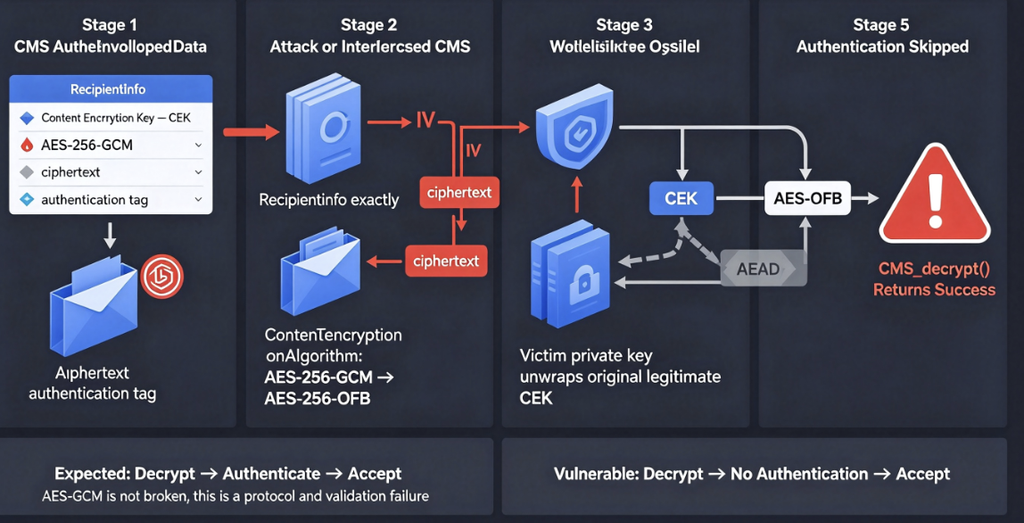
The most technically significant attack described by OpenSSL starts with a legitimate AES-GCM CMS message.
Imagine a recipient receives:
CMS AuthEnvelopedData

recipientInfos:
    encrypted CEK for Victim

contentEncryptionAlgorithm:
    AES-256-GCM

encryptedContent:
    C

MAC/tag:
    T
The attacker does not necessarily know the CEK.
The attacker also does not need the victim’s private key.
Instead, according to OpenSSL’s advisory, an on-path attacker can capture one legitimate AES-GCM AuthEnvelopedData object addressed to the victim.
The attacker then keeps the recipientInfos portion unchanged.
That is critical.
Because the encrypted CEK remains legitimate, the victim’s private key continues to unwrap the genuine CEK.
The attacker changes other cryptographic metadata.
Conceptually:
Original:

RecipientInfo ───► real CEK
                    │
                    ▼
                AES-256-GCM
                    │
             authenticated data
becomes:
Modified:

RecipientInfo ───► same real CEK
                    │
                    ▼
                AES-256-OFB
                    │
              attacker IV
                    │
           attacker ciphertext
OpenSSL’s advisory specifically describes rewriting the inner algorithm OID to AES-256-OFB while supplying an attacker-controlled IV and ciphertext. The recipient still decrypts the original legitimate CEK from recipientInfos, but OpenSSL then initializes AES-256-OFB using that CEK.
The result is a dangerous cryptographic type confusion.
The recipient believes it is processing an authenticated CMS container.
But the content has been redirected into a cipher mode that provides no authentication.
Even more importantly, the CMS MAC is not meaningfully consulted in this processing path.
OpenSSL reports that CMS_decrypt() can therefore return success.
The security transition is effectively:
Expected:

Decrypt
  ↓
Authenticate
  ↓
Accept
versus:
Vulnerable path:

Decrypt
  ↓
No meaningful authentication
  ↓
Accept
That is why describing CVE-2026-34182 merely as an “AES vulnerability” would be inaccurate.
AES has not failed.
AES-GCM has not been cryptanalytically broken.
Instead, the protocol implementation allowed an attacker to replace an authenticated encryption primitive with an unauthenticated one while preserving the legitimate encrypted CEK.
Why AES-OFB Makes the Problem Worse
OFB, or Output Feedback mode, effectively converts a block cipher into a synchronous stream cipher.
At a simplified level:
keystream = AES(KEY, state)
ciphertext = plaintext XOR keystream
and therefore:
plaintext = ciphertext XOR keystream
Encryption alone does not prove that a ciphertext was created by an authorized sender.
If an attacker can manipulate ciphertext, the receiver has no cryptographic integrity guarantee unless an independent MAC or equivalent authentication mechanism is verified.
That is precisely why authenticated encryption modes such as AES-GCM exist.
AES-GCM conceptually provides both:
Confidentiality
+
Integrity / Authenticity
AES-OFB provides:
Confidentiality
but not message authentication.
Allowing OFB inside a structure whose security contract says “authenticated encrypted data” therefore changes the fundamental security model of the message.
How CVE-2026-34182 Can Become a Decryption Oracle
The non-AEAD confusion is not limited to accepting unauthenticated data.
Its more interesting consequence occurs when the attacker can observe something about how the resulting plaintext is processed.
OpenSSL describes this condition explicitly: if the application exposes any indicator revealing whether decryption succeeded or failed, an attacker may be able to use the application as an oracle and obtain key-equivalent functionality for the CEK associated with the selected recipient.
An oracle does not necessarily reveal the key directly.
Instead, it exposes information about secret-dependent operations.
Consider an abstract application:
receive CMS object
      ↓
CMS_decrypt()
      ↓
parse decrypted message
      ↓
return response
Suppose different decrypted values cause distinguishable responses:
HTTP 200
HTTP 400

"Valid command"
"Invalid command"

JSON parse success
JSON parse error

database action
no database action

different timing
different output
The attacker may repeatedly construct candidate ciphertexts and observe these differences.
Each response leaks information about how the secret CEK transformed attacker-controlled input.
The victim’s CMS processor has effectively become a remotely accessible cryptographic computation service operating under a key the attacker does not possess.
That is what makes “key-equivalent functionality” a useful description.
The attacker may not extract:
CEK = 0x...
as raw key material.
But if the victim repeatedly performs useful cryptographic operations under that CEK on attacker-selected data, the distinction can become less important from the attacker’s perspective.
A Cryptographic Oracle Is Often an Application Vulnerability Too
One important detail is that CVE-2026-34182 does not exist in isolation from the application consuming OpenSSL.
The vulnerable library provides the primitive.
The application can amplify it.
For example:
Attacker
   │
   ▼
Modified CMS
   │
   ▼
OpenSSL CMS_decrypt()
   │
   ▼
Application parser
   │
   ├── success → observable response A
   │
   └── failure → observable response B
The distinction between response A and response B is the oracle.
Even applications that return the same HTTP status code should not automatically be considered safe. Observable differences can include response sizes, error strings, execution timing, external side effects, retries, queue behavior, logging patterns visible through another interface, or changes to application state.
This is one reason cryptographic vulnerability assessment cannot stop at package version identification.
The surrounding application behavior matters.
Attack Path Two: The One-Byte Authentication Tag
CVE-2026-34182 contains another attack primitive that is easier to understand but potentially just as serious.
Authenticated encryption algorithms generate an authentication tag.
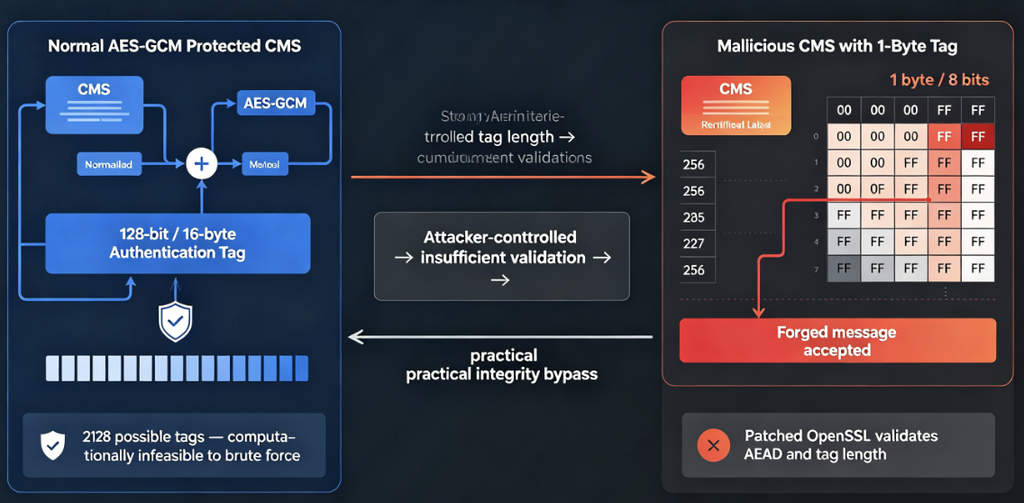
For AES-GCM, a 128-bit tag is common:
128 bits = 16 bytes
An attacker trying to randomly forge such a tag faces an enormous search space:
2^128
That is computationally infeasible.
But what happens if the implementation accepts a tag of only one byte?
One byte contains eight bits.
The forgery space becomes:
2^8 = 256
Instead of a cryptographic security boundary requiring an infeasible number of guesses, the attacker now faces only 256 possible tag values.
OpenSSL discovered that vulnerable CMS processing could accept exactly this kind of dangerously short authentication tag.
The official advisory states that an attacker could reduce the AEAD tag length to a single byte and brute-force CMS decryption, allowing modified content to bypass integrity validation in applications that depend on CMS_decrypt() to reject forged data.
The OpenSSL patch explains the intended limits more specifically.
RFC guidance recommends at least 12-byte authentication tags for AES-GCM and at least 4 bytes for AES-CCM in this context. Because the affected OpenSSL code is not algorithm-specific, the fix enforces a general minimum of four bytes and rejects values outside the accepted range. (GitHub)
The relevant conceptual change is:
Before:

tag length = attacker-controlled
             ↓
1 byte accepted
             ↓
256 possible tags
After the patch:
tag length
    ↓
validate range
    ↓
reject dangerously short value
This is a classic example of how a theoretically strong cryptographic primitive can be weakened catastrophically by unsafe parameter validation.
Why Tag Length Is a Security Parameter
Authentication tags are sometimes mistakenly treated as serialization details.
They are not.
Tag length directly determines forgery resistance.
Ignoring other attack strategies for a moment, a t-bit tag gives a random forgery probability approximately equal to:
1 / 2^t
For a 128-bit tag:
1 / 2^128
For a 96-bit tag:
1 / 2^96
For a 32-bit tag:
1 / 2^32
For an eight-bit tag:
1 / 256
The difference between a 128-bit authentication tag and an eight-bit authentication tag is therefore not cosmetic.
It is the difference between an effectively impossible random forgery and something that can be enumerated.
The mistake behind CVE-2026-34182 was allowing untrusted CMS metadata to influence this security parameter without sufficiently strict validation.
The Root Cause: Cryptographic Metadata Was Trusted Too Much
The vulnerability can be summarized as a failure to enforce invariants around attacker-controlled cryptographic metadata.
Two fields become particularly important:
content-encryption algorithm
authentication tag length
Both appear to be configuration information.
But when they arrive inside an attacker-controlled CMS object, they are untrusted input.
A secure parser needs to ask:
Is this algorithm valid for this CMS content type?

Is it an authenticated encryption algorithm?

Is the tag length safe for that algorithm?

Does this object preserve all requirements of AuthEnvelopedData?
Vulnerable OpenSSL code did not sufficiently enforce those questions.
The problem therefore sits at the intersection of parser security and cryptographic protocol security.
This is also why NVD maps CVE-2026-34182 to CWE-354: Improper Validation of Integrity Check Value. (NVD)
What OpenSSL Changed
The OpenSSL fix is relatively small in code size, but important in meaning.
The relevant patch changes crypto/cms/cms_enc.c.
First, AuthEnvelopedData processing now rejects non-AEAD content encryption algorithms.
Second, the code verifies authentication tag length rather than accepting dangerously small values.
The patch effectively introduces logic equivalent to:
if AuthEnvelopedData:
    require AEAD cipher

if AEAD:
    require acceptable tag length
The actual OpenSSL change rejects tag lengths below four bytes or above sixteen bytes in the affected processing path and raises an error if authenticated CMS data attempts to use an unsupported non-AEAD content-encryption algorithm. (GitHub)
That makes the fix instructive from a secure-development perspective.
The correct mitigation was not merely:
block AES-OFB
because another unauthenticated cipher could produce the same conceptual problem.
The security invariant instead needs to be:
AuthEnvelopedData
        ↓
AEAD required
This is stronger and more future-proof.
Affected OpenSSL Versions
OpenSSL lists the following branches as affected. (openssl-library.org)
| OpenSSL branch | Vulnerable versions | Fixed version |
|---|---|---|
| 4.0 | 4.0.0 | 4.0.1 |
| 3.6 | 3.6.0 – 3.6.2 | 3.6.3 |
| 3.5 | 3.5.0 – 3.5.6 | 3.5.7 |
| 3.4 | 3.4.0 – 3.4.5 | 3.4.6 |
| 3.0 | 3.0.0 – 3.0.20 | 3.0.21 |
| 1.1.1 | Not affected | N/A |
| 1.0.2 | Not affected | N/A |
OpenSSL’s June 9 security releases included the appropriate fixes across the supported affected branches. For example, the OpenSSL 3.6 release notes explicitly identify CVE-2026-34182 as fixed in 3.6.3, while the 3.0 branch received the fix in 3.0.21. (OpenSSL Library)
A basic version check can be performed with:
openssl version -a
However, production applications do not always use the same OpenSSL library as the system command-line binary.
For dynamically linked applications, security teams should also inspect the actual library dependency.
On Linux, that may involve commands such as:
ldd /path/to/application | grep -E 'libssl|libcrypto'
and package-level inventory:
rpm -qa | grep -i openssl
or:
dpkg -l | grep -i openssl
The application dependency is ultimately what matters.
CMS_decrypt() Is the Important API Surface
Current OpenSSL documentation states that CMS_decrypt() extracts decrypted content from CMS EnvelopedData or AuthEnvelopedData structures. (OpenSSL Docs)
Conceptually:
int CMS_decrypt(
    CMS_ContentInfo *cms,
    EVP_PKEY *pkey,
    X509 *cert,
    BIO *dcont,
    BIO *out,
    unsigned int flags
);
Applications are particularly relevant to CVE-2026-34182 when they accept CMS objects from untrusted or semi-trusted sources and ultimately pass them through this decryption path.
Security teams searching large codebases should therefore examine references to:
CMS_decrypt
CMS_ContentInfo
AuthEnvelopedData
d2i_CMS_ContentInfo
SMIME_read_CMS
The presence of one of these functions does not prove exploitability.
It identifies candidate attack surfaces.
The key follow-up question is whether attacker-controlled CMS content can reach them.
Which Applications Should Prioritize CVE-2026-34182?
A vulnerable OpenSSL package somewhere inside an operating system does not automatically mean the machine exposes a practical CVE-2026-34182 attack surface.
Risk is significantly higher where an application does all of the following:
accepts externally influenced CMS data
        ↓
processes AuthEnvelopedData
        ↓
uses vulnerable OpenSSL
        ↓
decrypts with CMS_decrypt()
        ↓
trusts successful decryption
The oracle path becomes more interesting when another condition is added:
attacker can observe processing outcome
Systems deserving particular attention can include secure messaging infrastructure, S/MIME-related software, custom PKI services, document gateways, certificate-management systems, cryptographic middleware, enterprise integration services, or proprietary protocols that use CMS as an encrypted container.
The precise risk therefore requires application-level investigation rather than only generic vulnerability scanning.
Why a Valid RecipientInfo Is So Important
One of the most elegant parts of the attack is that it separates CEK protection from content protection.
The attacker does not forge the recipient’s encrypted key material.
Instead:
recipientInfos
      ↓
left unchanged
      ↓
victim successfully unwraps CEK
while:
content encryption metadata
      ↓
modified
The attacker is effectively combining:
legitimate key wrapping
+
malicious encryption semantics
This exposes a broader cryptographic design lesson.
A protocol is not necessarily secure merely because one field remains cryptographically authentic.
Security often depends on the relationship between multiple fields.
If a key is legitimately transported but an attacker can independently change what that key is used for, the system may still be vulnerable.
This is closely related to ideas such as algorithm substitution, algorithm confusion, downgrade attacks, and missing cryptographic context binding.
CVE-2026-34182 Is Not a Private-Key Extraction Vulnerability
The phrase “key-equivalent functionality” deserves careful interpretation.
It does not mean the vulnerability simply prints the victim’s private key.
It also does not mean AES keys can immediately be read from process memory.
Instead, under suitable oracle conditions, an attacker may be able to use the vulnerable recipient as though they possessed certain cryptographic capabilities associated with the CEK.
This distinction matters.
Cryptography has repeatedly demonstrated that direct key extraction is not necessary for severe compromise.
If an attacker can remotely submit arbitrary data and obtain the same useful transformation that possession of the secret would provide, the resulting security impact can be functionally similar.
Hardware security modules are designed around the same conceptual distinction.
A private key inside an HSM may never leave the device, yet the device deliberately provides controlled signing operations.
An unintended cryptographic oracle resembles the dangerous version of that model: secret-key operations become available through a path the protocol never intended to expose.
CVE-2026-34182 vs CVE-2026-42768
OpenSSL disclosed another CMS-related oracle vulnerability in the same June 9, 2026 advisory: CVE-2026-42768.
The two should not be confused.
CVE-2026-42768 concerns a Bleichenbacher-style attack involving CMS_decrypt() and PKCS7_decrypt() and PKCS#1 v1.5 RSA processing. OpenSSL describes conditions involving multiple KeyTransRecipientInfo entries that can expose an adaptive chosen-ciphertext oracle.
CVE-2026-34182 is different.
| Vulnerability | Core problem |
|---|---|
| CVE-2026-34182 | AEAD enforcement and authentication-tag validation in AuthEnvelopedData |
| CVE-2026-42768 | RSA PKCS#1 v1.5 / multi-RecipientInfo Bleichenbacher oracle |
Both demonstrate how seemingly small differences in decryption behavior can expose cryptographic capabilities, but their underlying primitives are not the same.
Security scanners and remediation teams should therefore track both CVEs independently.
Is CVE-2026-34182 Remotely Exploitable?
Potentially, but “network reachable” should not be interpreted as “every OpenSSL server on the Internet can be attacked.”
CISA’s ADP assessment uses a network attack vector and assigns CVE-2026-34182 a CVSS 3.1 score of 9.1. (NVD)
The practical attack path still requires software that processes attacker-influenced CMS AuthEnvelopedData.
The first OpenSSL-described scenario additionally assumes an attacker can obtain a legitimate AES-GCM AuthEnvelopedData object addressed to the victim.
The attacker then preserves its recipientInfos, changes the symmetric encryption metadata and content, and submits the modified CMS object to the vulnerable recipient.
An application that never processes CMS is therefore not suddenly vulnerable merely because it uses vulnerable OpenSSL for HTTPS.
This is not a generic TLS handshake vulnerability.
That distinction is important for prioritization.
FIPS Modules Are Not Affected
OpenSSL explicitly states that its FIPS modules are not affected by CVE-2026-34182.
This reflects the location of the vulnerable functionality relative to the FIPS module boundary.
However, organizations should interpret that statement precisely.
“OpenSSL FIPS module is not affected” is not identical to:
every application using OpenSSL in a FIPS-oriented deployment
is automatically unaffected
An application’s CMS handling and integration architecture should still be reviewed.
The safest decision is based on whether the vulnerable OpenSSL CMS code is actually present and reachable, rather than relying exclusively on a compliance label.
Detecting Exposure to CVE-2026-34182
Detection should begin with two questions:
Do we run a vulnerable OpenSSL release?

Does untrusted CMS AuthEnvelopedData reach it?
The first can normally be answered through software inventory.
The second requires application context.
Source-code searches should identify CMS decryption APIs and ASN.1/CMS parsing entry points. Binary applications should be mapped to their actual libcrypto dependencies rather than assuming the /usr/bin/openssl version represents every process.
Security teams should then review whether external CMS content arrives through HTTP uploads, messaging infrastructure, e-mail processing, message queues, RPC endpoints, custom sockets, file-ingestion systems, PKI workflows, certificate APIs, or internal services reachable by potentially compromised components.
For oracle exposure, response normalization is also important.
Applications should avoid exposing detailed distinctions such as:
authentication failed
decryption failed
valid encryption but invalid payload
invalid JSON
unsupported command
when those distinctions depend on secret-key processing.
Even after patching OpenSSL, reducing unnecessary cryptographic side channels remains good defensive engineering.
What to Look for in Logs
CVE-2026-34182 does not necessarily produce an obvious crash.
That makes detection different from memory-corruption vulnerabilities.
Potential signals can include unusual CMS decryption failures, repeated submissions of similar CMS objects, rapid sequences of nearly identical encrypted messages, abnormal algorithm identifiers, unexpected use of OFB or other non-AEAD encryption algorithms inside authenticated CMS containers, abnormal authentication-tag lengths, or repeated parser-level failures immediately after successful cryptographic processing.
A one-byte-tag forgery attack may theoretically involve repeated modified messages.
That produces a detection opportunity.
But relying on rate-based detection alone would be weak security.
The correct control is strict cryptographic validation plus patching.
Defensive CMS Validation
Applications that perform their own CMS validation or wrap OpenSSL APIs should enforce strong algorithm policy.
Conceptually, the security policy should resemble:
if (cms_type == AUTH_ENVELOPED_DATA) {
    if (!cipher_is_aead(cipher)) {
        reject_message();
    }

    if (!tag_length_allowed(cipher, tag_length)) {
        reject_message();
    }
}
Applications should not blindly trust:
algorithm identifier
IV length
authentication tag length
recipient metadata
optional CMS attributes
simply because the ASN.1 decoder successfully parsed them.
Syntactic validity is not equivalent to cryptographic validity.
This distinction is broadly applicable to cryptographic APIs.
A parser asks:
Can I decode this?
A secure cryptographic implementation must additionally ask:
Should this combination ever be allowed?
CVE-2026-34182 existed in the gap between those questions.
How to Mitigate CVE-2026-34182
The preferred mitigation is upgrading OpenSSL.
OpenSSL’s official fixed versions are:
OpenSSL 4.0  → 4.0.1 or later
OpenSSL 3.6  → 3.6.3 or later
OpenSSL 3.5  → 3.5.7 or later
OpenSSL 3.4  → 3.4.6 or later
OpenSSL 3.0  → 3.0.21 or later
Organizations should prioritize applications processing CMS content rather than assuming that every OpenSSL-dependent service has identical exploitability.
Where immediate upgrading is impossible, an application-level mitigation should reject untrusted AuthEnvelopedData, enforce an explicit AEAD algorithm allowlist, enforce safe tag lengths, and prevent detailed decryption outcomes from becoming externally observable.
Such compensating controls should still be considered temporary.
Protocol validation is subtle, and recreating the OpenSSL fix at another layer can easily miss edge cases.
Why Simply Blocking AES-OFB Is Not Enough
The OpenSSL advisory uses AES-256-OFB as its concrete example.
That does not mean administrators should build a mitigation that says:
if cipher == AES-256-OFB:
    block
The underlying invariant is broader.
AuthEnvelopedData requires authenticated encryption.
Therefore the policy should be:
if cipher is NOT an approved AEAD cipher:
    block
Negative security controls based on one example are fragile.
Positive cryptographic allowlists are usually stronger:
Allowed:
AES-GCM
AES-CCM
other explicitly approved AEAD algorithms
rather than:
Blocked:
OFB
CBC
CTR
...
The latter can fail as soon as another supported unauthenticated cipher appears.
The Bigger Lesson: Algorithm Agility Can Become Algorithm Confusion
Cryptographic protocols frequently support multiple algorithms for interoperability and long-term migration.
That flexibility is known as algorithm agility.
But agility creates parser-controlled choices.
Those choices are security-sensitive.
When an untrusted message can select:
algorithm = X
the recipient must verify not merely that X exists, but that X is valid in the current protocol context.
Otherwise:
algorithm agility
can become:
algorithm confusion
CVE-2026-34182 is a strong example.
AES-OFB is a legitimate cipher mode.
AES-GCM is a legitimate AEAD mode.
The vulnerability emerges because the protocol context requires the second security property while the implementation accepted the first.
Security is therefore a property of:
algorithm
+
parameters
+
protocol context
+
implementation behavior
not merely the cipher name.
Why Authenticated Encryption Matters
Before authenticated encryption became common, applications frequently followed designs such as:
encrypt data
+
MAC data
Correctly combining those operations is surprisingly difficult.
Authenticated encryption with associated data, or AEAD, standardizes the desired security interface.
Conceptually:
AEAD_Encrypt(
    key,
    nonce,
    plaintext,
    associated_data
)
produces:
ciphertext
+
authentication tag
During decryption:
AEAD_Decrypt(
    key,
    nonce,
    ciphertext,
    associated_data,
    tag
)
should return plaintext only if authentication succeeds.
That “only if” is essential.
RFC 5083 applies the same principle to CMS and explicitly requires integrity verification before plaintext is released.
CVE-2026-34182 violated this security boundary by allowing a processing path in which the authenticated CMS container could effectively stop behaving like authenticated encrypted content.
Why OpenSSL Rated It Moderate
At first glance, confidentiality and integrity impact combined with a cryptographic oracle might sound unquestionably Critical.
OpenSSL nevertheless assigns CVE-2026-34182 Moderate severity. (openssl-library.org)
That classification is understandable when practical prerequisites are considered.
The application must process CMS AuthEnvelopedData. The described non-AEAD attack involves a legitimate encrypted object destined for the victim. Useful oracle exploitation depends on observable application behavior. CMS is also a narrower attack surface than generic TLS processing.
CISA-ADP, however, models the vulnerability using network access, low attack complexity, no privileges, no user interaction, and high confidentiality and integrity impact, producing 9.1 Critical. (NVD)
Neither number should replace threat modeling.
For an Internet-facing service automatically decrypting attacker-submitted CMS messages and exposing observable processing differences, the vulnerability deserves substantially more urgency than it would in a workstation where the affected code exists but is never reachable.
Testing CVE-2026-34182 Safely
Validation should focus on behavior rather than producing a weaponized exploitation chain.
A security team can create a controlled test environment containing a vulnerable OpenSSL release and a patched release, feed both deliberately invalid AuthEnvelopedData structures, and compare the results.
The expected patched behavior is straightforward:
AuthEnvelopedData + non-AEAD cipher
        ↓
reject
and:
AuthEnvelopedData + unsafe AEAD tag length
        ↓
reject
The OpenSSL patch itself is an excellent source for regression-test design because it documents both invariants directly. (GitHub)
This is preferable to treating a generic vulnerability scanner’s version match as proof of exploitability.
Version detection establishes exposure.
Behavioral validation establishes reachability.
What Security Teams Should Patch First
If an organization has thousands of systems using OpenSSL, CVE-2026-34182 prioritization should be based on CMS reachability.
The highest-priority systems are those where untrusted data can reach CMS decryption automatically.
A practical risk model is:
Vulnerable OpenSSL
        ×
CMS AuthEnvelopedData usage
        ×
attacker-controlled input
        ×
observable decryption behavior
If one of these factors is absent, practical exploitability may be greatly reduced.
If all are present, CVE-2026-34182 should receive rapid attention regardless of OpenSSL’s Moderate vendor rating.
Frequently Asked Questions About CVE-2026-34182
Is CVE-2026-34182 an AES-GCM vulnerability?
No.
The AES-GCM primitive itself is not broken. The problem is OpenSSL’s CMS processing, which failed to enforce that AuthEnvelopedData use an appropriate AEAD cipher and failed to enforce a safe authentication-tag length.
Can CVE-2026-34182 bypass CMS integrity checks?
Yes.
OpenSSL explicitly states that attackers may bypass integrity validation for affected CMS messages. One attack substitutes a non-AEAD content cipher, while another reduces the AEAD authentication tag to one byte.
Can CVE-2026-34182 leak encryption keys?
The advisory describes the possibility of key-equivalent functionality for a CMS CEK when an attacker can use application responses as a decryption oracle. That is different from directly recovering raw key bytes.
Does exploitation require the victim’s private key?
The attacker does not need to possess it.
In OpenSSL’s documented scenario, the victim uses its own private key to unwrap a legitimate CEK from an unchanged recipientInfos structure.
Why does keeping recipientInfos unchanged matter?
Because it allows the recipient’s normal key-management mechanism to recover the genuine CEK even though the attacker has modified the content-encryption algorithm and encrypted content.
Why is a one-byte GCM tag dangerous?
A one-byte authentication tag has only 256 possible values. That transforms forgery resistance from an enormous cryptographic search space into something that can theoretically be enumerated in a small number of attempts.
Is OpenSSL 1.1.1 affected?
No. OpenSSL states that versions 1.1.1 and 1.0.2 are not affected by CVE-2026-34182.
Are OpenSSL FIPS modules affected?
OpenSSL says its FIPS modules are not affected.
Is CVE-2026-34182 a TLS vulnerability?
Not directly.
The affected functionality is CMS AuthEnvelopedData processing. A web server using vulnerable OpenSSL only for ordinary TLS does not automatically expose this vulnerability.
What OpenSSL version fixes CVE-2026-34182?
Depending on the branch, upgrade to OpenSSL 4.0.1, 3.6.3, 3.5.7, 3.4.6, or 3.0.21 or any later appropriate security release. (openssl-library.org)
Final Analysis
CVE-2026-34182 is a useful reminder that many modern cryptographic failures occur outside the cipher itself.
AES-GCM remained cryptographically sound.
The recipient’s private key remained secret.
The content-encryption key could remain unknown to the attacker.
Yet the security of the system could still collapse because OpenSSL allowed attacker-controlled metadata to change how that legitimate CEK was used.
The first vulnerability path breaks the semantic relationship between AuthEnvelopedData and authenticated encryption. A legitimate AES-GCM CMS object can be transformed so that the same recipient key material drives AES-OFB, allowing OpenSSL to process unauthenticated ciphertext under the legitimate CEK and potentially exposing a cryptographic oracle.
The second path attacks a different assumption. Even when AEAD remains selected, an authentication tag is useful only if its length provides meaningful forgery resistance. Accepting a one-byte tag reduces the theoretical search space to only 256 possibilities.
OpenSSL’s fix therefore addresses both sides of the problem: the cipher must provide authenticated encryption, and the authentication tag must be long enough to provide meaningful integrity protection. (GitHub)
For defenders, package inventory is only the first step. Teams should determine whether externally influenced CMS AuthEnvelopedData reaches CMS_decrypt(), inspect how decryption results influence observable application behavior, and upgrade affected OpenSSL branches immediately where that attack surface exists.
For developers, the broader lesson is even more important.
Never treat cryptographic algorithm identifiers and parameters contained inside an untrusted object as harmless metadata.
They are part of the security boundary.
A protocol can use the strongest encryption primitive available and still fail if the implementation lets an attacker decide when its security properties no longer apply.
Primary references: OpenSSL’s June 9, 2026 security advisory provides the authoritative description, affected-version matrix, and remediation guidance for CVE-2026-34182. RFC 5083 defines the security semantics of CMS AuthEnvelopedData, including the requirement to authenticate content before releasing plaintext. The OpenSSL patch documents the concrete enforcement changes for AEAD-only processing and authentication-tag length validation. (GitHub) NVD tracks the vulnerability as CWE-354 and currently displays the CISA-ADP 9.1 CVSS assessment while NIST’s own base score remains unassigned. (NVD)


 English
  German
  French
  Spanish
  Portuguese
  Japanese
  Korean
  Hindi
Hindi  Arabic
  Turkish
  Hebrew