
CVE-2026-62815 is a critical remote code execution vulnerability in Microsoft QUIC disclosed as part of Microsoft’s August 2026 security updates. The vulnerability is particularly important because its published attack characteristics remove nearly every conventional barrier that defenders normally rely on: the attack vector is network-based, attack complexity is rated low, no privileges are required, and no user interaction is required.
Microsoft describes the vulnerability succinctly: a use-after-free flaw in Microsoft QUIC allows an unauthorized attacker to execute code over a network. The assigned weakness is CWE-416, Use After Free. Microsoft’s CVSS 3.1 assessment is 9.8 Critical, with the vector:
CVSS:3.1/AV:N/AC:L/PR:N/UI:N/S:U/C:H/I:H/A:H
That means successful exploitation could potentially compromise confidentiality, integrity, and availability of the affected system. (NVD)
The severity is easy to understand from the CVSS vector, but the actual risk requires more careful analysis. Microsoft has not publicly documented the exact QUIC packet sequence, internal object, callback, race condition, or protocol state transition responsible for triggering CVE-2026-62815. There is also no public source-level exploit chain attached to the advisory at the time of writing.
That distinction matters.
A defender should treat CVE-2026-62815 as a high-priority remote memory-corruption vulnerability while avoiding the common mistake of inventing a specific exploit mechanism simply because the bug has been classified as use-after-free.
CVE-2026-62815 at a Glance
| Attribute | CVE-2026-62815 |
|---|---|
| Vulnerability | Microsoft QUIC Remote Code Execution |
| CWE | CWE-416 Use After Free |
| Severity | Critical |
| CVSS 3.1 | 9.8 |
| Attack vector | Network |
| Attack complexity | Low |
| Privileges required | None |
| User interaction | None |
| Scope | Unchanged |
| Confidentiality impact | High |
| Integrity impact | High |
| Availability impact | High |
| Public disclosure date | August 11, 2026 |
| Vendor | Microsoft |
| Known exploitation at disclosure | None reported |
| CISA SSVC automatable | Yes |
| CISA SSVC technical impact | Total |
Microsoft’s CNA record and NVD data identify Windows 11 23H2, Windows 11 24H2, Windows 11 25H2, Windows 11 26H1, Windows Server 2022, and Windows Server 2025 among the affected platforms. CISA’s ADP enrichment classified exploitation as none, automation as yes, and technical impact as total when the record was published. (NVD)
That combination is worth paying attention to. “Exploitation: none” describes observed exploitation status at that point in time. It does not mean exploitation is impossible or that organizations should delay remediation. An unauthenticated network RCE with a 9.8 CVSS score remains a patch-priority vulnerability even in the absence of a public exploit.
What Is Microsoft QUIC?
Understanding CVE-2026-62815 requires understanding where QUIC sits in the Windows networking stack.
QUIC is a modern encrypted transport protocol standardized by the IETF. Instead of building an encrypted application protocol on top of TCP, QUIC operates over UDP and integrates transport functions with TLS 1.3.
Microsoft maintains its own implementation called MsQuic.
Microsoft describes MsQuic as a cross-platform C implementation of the IETF QUIC protocol. It supports features including authenticated TLS 1.3 handshakes, parallel streams, improved congestion control and loss recovery, connection migration, and low-latency networking. (GitHub)
A simplified networking stack looks like this:
Application
    |
    | HTTP/3 / SMB / Custom Protocol
    v
+--------------------------+
|       Microsoft QUIC     |
|          MsQuic          |
+--------------------------+
    |
    | QUIC packets
    | TLS 1.3 protected
    v
+--------------------------+
|           UDP            |
+--------------------------+
    |
    v
IP / Network
This matters for security because a memory-safety error inside the QUIC implementation can occur below the application protocol itself.
An application might be completely correct in how it handles HTTP requests or SMB authentication and still be exposed if malicious network traffic reaches a vulnerable QUIC implementation before the higher-level application security controls become relevant.
MsQuic Is Not Just Another Application Library on Windows
On Windows, the situation is more significant than an ordinary third-party library vulnerability.
Microsoft’s MsQuic platform documentation states that Windows includes MsQuic in the kernel as the msquic.sys driver to support built-in HTTP and SMB functionality. User-mode applications can also use msquic.dll. (GitHub)
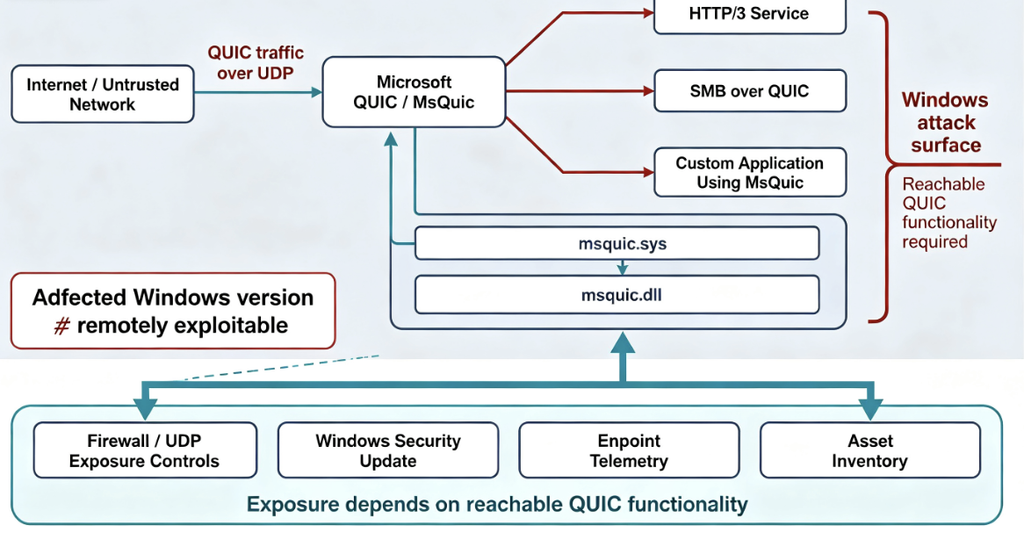
That gives defenders several possible exposure paths:
                    Internet / Untrusted Network
                              |
                              v
                       UDP QUIC Traffic
                              |
              +---------------+---------------+
              |                               |
              v                               v
       Windows QUIC Stack              User Application
         msquic.sys                     using msquic.dll
              |                               |
       +------+-------+                       |
       |              |                       |
       v              v                       v
    HTTP/3       SMB over QUIC          Custom QUIC app
The exact vulnerable path for CVE-2026-62815 has not been publicly explained by Microsoft. Therefore, it would be premature to claim that every one of these paths is independently exploitable in every affected Windows configuration.
What we can say confidently is that the affected component is Microsoft QUIC and that Microsoft’s published affected-product list includes both Windows clients and servers. (NVD)
Why QUIC Changes the Network Security Model
Traditional enterprise monitoring has spent decades focusing heavily on TCP.
Web servers meant TCP/80 and TCP/443. SMB meant TCP/445. Remote administration usually mapped to predictable TCP services.
QUIC complicates those assumptions because it runs over UDP.
Microsoft’s MsQuic deployment guidance explicitly notes that QUIC uses UDP rather than TCP, that QUIC-based protocols commonly use UDP/443, that traffic is encrypted end-to-end, and that network devices should not assume arbitrary UDP traffic is or is not QUIC solely from the port number. (GitHub)
For defenders, this creates an important lesson from CVE-2026-62815:
"No vulnerable TCP service found"
            !=
"No QUIC attack surface"
A firewall audit that looks only at TCP/443 can miss an internet-facing UDP/443 service entirely.
Similarly, a vulnerability scanner that fingerprints a web server only through HTTP/1.1 or HTTP/2 may not accurately characterize its HTTP/3 attack surface.
How Use-After-Free Vulnerabilities Work
Microsoft categorized CVE-2026-62815 as CWE-416: Use After Free.
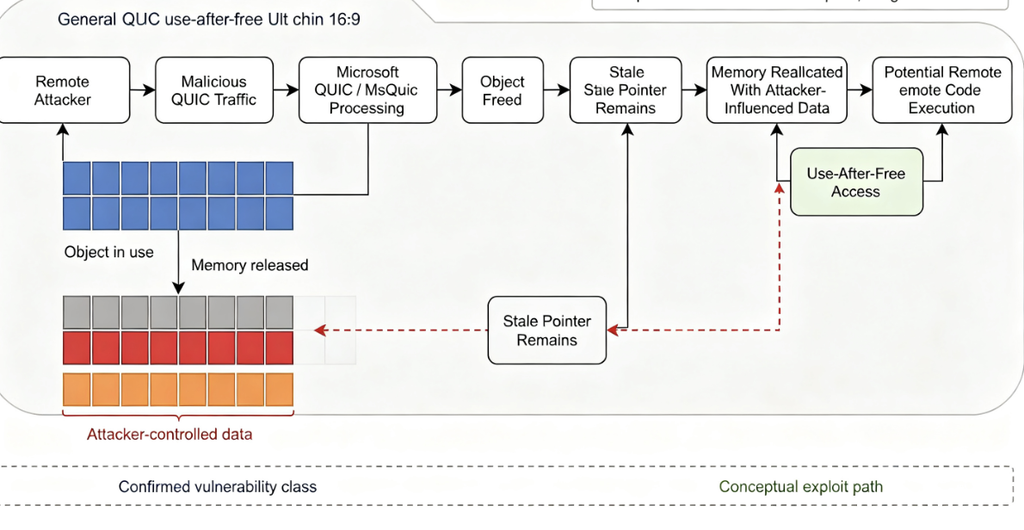
A use-after-free occurs when a program releases an allocated memory object but later continues using a pointer or reference to the memory that formerly belonged to that object.
Consider simplified C-style logic:
Connection *conn = allocate_connection();

initialize(conn);

free(conn);

/* conn is now stale */

process_packet(conn);
After free(conn), the pointer still contains an address, but the program no longer owns the object stored there.
The allocator may subsequently reuse that same memory for a completely different object.
Before free:

0x1000
+---------------------+
| QUIC Connection     |
| state               |
| stream pointers     |
| callback pointer    |
+---------------------+

After free:

0x1000
+---------------------+
|      FREE MEMORY    |
+---------------------+

Later allocation:

0x1000
+---------------------+
| Different Object    |
| attacker-influenced |
| data                |
+---------------------+

Stale pointer:
      |
      +-----------------------> 0x1000
If the vulnerable code later interprets that memory as the original QUIC object, the program may read incorrect fields, write to unintended locations, dereference corrupted pointers, or invoke invalid function pointers.
The result depends on the specific implementation.
A use-after-free might merely crash the process. Under more favorable conditions for the attacker, it can become a powerful memory-corruption primitive and ultimately remote code execution.
That is why Microsoft assigned high confidentiality, integrity, and availability impact to CVE-2026-62815. (GitHub)
What We Do Not Yet Know About the CVE-2026-62815 Root Cause
At the time of writing, Microsoft has not publicly identified which specific QUIC object is freed too early.
There is no authoritative disclosure stating that CVE-2026-62815 involves, for example:
- a connection object;
- a QUIC stream;
- an ACK structure;
- a packet buffer;
- a TLS object;
- a retransmission timer;
- a connection shutdown callback;
- a receive path;
- or another internal MsQuic structure.
That means any article claiming something like:
“CVE-2026-62815 is triggered by sending malformed ACK frames that free a stream object.”
would currently need evidence that Microsoft has not publicly provided.
It is worth mentioning this because Microsoft disclosed a different MsQuic vulnerability earlier in 2026 in which an integer underflow occurred while decoding an ACK frame. That advisory concerned another vulnerability and must not be conflated with CVE-2026-62815. (GitHub)
Security research becomes misleading very quickly when mechanics from one bug are copied onto another simply because the vulnerable component is the same.
A Plausible UAF Exploit Model
Although the exact trigger remains undisclosed, understanding a generic remote UAF chain is still useful.
A conceptual exploitation path might look like this:
Attacker
   |
   | specially constructed QUIC state
   v
QUIC packet parser / state machine
   |
   | unexpected lifetime transition
   v
Object released
   |
   | stale reference remains
   v
Additional network event
   |
   | stale reference accessed
   v
Use-after-free
   |
   +----------> Process crash
   |
   +----------> Controlled memory corruption
                        |
                        v
                 Exploitation primitive
                        |
                        v
                Remote code execution
Again, this is a generic UAF exploitation model, not a statement of Microsoft’s undisclosed CVE-2026-62815 root cause.
Real-world remote UAF exploitation often involves additional challenges such as heap layout control, race reliability, memory allocator behavior, mitigations such as ASLR and control-flow protection, and the exact privileges of the vulnerable component.
Nevertheless, Microsoft’s AC:L score indicates that Microsoft considers exploitation to have low attack complexity at the CVSS abstraction level. (NVD)
Why CVSS 9.8 Matters Here
The individual CVSS fields tell us much more than the overall number.
AV:N — Network Attack Vector
The attacker does not require local execution on the victim.
The vulnerable functionality can be reached over a network under the conditions represented by Microsoft’s assessment.
AC:L — Low Attack Complexity
The vulnerability does not depend on highly unusual external circumstances according to the vendor’s assessment.
This substantially increases remediation priority compared with memory-corruption bugs requiring difficult races or environment-specific prerequisites.
PR:N — No Privileges Required
The attacker does not need an existing authenticated account before attempting exploitation.
For an exposed service, that makes pre-authentication attack surfaces particularly important.
UI:N — No User Interaction
A victim does not need to open a file, click a link, visit a website, or approve an action.
C:H / I:H / A:H
Microsoft considers successful exploitation capable of causing high confidentiality, integrity, and availability impact.
Together, the vector describes one of the most concerning general classes of enterprise vulnerability:
remote
+
unauthenticated
+
low complexity
+
zero user interaction
+
code execution
That is the reason CVE-2026-62815 deserves priority even without evidence of widespread attacks.
Affected Windows Versions
Microsoft’s current CNA record identifies these major affected operating systems. (NVD)
| Product | Affected versions are below |
|---|---|
| Windows 11 23H2 | 10.0.22631.7517 |
| Windows 11 24H2 | 10.0.26100.9168 |
| Windows 11 25H2 | 10.0.26200.9168 |
| Windows 11 26H1 | 10.0.28000.2704 |
| Windows Server 2022 | 10.0.20348.5499 |
| Windows Server 2025 | 10.0.26100.33296 |
| Windows Server 2025 Server Core | 10.0.26100.33296 |
Microsoft released the relevant cumulative updates on August 11, 2026.
CVE-2026-62815 Patch Table
| Windows release | August 2026 update | Patched build |
|---|---|---|
| Windows 11 23H2 | KB5120240 | 22631.7517 |
| Windows 11 24H2 | KB5121003 | 26100.9168 |
| Windows 11 25H2 | KB5121003 | 26200.9168 |
| Windows 11 26H1 | KB5121000 | 28000.2704 |
| Windows Server 2022 | KB5120242 | 20348.5499 |
| Windows Server 2025 | KB5120233 | 26100.33296 |
Microsoft’s release documentation confirms these August 11 cumulative update builds. (Microsoft Support)
Because Windows cumulative updates supersede earlier fixes, organizations generally should deploy the latest applicable supported cumulative update rather than treating the exact August KB as the only acceptable patch forever.
Be Careful With Conflicting Build Numbers in Vulnerability Databases
There is an interesting vulnerability-management lesson in CVE-2026-62815.
NVD’s initial enrichment history contains some CPE thresholds that differ from Microsoft’s later/current CNA affected-version data. For example, NVD’s earlier CPE enrichment showed lower Windows 11 24H2 and Server build boundaries than the current Microsoft CNA record. (NVD)
This is exactly why vulnerability management should not blindly compare a locally installed build against a single third-party database snapshot.
For Microsoft vulnerabilities, a better hierarchy is:
Microsoft Security Update Guide / current CNA record
                    |
                    v
Current Microsoft release documentation
                    |
                    v
NVD enrichment
                    |
                    v
Third-party vulnerability databases
Third-party databases are extremely useful for enrichment and automation, but the vendor’s current security and servicing data should normally be treated as authoritative for the patch state.
Does Every Vulnerable Windows System Expose CVE-2026-62815 Remotely?
No.
This is one of the most important practical distinctions in the entire vulnerability.
The CVE says the affected software contains a remotely exploitable vulnerability. It does not imply that every Windows 11 laptop or every Windows Server instance is necessarily listening for attacker-controlled QUIC traffic from the public internet.
Exploitability depends on whether an attacker can reach an application or operating-system path using the vulnerable Microsoft QUIC component.
The useful exposure equation is closer to:
Affected OS
    +
Vulnerable component present
    +
Relevant QUIC functionality active
    +
Attacker can reach that functionality
    =
Meaningful remote exposure
This is why patch status and attack-surface analysis should happen together.
SMB over QUIC Is One Important Exposure Scenario
One particularly relevant Windows feature is SMB over QUIC.
Microsoft describes SMB over QUIC as an alternative transport for SMB that uses QUIC and TLS 1.3, generally over UDP/443, to provide secure file-server connectivity over untrusted networks such as the Internet. (Microsoft Learn)
The architecture is roughly:
Remote Windows client
        |
        | UDP/443
        | QUIC + TLS 1.3
        v
+------------------------+
|     SMB over QUIC      |
+------------------------+
        |
        v
+------------------------+
| Microsoft QUIC / MsQuic|
+------------------------+
        |
        v
+------------------------+
|      SMB Server        |
+------------------------+
This is precisely the sort of environment defenders should inventory when responding to a Microsoft QUIC vulnerability.
There is an important qualification, however: Microsoft explicitly says that administrators must opt in to enabling SMB over QUIC on a file server. It is not enabled by default, and a client cannot force a server to enable the capability. (Microsoft Learn)
Therefore:
Windows Server affected by CVE
        !=
SMB over QUIC publicly exposed
Administrators should verify configuration rather than assuming either safety or exposure.
Windows Server 2025 Expands the Importance of SMB over QUIC
Microsoft expanded SMB over QUIC availability with Windows Server 2025.
The feature, previously limited on the server side to Windows Server 2022 Datacenter: Azure Edition, is available in Windows Server 2025 Standard and Datacenter. Microsoft also provides controls for disabling SMB over QUIC through Group Policy or PowerShell. (Microsoft Learn)
That makes Windows Server 2025 especially important in an enterprise inventory exercise.
Edge file servers designed specifically to accept QUIC connections across untrusted networks should receive higher patching urgency than an isolated workstation whose QUIC functionality is not reachable by untrusted peers.
HTTP/3 Can Also Depend on QUIC
QUIC also underpins HTTP/3.
At a high level:
HTTP/1.1
   |
   v
TCP

HTTP/2
   |
   v
TCP + TLS

HTTP/3
   |
   v
QUIC
   |
   v
UDP
A Windows workload that intentionally exposes HTTP/3 may therefore have a different network attack surface than a server that exposes only HTTP/1.1 or HTTP/2 over TCP.
Microsoft’s MsQuic documentation confirms that the Windows kernel implementation is used to support built-in HTTP functionality as well as SMB functionality. (GitHub)
Again, the public advisory does not establish which exact application protocol is required to trigger CVE-2026-62815. Defenders should therefore avoid narrowing remediation to SMB alone or HTTP/3 alone unless Microsoft later publishes more specific prerequisites.
Custom Applications Using MsQuic Matter Too
Windows applications can also use MsQuic directly.
Microsoft documents user-mode deployment through msquic.dll, and MsQuic exposes interfaces for languages including C, C++, C#, and Rust. (GitHub)
That means inventory should not stop at built-in Windows services.
Potentially relevant workloads include:
- custom low-latency networking systems;
- software using MsQuic directly;
- products embedding Microsoft QUIC;
- HTTP/3 applications;
- edge gateways;
- file services using SMB over QUIC;
- internal infrastructure services built on QUIC.
The published Windows CVE primarily tells administrators which Windows operating systems require security updates. Dependency analysis may be required for separately distributed applications that bundle their own MsQuic versions.
How to Check Your Windows Build
A simple first-stage inventory can be performed with PowerShell:
Get-ComputerInfo |
    Select-Object WindowsProductName, WindowsVersion, OsBuildNumber
You can also inspect the Windows version directly:
Get-ItemProperty `
  'HKLM:\SOFTWARE\Microsoft\Windows NT\CurrentVersion' |
  Select-Object ProductName, DisplayVersion, CurrentBuild, UBR
The second command is particularly useful because CurrentBuild and UBR can be combined conceptually into the full build number.
For example:
CurrentBuild = 26100
UBR          = 9168

Full build:
26100.9168
For Windows 11 24H2, build 26100.9168 corresponds to Microsoft’s August 11, 2026 security update KB5121003. (Microsoft Support)
Checking Installed Updates
Administrators can also review update history:
Get-HotFix |
    Sort-Object InstalledOn -Descending |
    Select-Object -First 20
Or query the relevant KB:
Get-HotFix -Id KB5121003
The applicable KB obviously depends on the Windows release.
For large environments, endpoint-management or vulnerability-management platforms should collect OS version and patch state centrally rather than depending on manual host-by-host commands.
Look for UDP/443 Exposure
Because QUIC commonly uses UDP, network defenders should explicitly examine UDP listeners.
A useful starting point is:
Get-NetUDPEndpoint |
    Where-Object {
        $_.LocalPort -eq 443
    }
Do not interpret the result too simplistically.
The presence of UDP/443 is an exposure indicator, not proof of CVE-2026-62815 exploitability.
Likewise, the absence of UDP/443 does not prove that no QUIC functionality exists because QUIC can be deployed on other ports. Microsoft explicitly notes that QUIC-based protocols commonly use 443 but are not inherently restricted to it. (GitHub)
The correct workflow is:
Find UDP listener
      |
      v
Identify owning service/process
      |
      v
Determine whether it speaks QUIC
      |
      v
Identify Microsoft QUIC dependency
      |
      v
Check OS / component patch state
      |
      v
Assess network reachability
Check SMB over QUIC Configuration
On systems where SMB over QUIC might be enabled, administrators can examine SMB configuration using the Windows SMB PowerShell cmdlets.
For example:
Get-SmbServerConfiguration |
    Select-Object EnableSMBQUIC
and on clients:
Get-SmbClientConfiguration |
    Select-Object EnableSMBQUIC
Microsoft documents the corresponding disable commands as:
Set-SmbServerConfiguration -EnableSMBQUIC $false
and:
Set-SmbClientConfiguration -EnableSMBQUIC $false
These controls can be useful as a temporary risk reduction measure when SMB over QUIC is not operationally required and patch installation cannot happen immediately. (Microsoft Learn)
Disabling functionality should not be treated as a substitute for installing the security update.
Do Not Assume Blocking TCP/443 Mitigates CVE-2026-62815
This is an easy operational mistake.
HTTP/3 and many other QUIC deployments communicate over UDP, not TCP.
A firewall policy such as:
Block TCP/443
does not necessarily block:
UDP/443
and therefore may have no effect on a QUIC exposure.
Microsoft’s own deployment documentation tells administrators to create inbound UDP rules when deploying QUIC and specifically uses UDP/443 in its example. (GitHub)
Security teams responding to CVE-2026-62815 should review the protocol field in firewall policy rather than examining only port numbers.
Internet Exposure Is Particularly Important
An internet-facing Windows Server accepting QUIC traffic deserves a different urgency rating from a workstation isolated behind multiple network controls.
A reasonable CVE-2026-62815 prioritization model is:
| Environment | Suggested priority |
|---|---|
| Internet-facing QUIC service | Emergency / highest |
| Internet-facing SMB over QUIC | Emergency / highest |
| DMZ Windows Server using QUIC | Very high |
| Internal QUIC infrastructure | High |
| Windows system with unclear QUIC exposure | High until verified |
| Confirmed patched system | Monitor |
| Unsupported Windows build | Migrate/update urgently |
This is an example of why CVSS and exposure management should be combined.
CVSS tells defenders how serious the vulnerability can be.
Asset context tells defenders where it matters first.
Current Exploitation Status
At publication, CISA’s ADP enrichment for CVE-2026-62815 reported:
Exploitation: none
Automatable: yes
Technical Impact: total
The current public records checked for this article do not show CVE-2026-62815 as a CISA Known Exploited Vulnerability, and GitHub’s advisory database reports no known source code for an exploit. (NVD)
GitHub’s advisory database also showed an EPSS score around 0.9% when checked for this article. EPSS is dynamic and can change over time, so that number should never be treated as a permanent property of the CVE. (GitHub)
A low current EPSS estimate should not override the vulnerability’s technical characteristics.
CVE-2026-62815 has almost the textbook characteristics security researchers look for when assessing whether a vulnerability could eventually become attractive:
network accessible
     +
no authentication
     +
no user interaction
     +
memory corruption
     +
critical impact
Patch before exploitation becomes public rather than waiting for proof of attacks.
Why “No Public PoC” Is Not a Mitigation
Security teams sometimes divide CVEs into two groups:
PoC exists      -> patch now
No PoC exists   -> patch later
That is a dangerous model for critical memory-corruption vulnerabilities.
Once a vendor patch becomes available, researchers can potentially compare patched and unpatched binaries to identify the changed code.
A typical research workflow might conceptually include:
Old binary
    |
    +---- Binary diff ----+
                          |
New binary                v
                    Changed function
                          |
                          v
                 Root-cause analysis
                          |
                          v
                  Trigger discovery
This does not mean exploitation of CVE-2026-62815 is trivial.
Modern Windows exploitation is complex, and turning a crash into reliable code execution can require significant additional work.
It does mean the public release of a patch begins a period in which the root cause can become progressively easier for independent researchers and attackers to understand.
Detecting Exploitation Is Harder Than Detecting Exposure
A use-after-free vulnerability does not necessarily generate a clean security log entry saying:
CVE-2026-62815 exploit attempted
Detection therefore needs several layers.
Layer 1: Vulnerability State
Identify affected OS versions and patch level.
Layer 2: Service Exposure
Identify systems accepting QUIC traffic from untrusted networks.
Layer 3: Network Behavior
Monitor unusual UDP flows and QUIC connection patterns.
Layer 4: Endpoint Behavior
Look for crashes, memory corruption symptoms, unexpected child processes, or unusual code execution associated with networking components or exposed applications.
Layer 5: Post-Exploitation Signals
Detect credential access, persistence, lateral movement, unexpected PowerShell activity, service installation, outbound command-and-control traffic, or privilege abuse.
The important point is that organizations should not wait for a highly specific CVE signature before beginning mitigation.
QUIC Encryption Makes Network Detection More Complicated
One of QUIC’s strengths is also relevant to defensive visibility.
Microsoft notes that QUIC traffic is encrypted end-to-end. (GitHub)
Traditional network monitoring often extracts rich metadata from unencrypted protocol headers or inspects application data after TLS termination.
QUIC changes that model.
A defender may still observe:
source IP
destination IP
source port
destination port
packet size
packet timing
flow duration
connection frequency
QUIC-visible metadata where available
but deep application-layer detection may depend more heavily on endpoint telemetry or intentional TLS/QUIC inspection architecture.
CVE-2026-62815 therefore reinforces a broader security lesson: encrypted transport protocols move more detection responsibility toward endpoints.
Safe Validation of CVE-2026-62815
A good enterprise validation workflow should not start by firing an unverified exploit at production.
It should proceed incrementally.
1. Identify Windows version
            |
            v
2. Verify security update/build
            |
            v
3. Inventory QUIC usage
            |
            v
4. Determine network reachability
            |
            v
5. Identify exposed protocol/application
            |
            v
6. Reproduce only in controlled environment
            |
            v
7. Patch and retest
This distinction between a vulnerability signal and a vulnerability proof is important in AI-assisted security testing as well. A version fingerprint can establish that a system is a candidate for CVE exposure, but it does not by itself establish that an externally reachable exploit path exists. Penligent’s published guidance on AI-assisted CVE validation makes the same distinction: version information, scanner hits, and generated exploit hypotheses should be treated as evidence inputs that require independent validation rather than automatically promoted to confirmed findings. (Penligent)
That is especially important with CVE-2026-62815 because Microsoft’s public disclosure does not yet provide enough root-cause detail to safely claim exploitability from a banner or OS version alone.
A Defensive PowerShell Inventory Example
The following example focuses on inventory rather than exploitation:
$cv = Get-ItemProperty `
    'HKLM:\SOFTWARE\Microsoft\Windows NT\CurrentVersion'

Write-Host "Product:" $cv.ProductName
Write-Host "Version:" $cv.DisplayVersion
Write-Host "Build:" "$($cv.CurrentBuild).$($cv.UBR)"

Write-Host "`nUDP listeners commonly associated with QUIC:"
Get-NetUDPEndpoint |
    Where-Object {
        $_.LocalPort -eq 443
    } |
    Format-Table LocalAddress, LocalPort, OwningProcess

Write-Host "`nSMB server QUIC configuration:"
try {
    Get-SmbServerConfiguration |
        Select-Object EnableSMBQUIC
} catch {
    Write-Host "Unable to query SMB server configuration."
}

Write-Host "`nRecent hotfixes:"
Get-HotFix |
    Sort-Object InstalledOn -Descending |
    Select-Object -First 10
This script answers useful defensive questions:
Which Windows build is this?

Is UDP/443 listening?

Which process owns it?

Is SMB over QUIC enabled?

What security updates were recently installed?
It does not attempt to exploit CVE-2026-62815.
Patch Verification Is More Important Than “Update Installed”
After deploying the August update, verify that endpoints actually reached the expected build.
For example, Windows 11 24H2 should have reached at least:
26100.9168
through the August 11 KB5121003 security update, while Windows Server 2025 should have reached:
26100.33296
through KB5120233. (Microsoft Support)
This matters because enterprise patch deployments can fail for mundane reasons:
- devices were offline;
- WSUS targeting was incorrect;
- reboot deadlines were deferred;
- update rings excluded the machine;
- update installation failed;
- machines were restored from snapshots;
- golden images remained outdated;
- cloud instances were created from stale templates.
A ticket marked “patch deployed” is not equivalent to telemetry proving the endpoint is patched.
Patch the Images Too
CVE response frequently focuses only on running hosts.
That leaves another path to reintroduce vulnerable software:
Patched production host
        |
        | later replaced
        v
Old VM image / template
        |
        v
New vulnerable host
Organizations should update:
- Windows VM templates;
- Azure/AWS/GCP custom images;
- VDI base images;
- server golden images;
- disaster recovery images;
- offline installation media where appropriate;
- automated provisioning pipelines.
Otherwise a vulnerability can reappear weeks after the incident-response ticket was closed.
Temporary Mitigation When Immediate Patching Is Impossible
The primary remediation is to install Microsoft’s security update.
If immediate patching is operationally impossible, temporary controls should focus on reducing access to the vulnerable QUIC attack surface.
Potential measures include:
- Disable unnecessary SMB over QUIC functionality.
- Restrict inbound UDP traffic to trusted networks.
- Remove direct internet exposure where possible.
- Restrict UDP/443 at firewalls when QUIC is not required.
- Place exposed services behind appropriately patched gateways.
- Increase endpoint and network monitoring.
- Accelerate maintenance windows for affected servers.
Microsoft documents disabling SMB over QUIC with:
Set-SmbServerConfiguration -EnableSMBQUIC $false
and:
Set-SmbClientConfiguration -EnableSMBQUIC $false
when that protocol is not required. (Microsoft Learn)
Do not indiscriminately block UDP/443 across an enterprise without understanding application dependencies. HTTP/3, SMB over QUIC, and other legitimate applications may rely on it.
Firewall Restriction Example
Where operational requirements allow, an organization could temporarily restrict an exposed QUIC endpoint so that only known networks can reach it.
Conceptually:
Before mitigation

Internet
   |
   | UDP/443 from anywhere
   v
Windows Server


After mitigation

Internet
   X

Trusted gateway/VPN subnet
   |
   | UDP/443
   v
Windows Server
This changes the threat model from:
unauthenticated internet attacker
to something closer to:
attacker must first reach trusted network
That does not repair the memory-safety defect, but it can significantly reduce practical exposure while patch deployment is being completed.
Prioritize Edge Servers Before Ordinary Clients
Microsoft lists Windows 11 as affected alongside Windows Server.
But remediation order should consider exposure.
Imagine two hosts:
Host A
Windows Server 2025
UDP/443 open
Internet-facing
SMB over QUIC enabled
Unpatched

Host B
Windows 11 laptop
Behind corporate firewall
No inbound QUIC service identified
Unpatched
Both require the security update.
Host A should generally receive immediate priority because attacker reachability aligns much more closely with the network RCE model.
A good vulnerability-management system therefore evaluates:
Severity
   x
Exploitability
   x
Exposure
   x
Asset criticality
   x
Business impact
rather than sorting exclusively by CVSS.
CVE-2026-62898 Shows Why Microsoft QUIC Deserves Broader Review
CVE-2026-62815 was not the only Microsoft QUIC use-after-free issue disclosed in August 2026.
Microsoft also published CVE-2026-62898, another CWE-416 issue in Microsoft QUIC. In that case, the published impact is network-accessible information disclosure rather than remote code execution. The affected ecosystem includes .NET versions and Visual Studio products. (NVD)
The difference is instructive.
| CVE | Weakness | Primary impact |
|---|---|---|
| CVE-2026-62815 | CWE-416 Use After Free | Remote Code Execution |
| CVE-2026-62898 | CWE-416 Use After Free | Information Disclosure |
The same broad bug class can produce dramatically different consequences depending on which memory object becomes stale and how it is subsequently accessed.
A stale reference used only for a read might expose memory.
A stale reference used in a write or control-flow-sensitive context can potentially provide a path toward code execution.
Memory-Safety Bugs in Network State Machines Are Dangerous
QUIC implementations are highly stateful.
They manage concepts such as:
- connections;
- streams;
- packet numbers;
- acknowledgements;
- retransmission;
- congestion state;
- connection migration;
- TLS state;
- shutdown handling;
- timers;
- asynchronous callbacks.
Microsoft specifically advertises MsQuic as an asynchronous, performance-oriented networking implementation. (GitHub)
Asynchronous architectures can create complex object-lifetime requirements.
An object may logically disappear in one execution path while another worker, callback, timer, or receive event still holds a reference.
That does not establish that CVE-2026-62815 is a race condition.
It simply explains why lifetime correctness is a particularly important security property in high-performance networking software.
A Simplified Lifetime Problem
Imagine an abstract networking object:
void on_packet(Connection *c) {
    if (packet_requests_close()) {
        close_connection(c);
        free(c);
    }

    process_remaining_data(c);
}
The obvious issue is that process_remaining_data(c) occurs after the free.
Real software is far more complicated.
The stale reference might instead exist across several threads:
Worker A                    Worker B

lookup connection
     |                           |
     |                     schedule callback
     |                           |
close connection                 |
     |                           |
free object                      |
                                 |
                           callback executes
                                 |
                                 v
                          stale object use
Or through a queue:
network event
    |
    v
queue object reference
    |
connection closes
    |
object freed
    |
worker consumes queue
    |
    v
UAF
These examples are useful for understanding CWE-416, but they are not claims about the undisclosed Microsoft implementation flaw.
Why UAF Can Become RCE Instead of Just DoS
A crash is the simplest visible outcome of use-after-free:
stale pointer
     |
     v
invalid memory access
     |
     v
process termination
Remote code execution requires more.
Conceptually:
freed memory
     |
     v
memory reused
     |
     v
attacker influences replacement contents
     |
     v
stale reference interprets data as old object
     |
     v
read/write/control-flow primitive
     |
     v
mitigation bypasses
     |
     v
code execution
Whether these steps are feasible depends heavily on the vulnerability.
The fact that Microsoft’s final impact classification is remote code execution is therefore materially more serious than a generic “memory corruption may crash the service” description.
Why Defenders Should Expect More Technical Analysis to Appear
Immediately after a Patch Tuesday disclosure, technical details are often limited.
Over time, researchers may perform:
- patch diffing;
- symbol analysis;
- debugging;
- fuzzing;
- crash reproduction;
- packet mutation;
- state-machine analysis;
- coverage-guided testing;
- source comparison where applicable.
Microsoft’s public MsQuic project gives researchers a substantial amount of architectural context even when the exact Windows patch itself is not immediately described in source-level detail. (GitHub)
That creates an asymmetry defenders should understand:
Day 0:
Patch exists
Few exploit details

        ↓

Day N:
More researchers understand fix

        ↓

Later:
Trigger or PoC may emerge

        ↓

Unpatched systems become easier targets
The ideal patch strategy is to leave the vulnerable population before that progression reaches the exploit-publication stage.
Recommended Enterprise Response
For most organizations, a practical response to CVE-2026-62815 should follow four phases.
Phase 1: Identify
Inventory affected Windows releases.
Determine which hosts are below Microsoft’s fixed build.
Phase 2: Prioritize
Prioritize systems that are:
internet-facing
+
using QUIC
+
accepting inbound UDP
+
business-critical
Phase 3: Patch
Deploy the appropriate August 2026 cumulative update or a later security update that supersedes it.
Phase 4: Verify
Confirm the resulting OS build and retest network exposure.
A patch deployment without verification is incomplete remediation.
What Security Operations Teams Should Monitor
Until patch coverage reaches an acceptable level, SOC teams should consider searching for:
- unusual spikes in UDP traffic to Windows servers;
- unexpected UDP/443 exposure;
- repeated malformed or short-lived QUIC sessions;
- crashes involving network-facing applications;
- unexpected restart events;
- new processes spawned around a suspicious network event;
- abnormal PowerShell or command-shell execution;
- unexpected service creation;
- suspicious outbound connections following inbound UDP activity.
Not all of these signals are specific to CVE-2026-62815.
That is intentional.
Before reliable exploit-specific telemetry exists, detection engineering often needs to combine vulnerability exposure with generic exploitation and post-exploitation behaviors.
Vulnerability Scanners Need Context
A scanner might report:
Windows Server 2025
Build < fixed version
CVE-2026-62815
Critical
That is useful.
But it answers only:
Is this operating system candidate vulnerable?
It does not fully answer:
Can an attacker reach the relevant QUIC attack surface?
Nor does it prove:
Can this exact host be exploited with a known working chain?
A mature finding should preserve those distinctions:
| Evidence | Meaning |
|---|---|
| Vulnerable OS build | Candidate vulnerability |
| UDP QUIC service reachable | Exposed candidate |
| Relevant component confirmed | Stronger exposure evidence |
| Safe behavioral reproduction | Validated vulnerability |
| Working code execution | Confirmed impact |
This is especially important when automated AI systems summarize vulnerability data. A confident paragraph generated from a CVE feed should never substitute for evidence.
Patch Management Should Not Wait for CISA KEV
CISA’s Known Exploited Vulnerabilities catalog is extremely useful because it identifies vulnerabilities with evidence of real-world exploitation.
But KEV should not become an organization’s only patch queue.
Waiting for CVE-2026-62815 to enter KEV would mean waiting until defenders have stronger evidence that attackers are already exploiting it.
For an internet-accessible unauthenticated 9.8 RCE, that reverses the preferred order.
The better strategy is:
Critical remotely exploitable vulnerability
             |
             v
Evaluate exposure immediately
             |
             v
Patch before exploitation
             |
             v
KEV status becomes secondary
CISA itself describes the KEV catalog as an input into vulnerability prioritization rather than the entirety of a vulnerability-management program. (CISA)
CVE-2026-62815 vs a Typical User-Interaction RCE
Consider two theoretical vulnerabilities.
Vulnerability A
Network: Yes
Authentication: None
User interaction: None
Complexity: Low
Vulnerability B
Network delivery: Yes
Authentication: None
User must open malicious document
Complexity: High
Even if both eventually produce code execution, Vulnerability A can generally be automated far more easily against exposed infrastructure.
CVE-2026-62815’s published characteristics resemble Vulnerability A.
That explains CISA’s automatable: yes assessment and reinforces why exposure discovery should be rapid. (NVD)
Frequently Asked Questions
What is CVE-2026-62815?
CVE-2026-62815 is a critical use-after-free vulnerability in Microsoft QUIC that Microsoft says can allow an unauthorized attacker to execute code over a network. It was publicly disclosed on August 11, 2026. (NVD)
What is the CVSS score for CVE-2026-62815?
Microsoft assigned CVE-2026-62815 a CVSS 3.1 base score of 9.8 Critical.
The vector is:
CVSS:3.1/AV:N/AC:L/PR:N/UI:N/S:U/C:H/I:H/A:H
(NVD)
Does CVE-2026-62815 require authentication?
No privileges are required according to Microsoft’s CVSS assessment.
Does a victim need to click anything?
No. The user-interaction metric is UI:N.
Is CVE-2026-62815 remotely exploitable?
Microsoft describes it as allowing an unauthorized attacker to execute code over a network, and the CVSS attack vector is AV:N. (NVD)
What type of vulnerability is CVE-2026-62815?
It is classified as CWE-416, Use After Free.
Which Windows versions are affected?
Microsoft lists Windows 11 23H2, 24H2, 25H2 and 26H1, along with Windows Server 2022 and Windows Server 2025 variants, within the affected-version data. (OpenCVE)
What patch fixes CVE-2026-62815 on Windows 11 24H2?
Microsoft’s August 11, 2026 cumulative update KB5121003, which produces build 26100.9168, corresponds to the current fixed-version boundary for Windows 11 24H2. (Microsoft Support)
What patch fixes Windows Server 2022?
The August 11 security update is KB5120242, build 20348.5499. (Microsoft Support)
What patch fixes Windows Server 2025?
The August 11 update is KB5120233, build 26100.33296. (Microsoft Support)
Is CVE-2026-62815 being exploited in the wild?
The public information reviewed for this article does not establish active exploitation. CISA’s ADP record marked exploitation as none when the vulnerability was published, and the CVE was not shown as a known exploited vulnerability in the sources reviewed here. (NVD)
That status can change and should not be interpreted as a reason to defer patching.
Is there a public PoC?
GitHub’s advisory database currently reports no known source code associated with the vulnerability. That does not prove that private exploit research does not exist. (GitHub)
Is UDP/443 the only affected port?
No.
QUIC commonly uses UDP/443 for protocols such as HTTP and SMB, but Microsoft explicitly notes that QUIC is not inherently restricted to that port. (GitHub)
Is SMB over QUIC enabled by default?
No. Microsoft states that a file-server administrator must opt in to SMB over QUIC and that clients cannot force a server to enable it. (Microsoft Learn)
Does disabling SMB over QUIC completely mitigate CVE-2026-62815?
It can reduce attack surface in environments where SMB over QUIC is the relevant exposed QUIC service, but it should not be considered a universal replacement for patching because Microsoft QUIC supports other functionality and applications.
Install Microsoft’s security update.
Final Assessment
CVE-2026-62815 deserves attention not because exploitation has already become widespread, but because its technical profile leaves very little room for comfort.
Microsoft has classified the flaw as a network-accessible use-after-free capable of remote code execution. It receives a CVSS score of 9.8 because exploitation requires no authentication or user interaction and is considered low complexity, with potentially high confidentiality, integrity, and availability impact. (NVD)
At the same time, responsible analysis requires restraint.
Microsoft has not publicly described the exact internal object lifetime error, malicious QUIC frame sequence, heap manipulation technique, or code-execution chain behind CVE-2026-62815. Those details should not be invented.
For defenders, however, those missing exploit details do not materially change the immediate course of action.
Find affected Windows systems.
Identify where Microsoft QUIC is reachable.
Pay special attention to internet-facing UDP services, HTTP/3 workloads, custom MsQuic applications, and SMB over QUIC deployments.
Deploy the August 2026 security updates or newer cumulative updates.
Verify the resulting Windows build rather than trusting patch deployment status alone.
And do it before the vulnerability moves from a critical patch advisory into a widely reproducible exploit.
Microsoft’s primary advisory is available through the Microsoft Security Update Guide, with independent vulnerability metadata available from NIST NVD. Microsoft’s MsQuic documentation provides additional architectural context for understanding QUIC exposure. (GitHub)
For teams building a repeatable CVE-validation workflow rather than relying on version-only findings, Penligent’s guidance on separating vulnerability signals from independently verified evidence is also relevant. AI Pentesting Safe Validation Workflow
 English
  German
  French
  Spanish
  Portuguese
  Japanese
  Korean
  Hindi
Hindi  Arabic
  Turkish
  Hebrew