
SonicWall SMA1000 Faces Another Critical Security Flaw as Researchers Observe Exploitation Attempts
SonicWall has released emergency security updates for a critical server-side request forgery (SSRF) vulnerability affecting its Secure Mobile Access 1000 series appliances. Tracked as CVE-2026-102255, the vulnerability carries a maximum CVSS severity score of 10.0 and allows a remote, unauthenticated attacker to potentially manipulate the appliance into making requests to internal services that should not be accessible from the internet.
The vulnerability was addressed in SonicWall’s October 6, 2026, security advisory, SNWLID-2026-0017, alongside three additional security flaws involving remote code execution, path traversal, and stored cross-site scripting. Although SonicWall initially reported that it had no evidence of exploitation in the wild, independent security researchers subsequently identified network activity consistent with attempts to exploit CVE-2026-102255.
On October 9, 2026, security researcher Ryan Dewhurst, founder of threat intelligence company Previdian, told BleepingComputer that the company’s honeypot infrastructure had recorded suspicious requests targeting the vulnerable SMA1000 WorkPlace interface. The activity involved specially crafted HTTP OPTIONS requests designed to reach an internal CouchDB service through the appliance.
The distinction between an observed exploitation attempt and a confirmed compromise is important. Previdian’s findings provide evidence that attackers are attempting to abuse the vulnerability, but the researchers had not established whether those requests successfully compromised production systems. SonicWall’s published advisory, meanwhile, continued to state that there was no evidence of exploitation. These statements reflect different evidence thresholds and should not be treated as interchangeable.
Nevertheless, the security implications are significant. The affected appliances are commonly deployed at the boundary between the public internet and private enterprise networks, where they provide remote access to internal applications and services. An attacker who can abuse the gateway’s privileged network position may be able to interact with infrastructure that is otherwise protected by authentication and network segmentation.
More concerning is the history of the affected component. CVE-2026-102255 is the third critical pre-authentication SSRF vulnerability disclosed in SonicWall’s SMA1000 WorkPlace interface during 2026. Two earlier vulnerabilities, CVE-2026-15409 and CVE-2026-83548, were confirmed as exploited in the wild. The recurrence raises questions about the security boundaries between externally accessible gateway functionality and the appliance’s internal management services.
For organizations operating SonicWall SMA1000 appliances, the immediate priority is straightforward: identify affected firmware versions, install the available hotfixes, and investigate unusual activity against internet-facing WorkPlace interfaces.
What Is CVE-2026-102255?
CVE-2026-102255 is a pre-authentication server-side request forgery vulnerability in the Appliance WorkPlace interface of SonicWall SMA1000 remote access gateways. The flaw originates from an unintended alternate access path that may allow externally supplied requests to reach internal functionality.
The official CVE record associates the vulnerability with two weakness categories: CWE-918, Server-Side Request Forgery, and CWE-441, Unintended Proxy or Intermediary, also known as a confused deputy. Together, these classifications describe a trust-boundary failure in which an attacker potentially causes a trusted system to perform operations that the attacker cannot execute directly.
| Attribute | Details |
|---|---|
| CVE identifier | CVE-2026-102255 |
| Affected vendor | SonicWall |
| Product | Secure Mobile Access SMA1000 Series |
| Vulnerability type | Pre-authentication SSRF |
| CWE classifications | CWE-918, CWE-441 |
| CVSS v3.1 score | 10.0 — Critical |
| Attack vector | Network |
| Authentication required | No |
| User interaction required | No |
| Affected interface | Appliance WorkPlace |
| Vendor advisory | SNWLID-2026-0017 |
| Public disclosure | October 6–7, 2026 |
| Exploitation status | Exploitation attempts observed; successful compromise not established |
| Patch availability | Fixed firmware available |
The vulnerability has a CVSS v3.1 vector of:
CVSS:3.1/AV:N/AC:L/PR:N/UI:N/S:C/C:H/I:H/A:H
The severity calculation reflects a remotely reachable vulnerability with low attack complexity, no required privileges, and no requirement for victim interaction. It also assumes potentially high consequences for confidentiality, integrity, and availability across a changed security scope.
A CVSS 10.0 score does not mean that every successful SSRF request automatically produces complete system compromise. Rather, it reflects the maximum assessed severity of the vulnerability under the scoring model. Actual impact depends on the reachable internal functionality, service permissions, available attack paths, and surrounding security controls.
This distinction is especially relevant because the public vulnerability description does not establish that CVE-2026-102255 independently provides arbitrary code execution. The documented capability involves inducing the appliance to make requests and potentially perform unauthorized internal operations. The consequences of those operations require further technical examination.
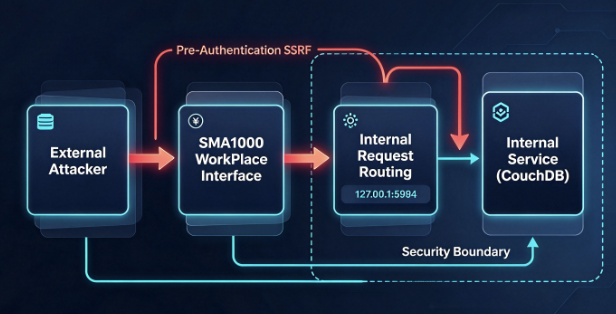
How CVE-2026-102255 Works: The SSRF Trust Boundary
The underlying security problem is not simply that a SonicWall appliance can send HTTP requests. Remote access gateways routinely communicate with backend services, internal applications, authentication systems, and management components. Such communication is essential to their operation.
The vulnerability arises when an unauthenticated external client can influence requests that the gateway sends from its own trusted execution environment.
Consider a typical SMA1000 deployment. The WorkPlace interface is exposed to the internet so that remote employees and authorized users can access corporate applications. Behind that interface, the gateway may communicate with internal services that are unavailable to external clients. Management interfaces and local services may have additional restrictions based on source address, network location, or the assumption that requests originate from a trusted component.
Under normal circumstances, an external user should not be able to transform a WorkPlace request into an arbitrary request against those internal endpoints.
CVE-2026-102255 undermines this boundary through what SonicWall describes as an unintended alternate access path. The vulnerability may enable an attacker to use the internet-facing appliance as an intermediary to reach internal functionality.
The resulting security issue can be understood as a confused-deputy problem. The gateway possesses connectivity or permissions that the external attacker lacks. By manipulating the gateway’s request-handling behavior, the attacker attempts to make the trusted appliance exercise those capabilities on the attacker’s behalf.
An illustrative attack sequence would involve an external client reaching the WorkPlace interface, triggering an unintended request-routing behavior, and causing the appliance to contact a local or internal service. If that internal service accepts the request and exposes sensitive functionality, the attacker may gain access to operations that would otherwise be unavailable.
The key failure occurs when external input crosses from an untrusted HTTP request into a trusted internal service interaction without sufficiently restrictive destination validation, authorization, or routing controls.
It is important not to confuse this conceptual sequence with a fully disclosed proof-of-concept exploit. SonicWall has not publicly documented every implementation detail of the vulnerable request handler, and the available reporting does not establish a complete end-to-end exploit chain. The architectural explanation describes the class of security boundary that the official vulnerability record identifies.
Why SSRF Is Especially Dangerous in Remote Access Appliances
In a conventional web application, SSRF can expose internal APIs, cloud metadata endpoints, or services that are reachable only from the application server. In a remote access appliance, the risk can be broader because the device is deliberately positioned between multiple security zones.
An SMA1000 gateway may have access to internal application networks, enterprise identity services, administrative components, and local processes that are isolated from the public internet. Such a gateway also participates in authentication and access-control workflows, making it a particularly sensitive part of the network architecture.
An SSRF vulnerability can turn that network position into an attack capability. Rather than connecting directly to a protected service, an attacker tries to persuade the gateway to initiate the connection.
This means that conventional firewall policies allowing trusted appliance-to-backend communication may not be sufficient to prevent misuse. From the backend service’s perspective, a malicious request may appear to originate from the gateway itself.
The resulting exposure depends heavily on whether the internal service independently authenticates and authorizes each operation. A service that relies primarily on loopback access or network location for trust is more vulnerable to this class of confused-deputy behavior than one that enforces strong application-layer authorization.
That is why SSRF vulnerabilities deserve special attention in VPN gateways, reverse proxies, identity appliances, application delivery controllers, and other internet-facing infrastructure.
Active Exploitation Attempts: What Security Researchers Have Observed
The first publicly reported evidence of exploitation attempts against CVE-2026-102255 emerged on October 9, 2026, when Previdian identified suspicious requests through its honeypot network.
According to BleepingComputer’s reporting, the observed activity targeted the SMA1000 WorkPlace Extraweb interface and attempted to exploit an unintended communication path to an internal CouchDB database service.
The requests reportedly used the HTTP OPTIONS method and attempted to access CouchDB on the local loopback address 127.0.0.1:5984. Researchers also observed attempts to reach a CouchDB design document’s _rewrite functionality, accompanied by an HTTP Basic Authorization header containing the credentials admin:admin.
These technical details are important because they offer an initial view of how attackers are approaching the vulnerability.
CouchDB is a document-oriented database that exposes an HTTP-based API. Depending on configuration, database design documents and associated request-handling functions can influence how requests are processed. When an internal database service is accessible only from localhost, developers may assume that external users cannot interact with it directly.
An SSRF vulnerability can invalidate that assumption.
In the reported attack attempts, the external client was not simply trying to connect to CouchDB over the public internet. Instead, the attacker appeared to be attempting to route a request through the SMA1000 appliance itself, using the gateway’s local network access to reach a service bound to the loopback interface.
The reported use of an HTTP OPTIONS request is also notable. OPTIONS is a legitimate HTTP method used to determine communication capabilities, but unusual method handling or routing behavior can sometimes expose implementation paths that ordinary GET and POST requests do not exercise.
This does not establish that OPTIONS is inherently dangerous, nor does it mean that every OPTIONS request against an SMA1000 portal is malicious. The security significance comes from the combination of the request method, the targeted interface, and the apparent attempt to access an internal service.
The observed Basic Authorization header also should not be interpreted as proof that the credentials succeeded. The presence of admin:admin indicates what the attacker supplied, not whether the backend authenticated the request.
Previdian’s founder explicitly cautioned that the researchers had not confirmed whether the attempts resulted in successful compromises.
As of October 12, the strongest supported conclusion is therefore that CVE-2026-102255 is being targeted by observed exploitation attempts, while the scope of successful real-world compromise remains unverified in the available reporting.
Previdian’s exploitation intelligence feed also tracks activity associated with the vulnerability, providing additional evidence of continued interest from attackers. However, sensor observations and vulnerability intelligence classifications should not be treated as equivalent to a forensic finding that a particular enterprise appliance was compromised.
Why Attack Attempts Matter Even Without Confirmed Compromise
Security teams often face a difficult prioritization problem when a critical vulnerability is disclosed but the vendor has not confirmed exploitation. Waiting for public confirmation may appear reasonable, especially when patching a remote access gateway requires operational planning.
The problem is that the absence of confirmed compromise is not the same as the absence of malicious activity.
Honeypot telemetry captures a narrow but valuable slice of attacker behavior. It can demonstrate that attack traffic exists without proving that the same traffic would work against every vulnerable build or configuration. It may also capture unsuccessful probes, partially developed exploits, or automated attempts using assumptions that do not hold in production.
For CVE-2026-102255, this distinction does not substantially reduce the urgency of remediation. The affected devices are exposed at a sensitive network boundary, the vulnerability requires no authentication, and fixed firmware is already available.
Organizations do not need to establish that a complete exploit chain has been weaponized before closing a known pre-authentication vulnerability with a maximum severity score.
Affected SonicWall SMA1000 Models and Vulnerable Firmware Versions
SonicWall identifies three SMA1000 appliance models affected by CVE-2026-102255: the physical SMA 6210 and SMA 7210 appliances and the virtual SMA 8200v platform.
The vulnerability affects specified firmware hotfix versions within the 12.4.3 and 12.5.0 branches. According to the official SonicWall product notice, the following versions must be upgraded.
| SMA1000 model | Vulnerable firmware | Fixed firmware |
|---|---|---|
| SMA 6210 | 12.4.3-03526 and earlier | 12.4.3-03670 or later |
| SMA 7210 | 12.4.3-03526 and earlier | 12.4.3-03670 or later |
| SMA 8200v | 12.4.3-03526 and earlier | 12.4.3-03670 or later |
| All three models | 12.5.0-02952 and earlier | 12.5.0-03082 or later |
The fixed versions were released in conjunction with SonicWall’s October 2026 security advisory. Administrators should obtain the latest supported hotfix for their firmware branch through the official MySonicWall portal and confirm the appliance’s installed platform-hotfix version after completing the upgrade.
One particularly important detail is that the previously released September hotfix versions, 12.4.3-03526 and 12.5.0-02952, remain vulnerable to CVE-2026-102255.
Those versions addressed earlier SMA1000 vulnerabilities, but they do not resolve the newly disclosed October SSRF issue. An organization that successfully patched the September vulnerabilities may therefore still have an exposed appliance unless it has installed the October update.
This illustrates a common challenge in vulnerability management: compliance with a previous emergency patch does not necessarily establish protection against a newly disclosed flaw in the same component.
Does CVE-2026-102255 Affect SonicWall SMA 100 or SonicOS SSL-VPN?
No. The affected product family is SonicWall SMA1000.
The separate SMA 100 Series product line and SSL-VPN functionality on SonicWall firewall products are not identified as affected by this particular vulnerability. The distinction is confirmed in the Censys technical advisory, which also documents the affected appliance models and firmware branches.
Administrators should still review the security advisories applicable to their own SonicWall products. A product being unaffected by CVE-2026-102255 does not mean that it is free from unrelated vulnerabilities.
CVE-2026-102255 Is the Third Major SMA1000 SSRF Disclosure in 2026
The most concerning aspect of CVE-2026-102255 may be its relationship to the earlier vulnerabilities disclosed in July and September 2026.
In July, SonicWall addressed CVE-2026-15409, a critical pre-authentication SSRF vulnerability affecting the SMA1000 series. The disclosure was accompanied by CVE-2026-15410, a separate remote code execution vulnerability. SonicWall reported that the vulnerabilities were being actively exploited.
In September, another critical SSRF vulnerability, CVE-2026-83548, emerged in the WorkPlace interface. It was accompanied by CVE-2026-83549, a post-authentication remote code execution issue. SonicWall’s September security notice explicitly confirmed active exploitation of those vulnerabilities and urged affected customers to apply updates and assess their appliances for indicators of compromise.
The October disclosure follows the same general pattern: a pre-authentication SSRF vulnerability in the internet-facing WorkPlace interface, published alongside additional vulnerabilities affecting functionality inside the appliance.
| Disclosure | SSRF vulnerability | Related RCE vulnerability | Exploitation evidence |
|---|---|---|---|
| July 2026 | CVE-2026-15409 | CVE-2026-15410 | Vendor-confirmed active exploitation |
| September 2026 | CVE-2026-83548 | CVE-2026-83549 | Vendor-confirmed active exploitation |
| October 2026 | CVE-2026-102255 | CVE-2026-102256 | Honeypot-observed exploitation attempts; successful compromise unverified |
The earlier incidents are documented in SonicWall’s September security notice SNWLID-2026-0016, while the Cloud Security Alliance’s October analysis examines the recurring SSRF pattern.
These incidents do not necessarily share an identical technical root cause. Similarity in vulnerability classification does not prove that the same defective function, code path, or request parser is responsible for each disclosure.
Nevertheless, the repeated appearance of critical SSRF vulnerabilities in the same exposed component suggests that request-routing and trust-boundary enforcement deserve particularly close scrutiny.
For defenders, the lesson extends beyond a single SonicWall security update. Internet-facing infrastructure can accumulate multiple layers of implicit trust, particularly when public web interfaces interact with internal management components. Fixing an individual routing defect may close one path without eliminating every unintended interaction between those components.
Could CVE-2026-102255 Be Chained With Remote Code Execution?
The possibility of vulnerability chaining is an important concern, but it requires careful qualification.
CVE-2026-102255 was disclosed alongside three additional security issues:
| CVE | Vulnerability | CVSS score | Security impact |
|---|---|---|---|
| CVE-2026-102255 | Pre-authentication SSRF | 10.0 | Unauthorized access to internal functionality |
| CVE-2026-102256 | OS command injection | 7.8 | Potential remote code execution under specified authenticated conditions |
| CVE-2026-102257 | Zip Slip path traversal | 7.2 | Potential remote code execution through crafted archive extraction |
| CVE-2026-102258 | Stored cross-site scripting | 5.5 | Potential execution of malicious JavaScript in the Appliance Management Console |
The additional vulnerabilities are described in NHS England’s October 2026 cyber alert, which reproduces the relevant vulnerability descriptions and recommends applying SonicWall’s security updates.
CVE-2026-102256 involves an OS command injection condition that could allow an attacker with the required administrator-level access to execute arbitrary operating system commands. CVE-2026-102257 involves improper archive extraction in the Appliance Management Console, potentially allowing files to be written outside their intended destination and leading to remote code execution.
In principle, an SSRF issue becomes more dangerous when it can be combined with another weakness in an internal service. If a vulnerable request-routing function provides access to an otherwise restricted administrative operation, it may change the practical accessibility of a second vulnerability.
That possibility is why defenders should consider the entire appliance security context rather than evaluating the SSRF finding in isolation.
However, there is currently no publicly verified exploit chain demonstrating that CVE-2026-102255 can be combined with CVE-2026-102256 or CVE-2026-102257 to obtain unauthenticated remote code execution.
The previous July and September incidents demonstrate that SSRF and code-execution vulnerabilities can present serious combined risks in this product family. They do not establish that the same outcome is achievable with the October vulnerabilities.
Any claim that CVE-2026-102255 independently grants arbitrary command execution, automatically bypasses administrator authentication, or guarantees full appliance compromise would exceed the confirmed technical evidence.
Internet Exposure and the Risk to Enterprise Networks
Attackers have strong incentives to search for vulnerable remote access infrastructure because these devices can provide access to enterprise environments without requiring an initial compromise of an employee workstation.
A remote access gateway commonly sits on a path between the public internet and protected corporate resources. It may terminate encrypted connections, participate in identity verification, enforce authorization policies, and broker connections to business applications.
This makes it a valuable target even when the attacker cannot immediately execute code.
Successful access to an internal administrative API could potentially allow the attacker to inspect configuration data, manipulate application state, or interact with services that have broad privileges. Access to internal authentication-related systems could expose sensitive information or create opportunities for further attacks, depending on the configuration and permissions.
These are potential consequences of SSRF against privileged infrastructure, not confirmed outcomes of CVE-2026-102255 exploitation.
The scale of SMA-related internet exposure also complicates risk assessment. Censys reported identifying thousands of SonicWall Secure Mobile Access services across its host and web indexes, although its findings include broader product-identification data rather than a verified list of appliances vulnerable to this specific CVE.
In its October 7 exposure analysis, Censys documented 5,966 hosts and 39,310 web properties matching its Secure Mobile Access identification criteria after excluding assets labeled as honeypots.
Those figures should not be interpreted as the number of vulnerable SMA1000 appliances. Internet-facing service identification does not necessarily reveal the precise appliance model, installed firmware, or hotfix state, and host and web-property counts are not directly interchangeable.
The operational significance is that remote access technology remains discoverable across the public internet. Once a critical pre-authentication vulnerability becomes public, attackers can prioritize known product interfaces for automated scanning and exploit development.
How to Detect CVE-2026-102255 Exploitation Attempts
Detection requires more than searching for a single HTTP request signature. The currently published evidence identifies several suspicious characteristics, but it does not provide a complete, validated detection rule covering every exploitation technique.
Security teams should combine appliance version assessment, HTTP request analysis, network telemetry, and post-exploitation investigation.
The first priority is establishing whether the organization operates an affected SMA1000 appliance. Asset inventories should distinguish SMA1000 devices from other SonicWall products and record their precise firmware hotfix versions. Vulnerability scanners can assist with this assessment; for example, Tenable published Nessus plugin 364476 for the group of vulnerabilities disclosed under SNWLID-2026-0017.
Where possible, authenticated or management-plane version verification is preferable to relying exclusively on remote product fingerprints. A gateway may be identified correctly as a SonicWall appliance without revealing whether the October hotfix has been installed.
Once affected appliances have been identified, security teams should examine available WorkPlace HTTP request logs, reverse-proxy records, WAF telemetry, and relevant internal service logs.
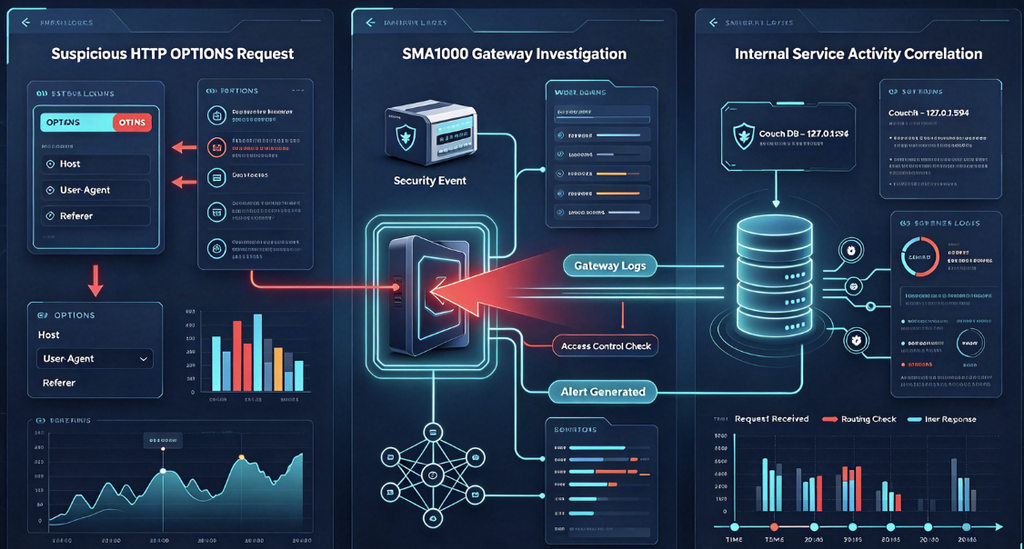
Investigating Suspicious HTTP OPTIONS Requests
The activity reported by Previdian provides a practical starting point for threat hunting.
Security analysts should investigate unusual OPTIONS requests directed at the WorkPlace interface, particularly when those requests contain unexpected internal-service references or coincide with anomalous behavior on the appliance.
References to the loopback address 127.0.0.1, port 5984, or CouchDB-specific paths such as _rewrite may be relevant to the reported technique. These strings are hunting indicators derived from observed activity, not a complete or vendor-certified signature.
A useful investigation should consider whether the request was made before authentication, whether similar requests appeared repeatedly from the same source, and whether the appliance subsequently communicated with an unexpected internal service.
For organizations using Splunk, the following is an illustrative threat-hunting query. Field names, index names, and hostname filters must be adapted to the environment.
index=reverse_proxy earliest=-14d
| search dest_host="YOUR_SMA1000_HOST"
| eval method=coalesce(http_method, method, request_method)
| eval request_text=coalesce(uri, uri_path, request, _raw)
| where method="OPTIONS"
    OR match(request_text, "(?i)(127[.]0[.]0[.]1|:5984|_rewrite)")
| stats count
    min(_time) as first_seen
    max(_time) as last_seen
    by src_ip, method, request_text
| convert ctime(first_seen) ctime(last_seen)
| sort - count
This query is intended for triage rather than definitive detection. It searches for OPTIONS requests or references associated with the publicly reported activity and groups results by source address, HTTP method, and request content.
The query will only detect information actually recorded by the relevant logging system. If a reverse proxy does not log the request component containing the suspicious destination, that detail will not be available for searching. Some environments also log only normalized request paths, which can obscure encoded or transformed input.
Furthermore, an ordinary OPTIONS request is not evidence of exploitation by itself. Legitimate browsers and applications may generate such traffic as part of normal operation.
A detection should therefore be treated as a prompt for further analysis, not proof that CVE-2026-102255 was successfully exploited.
Investigating Unexpected Internal Connections
HTTP access logs are only part of the picture. Since the vulnerability involves inducing server-side requests, network telemetry originating from the SMA1000 appliance may also provide useful evidence.
Analysts should look for unexplained connections from the appliance to internal management interfaces, database ports, sensitive administration services, or destinations outside the gateway’s established backend communication patterns.
Particular attention should be paid to connections that occur shortly after suspicious inbound WorkPlace requests.
However, a significant limitation exists with the technique reported by Previdian: communication to 127.0.0.1 occurs within the appliance’s own network namespace or local host environment. External firewalls and ordinary network flow collectors may not observe such loopback traffic.
Investigating localhost-targeted activity may therefore require appliance-level logging, diagnostic data, or forensic artifacts rather than relying on perimeter network monitoring alone.
Teams should also avoid assuming that a lack of visible outbound connections proves that exploitation did not occur. The availability and coverage of telemetry determine which attack stages can be reconstructed.
Looking for Evidence of Compromise
If suspicious traffic is discovered, analysts should examine activity that occurred after the suspected exploitation window.
Potentially relevant evidence includes unexplained administrator sessions, unexpected configuration modifications, unusual process execution, changes to local accounts, anomalous authentication events, and network connections inconsistent with the appliance’s normal role.
These are general compromise indicators and should not be mistaken for CVE-specific indicators of compromise published by SonicWall.
A successful investigation should correlate multiple sources of evidence, establish a timeline, and assess whether the suspicious request was followed by unauthorized activity.
Where internal logging is incomplete or the appliance may have been modified by an attacker, organizations should involve SonicWall Technical Support and their incident response team to determine which artifacts can be collected and preserved.
How to Patch and Mitigate CVE-2026-102255
SonicWall has released fixed platform-hotfix versions for both affected firmware branches. Installing these updates is the primary remediation for CVE-2026-102255.
Organizations running 12.4.3-03526 or earlier should upgrade to 12.4.3-03670 or a later supported version. Organizations running 12.5.0-02952 or earlier should upgrade to 12.5.0-03082 or a later supported version.
The official SonicWall security notice recommends that all affected physical and virtual SMA1000 deployments install the latest available hotfix.
Because these appliances often support business-critical remote access, updates should follow a controlled change process that accounts for configuration backups, high-availability arrangements, rollback preparation, and post-upgrade verification.
However, routine change-management procedures should not become a reason to leave a known critical pre-authentication vulnerability exposed indefinitely.
Where immediate patch deployment is impossible, administrators should reduce access to the affected WorkPlace interface using network controls appropriate to their environment. Restricting access to trusted source networks, placing the service behind an additional controlled access layer, or temporarily disabling unnecessary external exposure can reduce attack opportunities.
Such measures may disrupt legitimate remote access and require operational planning. They are also compensating controls rather than a vendor-verified workaround that eliminates the vulnerability.
Separately, the Appliance Management Console should remain isolated from the public internet and accessible only through appropriately protected administrative networks. Limiting management-plane exposure helps reduce the opportunities available to attackers even when an unrelated external service is vulnerable.
Network segmentation should also account for traffic initiated by the gateway itself. An appliance should not automatically receive unrestricted access to internal administrative services simply because it occupies a trusted infrastructure role.
Backend authentication, least-privilege service permissions, and restrictions on unnecessary internal connectivity can reduce the consequences of a server-side request forgery vulnerability.
These controls are consistent with the broader defensive principles documented in the OWASP Server-Side Request Forgery Prevention Cheat Sheet.
What If an SMA1000 Appliance May Already Be Compromised?
Patching closes the documented vulnerability, but it does not automatically reverse changes made by an attacker before remediation.
If an appliance shows credible signs of compromise, security teams should preserve relevant logs and evidence, assess the scope of unauthorized access, and consider restoring the appliance from a trusted state.
SonicWall’s September 2026 guidance for its earlier actively exploited SMA1000 vulnerabilities included contacting Technical Support for compromise assessment and, where indicators of compromise were found, reimaging or redeploying appliances, changing user and administrator passwords, and resetting TOTP tokens.
Those instructions were issued for the September vulnerabilities, not specifically as an October CVE-2026-102255 incident response directive. Nevertheless, they provide useful vendor context for handling a potentially compromised SMA1000 deployment.
Any credential rotation, appliance rebuild, or session revocation should be based on the actual investigation findings and the possibility that authentication material or configuration secrets were exposed.
Why Traditional Perimeter Security May Not Stop This Attack
CVE-2026-102255 illustrates a security problem that extends beyond SonicWall: an internet-facing application can become a bridge across an internal trust boundary when server-side requests are not adequately constrained.
Traditional perimeter controls often focus on which external clients can reach a service. SSRF introduces a different question: what can that service reach once it has accepted an attacker-controlled request?
The vulnerable gateway may already be authorized to communicate with systems that are invisible to internet clients. If an attacker can influence destination selection or internal request handling, the appliance may unintentionally carry the malicious request across a boundary that the firewall was designed to protect.
The resulting traffic can also appear more trustworthy than a direct external connection. An internal service may see a connection from a recognized gateway address rather than an unfamiliar internet address.
This is why authentication and authorization should be enforced at the internal service itself, even when network access is restricted.
An internal management endpoint should not assume that every request from localhost or another trusted address represents an authorized administrator. Similarly, sensitive operations should be protected against misuse when reached through an unexpected intermediary.
At the application level, effective SSRF defenses generally combine strict destination validation, explicit allowlists for necessary backend services, controlled redirect handling, and safeguards against unauthorized access to loopback or internal-only resources.
At the network level, organizations should constrain the destinations available to internet-facing gateways and monitor deviations from established communication patterns.
No single measure substitutes for fixing the vulnerable code, but layered controls can limit the consequences of future trust-boundary failures.
What CVE-2026-102255 Reveals About Vulnerability Management
The October SonicWall disclosure demonstrates why vulnerability management cannot rely exclusively on CVSS scores, exploit databases, or vendor-confirmed exploitation labels.
CVSS severity establishes one dimension of technical risk. Exploitation intelligence contributes information about observed attacker behavior. Internet exposure determines whether the vulnerable component is reachable, while network architecture and appliance permissions shape the potential impact.
Each dimension answers a different question.
An organization operating an affected appliance on an isolated test network does not face the same immediate exposure as a company using an internet-facing SMA1000 gateway for remote access to sensitive production applications.
Likewise, a publicly reported exploitation attempt does not establish that all affected environments have already been compromised. It does, however, demonstrate that the vulnerability has attracted attacker attention.
For CVE-2026-102255, the combination of unauthenticated reachability, a CVSS 10.0 rating, observed suspicious requests, and a history of exploited vulnerabilities in the same component supports prioritizing remediation even without evidence of widespread successful attacks.
The repeated 2026 disclosures also suggest that enterprises should review the broader security posture of their remote access infrastructure rather than treating each hotfix as a self-contained task.
The practical goal is not only to apply the October patch. It is to ensure that the gateway is correctly inventoried, that its access to internal management resources is limited, that its administrative interfaces are protected, and that security teams have sufficient telemetry to investigate future incidents.
Frequently Asked Questions About CVE-2026-102255
Is CVE-2026-102255 actively exploited in the wild?
Researchers have observed exploitation attempts consistent with CVE-2026-102255. On October 9, 2026, Previdian reported honeypot activity targeting the SMA1000 WorkPlace interface and attempting to reach an internal CouchDB service. However, the public reporting did not establish that these requests successfully compromised production appliances. SonicWall’s official advisory continued to state that it had no evidence of exploitation. The confirmed evidence therefore supports observed attack attempts, not a claim of verified widespread compromise.
Does CVE-2026-102255 require authentication?
No. CVE-2026-102255 is classified as a pre-authentication SSRF vulnerability. A remote attacker may potentially reach the vulnerable functionality without possessing a valid SMA1000 user account or administrator credentials.
What is the CVSS score for CVE-2026-102255?
The vulnerability has a CVSS v3.1 base score of 10.0, corresponding to Critical severity. The score reflects remote network accessibility, low attack complexity, no required privileges, and potentially severe impacts.
Which SonicWall firmware versions fix CVE-2026-102255?
SonicWall identifies 12.4.3-03670 and 12.5.0-03082 as the first fixed platform-hotfix versions for their respective firmware branches. Administrators should install these versions or later supported hotfixes, as appropriate for their deployment.
Is a public proof-of-concept exploit available?
As of the public research reviewed through October 12, 2026, a complete, independently validated public proof-of-concept exploit had not been established in the sources used for this article. Researchers have described suspicious request characteristics, but those descriptions should not be confused with a publicly verified exploit capable of reliably compromising affected devices.
Can CVE-2026-102255 lead to remote code execution?
The documented vulnerability allows potential unauthorized interaction with internal functionality through SSRF. Such access may create opportunities for further exploitation, particularly if other reachable services contain vulnerabilities. However, there is no publicly verified evidence in the reviewed sources that CVE-2026-102255 independently provides arbitrary code execution or that it has been successfully chained with the other October 2026 SonicWall vulnerabilities.
Is CVE-2026-102255 listed in CISA’s Known Exploited Vulnerabilities Catalog?
Reporting on October 9 indicated that CVE-2026-102255 was not yet listed in the CISA Known Exploited Vulnerabilities catalog. Independent exploitation intelligence sources have separately tracked observed attacks. Because catalog membership can change, organizations should check the official CISA KEV catalog for the latest status rather than treating an earlier report as permanent.
Conclusion
CVE-2026-102255 represents another serious security challenge for organizations relying on SonicWall SMA1000 appliances to provide remote access to internal infrastructure.
The vulnerability combines several characteristics that deserve immediate attention: it affects an internet-facing WorkPlace interface, requires no authentication, carries a maximum CVSS severity score, and potentially allows an external attacker to reach privileged internal functionality through server-side request forgery.
The October 9 honeypot observations make the disclosure more urgent, even though the available evidence does not establish widespread successful exploitation. The observed attempts show that attackers are investigating ways to reach local services through the vulnerable appliance, while the earlier July and September incidents demonstrate that the same product family has already experienced serious real-world exploitation.
Organizations should not wait for a confirmed large-scale incident before applying the October security updates.
The immediate remediation is to upgrade affected appliances to SonicWall’s fixed firmware versions, verify successful installation, and investigate suspicious activity where exposure existed. Longer-term protection requires stronger separation between public interfaces and internal management services, tighter network permissions, and reliable logging across remote access infrastructure.
Ultimately, CVE-2026-102255 is not just another critical vulnerability in a VPN appliance. It is a reminder that security gateways become high-value attack surfaces when their ability to access trusted internal systems can be influenced by unauthenticated external requests.
Closing that trust boundary is essential to protecting the enterprise networks behind them.

 English
  German
  French
  Spanish
  Portuguese
  Japanese
  Korean
  Hindi
Hindi  Arabic
  Turkish
  Hebrew