
“Black October” is a media label for October 2026 security disclosures, including PHP2Shell; it is not a single vulnerability or attack campaign. October 23 reporting uses the phrase. For an application owner, the useful response is to identify the runtime and trust decisions your service actually uses, apply the corresponding vendor guidance, and keep evidence of compromise separate from evidence that a patch was installed.
Reviewed October 24, 2026. The technical facts below come from PHP, Node.js, Oracle and Cloudflare. The incident-queue example uses synthetic records only. We have not reproduced these vulnerabilities or tested any reader’s environment. Treat the workflow as a way to organize a scoped response, not a claim that every service is affected or that an automated scan can certify a deployment as safe.
Why the headline cannot become one remediation ticket
A disclosure date, an attempted attack, a confirmed intrusion and a precautionary outage describe different things. A provider can block a suspicious request without establishing whether the same service was compromised earlier. An operator can take a website offline to perform maintenance without having observed an intrusion. Keep those distinctions in the incident record rather than turning a list of headlines into a claim that one coordinated attack hit every listed organization.
Start with the smallest unit you can assign to an owner: a serving PHP pool, a Node.js worker, a Java application with its own truststore, or a managed service whose operator must supply evidence. “We use PHP” is enough to open an inventory task but not enough to close a remediation task. Likewise, a company-wide software inventory can miss the runtime copied into a container or an application installer.
The table separates a few relevant notices by the decision they change. It is deliberately not a complete incident catalog. Follow each live advisory for the exact product, provider and build you deploy; avoid importing a prerequisite or a mitigation from one issue into another.
| Notice | Confirmed decision point | What not to infer |
|---|---|---|
| PHP2Shell: CVE-2026-109618 and CVE-2026-109619 | PHP’s October 21 security releases repair runtime memory-safety flaws. | A WordPress plugin update alone repairs the PHP runtime. |
| PHP CVE-2026-115560 | PHP’s October 23 notice concerns enabled upload progress plus an unusual runtime serializer transition. | Every PHP upload form demonstrates the described condition. |
| Node.js CVE-2026-111497 | Attacker-influenced Brotli data reaching the bundled decoder is the relevant exposure path. | Generating Brotli-compressed output proves a reachable decoder flaw. |
| Java and eMudhra certificate trust | Oracle’s October 23 guidance requires checking the actual runtime and applying its current trust remedy. | A working browser or an installed emergency version closes every Java trust question. |
The PHP rows are supported by the two dated PHP notices; the decoder row by the Node.js security release; and the trust row by Oracle’s current eMudhra instructions. The distinctions are operational: they determine which owner, evidence and acceptance test belong in each task.
The PHP decision has two different dates
For the earlier PHP2Shell issues, PHP lists 8.5.12, 8.4.27, 8.3.36 and 8.2.35 as its October 21 fixes. The October 23 notice separately recommends session.upload_progress.enabled=0 pending a regular bugfix release. Its described condition requires an initial php_binary or php_serialize handler, a runtime switch to php before session_start(), and upload progress still enabled. Do not relabel the earlier version list as the fix matrix for the later CVE.
A shared-hosting customer should ask which PHP handler serves the specific site and whether the provider activated the required change for that pool. An application owner should review session bootstrap code separately. The final value of a setting cannot, by itself, establish whether it changed earlier in the request. Keep a code-review outcome of unknown visible until the owner has traced the call path.
Cloudflare’s October 23 update says its known-attempt protection for the newer upload-progress issue depends on the default session.upload_progress.name; changed field names are outside that rule’s stated coverage. Cloudflare also advises patching despite WAF protection. Check your actual configuration instead of closing the issue with “we have a CDN.” This is vendor-described rule scope, not a rule evaluation performed for this article.
There are two ownership boundaries here. The provider owns the protection it operates; the application operator still needs evidence for the origin runtime and relevant settings. Record both. A WAF dashboard can show rule activity while leaving the runtime build unanswered, and a correct runtime inventory can leave a custom configuration unanswered.
Brotli exposure follows the consumer of compressed data
The Node.js bulletin describes an out-of-bounds write in the Brotli decoder and lists October 21 releases 22.23.4, 24.22.1 and 26.12.1. Inventory the executable that consumes untrusted compressed bytes. Include workers and outbound clients in the review, rather than limiting the task to the public web server. A provider backport needs the provider’s own security evidence.
Draw the byte path before running a test. An API frontend might store an object, enqueue its identifier and return immediately, while a worker processes it later. Looking only at the frontend can miss the process you need to update. Conversely, a build tool that only produces static assets has a different role from a long-running application that decodes network data. The framework name does not settle that distinction.
For each relevant process, connect the deployment identity to the active runtime and its task. A newer Node binary installed beside an old service is not activation evidence. After the normal rollout, verify the serving instances and exercise a benign application path. That compatibility check should remain separate from any conclusion about exploitability.
Certificate trust is not a web-server patch
Oracle’s eMudhra guide, updated October 23, directs operators to take additional action even after the listed emergency runtime updates. It offers specified root-certificate removal with backup and restart, or documented revocation checks, and links a checker for JDK 8 and later. Follow the version-specific instructions rather than copying an old blocklist procedure.
The review unit is the verifier. A Java application, a browser, an outbound proxy and a separately bundled client may not use the same trust configuration. Ask the application owner which runtime and store are selected. A printed configuration value is a useful clue; it is not evidence that the file was loaded or that a particular chain was rejected.
Define both expected outcomes before validating a trust change: an approved dependency should still work, and an approved negative fixture should fail for the intended certificate-policy reason. A timeout, DNS failure or wrong hostname can produce a failed connection without exercising that policy. Preserve the error category and test context, not just a red or green screenshot.
Give the response queue explicit evidence states
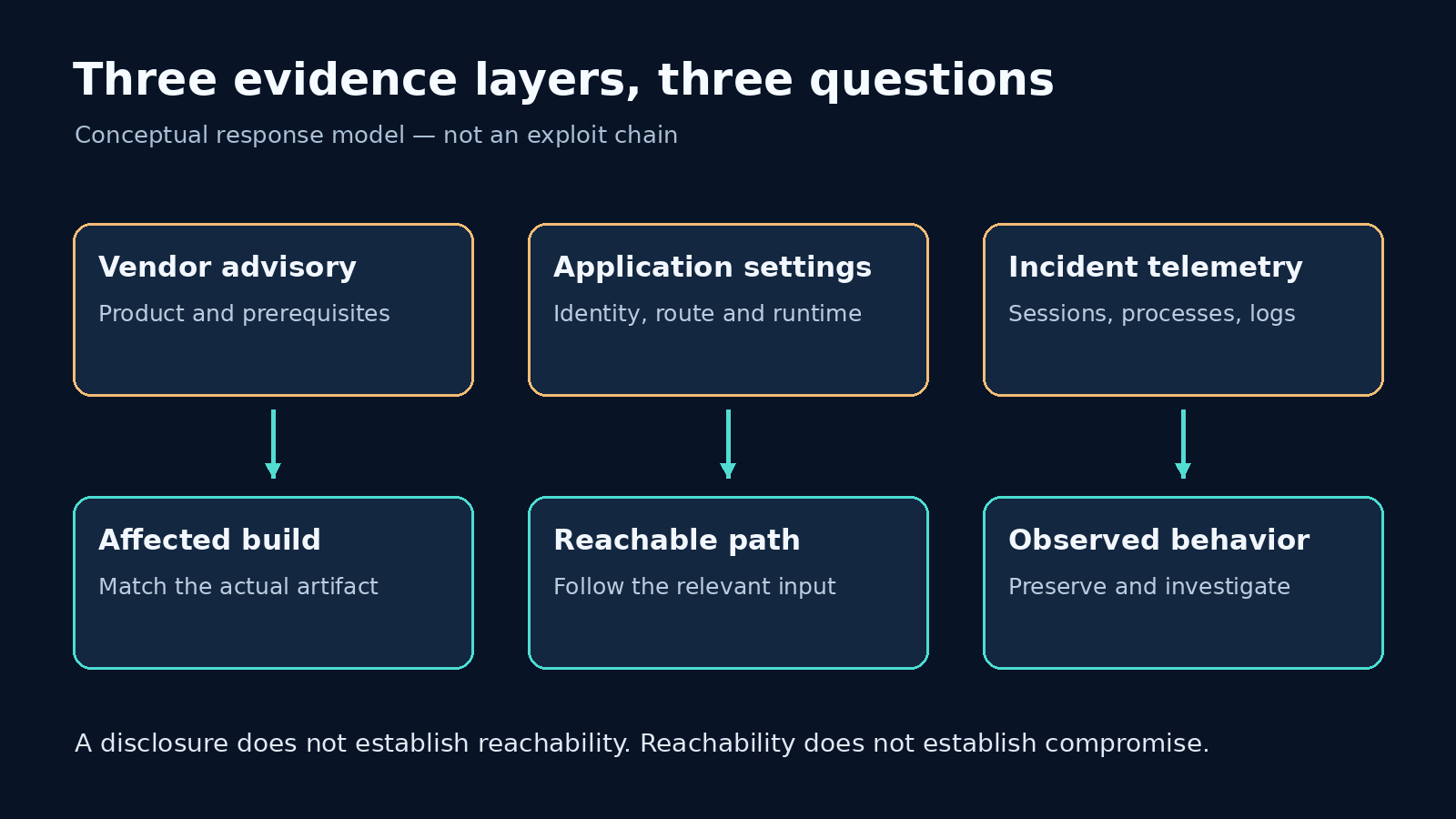
The first useful deliverable is a short queue, not a large automated report. For each workload, record the advisory, owner, build or image, relevant prerequisite, current containment, proposed change and test still required. Use yes, no and unknown consistently. Missing configuration evidence must not silently become no exposure.
| Observation | What it supports | What remains open |
|---|---|---|
| Vendor confirms a fixed package | A remedy is available for that named product/build. | Whether it reached the active deployment. |
| Serving process maps to the replacement artifact | The intended deployment was activated. | Whether application paths still work. |
| WAF blocked a matching request | A protection acted on that transaction. | Other paths and possible earlier access. |
| Approved negative fixture is rejected for the intended reason | That policy check behaved as expected in the tested context. | Untested clients, identities and routes. |
| No matching alert appears | No such alert was found in the reviewed telemetry. | Retention gaps and unobserved behavior. |
| A suspicious session or process is confirmed | Incident review deserves its own owner and evidence preservation. | Full scope, cause and recovery requirements. |
An issue may have two open workstreams: exposure remediation and incident investigation. Do not make either status stand in for the other. If a service has credible intrusion evidence, preserve the relevant records and coordinate containment through the incident owner even when the current build is already fixed. A patch does not explain what happened before it was deployed.
An offline queue model that keeps unknowns visible
We executed the following Python example against five synthetic records. It performs no network requests, reads no deployment inventory and does not detect any CVE. Its only purpose is to demonstrate a queue policy: incident evidence remains important after patching, missing prerequisites remain unknown, and an affected reachable workload gets a remediation task.
def queue(asset):
    if asset['incident_evidence']:
        return 'incident review + exposure containment'
    if asset['affected'] is None or asset['reachable'] is None:
        return 'owner verification required'
    if asset['affected'] and asset['reachable']:
        return 'prioritize remediation'
    if asset['affected']:
        return 'schedule fix; retain boundary evidence'
    return 'retain scoped version evidence'
The five inputs were: incident evidence on a currently unaffected record; an unknown affected state; an affected reachable record; an affected but not reachable record; and a record marked unaffected. The exact output was:
incident review + exposure containment
owner verification required
prioritize remediation
schedule fix; retain boundary evidence
retain scoped version evidence
These labels depend entirely on the supplied facts. The model cannot decide whether a build is fixed, whether a worker is reachable, or whether an alert establishes an intrusion. A real queue also needs a reason, source, timestamp and owner for each input. Avoid ranking by a headline or CVSS number alone when the deployment prerequisites are still unresolved.
What a small application team should finish first
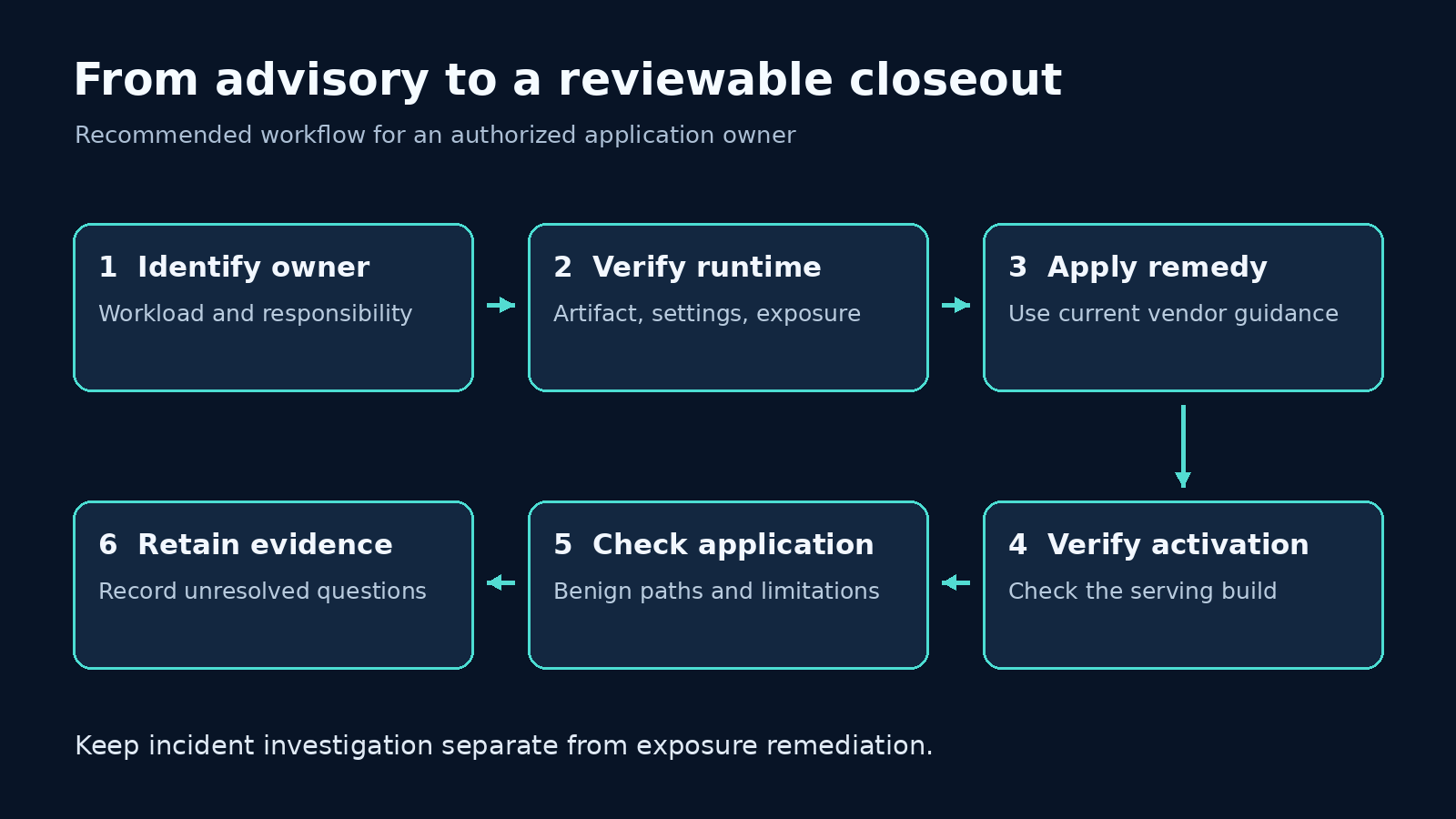
Choose one owner for the externally exposed workload and one record for the serving deployment. Confirm the runtime or verifier in use, follow the applicable vendor remedy, and retain the rollout identity. If you depend on a managed provider, ask for a statement tied to your service rather than an undated assurance that the platform is secure. Record outstanding answers as outstanding work.
After the platform work, verify the application behavior that matters to your users: login, ordinary uploads, queued jobs and one representative API flow. Keep test data synthetic and accounts restricted to the authorized environment. A successful homepage request is too narrow when the changed component runs in an authenticated worker path.
If you evaluate an AI-assisted application-testing workflow such as Penligent, make the first task narrow enough to review independently. Ask for the relevant identity context, observed behavior and evidence you can replay. This article does not establish dedicated detection for these CVEs, access to a private runtime inventory, or proof that an automated assessment can replace the owner’s deployment records.
A paid tool is a reasonable next step when a bounded trial produces useful evidence and the remaining constraint is repeatable work or capacity. When the obstacle is missing permissions, inaccessible application state or an unresolved provider answer, spending more does not itself close that gap. Keep the purchase decision connected to a task and an acceptance criterion.
Questions that should not become panic purchases
Should every site go offline? This article establishes no universal shutdown rule. Make a deployment-specific containment decision using the vendor guidance, exposure, available remedy and continuity requirements. Escalate uncertainty to the responsible operator rather than assuming either complete safety or inevitable compromise.
Does an AI-discovered flaw mean an AI attacker compromised me? Discovery method and evidence of intrusion are different facts. Investigate the behavior and records of your own environment; do not infer attribution or compromise from the month’s label.
Can a vulnerability scan prove the work is complete? A scan can provide evidence within its access and methodology. It cannot establish the contents of an internal truststore or the identity of every serving process unless the workflow actually observes them. Match the evidence source to the claim being closed.
What should I retain if I have little time? Keep the workload owner, applicable advisory, exact artifact, activation time, tested application path, result and unresolved questions. That compact record is more useful for the next shift than a large output file whose environment and timing are unknown.
The video below introduces a general Penligent workflow. It is not a demonstration of Black October exploitation, a dedicated detector for the listed vulnerabilities, or evidence that a particular deployment is fixed.
Close each task when its evidence matches the decision: the applicable remedy is active, the relevant application path has been checked, and incident questions have a separate disposition. The useful response to a crowded disclosure week is a queue of traceable decisions, with uncertainty preserved until someone resolves it.

 English
 German
 French
 Spanish
 Portuguese
 Japanese
 Korean
 Hindi
 Arabic
 Turkish
 Hebrew