
CVE-2026-20181 is a critical remote code execution vulnerability in Cisco Identity Services Engine and Cisco ISE Passive Identity Connector. The important qualifier is “authenticated.” Cisco says exploitation requires valid administrative credentials, but that should not make defenders comfortable. The same advisory says a successful attacker can execute arbitrary commands on the underlying operating system, obtain user-level OS access, and then elevate privileges to root. In single-node deployments, successful exploitation can also make the affected ISE node unavailable, blocking endpoints that have not already authenticated from accessing the network until the node is restored. (Cisco)
The reason this issue deserves serious treatment is not only the CVSS score. It is the product role. Cisco ISE often sits in the middle of network access decisions, device administration, endpoint posture, guest access, RADIUS, TACACS+, policy enforcement, and zero-trust access control. Cisco describes ISE as a policy decision point in a zero-trust architecture and as a network access control platform for managing endpoint, user, and device access to network resources. A command execution path on that kind of system is not the same operational problem as a bug in a low-trust internal web app. (Cisco)
As of June 29, 2026, Cisco’s advisory is the source of truth for affected products, fixed releases, and public exploitation status. Cisco first published the advisory on June 17, 2026, last updated it on June 19, 2026, marked it Critical, and stated that there are no workarounds. Cisco also said its PSIRT was not aware of public announcements or malicious use of the vulnerabilities described in the advisory. That statement should shape the response, not slow it down. A high-impact identity infrastructure vulnerability with no workaround still belongs in an urgent, evidence-driven patch and verification process. (Cisco)
CVE-2026-20181 at a glance
| الحقل | Current public information |
|---|---|
| مكافحة التطرف العنيف | CVE-2026-20181 |
| Vendor | Cisco |
| Affected products | Cisco Identity Services Engine and Cisco ISE Passive Identity Connector |
| فئة الضعف | Authenticated remote command execution against the underlying operating system |
| Root cause described by Cisco | Insufficient validation of user-supplied input |
| CWE listed for CVE-2026-20181 | CWE-22, Improper Limitation of a Pathname to a Restricted Directory |
| ناقل الهجوم | Network |
| Attack complexity | منخفضة |
| Privileges required | High, valid administrative credentials required |
| User interaction | لا يوجد |
| النطاق | Changed |
| التأثير | High confidentiality, integrity, and availability impact |
| CVSS v3.1 | 9.1 Critical, CVSS:3.1/AV:N/AC:L/PR:H/UI:N/S:C/C:H/I:H/A:H |
| Confirmed exploitation status | Cisco PSIRT said it was not aware of public announcements or malicious use at advisory publication |
| Workaround | Cisco says no workaround is available |
| Fixed path | Upgrade to the relevant fixed release or hot patch path listed by Cisco |
| Related Cisco ISE advisory issue | CVE-2026-20190, an unauthenticated information disclosure vulnerability in the same advisory |
Cisco’s fixed-release table gives the operational answer. Releases earlier than 3.3 must migrate to a fixed release. Cisco ISE or ISE-PIC 3.3 is fixed in 3.3 Patch 11. Release 3.4 is fixed in 3.4 Patch 6. Release 3.5 is listed as fixed in 3.5 Patch 4, noted by Cisco for August 2026, or through a hot patch for Cisco ISE Release 3.5 Patch 3 available by contacting Cisco TAC. Cisco also notes that ISE-PIC has reached end of sale and that Release 3.4 is the last supported ISE-PIC release. (Cisco)
Why an authenticated ISE RCE still deserves urgent action
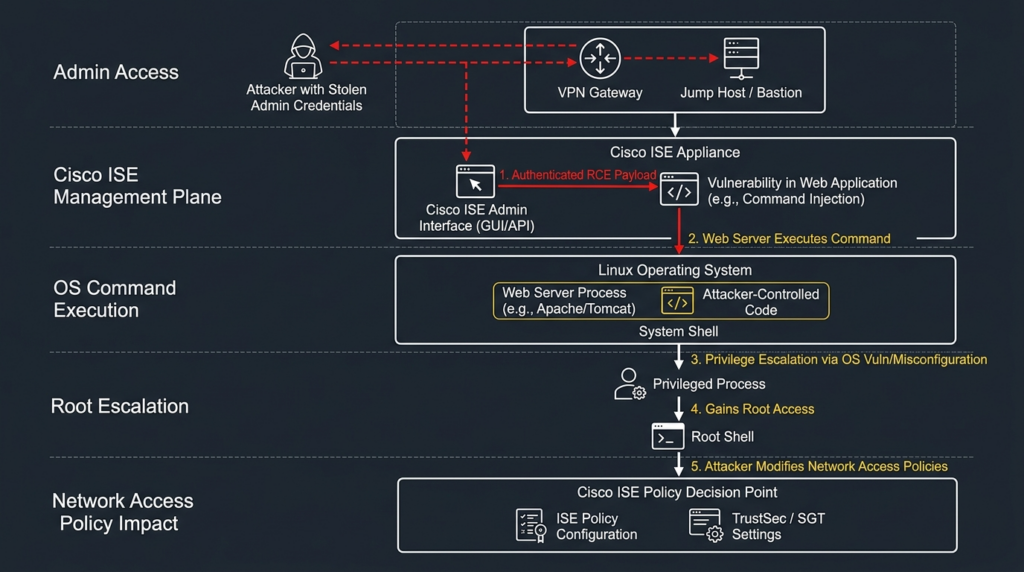
Security teams sometimes downgrade authenticated RCE in their heads because “the attacker already needs admin.” That shortcut is dangerous here. Administrative credentials are not a binary state owned only by trusted humans. They can be phished, replayed, reused, stolen from password vaults, exposed in scripts, recovered from backups, captured through compromised endpoints, inherited through vendor access, or abused by a malicious insider. When the vulnerable target is a control-plane system, the real question is not whether the attacker starts unauthenticated. The real question is what happens after a privileged credential is abused.
Cisco ISE deployments often bridge several trust zones. Administrators may reach them through VPNs, bastion hosts, jump boxes, SSO portals, privileged access management systems, remote support workflows, or internal admin VLANs. If those paths are broad, stale, or poorly monitored, “requires valid administrative credentials” becomes a weaker boundary than it sounds. A stolen admin session that would normally be limited to the application layer may become OS-level command execution. That is the step change defenders need to model.
The CVSS vector captures part of that story. CVE-2026-20181 is network-reachable, low complexity, and requires no user interaction, but it requires high privileges. The scope is changed, which means exploitation of the vulnerable component can affect resources beyond the component’s own security authority. Confidentiality, integrity, and availability are all rated high. That combination explains the 9.1 Critical score despite PR:H. (Cisco)
The CISA ADP enrichment visible in NVD’s change history marked exploitation as none, automatable as no, and technical impact as total. That is a useful nuance: there was no confirmed exploitation signal in that data, and the issue is not treated as trivially automatable. But “technical impact: total” matches the operational concern around OS-level control and root escalation on a system that can influence network access. (NVD)
What Cisco has publicly confirmed
The public facts are clear enough for defenders to act, but not detailed enough to justify exploit-level speculation. Cisco says CVE-2026-20181 is caused by insufficient validation of user-supplied input. An attacker with valid administrative credentials could exploit it by sending a crafted HTTP request to an affected device. A successful exploit could allow user-level access to the underlying operating system and then privilege escalation to root. In single-node deployments, exploitation could also cause denial of service by making the affected ISE node unavailable. (Cisco)
NVD repeats the same core description and lists CWE-22, path traversal, for CVE-2026-20181. GitHub’s advisory entry also repeats the authenticated RCE impact, the CVSS 9.1 score, and the CVSS base metrics. None of these public sources provide a safe, full exploit path, endpoint name, or payload. That absence matters. Defenders should avoid filling the gap with invented exploit details. (NVD)
The safe technical interpretation is narrower and more useful: the vulnerable surface is reachable through an HTTP request to an ISE or ISE-PIC management path available to an authenticated administrator; user-supplied input is not sufficiently constrained before it influences file path or command execution behavior; the result can cross from the application management plane into the underlying operating system. That is enough to justify patching, admin-plane restriction, credential review, and post-exposure log analysis.
Why CWE-22 matters, and what it does not prove by itself
CWE-22 is the classic path traversal weakness. At a simple level, the application accepts input that is supposed to identify a file or directory under an allowed parent directory, but it fails to neutralize path elements that resolve outside that boundary. In many applications, traversal is “only” an arbitrary file read or file write issue. In management appliances, it can become more serious when file paths intersect with scripts, jobs, configuration files, upload handlers, package workflows, service definitions, log viewers, backup restore functions, or command execution wrappers.
That does not mean every CWE-22 issue becomes RCE. The product architecture decides the blast radius. In CVE-2026-20181, Cisco’s description confirms command execution and possible root escalation, so defenders do not need to infer impact from CWE alone. CWE helps explain the weakness class; the Cisco advisory confirms the impact. (Cisco)
It is also important not to confuse the two CWE entries in Cisco’s advisory. The advisory lists CWE-22 and CWE-285 because it covers two vulnerabilities: CVE-2026-20181 and CVE-2026-20190. CVE-2026-20181 is the authenticated RCE issue. CVE-2026-20190 is the information disclosure issue caused by improper authorization checks when a resource is accessed. (Cisco)
The admin plane is the real attack surface
The strongest mental model for CVE-2026-20181 is not “remote code execution on a server.” It is “remote code execution through the administrative control plane of an identity and network access system.”
That distinction changes several decisions.
First, exposure is not only internet exposure. Many ISE systems are not directly internet-facing, but their admin interfaces may be reachable from VPN users, managed service provider networks, shared IT jump hosts, broad internal subnets, or emergency access ranges. A vulnerability that requires admin credentials can still be exploitable by an attacker who already crossed the perimeter through phishing, VPN credential theft, SSO token theft, endpoint compromise, or help desk account abuse.
Second, impact is not only OS compromise. ISE is tied to policy. Attackers who control the underlying OS may be able to disrupt authentication services, tamper with logs, alter local files, stage persistence, manipulate configuration artifacts, interfere with backups, or create conditions that make later response harder. Cisco’s public wording confirms OS command execution, user-level access, root escalation potential, and single-node availability impact. It does not describe every post-exploitation action. Defenders should reason from the product’s role without claiming unverified exploit behavior. (Cisco)
Third, recovery is not only patching. Patching closes the known vulnerability. It does not automatically answer whether an admin credential was stolen, whether a privileged session was abused, whether a hot patch was applied consistently across nodes, whether logs were centralized before the exposure window, or whether an attacker modified local artifacts before the patch.
CVE-2026-20190 changes the operating picture
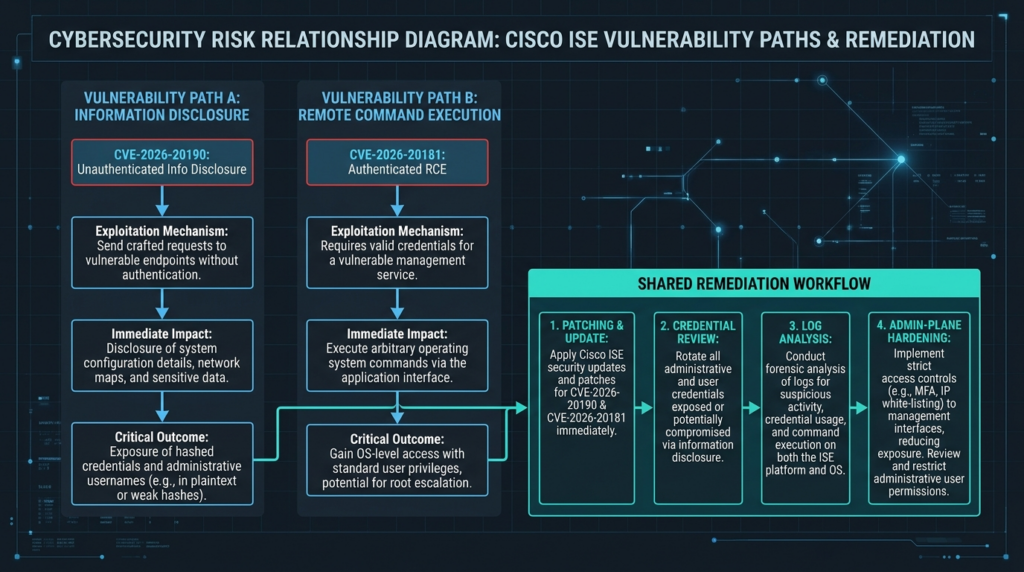
CVE-2026-20190 appears in the same Cisco advisory and should be triaged with CVE-2026-20181, even though Cisco says the vulnerabilities are independent and exploitation of one is not required to exploit the other. CVE-2026-20190 affects Cisco ISE and ISE-PIC and can allow an unauthenticated remote attacker to view sensitive information on an affected device because of improper authorization checks. Cisco says successful exploitation could expose sensitive information, including hashed credentials that could be used in future attacks. (Cisco)
That does not prove a public chain from CVE-2026-20190 to CVE-2026-20181. It does, however, change defensive prioritization. An unauthenticated information disclosure issue in the same product family can raise concern about credential material, credential hygiene, and whether exposed information could make later authenticated abuse easier. Qualys also summarized the pair as Cisco ISE and ISE-PIC RCE and information disclosure vulnerabilities and noted Cisco’s statement that it was unaware of public announcements or malicious use. (Qualys ThreatPROTECT)
The practical response is to patch both, inventory the same nodes, review the same exposure paths, and investigate credential-sensitive logs. Treat the pair as one remediation campaign, not as two unrelated tickets owned by different teams.
Affected releases and fixed paths
| Cisco ISE or ISE-PIC release | CVE-2026-20181 fixed path | CVE-2026-20190 fixed path | Operational note |
|---|---|---|---|
| Earlier than 3.3 | Migrate to a fixed release | Not vulnerable, according to Cisco’s table | Do not treat unsupported or older releases as “safe” for the RCE just because a patch number is unavailable |
| 3.3 | 3.3 Patch 11 | Not vulnerable | Confirm every node reports the fixed patch after upgrade |
| 3.4 | 3.4 Patch 6 | 3.4 Patch 6 | This is the cleanest supported target for many ISE-PIC deployments |
| 3.5 | 3.5 Patch 4, listed by Cisco for August 2026, or hot patch for 3.5 Patch 3 by contacting TAC | 3.5 Patch 3 | Track hot patch evidence carefully because scanner output may lag or may not understand a temporary TAC path |
| ISE-PIC support status | Cisco notes ISE-PIC has reached end of sale and Release 3.4 is the last supported release | Same advisory context | Plan migration and support lifecycle, not only emergency patching |
Cisco says there are no workarounds for these vulnerabilities. It also says it considers workarounds and mitigations, where applicable, to be temporary until upgrade to fixed software. For this advisory, the message is direct: use the fixed software path. (Cisco)
Do not verify production exposure by exploiting it
The worst way to handle a critical infrastructure vulnerability is to turn verification into a second incident. For CVE-2026-20181, production verification should not mean sending an exploit-style HTTP request to see whether command execution occurs. That can change system state, leave confusing forensic artifacts, disrupt services, trigger false incident signals, or break support assumptions.
A defensible verification workflow should answer five questions:
| سؤال | Evidence to collect | ما أهمية ذلك |
|---|---|---|
| Is the asset actually Cisco ISE or Cisco ISE-PIC | CMDB entry, admin console record, hostname pattern, certificate identity, device owner confirmation | Prevents false positives and unrelated Cisco asset noise |
| What release and patch is active | show version, GUI evidence, scanner authenticated check, upgrade record | Determines whether the system is on a fixed path |
| Which network zones can reach the admin surface | Firewall rules, VPN policy, jump host routes, controlled port checks | Converts software vulnerability into attack-path risk |
| Were admin credentials exposed or abused | SSO logs, PAM logs, local admin audit, failed logins, vendor access records | Required because exploitation needs valid administrative credentials |
| Was there suspicious pre-patch activity | ISE logs, web access logs, syslog, NetFlow, EDR where available, change records | Distinguishes clean patching from possible incident review |
Penligent’s public writing on AI-assisted penetration testing makes a useful point that applies here: safe security testing starts with scope, evidence, and control before payloads. In a CVE-2026-20181 response, that means the useful work is controlled asset discovery, version validation, reachability mapping, credential review, evidence capture, and retest after remediation, not unsupervised exploit replay. Penligent’s homepage describes its work around agentic AI pentesting, and its practical AI pentesting article emphasizes authorization, rate limits, validation workflows, and reportable evidence rather than letting automation roam freely. (بنليجنت)
Step 1, build the ISE asset set
Start with inventory. Do not assume the primary ISE node is the only node that matters. Large environments often have Policy Administration Nodes, Policy Service Nodes, Monitoring and Troubleshooting nodes, lab systems, DR nodes, temporary migration systems, regional nodes, and old ISE-PIC deployments that survived longer than expected.
Useful inventory sources include CMDB records, DNS, TLS certificate inventory, firewall object groups, load-balancer pools, TACACS+ server lists, RADIUS server lists, VPN configuration, wireless controller configuration, switch AAA configuration, vulnerability scanner results, network diagrams, backup schedules, and change tickets.
A low-noise, authorized discovery pass can identify candidate web management surfaces. It should not send vulnerability-specific payloads.
# Use only on networks you are authorized to assess.
# This checks common HTTPS and management ports without exploit payloads.

nmap -Pn -sV --version-light \
  -p 443,8443,9060,9443 \
  --open \
  -oA ise_candidate_web_services \
  10.20.0.0/16
Treat this output as candidate evidence, not proof of vulnerability. The goal is to find systems that may require authenticated validation. The actual product and patch state should be confirmed from Cisco-supported administrative methods, an authenticated scanner, or system owner evidence.
Step 2, collect version evidence from the system
Cisco’s ISE CLI reference describes show commands in EXEC show mode as commands used to display Cisco ISE settings and useful status information. For patch verification, defenders commonly collect version output from each node and attach it to the remediation record. (Cisco)
# Example evidence collection pattern.
# Run from an authorized administrative session.

ise/admin# show version
ise/admin# show application status ise
The exact output format can vary by release and deployment. The evidence record should preserve the hostname, node role, release, patch level, collection time, collector identity, and change ticket. Do not rely on a screenshot alone if the environment requires auditability. Save structured evidence where possible.
A simple CSV can help track nodes across an estate:
hostname,role,product,release,patch,admin_surface,zone,owner,evidence_time
ise-pan-01,PAN,Cisco ISE,3.4,Patch 5,https,admin-vlan,netsec,2026-06-29T18:40:00Z
ise-psn-03,PSN,Cisco ISE,3.4,Patch 6,https,internal,netsec,2026-06-29T18:45:00Z
ise-pic-01,ISE-PIC,Cisco ISE-PIC,3.3,Patch 10,https,admin-vlan,identity,2026-06-29T18:52:00Z
Then normalize the result against the fixed-release table. The following script is intentionally conservative and version-based. It does not test exploitability.
#!/usr/bin/env python3
"""
Non-exploit Cisco ISE / ISE-PIC CVE-2026-20181 exposure triage.

Input CSV columns:
hostname,role,product,release,patch,admin_surface,zone,owner,evidence_time

This script does not connect to devices. It only classifies collected
inventory evidence against Cisco's public fixed-release table.
"""

import csv
import re
from pathlib import Path

INPUT = Path("ise_inventory.csv")

FIXED_PATCH = {
    "3.3": 11,
    "3.4": 6,
}

def patch_number(value: str) -> int | None:
    if not value:
        return None
    match = re.search(r"(\d+)", value)
    return int(match.group(1)) if match else None

def classify(row: dict) -> str:
    release = (row.get("release") or "").strip()
    patch = patch_number(row.get("patch") or "")

    if not release:
        return "UNKNOWN_VERSION"

    if release.startswith("3.1") or release.startswith("3.2"):
        return "MIGRATE_TO_FIXED_RELEASE"

    if release.startswith("3.3"):
        if patch is not None and patch >= FIXED_PATCH["3.3"]:
            return "FIXED_FOR_CVE_2026_20181"
        return "AFFECTED_UPDATE_TO_3_3_PATCH_11"

    if release.startswith("3.4"):
        if patch is not None and patch >= FIXED_PATCH["3.4"]:
            return "FIXED_FOR_CVE_2026_20181"
        return "AFFECTED_UPDATE_TO_3_4_PATCH_6"

    if release.startswith("3.5"):
        return "CHECK_TAC_HOT_PATCH_OR_3_5_PATCH_4_PATH"

    return "CHECK_CISCO_ADVISORY_AND_TAC"

with INPUT.open(newline="") as f:
    reader = csv.DictReader(f)
    for row in reader:
        print(
            row.get("hostname", "unknown"),
            row.get("product", "unknown"),
            row.get("release", "unknown"),
            row.get("patch", "unknown"),
            classify(row),
            sep=","
        )
The script is deliberately not clever. It is a triage helper, not a replacement for Cisco’s advisory, TAC guidance, authenticated scanning, or post-upgrade validation.
Step 3, map reachable admin paths
CVE-2026-20181 requires administrative credentials, so reachability to the administrative surface matters. A system reachable only from a hardened management VLAN with MFA, PAM session recording, named admin accounts, tight firewall rules, and centralized logging has a different risk profile from a system reachable from broad VPN pools or vendor subnets.
Map admin reachability from at least these locations:
| Source zone | سؤال |
|---|---|
| Internet | Should be blocked unless there is a documented, highly controlled reason |
| Remote access VPN | Which user groups can reach ISE admin ports |
| IT admin network | Whether access is restricted to named jump hosts |
| Vendor support network | Whether access is temporary, approved, and logged |
| Branch networks | Whether user VLANs can reach admin interfaces |
| Data center server networks | Whether compromised servers can reach ISE admin paths |
| Security tooling networks | Whether scanners and SIEM collectors have only the access they need |
A non-destructive reachability check can be as simple as testing TCP connection state from approved vantage points:
# Run only from approved test hosts.
# This does not authenticate and does not send vulnerability payloads.

targets="ise-pan-01.example.com ise-psn-03.example.com ise-pic-01.example.com"

for host in $targets; do
  echo "== $host =="
  nc -vz -w 3 "$host" 443
  nc -vz -w 3 "$host" 8443
done
The result should feed firewall cleanup. Because Cisco says there is no workaround, blocking broad access is not a substitute for patching. It is still a valuable exposure reduction step while patching and post-patch validation proceed.
Step 4, review administrative identity risk
The credential requirement makes admin identity review central. The minimum review should cover:
| Control area | What to check |
|---|---|
| Named accounts | Remove shared admin accounts where possible |
| Local emergency accounts | Confirm they are vaulted, rotated, and rarely used |
| SSO and MFA | Confirm administrative access requires strong authentication |
| PAM | Confirm privileged sessions are approved and recorded |
| Vendor access | Confirm vendor paths are time-bound and logged |
| Role mapping | Remove unnecessary Super Admin or equivalent privileges |
| Dormant accounts | Disable accounts without recent valid business use |
| Password reuse | Rotate credentials if reuse or leakage is suspected |
| API credentials | Review any admin-equivalent API integrations |
| Break-glass process | Confirm emergency access does not bypass all monitoring |
Do not stop at the ISE local user list. Check SSO logs, identity provider groups, PAM policies, jump host logs, VPN group membership, and change records. An attacker does not need to steal a local Cisco ISE password if they can abuse an upstream path that grants administrative access.
Step 5, use scanners as corroboration, not as the only truth
Tenable’s plugin 321492 for this Cisco advisory is a local Nessus plugin. Tenable describes the remote device as missing a vendor-supplied security patch according to its self-reported Cisco ISE version, lists plugin ID 321492, and says no known exploits are available in its vulnerability information section. That is useful, but it also means the quality of the result depends on version reporting, plugin freshness, authentication, and scanner coverage. (Tenable®)
Qualys reported QIDs 317859 and 317860 for customers to detect vulnerable assets related to the Cisco ISE advisory. Again, scanner evidence is valuable. It is not the entire remediation record. (Qualys ThreatPROTECT)
Use this decision table when scanner output and system evidence disagree:
| الوضع | Likely cause | الإجراء الموصى به |
|---|---|---|
| Scanner says vulnerable, node shows fixed patch | Plugin lag, hot patch not recognized, stale scan, wrong target, unauthenticated check | Re-run authenticated scan, attach Cisco version evidence, confirm with vendor guidance if needed |
| Scanner says clean, node shows affected release | Scan missed node, wrong credential, unsupported check, load balancer confusion | Keep finding open until version evidence is fixed or explained |
| One node fixed, another node vulnerable | Cluster patch inconsistency | Treat deployment as not fully remediated |
| Hot patch applied on 3.5 Patch 3 but scanner still flags | Scanner may not understand temporary TAC hot patch | Preserve TAC case, package hash, install logs, and post-install evidence |
| Release earlier than 3.3 still exists | Migration required | Open a migration remediation track, not just a patch ticket |
Step 6, review logs before and after patching
Cisco ISE can forward logs to external syslog servers. Cisco’s documentation describes configuring external syslog servers as targets and notes that logs are classified into predefined categories that can be customized by category, target, and severity. This matters because local-only logs are fragile during an appliance compromise or service outage. (Cisco)
For CVE-2026-20181, log review should focus on admin-plane behavior rather than generic exploit signatures. Public sources do not provide a verified exploit endpoint, so defenders should avoid searching only for one rumored string. Search for classes of suspicious behavior:
| Evidence area | Signals to review |
|---|---|
| Admin logins | Unusual source IPs, new countries, unusual times, failed-to-success patterns |
| Privileged changes | New admin users, role changes, policy changes, password resets |
| Web access | Abnormal HTTP methods, encoded traversal patterns, unusual 4xx or 5xx bursts |
| API use | Unexpected automation clients, new integrations, high-volume admin calls |
| OS and service health | Unexpected restarts, process crashes, disk spikes, service instability |
| Network flow | Admin access from non-admin zones, VPN pools, branch networks |
| PAM and jump hosts | Sessions outside change windows, reused accounts, missing approvals |
| ملف التحف الفنية | Recently modified files in administrative, backup, or service-related paths |
| Scanner activity | Separate known scanning from unknown probing |
Example Splunk searches should be adapted to your field names and log sources:
index=ise sourcetype IN ("cisco:ise:syslog","cisco:ise")
(action="login" OR event="admin_login" OR "Administrator")
| stats count earliest(_time) as first latest(_time) as last by src_ip user result
| convert ctime(first) ctime(last)
| sort -count
index=ise sourcetype IN ("cisco:ise:syslog","cisco:ise:web")
(uri_path="*../*" OR uri_path="*%2e%2e*" OR uri_path="*%252e%252e*" OR uri_query="*..%2f*")
| table _time host src_ip user method uri_path status user_agent
| sort -_time
index=ise (status>=500 OR "exception" OR "traceback" OR "command" OR "permission denied")
| stats count values(status) as statuses values(uri_path) as paths by host src_ip user
| sort -count
Elastic-style queries can follow the same logic:
{
  "query": {
    "bool": {
      "must": [
        { "terms": { "event.dataset": ["cisco_ise.log", "cisco_ise.web"] } }
      ],
      "should": [
        { "wildcard": { "url.path": "*../*" } },
        { "wildcard": { "url.path": "*%2e%2e*" } },
        { "wildcard": { "url.query": "*%252e%252e*" } },
        { "wildcard": { "user_agent.original": "*python*" } },
        { "wildcard": { "user_agent.original": "*curl*" } }
      ],
      "minimum_should_match": 1
    }
  }
}
These searches are not exploit detectors. They are anomaly queries for suspicious admin-plane behavior. They should be combined with known scanner IPs, maintenance windows, TAC activity, and approved automation records.
Step 7, patch with evidence, not hope
Cisco’s patch installation documentation for ISE describes installing patches through the GUI under Administration, System, Maintenance, Patch Management, Install. It also notes that administrators should verify checksum after downloading the patch file. Cisco’s 3.4 upgrade guide describes the Upgrade and Rollback workflow and patch upgrade process. (Cisco)
A practical remediation record should include:
remediation_record:
  cve: CVE-2026-20181
  advisory: cisco-sa-ise-multi-G5WP8vv
  product: Cisco ISE
  node: ise-pan-01.example.com
  role: PAN
  pre_change:
    release: "3.4"
    patch: "Patch 5"
    admin_reachability:
      - admin_vlan
      - vpn_admin_group
    evidence:
      - show_version_output_2026-06-29.txt
      - scanner_result_pre_patch.json
  change:
    approved_ticket: CHG-2026-06181
    package: ise-patchbundle-example.SPA.x86_64.tar.gz
    checksum_verified: true
    maintenance_window: "2026-06-30T04:00:00Z/2026-06-30T06:00:00Z"
  post_change:
    release: "3.4"
    patch: "Patch 6"
    services_validated:
      - radius
      - tacacs
      - guest_portal
      - pxgrid
      - admin_gui
    evidence:
      - show_version_output_2026-06-30.txt
      - scanner_result_post_patch.json
      - service_validation_notes.md
  residual_actions:
    - rotate emergency admin credential
    - remove vpn_admin_group direct reachability
    - review admin logs for 30 days before patch
After patching, verify the active version on every node. Do not assume the deployment is remediated because the primary node was patched. Do not assume a patch file was installed because it was downloaded. Do not assume a change ticket closed successfully because the maintenance window ended. The evidence should show the fixed state.
Operational risk in single-node deployments
Cisco specifically calls out single-node deployments. Successful exploitation of CVE-2026-20181 could cause the affected ISE node to become unavailable. In that condition, endpoints that have not already authenticated would be unable to access the network until the node is restored. (Cisco)
That is more than a technical footnote. Single-node ISE deployments create a security and availability coupling problem. If the same system makes access decisions and has no resilient peer, a compromise or crash can become a business outage. Even if the attacker’s original goal is command execution, the practical effect may be authentication disruption, help desk overload, branch connectivity issues, guest access failure, or failed device administration.
For single-node environments, the patch plan should include:
| الإجراء | Reason |
|---|---|
| Confirm backup quality before patching | Recovery depends on usable backups |
| Schedule a business-aware maintenance window | Authentication disruption can block users and devices |
| Pre-stage console or out-of-band access | GUI or network access may fail during remediation |
| Validate critical access flows after patching | RADIUS, TACACS+, guest, posture, and admin workflows may be business-critical |
| Plan medium-term resilience | The vulnerability highlights the risk of single-node identity infrastructure |
Hardening the ISE management plane
Because Cisco says there is no workaround, hardening cannot replace the fixed software path. It can reduce the chance that stolen credentials become a successful exploit before, during, or after patching. (Cisco)
Start with network-level restrictions. The ISE administrative surface should be reachable only from documented management hosts or tightly controlled admin networks. Broad VPN pools, user VLANs, branch networks, general server subnets, and vendor networks should not have default access to ISE admin ports. Where vendors need access, use time-bound access, named accounts, approval records, and session logging.
Then reduce privilege. Not every operator needs full administrative access. Role-based access should reflect job function. Dormant accounts should be removed. Shared admin accounts should be replaced or tightly controlled. Break-glass accounts should be vaulted, monitored, and rotated after use. Local accounts should not survive employee departures, vendor contract changes, or migration projects.
Finally, make the management plane observable. Send ISE logs to external systems, retain admin activity, collect VPN and PAM context, and correlate admin actions with change tickets. When a future Cisco advisory lands, the organization should not need to ask whether it has logs.
Related CVEs that clarify the pattern
CVE-2026-20181 is not isolated in the broader Cisco control-plane risk pattern. Related vulnerabilities help defenders reason about priority without exaggerating this specific issue.
| مكافحة التطرف العنيف | Product area | Why it is relevant | Key defensive lesson |
|---|---|---|---|
| CVE-2026-20181 | Cisco ISE and ISE-PIC | Authenticated RCE against identity and network access infrastructure | Admin credentials are still a serious boundary when the target controls access policy |
| CVE-2026-20190 | Cisco ISE and ISE-PIC | Unauthenticated information disclosure in the same Cisco advisory | Treat credential-sensitive disclosure as part of the same remediation campaign |
| CVE-2026-20230 | Cisco Unified CM and Unified CM SME | Cisco collaboration control-plane issue requiring careful non-destructive verification | Safe verification should prove exposure through product, version, service state, reachability, and logs rather than production exploit execution |
| CVE-2025-20337 | Cisco ISE and ISE-PIC | Earlier maximum-severity ISE issue reported as allowing root-level code execution through crafted API requests | ISE has recurring high-impact management-plane exposure; old assumptions about admin surface isolation should be revisited |
| CVE-2026-20029 | Cisco ISE and ISE-PIC | Medium-severity issue involving administrative credentials and sensitive file access | Authenticated appliance bugs can still expose sensitive data and should not be dismissed automatically |
CVE-2026-20230 is especially useful as a verification comparison. It affects a different Cisco product family, but the operational lesson is the same: when a vulnerability affects a control-plane product, safe validation should avoid turning production systems into exploit labs. Penligent’s Cisco Unified CM verification write-up frames that kind of process around asset confirmation, version evidence, service-state checks, reachability, log review, and post-change validation. (بنليجنت)
What not to do
Do not wait for a public exploit before patching. Cisco’s statement that it was not aware of malicious use is good news, not a reason to defer. Public disclosure changes attacker incentives, and management-plane vulnerabilities often get attention after advisory publication.
Do not rely on perimeter exposure alone. A system hidden from the internet may still be reachable from compromised internal hosts, VPN pools, jump boxes, or vendors. The attack vector is network, not necessarily internet.
Do not collapse CVE-2026-20181 and CVE-2026-20190 into one bug. They are independent vulnerabilities in the same advisory. One is authenticated RCE. The other is unauthenticated information disclosure. Treat them together operationally, but describe them accurately. (Cisco)
Do not run untrusted PoC code on production ISE. Public exploit material for CVEs can be malicious or misleading in general, and production exploit validation can contaminate evidence. Even without a known public exploit for this issue, the right habit is to validate with the least invasive evidence that produces a reliable answer.
Do not close the ticket after one scanner result. Collect system evidence, patch evidence, scanner evidence, and post-change service validation. If scanners disagree with Cisco-supported evidence, resolve the discrepancy instead of picking the result that makes the dashboard look better.
A practical remediation playbook
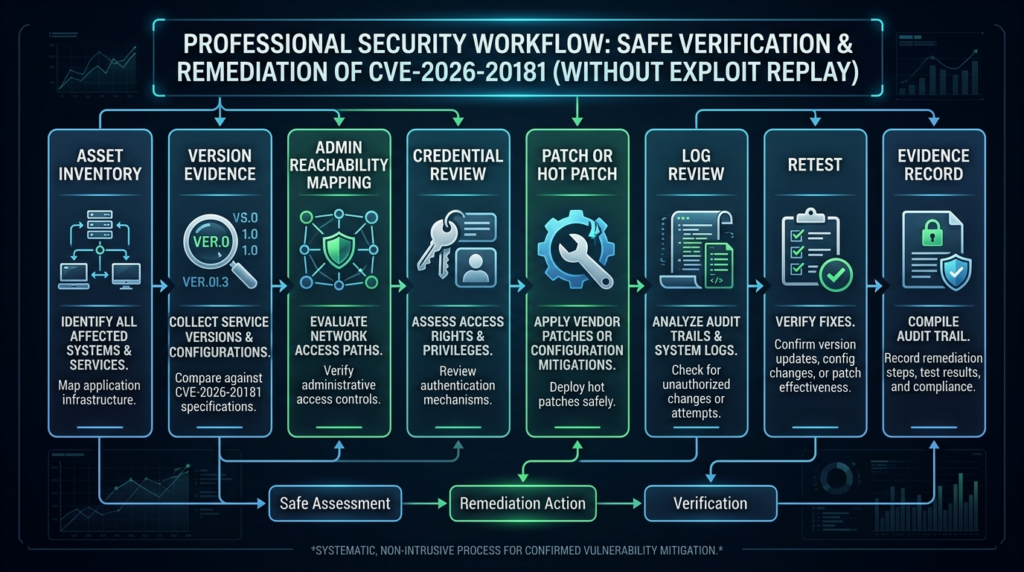
A usable CVE-2026-20181 playbook should be short enough to execute but complete enough to audit.
CVE-2026-20181 remediation playbook

1. Open an incident-adjacent vulnerability response ticket.
   Owner: network security, identity engineering, security operations.
   Scope: Cisco ISE and Cisco ISE-PIC nodes.

2. Freeze risky admin changes.
   Pause nonessential ISE admin modifications until inventory is complete.

3. Build the asset list.
   Include PAN, PSN, MnT, ISE-PIC, lab, DR, and migration nodes.

4. Collect version and patch evidence.
   Use Cisco-supported admin methods and authenticated scanner checks.

5. Compare against Cisco fixed-release table.
   Earlier than 3.3: migrate.
   3.3: update to 3.3 Patch 11.
   3.4: update to 3.4 Patch 6.
   3.5: confirm 3.5 Patch 4 path or TAC hot patch for 3.5 Patch 3.

6. Restrict admin reachability.
   Limit admin ports to approved management hosts and networks.

7. Review admin credential exposure.
   Check SSO, PAM, VPN, local accounts, vendor accounts, dormant accounts.

8. Patch or hot patch.
   Verify package integrity, follow Cisco upgrade guidance, preserve install logs.

9. Validate services.
   Test RADIUS, TACACS+, guest, posture, pxGrid, admin GUI, reporting, and integrations.

10. Review exposure-window logs.
    Look for suspicious admin access, unusual requests, role changes, service instability.

11. Retest.
    Run authenticated scanners and collect post-patch system version evidence.

12. Close with evidence.
    Attach before and after version output, scanner result, change record, log review summary,
    exceptions, and remaining hardening actions.
This is the level of detail that lets a second engineer reproduce the conclusion. That matters when the affected system is part of authentication and access control.
Detection engineering notes
Cisco’s advisory lists Snort rules 66658 and 66661 as action links. Those rule references are useful for teams running Snort or Cisco detection content, but rule IDs alone should not become the entire detection strategy. Network signatures can help identify known patterns, but authenticated management-plane abuse may also look like legitimate admin traffic until the request details, source, timing, and account context are examined. (Cisco)
A stronger detection plan combines:
| الطبقة | Detection value |
|---|---|
| Network IDS | Possible known malicious request patterns or suspicious traversal-like traffic |
| Web and application logs | Admin request paths, status codes, user-agent, source IP, session context |
| Identity provider logs | Admin authentication, MFA events, impossible travel, new device signals |
| PAM logs | Session start, session recording, approval mismatch |
| VPN logs | Admin access from unexpected users or locations |
| ISE audit logs | Role changes, policy changes, account creation, configuration export |
| NetFlow | Access to ISE admin ports from unexpected zones |
| File integrity or EDR where available | Unexpected local file changes, process creation, service behavior |
For many appliance-style systems, host-level telemetry may be limited. That makes external logging, network flow, PAM records, and strict admin path control more important.
Prioritization for different environments
The urgency of CVE-2026-20181 is high by default, but the exact order of work depends on deployment conditions.
| Environment condition | الأولوية | Reason |
|---|---|---|
| ISE admin UI reachable from internet | Immediate emergency | Exposure is inconsistent with the sensitivity of the system |
| ISE admin UI reachable from broad VPN pools | Immediate | Stolen VPN credentials can become an admin-plane path |
| Valid admin credentials suspected compromised | Immediate incident response | The prerequisite for exploitation may already exist |
| Single-node ISE deployment | Immediate | Cisco describes possible node unavailability with network access consequences |
| ISE-PIC 3.4 or older supported edge | عالية | Patch path and lifecycle planning both matter |
| 3.5 Patch 3 awaiting TAC hot patch | عالية | Evidence must show hot patch status and future 3.5 Patch 4 plan |
| Admin access tightly restricted and no credential concern | High, scheduled urgently | No workaround exists, but exposure controls may reduce short-term risk |
| Lab-only isolated deployment | Medium to high | Patch before reconnecting, and prevent stale lab systems from becoming production paths |
A useful vulnerability program does not treat every Critical the same. It also does not hide behind nuance. For CVE-2026-20181, the product role, no-workaround status, root escalation potential, and single-node availability impact make a strong case for fast remediation.
الأسئلة الشائعة
What is CVE-2026-20181?
- CVE-2026-20181 is a critical authenticated remote code execution vulnerability in Cisco ISE and Cisco ISE-PIC.
- Cisco says the flaw is due to insufficient validation of user-supplied input.
- An attacker with valid administrative credentials can send a crafted HTTP request to an affected device.
- Successful exploitation can allow user-level access to the underlying operating system and then privilege escalation to root.
- In single-node deployments, Cisco says exploitation could make the ISE node unavailable and prevent not-yet-authenticated endpoints from accessing the network. (Cisco)
Does CVE-2026-20181 require administrator credentials?
- Yes. Cisco states that exploitation requires valid administrative credentials.
- That requirement reduces exposure compared with unauthenticated RCE, but it does not make the issue low risk.
- Administrative credentials can be stolen, phished, reused, exposed through vendor workflows, or abused after an internal compromise.
- Because Cisco ISE is identity and network access infrastructure, abuse of an admin credential can have consequences beyond the ISE web application itself.
Which Cisco ISE versions fix CVE-2026-20181?
- Cisco lists Release 3.3 as fixed in 3.3 Patch 11.
- Cisco lists Release 3.4 as fixed in 3.4 Patch 6.
- Cisco lists Release 3.5 as fixed in 3.5 Patch 4, noted for August 2026, or through a hot patch for Release 3.5 Patch 3 available by contacting Cisco TAC.
- Releases earlier than 3.3 should migrate to a fixed release.
- Cisco says there are no workarounds for this vulnerability. (Cisco)
How is CVE-2026-20181 different from CVE-2026-20190?
- CVE-2026-20181 is the authenticated remote code execution vulnerability.
- CVE-2026-20190 is an unauthenticated information disclosure vulnerability in Cisco ISE and ISE-PIC.
- Cisco says CVE-2026-20190 is caused by improper authorization checks and can expose sensitive information, including hashed credentials.
- Cisco also says the two vulnerabilities are independent, meaning exploitation of one is not required to exploit the other.
- Operationally, they should still be patched and investigated together because they affect the same product family and advisory window. (Cisco)
Is it safe to verify CVE-2026-20181 by running an exploit?
- Not in production.
- Production verification should use version evidence, patch evidence, admin reachability mapping, scanner corroboration, credential review, and log analysis.
- Exploit-style validation can change system state, disrupt authentication services, create confusing artifacts, or damage forensic clarity.
- If exploit reproduction is needed, use an isolated lab with explicit authorization and no production data.
What logs should defenders review?
- Review ISE administrative logins, role changes, account creation, policy changes, configuration exports, and unusual admin actions.
- Correlate ISE logs with SSO, MFA, PAM, VPN, jump host, firewall, proxy, and NetFlow records.
- Look for suspicious HTTP paths, encoded traversal-like strings, unusual user agents, abnormal 4xx or 5xx bursts, and admin access from unexpected zones.
- Separate approved scanner activity and TAC activity from unknown access.
- If logs were not forwarded externally before the exposure window, document that limitation and improve logging as part of remediation.
Can a vulnerability scanner prove remediation?
- A scanner can provide useful corroborating evidence, especially when checks are authenticated and current.
- It should not be the only proof.
- Preserve device version output, patch installation records, package checksums, change tickets, post-patch service validation, and scanner results.
- If a scanner flags a system that appears patched, investigate plugin freshness, hot patch recognition, authentication quality, target identity, and cluster consistency.
- If the system is on an affected version but the scanner reports clean, keep the issue open until the mismatch is explained.
Should this be urgent if Cisco reported no known exploitation?
- نعم.
- Cisco’s no-known-exploitation statement is valuable context, but it does not remove the need to patch.
- The affected products are identity and network access control systems.
- Cisco assigned a Critical rating, gave a CVSS 9.1 score, confirmed possible OS command execution and root escalation, and stated that no workaround is available.
- The right response is fast, evidence-driven remediation with admin-plane hardening and credential review.
Final take
CVE-2026-20181 is easy to misread. It is not an unauthenticated internet RCE, and defenders should not describe it that way. It is also not a routine authenticated bug that can wait behind lower-impact application findings. It affects Cisco ISE and ISE-PIC, requires valid administrative credentials, and can cross into operating system command execution with potential root escalation and single-node denial-of-service impact.
The clean response is straightforward: identify every ISE and ISE-PIC node, collect version evidence, apply Cisco’s fixed release or TAC hot patch path, restrict management reachability, review administrative credential exposure, examine logs from the exposure window, and retest with evidence. Do not turn production verification into exploit replay. The strongest outcome is not a dramatic shell screenshot. It is a defensible record showing that the identity control plane is patched, reachable only from the right places, monitored well enough to trust, and no longer carrying a known critical command execution path.
 Arabic
  English
  German
  French
  Spanish
  Portuguese
  Japanese
  Korean
  Hindi
Hindi  Turkish
  Hebrew