
On September 25, 2026, Kiteworks did something enterprise software vendors rarely ask their customers to do: temporarily turn off production systems.
The company said it had received credible threat intelligence from federal intelligence authorities suggesting that a threat actor might attempt to target some Kiteworks systems. Rather than wait for an attack to become visible or for a vulnerability to be publicly identified, Kiteworks recommended a temporary shutdown during the period in which the threat was believed to be most acute. The company described the action as precautionary and said it had no indication that Kiteworks itself or its customers had already been compromised. (Kiteworks)
That distinction is the most important fact in the story.
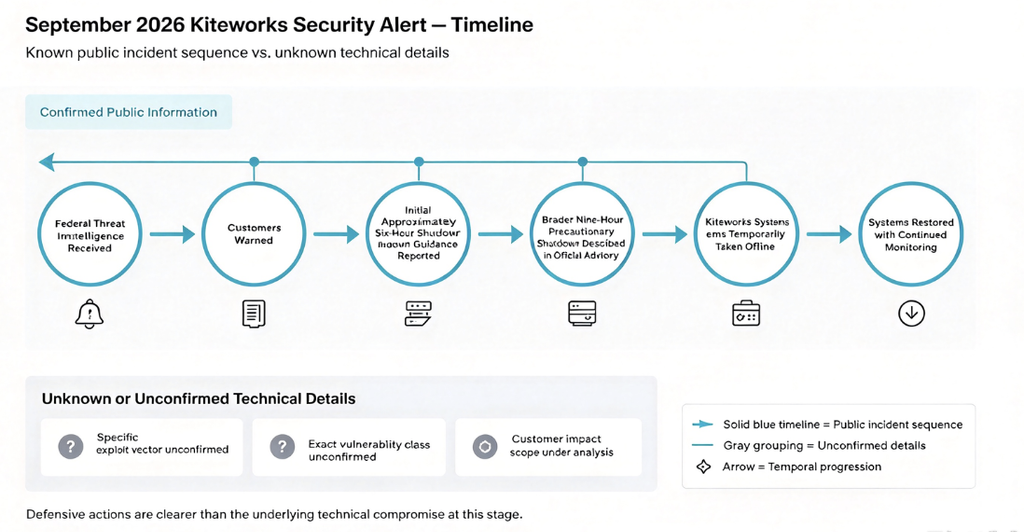
At the time of writing on September 26, there is no public evidence of a confirmed Kiteworks breach connected to this warning. Kiteworks has not announced an exploited CVE, published a technical description of the suspected vulnerability, identified a threat actor, or released indicators of compromise tied specifically to this event. What exists instead is an unusually early security intervention based on intelligence that appears to have arrived before technical evidence of exploitation became public.
That makes the September 2026 Kiteworks security alert more interesting than a conventional vulnerability disclosure. Normally, defenders learn about a bug and then scramble to understand whether attackers are using it. Here, customers were asked to reduce exposure before the public knew what the attack method might be.
What Happened With Kiteworks?
The incident became public on September 25 after reports emerged that Kiteworks CISO Frank Balonis had emailed customers about an imminent security concern. According to BleepingComputer, which cited reporting from German publication Heise, Kiteworks told customers that it had received credible intelligence from law enforcement indicating that an attack against Kiteworks systems could be imminent over the weekend. Customers were initially advised to shut down their systems for roughly six hours. (كمبيوتر نائم)
The timing was unusually specific. BleepingComputer reported that customers in Central Europe had been instructed to keep systems offline between approximately 4:00 a.m. and 10:00 a.m. on Saturday, September 26, while customers in New York were given a window beginning late Friday night. The same report said Kiteworks was recommending that servers be taken offline even if they were not directly exposed to the public internet. (كمبيوتر نائم)
SANS NewsBites independently summarized the customer guidance as a shutdown from 02:00 to 08:00 UTC and highlighted how unusual it was for a vendor to recommend shutting down systems regardless of version, architecture, or whether they were internet-facing. (SANS Institute)
Kiteworks subsequently issued its own public statement. That official advisory describes a nine-hour precautionary shutdown window, rather than the six-hour period reported from the earlier customer communication. Kiteworks said customers operating self-managed deployments on premises, AWS, or Azure should shut those systems down themselves, while Kiteworks would handle the shutdown for systems hosted directly by the company. (Kiteworks)
The difference between the six-hour and nine-hour figures should not be ignored. It appears that the shutdown guidance developed as Kiteworks continued coordinating its response. For administrators, the practical takeaway is straightforward: the latest direct instructions from Kiteworks should take precedence over screenshots or reproductions of the earlier customer email.
The company also stated that the threat did not affect several other businesses within the Kiteworks group, including Zivver, DRACOON, totemo, ownCloud, WAMNET, and 123Formbuilder. (Kiteworks)
Is This a Kiteworks Zero-Day?
A zero-day is one of the most discussed explanations for the shutdown, but it is important not to turn that possibility into a confirmed fact.
BleepingComputer reported that Kiteworks support personnel told Heise that the shutdown was intended to protect customers against potential zero-day attacks. TechCrunch obtained a copy of the customer communication and reported that Kiteworks was worried about vulnerabilities that might currently be unknown to the company. TechCrunch also reported that customers were told to shut down systems because Kiteworks could not rule out unknown routes of access. (كمبيوتر نائم)
That is strong evidence that an unknown vulnerability is part of Kiteworks’ threat model.
It is not, however, the same thing as confirmation that attackers possess a working zero-day exploit.
Kiteworks’ formal public statement uses much more cautious language. The company says federal intelligence authorities warned that a threat actor may attempt to target some Kiteworks systems, and it says that all vulnerabilities currently known to Kiteworks have been addressed in version 9.5.1. (Kiteworks)
The Record reached the same conclusion in its reporting: a Kiteworks support official referenced a potential zero-day, but there was no public CVE, patch, exploit description, or named attacking group associated with the September warning. (The Record from Recorded Future)
The technically accurate description, therefore, is a possible or suspected zero-day scenario, not a confirmed zero-day compromise.
That may sound like a semantic distinction, but it matters. A vulnerability can exist without being exploited. An attacker can possess an exploit without successfully compromising a customer. Intelligence services can also become aware of an intended attack before they fully understand the exploit chain involved.
For a security team trying to decide whether its environment has been compromised, those are very different situations.
Why Would Kiteworks Recommend a Full Shutdown?
The shutdown recommendation tells us something important about the level of uncertainty involved.
When a vulnerability is understood, defenders normally have more precise options. A vendor can release a patch. A firewall can block a particular endpoint. A web application firewall can reject a known request pattern. An administrator can disable one vulnerable service. Detection engineers can search for a specific payload, process tree, file hash, command line, or network indicator.
Those options become much harder when the underlying exploit is unknown.
If defenders do not know which component is vulnerable, what authentication level is required, which protocol carries the exploit, or what an attacker does after exploitation, temporarily removing the application from the network is one of the few controls that substantially reduces almost every remote application-level attack path at once.
This helps explain why the Kiteworks shutdown was so broad.
SANS instructor Lee Neely observed that Kiteworks appeared to be making its recommendation without knowing exactly what the attempted exploit would look like. He also noted an obvious limitation: attackers are not required to follow the anticipated attack window and could theoretically change their timing. His recommendation was therefore not to treat the shutdown as a replacement for normal controls such as patching, MFA, WAF protection, DDoS defenses, and monitoring. (SANS Institute)
That is an important way to interpret the event. A temporary shutdown is a containment measure, not a permanent remediation.
If a genuine vulnerability exists, it still has to be identified and fixed. If an attacker already obtained access before the shutdown, powering off the server does not answer the more difficult questions of persistence, lateral movement, or data exposure.
Why Secure File Transfer Platforms Attract Attackers
Kiteworks occupies a particularly sensitive position inside enterprise infrastructure.
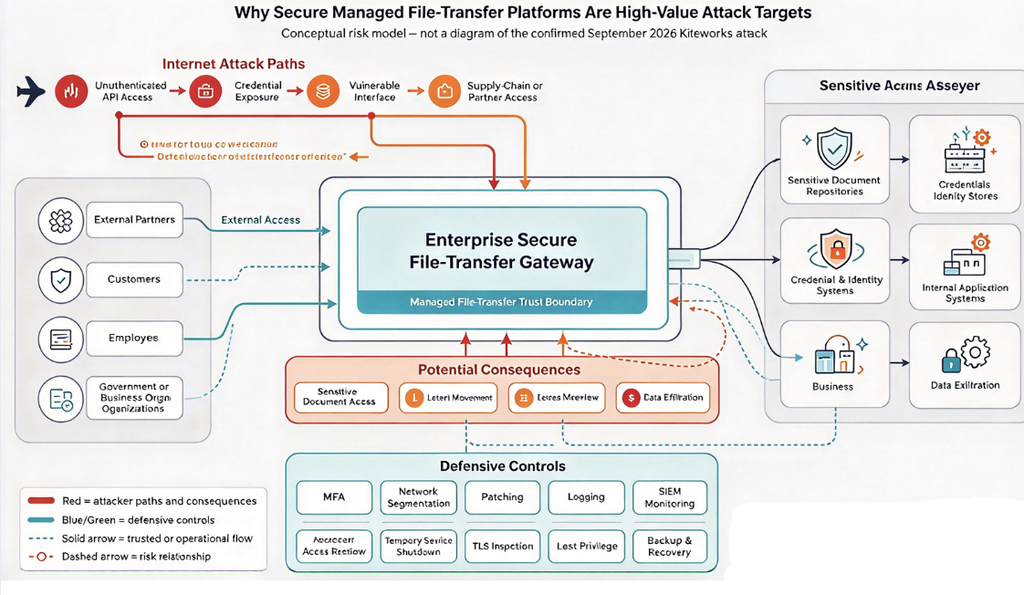
Secure file-transfer products exist because organizations need to move information that cannot simply be attached to an ordinary email or placed in a consumer file-sharing service. That often includes regulated records, contracts, intellectual property, financial documents, healthcare information, engineering files, internal corporate data, and material exchanged with governments, suppliers, customers, or outside counsel.
From an attacker’s perspective, that creates an unusually attractive target.
The server is often reachable by external parties because file exchange is its purpose, but it may simultaneously contain information valuable enough to support espionage, extortion, credential theft, or follow-on attacks. An attacker who compromises the transfer platform may not need to spend weeks exploring internal file shares looking for valuable data. Some of the most valuable material may already be concentrated in one place.
There is ample historical evidence that threat actors understand this.
One of the clearest examples was the 2023 exploitation of Progress MOVEit Transfer. CISA and the FBI documented how the CL0P group exploited CVE-2023-34362, a previously unknown SQL injection vulnerability, against internet-facing MOVEit systems. Compromised servers were used to deploy a web shell and facilitate large-scale data theft. (CISA)
That campaign was not an isolated case. File-transfer products have repeatedly appeared in high-impact exploitation campaigns because they combine external accessibility with access to sensitive business information.
This history does لا mean CL0P is responsible for the current Kiteworks warning. No such attribution has been made by Kiteworks, and there is currently no public evidence connecting a named group to the September 2026 event. BleepingComputer noted CL0P’s history of targeting file-transfer platforms, but explicitly said the actor behind the current potential attacks is unknown. (كمبيوتر نائم)
That distinction is important because historical similarity is useful for understanding risk, but it is not evidence of attribution.
The Accellion History Matters — but It Is Not the Same Incident
There is another reason the Kiteworks shutdown immediately caught the security industry’s attention. Kiteworks was previously known as Accellion, whose legacy File Transfer Appliance became the target of a major exploitation campaign in late 2020 and early 2021.
According to a joint cybersecurity advisory released by CISA and international partners, attackers exploited multiple vulnerabilities in Accellion FTA to compromise government and private-sector organizations across several countries. The flaws included CVE-2021-27101, CVE-2021-27102, CVE-2021-27103, and CVE-2021-27104. In some incidents, data was exfiltrated from compromised appliances and victims were subsequently extorted. (CISA)
CISA later added the Accellion vulnerabilities to its Known Exploited Vulnerabilities catalog and recorded that several had been associated with ransomware campaigns. (CISA)
It would nevertheless be misleading to describe the September 2026 event as another breach of the same product.
The 2021 attacks affected Accellion’s legacy FTA platform. Kiteworks’ own post-incident statement said the modern Kiteworks platform was built on a different codebase and had not been affected by those FTA attacks. Mandiant’s investigation at the time focused on vulnerabilities in the legacy FTA product, which Accellion subsequently accelerated toward end-of-life. (Kiteworks)
The relevant connection is therefore historical rather than technical.
The Accellion case showed just how valuable secure file-transfer infrastructure can become when attackers discover an exploitable path into it. The modern Kiteworks product is different software, but the economic incentive for attackers to target platforms that move sensitive enterprise data has not disappeared.
What Does Kiteworks 9.5.1 Tell Us?
Kiteworks has repeatedly told customers to run version 9.5.1, stating that all vulnerabilities currently known to the company are addressed in that release. (Kiteworks)
The wording deserves careful attention.
“Known vulnerabilities” does not mean “no vulnerabilities exist.” It means Kiteworks says it has addressed the vulnerabilities it currently knows about.
That is precisely why the possibility of a zero-day remains relevant. If federal authorities have intelligence concerning an exploit that has not yet been disclosed to the vendor, a fully patched 9.5.1 installation could still theoretically be exposed until that unknown issue is understood. Conversely, the intelligence might concern an attack path that does not involve a new vulnerability at all.
We simply do not know yet.
Kiteworks’ public vulnerability repository shows that the company has patched multiple issues during 2026. Earlier releases addressed vulnerabilities including SSRF, OS command injection, unrestricted file upload, cross-site scripting, SQL injection, and authorization weaknesses across different Kiteworks components. (جيثب)
For example, CVE-2026-28269 involved OS command injection functionality in Kiteworks Core before version 9.2.0, while CVE-2026-28271 involved an SSRF condition affecting versions before 9.2.0. Both were already patched months before the September shutdown. (جيثب)
Secure Data Forms also received fixes during 2026, including CVE-2026-24782, a SQL injection issue patched in version 9.3.0. (جيثب)
There is currently no evidence tying any of those disclosed vulnerabilities to the September 2026 threat warning.
That point is worth emphasizing because vulnerability news often produces a rush to connect an event to whichever recent CVE appears most technically dramatic. Without evidence from Kiteworks, authorities, or forensic investigations, doing so here would be speculation.
A Patched Kiteworks Server Still Deserves Investigation
Organizations should also avoid confusing vulnerability status with incident status.
These are separate questions.
The first question is: Is this system running software that contains a vulnerability we know about?
The second is: Has anyone already accessed or manipulated this system?
Upgrading to Kiteworks 9.5.1 helps answer the first problem because the vendor says the release addresses all currently known vulnerabilities. It cannot, by itself, prove that the machine was never compromised before the upgrade or that it was never exposed to an unknown attack technique.
That is why log preservation matters during an incident like this.
Organizations responsible for Kiteworks infrastructure should retain application logs, authentication history, operating-system logs, identity-provider records, reverse-proxy telemetry, firewall events, cloud audit logs, and other relevant data from the period before the shutdown. If Kiteworks or a federal agency later releases indicators of compromise, historical telemetry may become the only reliable way to determine whether a system encountered the suspected attack.
Administrators should pay particular attention to unexplained changes rather than attempting to invent an IOC for an exploit that has not been disclosed. Unexpected administrator accounts, authentication from unusual sources, unexplained configuration modifications, abnormal child processes, new scheduled jobs, unfamiliar outbound connections, unexpected application files, or anomalous access to large volumes of stored data would all justify deeper investigation.
None of those behaviors is currently a confirmed indicator of the September Kiteworks threat. They are simply normal areas of scrutiny when examining a sensitive application server for possible compromise.
This distinction keeps the investigation evidence-driven rather than turning generic suspicious behavior into a fabricated signature for an unknown attack.
Why “Not Internet-Facing” May Not Be Enough
One of the more striking details from the initial reporting was that Kiteworks reportedly advised customers to take systems offline even when those servers were not directly accessible from the internet. BleepingComputer and SANS both highlighted this element of the guidance. (كمبيوتر نائم)
It is tempting to interpret that as evidence of an internal attack vector, but that would be premature.
The safer interpretation is that Kiteworks did not want administrators to assume a particular network architecture made them immune while the suspected attack path remained unknown.
A server behind a VPN can still be reached by a compromised credential. A system behind a reverse proxy can still contain application-level vulnerabilities. An internal deployment can still be exposed through connected services, trusted partners, management interfaces, cloud infrastructure, or compromised endpoints.
None of those possibilities has been confirmed in the Kiteworks case.
The broader lesson is simply that network placement should not override direct vendor guidance during a threat for which the technical mechanics have not yet been disclosed.
The Six-Hour Versus Nine-Hour Shutdown Is Worth Explaining
Some organizations researching the Kiteworks incident will encounter seemingly contradictory reports.
Early reporting from Heise, BleepingComputer, The Record, and SANS described a six-hour shutdown. (كمبيوتر نائم)
Kiteworks’ later formal advisory describes a nine-hour precautionary shutdown window in customers’ local time zones. (Kiteworks)
Both statements exist in the public record.
This appears to reflect evolving guidance rather than evidence that one side fabricated the shutdown. The customer email circulated first, followed by Kiteworks’ official public statement. For incident documentation, the formal Kiteworks advisory should therefore be treated as the current authoritative version unless the company issues another update.
This detail may seem minor, but accurate chronology matters in security reporting. When guidance changes during an active incident, rewriting the earlier instructions as though they never existed makes it harder to understand how the response actually unfolded.
No Confirmed Breach Does Not Mean the Alert Was an Overreaction
Another trap is assuming that, if the weekend passes without reports of widespread exploitation, the shutdown was unnecessary.
Preventative security creates an unusual problem: when prevention works, the most visible outcome is often that nothing happens.
Kiteworks was not responding to a publicly documented compromise. It was responding to intelligence about something that might happen. The company therefore had to choose between accepting operational disruption immediately or accepting the possibility of a much more serious security incident if the intelligence proved accurate.
TechCrunch reported that the operational cost was real. One healthcare-sector Kiteworks customer told the publication that taking its server offline was disrupting communication between doctors and patients. (تك كرانش)
That gives the decision some useful context. Kiteworks was asking customers to accept genuine business consequences.
Companies do not normally advise enterprise customers to disable systems used in healthcare, government, finance, legal services, and other sensitive workflows without anticipating significant disruption.
That does not prove an attack was certain.
It does indicate that Kiteworks considered the intelligence credible enough to justify an unusually expensive defensive measure.
What We Still Do Not Know About the Kiteworks Security Alert
As of September 26, several questions remain unanswered, and those unknowns are more important than the speculation surrounding them.
Kiteworks has not publicly identified the federal authority that originated the threat intelligence. TechCrunch reported that the FBI declined to comment and that CISA would not comment on the record when asked about the alert. (تك كرانش)
The company has not named an attacker.
It has not publicly confirmed a zero-day vulnerability.
No new CVE associated with the shutdown has been announced.
No proof-of-concept exploit has been published.
No Kiteworks-specific IOC set associated with the September threat has been made public.
And most importantly, Kiteworks continues to say that it has no indication that its systems or customer systems have been compromised. (Kiteworks)
Those facts may change quickly if an investigation uncovers technical evidence.
Until then, the absence of information should not be filled with guesses.
What Security Teams Should Watch for Next
The next important development will probably be technical rather than rhetorical.
If Kiteworks publishes a new security release immediately after the incident, administrators should examine its release notes closely. A new CVE affecting 9.5.1 or earlier releases would materially change how defenders should assess historical exposure. A disclosure of an authentication bypass, remote code execution flaw, file upload vulnerability, command injection weakness, or another remotely reachable condition would also make threat hunting much more targeted.
Indicators of compromise would be even more useful. Once defenders know which URLs, commands, processes, files, accounts, hashes, IP addresses, or log patterns are associated with an attack, the problem changes from speculative risk management into conventional incident response.
Government guidance would also materially alter the picture. A CISA or FBI advisory could confirm whether exploitation actually occurred, identify the affected products, describe attack infrastructure, and potentially connect the activity to a known threat actor.
Until one of those things happens, administrators should treat unattributed screenshots, social-media claims, and unsupported declarations of a “Kiteworks zero-day exploit” cautiously.
The official record is narrower.
Federal threat intelligence indicated that a threat actor might target some Kiteworks systems. Kiteworks recommended a precautionary shutdown. The company says there is currently no evidence of compromise. Version 9.5.1 addresses all vulnerabilities known to Kiteworks. And the possibility of an unknown vulnerability has been discussed in customer communications and support conversations but has not been publicly confirmed as an exploited zero-day. (Kiteworks)
Why the September 2026 Kiteworks Shutdown Matters
The most interesting part of this incident is not the possibility of a mysterious zero-day. Cybersecurity has seen many zero-days.
What makes the September 2026 Kiteworks shutdown unusual is the order in which the defense happened.
In a typical vulnerability crisis, attackers or researchers discover a weakness. Technical evidence surfaces. A vendor investigates. A CVE is assigned. A patch appears. Security teams rush to deploy it.
Here, threat intelligence appears to have reached defenders before the vulnerability itself became publicly visible.
That is a much harder security problem.
Organizations have to make a decision without knowing the CVSS score, without a proof-of-concept, without an affected-version matrix, without reliable detection rules, and perhaps without knowing whether the attack relies on a vulnerability at all.
The only thing they may know is that a trusted intelligence source believes an attack is likely.
The Kiteworks response shows what an intelligence-led defense can look like under those conditions: reduce the attack surface first, investigate second.
Whether the decision ultimately proves necessary will depend on information that has not yet been released.
خلاصة القول
The September 2026 Kiteworks security alert should be taken seriously, but it should also be described accurately.
There is currently no confirmed Kiteworks breach associated with this warning. There is no publicly confirmed exploited Kiteworks zero-day. No attacker has been publicly attributed, and no new CVE or IOC set has been released for the suspected campaign.
What has been confirmed is still significant.
Kiteworks received credible threat intelligence from federal intelligence authorities indicating that a threat actor might attempt to target some Kiteworks customer systems. The company considered that intelligence serious enough to recommend an extraordinary precautionary shutdown, including self-managed deployments, while Kiteworks itself handled hosted environments. It continues to recommend version 9.5.1 and says that release addresses all vulnerabilities currently known to the company. (Kiteworks)
The possibility of a zero-day remains credible because Kiteworks customer communications and support personnel specifically discussed unknown vulnerabilities and potential zero-day attacks. But until technical evidence is released, “potential zero-day” remains the correct phrase. (تك كرانش)
For defenders, that is the important lesson from the Kiteworks incident. Security teams do not always receive a CVE before they receive a warning. Sometimes the intelligence arrives first, and the evidence follows later.
When that happens, there may be no elegant mitigation.
Sometimes the safest available control really is to turn the system off.
Key sources used in this article
The central primary source is Kiteworks’ own September 25, 2026 precautionary shutdown advisory, which contains the company’s statement on the federal intelligence warning, the nine-hour shutdown window, version 9.5.1, and the absence of any known compromise. Kiteworks Precautionary Shutdown Advisory
The initial six-hour shutdown guidance and the reported comments concerning potential zero-day attacks were documented by BleepingComputer and independently covered by TechCrunch, The Record, and SANS NewsBites. BleepingComputer report TechCrunch report The Record report SANS NewsBites analysis
For historical context on managed file-transfer exploitation, CISA’s joint advisories document the 2021 Accellion FTA exploitation campaign and the 2023 CL0P exploitation of MOVEit Transfer. (CISA)


 Arabic
  English
  German
  French
  Spanish
  Portuguese
  Japanese
  Korean
  Hindi
Hindi  Turkish
  Hebrew