
Cisco has disclosed a critical security vulnerability in Secure Email Gateway that attackers are already exploiting in real-world attacks. Tracked as CVE-2026-76519, the flaw affects the Advanced Malware Protection (AMP) functionality responsible for analyzing email attachments and determining whether files pose a security threat. Under specific conditions, an unauthenticated remote attacker can exploit improper attachment handling to write arbitrary files to the underlying operating system and execute commands with root privileges.
The vulnerability carries a CVSS v3.1 score of 9.8 out of 10, placing it among the most severe security issues affecting enterprise email infrastructure. Cisco published its advisory on October 14, 2026, and confirmed that its Product Security Incident Response Team (PSIRT) had become aware of active exploitation during October. The U.S. Cybersecurity and Infrastructure Security Agency (CISA) also added the vulnerability to its Known Exploited Vulnerabilities catalog on October 14, establishing that the threat is not merely theoretical.
What makes CVE-2026-76519 particularly concerning is the way it transforms a routine security function into a potential entry point for a system-level compromise. Cisco Secure Email Gateway is designed to inspect incoming and outgoing messages, identify malicious content, and protect organizations from email-borne threats. In this case, specially crafted content passing through that inspection process can potentially compromise the appliance performing the inspection.
For security teams, the immediate priority is not simply identifying whether Cisco Secure Email Gateway is deployed. Administrators must determine whether File Reputation is enabled, verify the installed Content Scanner Tools version, investigate signs of compromise, and apply the appropriate updates. Because attackers may obtain root access, updating a previously compromised appliance may not be sufficient to restore trust.
Cisco’s original disclosure, including the affected configuration, detection instructions, and remediation guidance, is available in the official Cisco security advisory. Independent reporting from كمبيوتر نائم also confirms the active exploitation and emergency patching context.
What Is CVE-2026-76519?
CVE-2026-76519 is a relative path traversal vulnerability in the Advanced Malware Protection feature of Cisco Secure Email Gateway. It is categorized under CWE-23, which describes improper restriction of a pathname to a designated directory. In practical terms, a software component that should process files only within an authorized location can be induced to access or write files outside that location.
The vulnerability occurs when the gateway handles certain email attachments while the File Reputation service is enabled. Cisco states that an attacker can exploit the weakness by transmitting a message containing a crafted attachment through an affected appliance. Successful exploitation can lead to arbitrary file writes and command execution with root privileges.
Unlike vulnerabilities that require a stolen administrator password or an authenticated management session, CVE-2026-76519 has no authentication requirement. The attack involves the email-processing path rather than a conventional login interface, meaning that organizations should not assess exposure solely by checking whether the administration console is accessible from the internet.
| Vulnerability detail | Confirmed information |
|---|---|
| CVE identifier | CVE-2026-76519 |
| Vendor | Cisco |
| Affected product | Cisco Secure Email Gateway |
| Vulnerable component | Advanced Malware Protection (AMP) |
| نوع الضعف | Relative path traversal / arbitrary file write |
| CWE classification | CWE-23 |
| CVSS v3.1 | 9.8 Critical |
| Authentication required | لا يوجد |
| User interaction required | لا يوجد |
| Potential impact | Root-level command execution |
| Active exploitation | Confirmed |
| CISA KEV | Added October 14, 2026 |
| Official disclosure | October 14, 2026 |
| Cisco advisory ID | cisco-sa-esa-afw-zqYJkjxp |
| Cisco bug ID | CSCwu56223 |
The CVSS vector, CVSS:3.1/AV:N/AC:L/PR:N/UI:N/S:U/C:H/I:H/A:H, reflects remote network exploitability, low attack complexity, no privilege requirement, and high potential impact on confidentiality, integrity, and availability. Cisco’s security advisory provides the authoritative severity assessment and affected configuration details.
How CVE-2026-76519 Works: From Email Attachment to Root Access
The technical significance of CVE-2026-76519 lies in the interaction between an external, attacker-controlled file and a privileged security-processing component. To understand the vulnerability, it helps to examine what happens when an email moves through Cisco Secure Email Gateway.
Under normal circumstances, the gateway receives messages, evaluates applicable mail policies, and inspects attachments using security services such as antivirus scanning, file reputation analysis, and malware detection. The AMP File Reputation service helps determine whether attachments are associated with malicious activity. The gateway then applies the organization’s configured security policies to the message.
That processing workflow creates a necessary trust boundary. Email attachments originate from potentially untrusted external senders, but the gateway must inspect their contents using software with access to local operating-system resources. The security of the appliance therefore depends on ensuring that attacker-controlled attachment data cannot influence privileged filesystem operations in unintended ways.
CVE-2026-76519 breaks that boundary through a relative path traversal weakness.
Understanding the Relative Path Traversal Vulnerability
A relative path traversal vulnerability occurs when an application fails to restrict filesystem paths to their intended directory. If untrusted input can influence a pathname, improper validation or normalization may allow the application to access locations outside the authorized processing directory.
For example, directory traversal sequences such as ../ can conceptually instruct a filesystem operation to move from its current directory into a parent directory. When those sequences are not properly controlled, software that intends to create a temporary file in a restricted location may instead operate elsewhere in the filesystem.
This example illustrates the general weakness classified as CWE-23 by MITRE. It is not a published exploit payload for CVE-2026-76519.
In the Cisco Secure Email Gateway case, Cisco attributes the vulnerability to improper handling of email attachments within the AMP functionality when File Reputation is enabled. The official disclosure confirms the potential for arbitrary file writes, but it does not publicly document the complete internal parsing sequence, exact attacker-controlled pathname structure, or a reproducible exploit payload.
This distinction matters because not every path traversal vulnerability leads to remote code execution. Some permit only unintended file reads, while others allow files to be created or overwritten in sensitive locations. The consequences depend on the privileges of the vulnerable process, the accessible filesystem paths, and whether the resulting file operations can influence executable code or system configuration.
For CVE-2026-76519, Cisco explicitly confirms that successful exploitation can extend to command execution with root privileges. This makes it substantially more dangerous than a path traversal issue limited to reading non-sensitive files.
The Potential Attack Chain
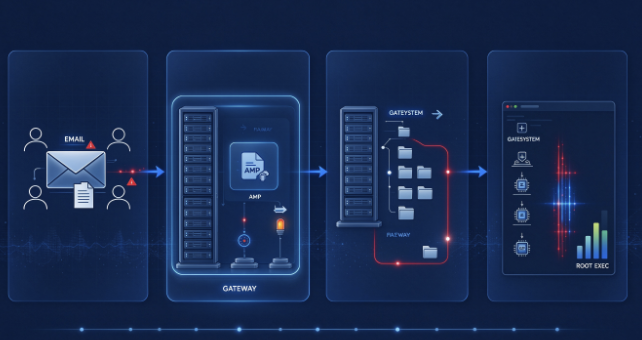
The exploitation scenario begins when a threat actor constructs an email containing an attachment designed to trigger the vulnerable processing behavior. The attacker then sends the message through a Cisco Secure Email Gateway appliance that meets the vulnerable configuration requirements.
When the message reaches the gateway, its attachment may be evaluated by the AMP File Reputation functionality. Under vulnerable conditions, improper attachment handling can lead to an arbitrary file write on the underlying operating system.
That filesystem access may subsequently allow command execution with root privileges. At this point, the security impact extends beyond manipulating a single email or bypassing a spam filter. The attacker may gain control over the appliance itself.
The broad sequence can be represented as follows:
Attacker-controlled email
Contains a specially crafted attachment
Cisco Secure Email Gateway
AMP File Reputation processes attachment data
Relative path traversal
Improper handling permits unintended filesystem writes
Arbitrary file write and root command execution
Potential system-level compromise of the email security appliance
Conceptual exploitation path based on Cisco’s disclosed vulnerability impact, not a verified exploit trace.
An important characteristic of this attack is that user interaction is not required. The attacker’s intended target is the gateway’s automated attachment-processing functionality, rather than an employee who must open a malicious attachment or click a phishing link.
This difference also changes defensive priorities. Employee security awareness programs and endpoint email protections can help with many phishing and malware campaigns, but they do not directly resolve a vulnerability inside the security gateway responsible for processing the message.
Why a Cisco Email Security Gateway Compromise Is Especially Dangerous
Cisco Secure Email Gateway commonly occupies a sensitive position in enterprise infrastructure. It processes mail traffic, enforces security policies, interacts with directory or authentication services, and may communicate with internal management and monitoring systems.
Compromising the gateway can therefore create risks beyond the immediate vulnerability.
One possible consequence is exposure of email-related data. Depending on the organization’s configuration and the attacker’s level of access, a compromised appliance may contain message-processing information, operational logs, quarantined content, and other sensitive artifacts. Root-level access could potentially expose information that ordinary users or external systems should never be able to retrieve.
A second concern involves the integrity of email security controls. An attacker who controls a trusted inspection appliance may attempt to modify configuration, interfere with security processing, or manipulate evidence of malicious activity. The precise ability to do so depends on the system and has not been publicly established as an observed post-exploitation action for CVE-2026-76519.
A third risk is lateral movement. Email security appliances often exist within carefully controlled network segments, but they may still communicate with management infrastructure, monitoring services, authentication systems, and other internal components. If an attacker obtains credentials or cryptographic material from a compromised gateway, those assets may become useful in attempts to access additional systems.
Cisco specifically warns about this possibility in clustered deployments. SSH key pairs used for communication between cluster members may be accessible following successful exploitation. Stolen private keys could potentially facilitate compromise of other cluster members, which is why Cisco recommends restoring every member of a cluster containing a compromised appliance.
Finally, root access creates a serious forensic challenge. An attacker with extensive operating-system privileges may be able to remove files, modify logs, and conceal traces of the original intrusion. This means that the absence of an obvious malware alert cannot automatically establish that an appliance remains trustworthy.
Cisco explicitly recommends reviewing independent network and firewall telemetry when investigating a potentially compromised Secure Email Gateway. These external sources may contain evidence that an attacker could not easily manipulate from within the appliance.
Is CVE-2026-76519 Being Actively Exploited?
Yes. Active exploitation is confirmed by Cisco and reflected in CISA’s Known Exploited Vulnerabilities catalog.
In the October 14 advisory, Cisco PSIRT stated that it became aware of exploitation during October 2026. The disclosure did not identify the attackers responsible, provide a detailed intrusion timeline, or establish how many organizations had been compromised.
The distinction between confirmed exploitation and incomplete attribution is important. It is reasonable to characterize CVE-2026-76519 as an actively exploited vulnerability. It would not be reasonable to assign the attacks to a particular nation-state group, ransomware operation, or previously documented campaign without additional evidence.
إن Canadian Centre for Cyber Security independently confirmed the October 14 addition to CISA’s KEV catalog and advised organizations to review the relevant Cisco updates.
Why the CISA KEV Listing Matters
CISA’s KEV catalog is designed to identify vulnerabilities for which credible evidence of exploitation exists. Inclusion in the catalog distinguishes a known exploited security weakness from one whose exploitation has only been predicted through severity scoring or proof-of-concept analysis.
CVE-2026-76519 entered the catalog on the same date Cisco published its advisory. This makes the vulnerability an immediate concern for organizations operating affected systems.
The catalog’s remediation entry identifies October 17, 2026, as the applicable due date for the relevant federal remediation requirement under CISA’s updated vulnerability prioritization guidance. That deadline should not be interpreted as permission for other organizations to delay remediation until then. Enterprises with affected gateways should prioritize the issue based on their actual exposure and potential business impact.
The official catalog is available through CISA’s Known Exploited Vulnerabilities resource.
As of October 15, public information establishes exploitation but provides limited detail about the tactics used after initial compromise. Security teams should therefore distinguish between Cisco-confirmed vulnerability behavior and hypothetical follow-on attacks.
Which Cisco Products and Versions Are Affected?
Not every Cisco email security installation has the same exposure to CVE-2026-76519.
According to Cisco, the vulnerability affects physical and virtual Cisco Secure Email Gateway appliances running vulnerable AsyncOS software when two conditions are simultaneously present.
First, the AMP File Reputation service must be enabled and assigned to a mail policy. Second, the installed Content Scanner Tools version must be earlier than 25.3.0.5525.
Both conditions are significant. An appliance running an older AsyncOS branch may already have received a fixed Content Scanner Tools package through its update mechanism. Conversely, a gateway that has not received the required component update may remain exposed even if its administrators believe routine maintenance has been performed.
This distinction makes component-level verification essential.
Cisco Secure Email Gateway Fixed Versions
Cisco provides the following software remediation targets in its October 14 advisory.
| Cisco AsyncOS release | First fixed release or required action |
|---|---|
| 15.5 | 15.5.5-014 |
| 16.0 | Migrate to a fixed release |
| 16.5 | 16.5.0-780 |
| Content Scanner Tools | 25.3.0.5525 or later |
Cisco recommends that customers running AsyncOS releases earlier than 16.5 migrate to version 16.5.0-780. It also confirms that the updated Content Scanner Tools package containing the fix is distributed across licensed and supported releases.
Organizations should follow the exact Cisco fixed-software guidance when selecting an upgrade path.
Cisco has also confirmed that Secure Email and Web Manager and Secure Web Appliance are not affected by this particular vulnerability. This distinction should not be confused with other vulnerabilities disclosed across Cisco’s email security product portfolio, some of which have different product scopes.
For Cisco Secure Email Cloud Gateway customers, Cisco states that it has already deployed a fixed Content Scanner Tools package through its managed update processes. No additional customer action is required specifically to deploy that package, although customers contacted about possible compromise should follow Cisco’s incident recovery guidance.
How to Check Whether Your Cisco Secure Email Gateway Is Vulnerable
Because CVE-2026-76519 involves both software state and service configuration, an accurate exposure assessment requires more than checking an appliance’s nominal AsyncOS release.
The first step is to inspect the File Reputation configuration. Sign in to the Cisco Secure Email Gateway web-based management interface and navigate to either Mail Policies > Incoming Mail Policies > Advanced Malware Protection أو Mail Policies > Outgoing Mail Policies > Advanced Malware Protection.
Select the relevant mail policy and inspect the Enable File Reputation checkbox. If the feature is enabled, the appliance meets one of the conditions specified by Cisco. Administrators should review all relevant policies rather than assuming one configuration applies globally.
The next step is to verify the actual Content Scanner Tools version.
Cisco provides the following command for this purpose:
contentscannerstatusA sample output for an outdated installation resembles the example included in Cisco’s advisory:
Component              Version
Content Scanner Tools  25.2.0.5427.15.5.001
This example is vulnerable because its Content Scanner Tools version predates the fixed 25.3.0.5525 release.
Administrators should compare the installed version against the threshold and confirm whether the updated package has been applied successfully.
An important operational detail is that Content Scanner Tools updates do not require a complete AsyncOS upgrade or an appliance restart. That provides an additional remediation path for supported deployments where a full operating-system migration would require a longer maintenance process.
However, the ability to update the component without restarting the device should not cause teams to overlook potentially malicious activity that occurred before the update.
How to Detect Possible Exploitation of CVE-2026-76519
Cisco has published a specific log-based method for investigating indicators associated with this vulnerability. Administrators can search the appliance’s system logs for security-related diagnostic messages.
The recommended command is:
grep "System Security" system_logsThe command should be executed through the supported Cisco appliance CLI. In clustered environments, each cluster member must be investigated separately.
Cisco identifies three relevant diagnostic results.
| System log message | Interpretation and response |
|---|---|
System Security: Suspected compromise indicator was found. | Potential compromise detected; follow Cisco incident-response guidance and contact TAC |
System Security: Security scan did not complete. | The security scan was incomplete; contact Cisco TAC |
System Security: No compromise indicator was found. | The scan found no compromise indicator; install fixed software if applicable and continue assessing risk |
These diagnostic messages are particularly useful because they provide appliance-specific guidance from Cisco rather than relying solely on generic intrusion detection signatures.
However, they also have important limitations.
The detection procedure is not equivalent to a guarantee that an attacker never accessed the system. Cisco warns that successful exploitation may provide sufficient privileges for attackers to hide or remove evidence. A negative scan result should therefore be interpreted in conjunction with the appliance’s update history, external network records, known exposure windows, and any other available incident evidence.
Investigating External Network Activity
When an appliance is suspected of being compromised, investigators should review logs collected by infrastructure outside the affected system. Network firewalls, proxies, DNS resolvers, SIEM platforms, and traffic-monitoring systems can provide independent records.
Of particular interest are unexpected outbound connections originating from the gateway. An email security appliance has legitimate reasons to communicate with external systems, including mail exchange, update services, and security intelligence infrastructure. The objective is therefore not to classify every external connection as suspicious, but to identify behavior inconsistent with the appliance’s documented operational baseline.
For example, an unexpected connection to an unfamiliar external host immediately after suspicious attachment-processing activity could warrant investigation. Unusual outbound data transfers, connections to newly observed destinations, or downloads from infrastructure unrelated to authorized services may also justify further analysis.
In its advisory, Cisco specifically encourages administrators to examine external network and firewall records for unexpected uploads from the affected appliance and downloads from malicious IP addresses.
Investigators can improve the quality of this analysis by correlating network activity with message-processing timestamps, configuration changes, and administrator activity. If centralized logs were collected before the suspected compromise, those records may preserve information that is no longer available locally.
Why Published Indicators Should Not Be Confused With a Complete Detection Strategy
As of October 15, 2026, Cisco has not publicly attributed the exploitation campaign for CVE-2026-76519 to a specific threat actor or published a comprehensive list of malicious IP addresses, payload hashes, and attacker-controlled domains for this vulnerability.
That does not mean defensive investigation is impossible. Instead, it places greater importance on vendor diagnostic messages, asset configuration verification, and behavioral evidence.
Security teams should also avoid importing indicators from unrelated Cisco vulnerabilities without confirming that they apply to the incident being investigated. In particular, detection signatures associated with older Cisco Secure Email Gateway attacks should not automatically be treated as indicators of CVE-2026-76519 exploitation.
For a complete explanation of Cisco’s current detection procedure, consult the Indicators of Compromise section of the official advisory.
How to Patch CVE-2026-76519
Cisco has released fixes for CVE-2026-76519, and there are no vendor-supported workarounds that fully address the vulnerability. Affected organizations should apply the available updates as a priority.
The appropriate remediation depends on whether the appliance shows signs of compromise and whether the organization is using a physical, virtual, or cloud-managed deployment.
Updating Content Scanner Tools
For licensed and supported installations, Cisco distributes the fix through the Content Scanner Tools component. Organizations that have enabled automatic updates should verify that version 25.3.0.5525 or later has actually been installed.
Where automatic updates have been disabled, administrators can request a manual update using the Cisco CLI command:
contentscannerupdateThe appliance then checks for available Content Scanner Tools updates.
After the update is complete, administrators should run contentscannerstatus again to verify that the installed component meets the fixed-version requirement.
This verification matters because issuing an update command is not the same as proving that the correct package was successfully installed. An interrupted update process, connectivity problem, or configuration issue may leave an appliance on an older version.
Organizations that rely on automatic updates should also confirm that the update infrastructure is functioning as expected.
The management interface provides a configuration path under Security Services > Service Updates, where administrators can enable automatic updates, submit the change, and commit the updated configuration.
Upgrading Cisco AsyncOS
Cisco also supplies fixed AsyncOS releases, including 15.5.5-014 and 16.5.0-780. Administrators operating older releases should evaluate migration to 16.5.0-780, following Cisco’s compatibility and support guidance.
A full AsyncOS upgrade should be planned with normal change-management controls, including compatibility validation, configuration review, operational coordination, and post-upgrade testing.
Email security infrastructure is often involved in critical business communications. An improperly scheduled upgrade can interrupt mail delivery or create temporary gaps in security coverage. At the same time, the operational impact of patching must be balanced against the risk of an actively exploited vulnerability that can result in root-level compromise.
For many organizations, a verified Content Scanner Tools update can provide a faster path to eliminating exposure while the broader AsyncOS migration is prepared.
Does Disabling File Reputation Fix the Vulnerability?
Disabling the feature involved in a vulnerability may appear to reduce exposure because it removes one of the documented preconditions. However, Cisco explicitly states that no workarounds address CVE-2026-76519.
Disabling File Reputation should therefore not be presented as a vendor-approved substitute for installing the fixed component or software release. Doing so also removes a malware inspection capability that may be important to the organization’s email security posture.
The appropriate response is to deploy the supported fix and verify the resulting software state. Any emergency configuration change should be evaluated separately, documented, and reviewed against Cisco’s current guidance.
What If the Cisco Secure Email Gateway Has Already Been Compromised?
Patching and incident recovery are different security operations.
Installing a fixed software package addresses the vulnerability that made exploitation possible. It does not necessarily remove malicious modifications, stolen credentials, or persistence mechanisms that may already exist on a compromised system.
This distinction is particularly important for CVE-2026-76519 because successful exploitation may grant attackers root-level privileges.
If an attacker has obtained this level of control, investigators cannot safely assume that every file, credential, or local log remains trustworthy.
Cisco provides different recovery recommendations depending on the deployment model.
Physical Appliances
For physical Cisco Secure Email Gateway devices where exploitation is suspected, Cisco recommends contacting the Technical Assistance Center for assistance. The support process can help determine the appropriate investigation and recovery procedures for the affected appliance.
Administrators should preserve relevant evidence according to their incident-response policies and coordinate any investigative access with Cisco and their internal security teams.
Virtual Appliances
For compromised virtual appliances, Cisco recommends preserving forensic information before performing destructive maintenance operations. The vendor explicitly warns that upgrading a compromised instance can destroy forensic data and logs.
Once the necessary evidence has been collected, the recommended recovery procedure involves deploying a new virtual machine with a fixed software release and rebuilding the configuration without importing previous configuration files.
Credentials and cryptographic materials installed on the compromised appliance should be renewed. The replacement system should then be monitored for anomalous behavior.
Rebuilding from a trusted software image is important because it avoids relying on potentially modified files from the compromised installation. Similarly, reconstructing the configuration rather than importing an untrusted copy reduces the risk of carrying malicious changes into the replacement environment.
Cisco also recommends restoring each member of a cluster when at least one member has been compromised, because shared SSH authentication material may have been exposed.
The full recovery instructions are documented in Cisco’s official response recommendations.
How CVE-2026-76519 Compares With Other Recent Cisco Email Security Vulnerabilities
CVE-2026-76519 is not the first critical issue to affect Cisco’s email security infrastructure in recent months. Its disclosure follows other severe vulnerabilities involving Cisco AsyncOS and the processing of untrusted email content.
In September 2026, Cisco disclosed CVE-2026-76461, a critical SQL injection vulnerability in the email parsing functionality of Cisco Secure Email Gateway. That vulnerability also received a CVSS score of 9.8 and could allow an unauthenticated remote attacker to execute arbitrary commands with root privileges.
Although the two vulnerabilities have similar potential consequences, their technical causes are different.
CVE-2026-76461 involves insufficient validation of email content that can lead to malicious SQL statement execution. CVE-2026-76519 involves improper attachment handling and relative path traversal within AMP File Reputation processing.
This difference affects how administrators determine exposure and how investigators search for evidence. A detection pattern designed to identify suspicious SQL statements in email logs is not a substitute for the system-security diagnostic procedure Cisco published for CVE-2026-76519.
The vendor’s CVE-2026-76461 advisory provides the technical distinction.
The broader history also includes CVE-2025-20393, a critical Cisco AsyncOS vulnerability associated with attacks against Secure Email Gateway and Secure Email and Web Manager. That earlier campaign involved root-level execution and a documented persistence threat, illustrating why compromised email security appliances require more than a routine patching response.
For background on those earlier incidents, see cve-2025-2025-20393: يوم سيسكو AsyncOS Zero-Day الذي يحول أجهزة أمن البريد الإلكتروني إلى رؤوس شاطئية على مستوى الجذر.
These incidents should not be treated as one continuous attack campaign without supporting evidence. However, collectively they highlight a recurring security challenge: email security appliances must process high volumes of untrusted data while operating with privileges and network access that make their compromise potentially consequential.
Why Traditional Vulnerability Scanning May Miss This Exposure
One challenge presented by CVE-2026-76519 is that vulnerability assessment cannot rely entirely on checking an exposed network port or identifying the main operating-system version.
The relevant exposure depends on an internal service configuration and the installed version of a specific scanning component.
A conventional network vulnerability scanner may correctly identify a device as Cisco Secure Email Gateway and discover its AsyncOS version, but that information alone may not establish whether File Reputation is enabled or whether the fixed Content Scanner Tools package has been installed.
Similarly, an appliance that appears to be running an older AsyncOS release may have received the patched scanner component through Cisco’s update mechanism.
This creates an opportunity for both false positives and false negatives in vulnerability-management workflows.
A more accurate assessment combines asset identification, authenticated configuration inspection, component-version verification, and evidence from the official vendor advisory. When possible, security teams should automate these checks across their appliance inventory and retain the results for auditing.
For organizations operating multiple gateways, the real task is to produce a reliable answer to a concrete question: which appliances are still running vulnerable scanner components with the affected feature enabled?
The answer should be based on verified data from the devices themselves, rather than assumptions derived from asset names or historical inventory records.
Where AI-Assisted Security Workflows Can Help
AI-assisted security workflows can help organize and interpret the evidence needed for vulnerability response, particularly when infrastructure includes different appliance versions, clusters, and management environments.
A practical use case is correlating an authoritative vulnerability advisory with an organization’s existing asset inventory, configuration records, and validated scanner results. Security teams can use automation to identify devices requiring additional investigation, generate remediation tasks, and summarize which systems have successfully received updates.
منصات مثل بنليجنت focus on AI-assisted penetration testing and vulnerability validation. In the context of a critical appliance vulnerability, the useful role of automation is to improve exposure visibility, organize authorized validation, and document remediation evidence.
However, AI-based testing should not be treated as a replacement for Cisco’s component-level version checks or a reliable method of excluding historical compromise. Any automated assessment should clearly distinguish confirmed vulnerability evidence from inferred risk, and potentially disruptive exploit testing should be confined to explicitly authorized environments.
For CVE-2026-76519, non-exploitative verification of installed component versions and mail-policy configuration provides a safer and more authoritative starting point than attempting to reproduce root-level command execution on production appliances.

A Practical Incident-Response Strategy for Enterprises
The most effective response to CVE-2026-76519 combines emergency patch management with targeted compromise assessment.
Security operations teams should begin by identifying all physical, virtual, and managed Cisco Secure Email Gateway deployments. The inventory should include clustered appliances, backup systems, and devices managed by regional IT teams or external service providers.
Once the inventory is established, administrators should inspect the AMP File Reputation configuration and the installed Content Scanner Tools version. Devices meeting both vulnerability conditions should receive immediate remediation priority.
At the same time, security teams should collect and review the Cisco-recommended system-security logs and determine whether independent network telemetry indicates suspicious appliance behavior. Reviewing compromise indicators before disruptive upgrades is especially important when there is reason to suspect an active intrusion.
The organization should then apply the correct remediation. For systems without suspected compromise, installing the fixed Content Scanner Tools package or migrating to a patched AsyncOS release is the central technical action. For systems with suspected compromise, incident-response procedures and Cisco’s recovery recommendations take precedence over ordinary patch management.
After remediation, administrators should verify the installed component version, confirm the intended mail policies remain functional, and monitor the system for unexpected behavior.
A successful response should produce evidence that the environment was checked and remediated. This can include configuration records, installed version information, log-review results, change approvals, and relevant incident-response documentation.
The operational objective is not simply to close a vulnerability ticket. It is to establish that affected assets are no longer vulnerable and that any potential compromise has been addressed appropriately.
Frequently Asked Questions About CVE-2026-76519
Is CVE-2026-76519 a zero-day vulnerability?
CVE-2026-76519 is being described as an actively exploited zero-day in security reporting because Cisco confirmed exploitation in October 2026 while publicly disclosing and patching the vulnerability on October 14. Cisco has not published a precise first-exploitation date, so the exact length of any pre-disclosure exploitation period remains unknown. The confirmed fact is that exploitation is occurring in the wild.
Can CVE-2026-76519 be exploited without authentication?
Yes. Cisco’s CVSS vector specifies that no privileges are required, and the vulnerability involves the processing of crafted email attachments rather than an authenticated administrative operation. An affected gateway can therefore be exposed through its normal email-processing workflow.
Does an employee need to open a malicious email attachment?
No. The published vulnerability involves Cisco Secure Email Gateway’s processing of an attachment. The attacker does not need to persuade an employee to open the attachment to trigger the vulnerable gateway-side functionality.
Does CVE-2026-76519 allow remote code execution?
Cisco confirms that successful exploitation may allow an attacker to write arbitrary files and execute commands with root privileges on the underlying operating system. Although the weakness is classified as relative path traversal, its potential impact includes remote command execution.
Is Cisco Secure Email and Web Manager affected?
No. Cisco explicitly lists Secure Email and Web Manager and Secure Web Appliance as products not affected by CVE-2026-76519. This conclusion applies to this specific vulnerability and does not imply that the products are unaffected by other Cisco security advisories.
Which version fixes CVE-2026-76519?
Content Scanner Tools version 25.3.0.5525 and later contain the fix. Cisco also identifies AsyncOS 15.5.5-014 and 16.5.0-780 as fixed releases, while customers on AsyncOS 16.0 are instructed to migrate to a fixed release. Cisco recommends migrating older deployments to 16.5.0-780.
Is a restart required to patch the vulnerable scanner component?
No. Cisco states that updating Content Scanner Tools does not require a full software upgrade or product restart. However, a complete AsyncOS version upgrade is a separate maintenance operation and may involve a reboot.
Are there any workarounds if immediate patching is impossible?
Cisco states that there are no workarounds that address this vulnerability. Organizations should coordinate deployment of the fixed component or software release as quickly as possible and use additional monitoring and network hardening to reduce broader operational risk.
Can a device be considered safe if no indicators of compromise are found?
A negative result from Cisco’s diagnostic scan is useful, but it is not an absolute guarantee that a system has never been compromised. Attackers with root privileges may be capable of concealing evidence. Administrators should consider external telemetry, the device’s exposure history, and other incident information when determining whether further investigation is necessary.
الأفكار النهائية
CVE-2026-76519 illustrates a serious security failure mode in modern enterprise infrastructure: a system designed to inspect malicious content can itself become the target of exploitation through that content.
The vulnerability combines several characteristics that make it particularly urgent. It can be triggered remotely without authentication or user interaction, affects a privileged security-processing component, allows arbitrary file writes that may lead to root command execution, and is already being exploited.
The available fixes provide a direct path to reducing exposure, but organizations must verify the specific conditions that determine whether their appliances are vulnerable. Checking only the main AsyncOS version is not sufficient when an independently updated Content Scanner Tools package may determine the appliance’s actual security state.
For enterprises using Cisco Secure Email Gateway, the immediate priorities are to verify File Reputation configuration, confirm that Content Scanner Tools has been updated to version 25.3.0.5525 or later, review available compromise indicators, and preserve forensic evidence wherever exploitation is suspected.
The larger lesson extends beyond this individual CVE. Security gateways occupy a critical position between untrusted external traffic and trusted enterprise infrastructure. When those gateways are compromised, both the security boundary and the organization’s ability to observe malicious activity can be undermined.
Maintaining accurate software inventories, validating the status of embedded security components, collecting independent telemetry, and preparing trusted recovery procedures are therefore essential elements of defending modern email infrastructure.
For the most authoritative and up-to-date technical guidance, refer directly to the Cisco Security Advisory for CVE-2026-76519فإن CISA Known Exploited Vulnerabilities catalogو Canadian Centre for Cyber Security advisory AV26-1042.
As exploitation continues to be investigated, additional threat intelligence may clarify the attack techniques, targeted environments, and post-compromise behavior associated with this vulnerability. Until those details are established, Cisco’s documented exposure conditions, diagnostic procedures, and fixed releases provide the strongest available foundation for defensive action.


 Arabic
  English
  German
  French
  Spanish
  Portuguese
  Japanese
  Korean
  Hindi
Hindi  Turkish
  Hebrew