
CVE-2026-56857 is a Windows directory-creation escape in Go’s os.Root APIs. The important detail is the position of a junction: the reported failure occurs when the junction is the final component passed to Root.Mkdir أو Root.MkdirAll. A test that puts another component after the junction does not exercise the same case. That distinction can decide whether a regression test is meaningful or merely looks relevant.
إن official Go vulnerability report GO-2026-6604 identifies fixes in Go 1.26.9 and Go 1.27.2. It describes directory creation at a junction’s empty target location outside the intended root. This is a specific filesystem boundary failure, not evidence that every Go application exposes unauthenticated remote code execution. Review the Windows application and the path to the affected operation before assigning application impact.

A local-looking name can resolve outside the root
A filename does not need .. to cross a filesystem boundary. Microsoft documents junctions as directory references implemented through reparse points. A directory entry inside an allowed tree can therefore refer to a different directory location. Validating only the characters in a path does not tell you where the filesystem operation will land.
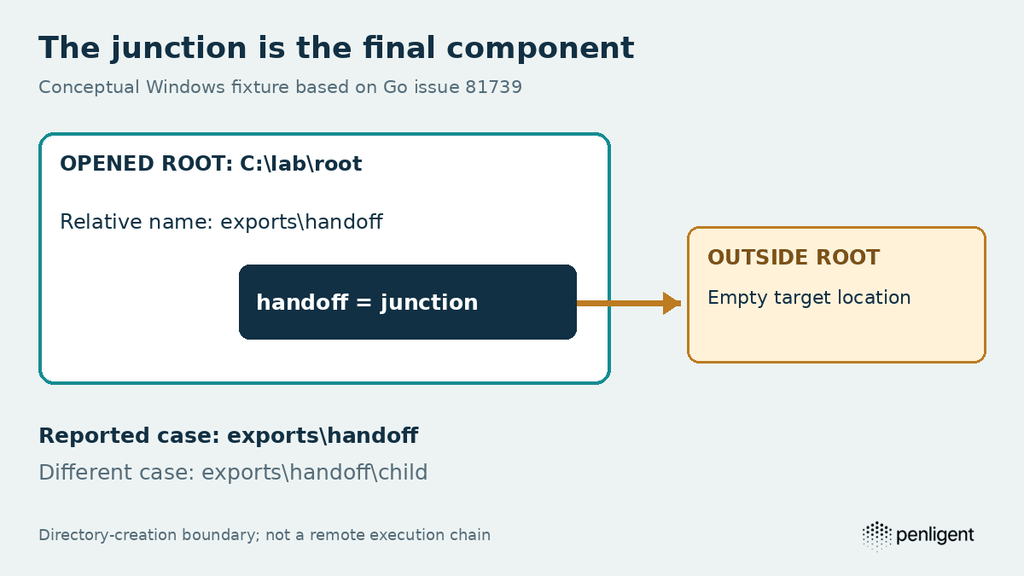
Consider an illustrative Windows workspace rooted at C:\lab\root. Within it, exports\handoff is a junction referring to a location under C:\lab\outside. The string exports\handoff is relative and contains no parent-directory traversal. The security question is whether the operation respects the opened root when it encounters that junction. Both locations in this example are disposable lab paths; they are not an observed deployment.
إن Go team’s issue 81739 narrows the vulnerable shape to a final junction component and says the corrected methods avoid resolving junctions. It explicitly distinguishes that shape from a path that continues below the junction. Preserve this condition in an application review: “uses junctions somewhere” is too broad, while “rejects filenames containing dot-dot” is too weak.
| Operation shape | Why it belongs in the review |
|---|---|
| Windows Root.Mkdir with a final junction | Matches the operation and final-component condition in the report. |
| Windows Root.MkdirAll with a final junction | Exercises the second named method under that condition. |
| A path that continues below the junction | A separate control; upstream explicitly distinguishes it. |
| An ordinary directory created within the root | A positive control that checks intended functionality still works. |
| The same test only on Linux | Cannot establish the Windows junction behavior. |
Review the filesystem influence, not just the request parameter
إن Go team’s explanation of traversal-resistant APIs separates filename sanitization from protection against changes or links in the filesystem. It also explains why resolving links and checking a path before a later operation can introduce a time-of-check/time-of-use race. Replacing an affected Root call with a hand-written “resolve, check, then create” sequence is not an equivalent security fix.
For your application, trace who can influence both the supplied name and the directory tree. A developer-controlled workspace, an imported archive, a plugin directory and a service-owned empty tree have different trust relationships. These are review scenarios, not claims that a particular archive format or product is affected. Ask which component can introduce or preserve a junction and which component later invokes directory creation with greater filesystem access.
That review also limits the impact claim. Creation of a directory outside the intended root does not by itself demonstrate arbitrary file contents, command execution or privilege escalation. Each additional effect needs an application-specific step. A useful assessment names the directory operation and the authority of the process performing it, rather than turning a filesystem primitive into a complete attack chain without evidence.
Check the Windows artifact you actually ship
إن Go release history dates the relevant security releases to October 8, 2026. Go 1.26.9 and 1.27.2 are the first fixes for this issue in those release lines; later supported patch releases should be considered when updating today. A developer installing a newer toolchain has not, by that action alone, replaced a previously distributed executable.
إن go version command documentation distinguishes reporting the current tool from inspecting named binaries. On a Windows development or release machine, these commands inspect the selected toolchain and a local executable you own. Replace the example executable path with the artifact under review.
go version
go env GOOS GOARCH GOTOOLCHAIN
go version -m .\owned-service.exe
Keep the executable’s identity with its build information. If the artifact was built elsewhere, your workstation’s go version is not its provenance. If metadata is unavailable, record that gap and use the release pipeline’s build record. Do not substitute a guessed version from a repository’s current default branch for the version used to create an older download.
Govulncheck’s documentation explains that source analysis uses a specific build configuration, while binary analysis uses the configuration embedded in the binary. Run the source check in the intended Windows build context, with the application’s normal build tags. A source result produced for a different operating system cannot settle a Windows-specific code path.
# Run from your owned module in the intended Windows build context.
govulncheck ./...

# Inspect the executable selected for distribution.
govulncheck -mode binary .\owned-service.exe
These are documented analysis commands, not captured scan output from this article. No Go toolchain or Windows runner was available for execution here. Binary-mode reports also lack the source call stacks that can help explain reachability. Use the report to focus code review, then examine whether the final-junction directory-creation scenario is possible in your application.
A regression test needs an outside-state assertion
For an isolated Windows test, create a disposable parent containing both the intended root and the outside target location. Keep the entire fixture under that parent. Exercise the two named methods separately, reset the fixture between cases, and inspect the outside location after each operation. A return value alone is not the security property: an operation must not create the prohibited directory even if it also reports an error.
Regression specification — not an executed result

Given: a disposable Windows fixture
       an opened root, and a final junction to an empty outside location
For:   Root.Mkdir and Root.MkdirAll, in separate fresh fixtures
Check: no directory was created at the outside target
Also:  ordinary in-root directory creation still works
Record: toolchain, fixture setup, returned error, and filesystem state
Include a setup failure as a distinct outcome. If the test could not create or verify the junction, it did not test the boundary. A skip caused by the runner’s filesystem or permissions must remain visible in CI. Similarly, testing only an already-existing target or only a descendant below the junction can miss the reported condition. Match the upstream case before interpreting a green build.
This is a proposed regression design, not a claim that we reproduced the CVE. It is deliberately narrower than an exploit demo: no network service, privileged directory, persistence or system file is required to evaluate the directory-creation boundary. Review the upstream issue and your fixture against the behavior of the Windows filesystem you actually support.
Update the build and keep the boundary test
Rebuild affected Windows applications with a supported patched Go release, check the resulting artifact, and replace the deployed or downloadable executable through your normal release process. Keep the final-junction test alongside the ordinary in-root control. That combination checks both the specific security boundary and the functionality the API exists to provide.


 Arabic
 English
 German
 French
 Spanish
 Portuguese
 Japanese
 Korean
 Hindi
 Turkish
 Hebrew