
AI pentesting cost depends first on what you are buying: software your team operates, a metered autonomous assessment, or a service with accountable human delivery. A monthly subscription, a credit balance, and a per-assessment quote are different commercial units. Comparing their headline prices without normalizing scope can produce a budget that looks inexpensive but does not cover the work the buyer actually needs.
As checked on October 19, 2026, Penligent’s pricing page displays Pro at $39.92 per month billed annually with 6,000 monthly credits. That annualized software commitment is $479.04 before applicable taxes or other charges. In a different delivery category, Stingrai’s published pricing displays a $3,000 autonomous assessment and a $6,800 hybrid assessment for one web application and its associated APIs. Those examples demonstrate the difference between buying product access and buying a defined assessment; they do not establish equivalent scope or a universal market price.
Ask instead: what will it cost to complete an agreed scope, obtain findings a reviewer can reproduce, and verify the fixes? This guide provides a transparent budgeting method, an offline calculator, and a pilot acceptance process. Its numerical scenarios are explicitly hypothetical. They are not vendor quotes, measured benchmarks, or promised savings.
AI pentesting pricing at a glance
Start by identifying the commercial model in the offer. The word “AI” does not tell you who configures access, reviews evidence, handles ambiguous results, or signs off the deliverable. Those responsibilities often explain more of the practical difference than the model selected behind the interface.
| Buying model | Typical billing unit | Buyer must establish | Main budgeting trap |
|---|---|---|---|
| Self-operated subscription | Seat, month, or year | Included usage, scope, operator duties | Treating the license as a complete service |
| Credit-based platform | Included credits plus top-ups | Debit rules and representative consumption | Converting credits to guaranteed targets |
| Bring-your-own-model workflow | Software plus model-provider usage | Who pays for tokens, tools, and infrastructure | Counting the same expense twice |
| Autonomous assessment service | Defined application or engagement | Scope limits, validation, and retest terms | Assuming every application has the same complexity |
| Hybrid engagement | Assessment plus human delivery | Review depth, responsibilities, acceptance | Comparing it with unattended software access |
| Private deployment | Contract, capacity, or license | Hosting, inference, support, operations | Assuming local deployment eliminates operating cost |
Use the table to select comparable offers, not to rank the categories universally. A consultancy with experienced operators may value reusable software. A startup facing a customer deadline may need an externally delivered assessment. An enterprise with strict data boundaries may need a deployment review before price comparisons are meaningful.
A low subscription price can be commercially attractive without replacing every obligation in a professional engagement. Equally, an expensive assessment can be poor value if its scope excludes the buyer’s important authenticated flows. The right comparison holds the required outcome constant and exposes the responsibilities attached to each option.
Before requesting quotes, write one sentence describing the outcome. For example: “Review the staging SaaS application across two customer tenants and three roles, deliver reproducible findings, and perform one verification cycle after fixes.” This sentence will still need detail, but it is a better foundation than asking three suppliers for “an AI pentest.”
What is included in the subscription price?
A subscription usually grants access to a product under defined terms. It may include a usage allowance, features, support, and reporting. It does not automatically include a dedicated consultant, independent review, target preparation, or unrestricted use of external model services. Read the offer rather than infer the bundle from the product category.
Penligent’s public page lists usage-based limits and describes Team collaboration and Enterprise private deployment as separate commercial tiers. Team and Enterprise direct buyers to sales rather than publishing a fixed price. The same page provides approximate target illustrations alongside credit selections; those illustrations should not be converted into a guarantee for an application with unknown authentication, depth, or retesting requirements. The figures above are a dated snapshot, and the live terms govern a purchase.
Annual billing also deserves explicit treatment. A displayed monthly equivalent can describe an annual commitment rather than a month-to-month charge. Multiplying the displayed equivalent by twelve is useful arithmetic, but the checkout or contract establishes the actual charge, taxes, discounts, and renewal terms. Preserve that distinction when presenting a budget to finance.
For an existing customer, check the account-specific plan. Legacy arrangements, negotiated offers, and purchased add-ons can differ from the public page. A pricing article cannot verify a particular account’s entitlement. Use the current account or contract record as the source for that buyer’s cost model.
Ask what happens after the included allowance is exhausted. Does execution pause, continue against prepaid credits, incur overages, or require an upgrade? Is there a hard spend ceiling? The answer affects both budget predictability and whether a time-sensitive assessment can finish without an unexpected procurement step.
Define the unit of work before estimating it
“One target” is not a stable engineering unit. A public brochure site, a role-based SaaS application, and an API with several tenant boundaries can all be described as one application. Their preparation, execution, and validation requirements differ substantially. An estimate that counts only domains hides those differences.
Define the business surface in terms that a tester can use. Record application entry points, included APIs, environments, roles, tenant relationships, sensitive workflows, and explicit exclusions. Identify whether the work includes source review, infrastructure testing, or only externally accessible application behavior. Do not let a broad product label silently expand the agreed scope.
Authentication is a particularly important cost driver. A working login does not establish that the intended role has the right permissions or that seeded objects are available. Someone must prepare accounts, preserve valid sessions, and confirm the intended authorization model. When that work is missing, an automated run can spend time exploring an unrepresentative or inaccessible application.
إن OWASP API Security Top 10 guidance on object-level authorization explains why object access checks matter. In budgeting terms, an authorization review needs identities, objects, and expected permissions that make the test interpretable. Counting endpoints without that context is a weak proxy for the work.
For a pilot, choose a bounded slice that includes the difficult part of the intended use. If the purchase is meant to improve authenticated testing, a public landing-page scan is not representative. If the purchase is meant to support client delivery, the pilot needs a report and handoff, not only a successful tool run.
Build the total cost from separate layers
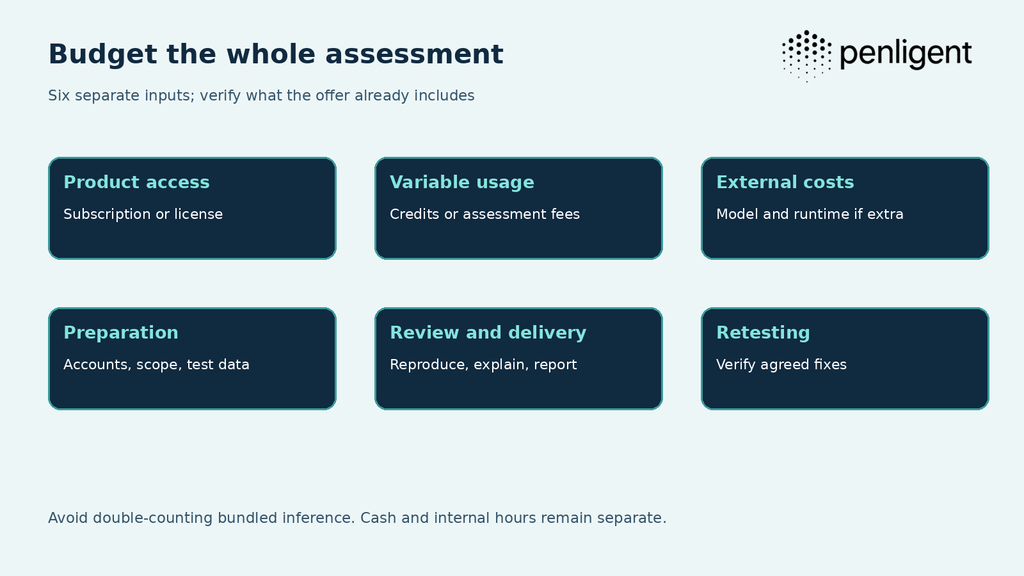
A useful budget separates recurring access, variable execution, setup, review, delivery, and retesting. Each layer should have an owner and a billing source. This makes it possible to determine which expenses are included and which are incremental instead of adding a generic “AI cost” on top of everything.
| Cost layer | Example budget input | Question for the supplier or operator |
|---|---|---|
| Product access | Subscription or seat allocation | What period and usage are included? |
| Platform usage | Credits, assessments, or overages | Which actions consume the allowance? |
| Model usage | Provider invoice when separately billed | Is inference included or paid directly? |
| Runtime | Approved worker, browser, storage, or compute | Who provisions and pays for it? |
| Preparation | Accounts, fixtures, scope, access | Who makes the target testable? |
| المراجعة | Reproduction and evidence assessment | Who decides whether a finding is valid? |
| Delivery | Report, stakeholder handoff, clarification | Which deliverables are contractual? |
| Retest | Verification after remediation | What is included and for how long? |
Keep cash spend and internal time visible as separate totals. A founder may initially care about the amount charged to a card. A security lead may also need to know how much staff time the workflow consumes. Combining both views in one unexplained figure makes it difficult to compare alternatives or understand where savings could come from.
Do not charge the full annual license to every assessment when the product supports multiple jobs during the year. Allocate the fixed cost under an explicit assumption, then retain the full annual commitment elsewhere in the budget. The allocation helps compare jobs; it does not change what the organization has committed to pay.
Likewise, do not assume planned usage will occur. A subscription divided by twenty planned assessments looks cheaper per job than the same subscription used twice. Show expected utilization and a lower-utilization case. That makes the estimate useful even when the team’s schedule changes.
Avoid double-counting model costs
Some products include model execution inside their platform charge. Other workflows require the buyer to connect a separately billed provider account. Still others use private inference infrastructure. The same run should not be charged both as an included platform cost and as an invented additional token bill.
Ask for the billing boundary before doing arithmetic. Which party receives the provider invoice? Which usage appears in the platform’s credit ledger? Are browser execution, search, storage, or other tools bundled or separately metered? If the supplier cannot explain the boundary, that uncertainty belongs in the purchase evaluation.
For separately billed inference, distinguish input, output, cache writes, cache reads, and tool-specific charges where applicable. Anthropic’s official pricing documentation publishes distinct token categories and additional pricing for some server-side tools. As one dated example, the reviewed table lists Claude Sonnet 5.5 at $2 per million base input tokens and $10 per million output tokens. Those are inference rates, not a quoted price for a penetration test.
A calculation using those rates is valid only for the stated token categories and billing mode. It should not silently apply the base rate to cached tokens or assume a partner-operated platform uses identical terms. Use actual invoice categories when estimating a real deployment, and update the rates when the provider changes them.
The model name alone is also a poor unit of comparison. Two workflows using the same model can send very different amounts of history, screenshots, tool output, and retries. The useful measurement is the usage required for the agreed test and accepted evidence, under the controls the buyer intends to use.
Credits are a meter, not a target count
A credit balance is meaningful only when its debit rules and representative consumption are understood. Credits may price execution in a way that simplifies purchasing, but a balance alone does not state how many authenticated applications can be assessed to a particular depth. Obtain the supplier’s explanation and measure a pilot.
Record the starting balance, ending balance, task scope, and outcome for each pilot run. Keep abandoned or failed branches in the measurement. Excluding them produces an artificially favorable estimate, because an ordinary buyer will still experience and pay for the workflow’s unsuccessful attempts under the applicable terms.
When comparing plans, ask whether allowance resets, rollover, expiration, refunds for technical failures, and purchased top-ups follow different rules. Do not infer those rules from another product or from an earlier subscription. They can materially change the annual cost even when the displayed monthly number is unchanged.
Use a range when pilot consumption varies. A simple estimate can show the median observed run and a more expensive observed run for the same scope. With a small sample, label the sample size and avoid statistical claims. Three runs can reveal operational problems without establishing a stable population distribution.
Keep target approximations as illustrations. If a price page shows an approximate number of targets, that may help orient a reader, but the buyer still needs to know what that illustration assumes. A role-heavy application with repeated verification cycles should not be budgeted as though it were identical to a lightweight public-site check.
An offline calculator for a transparent pilot budget
The following Python example performs local arithmetic only. It makes no network requests, executes no security tools, and sends no customer data anywhere. Its numbers are hypothetical budget inputs. The model rates match the illustrative base rates described above, while usage and labor figures are chosen solely to show the method.
from decimal import Decimal as D

def pilot_budget(
    license_allocation,
    platform_overage,
    runtime,
    input_million,
    output_million,
    input_rate,
    output_rate,
    model_billed_separately,
    preparation_hours,
    review_hours,
    retest_hours,
    hourly_internal_cost,
):
    model = (
        input_million * input_rate + output_million * output_rate
        if model_billed_separately else D('0')
    )
    cash = license_allocation + platform_overage + runtime + model
    hours = preparation_hours + review_hours + retest_hours
    internal = hours * hourly_internal_cost
    return {
        'allocated_cash_usd': cash.quantize(D('0.01')),
        'internal_hours': hours,
        'internal_cost_usd': internal.quantize(D('0.01')),
        'total_economic_cost_usd': (cash + internal).quantize(D('0.01')),
    }

example = pilot_budget(
    license_allocation=D('40'), platform_overage=D('20'),
    runtime=D('10'), input_million=D('2'), output_million=D('0.3'),
    input_rate=D('2'), output_rate=D('10'),
    model_billed_separately=True,
    preparation_hours=D('1'), review_hours=D('2'),
    retest_hours=D('1'), hourly_internal_cost=D('75'),
)
print(example)
The example produces $77 of allocated cash cost and four internal hours valued at $300, for a total economic cost of $377. These results are arithmetic, not evidence that a real assessment costs $377. A real estimate requires observed usage, the actual commercial bundle, and a scope that the team has accepted.
The license input is an allocation, not necessarily a new cash payment for that job. If finance needs incremental spend only, report the incremental amount separately. If model execution is included in the platform price, set the separate-model flag to false and remove that line from the additional cash estimate.
The function intentionally does not calculate risk reduction, breach probability, or guaranteed ROI. Those require evidence this example does not possess. It helps a buyer understand the operational bill; it cannot convert a test into a promised financial outcome.
Three hypothetical scenarios that explain the tradeoffs
A small comparison can reveal whether the expensive part is software access, execution, or review. The following scenarios are invented and use the same illustrative internal hourly cost of $75. They are not estimates of Penligent, Stingrai, or any other supplier’s actual performance.
| السيناريو | Allocated cash | Internal hours | Internal cost | Total economic cost |
|---|---|---|---|---|
| Bounded application slice | $77 | 4 | $300 | $377 |
| Same slice with preparation problems | $112 | 8 | $600 | $712 |
| More cash, less internal handling | $150 | 2 | $150 | $300 |
The third row is deliberately more expensive in cash and cheaper in the combined view. It demonstrates why optimizing only the subscription price can be misleading. It does not prove that spending more produces better results. The reduced hours would need to be observed while holding acceptance criteria constant.
The second row isolates a different problem: poor preparation. If accounts fail, fixtures are missing, or the intended role cannot reach the workflow, increasing the execution budget may not solve the underlying issue. A short preparation task can be a better next investment than another unattended run.
For a buyer without a defensible hourly cost, retain the hours and omit their dollar conversion. “$112 plus eight internal hours” is more honest than a precise-looking total based on an arbitrary rate. The comparison still exposes the operational burden and allows the organization to use its own accounting assumptions.
Never carry the scenario totals into a quotation as though they were measured. Keep a separate column for observed pilot values. This prevents a useful illustration from becoming an unsupported sales promise as the document moves from the technical team to procurement.
Scope changes that move the price
The most important variables are often hidden behind the phrase “one application.” Start with identities. Each role changes the set of permitted actions, and tenant boundaries create additional ownership relationships to test. A price based on one basic account may not cover the buyer’s administrator, billing, support, and customer roles.
Next, examine stateful workflows. An order, approval, refund, or invitation flow may require seeded data and a sequence of actions before the relevant permission check is reachable. A large endpoint list does not describe this preparation. Include the workflow’s prerequisites and expected business rule in the scope.
Environment stability matters too. A frequently changing staging environment can invalidate test data or make a reproduction difficult to compare with the original result. That does not make testing pointless. It means the buyer should coordinate a test window, record the build under review, and define how changes during the engagement will be handled.
Access restrictions can add setup work. Private networks, jump hosts, inference gateways, and tightly controlled credentials may be necessary for the customer’s requirements. Their commercial cost depends on the supplier and deployment. Ask for it explicitly rather than assuming that an ordinary public-web plan includes those arrangements.
Finally, define the evidence expected. A candidate issue list, a reproducible finding, and a human-reviewed assessment are not identical deliverables. If the buyer needs a particular report format, technical review meeting, or remediation verification, place it in the offer before comparing prices.
Compare quotations using the same acceptance criteria
A useful quote comparison begins with a common brief. Give each supplier the same target inventory, roles, tenant model, included APIs, constraints, and intended deliverables. Suppliers can propose different methods, but deviations should be visible. Otherwise, the cheapest quote may simply exclude the hardest part.
Ask each supplier to describe the test’s completion criteria. Is completion based on elapsed time, consumed credits, an enumerated scope, or an accepted deliverable? A run can stop successfully as software while leaving a business requirement unresolved. The contract should explain how incomplete access and blocked test paths are reported.
Separate validation from report generation. Producing a PDF is a formatting capability. Establishing that its findings are reproducible is a testing and review obligation. Ask what evidence accompanies a finding, who reviews it, and what happens when the customer cannot reproduce the issue.
Retesting must be comparable too. One offer might include a single verification cycle within a fixed window; another might meter each run; another might require a new engagement. Ask whether an application change that alters the proof path is included or treated as expanded scope. The answer can change the expected cost of closing the original finding.
Maintain a short unresolved-questions column. A quote that omits data handling, overages, or retest terms should not receive the same confidence as one that answers them. Uncertainty is not always a reason to reject a supplier, but it is a reason to request clarification before committing the full budget.
A report for a customer is a delivery requirement
If a sales opportunity depends on a security assessment, clarify what the customer expects before buying software. They may want a defined scope, testing dates, a named assessor, a methodology statement, remediation status, or independent review. A product’s export feature does not automatically satisfy those expectations.
Ask the receiving party for its requirements and evaluate the proposed deliverable against them. Avoid treating “audit-ready” or “compliance-aligned” as a guarantee that every auditor or customer will accept the output. The buyer should resolve those requirements with the party making the acceptance decision.
Budget the human work attached to delivery. Someone may need to remove secrets from evidence, explain the scope, distinguish unresolved findings from confirmed issues, and answer a customer’s follow-up. If the supplier provides these services, identify them in the agreement. If the buyer provides them, include the time in the internal estimate.
This is also why a subscription and an external engagement are different comparisons. A capable internal security team may use software to produce valuable evidence efficiently. A company that lacks that expertise may need additional service support. The appropriate purchase depends on the accountability required, not only on whether the report has a professional-looking cover.
For recurring customer delivery, retain reusable templates without turning them into unsupported assurance. The report should still identify the actual scope and evidence for each assessment. Reusing a layout can reduce formatting work; it cannot replace the analysis behind a customer’s particular result.
Retesting belongs in the original budget
A vulnerability finding often initiates engineering work rather than concluding it. Developers may change the application, the tester checks the corrected behavior, and the result needs to be recorded. If the budget ends when the first report is exported, the buyer can be left with findings that have no verified closure.
Define what the retest is intended to establish. It might confirm that a specific proof path no longer works under the same role and object conditions. A broader application change may require additional regression work. Do not represent one blocked request as proof that all related authorization paths are correct.
Estimate both execution and review. Even when a platform makes rerunning the earlier task easy, someone needs to confirm that credentials, fixtures, and expected behavior still make the result meaningful. A failed login should not be recorded as a successful security fix merely because the original exploit no longer completes.
Ask how many cycles are included and what starts a new charge. A retest window, a maximum number of findings, or a limit on changed functionality can affect the price. Those terms need to be understood before development schedules drift beyond the included period.
Keep the original evidence and the retest evidence connected. This reduces the time required for another reviewer to assess closure and makes it easier to see when the application has changed enough to require fresh testing. Better traceability can reduce avoidable handling without assuming that every future test will be cheap.
Design a paid pilot around the hardest requirement
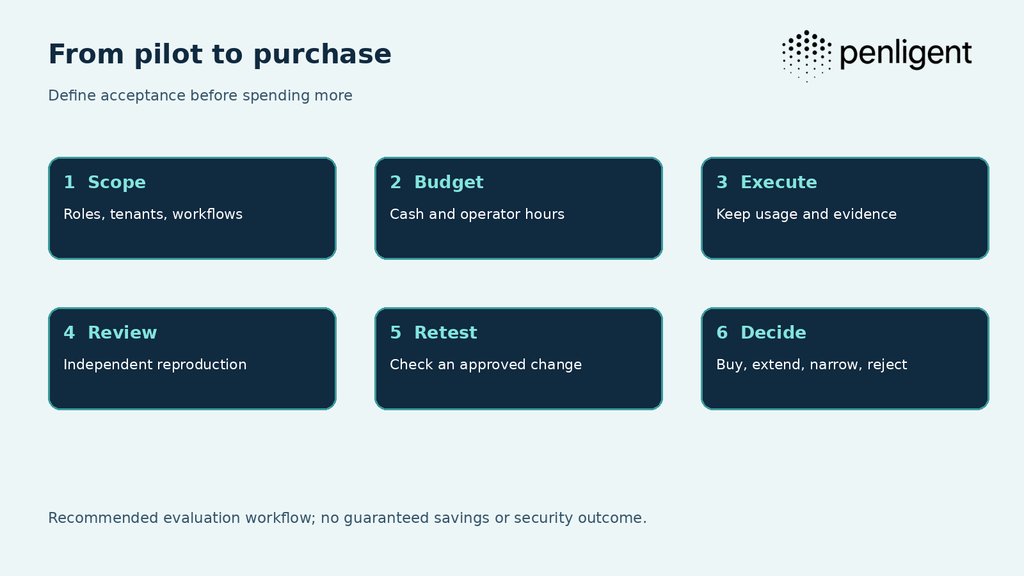
A pilot should answer whether the product can perform the buyer’s intended job under realistic constraints. Select one representative application slice and state the acceptable outcome before starting. Avoid choosing only the easiest public surface when the eventual deployment needs authenticated, multi-role testing.
Prepare a small test fixture with known permissions and synthetic data. Record the roles and object ownership states needed to interpret results. Provide the same material to each evaluated workflow where possible. A comparison in which one tool receives working accounts and another does not measures setup differences as much as product capability.
Define the budget envelope in two dimensions: cash and operator hours. A workflow that remains under a credit cap while consuming an unplanned day of senior review can still miss the purchase objective. Conversely, a workflow with a higher visible execution bill may be attractive if it demonstrably reduces handling while preserving evidence quality.
Include a final handoff. Have a reviewer who did not run the tool attempt to understand and reproduce a sample finding, or assess a documented negative test. The pilot should reveal whether evidence survives outside the originating session. That is closer to the work a customer or development team will actually receive.
Conclude with a buying decision rather than a general impression. Buy, extend the pilot to answer a named question, narrow the intended scope, or reject the fit. Each outcome can be useful if it follows from the agreed criteria. An indefinite trial with no acceptance decision is a hidden cost of its own.
Measure cost per accepted scope, not only cost per finding
Cost per validated finding can be useful, but it can also reward the wrong behavior. A healthy application may yield few findings after meaningful testing. A noisy system may generate many duplicate or low-value issues. Dividing total spend by finding count does not establish that the first workflow was worse.
Use a small set of complementary measures. Record accepted scope coverage, preparation time, execution spend, review time, evidence reproducibility, and retest effort. Keep unresolved test paths visible. These observations explain whether the tool completed the intended job even when the finding count is low.
For findings, define acceptance consistently. Count unique issues under the same deduplication rules and require evidence sufficient for the intended recipient. Do not count a candidate as validated simply because it has a severity label. If a human reviewer overturns the result, preserve that outcome in the pilot record.
Negative results deserve context. “No issue identified in the tested permission cases” is narrower than “the application is secure.” A report that documents the tested conditions and limitations can still be valuable. It should not manufacture findings to make the subscription look productive.
The purchasing question is whether the workflow improves the required testing program at an acceptable total cost. Findings contribute to that judgment, but the program also needs repeatability, responsible scope control, and evidence that developers can use. A cheaper metric is not automatically a better operational result.
Control retries without hiding incomplete work
Retries can be legitimate. A transient connection failure, a changed test fixture, or an expired session can justify another attempt. Repeatedly running the same blocked workflow without resolving the cause can consume both usage and operator attention while creating little additional evidence.
Set stop conditions before execution. Examples include repeated authentication failure, unexpected state changes, unresolved scope, or a pilot spend ceiling. These are recommended evaluation controls, not claims that a particular product exposes settings with these names. Verify the controls available in the actual platform.
When a run stops, retain its status. “Blocked by missing test account” should not disappear from the denominator when estimating completion cost. The next attempt may be successful, but the buyer still needs to understand the preparation work and usage consumed across the whole job.
Give the operator a useful escalation path. A stop condition should lead to a named action: refresh an approved account, repair a fixture, ask the application owner to clarify a business rule, or narrow the scope. A generic “try again later” response does not improve the cost model.
Budget controls also support predictable delivery. They help the team decide when a branch has consumed enough resources to require human judgment. The objective is not to minimize every tool call. It is to avoid paying repeatedly for a failure mode that the workflow has not diagnosed.
Private deployment changes where the bill appears
Private deployment can address a buyer’s data or network requirements, but it should be budgeted as an operating arrangement. The commercial scope may include software licensing, inference integration, runtime capacity, storage, support, and implementation. Some expenses may be internal rather than invoiced by the software supplier.
Separate local data storage from model processing. A workflow can store artifacts locally while sending selected prompts to an external inference provider. A genuinely isolated deployment needs an explicit account of model location, network access, update mechanisms, and support procedures. Do not infer these properties from the word “on-premise.”
Ask who maintains the environment. Someone must own deployment updates, backups of required configuration, credential rotation, capacity planning, and recovery. A supplier may include part of this work; the customer may own the rest. The contract and operating design should make the division visible.
Use capacity assumptions based on intended concurrency. An environment that handles one pilot run may not support several customer assessments at the same time. Measure representative resource use before committing to a larger deployment. Do not translate a model’s parameter count into a guaranteed throughput or a hardware quote.
For an initial budget, list unresolved infrastructure inputs explicitly and request a scoped proposal. An honest estimate with a few named unknowns is more useful than a flat “local AI is free” claim. Local control can be valuable while still requiring real operating work.
MSPs need margin per customer, not merely cheap credits
An MSP or consultancy buys a workflow that must support customer delivery. Its cost model should include customer onboarding, approved scope, tenant separation, execution, evidence review, reporting, and clarification. A low software charge does not create margin if each engagement requires extensive unplanned handling.
Start with a repeatable service definition. State the application class, included roles, testing boundaries, report, and retest. Price exceptions separately rather than letting every customer turn into a custom project under the same fixed fee. This is a recommended commercial discipline, not a claim about a particular reseller program.
Allocate shared costs sensibly. A platform subscription used across customers needs an explicit allocation method, while customer-specific overages and review time can be attributed directly. Keep utilization assumptions visible so a forecast does not depend on selling more engagements than the team can deliver.
Protect customer boundaries in both execution and evidence. A reusable report template should never retain another customer’s identifiers or findings. A shared workflow must still keep accounts, scope, artifacts, and permissions tied to the correct customer. Any additional isolation or review work belongs in the delivery cost.
Measure contribution at the service level: customer revenue minus the direct costs the business chooses to include under its accounting policy. Do not call that number net profit if staffing, overhead, taxes, or other costs have been excluded. Precise terminology makes the model easier to use with partners and finance.
Build an annual budget without assuming perfect utilization
An annual plan should separate committed spend from usage that depends on actual work. Subscription commitments belong in one line. Planned overages, separately billed inference, runtime, and service engagements belong in others. Internal time can be tracked alongside them without pretending it is always a new cash payment.
Create a base case and a lower-utilization case. If the team plans twelve assessments but completes six, a fixed license is spread over fewer jobs. That does not necessarily make the purchase bad; the product may still support valuable retesting and preparation. It does mean the original per-job allocation should be updated.
Also model higher complexity. Hold the number of applications constant and increase preparation or review time based on a plausible pilot observation. This reveals whether budget risk comes primarily from metered execution or from staff effort. Use the result to choose the next experiment rather than simply add a large unexplained contingency.
Keep annual commitment and renewal separate. A promotional price or a negotiated first term may not describe the next term. Retain the applicable renewal terms with the purchasing record. If the terms are not yet available, leave the renewal assumption visible instead of copying the first-year price indefinitely.
Review the model after a few completed jobs. Replace hypothetical consumption and handling estimates with observed values. The original budget is a decision aid, not a document that must remain correct after the team’s workload changes. Updating it is how the organization learns whether the software is earning its place.
What to ask before paying
The best procurement questions make commercial boundaries explicit. Ask the supplier what the price includes, what causes an additional charge, and what evidence the buyer receives. Then ask who is responsible when the target cannot be accessed or a finding cannot be reproduced.
| سؤال | Evidence to request |
|---|---|
| What is the billing unit? | Current plan or scoped quotation |
| Is model inference included? | Written explanation of the billing boundary |
| What scope is covered? | Roles, tenants, APIs, environments, exclusions |
| What consumes credits or triggers overages? | Metering terms and pilot ledger |
| What makes a finding accepted? | Reproduction evidence and review responsibility |
| What retesting is included? | Number of cycles, window, changed-scope policy |
| Where is data processed? | Deployment and inference data-flow description |
| What support is included? | Support scope and contractual commitments |
Do not substitute a demo for these answers. A demonstration can show a useful workflow, but the offer determines what the customer receives. Capture material promises in the agreement or written commercial terms before relying on them in a budget.
Ask for a representative output with sensitive details removed. Review whether it distinguishes confirmed findings, test limitations, and remediation verification. A buyer can learn a great deal from how a supplier explains an incomplete result. Clear limitations are a sign of usable evidence, not automatically a defect.
If a requirement is essential, test it during the pilot. A claim about multi-role testing should be evaluated with multiple roles. A claim about delivery efficiency should include report review and handoff. A claim about cost predictability should include the ledger and handling time. Purchase the demonstrated fit, not an adjective.
A startup pilot should answer the customer deadline
Consider a hypothetical startup whose prospective customer asks for application security evidence before signing. The founder sees a low monthly software price and a much higher assessment quote. The correct first action is to ask what the customer will accept, because the deadline is a deliverable problem as well as a testing problem.
If the customer requires an independent assessor and a named review process, a self-operated tool may support preparation without satisfying the entire request. If the customer accepts an internal assessment with reproducible evidence, software may be a more direct fit. Neither conclusion can be inferred from the price alone. The receiving party’s requirement determines the relevant comparison.
For the pilot, choose the customer-facing workflow that matters to the sale. Prepare synthetic objects and the roles needed to examine its access boundaries. Ask the internal owner to state expected permissions in plain language. This preparation gives the tester a way to distinguish a real authorization issue from ordinary application behavior.
Track elapsed time separately from operator time. A run that finishes overnight may still require substantial review the next morning. Conversely, a slower unattended step may fit comfortably within the deadline if it reduces manual handling. The startup needs to know whether the complete review and delivery will finish, not only when execution stops.
The acceptance meeting should inspect a sample finding or documented test result and the proposed customer report. Can the developer reproduce the observation? Does the report describe the actual scope? Are limitations visible? Can the recipient understand what was fixed and what remains open? These questions connect the purchase to the sales requirement without promising that one report closes every deal.
At the end, choose the smallest purchase that meets the accepted requirement. That might be software, an additional human review, a scoped external engagement, or a combination. Choose the arrangement that delivers the required evidence within the constraint. Buying the lowest price first and discovering the acceptance condition later can create a second purchase and a missed deadline.
A security team should test reuse across releases
An established security team may have a different objective: reduce repeated handling across application releases. Its pilot should therefore include more than a first assessment. A one-off result cannot demonstrate whether the workflow preserves context or makes a later verification cheaper.
Use a controlled sequence. First, assess a defined application slice. Next, make an approved change in the test environment. Finally, perform the agreed retest or regression review. Record the artifacts required at each step, the usage consumed, and the time needed to determine what changed. This sequence evaluates continuity rather than only initial discovery.
Avoid selecting a known issue as the entire benchmark. A known issue can be a useful positive control in an isolated environment, but the evaluation should also include expected-safe cases and ordinary functionality. Otherwise a tool may appear effective because it produces a finding where the evaluator already supplied the answer.
For an authorization example, prepare a small permission matrix: a role that should access its own object, a role that should not access another tenant’s object, and an ordinary permitted workflow that must continue to function. The evaluator can then distinguish detection of an unsafe condition from a failure that blocks everything. This is a recommended pilot design, not a claim about a product’s benchmark score.
The relevant budget is the full cycle. Include setup once where it is reusable, then measure the incremental work needed for the later release. Do not count all setup as permanently free, but do not charge the entire initial configuration to every retest either. State which work carries forward and which must be repeated when roles, fixtures, or application behavior change.
A successful pilot should identify the repeatable boundary. Perhaps the product reliably organizes evidence and reruns known checks, while a specialist still handles new business logic. That can be a valuable outcome. A purchase decision does not require pretending that the tool has replaced every part of the team’s methodology.
A service provider should test the second customer
For an MSP, a polished first demonstration can hide the work required to onboard another customer. The commercial pilot should include a second customer-shaped workspace with different accounts, scope, and reporting details, using synthetic environments where appropriate. This tests whether the delivery process is reusable without carrying information across boundaries.
Record what must be recreated. Accounts and permission assumptions should be customer-specific. Report formatting may be reusable. A scope template may be reusable only after the customer-specific targets and exclusions are reviewed. Treating all of those items as one reusable bundle risks both incorrect testing and accidental disclosure.
Measure the handoff between sales and delivery. A service that is easy for a senior operator to run may still be difficult to quote consistently. The pilot should produce a clear onboarding brief, a scope definition, a delivery checklist, and an exception policy. These artifacts reduce the likelihood that sales sells a fixed package whose actual delivery requires unbounded custom work.
Use the customer’s expected output to judge reporting efficiency. A report that requires hours of restructuring may erase the apparent savings from quick execution. Record editing time, technical clarification, and any manual work needed to remove irrelevant material. Do not count report export as completion if another team must rebuild the deliverable before sending it.
Test retest administration across the two customer-shaped cases. Can the team identify which original finding and application build a verification belongs to? Are account changes and expired fixtures visible? Is the remaining allowance or included retest window clear? These are operational questions that affect delivery margin even when the underlying testing is useful.
The resulting offer should describe what is repeatable and what is separately scoped. A standard service can include an agreed application class, roles, report, and verification cycle, with exceptions quoted transparently. That creates a more defensible margin than promising unlimited testing because the software subscription itself is inexpensive.
Reconcile the first invoice with the pilot record
After the pilot, compare the commercial ledger with the operating record before forecasting the year. Match the subscription period, any credits or top-ups, separately billed model usage, and runtime charges to the dates and jobs under review. A forecast built from the wrong billing period can appear accurate while omitting part of the actual spend.
Keep currency and tax treatment explicit. This guide’s examples use US dollars, but an organization’s invoices may not. Do not combine amounts in different currencies without a dated conversion assumption. Taxes and transaction charges should be included or excluded consistently according to the purpose of the budget, rather than silently varying between suppliers.
Check whether the pilot used a promotional allowance, free trial, or support intervention that will not recur. These can make evaluation easier without representing steady-state operation. Record them as differences from the intended paid arrangement. The purpose is not to reject helpful support, but to avoid forecasting permanent economics from a temporary condition.
Resolve unexplained variance at the line-item level. If actual spend exceeded the estimate, determine whether scope expanded, usage increased, additional retests occurred, or a previously uncounted service was billed. An unexplained multiplier called “AI overhead” is less useful than a specific adjustment to the model.
Internal time also needs reconciliation. Record which hours were preparation, investigation, report handling, and retesting. If the evaluator spent time learning a new interface, note that separately from recurring operation. Some onboarding effort may decline with experience; another task may remain necessary for every engagement. The next forecast should reflect that distinction rather than assuming all first-run effort repeats forever or disappears entirely.
The final pilot summary should reconcile the promise, observed work, accepted outcome, and actual bill. If those agree, the buyer has a credible basis for expansion. If they disagree, the variance identifies the next question to answer before increasing the commitment.
Define the evidence that would change the buying decision
A useful evaluation includes a way to say no. Before starting, identify which failure would make the product unsuitable for the intended job. Examples might include inability to maintain required role separation, evidence that another reviewer cannot interpret, an unresolved data-processing boundary, or costs that cannot be explained from the usage record.
Distinguish a repairable setup problem from a fundamental fit problem. A missing test account can be corrected and the affected step repeated. A delivery model that lacks a required independent review may need a different service rather than another technical run. This distinction keeps the pilot from consuming more budget while trying to solve a commercial mismatch with execution.
Specify what would justify expansion. It could be completion of the representative scope within the cash and time envelope, accepted evidence, and a successful retest. These are observable conditions. “The demo looked impressive” is a weaker reason to commit an annual budget because it does not describe the operating result the organization expects to repeat.
An extension should answer one named unresolved question. Set its additional scope, budget, and decision date. Avoid extending a trial simply because the team has not agreed on acceptance criteria. That converts indecision into an operating expense and makes the eventual comparison harder.
The purchase can still be valuable when the fit is narrow. A tool that improves evidence packaging or a specific authenticated workflow may earn its place without becoming the organization’s universal testing system. Buy that demonstrated role explicitly, and retain the other parts of the security program that the pilot did not evaluate.
Questions buyers ask about AI pentesting cost
How much does AI pentesting cost in 2026?
There is no single comparable price. Software subscriptions, metered platforms, autonomous assessments, and hybrid services sell different units. Use dated official prices as examples, then request a scope-matched offer and budget preparation, review, and retesting separately.
Is a low monthly subscription equivalent to a full pentest service?
No. Product access and externally delivered testing can carry different responsibilities. Determine who performs setup, validates findings, handles customer questions, and provides any required independent review before comparing the totals.
Are model API fees always additional?
No. Some commercial bundles include model execution, while other workflows bill the provider account separately. Add inference only when it is an incremental cost under the actual arrangement. Otherwise the estimate double-counts usage.
Can credits be converted into a fixed number of applications?
Only under clearly stated assumptions, and an illustration is not a guarantee. Measure representative consumption for the intended scope, including unsuccessful attempts and retests, before planning a larger workload around a target approximation.
Does an AI-generated report automatically satisfy a customer or auditor?
Do not assume acceptance. Obtain the receiving party’s requirements for scope, assessor accountability, evidence, remediation, and review. Match the deliverable to those requirements before purchasing the software or service.
What is the cheapest responsible way to start?
Begin with a bounded representative pilot, synthetic test data, approved accounts, and explicit cash and time limits. Review the evidence and usage before expanding. The least expensive purchase is poor value if it does not perform the required job.
Can a budget calculator prove ROI?
No. The local calculator estimates cost from the inputs supplied. It does not establish avoided losses, breach probability, expected bounty payouts, or guaranteed time savings. Use observed pilot results to assess operational value without inventing a financial return.
Buy a completed workflow
Choose an AI pentesting product or service by the cost of completing an agreed job with evidence the intended recipient can use. Keep the subscription, variable execution, internal handling, and retest obligations visible. Then use a representative pilot to replace assumptions with observations.
Start with a scoped evaluation: one application slice, known roles, a defined deliverable, a spend ceiling, and a reviewer who can assess the result. If the workflow performs that job reliably, expanding the purchase becomes a decision grounded in your own operating evidence.
 Arabic
 English
 German
 French
 Spanish
 Portuguese
 Japanese
 Korean
 Hindi
 Turkish
 Hebrew