
Cairn AI cyberattacks are a misuse-of-agents story with two security boundaries: the websites being targeted and the infrastructure running the agents. In its October 19 investigation, NorForge describes more than 20 exposed Cairn panels associated with likely malicious activity, alongside exposed legitimate testing operations. For defenders, an agent dashboard deserves the same scrutiny as a privileged administration console. It can contain both the means to direct work and the evidence that work produces.
The immediate question is whether an attacker can cross a boundary in your environment. That might mean writing into application state, turning an uploaded file into executable content, reading another customer’s assessment, or obtaining a reusable credential from a transcript. Calling the activity AI-driven does not answer any of those questions. Each needs an observable condition, an owner, and a test that can distinguish success from an agent’s confident explanation.
What the Cairn research establishes
NorForge describes Cairn as a general-purpose, state-based problem-solving engine: projects have an origin and goal, while workers share facts and intents through a project blackboard. Its researchers verified selected intrusions, including an uploader on a target website. They did not test whether every visible administrative control worked anonymously. Their model-cost and success-rate estimates have substantial uncertainty and should not be treated as audited campaign economics or an independent product benchmark.
An uploader is already a meaningful security finding, even when it is not itself a command-executing shell. But the boundary matters: the ability to place content on a server does not, by itself, prove arbitrary operating-system command execution. A defender should ask where the file was written, whether it can execute, who can retrieve it, and whether application credentials or data were accessible. Different answers produce different containment decisions.
The public research is a selected view through exposed infrastructure. It cannot establish the prevalence of the same behavior across every deployment, the security of every installation, or the probability that an arbitrary website will be compromised. It also does not justify attributing an operator’s behavior to the nationality suggested by a language setting, the hosting provider, or the developer of a reused tool.
| الأدلة | Reasonable conclusion | Conclusion it cannot support alone |
|---|---|---|
| A target appears in a project | Someone configured work involving that target | The target was contacted or compromised |
| An agent marks a goal complete | The agent’s workflow recorded success | The claimed security impact was independently verified |
| A request and response are preserved | A particular interaction occurred, subject to provenance | Every downstream claim in the narrative is true |
| A defender confirms an unexpected server-side artifact | A concrete change needs investigation | The original route in, full privilege level, or complete incident scope |
| An exposed panel shows sensitive material | There is a potential confidentiality incident | Every displayed credential remains valid or was abused |
This distinction should carry into incident tickets and executive reporting. Record an observed artifact as an observation, a researcher’s interpretation as an attributed finding, and an unverified claim as a lead. Combining those categories into one count of successful attacks makes prioritization harder rather than more decisive.
The important change is the feedback loop
A scanner can make many requests without understanding the result. An agent workflow can use a response to decide what to investigate next, preserve intermediate findings, and return to a partially promising path. The defensive consequence is a need to investigate sequences and resulting state changes, rather than only counting suspicious requests. A stream of individually ordinary interactions may deserve attention when it converges on an unexpected privilege or write operation.
Consider a hypothetical application assessment. A worker learns that one part of a site behaves differently from another. It records that observation, another worker tests the difference, and later work uses the result. This is a conceptual model, not a reconstruction of a particular Cairn intrusion. It illustrates why a security boundary must hold throughout a workflow: denying one request does not settle whether a later request reaches a different backend, identity, or storage path.
The same feedback loop creates a reliability problem for authorized testing. If an unsupported inference is recorded as a fact, later workers may treat it as a prerequisite that has already been established. A polished final report can then compress a chain of assumptions into a single apparent finding. Keep evidence references and confidence beside each intermediate conclusion, and require stronger evidence before a workflow performs a more consequential action.
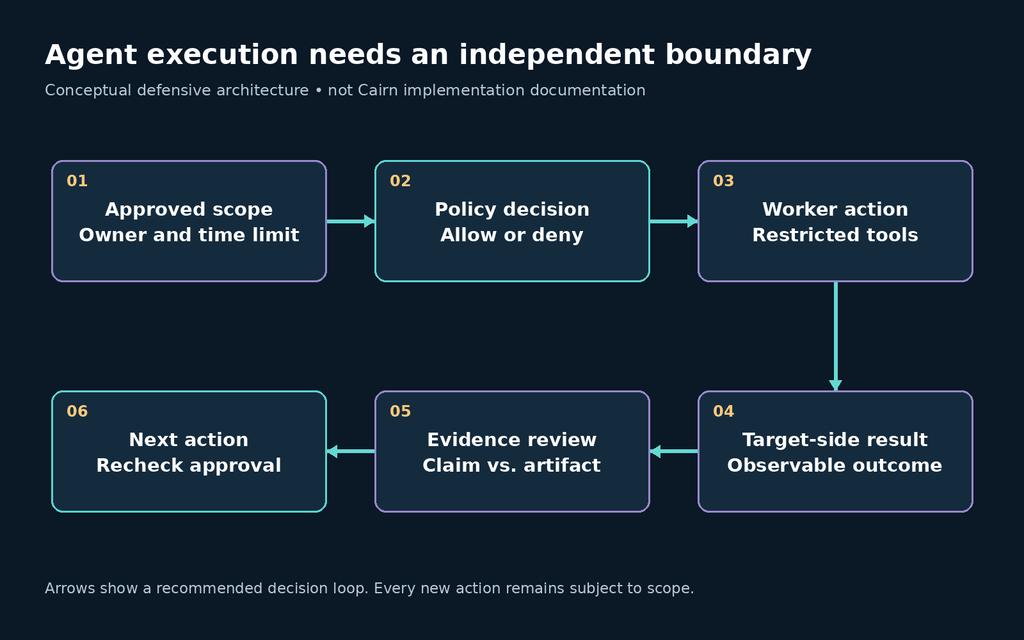
A recommended control architecture separates three decisions. The planner proposes an action. An independent enforcement layer checks whether that exact action is authorized. An evidence layer records what happened and whether the result supports the claim. Putting all three decisions into the same prompt makes them harder to audit and easier to confuse. The diagram is a defensive design recommendation, not documentation of Cairn’s implementation.
Authorization must describe more than a hostname. It should include the permitted environment, accounts, operations, time window, request budget, and stop conditions. A production domain can contain customer content, third-party payment flows, administrative services, and external redirects with different owners. Permission to assess one application does not automatically cover everything its pages link to or everything a browser session can access.
Harden the application boundaries an agent can revisit
Start with transitions where externally controlled data acquires new authority. An uploaded attachment becomes a server file. A session value becomes an application object. A low-privilege account triggers a privileged operation. A debug response reveals internal state. These are useful review boundaries whether the caller is an agent, a script, or a person; the test should establish what data crosses them and what the receiving component assumes.
For upload handling, OWASP recommends layered validation, application-generated filenames, size limits, and storage outside the webroot or on a separate server. Do not trust the supplied Content-Type as proof of file contents. In an application review, follow the object after acceptance: where it is stored, how it is transformed, how it is served, and whether any component interprets it as code.
A useful acceptance test uses harmless files and an isolated staging environment. Confirm that permitted content remains retrievable through the intended route and that denied content never appears in an executable location. Check transformations, thumbnails, imports, and cleanup jobs as separate consumers. A successful upload response is only one checkpoint; a later background task may handle the same bytes under a different identity or filesystem permission.
Session storage deserves a similarly explicit contract. OWASP’s deserialization guidance warns against processing untrusted serialized objects. The practical review is to identify who can write the stored representation and what code interprets it. A service called internal is not automatically a trusted source if another compromised application, shared account, or network path can modify its records.
Keep the application recommendation separate from incident attribution. Finding unsafe deserialization in a review does not prove it was used in the Cairn activity involving your organization. Conversely, failing to find that one pattern does not rule out a different route. Determine your own entry condition from preserved requests, deployment artifacts, application behavior, and server-side evidence; do not force a public case study onto an environment it does not describe.
| Boundary to review | Verification question | Useful closure evidence |
|---|---|---|
| Upload to storage | Can accepted content reach an executable or privileged location? | Storage path, handler configuration, harmless acceptance and rejection tests |
| Storage to application object | Can an untrusted writer influence objects the application reconstructs? | Writer inventory, access restrictions, serialization contract, regression result |
| Account to privileged action | Does the server enforce the user’s authority on every relevant request? | Tests using distinct authorized roles and denied operations |
| Frontend to backend | Do different instances enforce the same access policy? | Deployment inventory and verification across the served pool |
| Error to client response | Does a failure disclose secrets or internal state? | Sanitized error output and protected server-side diagnostics |
A closure record should name the tested deployment. With rolling releases, multiple application versions, or regional backends, testing one instance can leave the report disconnected from what users actually reach. Record the build identity and routing context available to the tester. Where visibility is incomplete, state the coverage limit instead of marking the entire service fixed.
Secure the testing platform before adding targets
The assessment platform is part of the client’s attack surface whenever it receives client information. A report database, browser profile, model transcript, or screenshot directory can contain material that never existed together in the target application. Treat that aggregation as a reason to restrict access and retention. A dashboard that looks read-only can still disclose enough information to make a separate intrusion easier.
Test anonymous access with a clean session that has never authenticated. Separately test whether an authenticated user in project A can read an object from project B. These checks answer different questions. A login page proves that one route asks for authentication; it does not establish that exports, background jobs, WebSocket connections, media objects, and worker interfaces apply the same project boundary.
Place the control plane behind the intended access boundary and verify it from the relevant external perspective using systems you own. Do not change a production exposure merely to reproduce a news report. For a local tool, confirm which interface it binds to, what publishes its port, and whether a reverse proxy or tunnel makes it reachable elsewhere. A localhost setting in one process is not a complete inventory of the network path.
Treat worker credentials and operator credentials separately. A worker should receive only the access required for its approved job, with a defined lifetime and revocation path. A browser profile used for one customer should not become the starting profile for another. Download directories, caches, terminal history, and temporary evidence need explicit handling because they can outlive the project visible in the dashboard.
| التحكم | Concrete acceptance check | Failure that still needs attention |
|---|---|---|
| Anonymous access | Unauthenticated requests cannot read protected project objects or control work | A protected homepage with a readable export route |
| Project isolation | Project A’s identity cannot retrieve project B’s artifacts | Object storage URLs bypass the application’s project check |
| Worker scope | The worker’s actual credentials and reachable services match the job | A narrow prompt paired with broad cloud credentials |
| Stop behavior | Canceling the job stops queued and running work within the agreed bound | The dashboard stops updating while a worker continues |
| Evidence retention | Deletion and expiry cover primary artifacts and derived copies | Expired project data remains in transcripts or backups |
These are acceptance criteria to adapt to the platform under review, not claims that any named product implements them. Ask the vendor or operator to demonstrate the result against an agreed test. Screenshots of configuration are helpful, but a controlled denial test provides different evidence from a screenshot of a checkbox.
A safe offline demonstration of scope enforcement
The following toy model demonstrates one narrow principle: a worker’s proposed action must be checked against an independently approved scope. It uses only Python’s standard library, creates no server, sends no requests, and contains no exploit. The URL is an invented local test identity. Run it with Python 3 after saving it as scope_demo.py. The expected result is one allowed proposal and five rejected proposals.
from dataclasses import dataclass, replace
from datetime import datetime, timedelta, timezone
from urllib.parse import urlsplit

@dataclass(frozen=True)
class Scope:
    origin: str
    actions: frozenset[str]
    expires: datetime
    approval_id: str

@dataclass(frozen=True)
class Proposal:
    url: str
    action: str
    approval_id: str

def allowed(scope, proposal, now):
    parsed = urlsplit(proposal.url)
    if parsed.username is not None or parsed.password is not None:
        return False
    if not scope.approval_id or proposal.approval_id != scope.approval_id:
        return False
    origin = (parsed.scheme, parsed.hostname, parsed.port)
    approved = urlsplit(scope.origin)
    expected = (approved.scheme, approved.hostname, approved.port)
    return (
        origin == expected
        and parsed.scheme == "https"
        and proposal.action in scope.actions
        and now < scope.expires
    )

now = datetime(2026, 10, 20, tzinfo=timezone.utc)
scope = Scope("https://app.test", frozenset({"read"}),
              now + timedelta(minutes=30), "approval-demo-001")
baseline = Proposal("https://app.test/status", "read", scope.approval_id)
cases = [
    ("approved read", scope, baseline, True),
    ("different host", scope, replace(baseline, url="https://other.test"), False),
    ("write request", scope, replace(baseline, action="write"), False),
    ("missing approval", scope, replace(baseline, approval_id=""), False),
    ("expired scope", replace(scope, expires=now), baseline, False),
    ("credentials in URL", scope,
     replace(baseline, url="https://user:pass@app.test"), False),
]
for label, approved_scope, proposal, expected in cases:
    actual = allowed(approved_scope, proposal, now)
    assert actual is expected, label
    print(label, "ALLOW" if actual else "DENY")
The scope object represents an approval held outside the worker’s control. The approval identifier in this example is a label, not a cryptographic authorization token. Immutability inside this program illustrates a boundary; it does not secure a real multi-process service. The caller is also assumed to provide well-formed URLs and timezone-aware timestamps. A production implementation needs fail-closed parsing and a reviewed policy representation.
The example deliberately omits DNS resolution, redirects, IP ranges, default-port normalization, path restrictions, subresources, and proxy behavior. Those are separate enforcement problems. A production request broker must decide which destination is actually contacted and enforce policy at execution, including after redirects. The strict tuple comparison here can reject equivalent origins; relaxing it without reviewing the consequences would change the demonstration’s meaning.
Most importantly, nothing checks the safety of a real read operation. An application can have side effects on a nominally read-only route. Use the demonstration to test the separation of approval and proposal, not to certify a website or a pentesting agent. Passing six local assertions establishes that those six synthetic cases behaved as expected and nothing more.
Collect evidence that survives an agent’s narrative
An assessment needs three related records: what the worker intended, what the tool actually did, and what the target-side evidence supports. Keep them distinct and link them through identifiers. If a tool call times out, the agent may not know whether the target completed the operation. A retry can therefore be more consequential than the planner assumes. Record the uncertainty rather than silently treating a timeout as a failed action.
OWASP’s logging guidance emphasizes application context and careful handling of sensitive information. A useful security record identifies the actor, action, object, time, result, and correlation context. Avoid copying raw access tokens or private customer data into broadly accessible logs. Protected raw evidence and a redacted analyst view can serve different needs without making every report reader a credential holder.
The following is an illustrative event design, not a native Cairn schema or an observed incident log. The denied result describes policy enforcement before tool execution. In an implementation, verify that a denial means the request was never dispatched, rather than merely hidden from the user interface.
{
  "event_kind": "policy_decision",
  "project_id": "synthetic-project-01",
  "run_id": "synthetic-run-01",
  "approval_id": "approval-demo-001",
  "proposed_action": "write",
  "target_origin": "https://app.test",
  "decision": "deny",
  "reason": "action_outside_scope",
  "tool_executed": false,
  "raw_secret_recorded": false
}
For website monitoring, correlate web requests with application identities, upload records, deployment changes, and server processes where available. A request to an unusual path is a lead. A new server-side object written by an unexpected identity, followed by access to that object, is a different level of evidence. Neither needs the defender to infer whether a language model generated the request.
Build the first detection around an outcome your team can investigate. For example, review writes into application code locations outside an approved deployment, unexpected account privilege changes, or access to assessment exports by an unrelated project identity. Define normal sources and planned maintenance before alerting. A rule that reports every legitimate upload or every authorized test will teach responders to disregard it.
Measure missing evidence as well as suspicious evidence. If a report cannot link a finding to a request, a request to a worker, or a worker to an approval, document that loss of provenance. It is a limitation in the assessment system even when no compromise has been established. A final narrative should not become more certain simply because the underlying records are unavailable.
Respond to website compromise and panel exposure separately
A website intrusion and an exposed assessment panel can overlap, but they require different containment actions. The website team needs to identify unauthorized changes and close the route that allowed them. The assessment operator needs to restrict access, preserve its own audit trail, and determine what customer information escaped its intended boundary. Completing either track does not automatically finish the other.
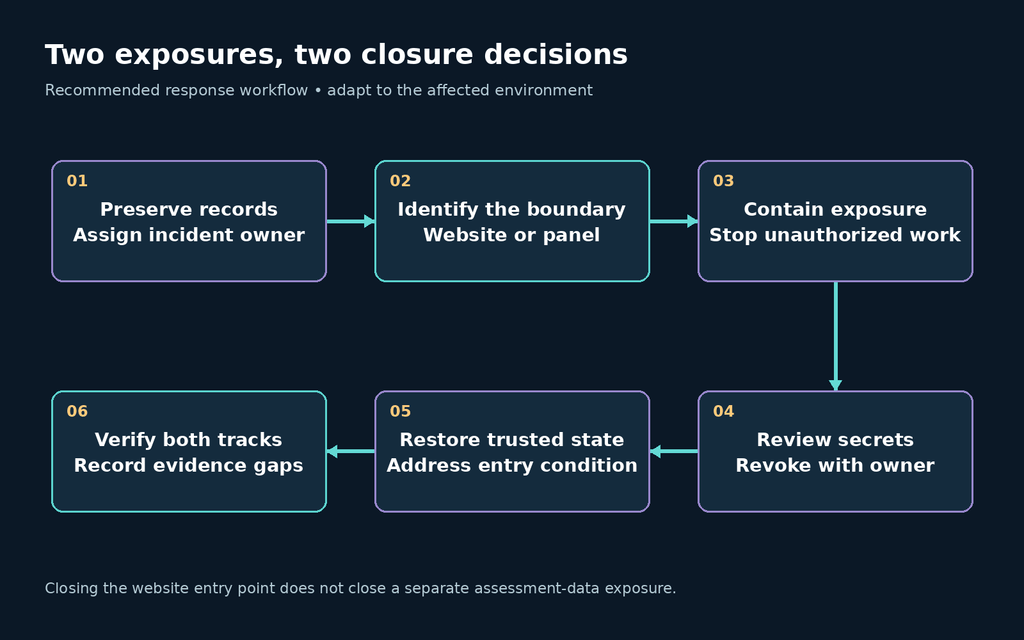
For a suspected website compromise, preserve the relevant logs and artifacts before ordinary cleanup destroys them. Establish who owns containment and which services can be isolated without losing essential evidence. Compare suspicious files with a trusted deployment baseline; do not assume that removing the first visible uploader restores the system. The original weakness, changed identities, and related secrets may remain.
For panel exposure, enumerate the projects and artifact types that were reachable during the exposure window. Determine whether access was anonymous, authenticated under the wrong role, or available through a public object URL. Inspect the actual access records where retained. A lack of logs limits what can be concluded; it does not establish that nobody read the data.
OWASP’s secrets-management guidance treats credentials as lifecycle-managed assets. When a secret is exposed, identify its owner, permissions, consumers, and revocation path. Rotate or revoke it through the responsible service and verify that the former value no longer authorizes access. Redacting a transcript changes visibility in that transcript; it does not invalidate a credential already copied elsewhere.
| الوضع | First operational decision | Evidence needed before closure |
|---|---|---|
| Unexpected website artifact | Preserve evidence and contain the affected component | Entry route addressed, trusted state restored, related access reviewed |
| Public assessment transcript | Restrict access and scope reachable projects | Exposure window, affected data types, access review, owner notification decision |
| Reusable credential in an artifact | Coordinate revocation with its service owner | Old credential rejected, required consumers updated, relevant use reviewed |
| Unknown worker activity | Stop execution through the actual control boundary | Running and queued work stopped; credentials and artifacts accounted for |
| Missing historical logs | Record the investigation limit | Explicit residual uncertainty and compensating review, not a clean bill of health |
Keep communication specific. An affected customer needs to know which project, which data categories, what interval, and what action is required. Avoid asserting that all customer systems were breached because a panel was exposed. Avoid the opposite shortcut of calling the exposure harmless because the associated assessment never produced a confirmed vulnerability.
A first authorized test for a small team
A solo developer does not need to recreate a criminal campaign to learn whether a security workflow is useful. Choose one staging application with representative access controls and disposable data. Define a small set of questions: can one user read another user’s object, can an upload reach an unintended location, and can the tool produce evidence sufficient to reproduce a finding safely? Record what the tool is allowed to do before giving it credentials.
Set a budget in both money and actions. Token spending, elapsed time, and requests answer different questions about an assessment. Stop criteria should include an agreed request limit, unexpected production traffic, access outside scope, or evidence that continuing would create unnecessary exposure. More autonomous work is not automatically more complete work; assess whether each additional action resolves an unanswered question.
If evaluating Penligent for that workflow, use the same scoped application and evidence requirements you would use for another tool. A useful result is an actionable, reproducible finding or an explicitly bounded assessment result. Treat the platform’s own handling of credentials, artifacts, and authorization as part of the evaluation. Product selection does not replace the scope owner’s responsibility to decide what is permitted.
Compare the final report with your application inventory. Which roles were tested? Which routes or components were excluded? Which findings are confirmed, and which remain candidates? A report with fewer findings can be more useful when it gives clear reproduction evidence and honest coverage limits. A long list of plausible weaknesses without target-side confirmation should remain a triage input.
For remediation, retain the original safe reproduction and run the relevant check against the changed deployment. Confirm both sides of an access-control fix: the forbidden action is denied and the intended authorized action still works. Record the deployed build and any conditions the test did not cover. That gives the team a regression asset instead of an isolated PDF that becomes stale after the next release.
Questions defenders are asking
Is Cairn itself a newly disclosed CVE?
The research discussed here concerns agent orchestration, malicious use, and exposed operating infrastructure. It should not be converted into a universal affected-version or patch table without a corresponding vendor advisory. Assess the actual application and platform boundaries in your environment.
Does avoiding Cairn remove the risk?
No. The practical controls concern authorization, application weaknesses, credentials, and evidence storage. Review those boundaries in whichever testing or automation platform you use. A product name is not a substitute for an exposure assessment.
Can an agent’s success label be accepted as a finding?
Use it as a lead until the supporting artifact establishes the claimed impact. Preserve the relevant request, response, environment, identity, and target-side result. If reproducing the full impact would be unsafe, document the narrower verified condition and the limit instead.
Should every exposed credential be tested to see whether it works?
No. Handle only credentials you are authorized to manage, and coordinate validation or revocation with the service owner. Do not use credentials found in someone else’s infrastructure. Avoid copying live secrets into incident tickets or chat messages when a protected reference is sufficient.
What can the offline demonstration prove?
It checks six synthetic approval decisions without network activity. It does not validate a deployed platform, enforce real browser scope, or certify a website as secure. Its purpose is to make the approval boundary inspectable before building a more complex execution system.
The useful response to this research is to demand evidence at both boundaries. Your application should reject unauthorized transitions, and your testing infrastructure should prevent approved work from exposing the people it is meant to protect. Keep those outcomes independently verifiable, even when the system performing the work can explain its reasoning fluently.

 Arabic
 English
 German
 French
 Spanish
 Portuguese
 Japanese
 Korean
 Hindi
 Turkish
 Hebrew