
CVE-2024-55591 is the kind of firewall vulnerability that changes the security meaning of the device itself.
A FortiGate is supposed to sit at a trust boundary. It controls traffic, terminates remote access, enforces security policy, and often becomes one of the most privileged pieces of infrastructure in an enterprise network. CVE-2024-55591 attacked that trust boundary directly: an unauthenticated remote attacker could abuse the affected FortiOS or FortiProxy management path and obtain super-admin privileges through crafted requests involving the Node.js WebSocket module. Fortinet disclosed the vulnerability on January 14, 2025 and confirmed that exploitation had already been observed in the wild. (FortiGuard)
The vulnerability carries a CVSS v3.1 vector of AV:N/AC:L/PR:N/UI:N/S:U/C:H/I:H/A:H, corresponding to a critical score of 9.8. More importantly, CISA added CVE-2024-55591 to its Known Exploited Vulnerabilities catalog on the same day it was publicly disclosed and required U.S. federal civilian agencies to remediate it by January 21, 2025. CISA’s assessment later classified exploitation as active, the issue as automatable, and the potential technical impact as total. (NVD)
That alone would justify urgent patching. But CVE-2024-55591 has become more significant with time rather than less.
As of August 2026, CISA’s KEV catalog identifies CVE-2024-55591 as known to be used in ransomware campaigns. A new joint #StopRansomware advisory on Gunra ransomware published on August 10, 2026 again explicitly references CVE-2024-55591 alongside CVE-2025-24472 in attacks involving vulnerable Fortinet infrastructure. In other words, this is no longer merely an interesting FortiOS zero-day from early 2025. It belongs to the much more important category of vulnerabilities with demonstrated post-disclosure operational value to real attackers. (CISA)
For defenders, that changes the question.
The question is no longer simply:
“Did we install the Fortinet patch?”
The useful questions are:
Was the FortiGate management interface ever exposed while the device was vulnerable? Did unexpected jsconsole activity occur? Were administrator or VPN users created? Were configuration changes made before patching? Could an attacker have left persistence behind? And are there other Fortinet trust paths—old credentials, weak authentication, exposed administration, or forgotten accounts—that remain exploitable even though this specific CVE is fixed?
Those are the questions that determine whether CVE-2024-55591 is merely a patch-management item or the beginning of an incident investigation.
What Is CVE-2024-55591?
CVE-2024-55591 is an authentication bypass using an alternate path or channel, classified under CWE-288.
Fortinet’s advisory states that specially crafted requests to the Node.js WebSocket module could allow a remote attacker to obtain super-admin privileges. The vulnerability affects FortiOS 7.0 and specific FortiProxy 7.0 and 7.2 releases. (FortiGuard)
The affected and fixed versions are straightforward:
| المنتج | الإصدارات الضعيفة | الإصدار الثابت |
|---|---|---|
| FortiOS 7.0 | 7.0.0 through 7.0.16 | 7.0.17 or later |
| FortiProxy 7.0 | 7.0.0 through 7.0.19 | 7.0.20 or later |
| FortiProxy 7.2 | 7.2.0 through 7.2.12 | 7.2.13 or later |
FortiOS 7.6, 7.4, 7.2 and 6.4, as well as FortiProxy 7.6, 7.4 and 2.0, were listed by Arctic Wolf as unaffected by CVE-2024-55591. (Arctic Wolf)
That limited version range can make the vulnerability look less serious than it is. The critical detail is what becomes available after exploitation.
This is not simply unauthorized access to a status page.
It is a path toward the FortiGate administrative CLI.
Why FortiGate Super-Admin Access Matters
The FortiGate web management interface includes a CLI console accessible through the browser. Fortinet administrators can use it to perform many of the same privileged operations they would normally perform through the appliance’s command-line interface.
Arctic Wolf noted that activity originating through this browser-based CLI is commonly recorded as jsconsole. During the campaign associated with CVE-2024-55591, researchers observed suspicious administrative access using this mechanism, followed by account creation, VPN configuration changes and other administrative actions. (Arctic Wolf)
Independent reverse engineering by watchTowr later demonstrated why the vulnerability was so powerful.
FortiOS used WebSocket routes including /ws/cli/open to connect the browser-based management console to the underlying CLI functionality. The Node.js application authenticated the management session and then constructed the context required to establish a CLI connection. (watchTowr Labs)
Under ordinary conditions, that architecture makes sense:
Browser
↓
FortiGate HTTPS management interface
↓
Node.js WebSocket service
↓
Validated administrator session
↓
CLI connection
↓
FortiOS administrative commands
CVE-2024-55591 broke the assumption that the session reaching the CLI had necessarily passed through the expected authentication path.
watchTowr’s analysis found that the affected authentication logic could be manipulated through the local_access_token handling path. Their research also identified timing behavior around the WebSocket-to-local-CLI connection that contributed to bypassing the normal trust assumptions. The final result was the ability to establish a privileged CLI context without legitimate administrator authentication. (watchTowr Labs)
That is why calling CVE-2024-55591 simply an “authentication bypass” can understate its operational consequence.
The more meaningful description is:
unauthenticated access to an administrative path capable of reaching FortiGate super-admin functionality.
Once an attacker controls that layer, the firewall should be treated as compromised.
The CVE-2024-55591 Attack Path
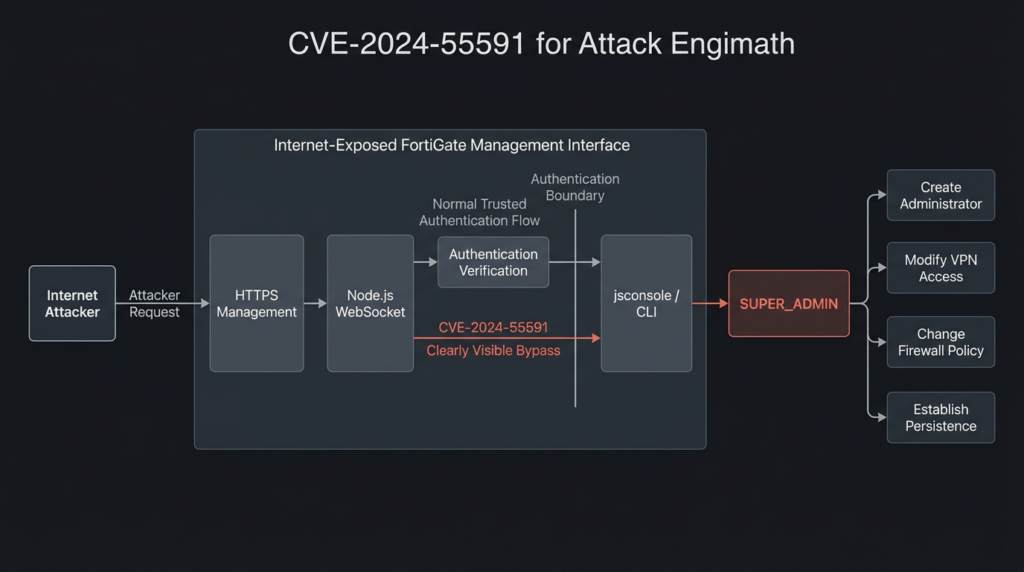
At a conceptual level, exploitation can be understood as a trust-boundary failure.
A legitimate FortiGate administrative workflow looks approximately like this:
Administrator
     |
     v
HTTPS Management Interface
     |
     v
Authentication / Session Validation
     |
     v
Node.js WebSocket
     |
     v
jsconsole
     |
     v
Privileged FortiOS CLI
CVE-2024-55591 allowed the attacker to interfere with the assumption between the WebSocket layer and the authenticated administrative session.
The resulting risk model becomes:
Internet Attacker
     |
     v
Exposed FortiGate Management Interface
     |
     v
Crafted WebSocket Interaction
     |
     v
Authentication Boundary Failure
     |
     v
Privileged CLI Context
     |
     v
SUPER_ADMIN
     |
     +--> Create administrator
     +--> Modify firewall configuration
     +--> Modify VPN configuration
     +--> Establish persistence
     +--> Access internal network
The exact exploitation details are more complicated than a single missing authentication check. watchTowr described several interacting behaviors involving the pre-authentication WebSocket connection, local_access_token handling and the timing of the WebSocket-to-CLI process. Their reproduction ultimately reached a functioning super_admin CLI context on a vulnerable FortiGate 7.0.16 system. (watchTowr Labs)
From a defensive perspective, however, the internal implementation matters less than the security boundary that failed.
An internet-reachable web management service could become a route into the device’s highest-privilege control plane.
Exploitation Started Before Public Disclosure
One of the strongest reasons CVE-2024-55591 deserves attention is that the public CVE came after attackers had already been using the underlying weakness.
Arctic Wolf began investigating suspicious FortiGate activity in late 2024. Its researchers divided the campaign into four broad phases:
| المرحلة | Observed Period |
|---|---|
| Vulnerability scanning | November 16–23, 2024 |
| الاستطلاع | November 22–27, 2024 |
| SSL VPN configuration | December 4–7, 2024 |
| Lateral movement | December 16–27, 2024 |
Arctic Wolf notified Fortinet about the activity on December 12, 2024, and Fortinet PSIRT acknowledged the investigation on December 17. CVE-2024-55591 was publicly disclosed almost a month later, on January 14, 2025. (Arctic Wolf)
This timeline matters because it demonstrates a common vulnerability-management problem.
If an organization patched CVE-2024-55591 on January 14 or January 15, that does not prove the organization was safe on December 10.
Patching prevents future exploitation of the patched vulnerability. It does not automatically remove administrator accounts, VPN users, configuration changes, stolen credentials, persistence mechanisms or downstream access established before the patch was applied.
For edge appliances in particular, organizations should distinguish two tasks:
المعالجة closes the vulnerability.
compromise assessment determines whether the vulnerability was already used.
CVE-2024-55591 requires both.
What Attackers Did After FortiGate Access
The campaign documented by Arctic Wolf shows why the post-exploitation phase deserves at least as much attention as the vulnerability itself.
Researchers observed unauthorized administrative logins, creation of local administrator accounts, creation or modification of SSL VPN-related accounts and configuration, and subsequent access into internal environments. In some affected networks, attackers progressed as far as credential-access operations involving DCSync. (Arctic Wolf)
Arctic Wolf mapped the campaign to techniques including exploitation of a public-facing application, creation of local accounts, use of external remote services, abuse of valid accounts and DCSync credential dumping. (Arctic Wolf)
This gives defenders a much better threat model than “someone logged into the firewall.”
The meaningful attack chain is closer to:
Internet-facing FortiGate
        ↓
Authentication bypass
        ↓
super_admin access
        ↓
Create persistent administrator
        ↓
Create or modify VPN access
        ↓
Return using legitimate-looking credentials
        ↓
Reach internal environment
        ↓
Credential access
        ↓
Lateral movement
        ↓
Domain / server compromise
This distinction is critical for incident response.
If a threat actor creates a second administrative mechanism after exploiting CVE-2024-55591, patching the original flaw may have almost no effect on the attacker’s existing access.
CVE-2024-55591 Is Now a Ransomware-Relevant Vulnerability
The threat history did not end with the first disclosure wave.
In March 2025, security researchers reported ransomware-related intrusions involving CVE-2024-55591 and the related Fortinet authentication-bypass issue CVE-2025-24472. Reporting around the Mora_001 activity described the use of compromised Fortinet devices as an entry point before SuperBlack ransomware deployment. (halcyon.ai)
CISA’s KEV catalog now explicitly labels both CVE-2024-55591 and CVE-2025-24472 as vulnerabilities known to have been used in ransomware campaigns. (CISA)
The issue became timely again on August 10, 2026, when CISA and partner agencies published a new #StopRansomware advisory on Gunra. That advisory again references CVE-2024-55591 and CVE-2025-24472 in the context of compromised Fortinet infrastructure. (CISA)
This is exactly why vulnerability prioritization should not be driven by publication date alone.
An older critical CVE with proven exploitation, internet-facing attack surface and ransomware utility can deserve substantially more attention than a newly published theoretical vulnerability with no known exploitation.
For CVE-2024-55591, several risk multipliers align:
| Risk Factor | CVE-2024-55591 |
|---|---|
| Remote attack surface | نعم |
| Authentication required | لا يوجد |
| User interaction required | لا يوجد |
| Management-plane compromise | نعم |
| Highest administrative privilege possible | نعم |
| Exploited before disclosure | نعم |
| CISA KEV | نعم |
| Known ransomware use | نعم |
| Edge security appliance | نعم |
That combination explains why the vulnerability remains operationally relevant long after the original patch release.
How CVE-2024-55591 Relates to FortiBleed
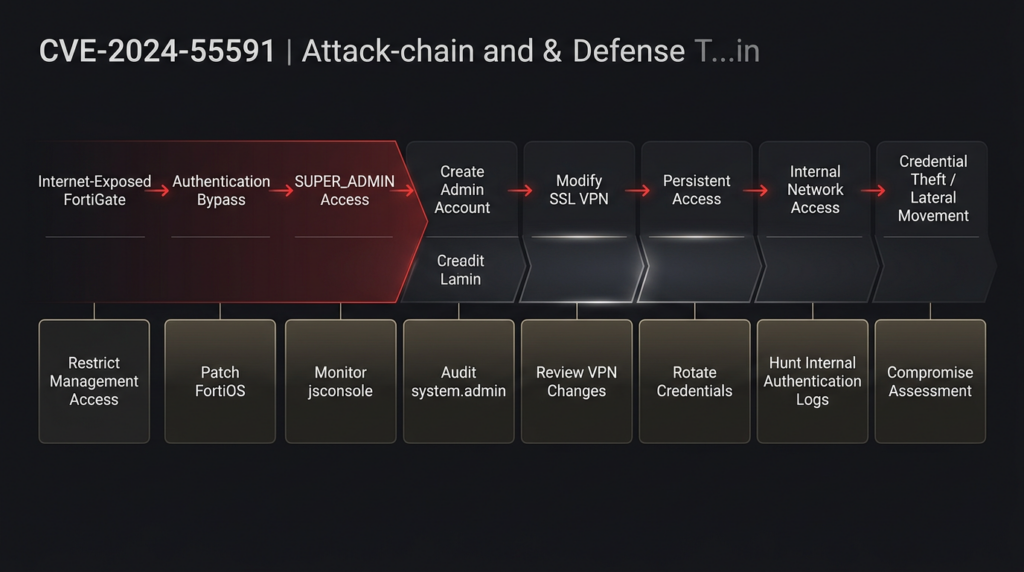
CVE-2024-55591 also illustrates a broader mistake defenders make when thinking about Fortinet incidents: reducing every FortiGate compromise story to a firmware-version question.
That approach misses credential-driven attacks.
The 2026 activity commonly referred to as FortiBleed is an important comparison. Fortinet has explicitly said that the credential-harvesting activity described under the FortiBleed name was not a new Fortinet vulnerability. Fortinet’s analysis linked the activity to reused credentials from previous incidents and brute-force attacks against devices with poor password hygiene and no MFA. (فورتنيت)
We covered that distinction in detail in FortiBleed CVE, Why the Fortinet Leak Is Not a New Vulnerability. The important lesson is that a FortiGate can be compromised through multiple trust failures that eventually converge on the same administrative control plane. (بنليجنت)
CVE-2024-55591:
Software vulnerability
        ↓
Authentication bypass
        ↓
super_admin
FortiBleed-style credential abuse:
Previously exposed / reused credentials
        ↓
Valid authentication
        ↓
Administrative access
Brute-force or weak-account attacks:
Internet-facing management interface
        ↓
Weak authentication
        ↓
Administrative access
The entry mechanisms differ.
The result can be the same.
That means organizations should not treat upgrading FortiOS as the end of FortiGate security hardening. Firmware remediation must be paired with management-interface isolation, administrator-account hygiene, MFA, credential rotation and continuous review for unexpected configuration changes.
Internet-Exposed Management Is the Real Risk Multiplier
Arctic Wolf’s investigation found a particularly important common characteristic among affected customers: the FortiGate management interface was exposed to the public internet. (Arctic Wolf)
That should not be interpreted as meaning exposure caused the vulnerability. CVE-2024-55591 was a software security flaw.
Exposure determined whether remote attackers could reach it.
This distinction is fundamental.
A vulnerable management service accessible only from a tightly controlled administrative network has a very different real-world attack surface from the same service listening on an internet-accessible interface.
For this reason, both Fortinet-linked remediation guidance and Arctic Wolf recommended either disabling HTTP/HTTPS administrative access or limiting which IP addresses could reach the management interface through local-in policies. (Arctic Wolf)
That control remains valuable even after CVE-2024-55591 is patched because it reduces exposure to the next management-plane vulnerability.
Security teams should therefore ask:
Is FortiGate administration reachable from the Internet?

        Yes
         |
         v
Why?

Is public access operationally required?

        No
         |
         v
Remove it.

        Yes
         |
         v
Can administration be restricted to VPN,
bastion, ZTNA, management network,
or tightly controlled source IPs?
This is a stronger long-term control than trying to predict every future FortiOS CVE.
The Agentic Cyberattack Problem Makes Edge Exposure More Dangerous
There is another reason internet-facing firewall management deserves more attention now than it did several years ago: attacker automation is improving.
The important AI security shift is not that every attacker suddenly discovers novel zero-days with a language model.
The more immediate change is that reconnaissance, fingerprinting, exploit research, target prioritization, credential testing, retry logic, result interpretation and post-exploitation planning are increasingly automatable.
We examined this shift in الهجمات السيبرانية العميلة تحتاج إلى اختبار ذكاء اصطناعي متحقق منه. The central argument is that offensive AI becomes operationally significant once it can keep a tool-using attack loop running rather than merely answering isolated cybersecurity questions. (بنليجنت)
Consider CVE-2024-55591 from that perspective.
A traditional operator might perform:
Search for exposed FortiGate
→ fingerprint version
→ read advisory
→ determine vulnerability
→ test target
→ inspect output
→ retry
→ create persistence
→ enumerate VPN configuration
→ identify internal access path
An agentic workflow can potentially coordinate significant portions of that sequence.
The underlying vulnerability does not become more powerful.
The attacker’s marginal labor cost decreases.
That changes the economics of exposed edge devices. A FortiGate management interface that previously required a motivated operator to investigate individually can increasingly become part of a machine-assisted queue of targets, hypotheses and validation attempts.
CVE-2024-55591 therefore belongs to a larger security problem: vulnerabilities on internet-facing control-plane infrastructure become especially dangerous when attackers can automate discovery and exploitation decisions around them.
How to Detect Possible CVE-2024-55591 Exploitation
Detection should begin with FortiGate administrative telemetry rather than traditional endpoint malware indicators.
Fortinet supplied suspicious logging patterns associated with successful jsconsole administrator activity and creation of new administrator objects. Singapore’s Cyber Security Agency reproduced these indicators in its advisory and specifically recommended reviewing unauthorized administrative accounts, configuration changes and suspicious SSL VPN connections. (Cyber Security Agency of Singapore)
At a SIEM level, a useful conceptual query is:
FortiGate logs
WHERE
    ui contains "jsconsole"
AND
    (
        profile contains "super_admin"
        OR action contains "Add"
        OR cfgpath contains "system.admin"
    )
That query is intentionally generic because FortiGate log normalization differs between environments.
The important fields are the behavior, not the syntax.
Look for:
| الإشارة | ما أهمية ذلك |
|---|---|
Unexpected jsconsole administrative login | May indicate browser/CLI management activity |
super_admin login from unknown source | Highest privilege compromise |
New system.admin object | Possible persistence account |
| Newly created VPN users | Possible alternate access path |
| User added to SSL VPN group | Possible persistence into internal network |
| Firewall policy changes | Potential security-control manipulation |
| Unexpected configuration revisions | Evidence of administrative compromise |
| VPN access after unusual admin activity | Possible attacker re-entry |
| VPS-hosted or unexpected source IPs | Common characteristic in observed campaign |
| Domain credential activity after firewall compromise | Possible progression beyond the appliance |
CSA also published several IP addresses observed in the original campaign, including 45.55.158.47, 87.249.138.47, 155.133.4.175, 37.19.196.65 و 149.22.94.37. These can assist historical hunting, but IP indicators should never be treated as a complete detection strategy because infrastructure changes easily. (Cyber Security Agency of Singapore)
Behavioral detection is more durable.
إن jsconsole Signal Deserves Special Attention
Arctic Wolf’s investigation repeatedly highlighted jsconsole.
FortiGate records CLI operations originating through the web management interface differently from SSH-originated administration. That provides defenders with an unusually useful telemetry source: an environment in which administrators rarely use the browser CLI may have a very low baseline of legitimate jsconsole activity. (Arctic Wolf)
Instead of asking only whether a listed malicious IP appeared, build a baseline:
Known administrator
+ known source network
+ expected management method
+ expected time
+ expected configuration change
Then investigate deviations:
Unknown source
+ jsconsole
+ super_admin
+ new administrator
+ VPN change
That combination is far more meaningful than any single indicator.
Patching CVE-2024-55591 Is Necessary but Not Sufficient
If an affected system is still running FortiOS 7.0.16 or earlier, FortiProxy 7.0.19 or earlier, or FortiProxy 7.2.12 or earlier, upgrading remains the first priority.
The minimum fixed releases identified for the vulnerability are:
FortiOS 7.0      → 7.0.17+
FortiProxy 7.0   → 7.0.20+
FortiProxy 7.2   → 7.2.13+
But organizations that operated a vulnerable and internet-accessible device should perform additional work.
A practical response sequence is:
1. Establish version truth
Do not rely only on a CMDB.
Confirm the actual FortiOS or FortiProxy version running on each appliance.
2. Establish historical exposure
Determine whether administrative HTTP or HTTPS was reachable from untrusted networks during the vulnerable period.
3. Review administrator accounts
Compare current FortiGate administrative accounts with historical records and approved administrators.
Unknown super-admin accounts should be treated seriously.
4. Review configuration history
Look for unexpected modifications involving administrators, firewall policies, VPN settings, authentication servers, Security Fabric relationships and remote-management configuration.
5. Review SSL VPN changes
The original campaign used VPN-related configuration as part of maintaining access. Unexpected local VPN users or group membership changes deserve investigation. (Arctic Wolf)
6. Hunt downstream
If firewall compromise is plausible, assume the device may have been used as an entry point rather than the attacker’s final objective.
Investigate authentication servers, directory infrastructure, administrative workstations, critical servers and privileged accounts.
7. Rotate potentially exposed credentials
This becomes especially important if attackers could have accessed configuration or authentication infrastructure.
8. Remove public management exposure
Where possible, place firewall administration behind a trusted administrative path rather than exposing it directly to the internet.
Fortinet-related guidance recommends disabling HTTP/HTTPS administration or restricting access using local-in policy when an immediate upgrade is not possible. (Cyber Security Agency of Singapore)
CVE-2024-55591 Versus CVE-2025-24472
CVE-2024-55591 is increasingly discussed alongside CVE-2025-24472, so the two should not be confused.
Both are Fortinet authentication-bypass vulnerabilities associated with super-admin access, and both have been placed in CISA’s KEV catalog. However, the documented attack paths differ.
CVE-2024-55591 involves crafted requests to the Node.js WebSocket module.
CVE-2025-24472 involves crafted CSF proxy requests. CISA currently lists both as known to have been used in ransomware campaigns. (CISA)
For incident response, the practical lesson is not to stop an investigation after confirming that CVE-2024-55591 was patched.
A Fortinet appliance may have multiple relevant authentication paths, and the same threat actor can exploit whatever route remains viable.
Safe Validation Should Focus on Proof, Not Destructive Exploitation
For an organization testing its own FortiGate environment, the first validation objective should be establishing exposure and patch state.
You usually do not need to reproduce the full authentication bypass on a production firewall to answer the most important questions.
Start with:
1. Is this an approved FortiGate/FortiProxy asset?
2. What exact firmware version is running?
3. Is the management interface externally reachable?
4. Was it externally reachable before remediation?
5. Are there unexpected administrator accounts?
6. Are there unexplained jsconsole events?
7. Were VPN or policy configurations modified?
8. Is there downstream evidence of lateral movement?
This is where evidence-driven AI penetration testing can be more useful than simply matching a CVE banner.
A scanner can identify FortiOS 7.0.16.
The more valuable security workflow asks whether that specific FortiGate was internet accessible, whether exploitation indicators exist, whether persistence was created and whether the appliance became a bridge into the internal environment.
That difference—between vulnerability identification and verified risk—is becoming increasingly important for edge-device security.
Do Not Treat FortiGate as Just Another Server
Firewalls deserve a different incident-response threshold from ordinary application servers.
A compromised FortiGate can expose information about:
- network topology;
- firewall rules;
- VPN users;
- remote-access configuration;
- trusted networks;
- administrative relationships;
- authentication infrastructure;
- segmentation design;
- internal services.
More importantly, the attacker may be able to change the controls defenders normally assume are protecting the environment.
That creates an uncomfortable inversion.
The security product becomes part of the attack path.
For CVE-2024-55591, this is exactly why the super_admin outcome matters more than the CVSS number.
Why CVE-2024-55591 Still Matters in 2026
CVE-2024-55591 was disclosed in January 2025.
It would be easy to classify it as old news.
That would be a mistake.
CISA still lists it in the Known Exploited Vulnerabilities catalog, marks it as known ransomware infrastructure, and the August 2026 Gunra advisory has brought it back into current incident-response discussions. (CISA)
More importantly, the vulnerability illustrates three security problems that remain very current.
The first is edge-device persistence. Organizations may patch faster than they investigate whether an edge device was already compromised.
The second is identity persistence. Attackers increasingly want accounts, sessions and remote-access mechanisms that survive the original vulnerability.
The third is الأتمتة. As offensive workflows become more agentic, scanning millions of internet-facing services, correlating versions with known exploits, retrying failed paths and maintaining attack context becomes cheaper.
That makes forgotten management interfaces increasingly difficult to defend through obscurity.
A Better FortiGate Security Model
The correct defensive model is not:
New CVE
→ Patch
→ Done
It is:
Asset inventory
      ↓
Management exposure
      ↓
Patch state
      ↓
Authentication state
      ↓
Administrator integrity
      ↓
Configuration integrity
      ↓
Exploit validation
      ↓
Compromise assessment
      ↓
Credential rotation
      ↓
Detection engineering
      ↓
Continuous retesting
CVE-2024-55591 is a good example of why this matters.
The vulnerability was real.
The patch mattered.
But attackers were already active before public disclosure, and post-exploitation actions could create access paths that survived remediation. (Arctic Wolf)
A mature response therefore validates both vulnerability state and compromise state.
Frequently Asked Questions
What is CVE-2024-55591?
CVE-2024-55591 is a critical authentication-bypass vulnerability affecting specific FortiOS and FortiProxy versions. A remote unauthenticated attacker can abuse the affected Node.js WebSocket functionality to obtain super-admin privileges. (NVD)
What is the CVSS score for CVE-2024-55591?
The vulnerability has a CVSS v3.1 score of 9.8 Critical, with network attack vector, low attack complexity, no privileges required and no user interaction required. (سينسيس)
Which FortiOS versions are vulnerable?
FortiOS 7.0.0 through 7.0.16 are affected. FortiOS 7.0.17 contains the fix. FortiOS branches 7.2, 7.4, 7.6 and 6.4 were listed as unaffected by this vulnerability. (Arctic Wolf)
Which FortiProxy versions are vulnerable?
FortiProxy 7.0.0 through 7.0.19 and FortiProxy 7.2.0 through 7.2.12 are affected. Fixed versions are 7.0.20 and 7.2.13 respectively. (Arctic Wolf)
Does CVE-2024-55591 require authentication?
No. The vulnerability can be exploited remotely without legitimate administrator credentials when the vulnerable management path is reachable. (NVD)
Can CVE-2024-55591 give an attacker super-admin privileges?
Yes. Fortinet’s advisory explicitly states that successful exploitation may allow a remote attacker to gain super-admin privileges. (FortiGuard)
Was CVE-2024-55591 exploited as a zero-day?
Yes. Arctic Wolf observed campaign activity beginning in November 2024, before Fortinet publicly disclosed CVE-2024-55591 on January 14, 2025. Fortinet later linked the disclosed vulnerability to the observed activity. (Arctic Wolf)
Is CVE-2024-55591 in CISA KEV?
Yes. CISA added CVE-2024-55591 to its Known Exploited Vulnerabilities catalog on January 14, 2025. (NVD)
Has CVE-2024-55591 been used in ransomware attacks?
Yes. CISA’s KEV catalog now marks CVE-2024-55591 as known to be used in ransomware campaigns, and the vulnerability has been referenced in ransomware activity including more recent Gunra-related reporting. (CISA)
Is FortiBleed the same vulnerability as CVE-2024-55591?
No. FortiBleed is not a standalone CVE. Fortinet has described the 2026 FortiBleed-related activity as credential reuse and brute-force activity rather than a new Fortinet vulnerability. The similarity is operational: both demonstrate why compromised credentials and administrative access must be investigated even after firmware is patched. (فورتنيت)
الوجبات الجاهزة النهائية
CVE-2024-55591 should be remembered less as “another critical Fortinet CVE” and more as a lesson about what happens when the authentication boundary of an internet-facing security appliance fails.
An unauthenticated attacker did not merely gain access to another web application.
The attacker could reach the FortiGate administrative control plane with super-admin privileges.
Real-world operators exploited that position to create accounts, modify VPN access and move deeper into victim environments. The vulnerability entered CISA KEV immediately after disclosure, became associated with ransomware activity, and remained relevant enough to appear again in government ransomware guidance in August 2026. (Arctic Wolf)
The defensive conclusion is therefore broader than “upgrade FortiOS.”
Patch the vulnerable firmware. Remove public management exposure. Audit jsconsole activity. Review every privileged account and VPN configuration change from the vulnerable period. Rotate credentials where compromise is plausible. Hunt downstream rather than assuming the firewall was the attacker’s final destination.
And do not assume the next FortiGate compromise will arrive through a newly named CVE. As the FortiBleed investigation demonstrates, valid credentials can sometimes achieve what an authentication bypass once did. As agentic cyberattacks become more capable of combining reconnaissance, credential attacks, vulnerability intelligence and repeated tool execution, leaving privileged edge infrastructure exposed becomes increasingly difficult to justify. (بنليجنت)
For CVE-2024-55591, the safest assumption is simple: if a vulnerable FortiGate management interface was exposed to the internet, patching tells you what the device is now; only evidence-driven investigation tells you what may have happened before the patch.

 Arabic
  English
  German
  French
  Spanish
  Portuguese
  Japanese
  Korean
  Hindi
Hindi  Turkish
  Hebrew