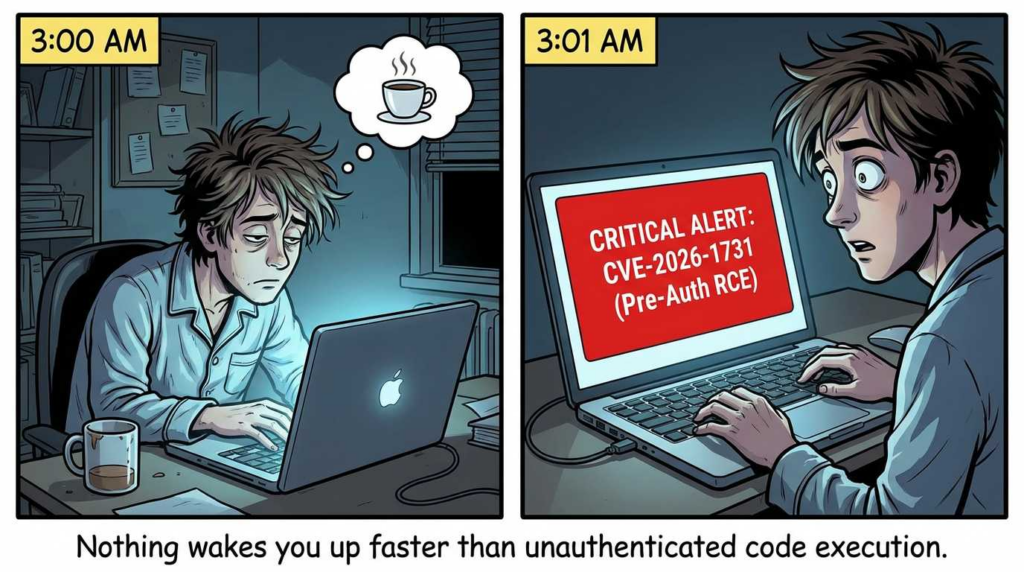
1. Why CVE-2026-1731 is a “Drop Everything” Vulnerability
In the hierarchy of enterprise security nightmares, unauthenticated remote code execution (RCE) on a remote access gateway sits at the very top. On February 6, 2026, BeyondTrust released security updates addressing CVE-2026-1731, a critical vulnerability affecting Remote Support (RS) و Privileged Remote Access (PRA).
This is not a routine “patch Tuesday” event. This is a structural risk to your identity perimeter.
What Happened (The Timeline)
The disclosure timeline reveals the severity with which the vendor treated this issue. While the public advisory and on-premise patches were released on February 6, 2026, BeyondTrust had already quietly patched their SaaS/Cloud instances on February 2, 2026. This four-day delta—standard practice for managed services—indicates that the vendor prioritized immediate remediation of their own infrastructure before public disclosure could arm threat actors.
The Security Primitive: Why It’s “Instant Breach”
The vulnerability is classified as an unauthenticated OS command injection. Unlike SQL injection or cross-site scripting, which often require chained exploits or specific user interactions, OS command injection allows an attacker to execute arbitrary commands directly on the underlying operating system.
Critically, this is pre-authentication. An attacker does not need credentials, a session token, or a VPN connection if the appliance is internet-facing. They simply need network access to the web interface.
Risk Framing: Identity-Adjacent Infrastructure
BeyondTrust RS and PRA are not simple web servers; they are session brokers. They are designed to hold the keys to the kingdom—brokering high-privilege sessions for helpdesks and sysadmins into sensitive endpoints.
If an attacker compromises the RS/PRA appliance via CVE-2026-1731, they rarely stop at the appliance. They leverage the appliance’s native capabilities—credential injection, session recording, and lateral movement tools—to pivot into the internal network. You are not just patching a server; you are defending the bridge between the internet and your Tier 0 assets.
Executive Summary (30-Second Brief for Leadership)
The Issue: A critical flaw (CVE-2026-1731) allows hackers to take full control of our remote support servers without a password.
المخاطرة: These servers are designed to connect to sensitive internal systems. Compromise allows immediate lateral movement into our network.
Status: Cloud versions were patched auto-magically on Feb 2, 2026. If we host our own servers (on-premise), we remain vulnerable until we apply Patch BT25-02.
الإجراء: We are verifying exposure and applying the patch immediately. Expect a brief maintenance window.
2. Verified Facts You Can Cite in a Postmortem
When communicating with stakeholders or writing an incident report, precision is mandatory. Rely on these verified facts rather than speculation.
CVSS Score and Classification
While the official NVD analysis is often lagging, the vendor and early analysis classify this as الحرجة. The Common Weakness Enumeration (CWE) is CWE-78: Improper Neutralization of Special Elements used in an OS Command (‘OS Command Injection’).
Affected Products and The Official Fix
The vulnerability impacts a wide range of versions, indicating the flaw has likely existed in the codebase for some time.
Remote Support (RS): Versions 21.3 through 25.3.1.
Required Action: Upgrade to a supported version if necessary, then apply Patch BT25-02-RS.
Privileged Remote Access (PRA): Versions 22.1 through 24.x.
Required Action: Apply Patch BT25-02-PRA.
Safe Harbor: PRA version 25.1 and newer are not impacted by this specific vulnerability.
Exploitation Status
As of the initial analysis by Arctic Wolf and Rapid7 immediately following the Feb 6 release, active exploitation in the wild was “not observed.” Furthermore, no public Proof of Concept (PoC) code was available on GitHub or ExploitDB at the time of disclosure.
However, a warning: The “not observed” status is temporary. Reverse engineering a patch for a command injection vulnerability is often trivial for sophisticated threat actors. Once the “diff” (difference between the patched and unpatched code) is analyzed, a working exploit can be generated in hours, not days.
What We Do NOT Know Yet
Specific Parameter: Vendors often redact the exact API endpoint or parameter (e.g., ?file_path= or POST body fields) to buy defenders time.
WAF Signatures: Without the specific attack string, generic WAF rules may catch some attempts, but tailored blocking rules are not yet widely available from WAF vendors.
CVE-2026-1731 RS/PRA Pre-Auth RCE
3. What Security Engineers Are Actually Searching For
If you are reading this, you are likely cycling through four specific intent clusters. Here is how we address them:
“Am I affected?” You need to check your build version immediately. If you are on SaaS, you are likely safe (check your change logs). If you are on-premise, assume you are vulnerable until proven otherwise.
“How do I patch safely?” The fear of “bricking” a remote access gateway during a crisis is real. The patch is delivered via the BeyondTrust update mechanism. We cover the decision tree in Section 4.
“How do I verify patching?” Dashboards lie. Caches persist. You need evidence that the code on disk has changed or the service has restarted. We cover verification in Section 10.
“Any IOCs / Detection?” Since there is no public PoC, you cannot search for a specific hash. You must hunt for السلوكيات: unexpected child processes and anomalous web requests. See Section 7.
The language regarding this CVE is specific: “Critical,” “Unauthenticated,” و “Internet-facing.” These keywords drive urgency because they describe the path of least resistance for ransomware groups.
4. Affected Version Matrix and Patch Decision Tree
Navigating vendor versioning can be complex. Use this matrix to determine your exact path to remediation.
Deployment Model: Cloud vs. On-Prem
SaaS / Cloud-Managed: BeyondTrust applied the fix to cloud instances on February 2, 2026. No action is required for the patch itself, but you should verify your configuration and review logs for activity prior to that date.
Self-Hosted / On-Premise: You are responsible for applying the patch.
Patch Matrix
المنتج
النشر
الإصدارات الضعيفة
Fix / Patch ID
Downtime Estimate
التحقق من الصحة
RS
On-Prem
21.3 – 25.3.1
BT25-02-RS
15–30 Minutes
Version Check + Service Restart
PRA
On-Prem
22.1 – 24.x
BT25-02-PRA
15–30 Minutes
Version Check + Service Restart
PRA
On-Prem
25.1+
None Required
N/A
Confirm Version is >25.1
RS/PRA
Cloud
All
Auto-Patched
لا يوجد
Verify Vendor Notification
Remediation Decision Tree
Identify Product: Are you running Remote Support (RS) or Privileged Remote Access (PRA)?
Check Version:
إذا كان PRA >= 25.1: You are safe from CVE-2026-1731. Document this in your asset inventory and stop.
إذا كان RS <= 25.3.1 (and >= 21.3): You must apply Patch BT25-02-RS.
إذا كان PRA <= 24.x (and >= 22.1): You must apply Patch BT25-02-PRA.
Legacy Check: If you are running a version older than the supported ranges (e.g., RS 20.x), you are in a double-risk scenario. You are likely vulnerable to this (or similar older exploits) and cannot apply the patch directly. You must upgrade to a supported base version first, then apply the patch.
5. Exposure Verification: “Are We Reachable from the Internet?”
Estimates from scanning services like Shodan and Censys suggest there are approximately 8,500+ internet-facing on-premise RS/PRA deployments. If you are one of them, your Time-To-Patch (TTP) target should be measured in hours.
Why Exposure Matters
Remote Support tools are often placed in the DMZ to facilitate vendor access or work-from-home support. However, “reachable” often extends beyond what is necessary.
What to Check (Defensive Inventory)
Do not launch exploits against your infrastructure. Instead, use safe verification methods:
Public DNS Records: Check for subdomains like support.company.com أو access.company.com.
Reverse Proxies: Verify if your Nginx/Apache/F5 configurations expose the /login أو /api paths of the BeyondTrust appliance to the world.
Asset Inventory: Search your internal CMDB or asset lists.
باش
`# Replace with your asset inventory export source
Goal: Find RS/PRA endpoints that are officially recorded as assets
If you find an asset, curl the login page from an external network (like a mobile hotspot) to confirm reachability. If it loads, you are exposed.
CVE-2026-1731 RS/PRA Pre-Auth RCE
6. Root-Cause Class: OS Command Injection in Enterprise Web Services
To defend against CVE-2026-1731, you must understand the class of vulnerability, not just the specific exploit.
الآلية
OS Command Injection (CWE-78) occurs when an application takes untrusted input (like a username, a filename, or an HTTP header) and passes it to a system shell command without proper sanitization.
In the context of a Remote Support appliance, the application might try to run a script to generate a session key or log an event.
The shell sees the semicolon, finishes the first command, and then executes the attacker’s command (cat /etc/passwd).
Why “Site User Context” is Catastrophic
Even if the web application runs as a low-privileged user (e.g., www-data أو site), the impact on an RS/PRA appliance is critical.
Configuration Access: The web user often has read access to configuration files containing database credentials or LDAP bind keys.
Local Privilege Escalation: Once inside the shell, attackers can exploit local kernel vulnerabilities or misconfigurations to gain root.
Pivoting: The appliance is designed to connect to other machines. The attacker can use the appliance as a jump box (SOCKS proxy) to attack the internal network.
7. Detection and Telemetry: What to Hunt Without a PoC
Do not wait for a GitHub PoC to start hunting. You can detect the symptoms of exploitation now.
Web Telemetry (The Front Door)
Look for anomalies in HTTP requests.
Method: Spikes in POST requests to endpoints that usually receive GETs, or high volumes of requests to specific API URIs.
الحمولات: Look for common shell characters in URIs or Headers: ;, |, &, $(), .
Status Codes: A sudden spike in 500 (Internal Server Error) might indicate an attacker fuzzing the injection point.
Host Telemetry (The Inside View)
This is your highest fidelity signal. The web service process (e.g., the BeyondTrust service binary) should generally لا be spawning shells.
Signals by Layer
الطبقة
الإشارة
Data Source
Triage Note
Network
URI containing ; /bin/sh أو wget
WAF / Load Balancer
Block immediately; likely an exploit attempt.
Endpoint
Service account spawning cmd.exe أو sh
EDR / Sysmon
CRITICAL. Indicates successful RCE.
Endpoint
الضفيرة أو wget to external IP
EDR / Netflow
Post-exploitation (fetching payloads).
Hunting Queries (Splunk/SIEM)
`# Web: Look for unusual POST bursts to RS/PRA from new IPs
Adjust “host” to match your BeyondTrust naming convention
index=proxy_logs (host=”rs*” OR host=”pra*”) method=POST | stats count dc(src_ip) by uri_path | where count > 200 AND dc(src_ip) > 20
Endpoint: Suspicious child processes spawned by RS/PRA service account
This looks for the web service spawning a shell—a classic RCE signature.
index=edr process_parent=”RemoteSupport” OR process_parent=”PrivilegedRemoteAccess” | search (process_name=”sh” OR process_name=”bash” OR process_name=”cmd.exe” OR process_name=”powershell.exe”)`
8. Mitigations When You Can’t Patch in the Next Hour
Sometimes, change management boards or operational constraints prevent immediate patching. In these cases, you must move to Containment.
1. Remove Public Exposure (The “VPN-Only” Strategy)
The most effective mitigation is to block internet access to the web interface. Reconfigure your firewall or load balancer to allow access فقط من:
Internal corporate IP ranges.
Trusted VPN egress IPs.
Specific vendor IP allowlists (if used for third-party access).
This turns an “Unauthenticated Internet RCE” into an “Insider Threat” issue, drastically reducing the attack surface.
2. Tighten Admin Surfaces
If you cannot block the user portal, ensure the /login/admin or administrative interfaces are restricted by IP or require a client certificate (mTLS) at the load balancer level.
3. Aggressive WAF Tuning
If you use Cloudflare, AWS WAF, or similar:
Enable “High Sensitivity” for OS Command Injection rulesets.
Rate limit IPs aggressively (e.g., block after 5 failed requests in 1 minute).
المصادقة: Before you end your shift, you must demonstrate to leadership that the risk is reduced. “We put it behind the VPN” is a valid interim status update.
9. The “History Lesson”: Why RS/PRA is a Repeat Target
Security engineering is about pattern recognition. BeyondTrust appliances have been targeted before, and this context matters for risk scoring.
Prior CVEs
CVE-2024-12356: A critical command injection vulnerability fixed in late 2024.
CVE-2024-12686: A related issue disclosed in the same window.
CISA KEV and Real-World Impact
CISA added CVE-2024-12356 to its الثغرات المعروفة المستغلة (KEV) catalog, confirming that threat actors weaponized it.
More alarmingly, in late 2024/early 2025, reports surfaced (including coverage by Reuters) regarding compromises of high-value targets, including elements of the U.S. Treasury, linked to remote access tool compromises. These incidents demonstrate that adversaries view these appliances as high-value chokepoints. When a new CVE like 2026-1731 drops, they essentially check their existing maps of the internet to see who hasn’t patched yet.
10. Patch Verification: Prove You’re Not Exposed
Applying the patch is step one. Verifying it is step two. Most teams skip step two.
Trust Evidence, Not Dashboards
A web dashboard might say “Up to Date” because it cached the status or because the update script failed silently. You need runtime evidence.
Version Evidence: Check the build number displayed on the login page source code (if visible) or via the command line interface if SSH is available.
Change Evidence: Verify the service restart timestamp. If the server uptime is 300 days, the patch didn’t apply (or didn’t take effect).
Runtime Evidence: Monitor logs immediately after the patch. Ensure the service is handling requests normally.
باش
`# Example: Capture version/build strings for audit evidence
Run this via SSH or the appliance console if available
1. Check kernel/OS info (sanity check)
uname -a
2. Verify time (for correlation with restart logs)
date -u
3. Check running processes to ensure the service restarted recently
11. Operational Playbook: Running This as an Incident
Do not treat CVE-2026-1731 as a standard Jira ticket. Treat it as an incident.
Triage Order
Internet-Exposed Instances: These are Priority 0. Patch or restrict immediately.
High-Privilege Integrations: Instances connected to Domain Controllers or Production DBs.
Internal-Only Instances: Priority 2. Patch within the standard window (24-48 hours).
In the rush to patch, teams often fall into the “Patch-and-Pray” trap—applying the fix and hoping it worked. A better approach is “Patch-and-Prove.” This is where reproducible verification becomes essential. You need to know, definitively, that your exposure controls (like WAF rules or VPN restrictions) are actually stopping external access.
بنليجنت aids this workflow by moving beyond simple vulnerability scanning.
Asset Profiling: Quickly identify which of your external assets match the profile of a BeyondTrust appliance, ensuring you haven’t missed a “shadow IT” deployment.
Safe Validation: Instead of firing live exploits, Penligent’s automated validation workflows can confirm if a patch has effectively closed the vulnerability or if a WAF rule is successfully blocking the attack vector, providing you with audit-ready evidence of remediation.
CVE-2026-1731 is a stark reminder that remote access tools are double-edged swords. They facilitate support, but they also facilitate breaches.
If you are Self-Hosted: You are on the clock. Patch BT25-02-RS or BT25-02-PRA immediately. If you cannot patch, cut the internet access.
If you are Cloud: You have dodged a bullet thanks to the vendor’s pre-emptive patching, but use this as a trigger to audit من has access to your portal.
The Big Picture: Treat your Remote Support infrastructure as part of your Identity Perimeter. It requires the same rigor, monitoring, and urgency as your Active Directory or Okta deployments.

 Arabic
  English
  German
  French
  Spanish
  Portuguese
  Japanese
  Korean
  Hindi
Hindi  Turkish
  Hebrew