
Why CVE-2026-21385 is not just another Android bulletin entry
Most Android security issues never escape the gravity of routine patching. They appear in a monthly bulletin, receive a severity label, and get absorbed into the endless machinery of backlog management. CVE-2026-21385 is different because the public signals around it are unusually strong. Google’s March 2026 Android Security Bulletin states that there are indications the issue may be under limited, targeted exploitation. CISA has added it to the Known Exploited Vulnerabilities catalog. NVD records it as a Qualcomm vulnerability with a High severity score and a memory-corruption description tied to integer overflow or wraparound. That combination changes how defenders should read the entry. This is not merely a line item in a vendor patch bundle. It is a live exploited-risk management problem in the Android ecosystem. (Android Open Source Project)
That distinction matters because mobile security programs often fail at the point where language looks calm but the operational implications are not. The official record for CVE-2026-21385 is compact. It does not come with dramatic screenshots, public exploit samples, or a vendor-published attack-chain postmortem. Yet the few facts it does contain are exactly the facts that should move a security team. The flaw sits in the March 2026 Android patch cycle. Google explicitly warns about possible targeted exploitation. Qualcomm is the originating vendor in the CVE metadata. CISA has elevated it into KEV. When those facts line up, defenders should stop asking whether the story sounds cinematic enough and start asking whether they can prove which devices in their environment are still exposed. (Android Open Source Project)
The deeper reason this issue deserves attention is structural. Android is not patched the way a single cloud service is patched. Google publishes the Android bulletin and upstream fixes. Qualcomm publishes its own security bulletin and distributes fixes to customers. OEMs integrate, test, and ship OTA updates on their own timelines. Carriers, support windows, device families, and regional release practices all introduce lag. In that environment, a vulnerability can be publicly fixed upstream while remaining exploitable in practice across a meaningful slice of the device population. CVE-2026-21385 lands in exactly that uncomfortable gap between disclosure and actual fleet closure. (Android Open Source Project)
This is why mobile defenders should be careful about minimizing the issue just because the description is terse or because the vector is listed as local. Android risk is not determined only by the CVSS vector string. It is determined by the role a vulnerability can play in real attacker workflows, the value of the devices involved, the friction in the patch chain, and the time window before affected endpoints become compliant. Once an issue also acquires an exploited label through Google’s bulletin and KEV inclusion through CISA, the burden of proof changes. It is no longer on the security engineer to prove that this is worth action. It is on the organization to prove that it has already reduced exposure. (Android Open Source Project)
What CVE-2026-21385 actually is
The facts public sources confirm
At the record level, the publicly confirmed facts are narrow but strong. NVD describes CVE-2026-21385 as “Memory corruption while using alignments for memory allocation.” The weakness is mapped to CWE-190, which covers integer overflow or wraparound. Qualcomm is the CNA source reflected in the NVD record. The published Qualcomm CVSS v3.1 score is 7.8 High with vector AV:L/AC:L/PR:L/UI:N/S:U/C:H/I:H/A:H. Android’s March 2026 bulletin places the issue in the 2026-03-05 patch level and labels the subcomponent as Display. Qualcomm’s March 2026 bulletin is referenced directly from the NVD record. These details are sufficient to describe the issue accurately without inventing technical specifics that have not been publicly confirmed. (NVD)
That public description tells us three important things. First, this is not an application-layer Android issue in the ordinary sense. It sits in a Qualcomm-linked component path that Android treats in the 2026-03-05 patch tier rather than the 2026-03-01 baseline tier. Second, the problem class points to memory unsafety and arithmetic handling rather than a logic bug like a permission bypass or access-control failure. Third, the listed impact across confidentiality, integrity, and availability is high, which means Qualcomm’s own scoring reflects the possibility of meaningful device compromise if an attacker reaches the vulnerable path. None of that proves a full exploit chain, but it is enough to establish that the issue is more than a low-stakes stability bug. (NVD)
The Android bulletin adds one more decisive fact: Google says there are indications the CVE may be under limited, targeted exploitation. That is not journalist paraphrase. It is in the bulletin itself. When an Android bulletin includes that kind of warning, defenders should read it as a signal that the vulnerability has already crossed from theoretical exploitability into observed abuse, even if the observed abuse is not broad and even if many details remain undisclosed. In real operations, that line matters more than many pages of speculative commentary. (Android Open Source Project)
What remains unclear in public
Public sources do not provide everything an engineer might want. There is no official public write-up from Google or Qualcomm that reconstructs the vulnerable code path end to end. There is no vendor-published public proof of concept. There is no confirmed public attribution to a specific threat actor or campaign. There is also no authoritative public list of all exact commercial devices that are definitely affected in the field. That absence does not mean the risk is low. It means the public record is designed to support remediation priority more than curiosity. (NVD)
This distinction matters because sparse public disclosures often tempt writers into overclaiming. With a vulnerability like CVE-2026-21385, responsible technical writing requires a clear line between fact and inference. It is fair to say that a CWE-190 memory-corruption issue in a display-related component may involve arithmetic errors around allocation size, alignment, or offset handling. It is not fair to present a detailed pseudo-root-cause diagram as if Google or Qualcomm had published it when they have not. It is fair to explain why a local memory-corruption flaw may matter in a multi-stage Android attack. It is not fair to claim a complete public exploit chain where none has been officially disclosed. Precision is not a stylistic choice here. It is the difference between useful analysis and fabricated authority. (NVD)
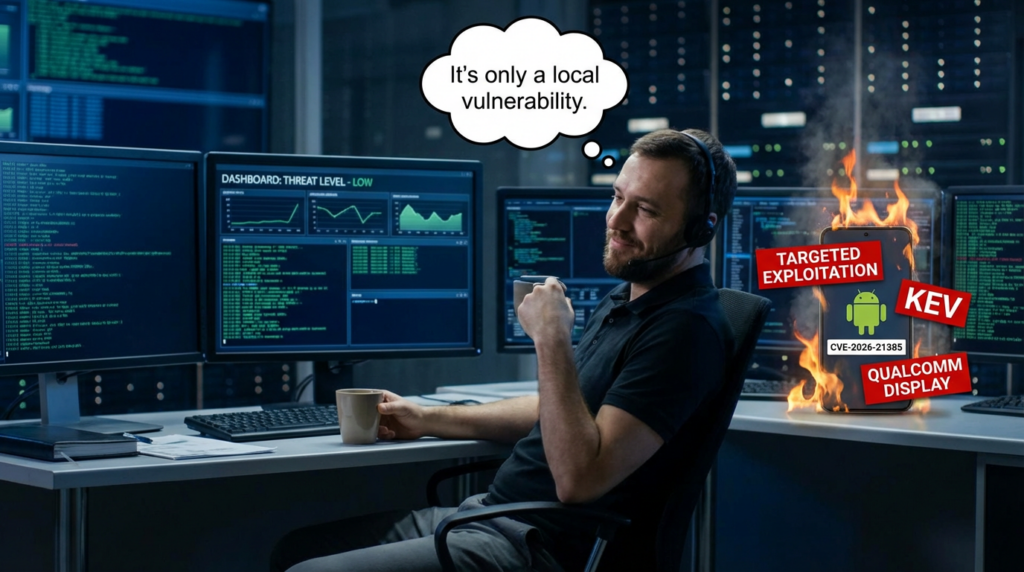
Why this flaw matters more than its CVSS suggests
The exploitation signal changes the operational priority
Security teams often default to CVSS as a sorting tool, but CVSS is only one input. For CVE-2026-21385, the more important signal is Google’s warning about limited, targeted exploitation. An exploited local High issue can be operationally more urgent than a theoretically worse bug that has never left the lab. This is especially true in mobile environments, where the value of a vulnerable device may be far higher than desktop administrators assume. A modern Android phone can hold privileged SaaS sessions, corporate messaging history, password-manager unlock paths, MFA approvals, recovery channels, and the browser state tied to sensitive work. A flaw that helps attackers gain stronger control over such a device may have business consequences out of proportion to its single-CVE description. (Android Open Source Project)
The phrase “limited, targeted exploitation” is easy to misread. Some teams hear “limited” and interpret it as low urgency. That is the wrong lesson. In security operations, “limited” usually means the activity is focused rather than noisy. It says more about targeting style than about harmlessness. A flaw exploited in a narrowly targeted manner may actually be more relevant to executive security, corporate legal functions, journalists, researchers, government contractors, or security administrators than a loud commodity bug affecting random consumers. Security teams that protect high-value users should treat “limited” as a reason to prioritize intelligently, not a reason to delay. (Android Open Source Project)
KEV inclusion is a hard escalation signal
CISA’s Known Exploited Vulnerabilities catalog exists to prioritize action around vulnerabilities with evidence of exploitation. CVE-2026-21385 appears there as a Qualcomm Multiple Chipsets Memory Corruption Vulnerability. KEV inclusion does not tell the whole story, but it removes one important ambiguity. Security leaders no longer need to debate whether the issue remains a hypothetical risk. CISA’s catalog is not a popularity list and not a generic severity feed. It is a risk-prioritization mechanism. When a mobile vulnerability lands there shortly after disclosure, it should be treated as more than patch-cycle background noise. (CISA)
KEV also matters because it changes internal communication. Many private-sector organizations use KEV as an escalation trigger even outside any federal requirement. It gives security teams a clean external signal they can carry into discussions with IT, endpoint teams, and leadership. Instead of arguing from instinct, defenders can say that the issue is publicly flagged by Google as potentially exploited and formally tracked by CISA as exploited. That moves the conversation from opinion to response planning. (CISA)
The Qualcomm–Android–OEM patch chain makes lag part of the risk
The public record around CVE-2026-21385 becomes even more important when read next to the Android patch model. Google’s bulletin explains that devices using security patch level 2026-03-05 or later address all applicable issues in the bulletin and previous levels. It also explains why Android bulletins have two security patch levels: partners can fix a subset of common issues faster, while the higher patch level incorporates the broader set of applicable fixes. That means a device sitting at 2026-03-01 is not equivalent to a device at 2026-03-05 in this case. CVE-2026-21385 lives in the higher patch tier. (Android Open Source Project)
This is not a cosmetic distinction. In practice, it means many organizations cannot answer their real exposure question by asking only whether “the March patch” is installed. They need to know which March patch level is installed. They also need to know whether device makers have actually shipped the relevant update across the models their users carry. Android fragmentation is often discussed as a consumer convenience issue. For security teams, it is a risk-distribution issue. The same bulletin can result in very different real exposure windows across different device populations. (Android Open Source Project)
CyberScoop’s reporting added an important operational detail here: the vulnerability was reported by Google’s Android security team to Qualcomm on December 18, Qualcomm said it notified customers on February 2, and fixes were reportedly made available to customers in January 2026. CyberScoop also reported that Qualcomm said the flaw affects 234 chipsets. Those details do not change the official remediation baseline, but they reinforce two points. First, the relevant parties treated the issue seriously before public disclosure. Second, the surface area is broad enough to make fleet visibility and OEM lag more than theoretical concerns. (CyberScoop)
What the March 2026 Android bulletin says about the bigger picture
CVE-2026-21385 should not be read as a lone event. Google’s March 2026 Android Security Bulletin says the release addresses 129 vulnerabilities. It also says the most severe issue in the bulletin is a critical vulnerability in the System component, CVE-2026-0006, that could lead to remote code execution with no additional execution privileges needed and no user interaction required. The bulletin’s Framework section includes CVE-2026-0047 as a critical elevation-of-privilege issue. The 2026-03-05 section also includes multiple critical Kernel-related entries, including CVE-2024-43859, CVE-2026-0037, and CVE-2026-0038. This matters because Android defense is rarely about one CVE. It is about how serious issues cluster in a patch window. (Android Open Source Project)
The March 2026 release is therefore best understood as a heavy Android security cycle rather than a single-issue headline. CyberScoop noted that Google’s March update contains the highest number of Android vulnerabilities patched in a single month since April 2018. That context helps explain why security teams should think in chains and windows. If your environment is already exposed to a patch window containing a critical no-interaction RCE, a critical Framework EoP, multiple Kernel issues, and a Qualcomm display-related memory-corruption vulnerability flagged for possible targeted exploitation, the right operational stance is not to debate which single CVE deserves all attention. The right stance is to bring the relevant Android fleet to the bulletin baseline quickly and document the exceptions. (CyberScoop)
It is also worth noticing where CVE-2026-21385 appears in the bulletin. In the 2026-03-05 vulnerability details, Google lists it under Qualcomm open-source components with High severity and the Display subcomponent. That placement supports a cautious but important conclusion: the issue belongs to a specific technical and remediation context inside Android’s partner-component security model. It is not a generic database artifact floating free of the Android patch process. Security teams should interpret the CVE in that exact ecosystem context, because that is what determines how quickly the risk will actually close on devices. (Android Open Source Project)
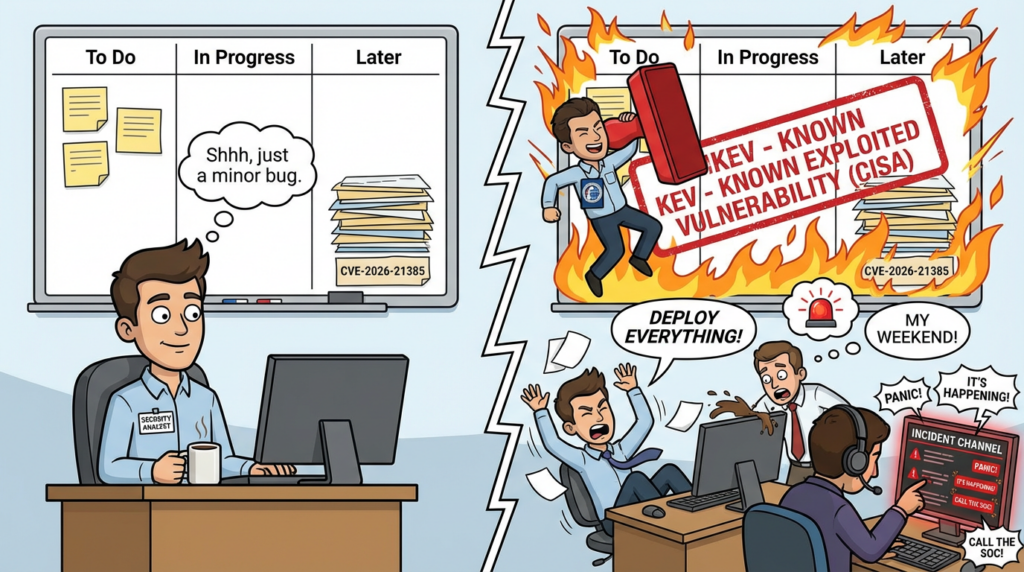
Why a local attack vector does not make this low risk
One of the oldest errors in vulnerability triage is treating local attack vector as equivalent to low operational importance. On Android, that shortcut is especially dangerous. A local memory-corruption issue can still be deeply valuable to an attacker when used as a privilege-escalation stage, a post-compromise strengthening stage, or part of a chain that begins elsewhere. The public record for CVE-2026-21385 does not spell out that chain. It does not need to for defenders to understand the risk model. If the vulnerable device is already a high-value asset, a local component flaw may be exactly what allows an attacker to turn a narrower foothold into stronger device control. (NVD)
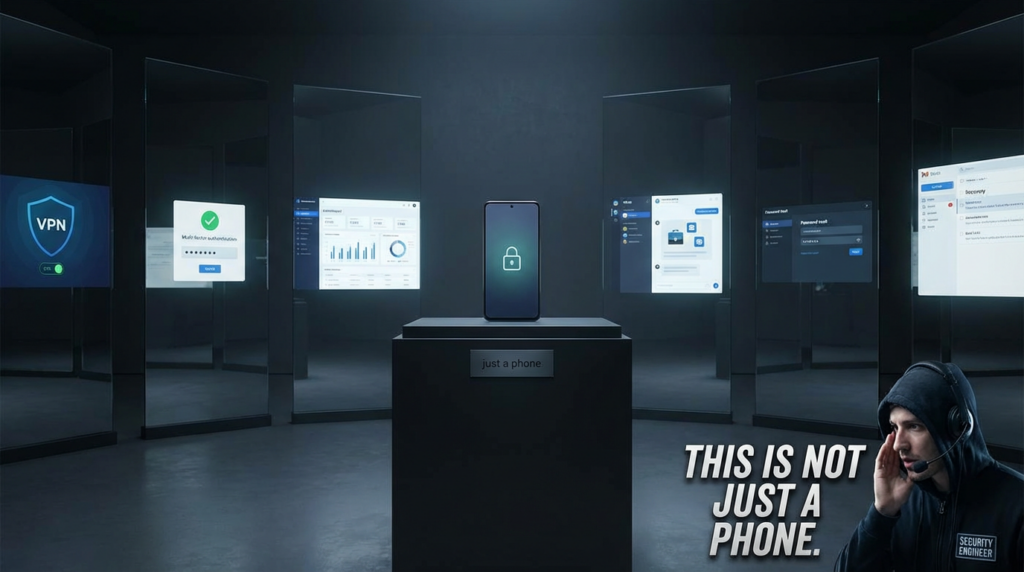
Mobile devices also compress more trust into a smaller footprint than many desktop defenders appreciate. A single Android device may serve as a passwordless authentication factor, a carrier of long-lived enterprise sessions, a browser endpoint for internal tools, a communication archive, and the recovery path for personal or business accounts. A local vulnerability affecting a component deep in the stack may therefore have business significance even if it is never publicly described as a “remote one-click” exploit. Android compromise is rarely about a single clean headline. It is often about stitching together enough control over a highly trusted personal endpoint. (Android Open Source Project)
Google’s own bulletin reinforces this layered view of exploitation by explicitly pointing to Android platform protections and Google Play Protect as mitigations that reduce the likelihood of successful exploitation. That is a subtle but important clue. It suggests Google sees exploitability in context rather than as an isolated CVE database property. Security teams should do the same. A flaw like CVE-2026-21385 is not best understood in binary terms such as “remote or local.” It is best understood as a contributor to attacker capability inside a device-security model that already depends on multiple layers. (Android Open Source Project)
What recent coverage adds, and what it does not
The broader security press adds useful context around timing and scale, but it does not replace the primary sources. CyberScoop reported that Qualcomm said the flaw affects 234 chipsets, that the Android security team reported the issue to Qualcomm on December 18, and that Qualcomm made fixes available to customers in January 2026. It also noted that Google addressed 129 vulnerabilities in the March update and that the second patch level contains fixes for eight closed-source Qualcomm issues and seven open-source Qualcomm issues, including CVE-2026-21385. Those facts help readers understand why the vulnerability is attracting attention. They do not authorize speculation about victim counts, exploit sophistication, or the exact nature of observed attacks. (CyberScoop)
Security commentary from mobile-focused firms like Zimperium adds another useful perspective: component-level Android issues can matter precisely because they sit below traditional app-level control boundaries. That is directionally valuable for defenders, especially those still over-indexing on app vetting while under-indexing on device posture and fleet patch state. But such commentary should still be treated as analysis, not primary-source confirmation of exploit details. The strongest defensible public facts remain the bulletin language, the NVD record, the Qualcomm bulletin, and KEV inclusion. (Zimperium)
That is an important discipline for any serious technical article. Readers do not benefit when journalists’ framing, vendor marketing, and official records are blended into one layer of certainty. They benefit when those sources are separated. In this case, the official sources establish the vulnerability, its classification, its patch placement, and its exploited status signal. Recent news coverage helps show why the issue matters now and why it is drawing disproportionate attention. That is the right way to combine them. (Android Open Source Project)
How defenders should assess real exposure
Start with the 2026-03-05 patch baseline
The first practical question is simple: which Android devices in the environment are below security patch level 2026-03-05. Google’s bulletin is explicit that devices using 2026-03-05 or later address all issues associated with that patch level and previous patch levels. It even specifies the patch string values manufacturers should set: ro.build.version.security_patch من 2026-03-01 أو 2026-03-05. That means defenders do not need to guess their first compliance checkpoint. The baseline is published. The job is to measure against it. (Android Open Source Project)
Too many organizations begin this kind of response by asking which exact handset models are vulnerable. That question is understandable, but it is not the best first move. Android exposure management should begin with patch level because it is measurable, directly tied to Google’s remediation language, and usually easier to verify than an exhaustive affected-model matrix. Once patch posture is clear, device population details and hardware-specific follow-up become much easier to prioritize. (Android Open Source Project)
Identify Qualcomm-dependent population where possible
The next useful step is to determine which Android devices in your environment are likely to depend on Qualcomm-linked components relevant to this patch path. For some teams, MDM data will make that easy. For others, chipset visibility may be partial and device records may stop at manufacturer and model. That is still enough to begin. What matters is not perfect reverse engineering of every handset. What matters is a practical narrowing of the exposed population into something that can be managed under time pressure. (Qualcomm Docs)
If your environment cannot reliably distinguish hardware families centrally, spot validation can still help. Build fingerprint, manufacturer, model, and platform hints are often enough to classify a device for triage purposes. A high-value device below 2026-03-05 does not need a perfect hardware ontology before you escalate it. In exploited-vulnerability response, good-enough evidence applied quickly is often better than waiting for perfect enrichment. (Android Open Source Project)
Prioritize by user criticality, not just device count
CVE-2026-21385 is a textbook example of why user criticality matters more than raw device numbers. If the public signal suggests limited, targeted exploitation, security teams should expect the highest-value devices to be the most relevant, not the most numerous. Executive devices, security-administrator phones, legal and finance staff phones, journalists, researchers, and any device used as a privileged SaaS access anchor should move to the front of the queue. An unpatched lab handset is not the same problem as an unpatched device carrying corporate identity and recovery workflows. (Android Open Source Project)
This matters because organizations often hide behind fleet-scale percentages. Saying that 88 percent of Android devices are compliant may sound reassuring, but it tells you nothing if the noncompliant 12 percent includes your most sensitive users. In targeted-exploitation scenarios, the long tail is often where the real risk sits. The right question is not only “What percentage is patched?” but also “Which people are still exposed?” (Android Open Source Project)
What security teams should do right now
Validate, do not assume
The first task is verification. Security teams should establish how many devices are at or above 2026-03-05, how many are below, how many are unmanaged, and how many cannot yet be confidently assessed. Those numbers should be available at device level and, ideally, broken down by business role. Vendor assurances, internal emails, or generalized “the March patch rolled out” statements are not enough. Android response quality depends on evidence. (Android Open Source Project)
Reduce risky app paths while patching catches up
Google’s bulletin explicitly reminds users that Google Play Protect is enabled by default on devices with Google Mobile Services and is especially important for users who install apps from outside Google Play. That is a useful operational cue. Security teams should review policies around sideloading, app-store restrictions, and managed distribution while patch rollout is underway. These controls do not patch CVE-2026-21385, but they can reduce the number of convenient routes through which an attacker might reach or support exploitation on a lagging device. (Android Open Source Project)
Apply access friction to lagging devices
Where patch rollout is delayed by OEM timelines or user behavior, conditional access becomes important. Sensitive applications and privileged workflows should not treat stale Android devices as fully trusted just because they are mobile. Reauthentication, shorter session lifetime, privileged-action blocking, reduced administrative scope, or temporary web-only access can all reduce business risk while the fleet catches up. These controls are often more feasible than a full immediate lockout and still meaningfully cut attacker opportunity. (Android Open Source Project)
Watch for broader compromise signals
Primary sources do not publish a clean detection signature for this CVE. That means defenders should watch for surrounding symptoms rather than waiting for a named indicator. Suspicious crashes or instability around graphics-adjacent behavior, unexplained device degradation followed by sensitive account use, policy violations involving app installation sources, unusual accessibility settings on high-value phones, or anomalous device-management events should all receive greater attention during the response window. None of these signals uniquely prove exploitation of CVE-2026-21385. They are still the right things to monitor when an exploited Android component issue is live. (Android Open Source Project)
Practical validation commands and defensive checks
ADB commands for spot validation
For small-scale investigation, ADB is still the fastest way to validate the basics.
adb shell getprop ro.build.version.security_patch
adb shell getprop ro.build.fingerprint
adb shell getprop ro.product.manufacturer
adb shell getprop ro.product.model
adb shell getprop ro.board.platform
adb shell getprop ro.hardware
These commands help confirm the patch-level string Google publishes in its bulletin, along with contextual device information that may assist triage. They do not prove exploitation. They do prove whether the device has crossed the remediation baseline Google set for the March 2026 partner-component fixes. (Android Open Source Project)
A simple CSV compliance script
For larger fleets exported from an MDM or asset tool, even a basic review script can quickly separate posture from guesswork.
import csv

TARGET_PATCH = "2026-03-05"

def is_compliant(patch_level: str) -> bool:
    return patch_level >= TARGET_PATCH

with open("android_inventory.csv", newline="") as f:
    reader = csv.DictReader(f)
    for row in reader:
        device = row.get("device_name", "unknown")
        user = row.get("user_name", "unknown")
        role = row.get("business_role", "unknown")
        patch = row.get("security_patch_level", "")
        managed = row.get("managed_state", "unknown")
        manufacturer = row.get("manufacturer", "unknown")

        if not is_compliant(patch):
            print(
                f"NON-COMPLIANT | device={device} | user={user} | "
                f"role={role} | patch={patch} | managed={managed} | manufacturer={manufacturer}"
            )
There is nothing glamorous about this code, and that is precisely the point. Mature response to an exploited mobile vulnerability usually depends less on cleverness than on the ability to prove which devices are below baseline, who uses them, and how quickly that list is shrinking. CVE-2026-21385 is an operational problem first. The faster you can turn raw inventory into action, the better your response will be. (Android Open Source Project)
A simple prioritization table
| Device state | User criticality | الإجراء الموصى به |
|---|---|---|
| Below 2026-03-05 | High-value user | Escalate immediately, require update, restrict privileged access until compliant |
| Below 2026-03-05 | Standard corporate user | Patch within short SLA, reduce risky access paths, enforce app-source policy |
| Unknown patch state | Any business user | Treat as noncompliant until verified |
| At or above 2026-03-05 | High-value user | Confirm additional mobile protections and continue monitoring |
| Unmanaged BYOD below baseline | Sensitive data access | Apply access friction or block until posture is verified |
This kind of table reflects what the public record justifies. It is grounded in the Android patch baseline, the targeted-exploitation signal, and the reality that device and user criticality should both influence remediation order. (Android Open Source Project)

Related CVEs security teams should keep in view
CVE-2026-21385 deserves attention, but security teams should resist the habit of turning one visible CVE into the entire month’s Android story. The same March 2026 bulletin includes CVE-2026-0006 in the System component, which Google says could lead to remote code execution with no additional execution privileges needed and no user interaction required. That alone makes it one of the most important issues in the bulletin. Framework includes CVE-2026-0047 as a critical EoP issue. The 2026-03-05 section also contains critical Kernel-related issues including CVE-2024-43859, CVE-2026-0037, and CVE-2026-0038. (Android Open Source Project)
The reason to mention these is not to imply a public exploit chain involving CVE-2026-21385. No such chain has been officially disclosed. The reason is to explain how Android risk should be managed in reality. Attackers think in combinations. Defenders should, too. A month that includes a critical System RCE, a critical Framework issue, multiple Kernel-level issues, and a Qualcomm component flaw flagged for possible targeted exploitation is a month in which bringing the right devices to the full patch baseline matters more than debating which single CVE should dominate the slide deck. (Android Open Source Project)
This is also why mobile security leaders should avoid overfitting their programs to sensational labels like “zero-day” without considering the rest of the bulletin. A less famous but unpatched adjacent issue can still increase the operational consequences of the named exploited flaw. Mature defense cares about environment state, not just press attention. For March 2026 Android patching, that means the safest posture is to treat the entire relevant release window as urgent on sensitive devices, with CVE-2026-21385 serving as the clearest external escalation signal. (Android Open Source Project)
What this means for enterprise mobile security programs
CVE-2026-21385 exposes a broader organizational weakness many teams still have: they treat mobile devices as important for productivity but secondary for security. That model no longer fits reality. Phones are identity anchors, collaboration endpoints, browser surfaces, and approval channels. They often contain more concentrated trust than laptops, especially for users who rely on mobile MFA, passwordless login, or messaging for sensitive work. A component-level Android vulnerability therefore deserves to be treated as an enterprise trust problem, not as a consumer device inconvenience. (Android Open Source Project)
The mismatch shows up most clearly in patch governance. Server teams usually have defined SLAs. Laptop compliance is often visible. Android posture is frequently less mature: mixed ownership, imperfect inventory, inconsistent MDM depth, and weaker enforcement for unmanaged or executive devices. A vulnerability like CVE-2026-21385 makes those weaknesses visible because the cost of lag is not hypothetical. Once targeted exploitation and KEV status enter the picture, every inventory blind spot becomes more expensive. (Android Open Source Project)
The durable lesson is not complicated. Mobile security programs need trustworthy device inventory, patch-level visibility, user-risk ranking, enforced update pressure where possible, and compensating controls where patch lag is unavoidable. They also need leadership language that does not trivialize mobile risk simply because the device runs in a pocket instead of under a desk. CVE-2026-21385 is exactly the kind of issue that separates organizations that “cover mobile” from organizations that actually govern it. (Android Open Source Project)
CVE-2026-21385 itself is not something any external platform can patch. Google, Qualcomm, OEMs, carriers, and device owners control the actual remediation path. That boundary should be explicit. No security platform should pretend to replace vendor-issued Android or chipset fixes. The responsible role of a platform in a case like this is not patch substitution. It is risk reduction around the environment that trusts vulnerable devices. (Android Open Source Project)
That is where Penligent can fit naturally. When Android devices interact with externally reachable MDM portals, SaaS admin panels, mobile APIs, remote support gateways, helpdesk surfaces, VPN front doors, or internet-facing internal applications, the broader risk is not just the device itself. It is also the enterprise surface that assumes the device is trustworthy. An AI-driven pentesting platform can help teams validate those connected attack surfaces faster, identify weak authentication paths, uncover exposed management endpoints, and reduce the room attackers have to turn a compromised mobile endpoint into a larger enterprise foothold. In that sense, Penligent complements the mobile patch response instead of pretending to replace it. (Android Open Source Project)
This is a better fit than forcing product language into a vulnerability story where it does not belong. The most credible message is simple: vendor patches close the CVE, while exposure validation and automated testing help shrink the surrounding blast radius. When used that way, the connection is practical and honest. (Android Open Source Project)
Final thoughts
The public record for CVE-2026-21385 is sparse, but the operational meaning is not. Qualcomm is the originating vendor in the CVE metadata. NVD classifies the issue as a High-severity memory-corruption flaw tied to CWE-190. Android’s March 2026 bulletin places it in the 2026-03-05 patch tier, associates it with Display, and warns of indications of limited, targeted exploitation. CISA has added it to the Known Exploited Vulnerabilities catalog. Those facts are already enough to justify decisive action from any organization that depends on Android devices for sensitive work. (NVD)
The most useful way to think about this vulnerability is not as a headline label but as a maturity test. Can your organization identify which Android devices are below 2026-03-05. Can it tell which of those devices belong to high-value users. Can it apply update pressure and access friction quickly enough to matter. Can it narrow the surrounding enterprise surface while patch lag works itself out across OEMs. Those are the questions that matter more than whether the public exploit details are entertaining. (Android Open Source Project)
CVE-2026-21385 deserves attention not because the public description is dramatic, but because it has already crossed the thresholds that serious defenders care about: official disclosure, live-exploitation signal, KEV status, and a patch path that depends on one of the most fragmented remediation ecosystems in security. For Android security teams, that is not a footnote. It is an incident until proven otherwise. (Android Open Source Project)
المراجع
- Android Security Bulletin, March 2026 (Android Open Source Project)
- NVD entry for CVE-2026-21385 (NVD)
- CVE.org record for CVE-2026-21385 (مكافحة التطرف العنيف)
- Qualcomm March 2026 Security Bulletin (Qualcomm Docs)
- كتالوج الثغرات الأمنية المعروفة المستغلة CISA (CISA)
- CyberScoop, Google addresses actively exploited Qualcomm zero-day in fresh batch of 129 Android vulnerabilities (CyberScoop)
- Zimperium, Qualcomm Zero-Day Exploited in Targeted Android Attacks (Zimperium)
- CVE-2026-21385, the Qualcomm Android flaw that matters more than its CVSS suggests (بنليجنت)
- CVE-2026-21385, the Qualcomm Android flaw security teams should treat as an incident, not a footnote (بنليجنت)
- CVE 2026, the vulnerabilities that matter most right now (بنليجنت)

 Arabic
  English
  German
  French
  Spanish
  Portuguese
  Japanese
  Korean
  Hindi
Hindi  Turkish
  Hebrew