
CVE-2026-22778 is a critical vulnerability in vLLM’s multimodal processing path. In affected deployments, an attacker can combine a heap-address disclosure with a heap overflow in the video-decoding stack and potentially execute code on the inference server.
The affected range is vLLM 0.8.3 through versions before 0.14.1. The vLLM project fixed the issue in version 0.14.1. The published GitHub advisory assigns a CVSS 3.1 score of 9.8 and describes a network-reachable, low-complexity, no-user-interaction attack. It also states an important boundary that should shape triage: deployments that are not serving a video model are not affected by the complete attack path described in the advisory.
That boundary matters. Finding an old vllm package in an image is not, by itself, proof that an internet-facing service is exploitable. Conversely, a production video-model endpoint on an affected release should not be downgraded merely because it sits behind an API key. The official advisory says the /v1/invocations route can expose the vulnerable processing path before authentication in relevant configurations.
The immediate response is straightforward:
- Inventory every running vLLM service and record its runtime version.
- Identify which instances serve video-capable models or accept video content.
- Upgrade affected instances to vLLM 0.14.1 or a later supported release.
- Until the upgrade is complete, remove untrusted video input from the reachable attack surface.
- Review logs and runtime telemetry for malformed image errors, video-decoder failures, crashes, restarts, and unexpected process or network activity.
The details are more nuanced. CVE-2026-22778 is not simply “a bug in an AI model.” It is a chain across API error handling, Python imaging, OpenCV, FFmpeg, JPEG2000 decoding, process memory, and deployment policy. Understanding those layers is the difference between checking a version box and actually reducing risk.
CVE-2026-22778 at a Glance
| الحقل | Confirmed detail |
|---|---|
| المنتج | vLLM |
| الضعف | Heap-address disclosure chained with a video-decoder heap overflow |
| Primary consequence | Potential remote code execution |
| الإصدارات المتأثرة | vLLM 0.8.3 and later, before 0.14.1 |
| نسخة مصححة | vLLM 0.14.1 |
| CVSS | 9.8 Critical, CVSS 3.1 |
| Relevant interfaces | /v1/chat/completions و /v1/invocations with video input |
| Main exposure condition | An affected vLLM instance serving a video model and processing attacker-controlled video content |
| المصادقة | Default vLLM deployments may have no authentication; the advisory also warns that the invocations path may be reachable before API-key enforcement |
| Published | February 2, 2026 |
| CWE classifications | CWE-122, heap-based buffer overflow, and CWE-532, insertion of sensitive information into a log or error channel |
إن GitHub security advisory is the most detailed primary source. The CVE record provides the standardized affected-version and scoring data, while the vLLM 0.14.1 release marks the official patch boundary.
There is a small but useful wording difference between the sources. The CVE description emphasizes the PIL error that leaks a heap address and says that the leak can be chained with a JPEG2000 decoder overflow. The project advisory presents the complete result as “vLLM RCE in Video Processing.” Those statements are compatible: the CVE tracks the vLLM-controlled weakness, while the security impact comes from combining that weakness with the reachable memory-corruption primitive in the media stack.
Why a Video Input Can Compromise an LLM Server
An LLM inference endpoint often looks like an application-layer service: JSON comes in, tokens come out. A multimodal endpoint is different. Before a model sees a video, the server may fetch a remote resource, parse a container, identify streams, decode compressed frames, resize or transform images, and convert them into tensors. Much of that work occurs in native code.
That means the attack surface is not limited to the model framework. It includes every parser and decoder on the path from the request to the tensor. A GPU may perform the expensive inference, but a CPU-side library can still parse hostile bytes first. If that parser contains a memory-safety flaw, the attacker may never need to interact with model semantics at all.
The vLLM advisory describes this data path:
Attacker-controlled request
        |
        v
video_url supplied to a vLLM multimodal endpoint
        |
        v
vLLM downloads the remote content as bytes
        |
        v
OpenCV VideoCapture processes the in-memory stream
        |
        v
FFmpeg and the JPEG2000 decoder parse encoded frames
        |
        v
Malformed channel mapping causes a heap overflow
The chain begins at an API boundary but crosses several trust boundaries. The remote URL is attacker-influenced. The fetched bytes are untrusted. The media container and codec metadata are untrusted. Yet those bytes reach complex native decoders inside the same process or container that holds model access, credentials, internal network connectivity, and expensive compute resources.
This is why a media-processing vulnerability in an inference service can have consequences far beyond a failed request. Code execution in the serving process may expose model artifacts, environment variables, mounted secrets, cloud metadata access, internal service credentials, request content, and the ability to pivot to adjacent infrastructure. The exact blast radius depends on the deployment, but the security boundary is the process and its surrounding runtime, not the model itself.
The First Link, A Heap Address Leaks Through a PIL Error
Address Space Layout Randomization, or ASLR, makes exploitation less reliable by placing code, libraries, stacks, heaps, and mappings at locations that vary between runs. ASLR is not a repair for memory corruption; it is an exploitation obstacle. If an attacker learns a useful address from the target process, much of that uncertainty can disappear.
In the vulnerable vLLM path, an invalid image causes Pillow, commonly imported as PIL, to raise an exception. A Python BytesIO object may appear in the exception text using a representation similar to this sanitized example:
cannot identify image file <_io.BytesIO object at 0x...>The hexadecimal portion is a process memory address. Returning that raw message to a remote client turns an internal implementation detail into an information disclosure. The project advisory reports that the disclosed heap location substantially reduces the number of guesses needed to locate useful process mappings in the tested environment.
Two qualifications are essential.
First, a heap address is not automatically a shell. It is information that makes a separate memory-corruption exploit more dependable. Treating the leak as equivalent to code execution would overstate what this stage does alone.
Second, address relationships vary across builds, allocators, operating systems, containers, Python versions, native libraries, and runtime state. The advisory describes a working exploit environment and gives a concrete reduction in ASLR uncertainty. Defenders should not assume every deployment has exactly the same offsets, but they also should not rely on offset variation as a control. Attackers adapt exploits to target environments, and standardized container images often make environments more predictable.
The underlying engineering lesson is broader than this CVE. An exception message is data crossing a trust boundary. It can contain addresses, file paths, object representations, SQL fragments, internal hostnames, dependency versions, stack details, and user-supplied content. Production APIs should map internal failures to controlled external errors while preserving detailed diagnostics only in appropriately protected telemetry.
That is what the first vLLM remediation changes addressed. Pull request 31987 improved the error returned to clients, and pull request 32319 standardized the use of vLLM’s error-response helper so sanitization would be applied consistently. The second change matters because a secure helper is not useful when adjacent routes bypass it.
The Second Link, JPEG2000 Channel Mapping Corrupts the Heap
The second part of the chain sits lower in the media stack. The project advisory describes a heap overflow associated with JPEG2000 decoding through the OpenCV and FFmpeg path used for video processing.
JPEG2000 files can contain a channel-definition box known as cdef. Channel definitions tell a decoder how encoded components map to display channels. In a normal file, those mappings help the decoder interpret color and opacity correctly. In the malicious case described by the advisory, a full-resolution luma plane is mapped into a smaller chroma-plane buffer.
For a common subsampled representation:
- The Y, or luma, plane uses approximately
width × heightbytes. - A U chroma plane may use approximately
(width / 2) × (height / 2)bytes. - Writing the Y-sized data into the U-sized allocation overruns the smaller buffer.
The advisory uses a 150 by 64 example. The Y plane requires 9,600 bytes, while the smaller U plane requires 2,400 bytes. The difference is 7,200 bytes written beyond the intended U allocation. The arithmetic is illustrative, but the security issue is concrete: attacker-controlled decoding operations can corrupt neighboring heap objects.
Heap overflows are dangerous because adjacent allocations may contain data pointers, object metadata, reference information, callbacks, or function pointers. The advisory’s exploit path describes corrupting an AVBuffer structure and redirecting a function pointer when that buffer is freed. That is the point where memory corruption can become controlled execution.
This article intentionally does not include a malicious media generator, exact overwrite layout, payload-building code, or a working request. Defenders do not need a weaponized file to determine exposure. Version evidence, model capabilities, route reachability, and safe staging tests provide a reliable path to remediation without risking a crash or code execution in production.
It is also important to use precise component language. OpenCV provides the video API vLLM calls. OpenCV builds commonly use FFmpeg for container and codec handling. FFmpeg’s JPEG2000 path can interact with OpenJPEG-related structures and format semantics, but packaging differs by platform. A Python wheel, Linux distribution package, CUDA image, and custom source build may not contain identical native dependencies. The vLLM version remains the authoritative remediation boundary for this CVE because the project fixed the reachable chain and published 0.14.1 as the patched release.
How the Two Vulnerabilities Become an RCE Chain
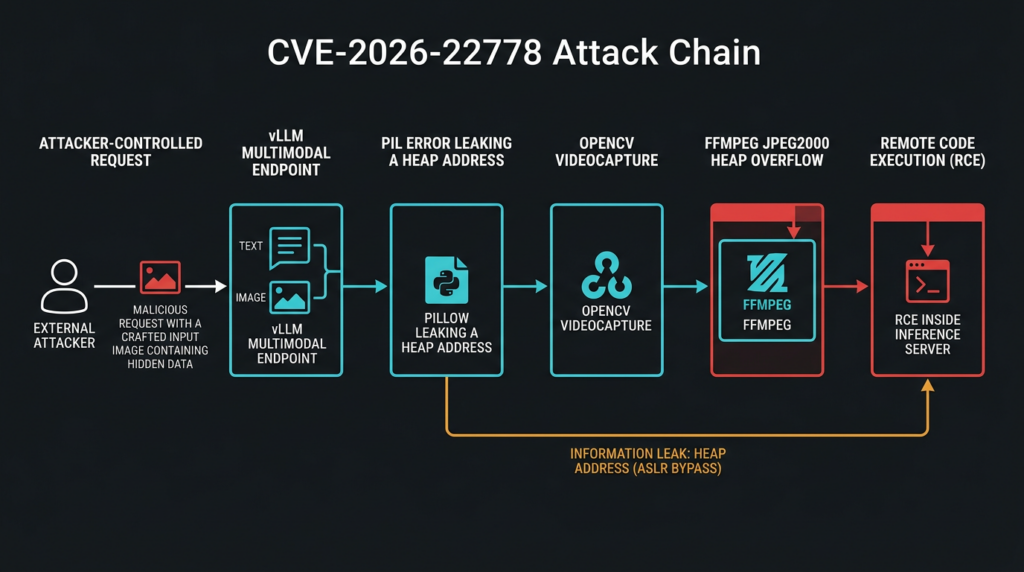
The complete chain can be understood as four security primitives:
| المرحلة | Attacker capability | Security effect |
|---|---|---|
| Error disclosure | Cause an invalid multimodal input to produce a raw PIL exception | Obtain a heap address from the target process |
| ASLR reduction | Use the heap address to infer other process mappings in a target environment | Make native-code exploitation substantially more reliable |
| Decoder overflow | Deliver a video containing malicious JPEG2000 data to the OpenCV-backed path | Write beyond a heap allocation |
| Control-flow hijack | Corrupt a useful target such as a callback or function pointer | Execute attacker-selected code in the vLLM server context |
Each stage compensates for a limitation in the next. The overflow provides write capability but may be unreliable when locations are randomized. The leak supplies location information but does not modify memory. Combining them creates a practical path that neither issue necessarily provides alone.
The attack is also an example of compositional risk. A maintainer can correctly view a verbose error as an information disclosure and a dependency maintainer can separately view a decoder flaw as memory corruption. In the deployed application, the same remote client can reach both conditions in one process. Severity must be evaluated at the composed system boundary.
This is especially relevant in AI infrastructure because application frameworks assemble deep stacks quickly. A serving image may include Python packages, model-specific processors, image libraries, audio and video codecs, CUDA libraries, web servers, tokenizers, and system packages. A vulnerability inventory that only lists the top-level framework misses the paths that determine exploitability.
Which vLLM Deployments Are Actually Affected
The affected software range is simple: vLLM versions from 0.8.3 up to, but not including, 0.14.1. Exposure is conditional.
The project advisory explicitly says that deployments not serving a video model are not affected by the described RCE chain. That does not mean old versions should remain indefinitely, or that they contain no other vulnerabilities. It means the vulnerable video-processing path must be reachable for this specific chain.
Use the following matrix to prioritize response:
| Runtime condition | Likely CVE-2026-22778 priority | Reason |
|---|---|---|
| vLLM before 0.8.3 | Not in the published affected range | The advisory begins the affected range at 0.8.3 |
| vLLM 0.8.3 to 0.14.0, internet reachable, video model enabled | Emergency | Version and primary attack path are present |
| vLLM 0.8.3 to 0.14.0, internal service, video model enabled | عالية | Network restrictions reduce exposure but do not remove malicious tenants, compromised clients, or lateral movement |
| vLLM 0.8.3 to 0.14.0, video model installed but video input disabled at a gateway | High until verified | A routing bypass, alternate endpoint, or direct service access may restore reachability |
| vLLM 0.8.3 to 0.14.0, text-only model and no video route | Lower for this CVE | The advisory excludes deployments not serving a video model from the full chain |
| vLLM 0.14.1 or later | Patched for the published issue | Confirm the running process really uses the updated environment |
| Unknown version or mutable container tag | Treat as unresolved | Inventory uncertainty is a security finding, not evidence of safety |
“Serving a video model” should be verified from runtime configuration, model capabilities, endpoint behavior, and deployment manifests. A service name containing “text” is not sufficient. Teams frequently reuse generic inference images, roll models behind shared gateways, or leave an alternate route enabled for operational testing.
Similarly, an API gateway does not prove the backend is unreachable. Check Kubernetes Services, ingress resources, load balancers, service meshes, node ports, port-forwarding practices, internal DNS, and direct pod access. The relevant question is whether an untrusted principal can cause attacker-controlled video bytes to reach an affected process, not whether the intended public route advertises video support.
Authentication Does Not Replace the Patch
The default vLLM API server may be deployed without authentication. In that case, an exposed vulnerable video endpoint presents the clearest risk: a network client can submit the relevant request without credentials.
Adding an API key improves the general security posture, but it is not an accepted fix for CVE-2026-22778. The project advisory specifically states that the exploit remains feasible in configurations using the optional API key because the invocations route can process the relevant payload before authentication.
Even if a team confirms that its exact build authenticates before media processing, credentials only change who can reach the bug. They do not remove it. Stolen keys, malicious tenants, compromised internal services, CI secrets, and overly broad service accounts can all turn an “authenticated-only” flaw into a practical incident.
Authentication should happen before expensive or dangerous parsing. Authorization should also distinguish capabilities: a caller allowed to submit text should not automatically be allowed to make the server fetch and decode arbitrary remote video. Rate limits, content limits, and tenant isolation add useful friction, but none are substitutes for running a fixed version.
Remote URLs Expand the Trust Boundary
The vulnerable workflow accepts a video_url. For HTTP or HTTPS resources, vLLM retrieves the content and passes downloaded bytes to its media loader. This design is convenient for clients, but it makes the inference server a network client and a media parser at the same time.
Several distinct controls are needed:
- URL authorization decides which schemes, hosts, ports, and destinations the service may contact.
- Redirect handling ensures an allowed public URL cannot redirect to a forbidden internal address.
- Network egress policy limits what the process can reach regardless of application validation.
- Download limits control time, byte count, redirect count, and decompressed resource use.
- Content handling treats declared MIME types and file extensions as hints, not proof of format.
- Decoder isolation limits the damage if a file still reaches a vulnerable native parser.
CVE-2026-22778 is not, by itself, proof of a separate server-side request forgery vulnerability. The fact that a server fetches a client-supplied URL creates an SSRF-sensitive design, but conclusions about address filtering and internal-resource access require their own evidence. Keeping those issues separate preserves technical accuracy while still encouraging the right architectural controls.
Safe Exposure Checks Without Sending a Malicious Video
Production triage does not require exploit reproduction. Start with passive and configuration-based checks.
Check the Installed Python Package
Run this inside the same environment as the serving process:
python -c 'from importlib.metadata import version; print(version("vllm"))'If the command prints a version from 0.8.3 through 0.14.0, the software is in the affected range. If it prints 0.14.1 or later, retain the result as evidence but verify that the serving process uses that interpreter and environment.
Package managers provide a second view:
python -m pip show vllm
python -m pip freeze | grep -i '^vllm=='
Do not rely exclusively on a lockfile. A rebuilt image, editable install, mounted virtual environment, stale pod, or failed rollout can make the running package differ from the declared dependency.
Check Containers and Images
Record the image by immutable digest where possible:
docker inspect --format '{{.Image}} {{.Config.Image}}' <container_name>
docker exec <container_name> python -c \
  'from importlib.metadata import version; print(version("vllm"))'
For Kubernetes, identify workloads that reference vLLM-related images and capture their current image IDs:
kubectl get deploy,statefulset,daemonset -A \
  -o custom-columns='KIND:.kind,NS:.metadata.namespace,NAME:.metadata.name,IMAGES:.spec.template.spec.containers[*].image'

kubectl get pods -A \
  -o custom-columns='NS:.metadata.namespace,POD:.metadata.name,IMAGE_ID:.status.containerStatuses[*].imageID'
Avoid assuming that a tag such as latest, stable, or an internal release name maps to one fixed artifact. Mutable tags also make incident reconstruction harder because the same label can refer to different images over time.
Establish Whether Video Processing Is Reachable
Review the server command line, model configuration, chat templates, API route configuration, gateway policies, and model documentation. Ask these questions:
- Does the loaded model support video input?
- Do
/v1/chat/completionsأو/v1/invocationsaccept video content? - Can a request reference an HTTP or HTTPS video URL?
- Which identities can reach the backend directly or through a gateway?
- Does authentication occur before URL retrieval and media parsing?
- Are there alternate routes that bypass the primary gateway?
- Can one tenant supply media processed in another tenant’s shared process?
Use a known-good, non-sensitive video in an authorized staging environment if functional confirmation is necessary. Do not upload malformed JPEG2000 content to production. A decoder crash can create an outage, destroy volatile evidence, or trigger code execution if the test artifact is unsafe.
Build an Evidence Record
A defensible exposure record should include:
| الأدلة | What to capture |
|---|---|
| Runtime version | Command output from the serving container or host |
| Artifact identity | Image digest, package hash, and deployment revision |
| Model capability | Exact model name and confirmation of video support |
| Route exposure | Gateway route, direct service route, network policy, and reachable principals |
| Input policy | Whether remote URLs, uploads, redirects, and data URLs are accepted |
| Authentication order | Proof that identity checks occur before or after media handling |
| Patch verification | Version after rollout plus a restart or replacement timestamp |
| Regression result | Successful legitimate requests and sanitized failure responses in staging |
This record is more useful than a binary scanner result. It supports remediation, audit, incident response, and future architecture decisions.
Detection Opportunities and Their Limits
There is no single log line that reliably proves exploitation. Detection should combine request telemetry, application errors, native crashes, container events, host behavior, and network activity.
| Data source | الإشارة | Interpretation | التقييد |
|---|---|---|---|
| بوابة واجهة برمجة التطبيقات | Bursts of multimodal requests containing video_url | Possible probing or normal video workload | Request shape alone is not malicious |
| vLLM application log | PIL “cannot identify image file” errors | Invalid image reached the image-processing path | Common with broken client input; may show only the leak stage |
| Error response capture | _io.BytesIO object at 0x... returned to a client | Strong evidence of the address-disclosure behavior | Does not prove memory corruption or code execution |
| OpenCV or FFmpeg log | JPEG2000, MOV, MP4, or decoder errors | Suspicious when correlated with unknown remote URLs | Media errors also occur naturally |
| Kernel or runtime | Segmentation fault, abort, illegal instruction | Potential decoder crash or failed exploitation | Many software defects can crash a process |
| Kubernetes | Repeated pod restarts or OOMKilled and error transitions | Service instability around suspicious requests | Resource pressure can produce similar events |
| EDR | Child process launched by Python or vLLM | High-value signal for a model server that should not spawn shells | Some legitimate wrappers launch helper processes |
| Network telemetry | New outbound connection after a decoder failure | Possible command-and-control or payload retrieval | The service already makes expected outbound media requests |
| File integrity | New executable, cron entry, SSH key, or modified startup file | Possible persistence after code execution | Requires a known baseline |
The leaked-address pattern is particularly useful for retrospective review. Search stored client responses, reverse-proxy bodies where legally and operationally appropriate, exception telemetry, and support traces for a BytesIO object followed by a hexadecimal address. Handle those records as sensitive because the logs themselves may preserve exploit-enabling information.
Generic search logic might look like this:
event.category = application
AND message contains "cannot identify image file"
AND message contains "BytesIO object at 0x"
Treat this as a hunting idea, not a universal signature. Logging formats differ, patched code may replace the detail, and an attacker may proceed without producing a retained response. A lack of matching logs is not proof that exploitation did not occur.
For process behavior, focus on deviations from the serving baseline. A vLLM worker generally should not launch sh, باش, command interpreters, download tools, package managers, or reconnaissance utilities. Alert on unexpected descendants of the Python or vLLM process, especially when preceded by decoder errors or requests from unusual clients.
Network analysis must account for the service’s normal behavior. Because the application may legitimately retrieve remote media, an outbound HTTP request is not inherently suspicious. Higher-confidence patterns include connections to newly observed destinations after a native crash, DNS lookups unrelated to submitted media hosts, connections on unusual ports, access to cloud metadata addresses, or traffic from a replacement process that should not have egress.
Incident Response if Exploitation Is Plausible
If a vulnerable video-serving instance was reachable by untrusted users, absence of a public indicator list should not become a reason to wait. Prioritize evidence preservation and containment.
Preserve Volatile and Centralized Evidence
Capture, according to your organization’s procedures:
- Load balancer, API gateway, WAF, and service-mesh request metadata.
- Request bodies or relevant structured fields if retention is permitted.
- vLLM application logs and Python exception telemetry.
- Container stdout and stderr, runtime events, and pod status history.
- Kernel logs containing segfault or process termination information.
- Process trees, open connections, loaded libraries, and mounted volumes.
- Cloud audit events and secret-access records.
- The exact image digest and deployment configuration.
- Copies or snapshots of affected containers and nodes when feasible.
Do not restart everything before collecting volatile data unless continued operation creates an unacceptable risk. Restarts can remove process memory, temporary files, network state, and crash context. At the same time, evidence preservation should not delay urgent isolation of a system believed to be under active attacker control.
Correlate Requests With Runtime Events
Build a timeline around:
- Invalid image errors that exposed object addresses.
- Requests containing video URLs from new or anomalous clients.
- Decoder warnings and failures.
- Worker crashes, pod replacements, or health-check failures.
- Unexpected process creation.
- Access to secrets, metadata services, storage, or internal APIs.
- New outbound connections.
The strongest conclusion comes from correlated evidence. For example, an address-bearing PIL response followed by a video request from the same source, then a worker crash and an unexpected shell child is materially different from an isolated malformed-image error.
Contain and Rebuild
Remove the vulnerable endpoint from service, isolate affected workloads, block suspicious sources and destinations where useful, and deploy a known-good image containing vLLM 0.14.1 or later. Rebuilding is preferable to attempting to clean a container or host after plausible code execution.
Rotate credentials that the process could access. This may include cloud tokens, object-storage keys, model-registry credentials, database passwords, API keys, service-account tokens, SSH material, and secrets mounted from orchestration systems. Review downstream systems for use of those credentials after the suspected compromise time.
If the server had access to proprietary model weights or sensitive prompts, include those assets in the impact analysis. Remote code execution in an inference process can affect confidentiality even when no customer database sits on the same host.
The Correct Fix Is vLLM 0.14.1 or Later
The vLLM project identifies version 0.14.1 as the fixed release. Upgrade the complete serving environment, replace running instances, and verify the runtime package after deployment.
python -m pip install --upgrade 'vllm>=0.14.1'
python -c 'from importlib.metadata import version; print(version("vllm"))'
In production, follow the project’s supported installation method and your normal image build process rather than modifying live containers. Pin an approved version or immutable image digest, rebuild from a controlled base, run tests, sign or attest the artifact if your pipeline supports it, and roll out with observable health checks.
The 0.14.1 release is described as a patch release addressing security and memory-leak fixes on top of 0.14.0. The advisory references multiple remediation pull requests, including the error-sanitization changes and an additional fix. This is why reducing the remedy to “hide the pointer” is incomplete.
Sanitizing the PIL exception removes the disclosed address. It does not make a vulnerable native decoder memory-safe. Updating only a transitive media package may reduce one observed path but does not establish that the vLLM application-level chain, route behavior, and error handling match the project-supported fix. The top-level vLLM upgrade is the clear, testable remediation boundary.
Temporary Mitigations When an Immediate Upgrade Is Impossible
Temporary controls should be treated as time-buying measures, not permanent acceptance of a critical flaw.
Disable Video Inputs
The strongest temporary application control is to stop processing video entirely on affected instances. Remove video-capable models from reachable services, reject video content parts, disable the relevant routes, or route requests to a patched pool.
Confirm the block at more than one layer. A gateway rule may cover /v1/chat/completions but miss /v1/invocations, an internal service address, a versioned alias, or a second ingress. Test the policy with harmless requests in an authorized environment.
Remove Arbitrary Remote Media Retrieval
If the product can operate with prevalidated internal objects, reject arbitrary client-selected URLs. Use short-lived references to controlled storage, allowlisted origins, strict redirect policies, and server-side object validation. This reduces the attacker’s ability to deliver arbitrary bytes and limits unrelated URL-fetching risks.
An allowlist should resolve and validate destinations safely, account for redirects, and be reinforced by egress controls. String-prefix checks and DNS checks performed only once are fragile.
Restrict Network Reachability
Place the service behind a gateway, require strong identity, restrict source networks, and remove direct pod or node exposure. Network restrictions are valuable because they reduce the set of actors who can reach the parser. They do not eliminate the vulnerability and may not protect a multi-tenant environment from a malicious authorized client.
Harden the Runtime
Run the inference service as a non-root user with a read-only root filesystem where practical. Drop Linux capabilities, apply seccomp or equivalent syscall restrictions, isolate workloads by trust level, avoid mounting host sockets, and minimize writable volumes. Restrict egress to destinations the service genuinely needs.
Keep high-value credentials out of the video-decoding process. Use workload identity with narrow permissions and short lifetimes. Separate model retrieval from steady-state serving so production workers do not retain broad registry or object-store access.
These controls do not prevent memory corruption, but they can reduce the damage after code execution.
Isolate Media Processing
Longer term, treat image, audio, document, and video decoding as hostile-file processing. Run decoders in a separate, low-privilege sandbox with strict CPU, memory, time, filesystem, and network limits. Return normalized media or tensors across a narrow interface rather than decoding untrusted formats in the primary inference process.
Isolation is not free. It adds latency, operational complexity, and another service boundary. For internet-facing multimodal systems, that tradeoff is often justified because native parser vulnerabilities recur across formats and libraries.
Controls That Are Not Sufficient by Themselves
Several measures sound reassuring but do not close the published issue:
| التحكم | Why it is insufficient alone |
|---|---|
| API key | The advisory warns about a relevant pre-authentication path, and authorized credentials can be stolen or abused |
| WAF | A WAF may not decode or understand nested media fetched by the backend |
| التحقق من صحة نوع MIME | Extensions and content types are attacker-controlled and do not prove safe decoder behavior |
| Hiding error details | Removes the known leak but not necessarily the heap overflow or other address sources |
| Updating OpenCV only | Does not establish the complete project-supported remediation state |
| Containerization | Code still executes inside the container and may reach secrets, networks, mounted files, or runtime weaknesses |
| ASLR | The chain was designed to reduce ASLR uncertainty; ASLR never repairs the overflow |
| Internal-only exposure | Compromised internal clients, malicious tenants, and lateral movement remain possible |
| Crash monitoring | Detects some failures after the parser is reached but does not prevent successful exploitation |
Defense in depth matters, but layering incomplete controls does not create the same assurance as removing the known vulnerable code path.
Patch Verification and Regression Testing
An upgrade is complete only when the running workload and exposed behavior match the intended state.
Verify the Runtime
Check the package version inside every new pod or container. Compare image digests before and after rollout. Confirm that old replicas, canary pools, autoscaling templates, disaster-recovery environments, and batch workers are not still serving traffic.
Look for partial rollouts. Kubernetes may retain old pods because of unavailable capacity, failing readiness probes, a paused deployment, or a separate StatefulSet. Cloud instance groups and edge deployments can lag behind the main cluster.
Verify Error Sanitization Safely
In an isolated, authorized test environment, submit benign invalid image data through the supported API and confirm that the external response does not include object addresses, internal paths, stack traces, or raw exception representations. The expected result is a controlled client error.
Do not perform this test against systems you do not own or have explicit permission to assess. Do not use a file designed to trigger memory corruption. The goal is to validate error handling, not reproduce the full exploit.
Test Legitimate Video Workloads
Run representative valid videos across the formats, sizes, durations, and models your service supports. Confirm latency, resource consumption, frame sampling, output quality, cancellation, and timeout behavior. Security fixes that break normal media processing may be rolled back under operational pressure, so regression evidence is part of a durable remediation.
Verify Authentication Order
Use controlled requests without credentials and with invalid credentials. Confirm that the gateway and application reject them before remote URL retrieval or media decoding. Review access and egress logs to ensure rejected requests did not trigger downloads.
This check remains valuable after patching because it limits future parser vulnerabilities and resource-exhaustion attacks.
Verify URL and Egress Policy
Test allowed and denied domains, redirects, private address ranges, unusual ports, oversized objects, slow responses, and content that does not match its declared type. Use harmless fixtures in a lab. Confirm both application behavior and network-policy enforcement.
Record Closure Criteria
Close the finding only when:
- Every relevant runtime reports vLLM 0.14.1 or later.
- No affected video-serving replica remains reachable.
- Error responses are sanitized.
- Legitimate video requests still work.
- Authentication occurs before media processing where applicable.
- Temporary blocks are either retained as hardening or removed through an approved change.
- Detection and incident-review decisions are documented.
Improving the Architecture Beyond This Patch
CVE-2026-22778 highlights a recurring mistake in AI threat models: teams focus on prompts, model output, and GPU isolation while treating media preprocessing as ordinary plumbing. The “plumbing” parses some of the most hostile data in the system.
Map Capabilities, Not Just Packages
An SBOM can tell you that vLLM, OpenCV, FFmpeg, or Pillow exists. It cannot by itself tell you whether a public route reaches a video decoder. Add runtime capability data to vulnerability management:
- Which models accept text, images, audio, or video.
- Which endpoints expose each modality.
- Which routes retrieve remote content.
- Which native libraries process each format.
- Which tenant and identity boundaries apply.
- Which processes possess secrets or broad network access.
This turns a long list of packages into an attack-path inventory.
Separate Fetching, Validation, and Inference
Remote retrieval, media parsing, and model inference have different risk profiles. A safer design separates them:
- A constrained fetcher retrieves from approved destinations with strict limits.
- A sandboxed processor validates and normalizes the media.
- A clean inference worker receives a narrow representation.
The boundaries should use authenticated channels, immutable object references, integrity checks, and explicit size and type metadata. The inference worker should not need unrestricted internet access merely because a client can submit a URL.
Minimize Shared Fate
Do not place workloads with different trust levels in one long-lived process. A public demo, an internal analyst tool, and a production customer API should not necessarily share the same model worker, credentials, or node. Process and tenant separation can prevent a low-trust media parser from becoming a bridge to high-value workloads.
Treat Error Schemas as Security Interfaces
Define an external error schema with stable codes, safe messages, and request correlation identifiers. Keep internal exceptions behind access controls. Add tests that fail when responses contain stack traces, memory-address patterns, filesystem paths, secret-like values, or raw object representations.
Central logs also need care. CWE-532 is commonly described as sensitive information in logs, but the practical boundary here is any diagnostic channel that an untrusted client can observe. Logs, traces, support bundles, API responses, and debugging proxies should all follow data-minimization rules.
Continuously Validate Reachability
Dependency scanning should trigger a question, not end the investigation: can untrusted input reach the vulnerable function in this deployment? Teams can codify that question through deployment tests, route inventory, configuration policy, and safe authenticated probes.
Where authorized automated validation is part of the security program, بنليجنت can support repeatable attack-surface checks and evidence capture around exposed AI services. The useful outcome is not an automated “vulnerable” badge; it is a reproducible record connecting a reachable endpoint, its runtime version, its enabled modality, and the post-remediation result. No scanner should send weaponized media to production by default.
Common Triage Mistakes
Marking Every vLLM Deployment as Critical Without Context
The package range matters, but the advisory’s video-model limitation also matters. A text-only service may be in the affected version range without exposing this complete path. Record it for upgrade, but prioritize reachable video-serving instances first.
Treating “Internal” as “Trusted”
Internal networks contain compromised laptops, CI workers, partner connections, shared tenants, and services with broad credentials. Network placement changes likelihood; it does not make hostile input impossible.
Checking the Build File Instead of the Running Process
A corrected requirements.txt does not replace old pods. Verify the package in the runtime and identify the artifact by digest.
Reproducing the Exploit in Production
Active exploitation is unnecessary for basic exposure confirmation and can cause code execution or service disruption. Use non-destructive evidence first. If exploit validation is required, use an isolated lab, explicit authorization, representative but non-sensitive infrastructure, and a documented stop condition.
Assuming No Crash Means No Exploitation
Successful memory-corruption exploits are often designed not to crash. Conversely, a crash does not prove an attacker gained execution. Use correlated telemetry.
Fixing Only the Error Message
The leak is one component of a chain. Follow the vLLM project’s patched-version guidance rather than backporting a cosmetic error change and declaring closure.
Ignoring Secrets Because the Service Runs in a Container
Containers frequently receive service-account tokens, model-storage credentials, environment secrets, writable volumes, and internal network access. Inventory what the serving process could reach and reduce it before the next parser bug arrives.
A Practical Remediation Runbook
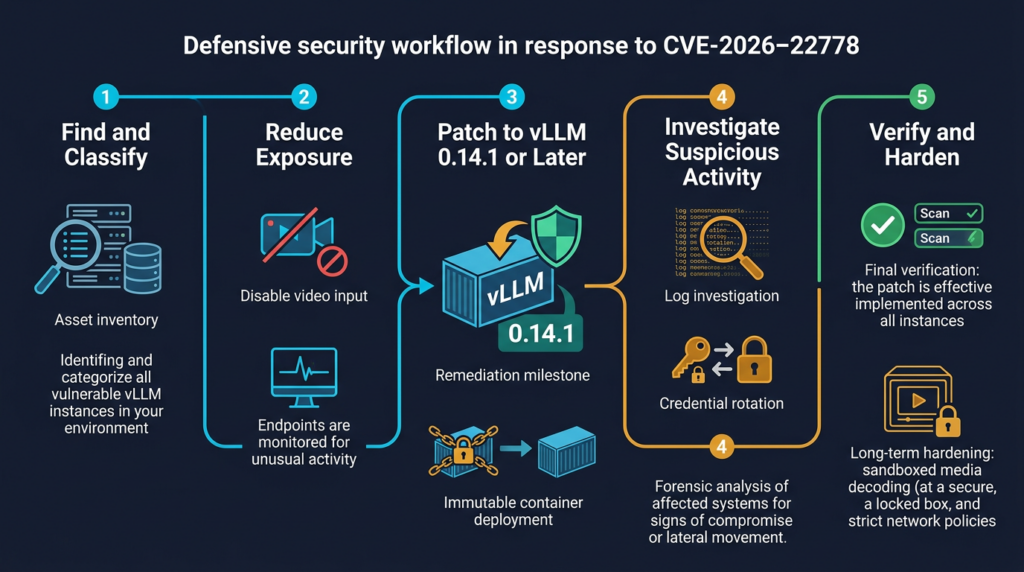
For teams handling many clusters, the following sequence balances speed and evidence quality.
Phase One, Find and Classify
- Search image registries, Kubernetes workloads, virtual machines, and Python environments for vLLM.
- Record runtime versions and immutable artifact identifiers.
- Identify video-capable models and reachable multimodal routes.
- Classify reachability by internet, partner, tenant, internal, or isolated access.
- Identify whether remote video URLs are accepted.
- Mark affected, reachable video services for emergency change.
Phase Two, Reduce Exposure
- Disable video input or remove the service from reachable routes.
- Block alternate endpoints and direct backend access.
- Restrict remote media retrieval and egress.
- Increase monitoring for decoder failures, restarts, child processes, and unusual connections.
- Preserve relevant logs before retention windows expire.
Phase Three, Patch
- Build a vLLM 0.14.1 or later image using approved dependencies.
- Run legitimate video regression tests.
- Verify controlled error responses in staging.
- Roll out by immutable digest.
- Confirm every replica and autoscaling template uses the fixed artifact.
Phase Four, Investigate
- Search historical responses and logs for the address-bearing PIL error.
- Correlate suspicious media requests with native crashes and process behavior.
- Review secret access and downstream authentication events.
- Escalate to full incident response when evidence suggests code execution or when exposure and telemetry gaps make compromise materially plausible.
Phase Five, Harden
- Put authentication and authorization before retrieval and parsing.
- Separate untrusted media processing from model inference.
- Enforce egress, filesystem, capability, and credential boundaries.
- Add modality and route reachability to asset inventory.
- Add sanitized-error and safe-media tests to release gates.
Frequently Asked Questions
Does CVE-2026-22778 affect every vLLM server?
- No. The published affected software range is vLLM 0.8.3 through versions before 0.14.1.
- The project advisory says deployments that do not serve a video model are not affected by the complete RCE path it describes.
- A precise assessment also checks whether attacker-controlled video can reach
/v1/chat/completions,/v1/invocations, or an equivalent enabled route. - Even text-only deployments should move to a supported patched release through normal security maintenance, but reachable video services deserve the highest urgency.
Is CVE-2026-22778 remotely exploitable without credentials?
- The advisory assigns a network attack vector and no privileges required in its CVSS 3.1 vector.
- Default vLLM instances may be deployed without authentication.
- The advisory also states that enabling the optional API key may not block the relevant invocations path because processing can occur before authentication.
- Defenders should patch rather than treating an API key as a compensating fix.
Can I verify exposure without running a proof of concept?
- Yes. Check the runtime vLLM version inside the actual serving container or environment.
- Confirm whether the loaded model supports video and whether video routes accept untrusted content or remote URLs.
- Map who can reach the route and whether any alternate path bypasses the gateway.
- Use only benign functional and error-sanitization tests in an authorized staging environment.
- A weaponized JPEG2000 file is not required for routine triage and should not be sent to production.
Is upgrading OpenCV or FFmpeg enough?
- Not as the primary remediation claim for this CVE.
- The published vLLM fix boundary is version 0.14.1, and the remediation includes vLLM error-handling and processing-path changes.
- Native-library updates can be valuable defense in depth, but packaging and backend selection differ across environments.
- Upgrade vLLM to 0.14.1 or later, rebuild the image, and verify the running process.
How can I tell whether CVE-2026-22778 was exploited?
- Look for address-bearing PIL errors, suspicious video URL requests, JPEG2000 or decoder failures, process crashes, and container restarts.
- Correlate those events with unexpected child processes, file changes, secret access, or outbound connections.
- A leaked address alone does not prove RCE, and a lack of crashes does not prove safety.
- If an affected video endpoint was exposed and telemetry is incomplete, use an incident-response process to assess credentials, model assets, customer data, and adjacent systems.
Does running vLLM in Docker or Kubernetes stop the exploit?
- No. The attacker may still execute code inside the vLLM container.
- Container boundaries can reduce impact when the workload is non-root, capabilities are dropped, filesystems are read-only, secrets are minimal, and egress is restricted.
- Weak configurations, mounted sockets, privileged containers, broad service accounts, and host volumes can greatly expand the blast radius.
- Container hardening is defense in depth, not a patch.
What should I do if I cannot upgrade immediately?
- Disable video processing and remove video-capable models from reachable affected instances.
- Block both chat-completions and invocations paths that can carry video.
- Restrict direct backend access, remote media URLs, redirects, and outbound network destinations.
- Monitor aggressively and schedule the upgrade as an emergency change.
- Document that these are temporary controls and verify them with harmless tests.
What is the minimum secure end state?
- Run vLLM 0.14.1 or a later supported release on every relevant replica.
- Verify that external errors contain no raw exceptions or memory addresses.
- Put authentication and authorization before URL retrieval and media parsing.
- Restrict remote content fetching and isolate native media decoding where feasible.
- Run the service with minimal credentials, filesystem access, Linux capabilities, and network egress.
- Keep evidence showing the runtime version, route exposure, regression results, and completed incident review.
CVE-2026-22778 deserves urgent action wherever an affected vLLM release serves video to untrusted clients. Its severity comes from composition: a Python imaging error discloses a useful address, a native video-decoding path supplies heap corruption, and the API makes both reachable across a network.
The response should remain equally compositional. Confirm the runtime, model modality, routes, authentication order, URL policy, and surrounding privileges. Upgrade to vLLM 0.14.1 or later. Review exposed systems for evidence of probing or execution. Then reduce the chance that the next media-parser flaw lands inside a credentialed, network-connected inference process.
The shortest reliable priority order is: patch reachable video servers first, disable video where patching is delayed, investigate correlated anomalies, and turn media preprocessing into an explicit security boundary.
 Arabic
  English
  German
  French
  Spanish
  Portuguese
  Japanese
  Korean
  Hindi
Hindi  Turkish
  Hebrew