
Microsoft Exchange vulnerabilities deserve attention whenever they cross an authentication boundary. CVE-2026-62911 is particularly important because the flaw is not simply another post-authentication privilege escalation hidden inside an administrative interface. It is associated with a capture-replay authentication bypass demonstrated as part of a successful Microsoft Exchange attack at Pwn2Own Berlin 2026.
Microsoft published CVE-2026-62911 on August 11, 2026 and describes it as an Exchange Server elevation-of-privilege vulnerability caused by an authentication bypass through capture-replay. Microsoft assigned the issue a CVSS 3.1 score of 8.0 with network reachability, low attack complexity, low privileges required, user interaction required, and high confidentiality, integrity, and availability impact. The weakness is categorized as CWE-294, Authentication Bypass by Capture-Replay. (NVD)
That description, however, does not tell the entire story.
TrendAI Zero Day Initiative, which handled the Pwn2Own submission, published a dedicated advisory for the capture-replay component under ZDI-26-534. ZDI says remote attackers can bypass authentication on vulnerable Exchange installations and explicitly states that authentication is not required for this particular weakness. ZDI attributes the problem to the way Exchange handles authentication requests and says a weaker alternative authentication path can be abused to bypass the expected authentication boundary. ZDI gives this component a CVSS score of 8.1 with no privileges and no user interaction required, but higher attack complexity. (Zero Day Initiative)
That discrepancy is central to understanding CVE-2026-62911.
The vulnerability should therefore not be evaluated purely by looking at Microsoft’s 8.0 score. It should be evaluated as part of a real, successfully demonstrated Exchange compromise chain in which an authentication weakness can remove one of the most important security barriers protecting an on-premises mail server.
CVE-2026-62911 at a Glance
CVE-2026-62911 was publicly disclosed on August 11, 2026. Microsoft’s CVE record identifies affected installations of Exchange Server 2016 CU23, Exchange Server 2019 CU14, Exchange Server 2019 CU15, and Exchange Server Subscription Edition RTM. The fixed build thresholds published with the CVE correspond to the August 2026 Exchange security updates. (NVD)
| السمة | التفاصيل |
|---|---|
| مكافحة التطرف العنيف | CVE-2026-62911 |
| المنتج | Microsoft Exchange Server |
| Microsoft classification | رفع الامتيازات |
| Core weakness | Authentication Bypass by Capture-Replay |
| CWE | CWE-294 |
| Microsoft CVSS | 8.0 High |
| Microsoft vector | CVSS:3.1/AV:N/AC:L/PR:L/UI:R/S:U/C:H/I:H/A:H |
| ZDI capture-replay score | 8.1 |
| ZDI vector | AV:N/AC:H/PR:N/UI:N/S:U/C:H/I:H/A:H |
| Attack surface | Network |
| Disclosure date | August 11, 2026 |
| Researcher | Orange Tsai of DEVCORE Research Team |
| Pwn2Own connection | Microsoft Exchange exploit chain at Pwn2Own Berlin 2026 |
| Fixed | August 2026 Exchange Security Updates |
One distinction matters immediately: a working exploit demonstrated during Pwn2Own is not the same thing as confirmed exploitation in the wild.
CISA’s enrichment data associated with the CVE listed exploitation as “none” shortly after disclosure and classified the flaw as not readily automatable, while assigning the potential technical impact as total. In other words, defenders should not interpret the Pwn2Own demonstration as evidence that mass exploitation campaigns are already occurring, but neither should they mistake the vulnerability for a purely theoretical weakness. (NVD)
Why CVE-2026-62911 Is More Important Than Its CVSS Score Suggests
A CVSS score of 8.0 can easily disappear inside a large Patch Tuesday queue. That would be a mistake here.
The first reason is that the vulnerability attacks authentication rather than merely exploiting functionality available after authentication. Authentication controls the boundary between an attacker on the network and the internal capabilities of Exchange. When that boundary becomes unreliable, other vulnerabilities that normally require credentials can become significantly more useful.
The second reason is empirical evidence.
This attack was not inferred from a code diff after Microsoft’s patch. It traces back to a successful Pwn2Own attack.
During Pwn2Own Berlin on May 15, 2026, Orange Tsai of DEVCORE Research Team chained three vulnerabilities against Microsoft Exchange and achieved remote code execution as SYSTEM. The successful entry earned $200,000 and 20 Master of Pwn points. (Zero Day Initiative)
The competition rules are also revealing. For the Exchange Server category, Pwn2Own required attacks involving authenticated services either to occur before authentication or to contain an authentication bypass. The Exchange target carried a $200,000 prize. (Zero Day Initiative)
This makes CVE-2026-62911 materially different from a vulnerability whose exploitability has only been estimated from static analysis.
A skilled researcher already crossed the relevant boundary under controlled conditions.
The Pwn2Own Berlin Origin of CVE-2026-62911
The Exchange attack was scheduled for May 15 during the second day of Pwn2Own Berlin 2026. Orange Tsai targeted Microsoft Exchange in the Server category, where a successful entry was worth $200,000. (Zero Day Initiative)
ZDI later confirmed that the attempt succeeded by chaining three bugs and achieving code execution as SYSTEM on the Exchange server. (Zero Day Initiative)
When the vulnerabilities were coordinated and publicly disclosed in August, ZDI published multiple advisories associated with CVE-2026-62911.
This is an unusual and important detail.
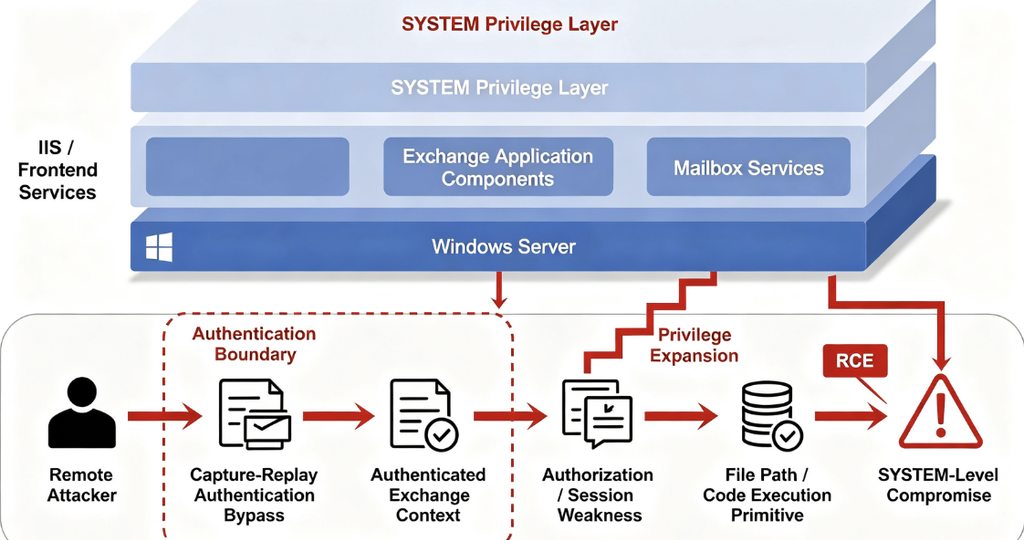
ZDI-26-534 describes the capture-replay authentication bypass. ZDI-26-535 describes an external-control-of-file-path issue that can lead to remote code execution. ZDI-26-538 describes improper authorization and session-management behavior that can lead to privilege escalation. All three advisories reference CVE-2026-62911. (Zero Day Initiative)
This means defenders should be careful about treating the Microsoft CVE description as a complete technical decomposition of what researchers demonstrated.
The capture-replay problem is especially significant because it provides the authentication-breaking primitive around which other post-authentication weaknesses can become much more dangerous.
ZDI’s RCE advisory states that authentication would ordinarily be required to reach the vulnerable file-path behavior, but that the existing authentication mechanism can be bypassed. Successful exploitation of that path can ultimately result in arbitrary code execution as SYSTEM. (Zero Day Initiative)
Similarly, ZDI’s privilege-escalation advisory says the affected authorization logic suffers from improper session management and can be combined with other vulnerabilities to execute code as SYSTEM. (Zero Day Initiative)
This is a classic vulnerability-chain problem.
One weakness defeats identity. Another expands authorization. Another turns newly gained capabilities into code execution.
Attackers do not care whether those primitives receive one CVE number or three. They care whether the sequence reaches SYSTEM.
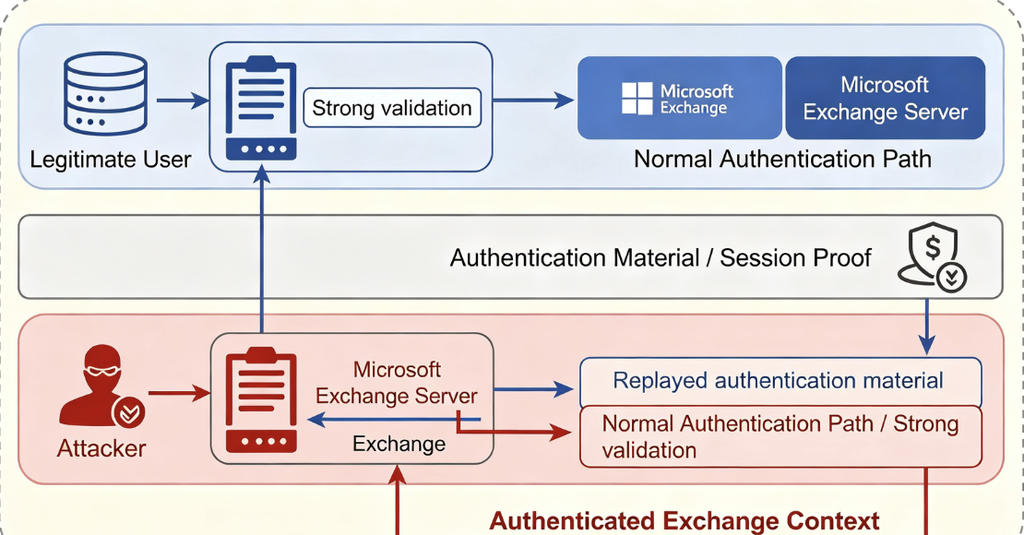
What Is a Capture-Replay Authentication Bypass?
To understand CVE-2026-62911, it helps to distinguish authentication replay from password theft.
Suppose a legitimate user proves their identity to a server. The authentication process generates or exchanges some artifact that the server accepts as evidence that the client is authorized.
Depending on the protocol, that artifact could conceptually resemble a session credential, authentication token, challenge response, signed request, ticket, or another proof derived from valid credentials.
A secure protocol should ensure that an authentication proof cannot simply be copied and reused in another context.
This is typically achieved through mechanisms such as freshness guarantees, cryptographic channel binding, nonces, timestamps, request-specific signatures, audience restrictions, session binding, or server-side replay detection.
A capture-replay weakness breaks one or more of those assumptions.
The simplified architecture looks like this:
Legitimate Client
       |
       | Authentication exchange
       v
Exchange Server
       |
       | Accepts authentication context
       v
Authorized Session
The dangerous version looks more like:
Legitimate authentication material
               |
               v
        Captured / obtained
               |
               v
        Reused by attacker
               |
               v
      Weak authentication path
               |
               v
Exchange accepts attacker-controlled request
The attacker does not necessarily need to reverse the user’s password.
The attacker instead abuses the fact that Exchange accepts authentication evidence in a context where it should no longer be valid.
MITRE’s CWE-294 classification describes exactly this family of failure: authentication material captured from legitimate traffic can be replayed against the target and accepted as though the original authentication were occurring again. Microsoft’s CVE record explicitly assigns CVE-2026-62911 to CWE-294. (NVD)
Replay Is Not the Same as Relay
Replay and authentication relay attacks are related concepts but should not be treated as synonyms.
In a relay attack, an attacker commonly sits between two parties and forwards a live authentication exchange from one endpoint to another.
In a replay attack, an attacker reuses authentication data that was valid in a previous or different authentication context.
The distinction matters because defenses can behave differently.
For example, Microsoft Exchange Extended Protection is designed to strengthen Windows authentication against authentication relay and man-in-the-middle attacks by improving the binding between authentication and the protected service. Microsoft explicitly describes Extended Protection as a defense against authentication relay and MITM scenarios. (Microsoft Support)
That makes Extended Protection good Exchange hardening.
It does not, however, justify assuming that Extended Protection alone eliminates CVE-2026-62911.
Microsoft released an Exchange security update specifically correcting CVE-2026-62911. Administrators should therefore treat the August 2026 security update as the authoritative remediation and Extended Protection as additional defense in depth rather than a replacement for patching.
The Weak Alternative Authentication Path
ZDI’s public advisory contains one particularly revealing technical statement about the root cause.
The flaw exists in Exchange’s handling of authentication requests, where an alternative authentication path provides weaker security guarantees than the expected path. An attacker can exploit that weaker path to bypass authentication. (Zero Day Initiative)
This is an important architectural lesson.
Authentication systems often become vulnerable not because the primary authentication mechanism is cryptographically broken, but because multiple authentication mechanisms converge on the same privileged backend.
Consider a simplified application:
                        +--> Authentication Path A --+
Client Request ---------+                           +--> Exchange Backend
                        +--> Authentication Path B --+
Path A might correctly enforce every expected security property.
Path B might exist for compatibility, federation, legacy clients, internal services, proxy communication, or another specialized workflow.
If Path B eventually produces an identity object that downstream Exchange components trust, then Path B effectively becomes part of the system’s security perimeter.
The strength of the entire authentication system becomes the strength of its weakest accepted path.
This is why authentication bypass vulnerabilities are frequently architecture vulnerabilities rather than simple missing if authenticated checks.
A modern enterprise application can contain layers of HTTP proxies, IIS authentication modules, Exchange frontend components, backend services, session mechanisms, identity translation, and authorization decisions.
A weakness in the transition between those components can allow an attacker to present authentication state in a form that one component trusts even though the original security assumptions were never satisfied.
ZDI has not publicly disclosed enough low-level implementation detail to responsibly claim which exact protocol fields or internal Exchange components form the replay primitive. Any article claiming a specific undocumented token format, header combination, endpoint, or replay payload should therefore be treated cautiously unless it is backed by subsequent primary technical research.
What we can say confidently is what ZDI has published: the weakness occurs in authentication request handling, involves a weaker alternative authentication path, can bypass authentication remotely, and originated from a successful Pwn2Own Exchange attack. (Zero Day Initiative)
Why Microsoft and ZDI Give Different Attack Preconditions
One of the most confusing aspects of CVE-2026-62911 is the difference between Microsoft’s CVSS vector and ZDI’s advisory.
Microsoft assigns:
CVSS:3.1/AV:N/AC:L/PR:L/UI:R/S:U/C:H/I:H/A:H
That translates to network-accessible exploitation, low attack complexity, low privileges required, and user interaction required. (NVD)
ZDI assigns its capture-replay finding:
AV:N/AC:H/PR:N/UI:N/S:U/C:H/I:H/A:H
ZDI therefore considers the capture-replay primitive remotely reachable without existing privileges and without user interaction, although with high attack complexity. (Zero Day Initiative)
Those are materially different threat models.
The difference likely reflects scope and modeling rather than a disagreement over whether the code exists.
Microsoft’s CVE encompasses the broader Exchange vulnerability and describes the overall security consequence as privilege escalation. ZDI’s ZDI-26-534 advisory is narrowly modeling the authentication-bypass primitive from the researcher’s exploit chain.
The broader ZDI disclosures reinforce that distinction. Its related RCE finding requires authentication in isolation but notes that authentication can be bypassed. Its privilege-escalation finding similarly assumes an authenticated state while acknowledging that the authentication layer can be defeated. (Zero Day Initiative)
From a defensive perspective, the safest interpretation is therefore not to pick whichever CVSS vector produces the larger or smaller number.
Instead, model the attack as a chain.
Remote attacker
      |
      v
Authentication-bypass primitive
      |
      v
Exchange authenticated context
      |
      v
Authorization / session weakness
      |
      v
File-operation or execution primitive
      |
      v
SYSTEM
The exact requirements for each primitive may differ.
The security outcome depends on the chain.
What Successful Exploitation Could Mean
Microsoft’s CVSS assessment gives high impact to confidentiality, integrity, and availability. (NVD)
For Exchange, that is significant because Exchange is not merely a message transport system.
An Exchange mailbox contains identity, communication history, attachments, reset links, business relationships, internal operational data, security alerts, invoices, contracts, meeting information, and often credentials or secrets inadvertently exchanged through email.
Compromising Exchange authentication can therefore create multiple classes of downstream risk.
An attacker able to impersonate Exchange users may read sensitive correspondence, access attachments, send messages using trusted internal identities, conduct business email compromise, search mailboxes for credentials, observe password-reset workflows, and impersonate executives or administrators.
The consequences become more severe if the authentication bypass is chained into Exchange server code execution.
ZDI’s related advisory says the file-path vulnerability associated with CVE-2026-62911 can ultimately execute arbitrary code in the context of SYSTEM when the required attack chain is satisfied. (Zero Day Initiative)
SYSTEM-level execution effectively changes the incident from “mailbox compromise” to “Exchange server compromise.”
From there, the Exchange server itself can become a foothold inside Active Directory-connected infrastructure.
That does not automatically mean domain administrator access, and defenders should avoid equating SYSTEM on a member server with instant domain compromise. But Exchange servers historically occupy highly trusted positions in Windows enterprise environments, handle credentials and authentication material, communicate extensively with Active Directory, and are attractive platforms for post-exploitation operations.
This explains why attackers repeatedly prioritize Exchange.
CVE-2026-62911 and the Three-Bug Exchange Chain
The best way to understand the practical risk is to examine the Pwn2Own outcome rather than the CVE score alone.
Orange Tsai chained three bugs and reached SYSTEM-level remote code execution. (Zero Day Initiative)
ZDI subsequently published three Exchange advisories carrying CVE-2026-62911:
| ZDI Advisory | الضعف | ZDI CVSS | Security Role |
|---|---|---|---|
| ZDI-26-534 | Capture-Replay Authentication Bypass | 8.1 | Cross authentication boundary |
| ZDI-26-535 | External Control of File Path | 7.2 | Remote code execution primitive |
| ZDI-26-538 | Improper Authorization / Session Management | 8.8 | Privilege expansion |
ZDI’s public advisory index confirms all three entries and their association with CVE-2026-62911. (Zero Day Initiative)
This structure demonstrates something that vulnerability-management programs regularly underestimate: the attack value of a vulnerability is not necessarily represented by its standalone CVSS score.
A vulnerability with limited impact by itself can become extremely valuable when it satisfies the prerequisite of another vulnerability.
Authentication bypasses are especially powerful for this reason.
Imagine a remote code execution vulnerability that requires an authenticated administrator.
Its standalone attack surface may look limited.
Now add an authentication bypass.
The security condition changes dramatically:
RCE requiring authentication
            +
Authentication bypass
            =
Potential remote unauthenticated compromise
That does not mean every CVE-2026-62911 exploit automatically results in SYSTEM RCE.
It means the Pwn2Own result proves that the relevant primitives could be successfully chained in the tested Exchange environment.
That is enough to justify urgent remediation.
Affected Microsoft Exchange Versions
Microsoft’s CVE data identifies four affected Exchange product branches.
For Exchange Server Subscription Edition RTM, builds earlier than 15.02.2562.046 are affected.
For Exchange Server 2019 CU15, builds earlier than 15.02.1748.049 are affected.
For Exchange Server 2019 CU14, builds earlier than 15.02.1544.044 are affected.
For Exchange Server 2016 CU23, builds earlier than 15.01.2507.072 are affected. (NVD)
Microsoft’s official Exchange build-number documentation confirms that these versions correspond to the August 11, 2026 security updates. (مايكروسوفت تعلم)
| Exchange Release | Patched August 2026 Build | Relevant Security Update |
|---|---|---|
| Exchange Server SE RTM | 15.02.2562.046 | August 2026 SU |
| Exchange Server 2019 CU15 | 15.02.1748.049 | KB5121574 |
| Exchange Server 2019 CU14 | 15.02.1544.044 | KB5121575 |
| Exchange Server 2016 CU23 | 15.01.2507.072 | KB5121576 |
Microsoft confirms that KB5121574 for Exchange 2019 CU15 resolves CVE-2026-62911 along with several other August Exchange vulnerabilities. (Microsoft Support)
The same applies to Exchange 2019 CU14 through KB5121575 and Exchange 2016 CU23 through KB5121576. (Microsoft Support)
An important operational point follows from these version ranges.
Checking that an organization is running “CU15” is not enough.
An Exchange 2019 CU15 server without the August 2026 SU can still be vulnerable.
Security teams need the full build number.
How to Check Whether an Exchange Server Is Patched
Microsoft recommends its Exchange Health Checker script as the preferred method for determining Exchange build and security update status. Microsoft’s build-number documentation specifically says Health Checker can display both the Exchange build and detected security updates. (مايكروسوفت تعلم)
Administrators can also inspect ExSetup.exe directly from the Exchange Management Shell:
Get-Command ExSetup.exe | ForEach-Object {$_.FileVersionInfo}
Microsoft documents this method and notes that it exposes the full Exchange file version, unlike Get-ExchangeServer, which may identify the cumulative update without reliably showing the installed security update level. (مايكروسوفت تعلم)
For CVE-2026-62911, the comparison should be straightforward.
An Exchange 2019 CU15 server should report August’s patched build 15.02.1748.049 or a later build.
An Exchange 2019 CU14 server should report 15.02.1544.044 or later.
Exchange Server SE RTM should report 15.02.2562.046 or later.
Exchange 2016 CU23 should report 15.01.2507.072 or later. (مايكروسوفت تعلم)
For vulnerability-management systems, scanning only the major Exchange product version is therefore insufficient. Build-level visibility is required.
Exchange 2016 and Exchange 2019 Have an Additional Problem
CVE-2026-62911 arrives at an awkward point in the Exchange lifecycle.
Microsoft ended normal support for Exchange Server 2016 and Exchange Server 2019 on October 14, 2025. Microsoft recommends moving Exchange 2019 deployments to Exchange Server Subscription Edition or migrating to Exchange Online; Exchange 2016 customers require a different upgrade path to SE. (TECHCOMMUNITY.MICROSOFT.COM)
Microsoft nevertheless provides security updates to eligible customers participating in the Extended Security Update program. Microsoft’s August 2026 Exchange documentation says Period 2 ESU customers can receive applicable security updates through the end of October 2026. (Microsoft Support)
This makes CVE-2026-62911 a useful reminder that end-of-support infrastructure creates a compounding security problem.
The immediate question is whether a server is patched.
The longer-term question is whether the organization can continue patching it.
An Exchange 2016 or 2019 server that receives the August 2026 update can be protected against the known CVE.
An Exchange 2016 or 2019 server that remains outside a supported servicing channel is accumulating future risk.
For security teams still operating these versions, CVE-2026-62911 should therefore trigger both an emergency patching workflow and a lifecycle discussion.
Is Exchange Online Affected?
Microsoft’s affected-product data for CVE-2026-62911 lists Exchange Server 2016 CU23, Exchange Server 2019 CU14, Exchange Server 2019 CU15, and Exchange Server Subscription Edition RTM. Exchange Online is not included in that published affected-product list. (NVD)
The vulnerability should therefore primarily be treated as an on-premises Exchange Server issue based on currently published vendor information.
Organizations running hybrid environments should still pay attention to their on-premises Exchange components.
Moving mailboxes to Microsoft 365 does not necessarily mean every on-premises Exchange server has disappeared. Hybrid management infrastructure can remain operational, and attackers care about exposed and trusted servers regardless of how much user mail still resides locally.
Asset inventories should therefore answer a concrete question:
Which Exchange Server binaries are actually running in the environment?
Not merely:
Where are our mailboxes hosted?
Does CVE-2026-62911 Require Credentials?
The most accurate answer is that Microsoft’s and ZDI’s published models differ.
Microsoft’s CVSS vector indicates low privileges are required and that user interaction is required. (NVD)
ZDI’s capture-replay advisory states that authentication is not required for that vulnerability component and assigns PR:N و UI:N. (Zero Day Initiative)
For threat modeling, defenders should not rely on a vulnerable Exchange server being safe simply because an attacker lacks a normal Exchange account.
The vulnerability’s defining characteristic is that the authentication boundary itself can be bypassed.
That is precisely why the Pwn2Own chain matters.
Does CVE-2026-62911 Give an Attacker RCE?
CVE-2026-62911 is officially titled an Exchange Server elevation-of-privilege vulnerability by Microsoft, not simply an unauthenticated RCE.
But the Pwn2Own submission reached remote code execution as SYSTEM by chaining three vulnerabilities. (Zero Day Initiative)
One of ZDI’s advisories associated with the same CVE describes a file-path validation weakness that allows arbitrary code execution as SYSTEM, although that primitive ordinarily requires authentication. ZDI explicitly notes that the authentication requirement can be bypassed. (Zero Day Initiative)
The technically correct conclusion is therefore:
CVE-2026-62911 contains or represents authentication and authorization weaknesses that were used as part of a demonstrated Exchange chain resulting in SYSTEM-level RCE.
It would be misleading to simplify that into “every request exploiting CVE-2026-62911 instantly executes SYSTEM commands.”
It would be equally misleading to dismiss it as a routine authenticated EoP.
Is CVE-2026-62911 Being Exploited in the Wild?
The Pwn2Own exploit proves practical exploitability in a controlled research environment.
That is not equivalent to confirmed malicious exploitation.
CISA’s initial enrichment record reported no observed exploitation and did not mark the flaw as automatable. (NVD)
At the same time, defenders should remember that the research community already knows a valid exploitation strategy exists.
The risk calculation therefore changes after patch release.
Before public disclosure, exploitation knowledge was concentrated among the original researcher, ZDI, and Microsoft.
After disclosure and patch publication, researchers and attackers can compare vulnerable and patched builds, analyze changed code paths, and attempt to reconstruct the vulnerability.
That does not guarantee immediate weaponization.
It does reduce the value of waiting.
Why Patch Diffing Changes the Clock
Once Microsoft ships a security update, attackers gain an additional source of information: the patch itself.
A vulnerable and patched Exchange binary can be compared.
Changed functions can be isolated.
Authentication and session-handling differences can be examined.
Code paths added to enforce validation or reject previously accepted states can provide clues about the underlying bug.
This is one reason defenders should not interpret “no active exploitation” as permission to defer patching indefinitely.
The disclosure state has changed.
The vulnerability is no longer a private zero-day known only to a researcher and vendor.
It is now a patched vulnerability with a known weakness class, known affected versions, known researcher, confirmed successful exploitation in Pwn2Own, and publicly described architectural characteristics.
The defender’s patch window has started shrinking.
Detection Strategy for CVE-2026-62911
Microsoft and ZDI’s public descriptions do not provide a simple universal IOC such as a malicious filename, fixed URI, or static payload that reliably identifies CVE-2026-62911 exploitation.
Detection therefore has to focus on behavior.
The first area is authentication anomalies.
A capture-replay weakness implies that defenders should look for authentication contexts that appear in unexpected locations, at unexpected times, or from multiple network origins.
For example, SOC teams can correlate Exchange authentication activity with source IP, user, user agent, protocol, session duration, mailbox access, and subsequent administrative behavior.
The important question is not simply whether an authentication event succeeded.
It is whether the surrounding context makes sense.
A successfully authenticated identity appearing almost simultaneously from unrelated source networks deserves investigation.
So does a session whose authentication context does not match its preceding request history.
Hunt for Mailbox Behavior, Not Just Login Failures
Authentication bypasses create an unfortunate visibility problem.
A successful bypass may not necessarily look like a traditional password attack.
There may be no password guessing.
There may be no long sequence of failed logins.
There may be no account lockout.
The malicious request may instead be accepted.
Defenders therefore need to look beyond authentication failures.
Mailbox access telemetry can reveal suspicious behavior such as sudden access to many unrelated mailboxes, unusual attachment downloads, anomalous message searches, abnormal mailbox enumeration, sending activity inconsistent with a user’s baseline, or administrative mailbox operations originating from unexpected systems.
If an attacker is attempting to transform an Exchange authentication bypass into information theft, mailbox behavior may provide stronger evidence than the authentication event itself.
Hunt for Post-Exploitation on the Exchange Host
Because the Pwn2Own chain reached SYSTEM-level code execution, endpoint telemetry from Exchange servers is equally important.
Security teams should review unexpected process creation involving Exchange- or IIS-related services.
The precise process tree will depend on the exploited component and the server configuration, so defenders should avoid building detections around a single assumed parent process unless later research provides a reliable exploit signature.
More generally, suspicious behavior includes Exchange-facing processes launching command interpreters, scripting engines, unfamiliar binaries, archive utilities, discovery commands, credential-access tooling, or network utilities that are inconsistent with normal server behavior.
Changes to web-accessible directories, abnormal scheduled tasks, unexpected services, new local accounts, unusual PowerShell activity, persistence mechanisms, and outbound network connections from an Exchange server should also receive immediate investigation.
A patched server can still contain artifacts from compromise that occurred before patch installation.
Patch deployment and incident hunting are different activities.
A Practical Defensive Model
Rather than attempting to detect “CVE-2026-62911” as a single atomic event, defenders can model the attack in stages:
Stage 1
External access to Exchange
        |
        v
Stage 2
Authentication/session anomaly
        |
        v
Stage 3
Unexpected privilege or mailbox access
        |
        v
Stage 4
Sensitive mailbox operations
        |
        v
Stage 5
Exchange host execution or persistence
        |
        v
Stage 6
Internal lateral movement
Different security tools see different stages.
A reverse proxy or network sensor may see the initial requests.
IIS and Exchange telemetry may reveal authentication or mailbox anomalies.
EDR may see host-level execution.
Identity systems may see unusual Active Directory access.
Email security monitoring may reveal messages sent from compromised accounts.
Combining those signals is far more resilient than relying on a single IOC.
How to Mitigate CVE-2026-62911
The primary remediation is straightforward: install Microsoft’s August 2026 Exchange security update appropriate to the deployed Exchange version.
Microsoft explicitly lists CVE-2026-62911 among the vulnerabilities fixed by the August security releases for Exchange 2016 CU23 and Exchange 2019 CU14/CU15. (Microsoft Support)
After installation, verify the resulting Exchange build rather than assuming that a successful installer exit code means the environment is secure.
Microsoft recommends using Exchange Health Checker to confirm update state and identify other configuration issues. (مايكروسوفت تعلم)
For defense in depth, Exchange Extended Protection should also be reviewed.
Microsoft says Extended Protection strengthens Exchange Windows authentication against authentication relay and man-in-the-middle attacks. (Microsoft Support)
However, administrators should not substitute Extended Protection for the CVE patch.
The security update corrects the vulnerable code.
Extended Protection strengthens the surrounding authentication architecture.
Both are valuable, but they solve different parts of the problem.
Reduce Internet Exposure Where Possible
Exchange servers historically need to expose services to users and other mail infrastructure, which makes blanket network isolation difficult.
That does not mean every management or backend interface must be globally reachable.
Organizations should review which Exchange endpoints are accessible from the public internet and whether administrative access can be restricted through VPNs, trusted networks, dedicated management hosts, identity-aware proxies, or other controlled paths.
Reducing exposed attack surface does not fix CVE-2026-62911.
It decreases the number of ways an attacker can interact with the Exchange environment and can make exploit chains harder to execute.
This distinction is important.
Compensating controls reduce risk.
Patching removes the known vulnerable condition.
Why MFA Is Not a Complete Answer
A common response to authentication vulnerabilities is: “We have MFA.”
MFA is extremely valuable for preventing many forms of credential theft and account takeover.
It does not automatically solve authentication implementation vulnerabilities.
CVE-2026-62911 is not described as an attacker simply learning a user’s password and logging in normally.
It is classified as authentication bypass by capture-replay.
If the vulnerable Exchange component accepts replayed authentication state through a path that does not properly enforce the intended authentication properties, the attacker is attacking the implementation surrounding authentication rather than defeating the user’s second factor directly.
MFA should absolutely remain enabled where applicable.
It should not be considered a substitute for the Exchange update.
Why Credential Rotation Alone Is Also Insufficient
Organizations sometimes respond to authentication incidents by immediately resetting passwords.
That can be necessary after confirmed compromise.
It is not the primary fix for CVE-2026-62911.
The vulnerability is in the server’s authentication handling.
Changing passwords does not correct vulnerable Exchange code.
The correct order for a potentially affected environment is therefore to close the vulnerability, investigate whether exploitation occurred, invalidate compromised authentication state where appropriate, rotate credentials if evidence warrants it, and monitor for persistence.
Resetting every password while leaving the vulnerable Exchange server exposed does not solve the underlying security problem.
Prioritizing CVE-2026-62911 Against Other August Exchange Vulnerabilities
Microsoft’s August 2026 Exchange security release did not contain only CVE-2026-62911.
The Exchange updates also address CVE-2026-62910, CVE-2026-62912, CVE-2026-62913, CVE-2026-62914, CVE-2026-62915, and CVE-2026-65813. Microsoft’s August CU15 update documents the group of resolved vulnerabilities. (Microsoft Support)
This means patching CVE-2026-62911 through the August security update delivers broader value than addressing a single authentication flaw.
From a prioritization standpoint, however, CVE-2026-62911 deserves special treatment because it has direct evidence of successful exploitation in Pwn2Own.
Rapid7’s August Patch Tuesday summary reports that Microsoft classified exploitation as less likely, while noting the vulnerability’s Pwn2Own origin. (رابيد7)
Defenders should understand what “less likely” means in this context.
It is an exploitation assessment.
It is not a statement that exploitation is impossible.
The existence of a working research exploit makes that distinction particularly important.
CVSS Alone Is Not Enough for Exchange Risk Prioritization
CVE-2026-62911 demonstrates a broader weakness in vulnerability-management practices.
Many organizations prioritize patches using formulas similar to:
Priority = CVSS score
A better model is closer to:
Risk =
    Exposure
  × Exploit feasibility
  × Security boundary crossed
  × Asset importance
  × Chainability
  × Threat activity
An internet-facing Exchange server scores highly on asset importance.
An authentication bypass scores highly on security-boundary impact.
A vulnerability demonstrated at Pwn2Own has strong evidence of exploit feasibility.
A weakness that enables additional authenticated Exchange vulnerabilities has high chainability.
Even without confirmed in-the-wild exploitation, those factors justify aggressive prioritization.
Why Capture-Replay Bugs Are Dangerous in Enterprise Infrastructure
Authentication protocols contain an implicit promise:
A successful authentication proves that the current request is connected to a legitimate identity.
Replay weaknesses break that promise.
The cryptographic operation may still be mathematically correct.
The credential itself may never be disclosed.
MFA may remain intact.
The user may not notice anything unusual.
Yet the server can still accept an attacker-controlled request because authentication state has been detached from the context in which it was originally valid.
This is particularly dangerous in enterprise applications because authentication state tends to propagate.
Once a frontend accepts the identity, backend components frequently assume that identity verification has already happened.
They focus on authorization.
If the authentication layer lies to the authorization layer, every downstream security decision starts with corrupted assumptions.
That is why a seemingly narrow authentication bug can become the first stage of a SYSTEM-level compromise chain.
What Security Teams Should Verify After Patching
Installing KB5121574, KB5121575, KB5121576, or the corresponding Subscription Edition August update should not be the final step.
Verify the full Exchange build number.
Run Microsoft’s Exchange Health Checker.
Confirm that all Exchange servers in the organization received the update rather than only the externally visible node.
Review load-balanced environments individually.
Check disaster-recovery or standby Exchange servers.
Review hybrid infrastructure.
Confirm that legacy Exchange servers believed to be decommissioned are actually powered down and inaccessible.
Then look retrospectively at security telemetry.
A server can be patched today and still have been compromised yesterday.
Because the public Pwn2Own chain demonstrates SYSTEM-level impact, unexplained host-level activity should receive the same seriousness as suspicious mailbox activity.
CVE-2026-62911 FAQ
What is CVE-2026-62911?
CVE-2026-62911 is a Microsoft Exchange Server elevation-of-privilege vulnerability involving authentication bypass through capture-replay. Microsoft categorizes it as CWE-294 and assigns a CVSS 3.1 score of 8.0. (NVD)
Who discovered CVE-2026-62911?
ZDI credits Orange Tsai of DEVCORE Research Team. The vulnerability was reported to Microsoft on May 21, 2026 and publicly disclosed on August 11, 2026. (Zero Day Initiative)
Was CVE-2026-62911 demonstrated at Pwn2Own?
Yes. Orange Tsai successfully chained three vulnerabilities against Microsoft Exchange at Pwn2Own Berlin 2026 and achieved remote code execution as SYSTEM, earning $200,000. (Zero Day Initiative)
Is authentication required?
Microsoft’s CVSS model says low privileges and user interaction are required. ZDI’s capture-replay advisory says that particular authentication-bypass primitive requires no existing authentication and no user interaction. (nvd.nist.gov)
Security teams should therefore not depend on lack of valid Exchange credentials as a sufficient mitigation.
Is CVE-2026-62911 an RCE vulnerability?
Microsoft officially classifies the CVE as elevation of privilege. However, the vulnerability was part of a demonstrated three-bug Exchange chain that reached RCE as SYSTEM, and a related ZDI advisory mapped to CVE-2026-62911 describes a file-path flaw capable of arbitrary code execution as SYSTEM when its prerequisites are satisfied. (Zero Day Initiative)
Which Exchange versions are affected?
Microsoft lists Exchange Server 2016 CU23, Exchange Server 2019 CU14, Exchange Server 2019 CU15, and Exchange Server Subscription Edition RTM below their August 2026 fixed builds. (NVD)
What builds fix CVE-2026-62911?
The August 11, 2026 fixed builds are Exchange SE RTM 15.02.2562.046, Exchange 2019 CU15 15.02.1748.049, Exchange 2019 CU14 15.02.1544.044, and Exchange 2016 CU23 15.01.2507.072. (مايكروسوفت تعلم)
Does Exchange 2019 CU15 automatically mean the server is safe?
No.
CU15 identifies the cumulative-update branch. Organizations must also verify that the relevant August 2026 Security Update or a later security update is installed.
Microsoft specifically warns that Get-ExchangeServer may expose only the CU level and recommends Health Checker or the full ExSetup.exe version when verifying installed security updates. (مايكروسوفت تعلم)
Is Exchange Online affected?
Microsoft’s published affected-product list for CVE-2026-62911 names on-premises Exchange Server products and does not list Exchange Online. (NVD)
Is there confirmed exploitation in the wild?
The Pwn2Own exploit provides confirmed practical exploitation under controlled research conditions. CISA’s initial enrichment data recorded no observed exploitation in the wild. (NVD)
Those statements are not contradictory.
A working exploit exists in the research context, while confirmed malicious deployment of that technique has not been established by the cited public evidence.
Does Extended Protection fix CVE-2026-62911?
Extended Protection is valuable Exchange authentication hardening and Microsoft says it helps mitigate authentication relay and MITM attacks. (Microsoft Support)
However, Microsoft released dedicated August 2026 Exchange security updates fixing CVE-2026-62911.
Extended Protection should therefore be treated as defense in depth, not as a replacement for the security update.
Final Assessment
CVE-2026-62911 is easy to underestimate if it is reduced to three pieces of metadata:
Microsoft Exchange
CVSS 8.0
Elevation of Privilege
The real security story is more serious.
The vulnerability involves a capture-replay authentication bypass.
ZDI says the relevant authentication primitive can be reached remotely without prior authentication.
The flaw originated from research by Orange Tsai of DEVCORE.
The vulnerability was successfully exercised as part of Pwn2Own Berlin 2026.
That Exchange attack chained three vulnerabilities and reached remote code execution as SYSTEM.
ZDI’s public disclosures show how authentication bypass, improper authorization, and a code-execution primitive can fit together into a much larger compromise path. (Zero Day Initiative)
At the same time, there is an important distinction between demonstrated exploitability and active exploitation. The available evidence establishes that the attack can work. It does not establish widespread malicious exploitation of CVE-2026-62911.
That distinction should affect incident-response language, but it should not slow patching.
For defenders operating Microsoft Exchange Server, the practical response is straightforward: identify every Exchange instance, verify the exact build number, deploy the August 2026 security update or a later superseding update, run Exchange Health Checker, review Extended Protection and network exposure, and inspect authentication, mailbox, and endpoint telemetry for anomalous activity.
Exchange Server 2016 and 2019 deployments deserve additional scrutiny because both products reached end of normal support on October 14, 2025. Organizations relying on those releases need an appropriate ESU path or a migration to Exchange Server Subscription Edition or another supported architecture. (TECHCOMMUNITY.MICROSOFT.COM)
The larger lesson from CVE-2026-62911 is not unique to Exchange.
Security boundaries fail in chains.
A replay primitive may not look like SYSTEM-level RCE.
A session-management flaw may not look remotely reachable.
A file-path bug may appear to require privileges.
But when an authentication weakness removes the prerequisite for the next vulnerability, those individual assumptions collapse.
That is exactly what Pwn2Own is designed to expose—and why CVE-2026-62911 should be treated as an Exchange identity-boundary vulnerability, not merely another CVSS 8.0 entry in August 2026 Patch Tuesday.


 Arabic
  English
  German
  French
  Spanish
  Portuguese
  Japanese
  Korean
  Hindi
Hindi  Turkish
  Hebrew