
Microsoft’s October 2026 Patch Tuesday has become one of the most consequential security update releases of the year, not simply because of the unprecedented number of vulnerabilities addressed, but because of the types of attack paths hiding inside that enormous list.
Released on October 13, 2026, the security updates address more than 1,400 vulnerabilities across Windows, Microsoft Office, Outlook, Exchange Server, SharePoint, SQL Server, .NET, and other enterprise technologies. CrowdStrike reports 1,413 vulnerabilities, including 75 rated Critical, while BleepingComputer counts 1,411 vulnerabilities and 70 Critical flaws under its narrower counting methodology.
The most urgent vulnerability is CVE-2026-96951, a Windows Shell security feature bypass that Microsoft confirms has already been exploited in the wild. Two additional vulnerabilities were publicly disclosed before the release of their fixes. Meanwhile, five critical Outlook remote code execution vulnerabilities introduce a particularly concerning attack surface involving the email preview pane.
These are not hypothetical concerns buried in a vulnerability database. They affect technologies that sit at the center of everyday enterprise operations: email clients used by employees, Windows systems processing downloaded files, authentication infrastructure, and servers handling network requests.
وفقاً ل CrowdStrike’s October 2026 Patch Tuesday analysis, elevation of privilege vulnerabilities account for 677 fixes, remote code execution vulnerabilities account for 317, and information disclosure vulnerabilities account for 254. These numbers illustrate how broad the release is, but they do not tell administrators which systems are most likely to be compromised first.
That distinction is what makes October’s updates unusually challenging. A vulnerability with a CVSS score of 8.8 and confirmed exploitation may require a faster response than a theoretical 9.8 vulnerability on a service that is disabled throughout an organization.
The practical question is no longer whether every Microsoft update should eventually be installed. It is which exposed assets need protection immediately, which vulnerabilities could lead to meaningful compromise, and how security teams can validate that their remediation actually worked.
October 2026 Patch Tuesday at a Glance
Reported CVEs
1,413
CrowdStrike and Rapid7 count
Critical vulnerabilities
75
CrowdStrike classification
Zero-days
3
One exploited, two publicly disclosed
Remote code execution
317
Reported vulnerabilities
October 13, 2026 reporting, using CrowdStrike’s counting methodology. Other researchers report different totals.
The headline figures alone make this one of Microsoft’s largest monthly security releases. Yet the vulnerability distribution is more revealing than the total count.
Elevation of privilege vulnerabilities represent nearly half the reported issues. This reflects a substantial volume of weaknesses in Windows components, privileged services, drivers, and trust boundaries. These vulnerabilities are especially relevant to attackers who have already obtained an initial foothold and want to move from a compromised user account to more powerful system privileges.
Remote code execution vulnerabilities are the next major category. They cover several fundamentally different scenarios, from a malicious document processed by an Office application to network-facing services that can receive unauthenticated traffic. Those scenarios should not receive identical priority simply because they share the RCE classification.
Microsoft has also introduced an exploratory approach called risk cohorts to help administrators group vulnerabilities by affected technology and shared environmental questions. As explained in Microsoft’s October 13 announcement, these are not new official severity categories and do not replace individual CVE analysis. Instead, they provide a way to evaluate large groups of vulnerabilities according to exposure, deployment patterns, and trust boundaries.
Why Different Sources Report Different CVE Counts
One unusual feature of October 2026 Patch Tuesday is that respected security organizations do not agree on the exact vulnerability total.
| المصدر | Reported vulnerabilities | الحرجة |
|---|---|---|
| كمبيوتر نائم | 1,411 | 70 |
| CrowdStrike | 1,413 | 75 |
| Cisco Talos | 1,415 | 85 |
| SANS Internet Storm Center | 1,417 | 76 |
These are reported figures, not four distinct Microsoft releases. Their differences reflect varying inclusion rules and reporting snapshots. Some researchers count previously fixed vulnerabilities, third-party components, or updates incorporated into the release differently. The exact explanation for every difference has not been fully reconciled.
BleepingComputer, for example, explicitly excludes 348 vulnerabilities fixed earlier in October from its Patch Tuesday count. The Zero Day Initiative separately identifies vulnerabilities already resolved by Microsoft or originally released by third parties. Comparing headline numbers without checking those distinctions can make the release appear inconsistent.
For operational purposes, the important point is that Microsoft released fixes covering more than 1,400 security issues. Administrators should rely on affected-product information, update applicability, and individual CVE records in the Microsoft Security Update Guide, rather than attempting to deploy patches based on a single headline count.
The Three Zero-Days in October 2026 Patch Tuesday
The October release contains three vulnerabilities commonly classified as zero-days because they were either exploited or publicly disclosed before patches became available. However, treating all three as equivalent would obscure an important difference: only one was confirmed to be under active exploitation at the time Microsoft released the updates.
| مكافحة التطرف العنيف | Affected component | CVSS | Status |
|---|---|---|---|
| CVE-2026-96951 | Windows Shell | 8.8 | Actively exploited |
| CVE-2026-108398 | .NET Framework | 8.8 | Publicly disclosed |
| CVE-2026-92707 | MessagePack-CSharp | 5.3 | Publicly disclosed |
The first vulnerability should be investigated and patched with immediate urgency. The second creates a meaningful risk to systems that rely on application control to limit attacker activity. The third is a denial-of-service issue in a serialization library, making its priority more dependent on how the vulnerable component is deployed.
The complete status of these vulnerabilities is documented in the Zero Day Initiative’s October 2026 Security Update Review. The distinction between exploitation and public disclosure matters: a publicly known vulnerability is not necessarily being exploited, and a high CVSS score is not evidence of an ongoing attack.
CVE-2026-96951: Windows Shell Zero-Day Exploited in the Wild
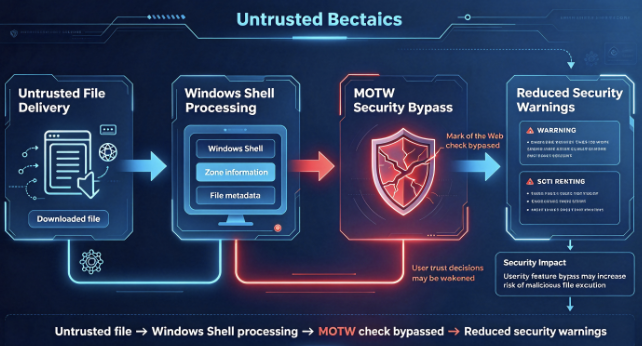
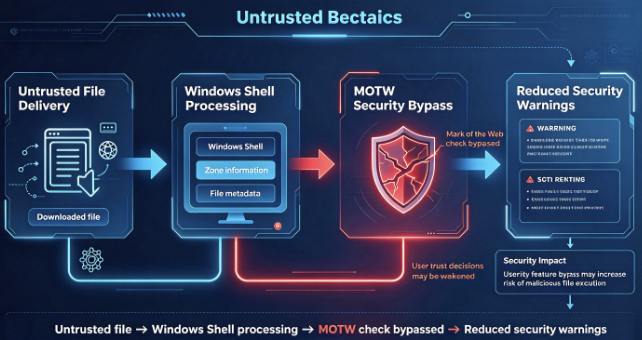
CVE-2026-96951 is the most urgent vulnerability in Microsoft’s October 2026 Patch Tuesday release. It affects Windows Shell and allows attackers to bypass security protections associated with Mark of the Web, commonly abbreviated as MOTW.
Microsoft assigns the vulnerability a CVSS score of 8.8 and rates it Important. Despite that classification, Microsoft has confirmed exploitation in the wild, making it a stronger immediate remediation candidate than many vulnerabilities labeled Critical.
The underlying weakness involves improper neutralization of special elements used in a command, a class of behavior associated with command injection. In this case, the security impact is the bypass of a Windows security feature rather than a straightforward unauthenticated remote code execution vulnerability.
Mark of the Web is an important part of Windows’ treatment of content originating from untrusted locations. When a user downloads a file from the internet, Windows may associate additional metadata with it to identify its origin. Security features can use that information to apply additional restrictions or warnings before potentially dangerous content is processed.
These protections can influence how Microsoft Office opens documents, whether SmartScreen warnings appear, and whether certain downloaded content is treated as trusted.
An attacker who can bypass that security boundary may make malicious content appear less suspicious to the operating system. Depending on the delivered payload and affected application, this can reduce the number of warnings or execution barriers that would otherwise interrupt an attack.
The particularly dangerous aspect is that the vulnerability does not need to provide a complete exploitation chain by itself. It can make another malicious action more likely to succeed.
Imagine an employee receiving a document through a convincing invoice email. Under normal conditions, Windows and Office may recognize that the file originated from an untrusted source and introduce additional protections. If an attacker successfully exploits a MOTW bypass, the file may avoid some of those checks, leaving the user or another security control with less information about its true origin.
That creates a valuable opportunity for phishing operators. They do not necessarily need a complicated new remote exploitation technique if they can persuade a user to interact with malicious content while bypassing protections intended to detect that interaction.
وفقاً ل Rapid7’s October Patch Tuesday analysis, exploitation requires a user to open a specially crafted malicious file or visit an attacker-controlled website. This is therefore not a confirmed zero-click compromise of every Windows machine connected to a network.
That distinction should not reduce its priority. User-assisted vulnerabilities frequently become effective when combined with credential theft, phishing, malicious downloads, and other common initial-access techniques. Microsoft has already observed exploitation, even though detailed public information about the attack campaigns remains limited.
What defenders should do: Prioritize Windows systems that process untrusted files, including employee workstations, administrative endpoints, remote desktop environments, and machines used to access externally supplied documents. Apply the relevant security updates, maintain SmartScreen and application control protections, and review endpoint telemetry for suspicious execution chains originating from downloaded files.
It is also important not to assume that the absence of a MOTW marker proves malicious activity. Legitimate file-transfer mechanisms, archive extraction tools, and application behavior can affect how origin metadata is preserved. The most useful detection strategy combines file provenance, suspicious process behavior, and confirmed indicators from trusted threat intelligence.
Microsoft’s vulnerability record is available at CVE-2026-96951 in the Microsoft Security Update Guide.
CVE-2026-108398: .NET Framework Application Control Bypass
The second significant zero-day is CVE-2026-108398, a .NET Framework security feature bypass vulnerability with a CVSS score of 8.8.
Unlike CVE-2026-96951, this vulnerability was publicly disclosed but was not reported as actively exploited at the time of Microsoft’s October security update.
The security issue involves an untrusted search path in .NET Framework. An authenticated attacker who already has local access to an affected system may be able to place a specially crafted .NET assembly on that system and register it for loading by a protected process.
If the exploitation conditions are satisfied, the attacker can bypass Windows Defender Application Control enforcement and execute unauthorized code within the protected process.
Windows Defender Application Control, now commonly referred to as App Control for Business, is designed to help organizations define which applications and executable content are allowed to run. This is particularly valuable in environments where administrators want to prevent users and malware from executing arbitrary binaries.
A security feature bypass undermines that model. Even if a company has carefully configured application allowlisting, a vulnerability in the enforcement boundary may offer an attacker a route around those restrictions.
The immediate exploitation prerequisites are more restrictive than those of an unauthenticated network vulnerability. The attacker needs an existing authenticated foothold and the ability to perform the relevant assembly-registration activity. Nevertheless, this matters because attackers rarely stop after gaining initial access.
A compromised employee account, malicious insider, or adversary who has already established a low-privilege position may attempt to evade application control as part of post-compromise activity.
The vulnerability was discovered by James Forshaw of Google Project Zero, according to Microsoft’s disclosure as reported by كمبيوتر نائم.
Organizations using strict allowlisting should give this patch particular attention. Administrative workstations, privileged access environments, application-controlled servers, and other hardened devices may rely on exactly the security property the vulnerability threatens.
The official advisory is available at CVE-2026-108398.
CVE-2026-92707: MessagePack-CSharp Denial of Service
The third publicly disclosed vulnerability is CVE-2026-92707, a denial-of-service flaw associated with MessagePack-CSharp, a serialization library used in .NET applications.
Microsoft assigns the vulnerability a CVSS score of 5.3 and rates it Moderate. The issue involves improperly controlled memory allocation that can allow specially crafted input to cause excessive resource consumption and disrupt service availability.
Serialization libraries are frequently overlooked during patch planning because they are not always deployed as obvious standalone applications. They may be included as dependencies within larger services, application frameworks, communication systems, or data-processing pipelines.
That makes dependency inventory important.
A company may not knowingly operate a product called MessagePack-CSharp while still running software that incorporates an affected version of the library. The risk depends on whether attacker-controlled data can reach the vulnerable code path and whether the application provides effective input validation and resource limits.
For an internal development tool with no untrusted inputs, the immediate risk may be comparatively limited. For an internet-facing service that processes serialized messages supplied by unknown clients, the same weakness deserves more attention.
There was no confirmed exploitation in the wild associated with this vulnerability in the reviewed October 13 disclosures. It should therefore not automatically outrank the exploited Windows Shell vulnerability or the critical Outlook RCE vulnerabilities.
Development and application-security teams should identify affected dependencies, review the official guidance, and update the vulnerable library through their normal dependency-management process.
The official record is available at CVE-2026-92707.
Five Critical Outlook RCE Vulnerabilities Make Email a Major October Patch Tuesday Priority
While the Windows Shell zero-day is the clearest immediate threat, Microsoft’s October 2026 updates also address five critical Outlook remote code execution vulnerabilities that deserve serious attention.
All five have CVSS scores of 9.8, and their documented attack surface includes the Outlook preview pane.
| مكافحة التطرف العنيف | المكوّن | CVSS | نوع الضعف |
|---|---|---|---|
| CVE-2026-70242 | Outlook | 9.8 | Remote code execution |
| CVE-2026-70291 | Outlook | 9.8 | Remote code execution |
| CVE-2026-88156 | Outlook | 9.8 | Remote code execution |
| CVE-2026-97016 | Outlook | 9.8 | Remote code execution |
| CVE-2026-97749 | Outlook | 9.8 | Remote code execution |
Outlook is a particularly attractive target because it receives content from outside the organization and presents that content through a complex application that handles multiple document, message, and formatting technologies.
Normally, many email-based malware attacks require the victim to open an attachment, follow a link, enable a macro, or launch a separate executable. Those requirements introduce opportunities for users and endpoint security systems to interrupt the attack.
Preview-pane vulnerabilities can change the interaction model.
The Outlook preview pane is designed to display message contents without requiring the user to open a message in a separate window. When a vulnerable processing component handles specially crafted content, that convenience feature can become an attack surface.
Rapid7 specifically identifies all five October Outlook vulnerabilities as having a preview-pane attack vector, warning that simply navigating through email content may be enough to reach vulnerable functionality. The precise circumstances under which exploitation succeeds still depend on the affected version, vulnerable code path, and other technical conditions.
October 2026
The significance is difficult to overstate. Email remains one of the most common ways an attacker can place untrusted content directly in front of employees. A vulnerability that reduces or removes the need for deliberate interaction can make that delivery channel more dangerous.
The technical weaknesses identified across these Outlook vulnerabilities include memory-corruption conditions such as heap-based buffer overflows, stack-based buffer overflows, and double-free errors.
A heap-based buffer overflow occurs when a program writes beyond the bounds of an allocated memory region. Depending on the memory layout and available mitigations, this can corrupt adjacent data and potentially alter application behavior.
A double-free vulnerability occurs when a program attempts to free the same memory allocation more than once. Such errors can interfere with memory management and, under certain circumstances, create an opportunity to redirect execution.
Not every memory-corruption bug is reliably exploitable for code execution. Successful weaponization may require bypassing additional operating-system and application defenses. Nevertheless, a CVSS score of 9.8, remote attack reachability, and the preview-pane exposure justify urgent patching even without evidence of active exploitation.
As of the October 13 disclosures reviewed here, Microsoft had not reported these five Outlook vulnerabilities as actively exploited.
For organizations using Outlook extensively, the practical remediation priority should be high. Security teams should confirm which versions of Outlook are installed, identify the applicable updates, and validate that endpoint patching reaches both ordinary employee devices and privileged users’ workstations.
Disabling the preview pane may reduce exposure to some preview-dependent attack paths as a temporary measure, but it should not be considered a comprehensive substitute for installing the updates. Administrators should not assume that every possible attack path is eliminated by changing a single display preference.
The official Microsoft records include CVE-2026-70242 و CVE-2026-70291. The complete group is also discussed in CrowdStrike’s October analysis.
Critical Windows Server Vulnerabilities: Active Directory, DHCP, and Network Services
Another major concern in the October release is the number of vulnerabilities affecting services that form the backbone of corporate infrastructure.
Desktop vulnerabilities may expose individual employees, but vulnerabilities in domain controllers, authentication servers, DHCP infrastructure, and network gateways can place entire environments at risk.
These systems are often difficult to update because they support business-critical operations. Yet that importance is precisely why defenders should evaluate them early.
CVE-2026-70229: Active Directory Domain Services Remote Code Execution
CVE-2026-70229 is a Critical remote code execution vulnerability affecting Windows Active Directory Domain Services, with a CVSS score of 8.1.
Active Directory is central to authentication, authorization, group policies, and identity management in many enterprise environments. Domain controllers therefore represent high-value targets for adversaries seeking broader control of a compromised network.
The vulnerability is associated with an authorization weakness. According to Cisco Talos, Microsoft considers exploitation more likely, although the vulnerability was not reported as being actively exploited at the time of release.
The consequence of a successful attack against a domain controller could be significantly more severe than compromise of an ordinary endpoint because of the privileges and authentication relationships that domain controllers maintain.
An attacker who can reach vulnerable services may attempt to use weaknesses in those services to move from limited access toward more powerful control over the enterprise identity infrastructure.
This does not mean that every domain controller is remotely exploitable by an unauthenticated attacker across the internet. Administrators must evaluate the precise conditions in Microsoft’s advisory, affected versions, network reachability, and available security controls.
The fact that domain controllers are commonly restricted to internal networks does not eliminate risk. Modern attacks often begin with compromised endpoints, stolen VPN credentials, or access through third-party services. Once an attacker gains access to internal network segments, previously inaccessible infrastructure may become reachable.
Security teams should prioritize affected domain controllers, particularly those supporting large user populations or sensitive administrative environments.
The official advisory is available at CVE-2026-70229.
CVE-2026-96934: DHCP Server Remote Code Execution
CVE-2026-96934 is a Critical Windows DHCP Server remote code execution vulnerability with a CVSS score of 9.8.
DHCP is responsible for dynamically assigning network configuration information to devices. It operates in an environment where network clients routinely communicate with infrastructure services to obtain addresses and other settings.
That interaction model makes DHCP vulnerabilities particularly concerning when attackers can reach the affected service.
According to the Zero Day Initiative, the October 2026 release includes several DHCP Server vulnerabilities with attack characteristics that warrant consideration as potentially wormable, meaning that exploitation may not require authentication or user interaction and could, under suitable conditions, be automated across reachable systems.
However, potentially wormable is not the same as actively worming. No self-propagating exploit campaign for these October vulnerabilities was established in the reviewed reports.
A practical attack would still depend on vulnerable service deployment, network access, and successful exploitation.
DHCP servers are frequently accessible to large numbers of devices on internal networks. Guest devices, compromised employee laptops, poorly segmented networks, and untrusted devices may all create opportunities for attacker-controlled traffic to reach infrastructure that would otherwise not be exposed.
Organizations should therefore examine not only whether a DHCP server is accessible from the public internet, but also which internal segments can communicate with it.
Segmentation, appropriate network access controls, and monitoring can reduce exposure, but patching remains the definitive remediation for vulnerable software.
The official vulnerability record is CVE-2026-96934.
CVE-2026-100202: Microsoft Message Queuing RCE
Microsoft Message Queuing, or MSMQ, is another enterprise service receiving important security fixes.
CVE-2026-100202 is a Critical remote code execution vulnerability affecting the Windows Message Queuing Queue Manager. It has a CVSS score of 9.8 and involves a use-after-free weakness.
A use-after-free occurs when software continues to access memory after that memory has been released. Under specific conditions, attackers may manipulate how memory is reused and potentially exploit resulting corruption.
MSMQ can be used by applications that require asynchronous communication between processes or systems. While many modern environments rely on other messaging technologies, legacy applications may continue to depend on MSMQ.
That creates a familiar vulnerability-management problem: administrators may not know that a particular server still uses the service because it was installed as part of an older application stack.
For this reason, patch prioritization should include a service inventory. The security team needs to know where MSMQ is installed, whether it is running, and what network paths can reach the vulnerable component.
A service that is not installed does not present the same exposure as an actively used and reachable instance. Conversely, an overlooked legacy server may represent a serious risk even if it receives little operational attention.
Microsoft’s advisory is available at CVE-2026-100202.
Exchange Server, SharePoint, and SQL Server: High-Value Enterprise Attack Surfaces
October’s Patch Tuesday also includes vulnerabilities affecting enterprise application platforms that frequently store sensitive business data or maintain privileged relationships with other systems.
Exchange, SharePoint, and SQL Server should not be treated as interchangeable technologies. Their network exposure, authentication models, exploitation prerequisites, and business impact differ substantially.
Nevertheless, they share one characteristic: a successful compromise can provide attackers with access to valuable information and potentially support subsequent movement across the environment.
CVE-2026-70571: Exchange Server Remote Code Execution
CVE-2026-70571 affects Microsoft Exchange Server and carries a CVSS score of 8.1.
The vulnerability involves a stack-based buffer overflow, and Microsoft’s assessment indicates that exploitation may be possible through specially crafted content processed by the affected Exchange Server.
This is particularly relevant because email servers routinely receive untrusted content from external senders.
Unlike some vulnerabilities that require a local authenticated foothold, certain mail-processing attack paths can place attacker-controlled data directly into server-side code.
However, exploitation complexity matters. The Zero Day Initiative notes that Microsoft’s guidance describes a requirement for considerable knowledge of the target environment and does not guarantee successful exploitation.
That constraint makes it inappropriate to describe CVE-2026-70571 as an easily exploitable, universal Exchange Server takeover.
At the same time, a high-complexity vulnerability on an externally reachable mail server can still be serious. Sophisticated attackers may have the technical capabilities and environmental knowledge necessary to investigate a difficult exploitation path.
Organizations operating on-premises Exchange Server should validate their affected versions and patch state, review their internet-facing service inventory, and examine suspicious mail-server activity where appropriate.
They should also distinguish between vulnerabilities affecting on-premises products and those addressed by Microsoft through cloud-service maintenance.
The official record is available at CVE-2026-70571.
CVE-2026-102866: SharePoint Privilege Escalation and Token Trust
SharePoint remains an attractive target because it manages internal documents, business records, collaboration workflows, and access permissions.
CVE-2026-102866 is a Critical SharePoint elevation of privilege vulnerability with a CVSS score of 8.1.
The weakness involves improper cryptographic signature verification. According to the Zero Day Initiative’s analysis, an attacker who obtains a valid proof token associated with a targeted user may be able to modify that token and submit it to the server in a way that enables authentication as the user.
This is not equivalent to an attacker being able to authenticate as any user without prerequisites. Obtaining the relevant valid proof token is an important part of the attack requirements.
Still, token-validation weaknesses are significant because modern enterprise security depends heavily on the integrity of authentication artifacts.
Security controls frequently make decisions based on signed tokens, claims, and identity assertions. When an application accepts manipulated authentication information, an attacker may cross a trust boundary that would otherwise prevent unauthorized access.
For SharePoint environments, defenders should give priority to affected servers that handle sensitive data, privileged collaboration sites, or externally accessible workflows.
Where feasible, organizations should review authentication logs for unusual access patterns, unexpected token usage, and suspicious access to sensitive SharePoint resources. Such indicators require correlation and investigation rather than being treated as conclusive proof of this specific vulnerability.
The Microsoft advisory is available at CVE-2026-102866.
CVE-2026-65674: SQL Server Deserialization Risk
CVE-2026-65674 is a Microsoft SQL Server remote code execution vulnerability with a CVSS score of 8.8.
The weakness involves deserialization of untrusted data. This class of vulnerability appears when software reconstructs objects from serialized data without adequately controlling the processing of potentially dangerous inputs.
In some implementations, unsafe deserialization can allow attacker-controlled content to influence application behavior in ways that extend beyond ordinary data processing.
For CVE-2026-65674, the Zero Day Initiative reports that an authenticated attacker can connect to an affected SQL Server and submit a specially crafted request that may enable code execution. No additional user interaction is required once the exploitation conditions are met.
The authentication requirement is important. It distinguishes this vulnerability from a straightforward pre-authentication network attack. However, organizations should not assume that authenticated vulnerabilities are unimportant simply because they require credentials.
Stolen application credentials, compromised service accounts, weakly protected database accounts, and excessive permissions can all create opportunities for attackers to reach authenticated attack surfaces.
SQL Server instances exposed directly to untrusted networks deserve particular scrutiny, as do database services accessible from compromised application servers or broad internal segments.
The remediation strategy should include installing the applicable security updates, reducing unnecessary database exposure, and auditing privileges and service-account access.
The official record is available at CVE-2026-65674.
What to Patch First: October 2026 Microsoft CVE Priority Matrix
The biggest mistake security teams can make during a release of this size is to sort every vulnerability by CVSS score and work down the list mechanically.
A 9.8 vulnerability with no deployed vulnerable component is not an immediate threat to that organization. An 8.8 vulnerability already being exploited against ordinary employee workstations may present a much more urgent operational problem.
Patch prioritization should therefore combine observed exploitation, attack prerequisites, business impact, asset exposure, and the effectiveness of existing controls.
The following matrix provides a practical starting point for enterprise remediation.
| الأولوية | Vulnerabilities or systems | Main concern | Recommended response |
|---|---|---|---|
| P0 — Immediate | CVE-2026-96951 | Confirmed exploitation of Windows Shell MOTW bypass | Emergency endpoint patching and threat hunting |
| P1 — Urgent | Five Outlook RCEs | Critical, preview-pane reachable attack paths | Update affected Outlook clients |
| P1 — Urgent | CVE-2026-70229, CVE-2026-96934 | Domain-controller and DHCP service compromise | Patch exposed or reachable infrastructure |
| P1 — Urgent | CVE-2026-70571, CVE-2026-102866 | Exchange RCE and SharePoint identity compromise | Prioritize affected business-critical servers |
| P1/P2 — Exposure-dependent | CVE-2026-100202, CVE-2026-65674 | MSMQ RCE and SQL Server RCE | Patch deployed and reachable services |
| P2 — Targeted | CVE-2026-108398 | Bypass of application control | Prioritize hardened and privileged systems |
| P2/P3 — Deployment-dependent | CVE-2026-92707 | Denial of service in MessagePack-CSharp | Update affected application dependencies |
These priorities represent a risk-based operational recommendation, not Microsoft’s official deployment ranking or a guarantee of exploitability.
Organizations with internet-facing vulnerable services, highly sensitive identity infrastructure, or unusual application dependencies may need to move specific P1 or P2 vulnerabilities into their immediate remediation queue.
For instance, an organization that does not deploy on-premises Exchange can deprioritize the Exchange-specific vulnerability after verifying that it has no affected assets. A healthcare provider operating an affected, business-critical MSMQ application may need to elevate the relevant vulnerabilities because service disruption or compromise could have significant consequences.
The same principle applies to the five Outlook RCEs. Although active exploitation had not been confirmed, the combination of critical severity, low interaction requirements, and widespread email-client deployment makes them important candidates for accelerated patching.
Why Confirmed Exploitation Should Outweigh CVSS Alone
CVSS is designed to communicate technical vulnerability severity. It is not a direct measurement of whether attackers are exploiting a vulnerability against a particular organization.
Two vulnerabilities with similar scores may have very different operational implications.
One may require extensive knowledge of a specific environment, valid credentials, and precise timing. Another may be reachable through a common user workflow, such as opening a downloaded file.
Exploitation status adds important evidence. A confirmed attack demonstrates that at least one adversary has found a practical way to abuse the vulnerability under real-world conditions.
The presence of an exploit does not establish that every affected organization is being targeted, but it substantially reduces uncertainty about whether exploitation is technically feasible.
This is why CVE-2026-96951 should lead the October 2026 remediation effort even though several other vulnerabilities have higher CVSS scores.
Security teams can supplement the Microsoft Security Update Guide with sources such as the كتالوج الثغرات الأمنية المعروفة المستغلة CISA, vendor advisories, endpoint detection telemetry, and reliable threat intelligence.
The CISA catalog can provide an additional prioritization signal, but organizations should not assume that every vulnerability reported as exploited by its vendor has already been added to the catalog.
Microsoft’s New Risk Cohorts Could Change Patch Management
October 2026 also marks an important development in how Microsoft is discussing vulnerability prioritization.
On October 13, Microsoft published a framework describing risk cohorts: provisional groups of vulnerabilities organized around shared environmental questions rather than simply their severity scores.
The motivation is straightforward. When a single security release contains more than 1,400 vulnerabilities, reviewing every CVE independently can lead to repetitive work.
A security team might repeatedly evaluate whether a server runs an affected service, whether the service accepts untrusted inputs, and whether low-privilege users can access sensitive operations.
Grouping related vulnerabilities can make those assessments more efficient.
For example, Microsoft’s proposed cohorts include Windows filesystems and storage, graphics and media processing, Office document and mail clients, kernel privilege boundaries, networking infrastructure, authentication systems, and virtualization services.
The Office document and mail cohort alone contains 135 CVEs in Microsoft’s illustrative grouping. Instead of starting with 135 unrelated questions, administrators can first identify which versions of Office are deployed, which employees process untrusted content, and how updates are delivered to those applications.
They can then prioritize the most consequential individual vulnerabilities within that group.
Microsoft emphasizes that risk cohorts are exploratory. They are not an official replacement for vulnerability severity classifications, do not change update guidance, and are not currently integrated into the Security Update Guide as a formal classification system.
For vulnerability-management teams, however, the underlying approach is useful even without a dedicated Microsoft product feature.
A practical process can group assets by common exposure: employee endpoints that receive external documents, remote-access gateways, identity infrastructure, application servers, and systems hosting legacy network services.
Within each group, administrators can identify the most serious attack paths instead of repeatedly rediscovering the same deployment information.
The full explanation is available in Microsoft’s official introduction to risk cohorts.
How to Check Whether Windows Systems Are Patched
Installing updates is only one part of remediation. The equally important task is confirming that the correct updates were applied to the correct systems.
Enterprises frequently have machines that appear compliant in a centralized dashboard but have not completed installation, require a reboot, or are reporting outdated inventory information.
Other devices may be excluded from standard maintenance schedules, operate behind restricted network connections, or use specialized software that complicates patch deployment.
Administrators should therefore verify the installed operating-system version, applicable security updates, and restart status.
Check Windows Version and Build Information
The following PowerShell command displays useful operating-system information on a Windows machine:
Get-ComputerInfo |
    Select-Object WindowsProductName,
                  WindowsVersion,
                  OsBuildNumber
The resulting information can help administrators identify the Windows version and build that must be compared against Microsoft’s supported security update information.
A Windows device should not be considered patched merely because it reports a recent operating-system version. The security update level still needs to be verified.
Check Recently Installed Windows Updates
PowerShell also provides a way to review installed Windows hotfixes:
Get-HotFix |
    Sort-Object InstalledOn -Descending |
    Select-Object -First 10 HotFixID,
                            Description,
                            InstalledOn
This provides a quick view of recent updates reported through Windows’ hotfix inventory.
إن Get-HotFix command uses Windows’ Quick Fix Engineering information. It does not provide a complete inventory of every Microsoft 365 application update, .NET component update, or separately serviced enterprise application.
Microsoft documents these limitations and the cmdlet’s available parameters in its Get-HotFix reference.
For reliable vulnerability remediation, administrators should match installed updates or application versions against the specific affected-product and KB information in Microsoft’s CVE advisories.
Identify Servers Running Sensitive Roles
For Windows Server environments, administrators can examine installed server roles using:
Get-WindowsFeature |
    Where-Object Installed -eq $true |
    Select-Object Name,
                  DisplayName,
                  InstallState
This command is intended for Windows Server systems with the ServerManager module available.
It can help identify infrastructure roles that deserve further assessment, including services related to networking, remote access, and enterprise applications.
For MSMQ, a more targeted service check is:
Get-Service -Name MSMQ `
    -ErrorAction SilentlyContinue
This returns the local MSMQ service when it exists, along with its current state.
A running service does not automatically mean the system is vulnerable. Administrators must still determine the installed component version, the applicability of the CVE, and network reachability.
Likewise, an absent or stopped service is not sufficient evidence that every related vulnerability is remediated.
Verify Office and Outlook Updates Separately
Office applications may follow different update mechanisms from the Windows operating system.
Microsoft 365 Apps can receive updates through Click-to-Run channels, while perpetual Office products and enterprise-managed deployments may use other servicing configurations.
Organizations should verify the installed Office application version and build, the assigned update channel, and whether the relevant security update has successfully reached the endpoint.
This is particularly important for October’s five critical Outlook vulnerabilities.
A machine that has installed the latest Windows cumulative security update is not necessarily running a fully patched Outlook client.
Administrators should also account for devices that have not been online recently, employees using laptops outside corporate networks, and specialized installations that may not follow the standard deployment process.
Detecting Potential Exploitation After October Patch Tuesday
Security updates eliminate known vulnerable conditions when they are correctly applied, but they do not automatically determine whether a system was compromised before remediation.
For the actively exploited Windows Shell vulnerability, detection should focus on suspicious behavior associated with untrusted files and unexpected process execution.
Because detailed, publicly validated indicators specific to the reported CVE-2026-96951 exploitation campaigns remain limited in the sources reviewed, defenders should avoid building overly specific detection rules based on an imagined exploit chain.
Instead, they should examine telemetry that can reveal the broader classes of behavior associated with malicious file execution.
Investigating Suspicious File Execution
A typical Windows file-delivery attack may begin with content received through email, a browser download, a messaging application, or an archive.
Investigators should look for suspicious child processes launched by applications commonly used to handle external content, particularly when the resulting activity does not match normal user behavior.
Examples include a document application unexpectedly starting PowerShell, an unusual executable running from a user-writable temporary directory, or a newly downloaded program attempting to establish outbound network connections.
Such patterns can indicate malicious activity, but none is conclusive evidence of CVE-2026-96951 exploitation without additional supporting information.
Organizations with endpoint detection and response capabilities should correlate process trees, file-origin information, network connections, and other available telemetry.
Inspecting Mark of the Web Metadata
On NTFS volumes, Windows may store internet-origin information using an alternate data stream named Zone.Identifier.
For investigation of a specific file, administrators can examine whether this stream is present:
Get-Item -Path "C:\Investigation\sample.docx" `
    -Stream Zone.Identifier `
    -ErrorAction SilentlyContinue
When the stream is present, its contents can be inspected:
Get-Content -Path "C:\Investigation\sample.docx" `
    -Stream Zone.Identifier `
    -ErrorAction SilentlyContinue
This can provide useful context about a file’s recorded origin.
However, the absence of a Zone.Identifier stream does not prove that a MOTW bypass occurred. Different applications, download methods, file systems, and file-handling operations may legitimately affect whether the metadata exists.
The correct analytical question is whether the file’s observed origin and handling behavior are consistent with its expected provenance.
Investigating Potential .NET Application Control Bypass Activity
For CVE-2026-108398, defenders should investigate suspicious attempts to introduce or register .NET assemblies in protected application environments.
The vulnerability’s prerequisites make existing authenticated access relevant. Investigators should therefore correlate application-control events with unusual assembly-loading activity, suspicious changes to executable locations, and unexpected code execution inside protected processes.
Application control logs can provide important context, but detecting exploitation of a particular vulnerability generally requires more than finding a blocked execution event.
A successful bypass may be notable precisely because the expected enforcement did not occur.
Defenders should monitor the integrity of protected processes and investigate anomalous behavior rather than relying entirely on application-control denial events.
Monitoring Vulnerable Network Services
For the DHCP, MSMQ, Active Directory, and other network-related vulnerabilities, telemetry should focus on the actual vulnerable services and their reachable attack surfaces.
Useful information includes service availability, unexpected client connections, unusual protocol activity, service crashes, changes to privileged accounts, and suspicious process execution on critical servers.
The relevant evidence will differ by service. A DHCP attack does not produce the same behavior as a SharePoint authentication bypass or a SQL Server deserialization attempt.
Cisco Talos has published an accompanying October 2026 Patch Tuesday analysis and Snort coverage information. The research describes new detection rules for attempts to exploit some of the disclosed vulnerabilities, providing network defenders with an additional source for detection engineering.
Network signatures should be tested and kept current. A signature match is an investigative lead, while the absence of alerts is not proof that exploitation did not occur.
Windows and Office End-of-Support Changes Make October 2026 More Important
October 2026 Patch Tuesday is also a significant lifecycle milestone.
A security update can fix a vulnerability today while leaving an organization exposed to future vulnerabilities if the underlying product reaches the end of its servicing period.
On October 13, 2026, Windows 11 version 24H2 Home and Pro editions reached the end of updates. Microsoft’s October security update is the final monthly security update for those editions.
This does not mean that every edition of Windows 11 version 24H2 has the same support status. Enterprise and Education editions can have different lifecycle dates, so administrators must evaluate the specific edition installed.
Microsoft’s Windows 11 version 24H2 release-health information provides the applicable servicing guidance.
Windows 10 Enterprise LTSB 2016 also reached the end of support on October 13, creating additional upgrade requirements for organizations that continue to operate that version.
Office 2021 and Office LTSC 2021 reached their published end-of-support dates on the same day. This is especially relevant because October’s updates contain numerous vulnerabilities affecting Office applications.
An organization that installs the final available security updates but continues operating unsupported Office installations still faces increasing long-term risk.
Microsoft recommends upgrading from Office LTSC 2021 to a supported version, such as Microsoft 365 Apps or Office LTSC 2024, depending on organizational requirements. Its official Office LTSC 2021 lifecycle announcement explains the security and support implications.
Windows Server 2012 and 2012 R2 also reached the end of their third year of Extended Security Updates in October 2026. Organizations still operating these systems should assess migration options and avoid assuming that ordinary monthly patching will continue indefinitely.
Windows Server 2022, by contrast, transitioned from mainstream to extended support. Extended support continues to provide qualifying security updates, making this a different situation from a product that has reached the end of all security servicing.
The broader lifecycle calendar is documented in Microsoft’s products ending support in 2026.
For security teams, October’s lifecycle changes create two separate responsibilities: apply the immediate vulnerability fixes and identify assets that now require operating-system or application upgrades to remain supportable.
A Practical 24-Hour, 72-Hour, and Seven-Day Patch Plan
There is no universal remediation schedule suitable for every organization. A critical hospital system, a large financial services environment, and a small company using managed endpoints may have very different operational constraints.
Nevertheless, a defined remediation timeline is more effective than allowing a large Patch Tuesday release to remain an open-ended administrative task.
The following schedule is a recommended enterprise response framework, not a Microsoft-mandated deadline.
First 24 Hours: Contain Immediate Exposure
The first day should focus on confirming whether the organization has exposed assets affected by the exploited Windows Shell vulnerability and identifying other high-priority attack surfaces.
Security operations teams should ensure that CVE-2026-96951 is represented in their vulnerability and endpoint inventories, identify affected Windows systems, and begin accelerated deployment of the applicable patches.
Where immediate deployment is not possible, organizations should apply appropriate temporary risk-reduction measures, strengthen monitoring, and document the operational reason for any delay.
At the same time, administrators should inventory potentially affected Outlook clients and critical Windows Server roles.
An important objective is to distinguish systems that are genuinely vulnerable and reachable from assets that merely share a broad product category.
Threat-hunting activity should focus on suspicious file-execution behavior and other indicators associated with already observed exploitation, while avoiding unsupported claims about specific attacker tools or malware families.
Within 72 Hours: Patch Critical Enterprise Attack Surfaces
During the next phase, organizations should prioritize the five critical Outlook RCE vulnerabilities and high-impact server vulnerabilities according to deployment and exposure.
Domain controllers, DHCP servers, externally reachable Exchange systems, sensitive SharePoint environments, and affected network services deserve targeted review.
Where critical infrastructure requires careful maintenance, patching should proceed through an accelerated but controlled process. Administrators should verify backups, system health, replication status, service dependencies, and recovery procedures before making changes that could interrupt essential operations.
High availability can help reduce patching disruption, but it should not become a reason to leave vulnerable clusters indefinitely unpatched.
For systems that cannot be updated within the intended window, security teams should document compensating controls, exposure restrictions, monitoring, and a firm remediation owner.
Within Seven Days: Complete High-Priority Remediation and Validate Coverage
By the end of the first week, organizations should aim to complete remediation of their identified high-priority vulnerabilities and verify that updates were successfully installed.
This includes confirming that Windows endpoints restarted when required, Office applications received the appropriate fixes, affected server roles were updated, and separately maintained application components were not omitted.
Vulnerability scanners and endpoint inventory systems should be used to validate remediation, but the results should be checked against actual product versions and applicable advisories.
A scan that reports a vulnerability as resolved is useful, yet it is not necessarily sufficient if the scan lacks authenticated access or accurate application-version information.
Teams should also examine deployment failures and identify systems that repeatedly fail to receive security updates.
Those failures are often more operationally important than they initially appear. A small group of consistently unpatched endpoints can remain exposed across multiple Patch Tuesday cycles, even when aggregate compliance metrics appear strong.
Measure Remediation by Exposure, Not Only Patch Percentage
An organization may report that 95% of its Windows devices are patched while leaving several highly privileged or externally reachable systems vulnerable.
That number alone does not provide a meaningful picture of residual security risk.
A more useful approach is to track the number of affected assets in each priority category, the time required to remediate them, whether known exploited vulnerabilities remain unresolved, and whether the most important services are still reachable through vulnerable paths.
Risk ownership also matters. Every exception should have a documented reason, an accountable team, and an expected resolution.
This approach makes patch management a measurable security operation rather than a monthly exercise in applying updates.
Why October 2026 Shows the Limits of CVE-Count-Based Security
The extraordinary size of this month’s release raises a broader question: if vulnerability disclosure volumes continue increasing, can enterprises realistically investigate every CVE at the same level of detail?
The answer increasingly depends on automation, asset intelligence, and prioritization methods that connect vulnerabilities to real attack paths.
One reason vulnerability counts have increased is the growing role of automated and AI-assisted vulnerability discovery. Researchers and vendors can analyze larger codebases, find recurring weakness patterns, and examine software behavior at scales that would previously have been difficult to sustain manually.
However, increasing the number of discovered vulnerabilities does not automatically mean that an equivalent number are being actively exploited.
The October release illustrates this distinction clearly.
More than 1,400 vulnerabilities were addressed, yet Microsoft confirmed active exploitation of only one of the three zero-days highlighted in the initial disclosures.
The Zero Day Initiative also noted that increasing vulnerability volumes are forcing defenders to reconsider how they organize security analysis. Its October security review argues that sheer CVE volume is no longer an effective proxy for real-world urgency.
For enterprise defenders, the challenge is therefore not simply to scan more systems or collect more vulnerability records. The challenge is to determine which findings can realistically contribute to an attack.
This requires understanding asset exposure, authentication requirements, service configurations, reachable trust boundaries, and whether an attacker can combine weaknesses into a more serious exploitation chain.
An unauthenticated RCE affecting a deployed network service may deserve urgent attention. A local privilege escalation vulnerability may become equally urgent when paired with a known initial-access technique. A vulnerability in a disabled feature may present no immediate reachable attack surface, even if the underlying software package is installed.
Security validation can help organizations test some of these assumptions in controlled environments. Authorized exposure assessments, authenticated configuration checks, application dependency analysis, and carefully scoped penetration tests can reveal whether the expected security boundaries are actually present.
For example, a network service that administrators believe is accessible only through an internal management segment might turn out to be reachable from broader user networks. An application-control policy assumed to be effective may have deployment gaps. A legacy server believed to be retired may still be processing production traffic.
These are not questions a CVSS score can answer.
AI-assisted security testing may become increasingly useful in connecting vulnerability intelligence to asset context, provided testing is authorized, evidence is verified, and tools do not mistake theoretical exploitability for demonstrated compromise.
The goal is not to generate more findings. It is to reduce the distance between understanding a vulnerability and making the right remediation decision.
Frequently Asked Questions About October 2026 Patch Tuesday
How many vulnerabilities did Microsoft fix in October 2026?
Microsoft’s October 13, 2026 Patch Tuesday addressed more than 1,400 vulnerabilities. CrowdStrike and Rapid7 reported 1,413, while BleepingComputer reported 1,411 and Cisco Talos reported 1,415. Differences reflect reporting snapshots and counting methodologies. For product-specific remediation, the Microsoft Security Update Guide is the authoritative source.
How many zero-days were patched in October 2026?
Three vulnerabilities were identified as exploited or publicly disclosed before fixes became available. CVE-2026-96951 was confirmed as actively exploited, while CVE-2026-108398 and CVE-2026-92707 were publicly disclosed but not reported as actively exploited at the time of the initial release.
What is the most dangerous October 2026 Microsoft vulnerability?
CVE-2026-96951 is the most urgent general remediation priority because exploitation has been confirmed in the wild. It affects Windows Shell and can bypass protections associated with Mark of the Web. The five critical Outlook RCE vulnerabilities and exposed enterprise network services may also represent severe risks, depending on an organization’s environment.
Is CVE-2026-96951 a remote code execution vulnerability?
Microsoft classifies CVE-2026-96951 as a security feature bypass, not a standalone remote code execution vulnerability. Its danger lies in allowing malicious content to bypass protections that would otherwise restrict or warn about untrusted files. Attackers may combine that weakness with other malicious techniques to achieve code execution.
Can Outlook be compromised without opening an attachment?
The October release includes five critical Outlook RCE vulnerabilities with a preview-pane attack vector. Under vulnerable conditions, processing malicious content in the preview pane may be sufficient to reach the affected code path. However, successful exploitation depends on the specific vulnerability and technical prerequisites. Organizations should patch affected Outlook versions rather than relying on user awareness alone.
Should Microsoft October 2026 updates be installed immediately?
Affected systems should be updated promptly, with the greatest urgency assigned to confirmed exploited vulnerabilities and high-risk exposed systems. The deployment schedule should reflect operational criticality, available testing, recovery capability, and actual vulnerability exposure.
Does installing the latest Windows update fix every October 2026 CVE?
No. Different vulnerabilities affect different products and components. Windows cumulative updates address many Windows vulnerabilities, while Office, .NET, Exchange, SharePoint, SQL Server, developer tools, and third-party dependencies may require separate updates or remediation actions. Administrators must verify coverage through the relevant Microsoft advisory and affected-product information.
Is Windows 11 24H2 still supported after October 2026?
Windows 11 version 24H2 Home and Pro reached the end of updates on October 13, 2026. Other editions may have different servicing periods. Organizations should confirm their installed editions and use Microsoft’s official lifecycle information before deciding whether a device must be upgraded.
Final Thoughts: Patch the Exploited Vulnerabilities First, Then Follow the Attack Surface
Microsoft’s October 2026 Patch Tuesday is a striking example of how modern vulnerability management is changing.
The sheer volume of vulnerabilities is unprecedented, but raw numbers should not distract defenders from the attack paths that matter most.
CVE-2026-96951 deserves immediate attention because attackers are already exploiting it. The five critical Outlook vulnerabilities raise serious concerns about malicious email content reaching vulnerable code through ordinary preview functionality. Active Directory, DHCP, Exchange, SharePoint, SQL Server, and other enterprise services introduce additional risk where vulnerable components are deployed and reachable.
The release also demonstrates why application inventories, patch validation, and product lifecycle management are just as important as vulnerability scanning.
A successful October remediation effort should do more than produce a high patch-compliance percentage. It should establish that exploited vulnerabilities have been addressed, critical services are protected, unsupported products have a migration plan, and high-risk attack paths have been reduced or eliminated.
The most effective strategy is straightforward: prioritize known exploitation, identify reachable critical vulnerabilities, patch the systems that matter most, and verify the results.
When more than 1,400 vulnerabilities arrive in a single release, security teams cannot afford to confuse the largest vulnerability list with the greatest security risk.
They need to know what an attacker can actually reach—and close those paths first.

 Arabic
  English
  German
  French
  Spanish
  Portuguese
  Japanese
  Korean
  Hindi
Hindi  Turkish
  Hebrew