
CVE-2025-68121 is a security flaw in Go’s crypto/tls standard library involving TLS session resumption and changing certificate trust policies. Under specific conditions, a connection that would fail certificate validation during a new TLS handshake can instead be successfully resumed using authentication state established under an earlier configuration.
The Go vulnerability database describes the issue as occurring when the ClientCAs or RootCAs associated with a TLS configuration change between the original handshake and a resumed handshake. In vulnerable versions, the resumed connection can succeed even though the same peer would no longer satisfy the certificate requirements of a fresh handshake. Go explicitly identifies Config.Clone and Config.GetConfigForClient as situations in which this can occur. (Go Packages)
That distinction is important. CVE-2025-68121 is not a universal TLS certificate bypass affecting every Go HTTPS client or server. Exploitation requires session resumption to interact with a change in authentication policy or trust configuration.
The flaw was published as Go vulnerability GO-2026-4337 on February 5, 2026. Fixed releases include Go 1.24.13, 1.25.7, and 1.26.0-rc.3. (pkg.go.dev)
CVE-2025-68121 at a Glance
| Item | Details |
|---|---|
| CVE | CVE-2025-68121 |
| Go advisory | GO-2026-4337 |
| Component | Go standard library crypto/tls |
| Weakness | CWE-295 Improper Certificate Validation |
| Primary trigger | TLS session resumption combined with changed CA trust configuration |
| Relevant fields | RootCAs, ClientCAs |
| Important APIs | Config.GetConfigForClient, Config.Clone |
| Client impact | A client can resume a connection to a server that would fail the current server-certificate trust policy |
| Server impact | A server can resume a connection from a client that would fail the current client-certificate trust policy |
| Fixed in | Go 1.24.13, Go 1.25.7, Go 1.26.0-rc.3 |
| NVD CVSS | 10.0 Critical |
| CWE | CWE-295 Improper Certificate Validation |
The Go advisory lists affected crypto/tls versions as versions before Go 1.24.13, the Go 1.25 branch before 1.25.7, and Go 1.26 release candidates before 1.26.0-rc.3. (Go Packages)
Why TLS Session Resumption Matters
A full TLS handshake does considerably more than derive encryption keys. When certificate authentication is being used, the peers also establish an authenticated identity.
A normal TLS connection can conceptually look like this:
Client
   |
   | ClientHello
   v
Server
   |
   | Certificate
   | CertificateVerify
   | Finished
   v
Client verifies:
   - certificate chain
   - trusted root CA
   - hostname / identity
   - optional application-specific policy
A later connection may instead use session resumption.
TLS resumption exists so the endpoints do not have to repeat all of the expensive work associated with a full handshake. In TLS 1.3, resumption is built around PSKs derived from an earlier connection. Go’s own ClientSessionCache documentation notes that TLS 1.3 session resumption uses the PSK mechanism and stores ClientSessionState specifically so previous sessions can be resumed. (Go Packages)
Conceptually:
FULL HANDSHAKE

Client                    Server
  |                          |
  |------ ClientHello ------>|
  |<----- Certificate -------|
  |<-- CertificateVerify ----|
  |------ verification ------|
  |<------- Finished --------|
  |                          |
  |   authenticated session  |
  |                          |
  |<---- session ticket -----|


RESUMED HANDSHAKE

Client                    Server
  |                          |
  |-- ClientHello + PSK ---->|
  |<----- resume session ----|
  |                          |
  |      connection ready    |
This optimization is safe only if the authentication assumptions represented by the resumed state still match the security policy under which the new connection is accepted.
That boundary is precisely where CVE-2025-68121 becomes important.
The Core Security Problem
Imagine that a Go application originally trusts:
Root CA A
A connection is successfully established and a resumable TLS session is created.
Later, the application’s configuration changes so that the connection is supposed to trust only:
Root CA B
A completely new handshake using a certificate chained only to CA A should now fail.
The expected policy is:
Certificate signed by CA A
        |
        v
Current RootCAs = CA B
        |
        v
REJECT
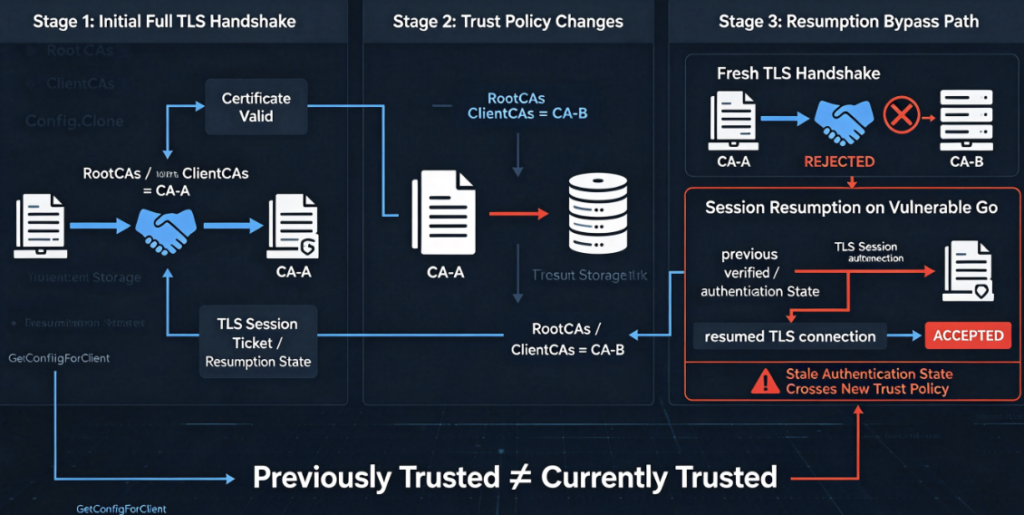
But session resumption introduces existing authentication state:
Earlier handshake
Certificate -> CA A
       |
       | successfully verified
       v
Session ticket / resumption state
       |
       | trust policy changes
       v
Current policy -> CA B only
       |
       | resume old session
       v
VULNERABLE BEHAVIOR:
connection may still succeed
The Go advisory summarizes exactly this condition: when ClientCAs or RootCAs change between the initial and resumed handshake, the resumed handshake may succeed even though it should have failed under the new configuration. (Go Packages)
In other words:
Previous authentication success could outlive the trust policy that originally made that authentication valid.
That is the security property administrators need to understand.
CVE-2025-68121 Is a Trust-Boundary Problem
Thinking about CVE-2025-68121 purely as a cryptographic defect is misleading.
The certificates are not necessarily forged.
The CA signatures are not necessarily broken.
TLS encryption is not necessarily defeated.
Instead, the problem concerns the binding between session-resumption state and the authentication policy under which that state was originally established.
An application may logically have two different security domains:
                    Shared TLS infrastructure
                            |
             +--------------+--------------+
             |                             |
             v                             v
       Trust Domain A                Trust Domain B
       ClientCAs = CA-A              ClientCAs = CA-B
             |                             |
       customers.example             admin.example
If a resumable session authenticated under Domain A can cross into Domain B without satisfying Domain B’s trust requirements, authentication isolation breaks.
Go specifically warns that configurations returned through GetConfigForClient can use the original configuration’s session ticket keys unless explicitly changed. Consequently, sessions established under a parent or sibling configuration can potentially be resumed across configurations. (Go Dev)
That behavior makes session-ticket scope part of the authentication architecture.
Understanding GetConfigForClient
Config.GetConfigForClient is one of the most important APIs for understanding CVE-2025-68121.
Go allows a server to inspect a ClientHello and dynamically select another tls.Config.
Conceptually:
baseConfig := &tls.Config{
    GetConfigForClient: func(hello *tls.ClientHelloInfo) (*tls.Config, error) {
        if hello.ServerName == "internal.example.com" {
            return internalConfig, nil
        }

        return publicConfig, nil
    },
}
This is useful for environments where different SNI names, customers, tenants, or services need different TLS behavior.
The documentation states that when the returned configuration does not explicitly establish different session-ticket keys, it can continue using the original configuration’s keys. Go now explicitly warns that this permits connections created under parent or sibling configurations to be resumed across those configurations. (Go Packages)
Consider a simplified mTLS architecture:
api.example.com
   ClientAuth = RequireAndVerifyClientCert
   ClientCAs   = Customer CA

admin.example.com
   ClientAuth = RequireAndVerifyClientCert
   ClientCAs   = Employee CA
During a fresh handshake, the separation is obvious.
A customer certificate trusted only by Customer CA should fail against the administrative service.
But if both configurations participate in compatible resumption state, then session resumption becomes another path through the authentication boundary.
That is why CVE-2025-68121 is especially relevant to dynamically configured TLS termination infrastructure.
Server-Side Impact: mTLS Authentication
The server-side case is particularly interesting because ClientCAs directly controls trust in client certificates.
Go defines ClientCAs as the root certificate authorities used by servers when client certificate verification is required. The strongest standard mTLS mode, RequireAndVerifyClientCert, requires that the client provide a valid certificate. (Go Packages)
A normal authentication flow looks like:
Client certificate
      |
      v
Certificate chain
      |
      v
Current ClientCAs
      |
      +---- trusted ----> authenticated client
      |
      +-- not trusted --> handshake rejected
Now imagine an organization rotating from:
Old Employee CA
to:
New Employee CA
A user previously authenticated under the old CA has existing session-resumption state.
The intended security policy becomes:
Old CA certificates -> no longer accepted
A fresh handshake reflects that immediately.
But vulnerable resumption behavior could allow authentication based on the previously established session, defeating the expected effect of the CA-policy change. The official Go vulnerability description explicitly states that a server can resume a session with a client that it would not have resumed with during the initial handshake under the current configuration. (Go Packages)
This matters for environments where certificate trust is being used as an authorization boundary rather than merely as transport encryption.
Examples include:
- internal service meshes;
- administrative APIs;
- machine-to-machine authentication;
- enterprise gateways;
- certificate-based device identity;
- customer-specific mTLS endpoints;
- certificate authority migration.
The CVE does not mean all these systems are automatically exploitable. They become interesting when different trust policies coexist with reusable TLS resumption state.
Client-Side Impact: RootCAs Changes
There is a corresponding client-side condition.
RootCAs defines which certificate authorities a Go TLS client uses when validating server certificates. Go’s documentation states that when RootCAs is nil, the host root CA set is used; otherwise the supplied pool defines server-certificate trust. (Go Packages)
Imagine:
Initial policy:
RootCAs = CA-A

server.example
certificate -> CA-A

FULL HANDSHAKE
     |
     v
certificate accepted
     |
     v
session cached
The client later changes its intended policy:
New policy:
RootCAs = CA-B
A fresh connection to the original CA-A server should fail.
The CVE concerns circumstances where an old session can instead be resumed based on prior authentication state, allowing the connection to continue despite the current trust configuration no longer accepting the original chain. (Go Packages)
This is why simply describing CVE-2025-68121 as an “mTLS bug” would also be incomplete.
Both sides of TLS authentication can be affected.
The Config.Clone Connection
The history of the vulnerability is slightly more complicated than the final advisory suggests.
An earlier Go security investigation focused on Config.Clone.
Go’s Config.Clone permits an existing TLS configuration to be cloned so the returned configuration can then be modified safely. Directly mutating a configuration after it has already been supplied to TLS is prohibited by the API documentation; the source documentation states that once a Config has been passed to a TLS function, it must not be modified. (Go Dev)
The earlier issue involved automatically generated session-ticket keys being copied into cloned configurations. That meant:
Config A
   |
   | Clone()
   v
Config B

but:

Config A ticket keys == Config B ticket keys
Therefore:
Session established using Config A
                 |
                 v
          session ticket
                 |
                 v
Config B can potentially resume it
even if Config B has different authentication rules.
The Go team initially changed Config.Clone behavior around automatically generated session ticket keys. Later, while addressing the broader issue, Go reverted that particular behavior change because the more comprehensive fix validates whether the root of the previously verified chain remains acceptable under the current CA configuration. (GitHub)
This history matters because it shows that the deeper problem was not simply “Clone copies a key.”
The real invariant that needed protecting was:
resumed authentication state
          must remain valid
under the current trust configuration
What the Final Go Fix Does
The security release for Go 1.24.13 and 1.25.7 describes the updated resumption check more precisely.
When the server uses either:
tls.VerifyClientCertIfGiven
or:
tls.RequireAndVerifyClientCert
Go now verifies during resumption that the root of the previously verified client certificate chain remains present in the current ClientCAs.
On the client side, when normal certificate verification is enabled—that is, InsecureSkipVerify is false—Go checks that the root of the previously verified server chain remains present in the current RootCAs. (Google Groups)
Conceptually, the fixed logic introduces an additional question:
Old verified chain
       |
       v
What root authenticated it?
       |
       v
Is that root still trusted
by the current configuration?
       |
   +---+---+
   |       |
  YES      NO
   |       |
RESUME    perform/reject
          resumption
This significantly reduces the dangerous mismatch between historical session state and current CA policy.
The VerifyPeerCertificate Trap
One of the most important defensive lessons from CVE-2025-68121 is that upgrading Go does not change the documented semantics of every certificate verification callback.
Specifically:
VerifyPeerCertificate
is not invoked for resumed connections.
The current Go documentation states this explicitly and even warns that the behavior also covers connections resumed across configurations created through Config.Clone or Config.GetConfigForClient. (Go Packages)
This means code like:
tlsConfig := &tls.Config{
    VerifyPeerCertificate: func(
        rawCerts [][]byte,
        verifiedChains [][]*x509.Certificate,
    ) error {
        return enforceCustomIdentityPolicy(rawCerts, verifiedChains)
    },
}
does not mean:
“Run
enforceCustomIdentityPolicyfor every TLS connection.”
It means the callback participates in the documented certificate-verification flow for full handshakes, but not resumed connections.
That difference can matter if the callback performs additional security checks such as:
certificate extension restrictions
SPIFFE-style identity checks
custom SAN constraints
device identity checks
tenant membership
certificate metadata policy
certificate pinning logic
A developer who assumes the callback executes on every connection can accidentally create a policy gap independent of the basic CA revalidation fix.
Use VerifyConnection for Per-Connection Policy
Go provides another callback:
VerifyConnection
Unlike VerifyPeerCertificate, the documentation states that VerifyConnection runs for all connections, including resumptions. (Go Packages)
That makes it the more appropriate API when an application requires additional policy evaluation every time a TLS connection becomes established.
For example:
tlsConfig := &tls.Config{
    RootCAs: roots,

    VerifyConnection: func(cs tls.ConnectionState) error {
        return enforceCurrentPolicy(cs)
    },
}
The important security difference is:
VerifyPeerCertificate
        |
        +--> full handshake
        |
        X--> resumed handshake


VerifyConnection
        |
        +--> full handshake
        |
        +--> resumed handshake
This does not mean developers should blindly move arbitrary logic from one callback to another. The callbacks expose different data and are intended for different uses.
But if a security property is explicitly required for every resumed connection, its enforcement point needs to run during resumed connections.
The Go security announcement itself recommends VerifyConnection for applications using GetConfigForClient or Clone when they do not want connections from the original configuration to be blindly resumed. (Google Groups)
Disabling Session Tickets Is Another Defensive Option
For applications that do not need resumption, Go exposes:
SessionTicketsDisabled: true
The standard library documentation says this disables session-ticket and PSK resumption support. On clients, resumption is also disabled when ClientSessionCache is nil. (Go Packages)
A security-sensitive server could therefore use:
config := &tls.Config{
    Certificates:           certs,
    ClientAuth:             tls.RequireAndVerifyClientCert,
    ClientCAs:              trustedClients,
    SessionTicketsDisabled: true,
}
This trades away the performance benefit of session resumption but removes an entire class of state-reuse behavior.
That can be reasonable for especially sensitive administrative interfaces or during emergency certificate revocation and trust-policy transitions.
The better long-term architecture depends on traffic volume and operational requirements, but the important point is that TLS resumption should be treated as authentication state, not merely as a latency optimization.
Session Ticket Keys Are Security-Domain Keys
Go also allows explicit management of session ticket keys.
The crypto/tls documentation notes that servers can use SetSessionTicketKeys when they need to control or synchronize session ticket keys across servers. (Go Packages)
Operationally, this means ticket keys should be considered part of the trust-domain architecture.
Suppose an organization operates:
Public API
Partner API
Employee API
Production Admin API
If each endpoint has meaningfully different client-certificate trust policies, indiscriminately sharing resumption credentials across them deserves the same kind of scrutiny as sharing authentication cookies or tokens between security domains.
A useful mental model is:
Session ticket key
      ≈
authority to recognize previous TLS authentication state
If two endpoints are not intended to recognize the same identity context, they should not accidentally recognize the same resumption state either.
What an Exploitation Sequence Looks Like
CVE-2025-68121 does not normally begin with an attacker sending one malformed packet.
The relevant sequence is stateful.
A representative server-side scenario is:
1. OLD TRUST POLICY

Server trusts:
Client CA-A

Attacker/client possesses:
certificate signed by CA-A


2. VALID INITIAL TLS HANDSHAKE

Client certificate
       |
       v
CA-A trusted
       |
       v
Connection accepted
       |
       v
resumable session created


3. TRUST POLICY CHANGES

Server now trusts:
Client CA-B

CA-A should no longer authenticate clients.


4. NEW FULL HANDSHAKE

Old client certificate
       |
       v
CA-A
       |
       v
Current ClientCAs = CA-B
       |
       v
REJECT


5. RESUMED CONNECTION ON VULNERABLE GO

Old session ticket
       |
       v
resumption
       |
       v
previous authentication state accepted
       |
       v
connection may succeed
The client-side form is symmetrical:
Client initially trusts Server CA-A
              |
              v
successful handshake
              |
              v
session cached
              |
        trust changes
              |
              v
Client now trusts Server CA-B
              |
              v
old session resumed
This dependency on historical state is one reason exploitability cannot be inferred solely from the presence of crypto/tls inside a binary.
Necessary Conditions for Practical Exposure
A useful CVE-2025-68121 assessment should ask several questions.
First, is the program actually built with an affected Go toolchain?
Second, does it use TLS session resumption?
Third, can authentication configuration differ between the initial connection and a resumed connection?
Fourth, are RootCAs or ClientCAs part of that change?
Fifth, does the architecture use GetConfigForClient, cloned configurations, shared session-ticket keys, or equivalent dynamic TLS configuration?
Sixth, does application security depend on callbacks such as VerifyPeerCertificate that do not run during resumption?
If the answers are effectively:
affected Go version         YES
session resumption          YES
trust policy changes        YES
cross-config resumption     YES
security consequence        YES
the finding deserves significant attention.
If instead the application has one immutable trust policy for its entire lifetime and never crosses authentication domains, practical exploitation may be substantially narrower even though the binary was compiled with an affected standard library.
That conditionality is reflected in the Go issue discussion itself. The Go team noted that directly mutating a tls.Config after it has been passed to TLS violates the API contract, while also identifying legitimate configuration patterns involving Clone and shared resumption behavior that required stronger protection. (Go Dev)
Why CVSS Scores for CVE-2025-68121 Differ So Much
CVE-2025-68121 is an unusually good example of why security teams should not treat a CVSS number as an exploitability verdict.
At the time of writing, NVD displays a CVSS 3.1 score of 10.0 Critical with:
CVSS:3.1/AV:N/AC:L/PR:N/UI:N/S:C/C:H/I:H/A:H
while the GitHub Advisory Database shows an unreviewed 4.8 Moderate assessment with high attack complexity, and Red Hat rates the issue 7.4 for its context. (nvd.nist.gov)
Red Hat explicitly explains that it considers attack complexity high because exploitation requires particular TLS resumption and runtime configuration conditions. It also does not assign an availability impact in its assessment. (Red Hat Customer Portal)
That does not make the vulnerability unimportant.
An authentication bypass affecting a privileged mTLS control plane could have major consequences.
But it does mean:
CVE severity and application exploitability are different questions.
A scanner sees:
Go version vulnerable
An engineer must determine:
Can an attacker reach the vulnerable state transition
in this specific application?
How to Check Whether Your Go Application Is Affected
The first step is straightforward: determine which Go toolchain built the application.
For source repositories, also run Go’s official vulnerability scanner.
go install golang.org/x/vuln/cmd/govulncheck@latest
govulncheck ./...
The Go documentation states that govulncheck uses source-level static analysis to identify known vulnerabilities and can narrow reports based on reachable functions and call paths. (Go Packages)
For a compiled Go binary:
govulncheck -mode binary ./my-service
Binary mode uses symbol information from the compiled program to identify vulnerable functions. The Go documentation cautions that binary analysis cannot reconstruct the complete call graph and can therefore report code that is present but unreachable. (Go Packages)
That limitation is particularly relevant to CVE-2025-68121.
A positive binary finding should therefore begin, rather than end, the investigation.
Search for High-Risk TLS Configuration Patterns
Review the codebase for:
GetConfigForClient
Config.Clone
RootCAs
ClientCAs
ClientAuth
VerifyPeerCertificate
VerifyConnection
ClientSessionCache
SessionTicketsDisabled
SetSessionTicketKeys
SessionTicketKey
For example:
rg 'GetConfigForClient|\.Clone\(\)|RootCAs|ClientCAs|VerifyPeerCertificate|VerifyConnection|SessionTicketsDisabled|SetSessionTicketKeys'
Finding these APIs does not automatically prove exploitability.
The next question is whether they participate in the same connection path.
A particularly interesting pattern is:
GetConfigForClient
       |
       v
returns different tls.Config values
       |
       v
different ClientCAs
       |
       v
session ticket keys remain shared
Another is:
baseConfig.Clone()
       |
       v
clone.RootCAs changed
       |
       v
session cache / resumption retained
Those patterns are much closer to the security condition described by GO-2026-4337. (pkg.go.dev)
Review Dynamic CA Rotation Carefully
Certificate rotation deserves special consideration.
Some Go applications reload trust stores without restarting.
For example:
09:00
Trusted clients:
CA-A

12:00
security incident

12:05
CA-A removed
CA-B installed
From an operator’s perspective, removing CA-A usually carries an intuitive expectation:
CA-A credentials stop authenticating.
Session resumption complicates that assumption because authentication state can survive beyond the full handshake that originally created it.
After patching CVE-2025-68121, Go performs stronger CA-root consistency checking for the affected normal certificate-verification paths. (Google Groups)
But applications using their own additional authorization semantics must still understand the documented behavior of the various verification callbacks.
This is especially important when a CA change is part of incident response rather than routine maintenance.
If the goal is immediate credential invalidation, consider whether existing TLS sessions and resumable sessions also need to be invalidated.
A Safer Pattern for Dynamic mTLS Configurations
Consider a server with multiple client trust domains.
A conceptual configuration might look like:
func buildTenantConfig(
    cert tls.Certificate,
    clientCAs *x509.CertPool,
) *tls.Config {
    return &tls.Config{
        Certificates: []tls.Certificate{cert},
        ClientAuth:   tls.RequireAndVerifyClientCert,
        ClientCAs:    clientCAs,

        VerifyConnection: func(cs tls.ConnectionState) error {
            return verifyTenantIdentity(cs)
        },
    }
}
The important design property is not this exact code.
It is the security invariant:
Every accepted connection
including resumed connections
must satisfy the current tenant policy.
Where different TLS configurations represent different authentication domains, session-ticket behavior should also be reviewed explicitly rather than inherited accidentally.
For especially sensitive boundaries, disabling resumption is the simplest conservative option:
cfg.SessionTicketsDisabled = true
Go documents this as disabling server-side session ticket and PSK resumption support. (Go Packages)
Do Not “Fix” It with InsecureSkipVerify
One dangerous reaction to TLS validation problems is to set:
InsecureSkipVerify: true
That is not a mitigation.
Go explicitly documents that when InsecureSkipVerify is true, the client accepts any server certificate and hostname unless custom verification is implemented, making the TLS connection vulnerable to machine-in-the-middle attacks. (Go Packages)
So this:
&tls.Config{
    InsecureSkipVerify: true,
}
turns off the certificate guarantee that CVE-2025-68121 is fundamentally about preserving.
Do not resolve a conditional validation problem by removing validation altogether.
Patch Guidance
The primary mitigation is upgrading the Go toolchain and rebuilding affected software.
The official Go vulnerability database identifies the corrected version boundaries as:
Go 1.24.x -> 1.24.13 or later fixed release
Go 1.25.x -> 1.25.7 or later fixed release
Go 1.26 RC -> 1.26.0-rc.3 or later
For applications distributed as static Go binaries, updating the operating system’s shared TLS libraries is generally not the relevant remediation path for this CVE. The vulnerable implementation resides in Go’s crypto/tls standard library used to build the program, so affected applications need to be rebuilt with an appropriate fixed Go toolchain.
After rebuilding, vulnerability scanning should be repeated against the exact artifact that will be deployed.
For example:
govulncheck -mode binary ./service-fixed
Go’s official govulncheck documentation specifically supports analysis of compiled Go binaries using the toolchain information and symbols present in the binary. (Go Packages)
Recommended Remediation Checklist
For security-sensitive Go applications, remediation should extend beyond simply making a vulnerability scanner green.
First, rebuild with a fixed Go release. (Go Packages)
Then identify all uses of:
GetConfigForClient
Clone
RootCAs
ClientCAs
VerifyPeerCertificate
VerifyConnection
SessionTicketKey
SetSessionTicketKeys
SessionTicketsDisabled
ClientSessionCache
Next, map which TLS configurations share authentication state.
The resulting model may look like:
                    Ticket Domain X
                    /             \
                   /               \
           Customer TLS        Admin TLS
          ClientCAs = A       ClientCAs = B
If configurations with different authentication policies share the same resumption domain, determine whether that is intentional.
For custom security checks that must apply to every connection, confirm that they execute during resumed connections. VerifyPeerCertificate does not; VerifyConnection does. (Go Packages)
Finally, test both:
fresh handshake
and:
resumed handshake after policy change
because testing only the fresh-handshake path can completely miss this class of flaw.
Why Conventional TLS Testing Can Miss CVE-2025-68121
Most TLS validation tests are stateless.
They ask questions such as:
Does an expired certificate fail?
Does an unknown CA fail?
Does hostname mismatch fail?
Does an unauthorized client certificate fail?
CVE-2025-68121 requires a different testing model.
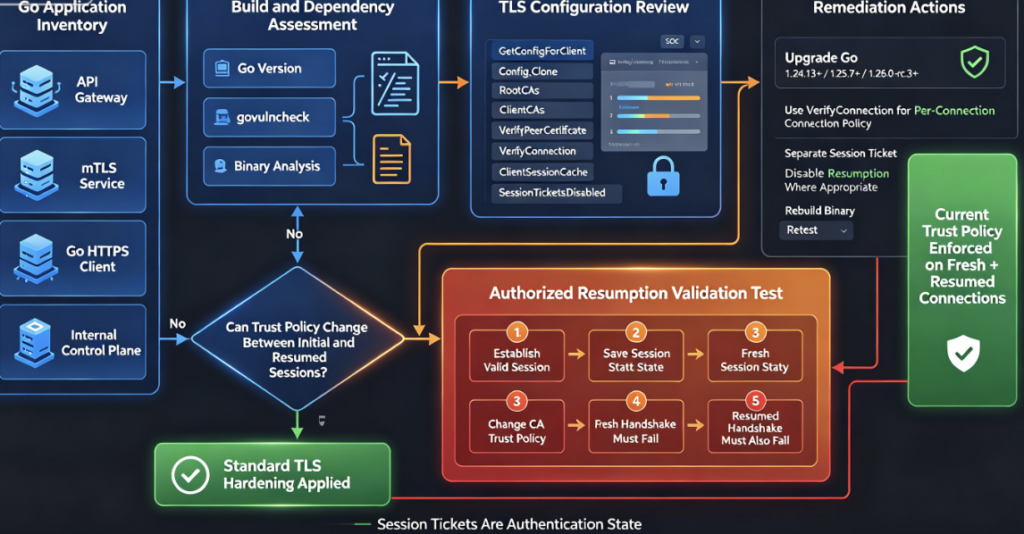
The relevant test is temporal:
STATE 1
Establish valid TLS session

        ↓

Save resumption state

        ↓

STATE 2
Change authentication policy

        ↓

Attempt fresh handshake

        ↓

Confirm fresh handshake fails

        ↓

Attempt resumed handshake

        ↓

Confirm resumed handshake ALSO fails
This is an important broader security lesson.
Authentication systems often contain state:
sessions
tokens
cookies
TLS tickets
cached authorization decisions
connection pools
credentials
Changing the policy that would reject a new authentication attempt does not necessarily invalidate state created by an older one.
CVE-2025-68121 is a particularly clean example of that architectural principle.
CVE-2025-68121 and Certificate Revocation Are Not the Same Problem
It is also worth separating this flaw from generic certificate revocation.
CVE-2025-68121 specifically concerns changed CA trust configuration and TLS session resumption behavior as implemented by Go. The official vulnerability record focuses on ClientCAs, RootCAs, Config.Clone, and Config.GetConfigForClient. (Go Packages)
The question is therefore:
Would the peer still authenticate
against the current Config?
rather than simply:
Has this certificate been revoked?
Those security concepts can overlap operationally, but they should not be treated as synonymous.
Why the Vulnerability Matters for Microservices
Modern Go services often place TLS inside infrastructure that is more dynamic than a traditional single-host HTTPS server.
A deployment might have:
                  Go TLS Gateway
                       |
         +-------------+-------------+
         |             |             |
      Tenant A      Tenant B      Internal
      CA Pool A     CA Pool B     CA Pool C
Dynamic configuration is useful because one gateway can service many identities.
But once a TLS server has multiple identity policies, every stateful optimization must answer a critical question:
To which security domain does this state belong?
That includes session tickets.
A ticket is not simply:
"this client connected before"
It effectively represents:
"this client established a TLS session
under a particular previous authentication context"
CVE-2025-68121 demonstrates what can happen when that historical authentication context and the current policy are insufficiently synchronized.
Defense in Depth
A resilient architecture should assume that CA trust configuration changes over time.
Keep TLS Configurations Immutable
Go’s API contract already requires a tls.Config not to be modified after it has been passed to TLS. Use new configurations or supported cloning patterns instead of mutating active structures in place. (Go Dev)
Separate Resumption Between Trust Domains
Where two services represent materially different authentication policies, consider whether they should share session-ticket keys at all.
Use VerifyConnection for Connection-Wide Custom Policy
If custom identity checks must run on resumed sessions, use an enforcement point whose documented semantics include resumptions. Go documents VerifyConnection accordingly. (Go Packages)
Disable Resumption Where Appropriate
Administrative control planes and extremely sensitive machine-authentication endpoints may prefer simpler authentication semantics over resumption performance.
SessionTicketsDisabled: true
is an available control. (Go Packages)
Test Trust Transitions
Security testing should include:
CA add
CA removal
CA rotation
tenant configuration switch
SNI configuration switch
client certificate policy change
with both fresh and resumed handshakes.
Detection and Verification Workflow
A practical engineering workflow can be represented as:
Identify Go services
       |
       v
Determine build Go version
       |
       v
Run govulncheck
       |
       v
Is CVE-2025-68121 present?
       |
      YES
       |
       v
Inspect crypto/tls configuration
       |
       +--> GetConfigForClient?
       |
       +--> Config.Clone?
       |
       +--> RootCAs changes?
       |
       +--> ClientCAs changes?
       |
       +--> shared ticket keys?
       |
       +--> VerifyPeerCertificate?
       |
       v
Can authentication policy differ
between original and resumed session?
       |
   +---+---+
   |       |
  YES      NO
   |       |
priority   lower practical
review     exposure
   |
   v
Upgrade Go
   |
   v
Retest fresh + resumed handshake
The purpose of this process is to distinguish:
package vulnerable
from:
application exploitable
while still patching the vulnerable toolchain.
Go’s own vulnerability tooling is designed around a similar philosophy: source analysis attempts to narrow findings based on reachable call paths rather than merely reporting every vulnerable module that exists somewhere in the dependency graph. (Go Packages)
Frequently Asked Questions
What is CVE-2025-68121?
CVE-2025-68121 is a certificate-validation issue in Go’s crypto/tls session resumption behavior. Under specific conditions, a TLS connection can be resumed using authentication state from an earlier handshake even though current RootCAs or ClientCAs settings would reject that peer during a fresh handshake. (Go Packages)
Is CVE-2025-68121 remotely exploitable?
The vulnerability concerns network TLS connections, but practical exploitation requires more than network reachability. The attacker needs a useful previously authenticated session and an environment where certificate trust configuration changes or differs across configurations participating in resumption. Red Hat consequently treats attack complexity as high in its own assessment. (Red Hat Customer Portal)
Does every Go HTTPS application have an authentication bypass?
No.
The vulnerable implementation may exist in affected Go binaries, but the security condition requires relevant session-resumption and trust-policy behavior. A static HTTPS service with one unchanged trust configuration is very different from a dynamic mTLS gateway using multiple CA pools.
Is CVE-2025-68121 only a server vulnerability?
No.
The official advisory covers both directions. Changing server-side ClientCAs can affect client-certificate authentication, while changing client-side RootCAs can affect server-certificate validation. (Go Packages)
Is it an mTLS vulnerability?
mTLS is one important scenario because ClientCAs is directly involved in client-certificate verification, but the vulnerability also applies to clients validating server certificates through RootCAs. (Go Packages)
Does Go revalidate the entire peer certificate during every resumed TLS connection?
Session resumption deliberately reuses authentication state rather than simply repeating the complete original handshake. The fix for this CVE adds checks tying the previously verified chain’s root to the current ClientCAs or RootCAs where applicable. (Google Groups)
Does VerifyPeerCertificate run on resumed sessions?
No.
Go’s documentation explicitly says VerifyPeerCertificate is not invoked on resumed connections. This remains true after the CVE fix. Applications requiring custom checks on resumed connections should evaluate VerifyConnection or disable/configure session resumption appropriately. (Go Packages)
Does VerifyConnection run during resumed connections?
Yes. Go documents VerifyConnection as executing for all connections, including resumptions. (Go Packages)
Which Go versions fix CVE-2025-68121?
The Go vulnerability database identifies the fixes as Go 1.24.13, Go 1.25.7, and Go 1.26.0-rc.3 for the corresponding affected version lines. (Go Packages)
Why does NVD rate CVE-2025-68121 10.0?
NVD currently displays a CVSS 3.1 score of 10.0 with network attack vector, low complexity, no required privileges, and high confidentiality, integrity, and availability impact. Other security databases interpret the environmental and exploitation prerequisites differently. (NVD)
Is CVE-2025-68121 really Critical?
It can be critical to a specific application, particularly where TLS certificates protect a highly privileged authentication boundary. But published scoring varies significantly: NVD currently shows 10.0, Red Hat assesses 7.4 for its context, and GitHub’s unreviewed advisory shows 4.8. The actual priority should therefore combine patch status with application-specific exploitability analysis. (nvd.nist.gov)
Final Assessment
CVE-2025-68121 is more subtle than its headline suggests.
The flaw is not simply:
Go forgot to validate certificates.
A better description is:
An identity was authenticated
under Trust Policy A.

TLS stored resumable state
representing that authentication.

The application later operated
under Trust Policy B.

The old resumable state could,
under affected conditions,
remain acceptable even though
Trust Policy B would reject
a fresh authentication attempt.
The Go security fix strengthens the binding between previously verified certificate chains and the current RootCAs or ClientCAs, preventing the affected normal certificate-verification paths from simply carrying obsolete trust across a session-resumption boundary. (Google Groups)
For defenders, however, the most valuable lesson goes beyond this CVE.
TLS session tickets are authentication state.
When authentication policy changes, engineers must consider not only what happens during the next full handshake, but also what previously created authentication state can still be replayed, resumed, cached, or reused.
For Go applications specifically, the remediation path is clear: rebuild with a fixed Go release, use govulncheck against both source and deployed binaries where appropriate, review GetConfigForClient and cloned TLS configurations, understand the security scope of session-ticket keys, and do not assume that VerifyPeerCertificate executes during session resumption. (Go Packages)
For environments where certificate identity is an actual authorization boundary—especially mTLS gateways, machine identities, administrative APIs, multi-tenant TLS termination, and dynamically rotated CA stores—the final verification test should always include both sides of the state transition:
Does the unauthorized peer fail
a fresh handshake?

AND

Does the unauthorized peer also fail
when attempting to resume
a previously valid session?
With CVE-2025-68121, that second question is the one that matters.


 English
  German
  French
  Spanish
  Portuguese
  Japanese
  Korean
  Hindi
Hindi  Arabic
  Turkish
  Hebrew