
A vulnerability hidden in the Linux kernel for nearly a decade has demonstrated how a seemingly ordinary cryptographic operation can undermine one of the operating system’s most fundamental security boundaries. Tracked as CVE-2026-31431 and publicly known as Copy Fail, the flaw allows an unprivileged local user to manipulate the in-memory contents of files they should not be able to modify. Under the right conditions, that capability can be transformed into full root-level access.
What makes Copy Fail particularly concerning is not simply that it enables privilege escalation. Linux has encountered numerous vulnerabilities with similar consequences. The difference lies in how reliably this bug can be triggered, how widely its vulnerable code has been deployed, and how little an attacker needs once they have obtained an initial foothold on a system.
The vulnerability was publicly disclosed on April 29, 2026, by researchers at Theori, who demonstrated a compact, 732-byte Python proof of concept capable of escalating privileges on several major Linux distributions. Unlike exploits that depend on kernel address leaks, carefully tuned heap layouts, or unpredictable race conditions, Copy Fail abuses a deterministic interaction between the Linux cryptographic subsystem and the page cache.
According to the original research published by Xint Code, the underlying issue stems from an optimization introduced in 2017. That change allowed certain authenticated encryption operations to reuse their input buffers as output buffers. When combined with file-backed memory references and a cryptographic implementation that writes outside its expected output region, the optimization creates an opportunity to overwrite protected file contents in memory.
The consequences extend beyond traditional multi-user Linux servers. Cloud infrastructure, container platforms, development environments, and continuous integration systems may all expose untrusted users or workloads to the same host kernel. In those environments, a vulnerability that turns ordinary local code execution into root privileges can have consequences far beyond the original compromised process.
Microsoft’s security researchers described Copy Fail as a significant threat to cloud Linux workloads and Kubernetes environments, particularly because an attacker does not need administrative privileges to begin exploiting the affected kernel interface. The vulnerability carries a CVSS v3.1 score of 7.8 (High) and was added to CISA’s Known Exploited Vulnerabilities catalog on May 1, 2026.
What Is CVE-2026-31431?
CVE-2026-31431 is a local privilege escalation vulnerability in the Linux kernel’s userspace cryptographic interface. The affected functionality is associated with algif_aead, a component that exposes authenticated encryption with associated data (AEAD) operations through the AF_ALG socket interface.
Ordinarily, Linux maintains strict boundaries between users who can read files and users who can modify them. A standard account might be allowed to execute a privileged system utility or read its binary from disk, but it cannot rewrite that binary. The operating system enforces these restrictions through filesystem permissions, memory protection, and kernel-managed execution semantics.
Copy Fail breaks an important assumption behind that model. An attacker does not need write permission to the original file because the malicious modification does not follow the normal filesystem write path. Instead, it occurs in the kernel’s page cache, the memory structure used to hold recently accessed file contents.
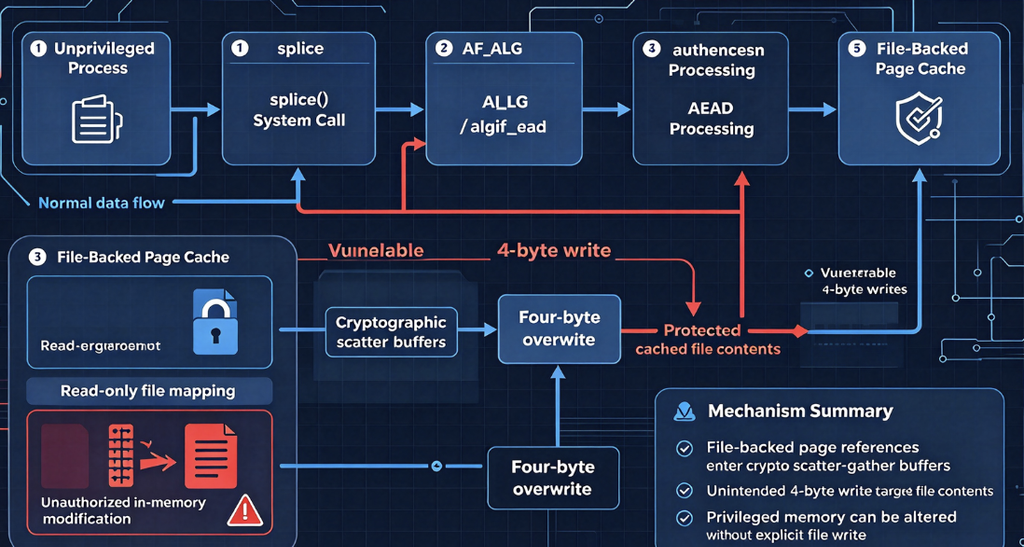
By manipulating the interaction between cryptographic scatter-gather buffers and file-backed memory pages, an attacker can cause the kernel to perform a controlled four-byte write into the cached representation of a readable file. Repeating this primitive can change selected portions of a privileged executable while leaving its on-disk contents unchanged.
If the modified file is subsequently executed with elevated privileges, the attacker-controlled instructions may execute in that privileged context. A commonly discussed target is /usr/bin/su, which is frequently installed as a setuid-root executable.
The Red Hat vulnerability advisory classifies the issue as Important and confirms that a low-privileged local attacker can exploit the cryptographic interface flaw to obtain root privileges. Red Hat also emphasizes that the local-access prerequisite explains why the vulnerability is not assigned its highest severity classification, despite the potentially complete compromise of an affected system.
Why Copy Fail Is More Dangerous Than a Typical Linux Privilege Escalation Bug
Many kernel exploitation techniques are complicated because they depend on conditions that are difficult to reproduce consistently. Memory layout randomization, allocator behavior, CPU timing, and kernel configuration can influence whether an exploit succeeds. Attackers often need to create precise conditions before they can reliably redirect execution or modify sensitive kernel data.
Copy Fail is different. Its central primitive is a logic error rather than a narrow timing vulnerability. The attacker arranges a sequence of ordinary kernel operations that unintentionally exposes page-cache-backed memory to a cryptographic write. Once the necessary kernel functionality is available, the same fundamental sequence can be repeated without racing another thread or predicting a kernel memory address.
The original researchers demonstrated the vulnerability on Ubuntu 24.04 LTS, Amazon Linux 2023, Red Hat Enterprise Linux 10.1, and SUSE 16. Although these tests covered different distributions and kernel builds, the same proof-of-concept approach worked across them.
Another important distinction is persistence. The initial page-cache modification does not directly rewrite the file stored on disk. Because the affected pages are not marked dirty for normal writeback, a conventional inspection of the on-disk executable may show that its original bytes remain intact. The corrupted memory contents can disappear when the cache is evicted or the system reboots.
That does not make the attack harmless. Root access obtained through the temporarily modified executable is genuine, and an attacker who achieves that level of access may subsequently install persistent malware, modify system configuration, steal credentials, or establish additional access mechanisms.
This combination of reliability, limited prerequisites, and in-memory modification explains why Copy Fail attracted immediate attention from Linux maintainers, cloud providers, and security researchers.
How CVE-2026-31431 Works: Understanding the Linux Kernel Vulnerability
To understand how Copy Fail works, it helps to examine three separate Linux kernel mechanisms that were never intended to create a writable path into protected file contents: the AF_ALG cryptographic interface, the splice() system call, and the kernel page cache.
Each mechanism serves a legitimate purpose. The vulnerability appears when they interact with the authencesn cryptographic template, whose implementation makes assumptions about writable scratch memory that are no longer valid in the affected execution path.
The AF_ALG Cryptographic Interface
Linux provides a kernel cryptographic API that applications can access without implementing every encryption algorithm themselves. One way to use this functionality is through AF_ALG, a socket-based interface that allows userspace programs to request encryption, decryption, hashing, and related operations.
Unlike ordinary network sockets, AF_ALG sockets are not primarily designed to communicate with another machine. Instead, they provide a mechanism for applications to submit cryptographic requests to the kernel.
The vulnerability affects the AEAD interface, which supports authenticated encryption with associated data. AEAD combines encryption with integrity verification, allowing an application to protect a message while authenticating additional information that does not need to be encrypted.
The specific implementation involved in Copy Fail is authencesn, a cryptographic template used in connection with IPsec Extended Sequence Number processing. Its internal processing requires manipulating sequence-number data during authentication.
In isolation, these cryptographic operations should not allow userspace programs to modify arbitrary protected files. However, the affected kernel implementation unintentionally gives certain cryptographic operations access to memory pages that originate from the filesystem cache.
How splice() Exposes Page Cache References
The Linux splice() system call is designed to move data efficiently between file descriptors, including pipes. Rather than copying every byte through a conventional userspace buffer, the kernel can transfer references to underlying memory pages.
This approach improves efficiency by reducing unnecessary memory copying. It is useful for applications that move substantial amounts of data between files, pipes, and other supported interfaces.
The important detail is that some of these referenced pages may originate from the kernel’s page cache.
When Linux reads a file, the kernel may retain its contents in memory so that later operations can reuse those cached pages. Applications accessing the same underlying file can therefore encounter the same physical cached data, subject to the filesystem’s caching and mapping behavior.
The kernel must ensure that transferring a reference to cached data does not accidentally grant permission to modify it. A process that can read a protected executable should not be able to alter the executable simply because its cached pages participate in another operation.
Copy Fail exploits a situation in which this separation breaks down.
When a file’s cached pages are passed through the splice() mechanism into an AF_ALG cryptographic operation, the kernel can retain references to those pages inside a scatter-gather list. A scatter-gather list represents data stored across multiple memory locations without requiring it to occupy one continuous buffer.
The problem becomes exploitable when those file-backed pages are subsequently treated as part of a writable destination.
The 2017 Optimization That Introduced the Vulnerability
The decisive change occurred in 2017, when Linux commit 72548b093ee3 introduced an optimization for in-place AEAD processing.
An in-place cryptographic operation reuses the input memory as the destination for the result. Under ordinary conditions, this can reduce copying and memory consumption. However, it also requires every participating implementation to respect the boundaries of the shared buffer.
For the vulnerable AF_ALG path, the destination scatter-gather list could contain references associated with file-backed page-cache memory. The kernel then configured the cryptographic request so that the source and destination were effectively the same combined scatterlist.
The result was a writable path into memory that originated from a file the attacker could read but could not ordinarily modify.
The problem was not necessarily obvious from the 2017 optimization alone. The earlier authencesn implementation already performed temporary writes while processing authentication information. Those operations were designed around assumptions about the destination buffer that became unsafe once the AF_ALG optimization changed the memory layout.
According to Theori’s technical analysis, the vulnerability emerged from the interaction of code introduced across several years, rather than from one isolated mistake. This explains how an apparently reasonable performance optimization could introduce a security problem affecting multiple generations of Linux kernels.
The Four-Byte Write Primitive
The core primitive behind CVE-2026-31431 is a controlled four-byte write into the page cache.
During certain authencesn decryption operations, the implementation manipulates sequence-number information and uses a location beyond the normal output data as temporary storage. In the vulnerable configuration, that location can overlap a page-cache-backed region referenced through the cryptographic scatter-gather list.
The attacker can influence the target offset and the four bytes written into the cached data by controlling the input structure and the file-backed region submitted to the operation.
An especially unusual aspect of the vulnerability is that the cryptographic operation does not need to complete successfully. Authentication verification may fail, and the kernel can return an error to userspace, while the earlier memory modification remains.
From the application perspective, the operation appears to have failed. From the kernel’s memory-management perspective, however, protected cached data has already been altered.
This distinction matters for detection. A security monitor that looks only for successful cryptographic requests could miss the relevant activity, while a monitor that observes abnormal AF_ALG operations may have an opportunity to identify exploitation.
The Linux kernel’s official CVE record identifies the underlying fix as a return to out-of-place AEAD processing. This separates the source and destination buffers and removes the vulnerable arrangement that allowed page-cache references to become part of the writable destination.
CVE-2026-31431 Exploit Analysis: From Unprivileged Access to Root
The publicly demonstrated Copy Fail exploit shows how a relatively small memory modification capability can become a serious privilege escalation vulnerability.
The initial requirement is local code execution on a vulnerable Linux system. The attacker might already possess a low-privileged shell account, have compromised an application running under a restricted service account, or control code executing inside a container.
This is an important limitation: CVE-2026-31431 is not a standalone unauthenticated remote code execution vulnerability. An attacker who has no method of executing code on the target machine cannot simply send a specially crafted network request and obtain root through Copy Fail alone.
However, once local execution is available, the vulnerability can provide a powerful second stage in an attack.
Consider a server hosting a web application. The application runs under an unprivileged service account, and the administrator has deliberately restricted that account from accessing sensitive configuration files or modifying system executables.
Suppose the application contains a separate vulnerability that allows an attacker to execute commands with the service account’s permissions. Normally, the attacker would remain limited by those permissions unless another weakness were available.
On a vulnerable Linux kernel, Copy Fail could allow the attacker to cross that boundary.
The public research demonstrates this by targeting the cached contents of a setuid-root executable. Such executables are special because the operating system can run them with the file owner’s effective privileges rather than those of the user invoking them.
The researcher-controlled page-cache modification changes part of the executable’s in-memory code. When the altered binary is subsequently executed, its privileged execution context can be abused to obtain root access.
The exploit does not need to permanently modify the executable on disk. It instead relies on the kernel reading the modified cached version during execution.
The original Copy Fail disclosure website documents the researchers’ demonstration and the publicly released proof of concept. That demonstration is significant because it establishes practical exploitability, rather than merely identifying a theoretical buffer-management problem.
Why the Exploit Can Be So Small
The original proof of concept attracted attention partly because it was implemented in approximately 732 bytes of Python.
That size reflects the nature of the vulnerability. The exploit does not need to implement an elaborate kernel memory-corruption framework, recover randomized kernel addresses, or build a complicated chain of memory-manipulation gadgets.
Instead, most of the difficult work is performed by ordinary Linux kernel interfaces. The attacker supplies data to those interfaces in a sequence that exposes the logic flaw.
The researchers’ Python implementation uses standard-library functionality rather than requiring a separate compiled exploitation framework. Its reliance on os.splice() means the published script requires a Python version exposing that function, but the underlying vulnerability is not specific to Python.
This distinction matters when evaluating risk. Removing Python from a container, preventing users from installing additional packages, or relying on a minimal base image does not necessarily eliminate the underlying attack surface. Other programming languages can invoke the relevant Linux system calls.
For defenders, the important question is whether untrusted code can access the vulnerable kernel interfaces, not whether one particular proof-of-concept script happens to run.
Which Linux Versions Are Affected by CVE-2026-31431?
One of the most challenging aspects of Linux vulnerability management is that kernel version numbers do not always directly indicate whether a particular security patch is present.
Linux distributions maintain their own kernel packages and routinely backport security fixes into older release branches. An enterprise distribution may therefore run a kernel with an older-looking version number while incorporating a security correction introduced in a much newer upstream kernel.
According to the Linux kernel CVE team, the vulnerability was introduced in Linux 4.14 through commit 72548b093ee3. The upstream project subsequently incorporated fixes into multiple maintained stable branches.
The official kernel advisory identifies the following fixed versions:
| Linux kernel branch | Fixed upstream version |
|---|---|
| 5.10 | 5.10.254 |
| 5.15 | 5.15.204 |
| 6.1 | 6.1.170 |
| 6.6 | 6.6.137 |
| 6.12 | 6.12.85 |
| 6.18 | 6.18.22 |
| 6.19 | 6.19.12 |
| Mainline | 7.0 |
These versions come from the Linux kernel security team’s official announcement. They describe upstream fixes, not every distribution’s individual kernel package. Older maintained distribution kernels may also contain vendor-backported corrections.
Ubuntu and Debian-Based Systems
Ubuntu confirmed that Copy Fail affected supported kernel packages and released updates and mitigations following the public disclosure.
For example, Ubuntu’s security tracker identifies the standard Ubuntu 24.04 LTS linux package as fixed in version 6.8.0-117.117, while Ubuntu 22.04 LTS received a fix in its standard linux package beginning with 5.15.0-179.189.
These package versions should not be generalized to every Ubuntu installation. Cloud-specific, hardware-enablement, and specialized kernel flavors use their own package versions and remediation schedules.
The Ubuntu security tracker for CVE-2026-31431 provides a detailed, continuously maintained record of the affected package families and their fix status. Ubuntu also published a separate Copy Fail remediation announcement.
For Debian-based systems, administrators should check the distribution’s own security advisories and package changelogs rather than assuming that an upstream version comparison is sufficient.
Red Hat Enterprise Linux and Enterprise Distributions
Enterprise Linux systems require particular attention because they often retain older kernel release families for long periods while incorporating selected security fixes.
Red Hat classified CVE-2026-31431 as an Important vulnerability and issued an expedited remediation program. The company confirmed that the flaw could allow a user with local access to gain root privileges and that the vulnerable functionality might be built directly into the kernel.
The distinction between built-in kernel functionality and loadable modules is operationally important. On systems where algif_aead is compiled into the kernel, simply creating a module blacklist file will not disable it.
Red Hat’s RHSB-2026-002 security bulletin documents the mitigation options, affected product families, and the remediation timeline. The bulletin states that the relevant Red Hat fixes have been made available and directs users to the product-specific advisories for exact package information.
SUSE, Amazon Linux, Rocky Linux, AlmaLinux, and other enterprise distributions should likewise be evaluated against their own kernel package advisories. The vulnerable upstream code was widely distributed, but identifying an affected installation requires considering the actual shipped kernel build, configuration, and backported patches.
Why CVE-2026-31431 Is a Kubernetes and Container Security Risk
The consequences of Copy Fail become more serious when Linux hosts run multiple containers belonging to different applications or tenants.
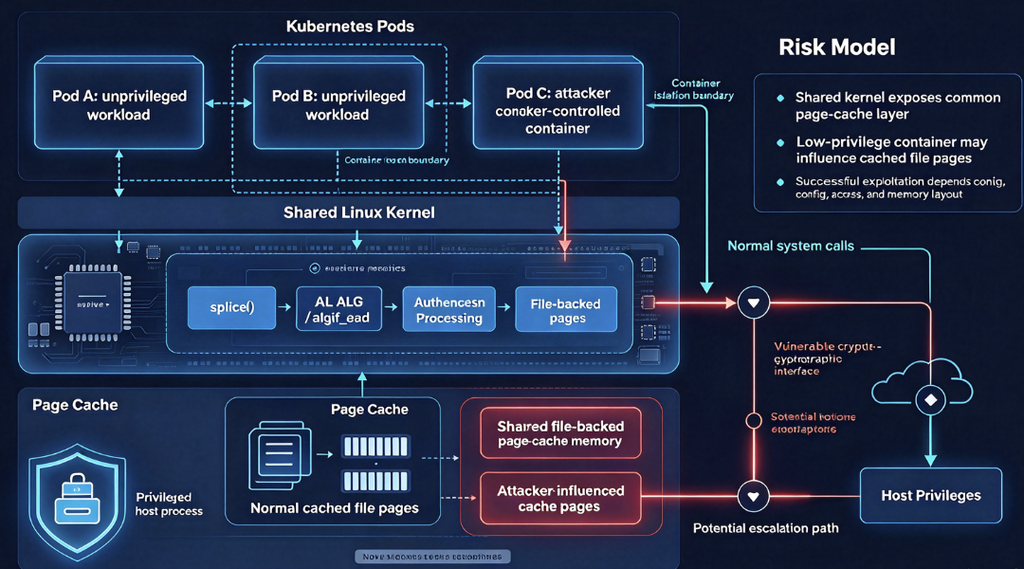
Containers isolate processes through Linux namespaces, control groups, filesystem views, and additional security mechanisms. These controls are useful, but containers running on the same host generally share the host’s underlying Linux kernel.
That shared kernel is a fundamental part of the container security model.
A vulnerability in the host kernel can therefore expose attack surfaces that are not isolated in the same way as ordinary userspace processes.
Copy Fail presents a particularly interesting problem because the exploited resource is the page cache. Containers with distinct filesystem views can still access file data backed by the same underlying cached pages.
For example, two containers built from related base images may share lower filesystem layers. Although each container appears to have its own root filesystem, some underlying file data may originate from the same host-managed storage objects.
If a vulnerable kernel operation allows one container to corrupt those shared cached pages, another container could subsequently observe the altered contents when accessing the same underlying file.
The risk is not limited to running a privileged executable inside the attacking container. Depending on the file mappings and runtime conditions, the corruption primitive may support cross-container code manipulation or a path toward host compromise.
In a follow-up investigation published on May 19, 2026, Theori demonstrated how Copy Fail could affect shared container image layers and participate in a Kubernetes container-escape attack involving the host container runtime. The research also described the importance of shared filesystem mappings rather than simply assuming that every container accessing a similarly named file shares identical cached pages.
The full analysis, Copy Fail: From Pod to Host, provides a deeper examination of this risk.
A Realistic CI/CD Attack Scenario
Consider a self-hosted continuous integration runner that executes code submitted through pull requests.
The runner uses containers to isolate build jobs and restricts ordinary workloads from modifying host configuration. Developers can execute build scripts and tests, but they do not have direct root access to the underlying worker node.
If the worker node runs a vulnerable kernel and the build environment exposes the affected AF_ALG functionality, a malicious job may be able to reach the Copy Fail attack surface.
The attacker would still need an exploitable path from the job’s execution context to a useful privileged target. However, once such a path is available, the shared-kernel design can turn an apparently restricted build execution environment into a route toward broader compromise.
A successful host-level compromise could expose credentials used by build agents, cached source repositories, deployment tokens, or secrets accessible to the compromised worker.
This is why shared CI infrastructure deserves a higher remediation priority than a conventional single-user workstation. The attacker’s starting privileges may be deliberately minimal, but their ability to execute arbitrary code is already part of the service’s operating model.
For workloads that execute code supplied by untrusted tenants, stronger isolation technologies such as dedicated virtual machines or microVMs can reduce the consequences of host-kernel attack surfaces. Container restrictions remain useful, but they should not be treated as a substitute for a patched kernel.
CVE-2026-31431 vs. Dirty Pipe and Dirty COW
Copy Fail belongs to a broader category of Linux vulnerabilities that turn restricted memory or filesystem operations into unauthorized writes.
Two of the most relevant historical comparisons are Dirty COW, tracked as CVE-2016-5195, and Dirty Pipe, tracked as CVE-2022-0847.
Dirty COW exploited a race condition in Linux’s copy-on-write memory handling. Under vulnerable conditions, an attacker could manipulate memory operations to modify data that should have remained protected.
Dirty Pipe exploited incorrect handling of pipe-buffer state, allowing attackers to overwrite cached file data under specific conditions. That vulnerability demonstrated the security implications of accidentally permitting writes into file-backed memory that should remain protected.
Copy Fail reaches a related result through a different subsystem.
Rather than relying on a copy-on-write race or the particular pipe-buffer state involved in Dirty Pipe, CVE-2026-31431 exploits the interaction between the cryptographic API, file-backed scatter-gather buffers, and an out-of-bounds scratch write.
The outcome can appear similar: a file that is protected by conventional filesystem permissions has its cached contents unexpectedly altered.
However, the root causes, affected kernel histories, exploit prerequisites, and fixes are different. A system protected against Dirty COW or Dirty Pipe is not automatically protected against Copy Fail.
This distinction is important for vulnerability scanners and incident responders. Broad categories such as Linux privilege escalation or page-cache corruption are useful for threat modeling, but each vulnerability requires its own patch validation and detection logic.
Is CVE-2026-31431 Being Exploited in the Wild?
CVE-2026-31431 has moved beyond a purely theoretical vulnerability.
Theori publicly released proof-of-concept material in April 2026, and additional implementations appeared in the security research community. Red Hat’s documented disclosure timeline also records the publication of a Metasploit module on April 29, 2026.
On May 1, 2026, the U.S. Cybersecurity and Infrastructure Security Agency added the vulnerability to its Known Exploited Vulnerabilities catalog.
The catalog inclusion is an important signal because it indicates that CISA has recognized evidence of exploitation rather than classifying the issue solely on theoretical severity. The agency assigned a May 15, 2026 remediation deadline for affected U.S. federal civilian executive branch agencies under the applicable directive.
The NIST National Vulnerability Database entry records the KEV inclusion, and Red Hat’s security bulletin independently confirms the date.
Nevertheless, inclusion in KEV should not be interpreted as proof that every major ransomware group is actively using Copy Fail or that exploitation is widespread across the internet.
Microsoft’s May 1 investigation reported that observed exploitation activity at that stage was limited and predominantly associated with proof-of-concept testing. The company also warned that the availability of a reliable public exploit increased the risk of further malicious adoption.
In practice, organizations should treat Copy Fail as a known-exploited vulnerability with an accessible public exploit, while avoiding assumptions about specific attacker campaigns unless supported by additional threat intelligence.
The distinction matters because the most likely exploitation path is post-compromise privilege escalation. An attacker may use another vulnerability, compromised credential, or insecure workload to obtain initial code execution before deploying Copy Fail.
How to Detect CVE-2026-31431 on Linux Systems
Detecting exposure begins with understanding which kernel is running, whether the relevant userspace cryptographic functionality is present, and whether the installed kernel package incorporates the fix.
An administrator can collect preliminary information using several non-destructive commands:
# Display the running kernel
uname -r

# Inspect the kernel configuration, if available
grep CONFIG_CRYPTO_USER_API_AEAD \
  /boot/config-$(uname -r)

# Check whether the affected module is loaded
lsmod | grep algif_aead

# Inspect advertised crypto algorithms
grep -A 5 'authencesn' /proc/crypto

# Review kernel package information on Debian/Ubuntu
dpkg-query -W 'linux-image*' 2>/dev/null

# Review the installed kernel package on RHEL systems
rpm -q kernel-core 2>/dev/null
These commands provide useful context, but none of them independently establishes that a system is vulnerable.
A system might have the relevant module compiled into the kernel rather than loaded dynamically. An algorithm may be available while the vulnerable code path has already been corrected. Conversely, an administrator might find an older-looking kernel version that contains the security fix through a distribution-specific backport.
For that reason, the most reliable exposure assessment combines the running kernel package, the vendor’s security advisory, and confirmation that the patched kernel is actually running.
Another consideration is reboot status. Installing an updated kernel package does not necessarily mean the machine has switched to that kernel. Unless an approved live-patching mechanism has applied the relevant correction, the vulnerable kernel may remain active until the host restarts.
Runtime Detection and Suspicious Behavior
Traditional vulnerability scanning identifies potentially exposed systems. Detecting actual exploitation requires a different approach.
A runtime security tool can monitor abnormal AF_ALG socket activity, unusual cryptographic operations, and suspicious process behavior occurring around the execution of privileged binaries.
The challenge is that the operations involved in Copy Fail use legitimate kernel interfaces. AF_ALG socket creation is not inherently malicious, and neither is the use of splice().
A more useful detection strategy correlates multiple observations. Repeated or unusual AEAD requests involving the affected cryptographic template, suspicious interactions with protected executable files, and unexpected privileged process execution may provide stronger evidence than any isolated event.
Sysdig published an analysis of Copy Fail on April 30, 2026, describing runtime detection using its security platform and a Falco-based detection approach. The company also noted that generic monitoring of AF_ALG socket creation can require tuning to reduce false positives.
The Sysdig technical report is particularly relevant for teams building behavioral detection rules rather than relying exclusively on package vulnerability scanning.
Why File Integrity Monitoring May Miss the Attack
Copy Fail creates a challenge for file integrity monitoring because the initial corruption occurs in the page cache rather than through an ordinary filesystem write.
Many integrity-monitoring systems detect unauthorized changes by calculating hashes or comparing file contents with a trusted baseline. Those approaches remain valuable, but their effectiveness depends on which representation of the file is examined and how it is accessed.
A tool inspecting the original on-disk blocks through an unaffected path may find that the file has not changed. Meanwhile, a process executing the file can encounter the corrupted cached contents.
This does not mean every integrity-monitoring product is universally incapable of detecting Copy Fail. Runtime tools that inspect the relevant memory state or correlate execution behavior may still identify malicious activity.
The practical lesson is that disk integrity and runtime integrity are not interchangeable. Security teams should consider attacks that manipulate cached or memory-resident code without first modifying persistent storage.
Theori’s container-focused research explains why agentless image scanning and disk snapshot inspection may fail to observe page-cache poisoning, while runtime monitoring offers additional visibility.
How to Fix CVE-2026-31431
The most effective remediation for CVE-2026-31431 is to install a vendor-supported kernel update containing the relevant fix.
The upstream correction removes the vulnerable in-place AEAD behavior and returns the implementation to separate source and destination handling. This prevents the affected cryptographic operation from treating file-backed page-cache references as writable output memory.
The fix is associated with upstream commit a664bf3d603dc3bdcf9ae47cc21e0daec706d7a5, with corresponding backports for several stable kernel branches.
Administrators should avoid assuming that manually applying one isolated upstream patch is preferable to installing a supported distribution update. The Linux kernel CVE team explicitly recommends updating to an appropriate stable kernel version and cautions against unsupported cherry-picking of individual changes.
For managed enterprise environments, patch installation should follow the operating system vendor’s guidance, including any dependencies, kernel flavor differences, and required restart procedures.
Temporary Mitigation When Kernel Patching Is Not Immediately Possible
If a production system cannot be patched immediately, reducing access to the affected cryptographic interface can provide a temporary defensive measure.
For environments where algif_aead is a loadable kernel module, administrators may be able to block module loading and disable the affected functionality. However, this approach requires checking whether the module is currently in use and whether applications rely on the AF_ALG AEAD interface.
A module-loading restriction is not sufficient when the relevant functionality is built directly into the running kernel.
Red Hat documents boot-time mitigations for its affected systems, including the kernel argument:
initcall_blacklist=algif_aead_initThis mitigation prevents initialization of the affected functionality when supported and correctly applied. It may require a reboot, must be deployed through the operating system’s supported kernel-command-line management mechanism, and should be verified after startup.
Other environments may use seccomp restrictions to prevent untrusted workloads from creating AF_ALG sockets. Such controls can remove the exploit primitive from selected application environments without necessarily disabling the entire cryptographic subsystem for the host.
These mitigations are not interchangeable across every distribution or deployment model. Blocking kernel cryptographic interfaces can also affect applications explicitly configured to use them.
The Red Hat mitigation guidance and Ubuntu security guidance provide vendor-specific approaches.
Securing Kubernetes Environments Against Copy Fail
For Kubernetes operators, remediation must focus on the worker-node kernel rather than only the container images.
Updating application dependencies, rebuilding container images, or changing the version of a userspace programming language will not correct a vulnerability that exists in the host kernel.
Organizations using managed Kubernetes platforms should verify whether their current worker-node images include the security correction. When necessary, they should upgrade or replace vulnerable nodes using their platform’s supported maintenance process.
Clusters hosting untrusted workloads should also review their isolation strategy. Restricting unnecessary kernel interfaces through seccomp, limiting container capabilities, enforcing appropriate security policies, and separating sensitive workloads can all reduce exposure.
However, these measures should be regarded as defense in depth. They do not eliminate the need to patch a vulnerable host.
Red Hat has published OpenShift-specific mitigation and fixed-version guidance, including patched platform releases and alternative strategies for affected clusters.
What CVE-2026-31431 Reveals About AI-Assisted Vulnerability Discovery
Copy Fail is also notable for the way researchers discovered it.
According to Theori’s disclosure, researcher Taeyang Lee had been investigating the interaction between the Linux cryptographic subsystem and page-cache-backed data. He recognized that the combination of AF_ALG and splice() created an interesting security boundary worth examining.
The team used Xint Code, an AI-assisted vulnerability research system, to analyze relevant kernel code paths. The research incorporated a specific hypothesis about page-cache references entering cryptographic scatter-gather lists.
The resulting investigation identified Copy Fail as a significant vulnerability.
This case illustrates an important distinction between merely asking an AI model to identify vulnerable code patterns and using AI-assisted analysis to investigate a concrete security hypothesis.
The flaw did not arise from an obvious unsafe function call sitting in isolation. It emerged from interactions between components that had evolved over several years.
A useful analysis therefore required understanding how data moved between kernel interfaces, which memory references remained shared, and how implementation assumptions changed when a performance optimization altered the buffer structure.
The AI-assisted component helped expand the scope of that analysis, while the researcher’s original observation gave the investigation a technically meaningful direction.
This does not establish that automated AI tools can reliably discover every similar vulnerability or replace expert verification. It does demonstrate how structured analysis of cross-component interactions can reveal security problems that are difficult to detect through simple pattern matching.
For defenders, the broader lesson is that vulnerability research should extend beyond obvious memory-unsafe operations. Data provenance, buffer ownership, implicit API contracts, and unexpected interactions between legitimate interfaces deserve attention.
The researchers’ original account describes the discovery process and the underlying reasoning in more detail.
Frequently Asked Questions About CVE-2026-31431
Is CVE-2026-31431 a remote code execution vulnerability?
No. CVE-2026-31431 is classified as a local privilege escalation vulnerability. An attacker needs the ability to execute code on the affected machine or within a workload that can reach the vulnerable kernel interface.
However, the vulnerability can be chained with other security weaknesses. A remotely exploitable application vulnerability that initially grants restricted command execution could become substantially more dangerous if the underlying kernel is also vulnerable to Copy Fail.
Does CVE-2026-31431 affect Docker containers?
Potentially, yes. Containers typically share their host’s kernel, so a vulnerable host may expose the affected functionality to code executing inside containers.
The actual exploitability and impact depend on the container’s restrictions, available kernel interfaces, filesystem mappings, and other environmental conditions. A container is not automatically exploitable simply because it uses Linux, but containerization alone is not a reliable defense against this vulnerability.
Can CVE-2026-31431 be exploited without root privileges?
Yes. The vulnerability specifically allows certain unprivileged local users to escalate their privileges under affected conditions.
The publicly demonstrated attack does not require the attacker to begin with administrative access. The security impact comes from crossing the boundary between an ordinary userspace process and privileged execution.
Does rebooting fix the vulnerability?
Rebooting can remove the temporary page-cache corruption created by a particular exploit attempt, but it does not correct the vulnerable kernel code.
If the machine restarts into the same vulnerable kernel, the underlying weakness remains available. A reboot is part of remediation only when it activates a corrected kernel or a verified boot-time mitigation.
Is Linux 6.8 vulnerable to CVE-2026-31431?
An upstream or distribution kernel derived from the affected code may be vulnerable unless it incorporates the fix. However, Linux version 6.8 alone is not enough information to determine exposure.
For example, Ubuntu has released patched kernel packages that retain a 6.8-based version number. Administrators must check the full distribution-specific package version and security status.
Is there a public exploit for CVE-2026-31431?
Yes. Theori published a proof of concept alongside its April 29, 2026 disclosure, and additional public implementations have been documented.
Organizations should not execute unverified exploit code against production systems merely to determine whether they are vulnerable. Vendor patch information, controlled testing environments, and non-destructive exposure checks are preferable for routine remediation validation.
Final Thoughts
CVE-2026-31431 is a reminder that major security vulnerabilities do not always originate from an obviously dangerous function or a newly introduced feature. Sometimes they emerge from interactions between otherwise legitimate components whose design assumptions have changed over time.
Copy Fail combines an older cryptographic scratch-write behavior, a userspace interface capable of handling file-backed memory references, and an optimization that unexpectedly places those references in a writable destination. Together, those mechanisms create a path from ordinary local code execution to protected page-cache modification and potentially full root privileges.
The broader security implications are substantial. Multi-user Linux servers, shared build infrastructure, cloud-hosted development environments, and container platforms all depend on the kernel to enforce boundaries between trusted and untrusted execution contexts.
When that boundary is compromised, controls implemented at higher layers may no longer provide the expected degree of isolation.
The availability of public exploitation techniques and the vulnerability’s inclusion in CISA’s Known Exploited Vulnerabilities catalog make remediation particularly important. Organizations should verify their installed kernel packages, apply vendor-supported fixes, inspect suspicious runtime activity, and consider additional restrictions for workloads that execute untrusted code.
Ultimately, the most reliable defense against CVE-2026-31431 is a patched Linux kernel, supported by runtime monitoring and strong workload isolation. The vulnerability may have remained unnoticed for nearly a decade, but its discovery reinforces a lasting principle of operating system security: read access must never become write access simply because data passes through an unexpected kernel subsystem.

 English
  German
  French
  Spanish
  Portuguese
  Japanese
  Korean
  Hindi
Hindi  Arabic
  Turkish
  Hebrew