
CVE-2026-34480 is an Apache Log4j Core vulnerability that exposes an uncomfortable truth about application security: an attacker does not always need remote code execution to create a serious security problem.
Sometimes making the evidence disappear is enough.
The vulnerability affects Log4j Core’s XmlLayout. When attacker-controlled data containing characters forbidden by XML 1.0 reaches a log message or Mapped Diagnostic Context, commonly called MDC, vulnerable versions of Log4j may generate malformed XML or fail while serializing the log event.
Depending on the StAX implementation used by the application, the result can be particularly dangerous from a defensive perspective: the security-relevant event may never reach the logging destination.
Apache describes CVE-2026-34480 as “Silent log event loss in XmlLayout due to unescaped XML 1.0 forbidden characters.” The Apache Software Foundation assigns it a CVSS 4.0 score of 6.9 Medium, with log4j-core as the affected component. The official affected ranges are 2.0-alpha1 through versions before 2.25.4, as well as Log4j 3 development releases from 3.0.0-alpha1 through 3.0.0-beta3. Version 2.25.4 contains the fix. (Apache Logging Services)
That description may initially sound like a formatting bug.
It is more interesting than that.
Logging is part of the security boundary of modern systems. Authentication attempts, authorization failures, API requests, suspicious parameters, administrative actions, payment operations, WAF alerts and incident-response evidence frequently travel through the same logging pipeline.
If malicious input can selectively disrupt that pipeline, an attacker may be able to create gaps exactly where investigators expect to find evidence.
CVE-2026-34480 therefore belongs to an important class of vulnerabilities involving log integrity and observability failure, rather than traditional confidentiality compromise or remote code execution.
CVE-2026-34480 at a Glance
| Field | CVE-2026-34480 |
|---|---|
| CVE | CVE-2026-34480 |
| Product | Apache Log4j Core |
| Component | XmlLayout |
| Maven artifact | org.apache.logging.log4j:log4j-core |
| Weakness | CWE-116 Improper Encoding or Escaping of Output |
| Apache CVSS 4.0 | 6.9 Medium |
| NVD CVSS 3.1 | 7.5 High |
| Primary impact | Security log corruption or silent log loss |
| Attacker interaction | Inject XML 1.0-forbidden characters into logged data |
| Affected Log4j 2 versions | >=2.0-alpha1, <2.25.4 |
| Affected Log4j 3 development versions | 3.0.0-alpha1 through 3.0.0-beta3 |
| Fixed version | Log4j Core 2.25.4 |
| Primary remediation | Upgrade Log4j Core |
Apache scores the issue at 6.9 under CVSS 4.0, while NVD’s CVSS 3.1 assessment is 7.5 High. The difference largely reflects different scoring models and interpretations of the integrity consequences; it does not mean the underlying vulnerability changed. (CVE)
What Is CVE-2026-34480?
The vulnerability exists because vulnerable versions of Log4j’s XmlLayout do not correctly sanitize characters that XML 1.0 does not permit.
Consider an application receiving an HTTP parameter:
username=aliceThe application might log it:
LOGGER.info("Authentication request for user {}", username);Normally there is no problem.
Now imagine the attacker supplies a string containing a control character such as Unicode U+0000.
Conceptually:
alice<U+0000>adminJava strings are capable of containing such characters.
XML 1.0 documents are not.
If XmlLayout attempts to serialize that message without replacing the illegal character, the resulting log record violates the XML specification.
Apache explains that vulnerable XmlLayout versions fail to sanitize XML 1.0-forbidden characters when those characters appear either in the log message or an MDC value. (Apache Logging Services)
The consequences then depend on the XML writer underneath Log4j.
That implementation detail is the central reason CVE-2026-34480 is more significant than a simple malformed-output bug.
How Log4j XmlLayout Works
A Log4j Layout transforms a LogEvent into a serialized representation that an appender can write or transmit.
Apache describes layouts as the component used by an appender to encode a LogEvent into a format expected by whatever system consumes that event. (Apache Logging Services)
A simplified pipeline looks like this:
Application
     |
     v
Logger.info(...)
     |
     v
LogEvent
     |
     +----------------+
     | message        |
     | timestamp      |
     | logger         |
     | MDC            |
     | exception      |
     | thread data    |
     +----------------+
             |
             v
        XmlLayout
             |
             v
       XML serialization
             |
             v
         Appender
             |
     +-------+-------+
     |               |
    File           Socket
     |               |
     v               v
 Log Agent         Collector
     \               /
      \             /
       v           v
         SIEM / SOC
Apache’s documentation shows a typical XmlLayout event similar to:
<Event
    level="INFO"
    loggerName="HelloWorld"
    thread="main">

    <Instant
        epochSecond="1493121664"
        nanoOfSecond="118000000"/>

    <Message>Hello, world!</Message>

    <ContextMap>
        <item key="bar" value="BAR"/>
        <item key="foo" value="FOO"/>
    </ContextMap>

</Event>
The important security observation is that values under <Message> and <ContextMap> may originate from external input.
Apache’s current documentation also says XmlLayout is planned for removal in the next major release and explicitly advises existing XML Layout users to migrate. (Apache Logging Services)
That recommendation matters when evaluating CVE-2026-34480: upgrading solves the immediate vulnerability, but organizations may also want to reconsider whether XML-formatted application logging is still necessary.
XML Escaping Is Not the Same as XML Character Validation
A subtle point explains why vulnerabilities like CVE-2026-34480 occur.
Most developers understand that XML requires certain characters to be escaped:
< -> <
> -> >
& -> &
" -> "
' -> 'But CVE-2026-34480 is not fundamentally about forgetting to convert < into <.
It concerns characters that cannot legally exist in an XML 1.0 document at all.
The XML 1.0 specification defines the allowed character ranges as:
#x9
#xA
#xD
#x20-#xD7FF
#xE000-#xFFFD
#x10000-#x10FFFF
That means many low control characters are forbidden.
For example:
U+0000 NULL
U+0001 START OF HEADING
U+0002 START OF TEXT
U+0003 END OF TEXT
...
U+0008 BACKSPACE
XML 1.0 allows tab (U+0009), line feed (U+000A) and carriage return (U+000D), but not most of the other C0 control characters.
The W3C specification explicitly defines the legal range and requires XML processors to reject characters outside it. (W3C)
This distinction is critical.
You cannot fix an XML 1.0-forbidden character simply by writing:
�because the referenced character itself is illegal.
The application needs to remove it, replace it or otherwise transform the value into valid XML-compatible data.
Log4j 2.25.4 chose replacement.
The Root Cause of CVE-2026-34480
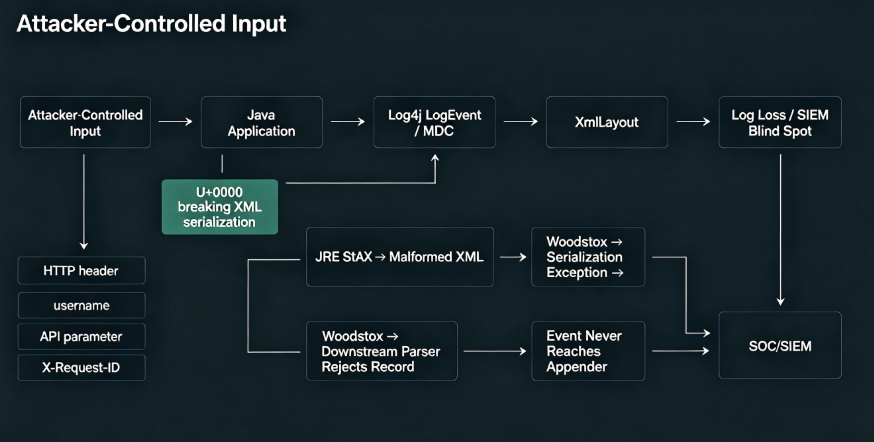
The vulnerable execution path can be simplified into four stages.
Attacker-controlled input
        |
        v
Application logs input
        |
        v
LogEvent / MDC
        |
        v
XmlLayout serialization
        |
        X
XML 1.0 forbidden character
        |
        +------------------------+
        |                        |
        v                        v
Malformed XML             StAX exception
        |                        |
        v                        v
Downstream parser        Event not delivered
rejects event            to intended appender
A secure serializer should ensure every string entering XML output conforms to the constraints of the target serialization format.
Vulnerable versions of XmlLayout failed to perform that sanitization consistently.
Apache classifies CVE-2026-34480 under CWE-116: Improper Encoding or Escaping of Output. (CVE)
The flaw therefore exists at the boundary between ordinary Java strings and XML 1.0.
The application accepts data Java can represent.
The logger accepts data Java can represent.
But the serialization format cannot represent all of it.
Without validation at that boundary, malformed log output becomes possible.
Two Different Failure Modes
One of the most interesting technical aspects of CVE-2026-34480 is that the observed behavior depends on which StAX implementation handles the XML.
Apache documents two cases.
JRE Built-In StAX
With the JRE-provided StAX implementation, forbidden characters can be written into the output.
The resulting document is malformed XML.
Conceptually:
<Event>
    <Message>login attempt: alice[0x00]admin</Message>
</Event>
The log writer may believe serialization succeeded.
The problem appears later.
A standards-compliant downstream XML parser sees an illegal character and rejects the document.
The pipeline becomes:
Application
   |
   | logging appears successful
   v
Malformed XML log
   |
   v
Collector
   |
   X
XML parser rejects record
   |
   v
SIEM never sees event
This is why Apache describes the issue as potentially causing downstream log-processing systems to drop affected records. (Apache Logging Services)
The application itself may continue functioning normally.
The attacker generates a request.
The request receives a response.
The application logs it.
No obvious exception needs to reach the user.
Yet the corresponding telemetry can disappear downstream.
Alternative StAX Implementations
With another StAX implementation such as Woodstox, the failure can occur earlier.
Apache specifically cites Woodstox, commonly encountered through Jackson XML-related dependencies, as an example.
Instead of writing invalid XML, the XML serializer throws an exception during the logging operation.
Apache states that in this situation the event is not delivered to its intended appender. It appears only in Log4j’s internal status logger. (Apache Logging Services)
The pipeline becomes:
Application
     |
     v
LOGGER.info(...)
     |
     v
XmlLayout
     |
     X
StAX exception
     |
     +----> Log4j Status Logger

Intended Appender
     X

SIEM
     X
This is arguably even more deceptive in some environments.
The security monitoring system expects an application event.
The event exists.
Logging was attempted.
But the configured appender never receives it.
Unless operations teams are monitoring Log4j’s internal status output, they may have no immediate indication that telemetry is being lost.
Why CVE-2026-34480 Is Not Log4Shell
Anything involving Log4j inevitably creates comparisons with CVE-2021-44228.
That comparison is misleading here.
CVE-2026-34480 does not describe a JNDI lookup vulnerability.
It does not describe arbitrary class loading.
It does not describe command execution.
It does not describe remote code execution.
Its primary security consequence is corruption or loss of logging telemetry.
The attack objective is therefore different.
Log4Shell looked conceptually like:
Attacker input
     |
     v
Log4j message processing
     |
     v
JNDI lookup
     |
     v
Attacker-controlled resource
     |
     v
Potential code execution
CVE-2026-34480 looks more like:
Attacker input
     |
     v
Log4j message
     |
     v
XmlLayout
     |
     v
Invalid XML
     |
     v
Log ingestion failure
     |
     v
Observability gap
Calling CVE-2026-34480 “another Log4Shell” would therefore exaggerate the vulnerability and misrepresent its technical mechanism.
Its significance comes from the security importance of logs themselves.
Why Silent Log Loss Is a Security Vulnerability
Consider a web application that records authentication failures:
LOGGER.warn(
    "Failed login username={} source={}",
    username,
    remoteAddress
);
The SOC expects to detect password spraying through events such as:
Failed login username=admin source=203.0.113.25
Failed login username=root source=203.0.113.25
Failed login username=test source=203.0.113.25
A correlation rule might trigger after 20 attempts.
Now suppose an attacker discovers that supplying a specific control character inside username causes the corresponding XML log event to disappear.
The application’s authentication mechanism still rejects the passwords.
But the detection mechanism sees:
Attempt 1  -> logged
Attempt 2  -> dropped
Attempt 3  -> dropped
Attempt 4  -> dropped
...
Attempt 20 -> dropped
The authentication system remains secure.
The monitoring system does not.
This is an important distinction.
Security frequently depends on two separate controls:
Preventive control
        +
Detective control
For authentication:
password validation
        +
failed-login monitoring
For APIs:
authorization
        +
audit logging
For administration:
RBAC
        +
administrative action logs
CVE-2026-34480 potentially attacks the second layer.
Security Logs Are Evidence
The impact becomes especially relevant during incident response.
Suppose investigators are reconstructing:
10:01  user authenticated
10:03  API token created
10:05  privilege changed
10:06  sensitive endpoint accessed
10:07  data exported
If malicious parameters cause selected events to vanish, investigators may instead see:
10:01  user authenticated
10:03  API token created
[missing telemetry]
10:07 data exported
Missing logs introduce several problems.
First, detection rules can fail.
Second, incident timelines become incomplete.
Third, attribution becomes harder.
Fourth, forensic confidence decreases.
Fifth, compliance investigations may incorrectly conclude that an action never occurred.
This is why CVE-2026-34480 should not be evaluated exclusively through the lens of application availability.
The key asset being attacked is telemetry integrity.
How an Attacker Could Reach the Vulnerable Path
The vulnerability does not mean every Internet-facing application using Log4j is automatically exploitable.
Several conditions need to line up.
A realistic exposure chain looks like:
External input
     |
     v
Application-controlled field
     |
     v
Logged without removing forbidden XML characters
     |
     v
Log4j Core
     |
     v
XmlLayout
     |
     v
Vulnerable version
     |
     v
Malformed / rejected event
Candidate inputs can include:
HTTP headers
URL parameters
JSON fields
form values
usernames
device names
API object names
search strings
file metadata
client identifiers
RPC arguments
message queue payloads
MDC values
Not every field needs to be directly logged.
An application may first place the value into MDC:
ThreadContext.put("requestUser", username);and later log an unrelated message:
LOGGER.info("Authentication request processed");If XmlLayout includes the MDC, the malicious value may still reach XML serialization.
This explains why Apache explicitly calls out both messages and MDC values in the vulnerability description. (GitHub)
MDC Makes the Attack Surface Larger Than It First Appears
Mapped Diagnostic Context is heavily used in modern Java applications.
Applications commonly attach metadata such as:
requestId
traceId
tenantId
username
sessionId
clientId
region
transactionId
deviceId
A simplified example:
ThreadContext.put("requestId", request.getHeader("X-Request-ID"));
ThreadContext.put("tenant", tenantName);

LOGGER.info("Processing API request");
The message itself contains no attacker data:
Processing API requestBut the corresponding structured log could contain:
<ContextMap>
    <item key="requestId" value="USER_CONTROLLED_VALUE"/>
    <item key="tenant" value="acme"/>
</ContextMap>
That means reviewing only logging statements such as:
LOGGER.info(userInput);is not sufficient when determining CVE-2026-34480 reachability.
Security teams should trace both message data and logging context data.
A Safe Local Demonstration
The following example illustrates the vulnerable condition in a controlled development environment.
It is intended for local validation of applications you own or are authorized to test.
A vulnerable dependency configuration might contain:
<dependency>
    <groupId>org.apache.logging.log4j</groupId>
    <artifactId>log4j-api</artifactId>
    <version>2.25.3</version>
</dependency>

<dependency>
    <groupId>org.apache.logging.log4j</groupId>
    <artifactId>log4j-core</artifactId>
    <version>2.25.3</version>
</dependency>
A minimal application:
import org.apache.logging.log4j.LogManager;
import org.apache.logging.log4j.Logger;
import org.apache.logging.log4j.ThreadContext;

public class XmlLayoutTest {

    private static final Logger LOGGER =
            LogManager.getLogger(XmlLayoutTest.class);

    public static void main(String[] args) {

        String forbidden = "alice\u0000admin";

        ThreadContext.put("username", forbidden);

        LOGGER.info(
            "Authentication request for user: {}",
            forbidden
        );

        ThreadContext.clearAll();
    }
}
The important character is:
\u0000Java accepts it inside the string.
XML 1.0 does not.
A simplified Log4j configuration can route the event through XmlLayout.
For example:
<?xml version="1.0" encoding="UTF-8"?>

<Configuration status="DEBUG">

    <Appenders>

        <File
            name="XML"
            fileName="logs/events.xml">

            <XmlLayout
                complete="true"
                compact="false"/>

        </File>

    </Appenders>

    <Loggers>

        <Root level="info">

            <AppenderRef ref="XML"/>

        </Root>

    </Loggers>

</Configuration>
The exact observed failure can differ according to the serialization stack, which is precisely what Apache documents for CVE-2026-34480.
The useful test condition is not simply:
Did Java throw an exception?Instead examine the complete pipeline:
Was LOGGER.info() called?
        |
        v
Was a LogEvent created?
        |
        v
Did the configured appender receive it?
        |
        v
Was XML written?
        |
        v
Can a conforming XML parser read it?
        |
        v
Did the collector ingest it?
        |
        v
Did the event reach the SIEM?
A pentest or regression test that verifies only application behavior can miss the real vulnerability.
Why Production Exploitation Can Be Hard to Notice
CVE-2026-34480 produces an unusual observability paradox.
The component intended to reveal abnormal behavior becomes the component whose failure hides that behavior.
Imagine an API:
POST /api/login
Content-Type: application/json

{
  "username": "malicious-value",
  "password": "wrong"
}
The server responds normally:
HTTP/1.1 401 UnauthorizedFrom an application perspective:
request received
authentication attempted
authentication rejected
response returned
Everything looks correct.
But the security telemetry pipeline could look like:
authentication failure
        |
        v
Log4j event
        |
        v
XmlLayout
        |
        X
serialization failure
An automated functional health check would still report:
API healthyThe actual state might be:
API healthy
security monitoring degraded
That is why log pipeline health deserves independent monitoring.
A More Realistic Attack Scenario
Consider a multi-tenant Java SaaS application.
Requests contain:
X-Tenant-ID: example-corp
X-Request-ID: 9c214...
The application automatically copies them into logging context:
ThreadContext.put(
    "tenant",
    request.getHeader("X-Tenant-ID")
);

ThreadContext.put(
    "requestId",
    request.getHeader("X-Request-ID")
);
Every subsequent request log inherits them.
An attacker controls X-Request-ID.
If the value contains an XML 1.0-forbidden character and the application uses vulnerable XmlLayout, a request could cause its associated log events to become malformed or fail serialization.
An attacker could potentially combine this behavior with another attack:
Step 1
Discover which inputs propagate into logging context

Step 2
Find a value that disrupts XmlLayout serialization

Step 3
Attach that value to malicious requests

Step 4
Perform application probing or abuse

Step 5
Security logs corresponding to those requests are lost

Step 6
Detection and forensic visibility decrease
The key word is combine.
CVE-2026-34480 is more concerning when it acts as an anti-forensics primitive supporting another vulnerability or intrusion technique.
CVE-2026-34480 and Log Injection Are Different
Traditional log injection commonly involves newline characters.
For example:
username=alice%0AINFO authentication successfulA vulnerable plaintext logger might produce:
WARN authentication failed username=alice
INFO authentication successful
The attacker has injected a fake log line.
CVE-2026-34480 works differently.
The goal does not need to be introducing an attacker-defined event.
Instead the malformed character damages serialization.
Conceptually:
Traditional log injection
=========================

attacker data
     |
     v
fake / misleading log record


CVE-2026-34480
==============

attacker data
     |
     v
invalid XML
     |
     v
real log record disappears
Both affect logging integrity, but their exploitation mechanics and detection strategies differ.
CVE-2026-34480 vs CVE-2026-34479
These two CVEs are easy to confuse because they were disclosed together and involve nearly identical XML character handling.
They affect different components.
| CVE | Component | Layout | Affected artifact |
|---|---|---|---|
| CVE-2026-34480 | Log4j Core | XmlLayout | log4j-core |
| CVE-2026-34479 | Log4j 1-to-2 compatibility bridge | Log4j1XmlLayout | log4j-1.2-api |
Apache describes CVE-2026-34479 as affecting users who either configure Log4j1XmlLayout directly or use the Log4j 1 configuration compatibility layer with org.apache.log4j.xml.XMLLayout. (Apache Logging Services)
CVE-2026-34480 concerns the Log4j Core XmlLayout.
This distinction becomes important when vulnerability scanners produce dependency findings.
Seeing:
log4j-apidoes not by itself prove that CVE-2026-34480 is reachable.
The vulnerable component identified by Apache is:
org.apache.logging.log4j:log4j-coreMore importantly, practical exploitability requires the vulnerable layout to actually be used.
Dependency Presence Is Not the Same as Reachability
A software composition analysis tool may report:
log4j-core 2.24.x
CVE-2026-34480
That is useful.
But it answers only:
Is a vulnerable package present?
It does not answer:
Can attacker-controlled data reach XmlLayout?
A meaningful assessment therefore requires several layers.
Layer 1
Is log4j-core present?

Layer 2
Is its version vulnerable?

Layer 3
Is XmlLayout configured?

Layer 4
Does attacker-controlled input reach messages or MDC?

Layer 5
Can forbidden XML characters survive application validation?

Layer 6
Does the resulting serialization failure produce security impact?
This is the difference between dependency vulnerability detection and runtime vulnerability validation.
The distinction is especially useful for organizations facing hundreds of Log4j findings across large Java estates.
How to Identify Vulnerable Log4j Versions
Start with your dependency tree.
For Maven:
mvn dependency:tree \
  -Dincludes=org.apache.logging.log4j
For Gradle:
./gradlew dependenciesor:
./gradlew dependencyInsight \
  --dependency log4j-core
You are primarily looking for:
org.apache.logging.log4j:log4j-coreAn affected result might resemble:
org.apache.logging.log4j:log4j-core:2.25.3Apache’s authoritative advisory places all Log4j 2 log4j-core releases from 2.0-alpha1 up to but excluding 2.25.4 in the affected range. (CVE)
Do not automatically conclude that every such application is practically exploitable, however.
Next determine whether XmlLayout is actually configured.
Searching for XmlLayout Configuration
Search application repositories for:
XmlLayout
XMLLayout
For example:
grep -Rni "XmlLayout" .You can also search common configuration locations:
log4j2.xml
log4j2.json
log4j2.yaml
log4j2.yml
log4j2.properties
An XML configuration might contain:
<XmlLayout/>Properties-based configuration could indirectly reference the same plugin.
Remember that logging configuration can also be supplied externally at runtime.
The absence of XmlLayout inside the application repository does not guarantee it is absent in production.
Check:
container images
Kubernetes ConfigMaps
Helm charts
VM deployment scripts
environment-specific config repositories
application server configuration
runtime JVM arguments
mounted configuration volumes
Inspect the Runtime Artifact, Not Just the Source Repository
Java dependency analysis can become misleading when applications are packaged as:
fat JARs
WAR files
EAR files
Spring Boot executable JARs
Docker images
application-server deployments
A project-level pom.xml may not reflect what is actually running.
Useful inspection commands include:
find . -iname '*log4j*.jar'and:
jar tf application.jar | grep -i log4jFor containers:
docker run --rm IMAGE_NAME \
  find / -iname '*log4j*.jar' 2>/dev/null
The goal is to establish:
runtime Log4j version
+
runtime logging configuration
+
actual XmlLayout use
Testing Input Reachability
Once vulnerable XmlLayout usage is confirmed, identify externally controlled values reaching logging.
For HTTP services this can include:
User-Agent
Referer
X-Request-ID
X-Forwarded-For
custom tenant headers
URL path
query string
form input
JSON values
GraphQL arguments
uploaded filenames
authentication usernames
Trace each value.
For example:
X-Request-ID
    |
    v
Servlet filter
    |
    v
ThreadContext.put("requestId", ...)
    |
    v
MDC
    |
    v
every LogEvent
    |
    v
XmlLayout
This path can be more important than an obvious statement such as:
LOGGER.info(request.getParameter("name"));because framework-level request context frequently propagates automatically across hundreds of logging calls.
Detection Strategy: Look for Log Pipeline Discontinuity
Detecting CVE-2026-34480 exploitation purely inside the SIEM can be difficult.
Why?
Because the defining symptom may be:
the event is not in the SIEMYou cannot reliably write a SIEM rule that matches a nonexistent event.
Instead use independent signals.
A strong architecture compares application activity with log-ingestion activity.
         Application
        /           \
       /             \
      v               v
Request counter     Log pipeline
      |               |
      v               v
Metrics system      SIEM
      |               |
      +-------+-------+
              |
              v
       Volume comparison
For example:
HTTP authentication failures observed by metrics:
10,000

Authentication failure logs received:
9,998
A tiny difference can be normal.
A sudden divergence such as:
HTTP failures:
10,000

SIEM events:
1,200
deserves investigation.
Monitor the Log4j Status Logger
Apache specifically notes that with certain alternative StAX implementations, failed events may appear only through Log4j’s internal status logger rather than the intended appender. (Apache Logging Services)
That suggests another defensive signal.
Monitor for unexpected Log4j serialization exceptions.
Potential categories include:
XMLStreamException
XML serialization failure
invalid XML character
appender write error
layout serialization exception
The precise exception text varies by implementation and should not be treated as universal.
A better detection approach is behavioral:
repeated XmlLayout failures
+
attacker-facing request activity
+
missing expected application logs
The combination has substantially higher confidence.
Validate Stored XML
Organizations retaining raw XML log files can periodically validate them.
For example, with xmllint:
xmllint --noout events.xmlMalformed records can indicate serialization problems.
However, this technique works only for the JRE-style scenario where malformed XML is actually written.
If the serializer throws before the appender receives the event, there may be no malformed record to scan.
The absence of malformed XML therefore does not prove the vulnerability has never been triggered.
Compare Edge Logs With Application Logs
Reverse proxies and load balancers offer another useful independent telemetry source.
Suppose nginx records:
203.0.113.25 POST /login 401but your Java service has no corresponding authentication event.
An individual discrepancy proves little.
A pattern can be significant.
Useful independent sources include:
CDN logs
load balancer access logs
WAF logs
API gateway logs
service mesh telemetry
reverse proxy logs
cloud flow logs
application metrics
distributed traces
The general principle is:
Never use the potentially vulnerable logging pipeline as the only mechanism for monitoring its own reliability.
How CVE-2026-34480 Was Fixed
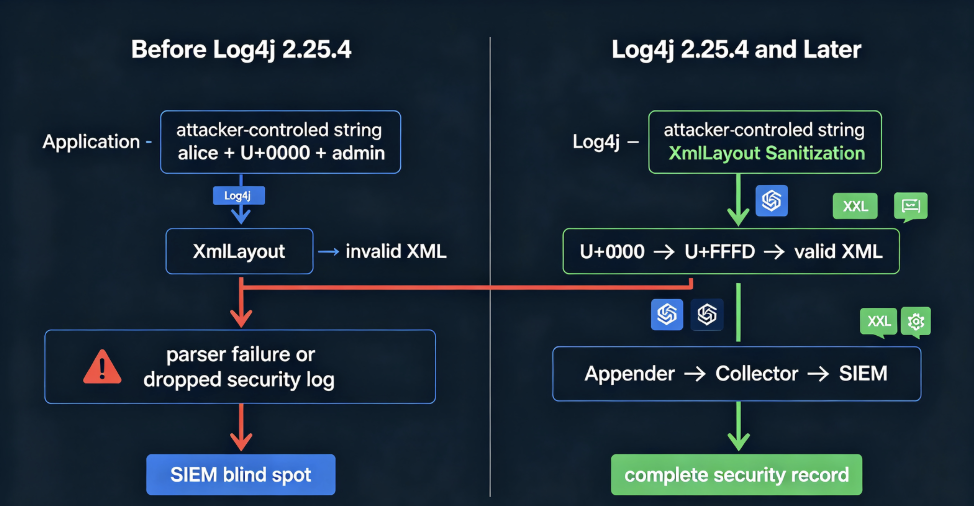
Apache Log4j 2.25.4 changed the behavior of XmlLayout so invalid characters are replaced before XML output.
The Log4j 2.25.4 release notes explicitly state:
Replace invalid characters in XmlLayout output with the Unicode replacement character (U+FFFD).
That change is associated with Log4j pull request #4077. (Apache Logging Services)
The transformation can be understood conceptually as:
Before
------

"alice" + U+0000 + "admin"

        |
        v

invalid XML


After 2.25.4
------------

"alice" + U+FFFD + "admin"

        |
        v

valid XML
Unicode U+FFFD is the familiar replacement character:
�The goal is not to preserve the forbidden byte exactly.
The goal is to preserve the existence and structure of the log record.
That is the correct priority for logging security.
Losing one invalid character is preferable to losing the entire forensic event.
Upgrade to Log4j 2.25.4 or Later
Apache’s direct remediation is straightforward:
Upgrade Apache Log4j Core to 2.25.4.For Maven:
<dependency>
    <groupId>org.apache.logging.log4j</groupId>
    <artifactId>log4j-core</artifactId>
    <version>2.25.4</version>
</dependency>
Teams using multiple Log4j modules should generally manage them consistently rather than independently pinning one artifact.
Using the Log4j BOM can help avoid dependency skew:
<dependencyManagement>

    <dependencies>

        <dependency>
            <groupId>org.apache.logging.log4j</groupId>
            <artifactId>log4j-bom</artifactId>
            <version>2.25.4</version>
            <type>pom</type>
            <scope>import</scope>
        </dependency>

    </dependencies>

</dependencyManagement>
Then declare:
<dependency>
    <groupId>org.apache.logging.log4j</groupId>
    <artifactId>log4j-api</artifactId>
</dependency>

<dependency>
    <groupId>org.apache.logging.log4j</groupId>
    <artifactId>log4j-core</artifactId>
</dependency>
As of September 2026, Apache’s current Log4j 2 download page lists 2.26.1, so organizations not constrained to the 2.25.x line should evaluate moving to the current supported release rather than treating 2.25.4 as a permanent target. The critical point for CVE-2026-34480 specifically is that 2.25.4 is the first fixed 2.x version. (Apache Logging Services)
Do Not Patch Only log4j-api
This deserves special emphasis.
CVE-2026-34480 affects:
log4j-corenot simply:
log4j-apiA system might contain:
log4j-api 2.25.4
log4j-core 2.24.3
That should not be treated as patched.
The runtime implementation remains vulnerable.
Keep relevant Log4j components version-aligned.
This also helps avoid confusing dependency scanner results. A real Dependency-Check issue was opened after CVE-2026-34480 was incorrectly associated with log4j-api; the reporter specifically noted that the flaw is limited to Log4j Core. (GitHub)
Temporary Mitigations When Immediate Upgrade Is Impossible
Upgrading should be the preferred response.
If emergency constraints prevent it, reducing exposure can still help.
Stop Using XmlLayout
The strongest configuration-level mitigation is eliminating the vulnerable serialization path.
Instead of:
<XmlLayout/>move to a different structured logging format where possible.
Apache itself currently recommends JSON Template Layout for structured logging and says XmlLayout is planned for removal in a future major release. (Apache Logging Services)
Changing the logging format can affect ingestion systems, however.
Do not silently switch production output without validating:
collector compatibility
parsing rules
SIEM schemas
dashboards
alert rules
retention pipelines
forensic tooling
Sanitize Untrusted Data
An application can remove XML-forbidden characters before inserting external data into logging fields.
Conceptually:
String sanitizeForXml10(String input) {

    if (input == null) {
        return null;
    }

    return input.replaceAll(
        "[\\x00-\\x08\\x0B\\x0C\\x0E-\\x1F]",
        "\uFFFD"
    );
}
This simplified example is useful for demonstrating the principle but should not be treated as a complete Unicode/XML sanitizer.
Production implementations should properly account for the complete XML 1.0 character definition, Unicode code points and surrogate handling.
More importantly, application-level sanitization should be considered defense in depth, not a substitute for upgrading Log4j.
Restrict Control Characters at Trust Boundaries
Some inputs have no legitimate need for arbitrary control characters.
Examples include:
request IDs
tenant IDs
account names
hostnames
UUID-like identifiers
API keys represented as printable strings
Validation such as:
[A-Za-z0-9._:-]+can eliminate the problematic character class for those specific fields.
Do not apply arbitrary restrictive validation to general Unicode text fields solely to work around the logging vulnerability.
Validation should follow the business meaning of the field.
Retest the Full Logging Pipeline After Patching
A dependency upgrade is not the end of remediation.
Run an integration test that intentionally sends:
normal characters
XML metacharacters
Unicode characters
XML-forbidden control characters
long strings
MDC values
exception messages
Then verify:
application accepts/rejects request correctly
        |
        v
Log4j generates event
        |
        v
appender receives event
        |
        v
serialized XML is valid
        |
        v
collector accepts event
        |
        v
SIEM indexes event
        |
        v
alert/query can retrieve event
The final check matters.
Security teams do not care merely whether XmlLayout returned without an exception.
They care whether the evidence arrived at its destination.
Why CVE-2026-34480 Matters for SOC Teams
Security operations teams typically assume logging infrastructure observes application behavior from outside the attack surface.
That assumption is not always valid.
The application and its telemetry pipeline share data.
User input
   |
   +----------> Application logic
   |
   +----------> Logging logic
A malicious value can therefore potentially affect both.
CVE-2026-34480 demonstrates why telemetry itself requires threat modeling.
Security engineers should ask:
Can attackers control log fields?

Can they create malformed structured logs?

Can one bad event block a batch?

Can a parser failure stop ingestion?

Do logging errors trigger alerts?

Can a logging failure affect the application thread?

Can we detect discrepancies using another telemetry source?
These questions extend beyond Log4j.
They apply to:
JSON loggers
protobuf telemetry
OpenTelemetry exporters
Syslog
Kafka-based logging
SIEM collectors
custom audit pipelines
Batch Processing Can Amplify the Impact
One malformed event may not always remain isolated.
Consider a collector batching:
Event A
Event B
Event C
Malicious Event D
Event E
Event F
If the parser handles each record independently:
A OK
B OK
C OK
D DROP
E OK
F OK
impact is narrow.
If the collector treats the entire file or batch as a single XML document:
A
B
C
D <- malformed
E
F

XML parser
    |
    X

entire batch rejected
the operational impact can become much larger.
The exact behavior depends on downstream architecture and is not itself guaranteed by CVE-2026-34480.
But it is an important environment-specific question during risk assessment.
A vulnerability’s practical severity often depends less on the CVSS score than on what surrounds the vulnerable component.
Cloud-Native Environments Add More Layers
A Kubernetes application may have a pipeline such as:
Java service
    |
    v
Log4j XmlLayout
    |
    v
stdout / file
    |
    v
Fluent Bit
    |
    v
Kafka
    |
    v
Logstash
    |
    v
Elasticsearch
    |
    v
SIEM
Any parser in the chain may react differently to malformed XML.
Therefore remediation verification should not stop at:
kubectl logsTrace the event all the way to:
final searchable security datastoreFor high-value systems, build a synthetic telemetry test.
For example, periodically generate an expected security event:
SECURITY_LOG_HEALTH_CHECKand alert when it fails to arrive within the expected period.
That transforms logging integrity into a monitored service-level objective.
CVE-2026-34480 and Audit Logging
The vulnerability becomes especially sensitive when XmlLayout feeds audit records.
Audit logs often support requirements involving:
administrator activity
authentication events
data access
configuration changes
privilege escalation
financial transactions
regulated records
If an application calls:
AUDIT_LOGGER.info(...)but the resulting event never reaches durable storage, the existence of the logging statement does not guarantee an effective audit control.
Organizations should therefore review whether vulnerable XmlLayout instances are connected specifically to:
audit appenders
security appenders
authentication logging
compliance event pipelines
privileged activity logs
Those instances deserve higher remediation priority than development-only debug logs.
Prioritizing CVE-2026-34480
A sensible prioritization model looks at reachability rather than simply the CVSS value.
Highest Priority
Systems where:
log4j-core < 2.25.4
+
XmlLayout enabled
+
Internet-controlled data reaches logs/MDC
+
logs feed security detection or audit systems
High Priority
Systems where:
XmlLayout enabled
+
attacker-controlled values are likely
+
downstream XML parsing is strict
Medium Priority
Systems where:
vulnerable library exists
+
XmlLayout use is uncertain
Lower Immediate Exploitability
Systems where:
vulnerable log4j-core exists
+
XmlLayout is demonstrably unused
Even the final category should eventually upgrade because carrying known-vulnerable dependencies creates unnecessary risk and future configuration changes can make previously unreachable code reachable.
Why CVE-2026-34480 Was Easy to Underestimate
Security vulnerabilities are often mentally ranked according to outcomes such as:
RCE
authentication bypass
SQL injection
arbitrary file read
privilege escalation
Logging vulnerabilities feel less dramatic.
But attackers frequently care about visibility.
A useful attack sequence is:
Gain capability
        +
Hide evidence
Anti-forensic techniques are valuable precisely because they increase the usefulness of other vulnerabilities.
A logging weakness can therefore become a force multiplier.
CVE-2026-34480 is best understood in this context.
It does not give an attacker a shell.
It may help create a place where defenders cannot see what happened.
The Release Timeline Is Also Interesting
Log4j 2.25.4 was released on March 28, 2026, and its release notes included the XmlLayout sanitization change.
The public CVE record was published on April 10, 2026. (Apache Logging Services)
That means administrators following upstream patch releases could have received the fix before the public CVE announcement.
This is another reason security programs should not rely exclusively on CVE feeds.
Dependency maintenance should combine:
CVE monitoring
+
upstream release monitoring
+
SBOM inventory
+
regular dependency upgrades
A CVE identifier is sometimes the public explanation of a problem whose fix is already available.
Do You Need to Search the Internet for CVE-2026-34480 Exploits?
For defensive validation, generally no.
The trigger condition is simple enough to reproduce locally.
You need to determine whether:
forbidden XML character
        |
        v
logged message / MDC
        |
        v
XmlLayout
        |
        v
event loss
That can be tested safely in your own environment.
Downloading arbitrary third-party exploit repositories adds little value for this vulnerability and introduces unnecessary supply-chain risk.
The Apache advisory, source patch and your own integration tests provide stronger evidence.
Patch Validation Checklist
After upgrading, security teams can verify the remediation using the following sequence:
1. Confirm runtime log4j-core version >= 2.25.4

2. Confirm dependency convergence

3. Restart all affected JVMs

4. Confirm old JARs are not still packaged

5. Test a normal log message

6. Test message containing XML metacharacters

7. Test XML 1.0-forbidden character

8. Test attacker-controlled MDC value

9. Verify intended appender receives the event

10. Validate generated XML

11. Verify collector ingestion

12. Search for the event inside the SIEM

13. Confirm no unexpected Log4j status errors occur
Do not skip the restart.
Replacing a JAR on disk does not necessarily change classes already loaded inside a running JVM.
Software Supply Chain Considerations
Log4j is frequently present transitively.
Your application may never explicitly declare:
log4j-corebut another framework may.
That makes SBOM-based inventory valuable.
Search:
Maven lock/dependency data
CycloneDX SBOMs
Syft results
container package inventories
SCA findings
CI dependency reports
Then distinguish:
presentfrom:
reachablefrom:
exploitableThese are not interchangeable states.
Why Scanner Severity May Differ
You may encounter CVE-2026-34480 marked:
Mediumin one platform and:
Highin another.
That does not necessarily indicate bad vulnerability intelligence.
Apache’s CNA record gives:
CVSS 4.0: 6.9 MediumNVD’s CVSS 3.1 assessment has been reported as:
CVSS 3.1: 7.5 HighUbuntu likewise lists a CVSS 3 severity score of 7.5 while assigning its own Ubuntu priority of Medium. (CVE)
For defenders, the practical question should be:
Does this vulnerable logging path protect something important in my environment?
A 6.9 issue affecting your central authentication audit trail may deserve faster remediation than a theoretical 9.0 vulnerability in unreachable code.
Should You Migrate Away From XmlLayout?
For many environments, yes.
Apache’s current Log4j documentation states that XmlLayout is planned for removal in the next major release and recommends migration. It separately recommends JSON Template Layout for modern structured logging use cases. (Apache Logging Services)
That does not mean XML itself is insecure.
The issue is architectural lifecycle and operational complexity.
Modern observability stacks are generally optimized around:
JSON
OpenTelemetry
structured events
schema-aware ingestion
If XML logging exists solely because of historical configuration, CVE-2026-34480 is a useful opportunity to question whether it should remain.
Recommended Long-Term Architecture
A more resilient security logging architecture separates four concerns:
Application data
      |
      v
Structured event model
      |
      v
Safe serialization
      |
      v
Reliable transport
      |
      v
Independent ingestion validation
      |
      v
SIEM
Security controls should exist at each boundary.
For example:
Input validation
        |
        v
Log field normalization
        |
        v
Format-safe serializer
        |
        v
Appender health monitoring
        |
        v
Collector health monitoring
        |
        v
Volume reconciliation
        |
        v
Detection rules
That architecture prevents any single encoding failure from silently destroying security visibility.
CVE-2026-34480 Detection Logic for Defenders
There is no universal network signature because the vulnerable character can appear in many protocols and fields.
Detection should instead focus on three signal classes.
Input Signals
Look for unusual control characters in attacker-controlled input.
Examples:
HTTP headers
usernames
API identifiers
query parameters
file names
tenant metadata
Application Signals
Look for:
XML serialization exceptions
StAX failures
Log4j Status Logger errors
appender failures
unexpected logging exceptions
Pipeline Signals
Look for:
drop in indexed log volume
collector parse errors
difference between request volume and event volume
gaps in security audit sequences
unexpected XML parser failures
The most reliable detection combines all three.
suspicious input
+
serialization error
+
missing corresponding SIEM event
Security Testing Should Validate Evidence, Not Just Exploitation
CVE-2026-34480 illustrates an important change in security testing methodology.
Traditional pentesting often asks:
Did the payload execute?For logging vulnerabilities the important question becomes:
What evidence survived?A stronger validation workflow therefore captures:
request
response
application behavior
raw application log
Log4j Status Logger
appender output
collector output
SIEM result
This creates an evidence chain capable of proving whether telemetry was actually lost.
That approach is particularly useful for agentic or automated security testing systems: finding a vulnerable package is only the first step. The system should determine configuration, runtime reachability, trigger behavior and downstream security impact before declaring the issue exploitable.
Frequently Asked Questions About CVE-2026-34480
Is CVE-2026-34480 another Log4Shell?
No.
CVE-2026-34480 concerns improper handling of XML 1.0-forbidden characters in Log4j XmlLayout, potentially causing malformed logs or lost log events.
It is not the JNDI remote-code-execution issue associated with CVE-2021-44228.
Does CVE-2026-34480 allow remote code execution?
The Apache advisory does not describe remote code execution.
The documented impact is log event loss caused by invalid XML serialization. (Apache Logging Services)
What versions are vulnerable to CVE-2026-34480?
Apache lists:
Log4j Core >= 2.0-alpha1 and < 2.25.4

and

Log4j 3.0.0-alpha1 through 3.0.0-beta3
as affected. (CVE)
What version fixes CVE-2026-34480?
Apache Log4j Core 2.25.4 is the first fixed 2.x release.
Apache says the fix sanitizes forbidden characters before XML output. (Apache Logging Services)
What exactly does Log4j 2.25.4 do differently?
Invalid characters in XmlLayout output are replaced with Unicode replacement character:
U+FFFDrather than allowing them to create invalid XML. (Apache Logging Services)
Is log4j-api vulnerable?
CVE-2026-34480 specifically identifies Log4j Core as the affected component.
The relevant artifact is:
org.apache.logging.log4j:log4j-coreDo not confuse this vulnerability with other 2026 Log4j issues affecting different artifacts.
Is every application using log4j-core vulnerable in practice?
Not necessarily.
Practical reachability generally requires:
vulnerable log4j-core
+
XmlLayout
+
attacker-controlled message/MDC data
+
XML-forbidden character survives input handling
The package version alone establishes exposure, not necessarily runtime exploitability.
Can WAF rules completely mitigate CVE-2026-34480?
No.
A WAF may reduce exposure for certain HTTP inputs, but attackers may influence logs through many channels:
HTTP
WebSocket
message queues
RPC
uploaded metadata
database content
internal APIs
Upgrading Log4j is the proper fix.
Can this vulnerability affect SIEM detection?
Yes.
That is one of the most important practical impacts.
If an event is malformed or never reaches its appender, downstream collectors and SIEM systems may never receive the security event.
Can it be used for anti-forensics?
Potentially.
If an attacker can deliberately trigger log loss while performing other malicious operations, the vulnerability can reduce forensic visibility.
That does not make CVE-2026-34480 an RCE or privilege-escalation vulnerability; it means the log-loss primitive can complement another attack.
Final Assessment
CVE-2026-34480 is a useful example of why vulnerability severity cannot be reduced to the question, “Can an attacker execute commands?”
Apache Log4j Core’s vulnerable XmlLayout crosses a data-format boundary incorrectly.
Java accepts the attacker’s character.
The logging API accepts the attacker’s character.
The LogEvent accepts the attacker’s character.
But XML 1.0 does not.
Before Log4j 2.25.4, XmlLayout could allow that mismatch to propagate into the logging pipeline.
With the JRE StAX implementation, the result can be malformed XML that conforming downstream parsers reject. With alternative StAX implementations such as Woodstox, serialization can fail during the logging operation and prevent the event from reaching its intended appender. Apache’s fix replaces invalid characters with U+FFFD, preserving the log event while maintaining valid XML. (Apache Logging Services)
The resulting attack chain is therefore simple:
Attacker-controlled input
        |
        v
Log message or MDC
        |
        v
CVE-2026-34480
        |
        v
XmlLayout serialization failure
        |
        v
Malformed or missing log
        |
        v
Collector / SIEM blind spot
        |
        v
Reduced detection and forensic visibility
For defenders, the response should be equally straightforward.
Upgrade log4j-core to 2.25.4 or later, verify that the production runtime actually received the new dependency, identify remaining XmlLayout configurations, test attacker-controlled message and MDC values, monitor Log4j’s internal status errors, and validate that security events arrive at their ultimate logging destination.
Apache’s broader guidance also deserves attention: XmlLayout is now planned for removal, while JSON Template Layout is the project’s recommended option for modern structured logging. (Apache Logging Services)
CVE-2026-34480 may not give an attacker control of a server.
But in a mature security environment, control over what defenders can see can be valuable in its own right.
 English
  German
  French
  Spanish
  Portuguese
  Japanese
  Korean
  Hindi
Hindi  Arabic
  Turkish
  Hebrew