
CVE-2026-42533 is a heap buffer overflow in NGINX request processing that can arise when the map directive combines regular expressions, capture variables, and a particular variable-evaluation order. An unauthenticated remote attacker may be able to trigger the vulnerable path with crafted HTTP requests, but only when the target is running an affected build and its configuration satisfies conditions the attacker cannot create independently.
The configuration dependency is important, but it should not be mistaken for a minor issue. A successful trigger can corrupt memory in an NGINX worker process and cause that worker to terminate or restart. The official CVE description also states that code execution may be possible when Address Space Layout Randomization is disabled or can be bypassed. The vulnerability affects the data plane rather than the NGINX control plane, meaning it is reached through traffic processing rather than an administrative interface. That distinction narrows the attack surface, but it does not remove the availability, confidentiality, or integrity implications of memory corruption in an internet-facing proxy. (NVD)
NGINX released Open Source versions 1.30.4 and 1.31.3 on July 15, 2026, with fixes for CVE-2026-42533. F5 also published corresponding NGINX Plus fixes, including R36 P7 and PLS.37.0.3.1. Organizations should patch first, then use version evidence and configuration review to determine whether a particular deployment was exposed. Sending an untrusted crash-oriented proof of concept to production is neither necessary nor advisable. (NGINX Community Forum)
CVE-2026-42533 at a Glance
| Field | Confirmed information |
|---|---|
| Vulnerability | Heap buffer overflow during NGINX script and complex-value processing |
| Affected feature | map with regular expressions and capture-sensitive expressions, plus certain non-cacheable variable conditions |
| CWE | CWE-122, Heap-based Buffer Overflow |
| Attacker access | Remote and unauthenticated |
| User interaction | None |
| Configuration dependency | Yes |
| Primary process affected | NGINX worker process |
| Primary operational impact | Worker termination or restart, request disruption, and possible denial of service |
| Potential security impact | Code execution may be possible if ASLR is disabled or bypassed |
| Plane affected | Data plane only, with no control-plane exposure identified |
| Fixed NGINX Open Source releases | 1.30.4 and 1.31.3 or later |
| Fixed NGINX Plus releases identified by F5 | R36 P7 and PLS.37.0.3.1 |
| CVSS v4.0 | 9.2, Critical, assigned by the F5 CNA |
| CVSS v3.1 | 8.1, High, assigned by the F5 CNA |
| Public disclosure date | July 15, 2026 |
| CISA ADP exploitation assessment at disclosure | None observed |
| CISA ADP automatable assessment at disclosure | No |
The two CVSS scores do not represent a disagreement about the underlying bug. They use different versions of the CVSS specification. The F5 CNA assigned a 9.2 score under CVSS v4.0 and an 8.1 score under CVSS v3.1. Both vectors characterize the vulnerability as remotely reachable, requiring no privileges and no user interaction, while assigning high attack complexity because successful exploitation depends on a qualifying server configuration and runtime conditions. At the time of writing, the NVD entry was still marked as awaiting NVD enrichment, so defenders should distinguish the CNA’s published assessment from any later NVD analysis. (NVD)
The CISA Authorized Data Publisher information attached to the CVE marked exploitation as “none” and automatable as “no” on July 15, 2026. That is a point-in-time assessment, not a guarantee that exploit research, scanning behavior, or attacker interest will remain unchanged. It should influence monitoring and threat-intelligence decisions, but it should not delay deployment of an official security fix. (NVD)
What NGINX Disclosed
The official NGINX security advisory describes CVE-2026-42533 as a buffer overflow associated with map and regular expressions. NGINX Open Source versions from 0.9.6 through 1.31.2 are identified as vulnerable, while 1.30.4 and 1.31.3 are listed as not vulnerable. The NGINX changelog uses more specific implementation language, stating that a heap buffer overflow could occur in a worker process when a map directive uses a regular expression and the resulting map variable is included in a string expression after a capture affected by that map. The changelog also identifies a similar issue involving a non-cacheable variable whose value changes during expression evaluation. (Nginx)
The CVE record provides a useful description of the attack boundary. The server must contain the relevant map and expression structure before an attacker can do anything. The attacker cannot remotely add a regex map, reorder variables, or mark a variable as non-cacheable. Once those conditions exist, however, an unauthenticated party may be able to send HTTP input that reaches the affected evaluation path.
That distinction can be summarized as follows:
- The configuration creates the vulnerable state.
- The request supplies the runtime input.
- The worker evaluates the stateful expression.
- The length prediction becomes inconsistent with the subsequent copy.
- The copy operation may cross the allocated heap-buffer boundary.
This is why the vulnerability has high attack complexity without requiring credentials. The attacker does not control every prerequisite, but a public-facing deployment may already contain the prerequisite on the attacker’s behalf.
F5’s CVE record identifies the direct consequence as a heap buffer overflow in the worker process, resulting in worker restart. It further states that code execution is possible if ASLR is disabled or bypassed. The wording matters. It does not say that reliable code execution is universal, trivial, or publicly demonstrated against every supported platform. Exploitability will depend on build options, allocator behavior, operating system protections, memory layout, request handling, and the exact corrupted objects. The defensible conclusion is therefore that denial of service is a direct and credible outcome, while code execution is a conditional higher-impact possibility documented by the vendor. (NVD)
The record also states that there is no control-plane exposure. An attacker is not using this bug to log into an administrative console, upload a configuration, or invoke a management API. The vulnerable operation occurs while a worker processes traffic. For organizations using NGINX as a reverse proxy, API gateway, content-delivery edge, service-mesh ingress, authentication front end, or load balancer, that data-plane position is still highly sensitive.
How the map Directive Normally Works
The NGINX map directive creates a variable whose value is selected according to one or more source values. A deployment might use map to classify requests by hostname, URI, header, device type, geographic marker, authentication state, or another variable already available to NGINX.
A simple, non-regex example might look like this:
map $http_upgrade $connection_mode {
    default upgrade;
    ''      close;
}
This pattern creates $connection_mode from the value of $http_upgrade. It is widely used to support WebSocket connection handling. There is no inherent vulnerability in using map, and the existence of a map block alone is not evidence of exposure to CVE-2026-42533.
Regular-expression maps are more expressive. They can match portions of a source value and create named or positional captures that are then available as variables. The official NGINX documentation permits regular-expression entries and their captures, and it supports a volatile parameter that marks the resulting map variable as non-cacheable. Map variables are generally evaluated only when they are used, which makes complex configurations efficient but also means evaluation timing matters. (Nginx)
Consider a schematic, intentionally incomplete structure:
# Structural illustration only.
# This is not a production-ready or exploit demonstration configuration.

map $request_derived_value $classification {
    ~<regex-with-named-capture>  $captured_component;
}

set $combined_value "$captured_component $classification";
The risk is not simply that a regex exists. The significant relationship is that evaluating $classification may execute the regex and update $captured_component. At the same time, $combined_value refers to $captured_component before it refers to $classification.
That order can create two different views of the expression:
- Before
$classificationis evaluated,$captured_componentmay be empty or contain an older value. - Evaluating
$classificationcan run the map regex and update the capture. - A later pass through the expression may now see a longer capture value at the beginning.
- If the buffer size was calculated from the earlier value, the allocated capacity may be too small for the later value.
The issue involving non-cacheable variables follows the same deeper pattern. A value used while calculating length is expected to remain consistent when the expression is copied. If the variable is evaluated again and produces a different-length result, that expectation is broken.
The official patch discussion describes this problem in terms of variables with side effects and non-cacheable values changing between the length-calculation and copy phases. This is a more precise description than saying “regex is unsafe.” Regex processing is only one mechanism through which evaluation changes request-scoped state. (GitHub)
How the NGINX Script Engine Lost Track of Buffer Length
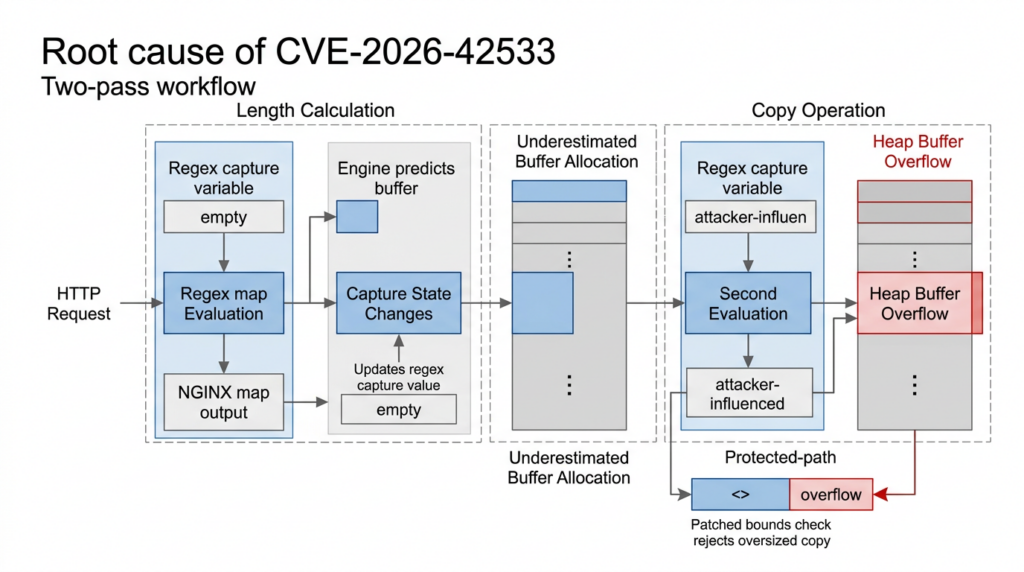
The vulnerable behavior is easiest to understand as a failure to preserve one invariant:
The number of bytes copied into a generated string must not exceed the number of bytes reserved for that string.
NGINX uses script-like internal machinery for values that combine fixed text, variables, captures, rewritten URI components, and other dynamically generated data. A simplified execution model has two phases.
The length phase
The engine walks the expression and determines how much memory the resulting value should require. If an expression contains a literal space, a variable, another literal, and a second variable, the engine adds the expected length of each component.
Conceptually:
required_length =
    length(first_variable)
    + length(separator)
    + length(second_variable)
After this calculation, NGINX can allocate one contiguous buffer rather than repeatedly growing it.
The copy phase
The engine then walks the expression again and copies each component into the allocated buffer.
Conceptually:
copy first_variable
copy separator
copy second_variable
This design is efficient when each component has the same length in both phases. A literal always does. A stable request variable normally does. A variable with side effects or a non-cacheable value may not.
The state change
Suppose the first variable is a regex capture and the second variable is a map output. Initially, the capture is empty.
During the length phase:
- The engine checks the capture and records a length of zero.
- It records the one-byte separator.
- It evaluates the map output.
- Evaluating the map runs a regular expression.
- That regex populates the capture with attacker-influenced request data.
- The engine records the map output length.
At the end of the length phase, the capture is no longer empty, but its earlier contribution to the predicted length remains zero.
During the copy phase:
- The engine returns to the start of the expression.
- It reads the capture again.
- This time the capture contains the value populated during the length phase.
- It copies the longer capture.
- It copies the separator.
- It evaluates and copies the map output.
The copy phase can therefore require more bytes than the length phase predicted.
A state table makes the mismatch clearer:
| Step | Capture state | Length contribution or copy size |
|---|---|---|
| Expression begins | Empty | Zero |
| Length pass reads capture | Empty | 0 bytes predicted |
| Length pass evaluates map | Updated by regex | Map length predicted |
| Copy pass reads capture | Already populated | Capture bytes copied |
| Copy pass evaluates map | Populated or updated again | Map bytes copied |
| Final result | Longer than prediction | Capacity may be exceeded |
The buffer overflow does not require a conventional integer overflow or an obviously unbounded memcpy argument supplied directly by a client. It arises because two individually reasonable evaluations observe different request state.
That detail is valuable for defenders because it explains why simplistic configuration searches are insufficient. A search for map can identify candidate files, but it cannot determine whether:
- a regex entry produces captures;
- the capture is reused elsewhere;
- the capture appears before the map output in a complex value;
- evaluation is repeated;
- a variable is non-cacheable;
- the input is request-controlled;
- the resulting path is reachable.
It also explains why an application-level WAF signature is an uncertain mitigation. The flaw is not tied to one universal byte sequence. The relevant request content depends on the local regex, the selected source variable, the capture structure, the expression, and the surrounding configuration.
What the Official Patch Changed
The security fix adds explicit knowledge of the destination buffer’s end to the NGINX script execution context. Before copying variable-length data, the patched code checks whether the remaining space is sufficient. If it is not, NGINX stops the operation instead of allowing the copy to continue beyond the allocated region.
The patch adds a helper that compares the requested copy length with the distance between the current write position and the recorded buffer end. When there is not enough space, the code logs the message no buffer space in script copy, sets an error status, and terminates the affected script operation. Bounds checks were applied across several copy paths, including ordinary values, variables, regex captures, URI arguments, and complex values. Related changes were made in both HTTP and stream script code. (GitHub)
The security significance of this design is straightforward:
- The old behavior depended too heavily on the length phase being perfectly predictive.
- The new behavior treats the destination boundary as authoritative.
- A state change can still make the original prediction wrong.
- The subsequent copy is nevertheless prevented from crossing the boundary.
- The request may fail, but memory safety is preserved.
This is a useful example of defense in depth. Removing all side effects from a mature configuration language may be impractical. Enforcing a hard destination limit at the final write operation protects against the current bug and may reduce the impact of other unexpected length inconsistencies.
The new error message may also provide defenders with a diagnostic signal after patching. If a fixed instance logs no buffer space in script copy, the bounds check has detected an attempted copy that did not fit the predicted buffer. That does not prove malicious exploitation. A legitimate request, an unusual configuration, another software defect, or an unsupported module interaction might reach the same safeguard. It should nevertheless trigger configuration review because normal expression evaluation should not repeatedly exhaust its precomputed buffer.
Why Data Plane Only Is Still Serious
The F5 CVE description says CVE-2026-42533 affects the data plane and does not expose the control plane. That is a meaningful boundary, but “data plane only” should not be translated into “availability only” or “low priority.”
NGINX commonly uses a master-worker architecture. The master process manages configuration-related operations and worker lifecycles, while worker processes accept and process connections. A memory-corruption bug reached through HTTP traffic therefore occurs in the part of the system handling real client requests. (Nginx)
A worker restart can affect:
- active client connections;
- requests currently being proxied;
- TLS sessions terminating in the worker;
- upstream response delivery;
- long-lived streams;
- WebSocket connections;
- local connection capacity;
- latency while traffic redistributes;
- load-balancer health assessments;
- retry behavior in clients and upstream proxies.
A single worker failure may be absorbed by redundant workers and nodes. Repeated failures can produce a very different operational profile. Capacity can fluctuate, retries can increase upstream load, health checks can remove and re-add instances, and autoscaling systems may react to misleading symptoms. In a multi-layer architecture, an edge-worker crash may surface as a connection reset, gateway error, timeout, application failure, or regional availability event.
Automatic process recovery is therefore not a substitute for patching. Restart behavior limits downtime under ordinary faults; it does not guarantee service continuity under attacker-controlled repetition.
The potential code-execution statement raises a second concern. A worker may possess access that is useful even when it does not control the NGINX configuration. Depending on deployment design, it may handle plaintext HTTP after TLS termination, communicate with internal upstreams, read selected files, access local sockets, or hold request metadata in memory. Containerization, privilege separation, mandatory access control, read-only filesystems, seccomp, and network segmentation can reduce post-exploitation impact, but they do not make worker memory corruption harmless.
The control-plane limitation should shape incident scope. A responder should not assume that the NGINX configuration was changed merely because the worker crashed. Conversely, responders should still investigate request data, process behavior, credentials or secrets available to the worker, network connections, child processes, filesystem changes, and lateral movement evidence if exploitation is suspected.
Affected Releases and Fixed Builds
NGINX’s public security advisory identifies Open Source versions 0.9.6 through 1.31.2 as vulnerable. The stable 1.30 branch is fixed in 1.30.4, while the mainline 1.31 branch is fixed in 1.31.3. Both fixed releases were announced on July 15, 2026. (Nginx)
The F5 CVE record also identifies affected NGINX Plus lines. It lists R33 as affected, R36 versions before R36 P7 as affected, and PLS.37 builds before PLS.37.0.3.1 as affected. F5’s NGINX Plus release documentation records R36 P7 and PLS.37.0.3.1 as July 15 security releases containing the CVE-2026-42533 fix. (NVD)
| Product line | Status | Required action |
|---|---|---|
| NGINX Open Source 0.9.6 through 1.30.3 | Vulnerable range | Upgrade to 1.30.4 or a later supported release |
| NGINX Open Source 1.31.0 through 1.31.2 | Vulnerable range | Upgrade to 1.31.3 or later |
| NGINX Open Source 1.30.4 | Fixed stable release | Deploy and verify active workers use the new binary |
| NGINX Open Source 1.31.3 | Fixed mainline release | Deploy and verify active workers use the new binary |
| NGINX Plus R33 | Identified as affected in the CVE record | Obtain branch-specific direction from F5 support |
| NGINX Plus R36 before P7 | Affected | Upgrade to R36 P7 or a later supported release |
| NGINX Plus R36 P7 | Fixed | Deploy according to F5 guidance |
| NGINX Plus PLS.37 before PLS.37.0.3.1 | Affected | Upgrade to PLS.37.0.3.1 or later |
| NGINX Plus PLS.37.0.3.1 | Fixed | Deploy according to F5 guidance |
| End-of-technical-support releases | Not necessarily evaluated | Do not assume safety; migrate or obtain vendor guidance |
Version assessment becomes more complicated when operating-system vendors backport patches. A distribution may retain an older upstream version string while adding a package-specific security revision. In that situation, an upstream comparison alone can produce a false positive. Defenders should check all of the following:
- the upstream NGINX version;
- the operating-system package release;
- the distribution’s security advisory;
- the package changelog;
- the actual binary running in memory;
- the container image digest;
- the vendor’s statement for any embedded product.
The reverse mistake is also common. A repository may contain a fixed package while an old process remains active. An image registry may have a corrected tag while existing pods still use the previous digest. A configuration-management system may report a successful deployment while one availability zone, edge node, or autoscaling template retains the vulnerable build.
A complete patch assertion should therefore answer two separate questions:
- Is an approved fixed artifact available?
- Is every relevant request-processing worker actually running that artifact?
Interpreting the Severity Without Hype
The F5 CNA’s CVSS v4.0 vector is CVSS:4.0/AV:N/AC:H/AT:N/PR:N/UI:N/VC:H/VI:H/VA:H/SC:N/SI:N/SA:N, producing a score of 9.2. Its CVSS v3.1 vector is CVSS:3.1/AV:N/AC:H/PR:N/UI:N/S:U/C:H/I:H/A:H, producing 8.1. (NVD)
Several parts of those vectors deserve practical interpretation.
Network reachable
The vulnerable worker path can be reached through network traffic. The attacker does not require local shell access.
No privileges required
Authentication is not a universal prerequisite. If the vulnerable expression processes unauthenticated requests, the attack surface may begin at the public edge.
No user interaction
A user does not need to click a link, open a file, or approve an action.
High attack complexity
The attacker depends on conditions outside direct control. The target must run an affected build and contain a qualifying configuration. The request must also reach the relevant expression with values that create the mismatch.
High attack complexity should affect probability estimates, not impact estimates. A configuration-dependent flaw can still be highly exploitable against one organization if that organization uses the exact pattern extensively.
High confidentiality, integrity, and availability impact
These ratings reflect the potential consequences of successful memory corruption, including the vendor’s conditional code-execution statement. They do not mean that every malformed request automatically obtains code execution.
A responsible risk statement is therefore:
CVE-2026-42533 is a remotely triggerable, configuration-dependent worker-process memory corruption vulnerability with a direct availability impact and a conditional possibility of code execution.
That sentence is more accurate than either extreme: “every NGINX server is remotely exploitable” or “it only crashes a disposable worker.”
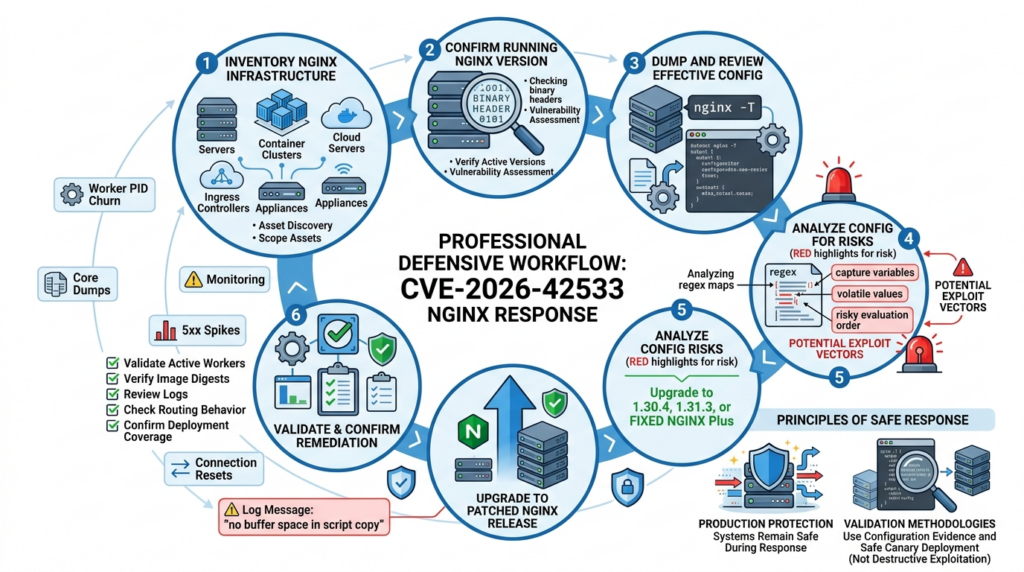
Determining Whether a Deployment Is Exposed
A useful exposure assessment separates five questions that are often collapsed into one.
Is the running binary affected?
Collect the version from the actual execution environment:
nginx -v
nginx -V 2>&1
The lowercase -v option reports the version. The uppercase -V option also displays compiler and configuration arguments. Official NGINX command-line documentation additionally defines -t for configuration testing and -T for testing while dumping the full configuration. (Nginx)
In containers, execute the command inside the running image or inspect the binary from the deployed digest. A host-level nginx -v result says nothing about a separate NGINX binary inside a pod.
Does the effective configuration contain map?
Do not inspect only /etc/nginx/nginx.conf. NGINX configurations commonly use multiple include statements, generated files, controller templates, and product-specific directories.
Use:
sudo nginx -T > /tmp/nginx-effective.conf \
  2> /tmp/nginx-effective.stderr
The output may contain sensitive operational information. Restrict permissions immediately:
sudo chmod 600 /tmp/nginx-effective.conf \
  /tmp/nginx-effective.stderr
Then locate candidate map blocks:
grep -nE '^[[:space:]]*map[[:space:]]' \
  /tmp/nginx-effective.conf
Do any maps use regular expressions or volatile behavior?
Search for common regex-map syntax and the volatile parameter:
grep -nE '^[[:space:]]*~\*?[[:space:]]' \
  /tmp/nginx-effective.conf

grep -nE '^[[:space:]]*volatile[[:space:]]*;' \
  /tmp/nginx-effective.conf
These searches are intentionally broad. They identify review candidates, not confirmed vulnerabilities.
Do captures and map outputs interact in a risky order?
For every regex map:
- Identify named and positional captures.
- Identify the map output variable.
- Search for complex expressions that reference both.
- Check whether a capture appears before the map output.
- Determine whether evaluating the map output can update that capture.
- Review non-cacheable values that may change between evaluations.
A line such as the following is structurally suspicious:
set $derived_value "$capture_from_map $map_output";
It is not sufficient by itself to prove exposure. The reviewer must confirm that $capture_from_map is actually populated by the relevant map and that the expression reaches the vulnerable engine behavior.
Can an external request influence and reach the path?
Determine the source variable of the map. Examples of potentially request-derived values include:
$uri;$request_uri;- request headers;
- cookie values;
- query arguments;
- hostnames;
- variables derived from earlier rewrite processing.
Then determine whether an unauthenticated external request can reach the location, server, or stream context where the expression is used. Internal-only administration locations, mutually authenticated routes, or values created exclusively from trusted configuration may have different practical exposure.
This produces a more defensible classification:
| Classification | Evidence | Recommended response |
|---|---|---|
| Patched | Fixed binary confirmed on every active instance | Continue monitoring and preserve evidence |
| Affected version, no relevant map | Effective configuration contains no qualifying map | Patch normally; do not claim exploitable exposure |
| Affected version, regex map present | Regex maps exist but interactions are unresolved | Prioritize manual configuration review |
| High-confidence configuration match | Capture-before-map or changing non-cacheable pattern is confirmed | Treat as urgent exposure and patch immediately |
| Suspicious runtime behavior | Matching configuration plus worker crashes or churn | Begin incident triage while patching |
| Unknown | Version, configuration, or deployment coverage incomplete | Treat uncertainty as remediation work, not as safety |
Safe PoC, Modeling the Length and Copy Mismatch
The following demonstration does not run NGINX, open a socket, send an HTTP request, corrupt memory, or contain an exploit payload. It is a standalone Python model of the state inconsistency described by the official patch.
Its purpose is to show why a two-pass expression engine can under-allocate when evaluating one variable changes another variable.
#!/usr/bin/env python3
"""
Safe educational model for CVE-2026-42533.

This program:
- does not run or contact NGINX;
- performs no out-of-bounds write;
- uses no network traffic;
- prints the size mismatch that a bounds check must catch.
"""

from dataclasses import dataclass


@dataclass
class RequestState:
    capture: str = ""

    def evaluate_map(self, source: str) -> str:
        """
        Toy map evaluation.

        In a real regex map, evaluating the map output may populate a
        request-scoped capture. Here we model that side effect by assigning
        a normalized source string to self.capture.
        """
        mapped = source.strip("/")
        self.capture = mapped
        return mapped


def length_pass(state: RequestState, source: str) -> int:
    """
    Model an engine that reads the capture before evaluating the map.
    """
    capture_length = len(state.capture)
    separator_length = 1
    map_length = len(state.evaluate_map(source))

    return capture_length + separator_length + map_length


def copy_pass_without_writing(
    state: RequestState,
    source: str,
) -> tuple[str, int]:
    """
    Model the second evaluation pass.

    The function creates a normal Python string and reports its length.
    It never writes into a fixed-size buffer.
    """
    result = f"{state.capture} {state.evaluate_map(source)}"
    return result, len(result)


def checked_copy(predicted_capacity: int, value: str) -> None:
    """
    Model the patched behavior: reject a copy that exceeds capacity.
    """
    actual_length = len(value)

    if actual_length > predicted_capacity:
        excess = actual_length - predicted_capacity
        raise BufferError(
            "Copy rejected: actual value exceeds predicted capacity "
            f"by {excess} bytes"
        )

    print("Copy is within the predicted capacity.")


def main() -> None:
    state = RequestState()
    request_derived_value = "/tenant-alpha"

    predicted = length_pass(state, request_derived_value)
    value, actual = copy_pass_without_writing(
        state,
        request_derived_value,
    )

    print(f"Predicted capacity: {predicted}")
    print(f"Actual copy length: {actual}")
    print(f"Generated value: {value!r}")

    try:
        checked_copy(predicted, value)
    except BufferError as error:
        print(error)


if __name__ == "__main__":
    main()
A typical result is:
Predicted capacity: 13
Actual copy length: 25
Generated value: 'tenant-alpha tenant-alpha'
Copy rejected: actual value exceeds predicted capacity by 12 bytes
The first pass sees an empty capture, so it allocates capacity for:
empty capture + separator + map output
Evaluating the map output populates the capture. The second pass now produces:
populated capture + separator + map output
The actual expression is longer than the prediction.
Python manages memory safely, and the program never attempts to force a write past a buffer. The checked_copy function represents the security property added by the NGINX patch: even if the prediction is wrong, the final copy must remain bounded.
This model does not establish that a real NGINX server is vulnerable. It does not account for NGINX’s complete configuration parser, script bytecode, memory pools, regex engine, request phases, module interactions, or platform mitigations. It teaches one narrow concept: a variable with a side effect can invalidate an earlier length calculation.
A production validation plan should stop at that conceptual boundary. Defenders generally do not need to discover the exact request that crashes an exposed worker. If the binary and configuration match the vendor’s conditions, the system should be treated as vulnerable and upgraded.
A Defensive Configuration Audit
A useful local review starts with evidence preservation.
set -euo pipefail

audit_dir="/var/tmp/nginx-cve-2026-42533-audit"
sudo install -d -m 700 "$audit_dir"

sudo nginx -v \
  2> "$audit_dir/nginx-version.txt"

sudo nginx -V \
  2> "$audit_dir/nginx-build.txt"

sudo nginx -t \
  > "$audit_dir/config-test.stdout" \
  2> "$audit_dir/config-test.stderr"

sudo nginx -T \
  > "$audit_dir/effective-config.txt" \
  2> "$audit_dir/effective-config.stderr"

sudo chmod 600 "$audit_dir"/*
nginx -t checks configuration syntax and attempts to open referenced files. nginx -T performs the test and additionally prints the complete configuration. NGINX’s documented reload process also validates the new configuration before starting replacement workers and gracefully retiring old ones. (Nginx)
Record hashes so the reviewed configuration can be tied to a specific artifact:
sudo sha256sum \
  "$audit_dir/nginx-version.txt" \
  "$audit_dir/nginx-build.txt" \
  "$audit_dir/effective-config.txt" \
  | sudo tee "$audit_dir/SHA256SUMS"
Run initial searches:
sudo grep -nE \
  '^[[:space:]]*map[[:space:]]' \
  "$audit_dir/effective-config.txt"

sudo grep -nE \
  '^[[:space:]]*~\*?[[:space:]]' \
  "$audit_dir/effective-config.txt"

sudo grep -nE \
  '^[[:space:]]*volatile[[:space:]]*;' \
  "$audit_dir/effective-config.txt"

sudo grep -nE \
  '\(\?<[_[:alpha:]][_[:alnum:]]*>' \
  "$audit_dir/effective-config.txt"
The review should then follow data flow rather than isolated keywords:
- For each
map, record its source expression. - Record its output variable.
- Record each regex rule and capture name.
- Search the full configuration for those capture variables.
- Search for expressions containing both a capture and the map output.
- Record their left-to-right order.
- Determine whether the expression is evaluated in a reachable request path.
- Determine whether external input influences the source.
- Review
volatilemaps and other non-cacheable values separately. - Have an experienced NGINX reviewer confirm high-confidence matches.
When finished, move the evidence into an approved restricted system or remove the temporary copy:
sudo shred -u "$audit_dir/effective-config.txt" 2>/dev/null \
  || sudo rm -f "$audit_dir/effective-config.txt"
shred does not guarantee secure erasure on every filesystem, snapshotting layer, or solid-state device. The stronger control is to avoid placing sensitive configuration data on an untrusted filesystem in the first place.
A Local Static Triage Script
The following script processes only a local configuration dump. It does not contact a server and does not generate test requests. It is a heuristic intended to reduce the amount of configuration requiring manual review.
Save it as audit_nginx_map_42533.py:
#!/usr/bin/env python3
"""
Local heuristic scanner for configuration patterns relevant to
CVE-2026-42533.

Input:
    A local file produced by `nginx -T`.

Output:
    Candidate map blocks and expressions requiring manual review.

Limitations:
    This is not a complete NGINX parser and cannot prove exploitability.
"""

from __future__ import annotations

import argparse
import re
from dataclasses import dataclass
from pathlib import Path


MAP_START = re.compile(
    r"^\s*map\s+(.+?)\s+\$([A-Za-z_][A-Za-z0-9_]*)\s*\{"
)
VARIABLE = re.compile(r"\$([A-Za-z_][A-Za-z0-9_]*)")
NAMED_CAPTURE = re.compile(
    r"\(\?(?:<|P<)([A-Za-z_][A-Za-z0-9_]*)>"
)
REGEX_ENTRY = re.compile(r"^\s*~\*?\s+")
VOLATILE = re.compile(r"^\s*volatile\s*;")


@dataclass
class MapBlock:
    start_line: int
    end_line: int
    source: str
    output: str
    lines: list[str]
    has_regex: bool
    is_volatile: bool
    captures: set[str]


def remove_comment(line: str) -> str:
    """
    Remove a simple trailing NGINX comment.

    This intentionally does not attempt to model every quoted-string edge
    case. The script is a triage tool, not a configuration parser.
    """
    escaped = False
    quoted = False
    result: list[str] = []

    for char in line:
        if escaped:
            result.append(char)
            escaped = False
            continue

        if char == "\\":
            result.append(char)
            escaped = True
            continue

        if char == '"':
            quoted = not quoted
            result.append(char)
            continue

        if char == "#" and not quoted:
            break

        result.append(char)

    return "".join(result)


def brace_delta(line: str) -> int:
    clean = remove_comment(line)
    return clean.count("{") - clean.count("}")


def parse_maps(lines: list[str]) -> list[MapBlock]:
    blocks: list[MapBlock] = []
    index = 0

    while index < len(lines):
        clean = remove_comment(lines[index])
        match = MAP_START.search(clean)

        if not match:
            index += 1
            continue

        source = match.group(1).strip()
        output = match.group(2)
        start = index
        depth = brace_delta(clean)
        body = [lines[index]]
        index += 1

        while index < len(lines) and depth > 0:
            body.append(lines[index])
            depth += brace_delta(lines[index])
            index += 1

        captures: set[str] = set()
        has_regex = False
        is_volatile = False

        for raw_line in body:
            candidate = remove_comment(raw_line)

            if REGEX_ENTRY.search(candidate):
                has_regex = True
                captures.update(NAMED_CAPTURE.findall(candidate))

            if VOLATILE.search(candidate):
                is_volatile = True

        blocks.append(
            MapBlock(
                start_line=start + 1,
                end_line=index,
                source=source,
                output=output,
                lines=body,
                has_regex=has_regex,
                is_volatile=is_volatile,
                captures=captures,
            )
        )

    return blocks


def find_expression_matches(
    lines: list[str],
    block: MapBlock,
) -> list[tuple[str, int, str]]:
    findings: list[tuple[str, int, str]] = []

    for line_number, raw_line in enumerate(lines, start=1):
        clean = remove_comment(raw_line)
        variables = VARIABLE.findall(clean)

        if block.output not in variables:
            continue

        map_position = variables.index(block.output)

        for capture in sorted(block.captures):
            if capture not in variables:
                continue

            capture_position = variables.index(capture)

            if capture_position < map_position:
                findings.append(
                    (
                        "HIGH-CONFIDENCE REVIEW",
                        line_number,
                        (
                            f"${capture} appears before "
                            f"${block.output} in the same expression"
                        ),
                    )
                )
            else:
                findings.append(
                    (
                        "ORDER REVIEW",
                        line_number,
                        (
                            f"${capture} and ${block.output} appear "
                            "in the same expression"
                        ),
                    )
                )

    return findings


def main() -> int:
    parser = argparse.ArgumentParser()
    parser.add_argument(
        "config",
        type=Path,
        help="Path to local `nginx -T` output",
    )
    args = parser.parse_args()

    if not args.config.is_file():
        parser.error(f"File does not exist: {args.config}")

    lines = args.config.read_text(
        encoding="utf-8",
        errors="replace",
    ).splitlines()

    maps = parse_maps(lines)

    if not maps:
        print("No map blocks were identified.")
        return 0

    print(f"Identified {len(maps)} map block or blocks.\n")

    for block in maps:
        print(
            f"Map ${block.output}, lines "
            f"{block.start_line}-{block.end_line}"
        )
        print(f"  Source: {block.source}")
        print(f"  Regex entries: {'yes' if block.has_regex else 'no'}")
        print(f"  Volatile: {'yes' if block.is_volatile else 'no'}")
        print(
            "  Named captures: "
            + (
                ", ".join(f"${name}" for name in sorted(block.captures))
                if block.captures
                else "none detected"
            )
        )

        if block.is_volatile:
            print(
                "  REVIEW: Non-cacheable map output may change "
                "between evaluations."
            )

        if block.has_regex and not block.captures:
            print(
                "  REVIEW: Regex map detected. Positional captures or "
                "indirect state may require manual analysis."
            )

        matches = find_expression_matches(lines, block)

        for severity, line_number, reason in matches:
            print(
                f"  {severity}: line {line_number}: {reason}"
            )

        if block.has_regex and not matches:
            print(
                "  REVIEW: No direct named-capture interaction was "
                "found, but manual analysis is still required."
            )

        print()

    print(
        "Result is heuristic. A clean report does not prove that the "
        "configuration is unaffected."
    )
    return 0


if __name__ == "__main__":
    raise SystemExit(main())
Run it against the protected configuration dump:
sudo python3 audit_nginx_map_42533.py \
  /var/tmp/nginx-cve-2026-42533-audit/effective-config.txt
The script deliberately errs on the side of producing review items. It is not an NGINX grammar implementation. Several limitations remain:
- quoted braces and unusual strings may confuse its block counting;
- positional regex captures are not fully traced;
- indirect variable dependencies are not resolved;
- embedded scripting modules can change values outside ordinary syntax;
- templates may differ from the rendered configuration;
- third-party modules may add non-cacheable variables;
- runtime reachability is not calculated;
- request controllability is not calculated;
- package patch status is not calculated;
- exploitability is not calculated.
The correct use of the output is to direct an engineer to a small set of map blocks and expressions. The incorrect use is to treat “no high-confidence match” as a reason not to install the security update.
Runtime Detection and Incident Triage
CVE-2026-42533 does not come with one reliable network signature that applies to every vulnerable organization. The triggering request is shaped by local configuration. Detection should combine process, application, configuration, and deployment evidence.
Worker-process churn
Establish whether worker PIDs are changing more frequently than normal.
ps -eo pid,ppid,lstart,cmd \
  | grep '[n]ginx: worker process'
Capture a baseline and compare it over time:
while true; do
    date -Is
    pgrep -a -f 'nginx: worker process' || true
    sleep 30
done
Frequent PID changes are not CVE-specific. Normal reloads, orchestration actions, package updates, administrator signals, resource limits, and other crashes can produce the same observation.
Service-manager logs
For a systemd-managed installation:
sudo systemctl status nginx --no-pager

sudo journalctl \
  -u nginx \
  --since "2026-07-15 00:00:00" \
  --no-pager
Review operating-system logs for segmentation faults, abnormal terminations, restart activity, and timestamps matching client-visible failures.
Core dumps
On systems using systemd-coredump:
sudo coredumpctl list nginx

sudo coredumpctl info nginx
Do not export or distribute a core dump casually. A worker’s memory may contain request bodies, headers, session material, routing data, upstream responses, cryptographic context, or application secrets. Core files should be handled as sensitive incident artifacts.
NGINX logs and traffic symptoms
Review:
- abrupt connection resets;
- unexplained 499, 500, 502, 503, or 504 increases;
- requests that begin but never receive a completed response;
- repeated failures associated with similar URI lengths or request fields;
- errors concentrated on one location or virtual server;
- sudden upstream retry growth;
- load-balancer health flapping;
- connection-capacity reductions.
None of those signals uniquely identifies a heap overflow. Their value comes from correlation.
A higher-confidence timeline might show:
- An affected NGINX version was active.
- A qualifying regex map was reachable.
- A cluster of unusual requests reached that route.
- A worker terminated at the same time.
- Client errors increased.
- The behavior stopped after the fixed build was deployed.
Even that sequence does not automatically establish successful code execution. It establishes a strong reason for memory-corruption investigation.
Patched bounds-check alerts
On fixed builds, search for the patch’s defensive message:
sudo grep -R \
  --line-number \
  --fixed-strings \
  'no buffer space in script copy' \
  /var/log/nginx 2>/dev/null
The official patch adds this alert when a copy would exceed the end of the allocated script buffer. Repeated occurrences merit investigation, particularly when they correlate with external requests. (GitHub)
A single alert is still not proof of CVE exploitation. It may identify the risky expression under benign input, a configuration defect, a module interaction, or another length-prediction problem. The useful response is to preserve the request context where permitted, identify the expression being evaluated, and simplify or correct the configuration.
Container and Kubernetes evidence
For a container:
docker inspect \
  --format '{{.Image}} {{.Config.Image}}' \
  <container-name>

docker exec <container-name> nginx -V
For Kubernetes:
kubectl get pods -A \
  -o custom-columns='NAMESPACE:.metadata.namespace,NAME:.metadata.name,IMAGE:.spec.containers[*].image'

kubectl describe pod \
  -n <namespace> \
  <pod-name>

kubectl logs \
  -n <namespace> \
  <pod-name> \
  --previous
The --previous option can be useful when a container restarted and the current instance no longer contains the prior process logs.
Incident escalation criteria
Escalate from vulnerability management to incident response when several of the following are true:
- an affected build was internet reachable;
- a high-confidence configuration pattern is confirmed;
- worker crashes began before patching;
- crashes correlate with unusual external requests;
- core dumps show corruption in script-copy or regex-related paths;
- unexplained child processes, file changes, or outbound connections appear;
- the worker handled sensitive plaintext or internal credentials;
- evidence suggests an attacker moved beyond a process crash.
If only the version and configuration match, patch urgently and increase monitoring. Do not manufacture an incident conclusion without runtime evidence.
Remediation Playbook
The official fix is the preferred remediation. Configuration changes may reduce exposure, but they should not replace the fixed binary.
Inventory every NGINX execution point
Include more than obvious web servers:
- internet edge proxies;
- internal API gateways;
- ingress controllers;
- sidecars;
- service appliances;
- authentication gateways;
- developer environments exposed through tunnels;
- CI preview environments;
- CDN origin gateways;
- vendor products embedding NGINX;
- autoscaling images;
- disaster-recovery environments;
- dormant but launchable machine templates.
Record the owner, environment, external reachability, current version, deployment artifact, configuration source, and patch path.
Prioritize by exposure and consequence
Internet-facing deployments with regex maps should receive immediate attention. Other high-priority categories include:
- multi-tenant gateways;
- systems terminating sensitive TLS traffic;
- proxies with access to internal control services;
- high-volume API entry points;
- systems with weak process isolation;
- systems running with ASLR disabled;
- unsupported operating systems;
- environments with unexplained worker instability.
A vulnerable version without a qualifying configuration is less likely to be triggerable through this CVE, but it should still be upgraded. Configuration changes over time can silently create exposure, and the fixed releases include additional security corrections.
Acquire a trusted fixed artifact
For upstream NGINX Open Source, use 1.30.4, 1.31.3, or a later supported release. For distribution packages, use the vendor’s security-fixed package. For NGINX Plus, follow F5’s release and support guidance. (Nginx)
Verify package signatures, repository origin, image signatures where available, and checksums through the organization’s normal software-supply-chain controls.
Do not download a binary from an unverified third-party mirror because its filename claims to contain the fix.
Test configuration compatibility
Before rollout:
sudo nginx -t
In a staging environment, exercise:
- normal routing;
- regex-map matches;
- default map branches;
- long but valid URIs;
- percent-encoded values;
- headers used by maps;
- empty values;
- maximum accepted field sizes;
- redirects and rewrites;
- cache-key generation;
- upstream selection;
- authentication paths;
- WebSocket upgrades;
- observability fields built from captures.
The objective is not to rediscover the crash. It is to confirm that the fixed binary preserves legitimate behavior and that any configuration refactoring does not change routing or security policy.
Deploy through a controlled canary
Move a limited portion of traffic to the fixed build. Compare:
- error rate;
- latency;
- worker count;
- worker restart frequency;
- upstream connection behavior;
- memory consumption;
- CPU utilization;
- map-dependent routing results;
no buffer space in script copyalerts;- business-level request success.
If canary behavior is healthy, expand rollout by availability zone, region, cluster, or another failure-isolation boundary.
Reload or restart correctly
NGINX supports controlled configuration reloads through signals, including:
sudo nginx -s reload
During a successful reload, the master process validates the configuration, starts new workers with the new configuration, and gracefully shuts down old workers. If the new configuration cannot be applied, NGINX can continue using the old one. (Nginx)
A binary security update may require service-manager behavior that starts workers from the new executable. Follow the package or platform’s documented process rather than assuming every reload replaces the binary in memory.
After deployment, verify:
nginx -v
nginx -V 2>&1
ps -ef | grep '[n]ginx'
On Linux, inspect the executable linked to each process where appropriate:
for pid in $(pgrep -f 'nginx: (master|worker) process'); do
    printf '%s ' "$pid"
    sudo readlink -f "/proc/$pid/exe"
done
Account for deleted or replaced executables. A process can continue running an old binary after the file on disk has been updated.
Eliminate old instances
Check:
- stale pods;
- paused virtual machines;
- old autoscaling launch templates;
- blue-green environments;
- regional failover pools;
- development clusters;
- batch jobs with embedded NGINX;
- image caches;
- node-local daemons;
- disaster-recovery images.
Patch completion means there is no realistic path for vulnerable capacity to re-enter service, not merely that the primary production pool was updated.
Preserve remediation evidence
A defensible record should include:
- affected asset list;
- pre-patch version output;
- package or image identifier;
- vendor advisory used;
- configuration review result;
- change ticket;
- deployment timestamps;
- post-patch version output;
- active-process confirmation;
- canary results;
- monitoring window;
- residual exceptions;
- exception owner and deadline.
This evidence supports incident reconstruction, compliance review, customer assurance, and future automation.
Container Remediation
Restarting a container does not update its filesystem image. If an image contains a vulnerable NGINX binary, repeatedly creating containers from that image repeatedly recreates the vulnerability.
The correct sequence is:
- Update the package or base image in the build definition.
- Rebuild the image.
- Run configuration and application tests.
- Scan and sign the new artifact according to organizational policy.
- Publish it under an immutable identifier.
- Update deployment manifests.
- replace all running containers.
- Verify the image digest and the NGINX version from inside the running workload.
- Remove or restrict the vulnerable image.
- Update autoscaling and recovery templates.
Prefer immutable digests for evidence:
containers:
  - name: edge-nginx
    image: registry.example/nginx-edge@sha256:<approved-digest>
A mutable tag such as stable can point to different bytes at different times. It is convenient operationally but weak as audit evidence.
Also inspect multi-stage builds. A Dockerfile may update NGINX in one stage and copy an older binary from another. Package-manager caches, pinned repositories, private mirrors, and architecture-specific images can produce inconsistent results across AMD64 and ARM64 nodes.
Kubernetes and NGINX Ingress Deployments
The presence of “NGINX” in a controller’s name does not by itself establish exposure. NGINX core, NGINX Plus, F5 NGINX Ingress Controller, community ingress-nginx, commercial appliances, and vendor-derived images have different release processes and may bundle different binaries, patches, modules, and generated configurations.
For each controller deployment, determine:
- the exact controller product;
- image repository and digest;
- bundled NGINX version;
- vendor advisory status;
- whether the vendor backported the patch;
- generated NGINX configuration;
- whether regex maps and captures are present;
- which annotations, ConfigMaps, templates, or custom resources create them;
- whether external requests reach those expressions.
Inspect a running pod:
kubectl exec \
  -n <namespace> \
  <pod-name> \
  -- nginx -V
Dump the effective configuration only into an approved secure location:
kubectl exec \
  -n <namespace> \
  <pod-name> \
  -- nginx -T \
  > effective-nginx-config.txt \
  2> effective-nginx-config.stderr
After rollout, confirm every replica uses the new digest:
kubectl get pods \
  -n <namespace> \
  -o jsonpath='{range .items[*]}{.metadata.name}{"\t"}{.status.containerStatuses[*].imageID}{"\n"}{end}'
Check for old ReplicaSets and failed pods:
kubectl get rs,pods \
  -n <namespace> \
  -o wide
A completed Deployment status does not necessarily cover daemon workloads, secondary controllers, canary ingress classes, test namespaces, or manually created pods.
Appliances and Embedded NGINX
Many products use NGINX internally without exposing its package management to the customer. Replacing the embedded binary manually can break signatures, support contracts, startup scripts, proprietary modules, configuration assumptions, or upgrade mechanisms.
For an appliance or commercial product, ask the vendor:
- Does the product include an affected NGINX or NGINX Plus version?
- Is the vulnerable
mapand regex functionality reachable? - Is the official fix backported?
- Which product or firmware release contains the fix?
- Are unsupported product generations affected?
- Is a configuration workaround endorsed?
- What telemetry indicates attempted triggering?
- Does the worker run with additional product privileges?
- Must the product be restarted after patching?
Document the vendor’s answer. “NGINX is not externally visible” is not sufficient if the appliance accepts HTTP traffic through the embedded worker.
Temporary Risk Reduction
Some organizations cannot deploy a new binary immediately. They may be constrained by a release freeze, appliance-vendor timing, regulated change control, dependency conflicts, or a high-risk operational window.
Temporary measures can reduce exposure, but they should have an explicit expiration date.
Remove unnecessary regex maps
If a regex map is no longer needed, replace it with exact string matches or remove the feature. Exact matches avoid capture side effects and are generally easier to reason about.
Do not make an emergency semantic change without testing. A routing map may enforce security boundaries or tenant isolation.
Eliminate capture-before-map expressions
Where the configuration contains an expression that reads a capture before the map output responsible for populating it, refactor the data flow so evaluation is explicit and stable.
The safe design goal is not merely changing textual order. It is ensuring that a value used during sizing cannot unexpectedly change another value used by the same expression.
Review volatile
If a map is marked volatile, determine why repeated evaluation is required. Removing volatile may stabilize a value, but it can also change intended behavior. Treat the change as application logic, not as a harmless security toggle.
Restrict reachability
If the risky path is only required for a narrow client population, temporarily apply a reliable upstream access control, network restriction, authenticated gateway, or route disablement.
This can reduce the number of parties capable of reaching the expression. It does not repair the memory-safety defect.
Increase worker and service monitoring
Add alerts for:
- worker exits;
- restart bursts;
- connection resets;
- error-rate changes;
- patched bounds-check messages;
- core dump creation;
- unexpected container restarts.
Do not rely on WAF signatures alone
A WAF sees request bytes. The vulnerability depends on how those bytes interact with a private NGINX regex, capture variables, map output, expression order, and cacheability. A rule that blocks one laboratory trigger may miss a different configuration’s trigger and may cause unacceptable false positives if made too broad.
A WAF can be part of temporary containment when a specific local path is understood, but it cannot provide the same assurance as the fixed copy bounds.
Non-Destructive Validation After Patching
A good validation answers three questions:
- Is the fixed artifact installed?
- Is the fixed artifact running everywhere?
- Does the service still behave correctly?
Validate the artifact
Capture:
nginx -v
nginx -V 2>&1
For packages:
# Debian and Ubuntu
dpkg-query -W -f='${Package}\t${Version}\n' nginx\*

# RPM-based systems
rpm -qa | grep -i '^nginx'
Interpret vendor package versions using the vendor’s advisory. Do not assume an older-looking upstream string is vulnerable if a verified backport exists.
Validate active processes
Confirm that master and worker processes were started after the update and use the expected executable.
Record process start times:
ps -eo pid,lstart,cmd \
  | grep '[n]ginx'
Validate configuration
Run:
sudo nginx -t
Then perform legitimate application tests that cover the maps under normal and boundary inputs. Examples include empty values, expected maximum field lengths, known regex branches, default branches, and encoded values accepted by the application.
Do not add a crash payload to the acceptance suite.
Validate deployment coverage
Compare inventory with:
- cluster replicas;
- load-balancer backends;
- regional pools;
- image digests;
- package-management reports;
- autoscaling templates;
- standby environments;
- disaster-recovery resources.
Every exception should have an owner, containment decision, and deadline.
Validate monitoring
Observe at least one representative traffic period. Look for:
- new error logs;
- bounds-check alerts;
- worker churn;
- routing differences;
- latency regressions;
- memory changes;
- connection instability;
- upstream failures.
A fixed binary can expose latent configuration assumptions by safely rejecting a copy that previously crossed a boundary. An alert after patching should lead to configuration correction, not rollback to the vulnerable binary.
Validate the evidence chain
Security teams increasingly use automation and AI-assisted validation to classify assets, correlate configuration findings, verify rollout coverage, and preserve retest evidence. Those systems should support patch decisions rather than attempt autonomous exploitation against production. An agentic platform such as Penligent can be considered for evidence-oriented validation workflows, while its analysis of CVE-2026-42945 and NGINX rewrite-layer memory corruption provides a useful comparison with another configuration-dependent NGINX flaw. Official NGINX and F5 advisories should remain the authority for affected versions and remediation. (Penligent)
The practical automation goal is a reproducible statement such as:
All 86 internet-facing NGINX instances were mapped to immutable artifacts, 86 were verified on fixed builds, 14 regex-map configurations received manual review, two risky expressions were refactored, and no pre-patch worker-crash evidence was found in the retained monitoring window.
That statement is more valuable than “the scanner returned no exploit.”
Related NGINX Memory-Safety CVEs
CVE-2026-42533 was released alongside other NGINX security fixes and follows several earlier 2026 memory-safety disclosures. These issues should not be treated as interchangeable, but comparing them helps defenders understand why version maintenance and configuration-aware review matter.
The official NGINX advisory lists the affected and fixed releases for the following vulnerabilities. (Nginx)
| CVE | Relevant component or condition | Security issue | Fixed Open Source releases | Relationship to CVE-2026-42533 |
|---|---|---|---|---|
| CVE-2026-42533 | map, regex captures, complex expressions, or changing non-cacheable values | Heap buffer overflow | 1.30.4 and 1.31.3 | Length and copy phases observe different variable state |
| CVE-2026-42945 | Rewrite processing under a specific rewrite and capture pattern | Buffer overflow | 1.30.1 and 1.31.0 | Another expression-engine memory issue involving request-dependent captures |
| CVE-2026-9256 | Rewrite processing with overlapping regular-expression captures | Buffer overflow | 1.30.2 and 1.31.1 | Demonstrates risk around capture handling and output construction |
| CVE-2026-42055 | PROXY protocol version 2 handling with gRPC under qualifying conditions | Buffer overflow | 1.30.3 and 1.31.2 | Protocol and configuration interaction rather than map evaluation |
| CVE-2026-60005 | Slice module behavior | Uninitialized-memory access and potential disclosure or worker restart | 1.30.4 and 1.31.3 | Shipped in the same security releases but has a different root cause |
| CVE-2026-56434 | SSI processing with particular upstream and buffering conditions | Use-after-free | 1.30.4 and 1.31.3 | Another configuration-dependent worker memory-safety issue |
CVE-2026-42945
CVE-2026-42945 concerns an NGINX rewrite-layer buffer overflow under a particular combination of rewrite operations and regular-expression capture handling. It was fixed in NGINX 1.30.1 and 1.31.0. Its relevance is architectural: rewrite and complex-value systems transform request-controlled data into internally allocated strings, and subtle disagreement about captures, escaping, or length can become memory corruption. (Nginx)
The remediation lesson is not that every rewrite rule is unsafe. It is that complex expression behavior should be tested on maintained builds, and security teams should preserve generated configuration for review.
CVE-2026-9256
CVE-2026-9256 involved overlapping regex captures in rewrite processing and was fixed in 1.30.2 and 1.31.1. Overlapping captures are difficult because source and destination regions or calculated capture boundaries may not behave like independent immutable strings. (Nginx)
Its relationship to CVE-2026-42533 is the importance of capture semantics. The two bugs are not one exploit chain and should not be detected with one generic signature. They do reinforce the need to review configurations that make heavy use of request-dependent regex captures.
CVE-2026-42055
CVE-2026-42055 is associated with PROXY protocol version 2 and gRPC processing under qualifying conditions. It was fixed in 1.30.3 and 1.31.2. Unlike CVE-2026-42533, its central issue is not a map output changing a capture between script passes. It demonstrates another recurring operational problem: an NGINX instance may expose a core vulnerability only when several features are enabled together. (Nginx)
Feature-interaction vulnerabilities are poorly served by version-only vulnerability scanners. Version data identifies candidates, but configuration and traffic-path evidence determine exposure.
CVE-2026-60005
CVE-2026-60005 concerns uninitialized memory associated with the slice module. It can result in disclosure of worker-process memory or worker restart under the documented conditions. It was fixed in the same 1.30.4 and 1.31.3 security releases as CVE-2026-42533. (Nginx)
This creates an additional reason not to delay the July 15 updates after deciding that a deployment does not use a risky regex map. The release contains multiple independent security corrections.
CVE-2026-56434
CVE-2026-56434 is an SSI-related use-after-free requiring a specific configuration and an attacker capable of influencing upstream responses under the documented threat model. It was also fixed in 1.30.4 and 1.31.3. (Nginx)
The broader lesson is that “configuration-dependent” does not mean “configuration-only.” Configuration determines whether the vulnerable code is reachable, while external traffic or upstream data may supply the trigger.
A Realistic Edge-Proxy Scenario
Consider a hypothetical software-as-a-service provider operating an NGINX cluster at its public API edge.
The organization uses a regex map to extract a tenant identifier from the request URI. The capture is later combined with the map output to form an internal routing label. The configuration was created years earlier, copied into several regional templates, and modified by different teams.
The cluster runs an affected NGINX version. The application does not expose an administrative NGINX interface, and the attacker cannot change the configuration. The attacker can, however, send arbitrary unauthenticated requests to the URI parser.
Under the vulnerable expression order, selected requests create a mismatch between the calculated length and the value copied during the second pass. One worker terminates. The master or container platform replaces it, and traffic continues.
At first, monitoring shows only a small increase in connection resets. Client retry logic hides part of the effect. As repeated requests reach more workers, several secondary effects appear:
- p99 latency rises;
- upstream connections are retried;
- health checks remove workers during replacement;
- some clients receive gateway errors;
- autoscaling adds new pods from the same vulnerable image;
- the new pods reproduce the problem;
- operations initially suspects an upstream application regression.
The security team correlates the first crash timestamp with external request logs. It confirms:
- the running image contains an affected version;
- the rendered configuration contains a regex map;
- a named capture appears before the relevant map output;
- the source variable is derived from the public URI;
- worker restarts cluster around similar requests.
The team does not replay the suspected trigger against production. It deploys a fixed image to an isolated staging environment, verifies normal routing, and rolls it out through a canary. It also refactors the expression so that a capture is not implicitly changed during construction of another value.
After deployment, the team checks:
- image digests for every pod;
- actual
nginx -Voutput; - worker start times;
- error and restart rates;
- regional coverage;
- old ReplicaSets;
- autoscaling templates;
- retained crash evidence.
This scenario is not a report of a known real-world incident. It illustrates why automatic worker replacement can conceal a memory-safety problem and why a configuration-dependent vulnerability can still be operationally disruptive.
Common Assessment and Remediation Mistakes
Searching for map and stopping
A plain-text search for map produces too many false positives. Exact-match maps with no relevant capture behavior are not equivalent to the disclosed pattern.
Use the search to build an inventory, then analyze regex use, captures, output variables, non-cacheable behavior, expression order, request control, and reachability.
Assuming no volatile means no exposure
The primary official condition involves a regex map and capture variables. The non-cacheable-variable condition is an additional related trigger shape, not the only trigger.
A configuration can therefore require review even when no volatile line exists.
Assuming any regex map proves exposure
The reverse is also wrong. A regex map that does not interact with captures in the dangerous expression order may not expose this vulnerability.
Do not label customers or systems as exploitable from a single keyword match.
Treating worker restart as remediation
A restarted worker may restore capacity after an accidental crash. It does not prevent the same request class from reaching replacement workers.
Recovery mechanisms reduce fault duration. They do not repair memory corruption.
Updating the file but not the process
Package installation can replace /usr/sbin/nginx while existing processes still execute the old inode. Containers can continue running an old image after a registry tag is updated.
Verify process start times, executable paths, image IDs, and version output from the active workload.
Rebuilding an image without updating every deployment
A fixed image in the registry does not patch:
- old pods;
- another region;
- a canary controller;
- a standby cluster;
- an autoscaling template;
- a developer ingress;
- a disaster-recovery image.
Measure patch coverage against asset inventory.
Sending public PoCs to production
A crash confirms that production can be crashed. It can interrupt traffic, destroy volatile evidence, trigger failovers, expose sensitive core dumps, and complicate incident interpretation.
Use version and configuration evidence. If dynamic reproduction is necessary for engineering research, perform it only in an isolated lab with explicit authorization and synthetic data.
Assuming a WAF has permanently solved the issue
Request filtering may reduce known trigger traffic, but the local regex and expression determine what constitutes a trigger. A fixed buffer boundary is stronger than a pattern-matching guess at the edge.
Manually replacing NGINX inside an appliance
An unsupported binary swap can damage a product and may omit proprietary patches or modules. Use the appliance vendor’s supported firmware or mitigation.
Ignoring end-of-support builds
The absence of a CVE evaluation for an obsolete release is not evidence of non-exposure. Unsupported software may contain the vulnerable code and lack a supported patch path.
Calling every worker crash CVE-2026-42533
NGINX workers can fail because of:
- other memory-safety bugs;
- third-party modules;
- resource exhaustion;
- operating-system faults;
- invalid library combinations;
- administrative actions;
- unrelated software defects.
Require version, configuration, request, and crash-context evidence before assigning a root cause.
Operational Decision Matrix
| Observation | Likely interpretation | Priority |
|---|---|---|
| Fixed version is active on every node | CVE-2026-42533 memory-safety fix is present | Verify configuration behavior and monitor |
Affected version, no map in effective configuration | Disclosed trigger is not apparent | Patch through normal emergency process |
| Affected version with exact-match maps only | Lower likelihood of this specific trigger | Confirm no generated regex maps, then patch |
| Affected version with regex maps | Candidate exposure | Perform urgent data-flow review |
| Capture appears before related map output | Strong configuration concern | Patch immediately and refactor |
volatile map participates in complex values | Changing-value concern | Patch immediately and review repeated evaluation |
| Request-derived source reaches risky expression | Remote trigger surface exists | Treat as high-priority exposure |
| Worker crashes correlate with suspicious requests | Possible triggering or another traffic-induced defect | Patch and begin incident triage |
| Fixed build logs copy-bound alerts | Overflow prevented, configuration still inconsistent | Investigate and correct expression |
| Version status is unknown | Asset evidence is incomplete | Resolve immediately; do not assume safety |
Frequently Asked Questions
What is CVE-2026-42533?
- It is a heap buffer overflow in NGINX worker-process expression handling.
- The disclosed condition involves
mapwith regular expressions and an expression that reads an affected capture before reading the map output that can update that capture. - A related condition involves a non-cacheable value changing between expression-evaluation phases.
- An unauthenticated attacker may trigger the vulnerable path with crafted HTTP requests when the server already has the required configuration.
- NGINX Open Source 1.30.4 and 1.31.3 contain the fix. (NVD)
Is every NGINX server using map vulnerable?
- No.
- The server must run an affected NGINX version.
- The relevant map must use regex or participate in the documented changing-value condition.
- Captures, map output, and expression order must create the vulnerable state.
- Attacker-controlled input must reach the expression.
- Exact-match maps with stable values should not be automatically classified as exposed.
- All affected builds should still be upgraded because configurations change and the fixed releases contain other security corrections.
Can CVE-2026-42533 lead to remote code execution?
- F5 states that code execution is possible if ASLR is disabled or bypassed.
- That statement establishes a potential integrity and confidentiality impact.
- It does not establish reliable code execution on every platform or configuration.
- A worker crash or restart is a more direct documented consequence.
- Exploitability depends on operating-system defenses, build options, allocator behavior, memory layout, configuration, and the corrupted state.
- Defenders should not downgrade the issue to a pure denial of service, but they should also avoid claiming universal remote code execution. (NVD)
Which NGINX versions fix the vulnerability?
- NGINX Open Source 1.30.4 fixes the stable branch.
- NGINX Open Source 1.31.3 fixes the mainline branch.
- NGINX Plus R36 P7 contains the corresponding fix.
- NGINX Plus PLS.37.0.3.1 contains the corresponding fix.
- F5’s CVE record identifies R33 as affected, so R33 customers should obtain branch-specific guidance from F5.
- Distribution packages may backport the patch under a vendor-specific package revision.
- End-of-support versions should not be assumed safe merely because they were not fully evaluated. (Nginx)
How can teams verify exposure without exploiting production?
- Confirm the actual running NGINX version or vendor package revision.
- Use
nginx -Tto obtain the effective configuration in a protected location. - Locate regex maps, captures, map output variables, and
volatiledeclarations. - Review expressions where an affected capture appears before its map output.
- Determine whether public request data influences the map source.
- Check whether the relevant route is reachable without authentication.
- Review worker restarts, core dumps, errors, and request timelines.
- Patch based on a qualifying version and configuration; do not require a production crash as proof.
Can a WAF reliably block CVE-2026-42533?
- A WAF may help restrict a locally understood request path.
- There is no universal request signature independent of server configuration.
- The trigger depends on private regex rules, variable relationships, expression order, and runtime state.
- A rule created for one laboratory configuration may not match another.
- Broad blocking may introduce false positives against legitimate URIs or headers.
- WAF controls should be treated as temporary containment, not as an alternative to the fixed NGINX binary.
Are NGINX Ingress Controller deployments affected?
- They are not automatically affected merely because they use NGINX.
- Exposure depends on the NGINX version bundled in the exact controller image.
- Vendor backports may alter package status.
- The generated configuration must contain a qualifying
mapand expression path. - Inspect the running pod’s image digest,
nginx -Voutput, vendor advisory, and effective generated configuration. - Verify every ingress class, replica set, region, canary deployment, and standby environment.
- Do not apply conclusions from one NGINX-based controller product to a different project with the same name.
What does data plane only mean for incident response?
- The disclosed path is reached through traffic-processing workers rather than an NGINX management interface.
- It does not directly imply that an attacker changed configuration or gained control-plane credentials.
- Worker crashes can still interrupt active connections and reduce proxy capacity.
- Conditional code execution could expose data or access available to the worker.
- Incident review should examine process behavior, network activity, files, child processes, core dumps, and credentials accessible to the worker.
- Configuration integrity should still be checked, but responders should not assume control-plane compromise without evidence.
Closing Assessment
CVE-2026-42533 has a narrower trigger than a universal parser flaw: an affected version must meet specific map, regex, capture, expression-order, or non-cacheable-variable conditions. That narrower condition reduces the number of exposed deployments, not the seriousness of a confirmed match.
The safest sequence is to patch, prove that the fixed binary is running everywhere, inspect the effective configuration, and monitor worker behavior. Production exploitation is unnecessary for vulnerability management and may create the outage the security team is trying to prevent.
A strong final state consists of four pieces of evidence: every active instance is on an approved fixed build, risky expressions have been reviewed or refactored, worker anomalies are monitored, and the remediation can be reproduced from immutable deployment records. That is the difference between installing an update and actually closing the data-plane risk.


 English
  German
  French
  Spanish
  Portuguese
  Japanese
  Korean
  Hindi
Hindi  Arabic
  Turkish
  Hebrew