
CVE-2026-46817 is not just another Oracle patch entry. It is a critical vulnerability in Oracle Payments, a product inside Oracle E-Business Suite, specifically in the File Transmission component. Oracle’s May 2026 Critical Security Patch Update lists supported affected versions as Oracle E-Business Suite 12.2.3 through 12.2.15. NVD records the same scope and assigns a CVSS 3.1 base score of 9.8, with the vector AV:N/AC:L/PR:N/UI:N/S:U/C:H/I:H/A:H: network reachable, low complexity, no privileges required, no user interaction, unchanged scope, and high impact to confidentiality, integrity, and availability. Oracle’s own wording is blunt: successful attacks can result in takeover of Oracle Payments. (Oracle)
That combination changes the response posture. A vulnerability in a payment-related EBS component, reachable over HTTP without authentication, cannot be treated as a routine monthly patch unless the organization has already proven that every affected EBS environment is patched, not reachable from untrusted networks, and free of suspicious activity during the exposure window.
The public record is still limited in one important way: Oracle has not published root-cause details or a full exploit path for CVE-2026-46817. That is normal for many enterprise application advisories, but it creates a practical problem. Defenders need to act quickly without inventing technical claims. The right response is to separate confirmed facts from hypotheses, verify exposure safely, apply the Oracle fix, hunt for behavior consistent with unauthenticated file-access attempts, and preserve evidence for remediation and audit.
What is confirmed about CVE-2026-46817
The confirmed public facts are unusually severe even without exploit code. Oracle’s May 2026 CSPU says Oracle E-Business Suite received 12 new security patches and that three EBS vulnerabilities in that release may be remotely exploitable without authentication. The same advisory tells EBS customers to consult the Oracle E-Business Suite Release 12 Critical Security Patch Update Knowledge Document for patch information and recommends applying Database and Fusion Middleware patches that may affect EBS environments. (Oracle)
The Oracle risk matrix text form gives the precise entry for CVE-2026-46817: Oracle Payments, File Transmission, affected versions 12.2.3 through 12.2.15, unauthenticated network access via HTTP, easy exploitability, and potential takeover of Oracle Payments. NVD repeats the same description and shows the CVE was published on May 28, 2026 and last modified on June 17, 2026. (Oracle)
| Field | Confirmed status |
|---|---|
| CVE | CVE-2026-46817 |
| Vendor | Oracle |
| Product family | Oracle E-Business Suite |
| Product | Oracle Payments |
| Component | File Transmission |
| Affected supported versions | 12.2.3 through 12.2.15 |
| Attack vector | Network |
| Protocol named by Oracle | HTTP |
| Authentication required | No |
| User interaction required | No |
| Attack complexity | Low |
| CVSS 3.1 score | 9.8 |
| Confirmed impact wording | Takeover of Oracle Payments |
| Patch availability | Oracle May 2026 CSPU |
| Public root cause | Not disclosed in public Oracle/NVD text |
| Public safe PoC | No broadly confirmed public PoC in the authoritative public record reviewed here |
| Reported exploitation signal | Defused reported unauthenticated file-read attempts against EBS decoys on June 27, 2026; BleepingComputer reported attackers had begun exploiting the flaw based on that intelligence. (defusedcyber.com) |
CSA Singapore also warned on June 3, 2026 that CVE-2026-46817 affects Oracle E-Business Suite Oracle Payments versions 12.2.3 through 12.2.15 and may allow an unauthenticated attacker to take over the affected Oracle Payments system. That advisory matters because it shows public-sector security teams quickly treated the issue as part of a broader set of critical Oracle product vulnerabilities. (Cyber Security Agency of Singapore)
Tenable’s analysis of Oracle’s May 2026 CSPU provides useful context: Oracle addressed 35 CVEs in 35 security updates across five Oracle product families, with 11 critical issues. Tenable also noted that Oracle E-Business Suite received the largest share of patches in that release, with 12 patches, or 34.3% of the total. (Tenable®)
The key point is not that every EBS deployment is exploitable from the internet. Many are not. The key point is that the vulnerability conditions Oracle disclosed are bad enough that teams should not wait for exploit chatter, scanner coverage, or public proof-of-concept code before taking action.
Why Oracle Payments File Transmission is a high-value target
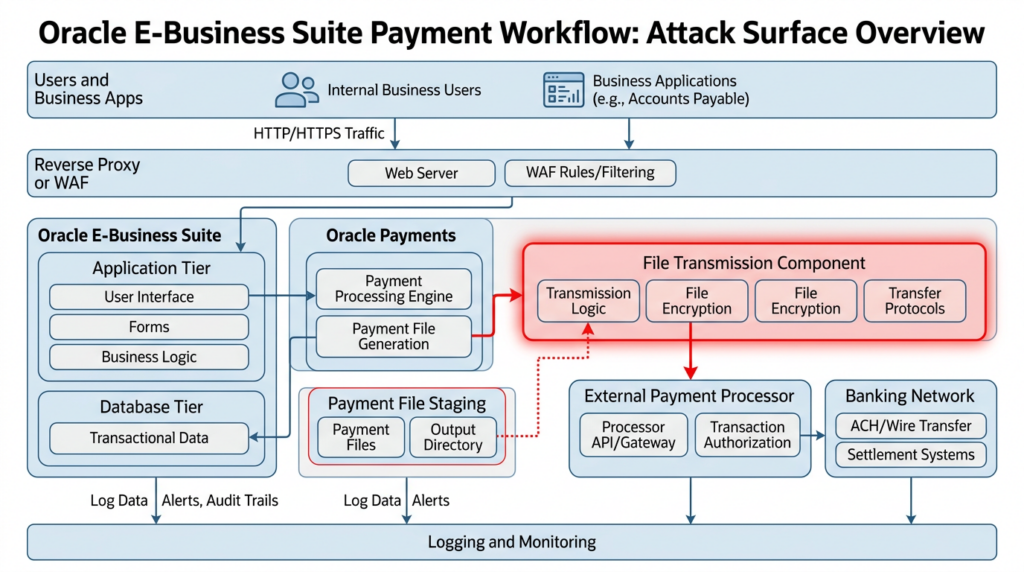
Oracle E-Business Suite is usually not a peripheral application. It often sits close to finance, procurement, HR, supply chain, invoicing, payroll, vendor management, approvals, and reporting. Oracle Payments, by design, participates in payment-related workflows. The File Transmission component name is especially important because file movement in enterprise finance systems often touches bank files, payment instructions, settlement processes, acknowledgements, integration queues, or downstream reconciliation workflows.
The public CVE text does not say exactly which files can be read, written, executed, transmitted, or influenced. It does not say whether the defect is path traversal, missing authentication, unsafe XML processing, insecure file handler exposure, command execution, deserialization, SSRF, or another class. Any article claiming the exact root cause without citing a credible technical disclosure should be treated skeptically.
What can be said safely is narrower but still serious. An unauthenticated HTTP flaw in a payment file-transmission component creates risk across three planes.
The first plane is data exposure. Payment systems can contain sensitive business data even when they do not store raw cardholder data. File names, remittance files, batch identifiers, vendor names, bank routing metadata, reconciliation records, and internal path structures can be useful to an attacker. Even a “file read only” primitive can become operationally damaging when it exposes configuration, credentials, integration secrets, or evidence of high-value workflows.
The second plane is data integrity. Oracle’s CVSS vector for CVE-2026-46817 includes high integrity impact. That does not prove a specific unauthorized write method, but it does tell defenders that Oracle’s scoring model considers integrity loss a full-impact outcome. In a payment context, integrity is not limited to database rows. It includes whether a file transfer job can be altered, whether outbound content can be changed, whether acknowledgements can be forged, whether business process state can be manipulated, and whether evidence trails can be polluted.
The third plane is availability. A takeover of Oracle Payments can disrupt finance operations even if the attacker does not reach the entire EBS instance or database. Payment file transmission failure can delay vendor payments, disrupt treasury operations, break reconciliation, and cause incident-response teams to freeze normal processing until they can prove the workflow is trustworthy.
That is why the phrase “takeover of Oracle Payments” should be read precisely. It is not the same as a confirmed operating-system takeover, full database compromise, or complete takeover of every EBS module. But in many enterprises, control of Oracle Payments is already a business-critical compromise.
The attack conditions that matter
The CVSS vector gives defenders a clean starting point. CVE-2026-46817 is network reachable, low complexity, requires no privileges, requires no user interaction, and uses HTTP. That means the first triage question is not “Do we have a working exploit?” The first triage question is “Which EBS web endpoints can an unauthenticated network actor reach?”
A useful model looks like this:
| Exposure condition | Why it matters | Practical priority |
|---|---|---|
| Public internet-facing EBS web tier | Unauthenticated HTTP reachability can be attempted by any remote actor that can reach the endpoint | Emergency patch and immediate log review |
| EBS reachable through VPN | Compromised VPN accounts, vendor accounts, contractor access, and malware footholds can turn “internal” exposure into exploitable exposure | High priority, especially if VPN is broad or third-party heavy |
| EBS reachable only from corporate network | Still relevant because no application account is required; a single internal foothold may be enough | High priority, tied to internal segmentation strength |
| UAT, QA, clone, or DR EBS instance | Test copies often lag in patching and may contain production-like data | High priority if reachable and not provably isolated |
| Decommissioned but still running EBS instance | Forgotten systems often have stale patches and weak monitoring | Emergency inventory issue |
| EBS behind WAF or reverse proxy | WAF may reduce some exploit attempts but does not patch the vulnerable code | Patch still required |
| HTTPS-only external access | Oracle names HTTP in the CVE record, but many deployments terminate TLS at a proxy and forward HTTP internally | Verify the full path, not only the public scheme |
The HTTPS point deserves care. Oracle’s CVE text names HTTP. Many modern deployments expose https:// publicly while the reverse proxy, load balancer, or Oracle HTTP Server layer forwards traffic to backend components using HTTP. A public HTTPS URL does not automatically mean the HTTP condition is irrelevant. Defenders need to map the full request path from edge to EBS application tier.
The same logic applies to SSO. If an EBS environment uses single sign-on, reverse proxy authentication, or identity-aware access, that can reduce exposure only if unauthenticated requests cannot reach the vulnerable component at all. A login page in front of normal users does not prove that every /OA_HTML/ or file-transmission path is protected. Misrouted legacy paths, callback endpoints, integration paths, and direct app-tier access often create exceptions.
Reported exploitation, and what it does not prove
Defused reported that its Oracle E-Business Suite decoys captured the first in-the-wild exploitation of CVE-2026-46817 on June 27, 2026. Its public page describes six unauthenticated file-read attempts from a single source, roughly six weeks after Oracle’s May 2026 patch and before any public proof-of-concept existed. Defused characterizes the activity as a targeted proof-of-concept rather than broad scanning and shows a sanitized, redacted request involving a POST to /OA_HTML/, XML content, and a file path parameter, while withholding the exact endpoint and details. (defusedcyber.com)
BleepingComputer reported on June 29, 2026 that attackers had begun exploiting CVE-2026-46817 in attacks, citing Defused’s threat intelligence. The report repeats the core Oracle facts: the vulnerability affects Oracle Payments File Transmission, is reachable over HTTP without authentication, and enables low-complexity attacks against vulnerable deployments. (BleepingComputer)
That changes operational priority, but it does not justify overclaiming. The public evidence does not prove mass exploitation. It does not prove that every internet-facing EBS instance is being scanned. It does not provide a safe exploit recipe. It does not establish that the observed activity was successful against real enterprise systems. It does, however, prove that at least one actor or researcher had enough knowledge to attempt unauthenticated file access against EBS-like targets before a broadly documented public PoC was available.
For defenders, that distinction matters. “No public PoC” is no longer a reason to wait. “Only limited observed activity” is not a reason to panic. The right middle ground is urgent, evidence-driven response.
Why the 2025 Oracle EBS campaign should shape the response
CVE-2026-46817 should be handled in the context of recent Oracle E-Business Suite targeting, not as an isolated database entry.
In October 2025, Oracle released an emergency advisory for CVE-2025-61882, a critical Oracle EBS vulnerability in Oracle Concurrent Processing, BI Publisher Integration. NVD describes that vulnerability as affecting Oracle EBS versions 12.2.3 through 12.2.14, remotely exploitable without authentication via HTTP, and capable of takeover of Oracle Concurrent Processing. Oracle’s advisory for CVE-2025-61882 told customers to apply updates as soon as possible and included indicators of compromise such as IP addresses, observed commands, and files. (NVD)
Google Cloud’s threat intelligence team reported that the CL0P extortion campaign followed months of intrusion activity targeting EBS customer environments, that activity possibly exploiting CVE-2025-61882 occurred as early as August 9, 2025, and that some impacted organizations suffered significant data exfiltration. CrowdStrike also analyzed the campaign, saying Oracle publicly disclosed CVE-2025-61882 on October 4, 2025 and that the vulnerability could result in unauthenticated remote code execution. CrowdStrike described observed exploitation paths involving Oracle EBS Java servlets and malicious template execution in the BI Publisher area. (Google Cloud)
CVE-2025-61882 is not the same bug as CVE-2026-46817. The affected EBS product and component are different. The exploit mechanics should not be copied from one to the other. But the earlier campaign teaches three durable lessons.
First, EBS is a high-value target because it holds business data worth stealing. Attackers do not need to encrypt the whole enterprise to create leverage if they can extract sensitive financial, HR, procurement, or vendor data.
Second, unauthenticated HTTP flaws in EBS can move from advisory to exploitation quickly. The window between patch release, technical understanding, leaked or private exploit material, and real-world targeting can be shorter than many enterprise patch cycles.
Third, patching alone may not answer the incident question. Google Cloud’s reporting on the 2025 campaign described activity before the public patch. When a vulnerability has plausible pre-patch exploitation or early post-patch probing, defenders must ask both “Are we fixed now?” and “Were we touched before we fixed it?”
CVE-2026-46817 belongs in that same operational category. It is not safe to treat it as merely a software maintenance item.
What not to assume
The most common failure in CVE response is not ignorance. It is false certainty.
Do not assume CVE-2026-46817 is remote code execution unless a credible source proves that specific result. Oracle and NVD say takeover of Oracle Payments. Some secondary write-ups may describe the issue as RCE, but the public Oracle/NVD text does not provide a root-cause-level exploit description. “Takeover” is serious enough; it does not need embellishment.
Do not assume “file read” is the full impact either. Defused observed unauthenticated file-read attempts in its decoys, but Oracle’s CVSS vector includes high confidentiality, high integrity, and high availability impact. A decoy observation is evidence of one attempted behavior, not a complete boundary of the vulnerability.
Do not assume internal-only means safe. No authentication is required. If an attacker has a foothold on a workstation, VPN account, vendor laptop, jump host, or adjacent server, internal network reachability may be enough to attempt exploitation.
Do not assume a WAF eliminates risk. A WAF rule might block a known payload after one becomes public. It is much weaker against a private exploit, alternate encoding, endpoint-specific behavior, or direct internal access that bypasses the WAF.
Do not assume a scanner’s silence means the environment is patched. Scanner coverage for newly disclosed enterprise application CVEs often lags, and safe checks may only detect version or patch metadata rather than exploitability. A negative scan is useful only when you know what the scanner checked.
Do not assume applying the patch in one file system means production traffic is patched. EBS 12.2 online patching uses a dual file-system model. The cutover state matters.
Safe exposure verification
A safe verification workflow should not begin with an exploit payload. It should begin with inventory, reachability, version, patch state, and logs.
Step 1, build an EBS asset list
Start by identifying every EBS URL, every application-tier host, every load balancer, every reverse proxy, every disaster-recovery instance, and every non-production clone. Many organizations discover that the risky instance is not the main production URL. It is a training environment, vendor test system, finance UAT instance, DR host, or old clone still reachable over VPN.
A simple inventory starter can look like this:
# Pull candidate EBS endpoints from proxy configs, DNS exports, and known host lists.
# Adjust paths for your environment.

grep -RIE "OA_HTML|E-Business|EBS|oracle.apps|appslogin" \
  /etc/nginx /etc/httpd /etc/apache2 /opt /u01 2>/dev/null \
  | sed 's/[[:space:]]\+/ /g' \
  | sort -u > ebs_candidates.txt

# Resolve hostnames collected from an existing endpoint list.
awk '{print $1}' known_ebs_urls.txt \
  | sed -E 's#https?://##; s#/.*##' \
  | sort -u \
  | while read h; do
      printf "%-60s " "$h"
      dig +short "$h" | paste -sd "," -
    done
This does not prove vulnerability. It prevents the more dangerous mistake: patching the system everyone remembers while leaving a reachable clone exposed.
Step 2, confirm the EBS release and component context
Oracle’s public affected range is 12.2.3 through 12.2.15. Version checks differ by environment, but EBS teams typically confirm release and code levels from application context files, Oracle Applications Manager, AD/TXK levels, and database patch records.
A defensive SQL check might start with release metadata and applied patch tables. The exact patch identifiers for the May 2026 CSPU should come from My Oracle Support and the Oracle EBS CSPU availability document, not from a blog post.
-- Run only with an account approved for EBS administration.
-- This is an inventory aid, not a vulnerability test.

SELECT release_name
FROM fnd_product_groups;

SELECT bug_number, creation_date
FROM ad_bugs
WHERE bug_number IN (
  -- Replace these placeholders with the May 2026 EBS CSPU bug/patch numbers
  -- from Oracle's official My Oracle Support availability document.
  'REPLACE_WITH_ORACLE_PATCH_ID'
)
ORDER BY creation_date DESC;
Do not hard-code patch identifiers from an untrusted source. Oracle’s CSPU page points customers to My Oracle Support documents for the exact EBS patch availability and installation instructions. Oracle’s EBS Technology blog also directs customers to MOS Article KA923 and the May 2026 EBS CSPU availability document, emphasizing that the supporting documentation should be reviewed before applying patches. (Oracle)
Step 3, verify unauthenticated reachability without exploiting
A safe reachability check should avoid vulnerability-specific payloads. The goal is to learn whether unauthenticated network users can reach EBS web paths at all, whether HTTP is exposed, whether requests are redirected, and which proxy tier answers.
# Safe endpoint reachability checks.
# These do not test CVE-2026-46817. They map unauthenticated web exposure.

targets=(
  "https://ebs.example.com/OA_HTML/AppsLogin"
  "http://ebs.example.com/OA_HTML/AppsLogin"
)

for url in "${targets[@]}"; do
  echo "== $url =="
  curl -k -sS -o /dev/null \
    -w "status=%{http_code} remote_ip=%{remote_ip} redirect=%{redirect_url} server=%{ssl_verify_result}\n" \
    "$url"
done
If public HTTP returns a live EBS login, a redirect to HTTPS, or a recognizable Oracle web tier response, the environment needs urgent review. Even if production users normally browse over HTTPS, the backend may still process HTTP internally.
Step 4, map the proxy chain
For CVE-2026-46817, edge architecture is part of the vulnerability story. You need to know where TLS terminates, where HTTP begins, and whether the app tier is reachable directly.
# Identify listening web ports on application-tier hosts.
# Run only on systems you administer.

sudo ss -ltnp | awk '$4 ~ /:80$|:443$|:8000$|:8080$|:8081$|:8443$/ {print}'

# Find common Oracle HTTP Server or Apache access logs.
sudo find /u01 /opt /var/log -type f \
  \( -name "*access*log*" -o -name "access_log*" \) 2>/dev/null \
  | sort
The most dangerous configuration is not always “public internet to EBS.” It may be public internet to reverse proxy, reverse proxy to OHS, OHS to EBS, with an internal firewall rule that also allows direct access from broad corporate networks. Attackers who compromise one internal host may bypass the external control plane entirely.
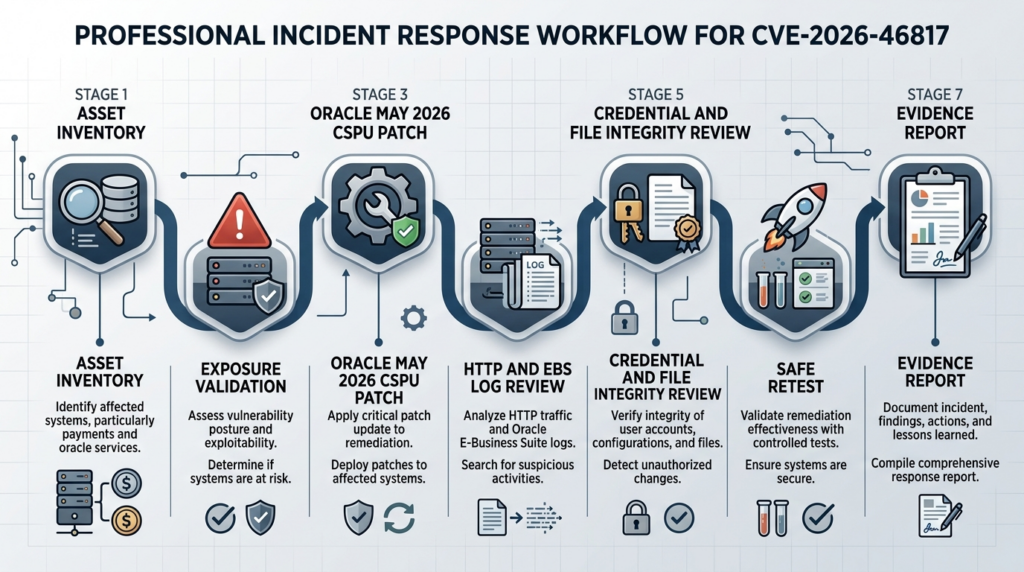
Patch first, but verify the patch path
Oracle EBS 12.2 patching is its own discipline. Oracle’s maintenance documentation says all EBS Release 12.2 patches are applied online and that online patching is mandatory in Release 12.2. Oracle also says patches may update the EBS file system, the database, or both, and that EBS patches are applied and tracked through utilities such as adop. (Oracle Docs)
Oracle’s online patching documentation describes the dual file-system model, where one application tier file system is the run edition and the other is the patch edition. It also lists the online patching cycle phases: prepare, apply, finalize, cutover, and cleanup. The examples include commands such as adop phase=prepare, adop phase=apply patches=..., adop phase=finalize, adop phase=cutover, and adop phase=cleanup. (Oracle Docs)
A simplified operational checklist looks like this:
| Phase | What defenders need to prove |
|---|---|
| Advisory intake | CVE-2026-46817 is in scope for EBS 12.2.3 through 12.2.15 and Oracle Payments/File Transmission is relevant to the environment |
| Patch source | Patch numbers and prerequisites come from Oracle’s May 2026 EBS CSPU availability document in My Oracle Support |
| Pre-checks | Backups, downtime/cutover plan, AD/TXK prerequisites, language patches, customizations, and integrations are reviewed |
| Test apply | Non-production environment patched first, with Oracle Payments workflows tested |
| Production apply | adop cycle is completed according to Oracle instructions |
| Cutover | Production traffic is confirmed to be served by the patched run edition |
| Cleanup | Old edition cleanup is completed according to policy |
| Evidence | Patch state, logs, screenshots, change ticket, test results, and retest output are stored |
| Monitoring | Suspicious pre-patch and post-patch activity is reviewed |
The most important failure mode is stopping after “apply” and not proving that cutover happened correctly. A patch sitting in the patch edition does not protect production traffic until the environment is actually running the patched edition.
Temporary mitigations while patching is in progress
Oracle’s May 2026 CSPU states that until patches are applied, it may be possible to reduce risk by blocking the network protocols required by an attack, while warning that such changes can break application functionality and should not be treated as long-term solutions. (Oracle)
That guidance maps cleanly to CVE-2026-46817. Temporary controls should focus on reachability and behavior, not on pretending to patch the vulnerable code.
Useful short-term mitigations include:
| Mitigation | Value | Limitation |
|---|---|---|
| Restrict EBS web access to trusted VPN or administrative networks | Reduces unauthenticated remote reachability | Does not help if attacker has internal access |
| Block direct app-tier access except from approved proxies | Prevents bypass of WAF, SSO, or logging controls | Requires accurate network mapping |
| Disable or restrict unnecessary HTTP listeners | Aligns with the protocol named in the CVE | Must not break required EBS traffic without testing |
| Add reverse-proxy rules for abnormal unauthenticated XML POSTs to EBS paths | May reduce opportunistic attempts | Can be bypassed and may cause false positives |
| Increase OHS, proxy, and WAF logging | Improves investigation quality | Does not prevent exploitation |
| Isolate stale UAT or clone systems | Removes forgotten exposure | Requires business owner confirmation |
| Preserve logs before rotation | Protects evidence | Needs fast action in high-volume environments |
A WAF rule is a control, not a fix. The strongest temporary mitigation is reducing who can reach the vulnerable surface at all. The permanent fix is to apply Oracle’s patch.
Detection and log review
Because the public exploit details are incomplete, detection should focus on behavior. The Defused public snapshot provides a useful clue: unauthenticated attempts involved XML content sent to an EBS /OA_HTML/ path and a parameter associated with a full file path, but the exact request was intentionally redacted. (defusedcyber.com)
Do not build detection only around the redacted sample. Build detection around the class of behavior.
Start with web access logs from Oracle HTTP Server, Apache, reverse proxies, WAF, and load balancers. Look for unauthenticated requests to EBS paths, especially unusual POST requests, XML content types, abnormal request bodies, error responses, and response-size anomalies.
# Example Apache/OHS access-log triage.
# Adjust log format assumptions before relying on output.

LOGDIR=/u01
SINCE="27/Jun/2026"

sudo find "$LOGDIR" /var/log -type f \
  \( -name "*access*log*" -o -name "access_log*" \) 2>/dev/null \
  -print0 |
while IFS= read -r -d '' log; do
  zgrep -H "OA_HTML" "$log" 2>/dev/null |
  grep -E "POST|xml|500|404|403|200" |
  grep -E "Jun/2026|Jul/2026"
done > ebs_oa_html_post_review.txt
Then look for content-type and header anomalies in proxy logs, if those fields are recorded.
# Example search over logs that include request headers.
# This is intentionally broad and should be tuned.

grep -RIE \
  "Content-Type: text/xml|application/xml|DeliveryRequest|FULL_FILE_PATH|CodePackage|EntryPoint" \
  /var/log /u01 2>/dev/null \
  > ebs_xml_indicator_review.txt
The strings DeliveryRequest, CodePackage, EntryPoint, and FULL_FILE_PATH come from Defused’s sanitized public example. They should be treated as hunting leads, not as the complete detection set. Attackers may change casing, encoding, parameter names, endpoint paths, body structure, or transport path.
For SIEM-style detection, start with a broad rule and then reduce false positives.
title: Suspicious Unauthenticated XML POST to Oracle EBS Web Path
status: experimental
description: Detects unusual XML POST requests to Oracle E-Business Suite web paths that may warrant review during CVE-2026-46817 triage.
logsource:
  category: webserver
detection:
  selection_path:
    cs_uri_stem|contains:
      - "/OA_HTML/"
  selection_method:
    cs_method: "POST"
  selection_content:
    cs_content_type|contains:
      - "xml"
  condition: selection_path and selection_method and selection_content
fields:
  - src_ip
  - cs_host
  - cs_uri_stem
  - cs_uri_query
  - cs_method
  - cs_content_type
  - sc_status
  - sc_bytes
  - user_agent
  - request_body_hash
falsepositives:
  - legitimate EBS integrations using XML over HTTP
  - internal batch jobs
  - monitoring systems
level: high
Add enrichment. A single request from a known integration host may be normal. A request from an unfamiliar ASN, a cloud VPS, a TOR exit, a scanner, or a workstation that never talks to EBS is different. A low-volume targeted attempt can be more important than a noisy scan.
A practical review sequence is:
| Signal | Why it matters | Follow-up |
|---|---|---|
POST to /OA_HTML/ with XML content from unknown source | Matches the broad shape of public exploitation reporting | Review body metadata if safely logged, source reputation, session state |
| Parameter or body values resembling file paths | Suggests file-read or file-transmission abuse | Check response size, file-access logs, app errors |
| 500 errors followed by 200 responses from same source | May indicate probing or exploit refinement | Correlate timestamps with app logs |
| Unauthenticated request that triggers backend processing | Authentication boundary may be bypassed | Compare with expected login/session behavior |
| Requests to EBS app tier bypassing proxy | Edge controls may be irrelevant | Fix network ACLs |
| Large outbound responses after suspicious requests | Possible data exposure | Review proxy byte counts and DLP logs |
| New files, templates, scripts, or unusual Java artifacts after request | Possible post-exploitation | Escalate to incident response |
The goal is not to prove CVE-2026-46817 exploitation from one log line. The goal is to decide whether the organization can reasonably say no suspicious activity was observed, or whether forensic review is required.
Database and application-layer review
EBS web logs are only one part of the picture. If suspicious requests appear, review application and database evidence around the same timestamps.
Start with questions, not assumptions:
| Question | Evidence source |
|---|---|
| Did an unauthenticated request map to an EBS session? | Web session logs, application logs, FND session data where available |
| Did Oracle Payments jobs or file-transfer processes run unexpectedly? | Concurrent request history, payment process logs, scheduler records |
| Were payment files read, generated, modified, transmitted, or deleted? | File system metadata, application logs, database audit, integration logs |
| Did unknown source IPs touch sensitive paths? | Proxy, OHS, WAF, firewall, VPN, load-balancer logs |
| Were configuration files or wallet/credential files accessed? | OS audit, EDR telemetry, file integrity monitoring |
| Was there new code or template material uploaded? | Application metadata, file system, EDR |
| Did the same source touch other EBS modules? | Cross-module web logs |
A generic SQL pattern for concurrent request review might look like this, but EBS teams should adapt it to their schema, privileges, and local naming conventions.
-- Defensive review pattern for unusual concurrent activity.
-- Use approved read-only access and adapt names for your environment.

SELECT
  request_id,
  requested_start_date,
  actual_start_date,
  actual_completion_date,
  phase_code,
  status_code,
  program_application_id,
  concurrent_program_id,
  argument_text
FROM fnd_concurrent_requests
WHERE requested_start_date >= TO_DATE('2026-06-27', 'YYYY-MM-DD')
ORDER BY requested_start_date DESC
FETCH FIRST 200 ROWS ONLY;
Do not interpret every unusual payment job as compromise. Finance systems have real batch activity. Instead, correlate: unusual web request, unusual source, unusual response, unusual payment/file activity, unusual OS or database activity, and the absence of a valid business owner.
Why patch verification needs a retest plan
A patch ticket is not the same as risk removal. For CVE-2026-46817, retesting should prove at least five things.
First, the affected EBS version and patch state are known for every instance. “Production is patched” is not enough if UAT, DR, or a vendor-accessible clone remains vulnerable.
Second, the production run edition is patched. In EBS 12.2, the dual file-system and online patching model means teams need to confirm cutover and current runtime state, not only patch application.
Third, unauthenticated reachability has been reduced where possible. Even after patching, a critical payment workflow should not be broadly reachable from unnecessary networks.
Fourth, logs from the exposure window have been reviewed and preserved. If suspicious activity occurred before patching, a clean post-patch scan does not answer the incident question.
Fifth, the business workflow still works. Oracle Payments is not a static web app. Payment file generation, transmission, acknowledgement, reconciliation, and integrations may need business-owner validation after patching.
An evidence packet for a high-quality remediation record should include:
CVE: CVE-2026-46817
System: <EBS instance name>
Environment: production / UAT / DR / clone
Business owner: <team>
Technical owner: <team>
EBS release: <release>
Oracle Payments used: yes/no/unknown
External exposure: internet / VPN / internal / isolated
Patch source: Oracle May 2026 EBS CSPU availability document
Patch applied: yes/no
Cutover completed: yes/no
Retest completed: yes/no
Log review window: <date range>
Suspicious activity found: yes/no/inconclusive
Compensating controls: <network ACLs, proxy rules, monitoring>
Residual risk: <accepted / pending action>
Evidence location: <ticket, report, repository>
This is where automated, evidence-oriented security workflows can help, provided they stay inside authorized scope. A tool such as Penligent can support black-box attack-surface mapping, assisted validation, retesting, and report generation for authorized environments; its AI pentesting page describes live-application surface mapping, verified findings, evidence and remediation guidance, human-in-the-loop control, and exportable reports. (Penligent) For a CVE like CVE-2026-46817, the useful role is not to run unknown exploit payloads against production. It is to organize safe checks, preserve evidence, validate that exposed paths are reduced, and turn remediation work into a reproducible record. Penligent’s homepage also frames the product around finding vulnerabilities, verifying findings, executing authorized testing, and producing one-click reports, with a clear authorized-use disclaimer. (Penligent)
Practical response plan for security teams
A strong response can be completed in waves.
First 4 hours
Identify all known EBS instances, including production, DR, UAT, training, clones, and vendor-accessible systems. Confirm whether versions fall into 12.2.3 through 12.2.15. Check whether any EBS web tier is reachable from the internet, broad VPN ranges, third-party networks, or user subnets. Open a change record for Oracle’s May 2026 CSPU if it is not already applied. Preserve access logs from June 27, 2026 onward, because Defused’s public exploitation signal begins on that date. (defusedcyber.com)
If the environment is externally reachable and unpatched, reduce exposure immediately. Restrict source IP ranges, disable unnecessary direct HTTP access, and ensure only expected reverse proxies can reach application-tier listeners. Do not wait for a perfect patch window if the exposure is public and unauthenticated.
First 24 hours
Obtain the official Oracle EBS May 2026 CSPU patch information from My Oracle Support. Review prerequisites, AD/TXK requirements, language patches, and any database or Fusion Middleware dependencies. Patch non-production first if your process allows, but do not let test cycles become an indefinite delay for public production exposure.
Begin log review. Look for suspicious unauthenticated POST requests to EBS paths, XML content, file-path-like body values, abnormal response sizes, and unknown source IPs. Correlate web logs with Oracle Payments activity, concurrent requests, file-system access, and EDR telemetry.
First 72 hours
Complete production patching and cutover. Confirm the patched run edition. Retest reachability and business workflows. Expand the review to older logs if any suspicious activity appears. If there is evidence of file access, unexpected payment workflow execution, unexplained outbound data volume, or suspicious post-exploitation artifacts, escalate to incident response rather than closing the vulnerability ticket as “patched.”
First 2 weeks
Finish long-tail remediation: patch clones, rebuild stale images, update build documentation, remove direct app-tier access, tune WAF/proxy rules, write detection content, and update the EBS asset inventory. Run a tabletop exercise for the next Oracle EBS critical advisory. The 2025 EBS exploitation campaign and the 2026 CVE-2026-46817 activity both show that enterprise application teams need a repeatable process, not one-off heroics. (Google Cloud)
Prioritization matrix
Not every EBS environment carries the same risk. Use a matrix that combines exploitability, exposure, business impact, and evidence.
| Environment | Patch status | Reachability | Oracle Payments used | Suspicious logs | Priority |
|---|---|---|---|---|---|
| Production EBS 12.2.15 | Unpatched | Internet-facing | Yes | Unknown | Critical |
| Production EBS 12.2.14 | Patched, cutover confirmed | Internet-facing | Yes | No suspicious activity | High monitoring |
| DR clone 12.2.13 | Unpatched | VPN-wide | Yes | Not reviewed | Critical |
| UAT 12.2.12 | Unpatched | Internal user subnets | Production-like data | Unknown | High |
| Training clone | Unknown | Vendor network | Unknown | No logs | High until proven otherwise |
| Legacy instance | Out of support or unknown | Internal only | Unknown | Unknown | Critical inventory gap |
| Production EBS not in affected version range | Confirmed not affected | Restricted | Yes | No suspicious activity | Routine monitoring |
The strongest signal is not CVSS alone. It is CVSS plus reachability plus business importance plus exploitation evidence. CVE-2026-46817 has the CVSS and business-importance pieces by default. Your job is to determine reachability, patch state, and evidence.
Scanner use and its limits
Vulnerability scanners are useful for finding known EBS URLs, fingerprinting product versions, detecting missing patches when plugins exist, and creating dashboards for management. They are less reliable as the sole source of truth for a fresh enterprise application vulnerability with limited public exploit details.
A safe scanner strategy should follow these rules:
| Rule | Reason |
|---|---|
| Prefer authenticated or administrator-assisted version checks where possible | They are safer and more reliable than exploit probes |
| Avoid untrusted PoC modules on production EBS | Payment systems are too sensitive for unknown payloads |
| Validate scanner plugins against Oracle patch records | A scanner finding may lag Oracle documentation or misread backported fixes |
| Scan clones only if they are representative and authorized | A clone may not match production patch state |
| Treat “not detected” as “not proven” unless the check method is known | Absence of evidence is not evidence of patching |
| Store scanner output with change tickets | Evidence matters for audit and incident review |
For red teams and bug bounty hunters, the ethical boundary is straightforward. Do not test CVE-2026-46817 against systems you do not own or have explicit permission to assess. An unauthenticated critical flaw in a financial application is not a playground. If you discover a vulnerable EBS instance during authorized testing, stop at safe evidence, notify the owner, and follow the program’s rules.
Common mistakes during CVE-2026-46817 response
The first mistake is patching only the obvious production URL. EBS estates often include clones, regional instances, old app-tier hosts, reporting integrations, and disaster-recovery environments. A stale clone with production data can be worse than a patched production instance.
The second mistake is ignoring HTTP because the public URL uses HTTPS. TLS termination can hide backend HTTP. Oracle’s protocol field should trigger request-path mapping, not a superficial scheme check.
The third mistake is treating Oracle Payments usage as binary. Even if a team believes it does not actively use a feature, installed components, old configurations, integration endpoints, or dormant jobs may still exist. Confirm with EBS administrators, finance owners, and application logs.
The fourth mistake is closing the ticket immediately after patching. If the system was exposed before patching, log review is part of the remediation. The 2025 EBS campaign showed why post-patch confidence does not automatically answer pre-patch compromise questions. (Google Cloud)
The fifth mistake is running a public exploit to “verify” the fix. For CVE-2026-46817, public technical details are incomplete, and unauthorized or unsafe payloads could damage payment workflows. Safe validation should rely on patch records, reachability reduction, log review, and authorized non-destructive testing.
The sixth mistake is assuming this is only an AppSec issue. EBS vulnerabilities cross application security, infrastructure, identity, finance operations, database administration, incident response, and audit. The response owner needs enough authority to coordinate all of them.
FAQ
What is CVE-2026-46817?
- CVE-2026-46817 is a critical vulnerability in Oracle Payments, part of Oracle E-Business Suite.
- Oracle identifies the affected component as File Transmission.
- Oracle and NVD list supported affected versions as Oracle E-Business Suite 12.2.3 through 12.2.15.
- The vulnerability is remotely reachable over HTTP without authentication and has a CVSS 3.1 score of 9.8.
- Oracle states that successful exploitation can result in takeover of Oracle Payments. (Oracle)
Which Oracle EBS versions are affected?
- Public Oracle and NVD records list Oracle E-Business Suite 12.2.3 through 12.2.15 as affected for CVE-2026-46817.
- Older unsupported versions should not be assumed safe just because they are outside the supported-version wording.
- Oracle says product releases outside Premier Support or Extended Support are not tested for vulnerabilities addressed by the CSPU, and earlier affected releases may also be affected. (Oracle)
- EBS teams should use Oracle’s official May 2026 EBS CSPU availability document in My Oracle Support for exact patch requirements.
Is CVE-2026-46817 being exploited?
- Defused reported that its Oracle E-Business Suite decoys captured unauthenticated file-read attempts related to CVE-2026-46817 on June 27, 2026.
- The public Defused report describes six attempts from a single source and characterizes the activity as targeted proof-of-concept activity, not broad scanning.
- BleepingComputer reported on June 29, 2026 that attackers had begun exploiting the flaw, citing Defused.
- Teams should treat this as an early exploitation signal and patch urgently, while avoiding unsupported claims of mass exploitation. (defusedcyber.com)
Is there a public PoC for CVE-2026-46817?
- The authoritative public Oracle and NVD records do not provide exploit code or root-cause details.
- Defused’s public request example is intentionally redacted for safe disclosure.
- A lack of public PoC does not make the vulnerability low risk.
- Private exploit knowledge can exist before broad public exploit code appears, especially for high-value enterprise applications.
How can I safely check whether I am exposed?
- Inventory every EBS instance, including production, DR, UAT, training, clone, and vendor-accessible systems.
- Confirm whether each instance runs EBS 12.2.3 through 12.2.15.
- Confirm May 2026 CSPU patch state through Oracle-supported patch records, not screenshots or assumptions.
- Check whether unauthenticated users can reach EBS web paths through internet, VPN, internal, or proxy routes.
- Review logs for suspicious unauthenticated XML POST requests, file-path-like parameters, abnormal response sizes, and unexpected Oracle Payments activity.
- Do not run unknown exploit payloads against production.
Does patching Oracle Payments fully remove the risk?
- Patching is the required core fix for CVE-2026-46817.
- Patching does not answer whether the system was accessed before the patch.
- Patching one EBS instance does not protect clones, DR, UAT, or forgotten hosts.
- Patching must be followed by cutover verification, reachability review, log review, and business workflow testing.
Should internal-only EBS systems be patched?
- Yes, if they run affected versions.
- CVE-2026-46817 requires no application credentials, so any attacker with network reachability may be able to attempt exploitation.
- Internal reachability can become real exposure through compromised workstations, VPN accounts, vendor networks, jump hosts, or malware.
- Internal-only systems can still contain production-like financial data.
What logs should defenders review first?
- Start with reverse proxy, WAF, load balancer, Oracle HTTP Server, and Apache access logs.
- Focus on unauthenticated POST requests to EBS paths, especially
/OA_HTML/, XML content types, abnormal response sizes, and unfamiliar source IPs. - Correlate suspicious web activity with Oracle Payments jobs, concurrent request history, file-system access, database audit events, and EDR telemetry.
- Preserve logs before rotation, especially from June 27, 2026 onward.
Closing judgment
CVE-2026-46817 has the traits that make enterprise application vulnerabilities operationally dangerous: a critical business system, a payment-related component, unauthenticated HTTP reachability, low attack complexity, high confidentiality and integrity impact, and early public reporting of exploitation attempts. The fact that Oracle has not published the root cause does not reduce urgency. It only changes the verification method.
The safest response is disciplined and fast: identify every EBS instance, confirm whether versions 12.2.3 through 12.2.15 are present, apply Oracle’s May 2026 CSPU, verify cutover, reduce unnecessary HTTP reachability, review logs from the exposure window, and document evidence. Treat public exploit code as unnecessary for defense. The organizations that handle CVE-2026-46817 well will be the ones that can prove not only that they patched, but that they understood what was exposed, what was attempted, what changed, and what risk remains.

 English
  German
  French
  Spanish
  Portuguese
  Japanese
  Korean
  Hindi
Hindi  Arabic
  Turkish
  Hebrew