
CVE-2026-82329 is a critical authentication bypass vulnerability affecting JFrog Artifactory that can allow an unauthenticated attacker with network access to obtain administrative privileges.
That description alone makes the vulnerability serious. What turns CVE-2026-82329 into an emergency, however, is the speed with which exploitation followed disclosure.
JFrog publicly disclosed the vulnerability on August 28, 2026. Within days, security researchers reported observing attackers targeting vulnerable Artifactory systems and generating administrator tokens. On September 2, the U.S. Cybersecurity and Infrastructure Security Agency added CVE-2026-82329 to its Known Exploited Vulnerabilities catalog based on evidence of active exploitation. (JFrog Docs)
For organizations operating self-managed JFrog Artifactory, this is therefore no longer a theoretical vulnerability-management exercise.
The exploitation phase has already begun.
The risk is amplified by Artifactory’s position inside modern software delivery infrastructure. Compromise of a public-facing application server is serious. Compromise of a repository platform trusted by developers, build pipelines, container workflows, deployment systems, and package managers can become a software supply-chain incident.
An attacker who gains administrative control of Artifactory may potentially reach far beyond the repository server itself.
What Is CVE-2026-82329?
CVE-2026-82329 is an improper authentication vulnerability in JFrog Artifactory.
JFrog describes the issue as an authentication weakness that, under the product’s default configuration, may allow an unauthenticated attacker with network access to obtain administrative privileges. The vulnerability is classified as CWE-287: Improper Authentication. (docs.jfrog.com)
The vulnerability has a CVSS v3.1 score of 9.8 out of 10, with the following vector:
CVSS:3.1/AV:N/AC:L/PR:N/UI:N/S:U/C:H/I:H/A:H
The individual characteristics explain why defenders should treat CVE-2026-82329 as an emergency:
| CVSS Metric | Value | Security Meaning |
|---|---|---|
| Attack Vector | Network | The attack can be performed remotely |
| Attack Complexity | Low | Exploitation does not depend on unusually difficult conditions |
| Privileges Required | None | The attacker does not need an existing account |
| User Interaction | None | No victim action is required |
| Confidentiality | High | Sensitive information may be exposed |
| Integrity | High | Data and artifacts may potentially be modified |
| Availability | High | Compromise can affect system availability |
| Base Score | 9.8 | Critical |
GitHub’s advisory database and other vulnerability databases reproduce the same CVSS 9.8 assessment. (GitHub)
The combination of network reachability, no authentication requirement, low attack complexity, and administrator-level impact is particularly dangerous.
It effectively removes several defensive barriers that normally stand between an Internet attacker and privileged control.
CVE-2026-82329 Affected Versions
JFrog has published specific affected and patched Artifactory branches.
According to the vendor advisory, administrators should move to the corresponding fixed release or a newer supported version. (JFrog Docs)
| Artifactory Branch | Vulnerable Versions | Patched Version |
|---|---|---|
| 7.161.x | before 7.161.20 | 7.161.20 |
| 7.146.x | before 7.146.38 | 7.146.38 |
| 7.133.x | before 7.133.29 | 7.133.29 |
| 7.125.x | before 7.125.20 | 7.125.20 |
| 7.117.x | before 7.117.28 | 7.117.28 |
| Older affected releases | before 7.111.21 according to the CVE record | 7.111.21 or later supported release |
JFrog’s CVE record models versions prior to 7.111.21 as affected and identifies the vulnerable ranges of the later maintenance branches. (OpenCVE)
Administrators should not simply compare major or minor version numbers.
For example, running Artifactory 7.146 does not establish that the environment is safe. The exact maintenance release matters.
A deployment on 7.146.25 remains materially different from one on 7.146.38.
CVE-2026-82329 Is Already Being Exploited
The active exploitation status dramatically changes remediation priority.
JFrog disclosed the vulnerability on August 28, 2026.
By August 31, watchTowr reportedly observed exploitation attempts against its global honeypot infrastructure. Dark Reading reported that the activity involved attackers creating administrative tokens and then enumerating information such as users, groups, credential sets, and federated-access topology. (Dark Reading)
BleepingComputer subsequently reported the same central behavior: attackers exploiting CVE-2026-82329 to create tokens providing administrative access. (BleepingComputer)
Tenable now classifies CVE-2026-82329 as a vulnerability of interest and explicitly recommends immediate patching because exploitation has been reported in the wild. (Tenable®)
Then came the strongest external prioritization signal.
On September 2, 2026, CISA added CVE-2026-82329 to its Known Exploited Vulnerabilities catalog as JFrog Artifactory Improper Authentication Vulnerability. CISA’s KEV additions are based on evidence that vulnerabilities have actually been exploited rather than merely being theoretically exploitable. (Fortify Your SMB)
That sequence can be summarized as:
| Date | Event |
|---|---|
| August 28, 2026 | JFrog publishes CVE-2026-82329 and patched releases |
| August 31, 2026 | Researchers report observing exploitation attempts |
| September 1, 2026 | Multiple security organizations publicly report exploitation |
| September 2, 2026 | CISA adds CVE-2026-82329 to KEV |
| September 3, 2026 | Organizations should treat unpatched reachable instances as possible compromise candidates |
The transition from disclosure to observed exploitation happened in approximately three days.
That window illustrates the increasingly compressed patch race around high-impact enterprise vulnerabilities.
Why CVE-2026-82329 Is More Dangerous Than a Typical Authentication Bug
Authentication vulnerabilities vary enormously in severity.
Some allow attackers to access a limited feature.
Others leak information associated with another user.
CVE-2026-82329 sits near the opposite end of that spectrum.
The security boundary that can fail is the boundary separating an anonymous network client from Artifactory administrative privileges.
That distinction matters because an Artifactory administrator potentially controls a system sitting directly in the software-delivery trust chain.
JFrog Artifactory is commonly used for storing and distributing:
- application packages,
- internal libraries,
- container images,
- build artifacts,
- release binaries,
- dependency caches,
- package-manager repositories,
- metadata,
- CI/CD outputs.
Administrator compromise therefore creates several possible post-exploitation paths.
The immediate objective might be persistence inside Artifactory.
But the strategic objective could instead be compromise of downstream build or deployment infrastructure.
From Authentication Bypass to Administrator Token
Public reporting indicates that attackers are not merely opening an administrative webpage.
They have been observed minting administrator tokens. (Dark Reading)
This difference is operationally important.
A reusable privileged token gives an attacker an identity that can potentially be used through APIs and automated tooling. An attacker no longer necessarily needs to remain attached to the original exploitation request.
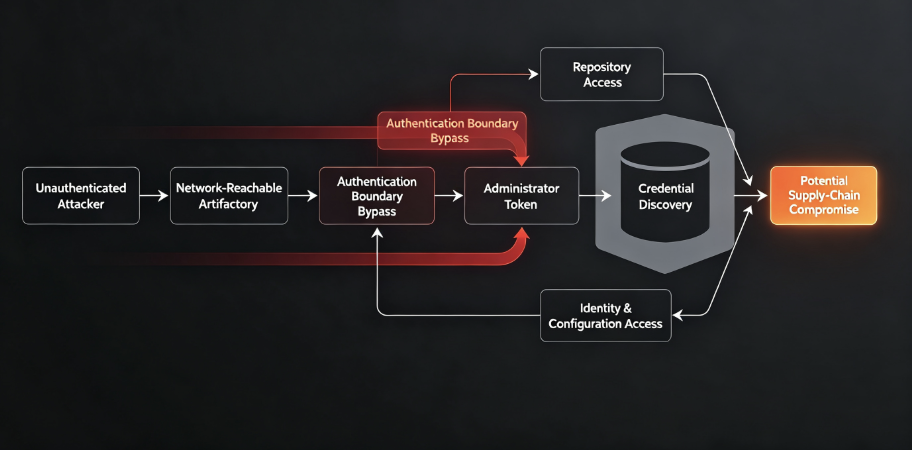
Conceptually, the attack chain looks like this:
Internet or reachable network
        |
        v
Vulnerable Artifactory instance
        |
        v
Authentication boundary failure
        |
        v
Administrative identity/token obtained
        |
        v
Privileged Artifactory API access
        |
        +-----------------------------+
        |              |              |
        v              v              v
Repository         Credential      Identity/
access             discovery       configuration
        |              |              |
        +--------------+--------------+
                       |
                       v
            Potential downstream
            supply-chain compromise
The critical point is that authentication bypass becomes an identity-security problem.
Once the attacker acquires an administrator-equivalent credential, subsequent behavior may resemble legitimate administrative API activity.
That complicates detection.
What Do We Know About the Technical Root Cause?
JFrog’s public security advisory intentionally provides relatively little implementation-level detail.
The vendor classifies CVE-2026-82329 as improper authentication and confirms that default configurations can be vulnerable, but the advisory does not provide a complete exploit-chain description. (JFrog Docs)
Independent reproduction research has gone further.
Third-party research published after disclosure indicates that the vulnerable behavior involves Artifactory’s Access service, service-registration or join-related authentication logic, JWT validation, and join-key handling.
One public reproduction attributes the weakness to token-validation logic that could trust an improperly initialized or blank additional join key and allow a forged authentication path to reach privileged token-generation logic. The researcher also reported that patched releases reject the previously accepted condition. (Pruva)
This distinction should be kept clear:
The existence, severity, affected versions, and administrative impact are vendor-confirmed.
The detailed join-key/JWT mechanism comes from independent technical reproduction rather than JFrog’s short advisory.
That difference matters when writing detection logic or conducting forensic analysis. Defenders should treat third-party reverse engineering as valuable technical intelligence, but not substitute it for official patch guidance.
Why Default Configuration Matters
JFrog specifically states that CVE-2026-82329 can be exploited under default configuration. (JFrog Docs)
That phrase is one of the most significant parts of the advisory.
Many critical enterprise vulnerabilities only become exploitable when administrators enable an unusual optional feature, expose a normally internal management interface, or configure a specific integration.
Default-config vulnerabilities are different.
They increase the probability that a large percentage of real deployments share the vulnerable condition.
The practical question should therefore not be:
“Did we enable the vulnerable feature?”
It should be:
“Can we prove this instance is patched?”
That is a much safer vulnerability-management assumption.
Self-Hosted Artifactory Is the Primary Concern
JFrog’s advisory distinguishes its cloud service from affected self-managed deployments.
The company says affected JFrog Cloud environments have already been fortified and that customers using those cloud environments do not need to perform the same remediation action. (JFrog Docs)
Dark Reading also reported JFrog CTO Yoav Landman stating that the vulnerability affects self-hosted deployments rather than the JFrog SaaS platform. (Dark Reading)
This means organizations operating:
- on-premises Artifactory,
- private-cloud Artifactory,
- Kubernetes-hosted Artifactory,
- VM-based self-managed instances,
- externally exposed development infrastructure,
should conduct immediate inventory and version validation.
Cloud customers should still follow vendor notifications and normal security monitoring, but the published emergency upgrade guidance is primarily relevant to self-managed environments.
Why an Artifactory Administrator Account Is So Powerful
To understand the true impact of CVE-2026-82329, it helps to think about Artifactory as infrastructure rather than merely an application.
A repository manager occupies a privileged position between developers and production systems.
A simplified software-delivery flow often looks like:
Developer
   |
   v
Source Repository
   |
   v
CI Build System
   |
   v
Artifact Repository
   |
   +------------------+
   |                  |
   v                  v
Containers         Packages
   |                  |
   +--------+---------+
            |
            v
        Deployment
            |
            v
        Production
If attackers compromise the artifact repository, they may insert themselves into this trust chain after source-code review but before deployment.
That creates possibilities which are qualitatively different from compromising an ordinary content-management system.
Software Supply-Chain Risk
One of the most serious consequences of Artifactory compromise is artifact tampering.
Suppose an organization internally distributes a dependency called:
company-auth-libraryDevelopers may trust that anything retrieved from the corporate Artifactory instance has passed internal build and security controls.
If an attacker gains repository-administration capabilities and modifies or replaces that artifact, the malicious version could potentially flow into multiple downstream applications.
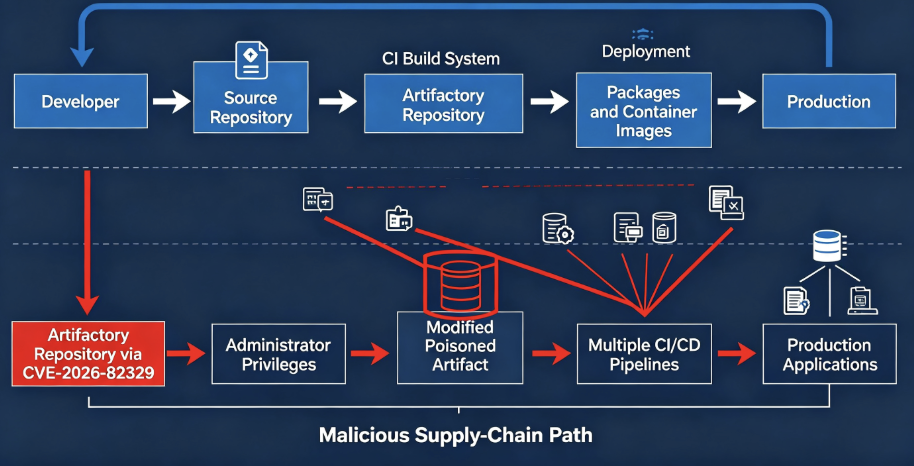
The compromise then changes shape:
One vulnerable Artifactory
        |
        v
One privileged repository account
        |
        v
One modified artifact
        |
        v
Multiple build pipelines
        |
        v
Multiple deployed applications
This is why the consequences of CVE-2026-82329 should be evaluated as potential software supply-chain compromise, not merely unauthorized access to one server.
Dark Reading similarly noted the possibility of attackers stealing or tampering with software packages and build artifacts after gaining administrative access. (Dark Reading)
Repository Poisoning
Repository poisoning is particularly concerning when automated systems trust Artifactory.
Potential high-level attacker objectives include:
- replacing legitimate binaries,
- modifying packages,
- inserting malicious dependencies,
- manipulating metadata,
- changing repository routing,
- creating malicious repository entries,
- altering permissions,
- compromising downstream package consumers.
Whether every action is possible depends on the particular repository configuration and granted administrative scope.
But the fundamental security model has already failed once administrator-level control is obtained.
Security teams should consequently validate not just whether the Artifactory server was accessed, but whether artifacts changed during the exposure window.
Credential and Secret Exposure
Another important investigation area is credential material.
Repository infrastructure frequently interacts with other systems.
Depending on configuration, those relationships may include:
- source-code hosting,
- CI/CD systems,
- container registries,
- remote package repositories,
- cloud services,
- deployment infrastructure,
- federated JFrog environments,
- automation accounts.
Attackers observed in the wild reportedly enumerated credential sets and federated-access information after exploitation. (Dark Reading)
That behavior is a strong indicator of attacker intent.
It suggests the Artifactory instance may be viewed not only as the final target, but as an entry point into a larger software-development environment.
Lateral Movement Into CI/CD
A compromised Artifactory server can become a useful pivot point.
The exact path differs across environments, but a realistic threat model is:
External attacker
      |
      v
CVE-2026-82329
      |
      v
Artifactory administrator
      |
      +--> Repository data
      |
      +--> Tokens / credentials
      |
      +--> Service topology
      |
      +--> Remote repositories
      |
      +--> CI/CD relationships
                 |
                 v
          Additional systems
This is why remediation alone is insufficient once exploitation is possible.
An organization that was exposed before patching should answer two independent questions:
- Is the vulnerability fixed?
- Was the vulnerability exploited before we fixed it?
Answering only the first leaves an important incident-response gap.
How to Determine Whether Your Artifactory Is Vulnerable
The safest first step is inventory rather than exploitation.
Identify every self-managed Artifactory deployment and record:
- hostname,
- IP address,
- environment,
- business owner,
- Artifactory version,
- Internet exposure,
- reverse proxy,
- authentication architecture,
- deployment type,
- patch status.
Then compare the exact build version against JFrog’s affected-version table.
Do not rely on application banners alone if those banners may be modified, hidden, or supplied by an intermediary reverse proxy.
Obtain authoritative version information from your deployment configuration, package inventory, container image, JFrog administration interface, or supported product API.
For containerized infrastructure, administrators can also review their deployment manifests for the deployed image tag.
For example:
kubectl get deployments -A -o yaml | grep -i -E "artifactory|jfrog"For Docker-based environments:
docker ps --format '{{.Image}} {{.Names}}' | grep -i artifactoryThese commands do not exploit the vulnerability. They simply help identify Artifactory deployments and their container versions.
Once the version is known, compare it against the vendor’s patched releases. (JFrog Docs)
Internet Exposure Should Increase Priority
An Internet-facing vulnerable Artifactory system should receive the highest remediation priority.
But “internal only” should not be treated as equivalent to safe.
Because the CVSS attack vector is network-based, exploitation requires reachability rather than direct Internet exposure. (OpenCVE)
An internal Artifactory server could potentially still be attacked by:
- a compromised developer endpoint,
- a compromised VPN user,
- malware inside the corporate network,
- another breached application,
- a malicious insider,
- an attacker who has already gained an internal foothold.
Internet exposure changes the probability of attack.
It does not change the underlying vulnerability.
Do Not Depend on a Public PoC to Decide Whether You Are Vulnerable
One common vulnerability-management mistake is waiting for a reliable public exploit before acting.
That would be particularly inappropriate for CVE-2026-82329.
Active exploitation has already been reported and CISA has already placed the vulnerability in KEV. (Fortify Your SMB)
The defensive decision tree is therefore simple:
Self-hosted Artifactory?
        |
       Yes
        |
        v
Affected version?
     /       \
   Yes        No
    |          |
    v          v
PATCH NOW    Verify inventory
    |
    v
Was it reachable before patch?
    |
   Yes
    |
    v
Investigate for compromise
A penetration test or exploit reproduction can have value in a controlled authorized lab.
It should not become a prerequisite for emergency remediation.
How to Detect Possible CVE-2026-82329 Exploitation
Detection should focus on behavior, not merely the initial exploit request.
That is especially important because successful exploitation reportedly leads to privileged token creation.
Security teams should investigate several categories of activity.
Unexpected Administrative Token Creation
Look for privileged tokens created without a corresponding legitimate administrative workflow.
Compare token issuance against:
- administrator logins,
- automation activity,
- API-client identities,
- deployment jobs,
- maintenance windows.
An administrative token appearing from an unfamiliar source shortly after anonymous traffic is particularly suspicious.
Unexpected User and Group Enumeration
watchTowr reported observing attackers enumerate users and groups after gaining access. (Dark Reading)
Review Artifactory and Access logs for abnormal bursts of identity-management API calls.
Pay particular attention to sequences where a newly observed token rapidly requests information about:
- users,
- groups,
- permissions,
- authentication configuration.
Credential Enumeration
Attackers were also reportedly interested in credential sets. (Dark Reading)
Any unusual administrative access to credential configuration should therefore receive high priority during investigation.
Federated Environment Discovery
Organizations using JFrog federation or multiple connected environments should investigate unusual topology-enumeration activity.
An attacker may use a compromised Artifactory deployment to understand what additional systems are reachable.
Repository Changes
Review:
- package uploads,
- deletions,
- overwrites,
- metadata modifications,
- permission changes,
- remote-repository modifications,
- repository creation,
- configuration changes.
The relevant investigation window should begin before the public disclosure date if logs are available.
Although public exploitation was reported shortly after disclosure, defenders should avoid assuming that the first publicly observed activity represents the first exploitation anywhere.
Review Reverse Proxy Logs
Many Artifactory instances sit behind:
- NGINX,
- Apache,
- HAProxy,
- cloud load balancers,
- WAFs,
- ingress controllers.
These systems may retain useful evidence even when Artifactory application logging is incomplete.
A basic defensive search might look for unusual anonymous request bursts followed by privileged API activity originating from the same source address.
For NGINX logs:
grep -i "artifactory\|access/api" /var/log/nginx/access.logFor a compressed log archive:
zgrep -i "access/api" /var/log/nginx/access.log*The purpose here is log review, not exploitation.
Security teams should correlate results with Artifactory application and Access service logs rather than judging individual requests in isolation.
Investigate Newly Created Credentials
The attacker behavior reported by watchTowr makes token review particularly important.
Create an inventory of:
- currently valid administrator tokens,
- creation timestamps,
- associated identities,
- source addresses if available,
- last-use timestamps,
- scopes,
- expiration periods.
Then identify any credentials that cannot be mapped to a documented business process.
If compromise is suspected, simply deleting one suspicious token may be inadequate.
Broader credential rotation should be considered.
Rotate Potentially Exposed Secrets
Where compromise cannot be excluded, defenders should consider rotating credentials accessible to or trusted by the Artifactory environment.
The exact scope depends on architecture, but may include:
- Artifactory administrator credentials,
- access tokens,
- service tokens,
- CI/CD credentials,
- remote repository credentials,
- automation secrets,
- federation credentials,
- API keys.
Do not rotate everything blindly without understanding dependencies if doing so could cause significant outages.
But also do not assume that patching removes credentials an attacker may already have acquired.
Patching prevents further exploitation.
It does not invalidate information stolen before patching.
Verify Artifact Integrity
This is one of the most important steps and one of the easiest to overlook.
If Artifactory administrator compromise occurred, defenders should verify whether stored artifacts were changed.
Useful evidence includes:
- checksums,
- signed-package metadata,
- build provenance,
- CI build records,
- software bills of materials,
- artifact creation timestamps,
- repository event logs,
- trusted external copies.
For critical production packages, compare current repository contents with previously trusted builds.
If cryptographic signing is already part of the software-delivery process, validate signatures independently.
The investigation question is not simply:
“Did somebody log in?”
It is:
“Can we prove that the software distributed through this repository remained trustworthy?”
Patch CVE-2026-82329 Immediately
JFrog’s recommended solution is straightforward: upgrade affected self-managed Artifactory deployments to a patched version. (JFrog Docs)
At minimum, move to the fixed release corresponding to the installed branch:
7.161.x  -> 7.161.20 or later
7.146.x  -> 7.146.38 or later
7.133.x  -> 7.133.29 or later
7.125.x  -> 7.125.20 or later
7.117.x  -> 7.117.28 or later
older vulnerable deployments -> 7.111.21 or an appropriate newer supported release
Where operationally feasible, upgrading to the latest vendor-supported release is generally preferable to remaining on the minimum patched maintenance release.
Organizations should consult the current JFrog release documentation before upgrading because dependency, database, Helm, container, and platform requirements can change between Artifactory releases.
JFrog Artifactory Self-Managed Releases
Emergency Mitigation When Immediate Patching Is Impossible
Patching should remain the primary remediation.
If an organization genuinely cannot patch immediately, temporary compensating controls should focus on reducing network reachability.
Possible measures include:
- remove public Internet exposure,
- restrict Artifactory management/API access to trusted networks,
- enforce VPN or zero-trust access controls,
- apply reverse-proxy restrictions,
- segment Artifactory from untrusted internal networks,
- increase authentication and token monitoring,
- deploy current IPS protections where available.
Check Point, for example, published IPS protection information specifically for attempted exploitation of CVE-2026-82329. (Check Point Software)
However, an IPS rule should be treated as an additional layer.
It is not the same thing as removing the underlying authentication vulnerability.
Why a WAF Is Not a Patch
Authentication-bypass vulnerabilities frequently tempt defenders to create HTTP filtering rules and postpone upgrades.
That strategy has obvious limitations.
An HTTP security product must correctly identify every relevant exploit variant.
The application patch, by contrast, changes the vulnerable authentication logic itself.
Third-party reproduction work has already suggested that multiple request paths may converge on the same vulnerable internal validation behavior. (Pruva)
That illustrates why endpoint-specific blocking is weaker than fixing the vulnerable trust decision.
Use WAF or IPS controls for defense in depth.
Do not use them as justification for leaving CVE-2026-82329 unpatched.
Treat Previously Exposed Servers as Potentially Compromised
This principle deserves emphasis.
Because CVE-2026-82329:
- is remotely reachable,
- requires no authentication,
- has low attack complexity,
- needs no user interaction,
- provides administrative privileges,
- has public technical reproduction,
- is reportedly exploited,
- is now in CISA KEV,
an Internet-facing vulnerable instance that remained exposed should not be treated as clean merely because it has now been upgraded. (OpenCVE)
Organizations should perform at least a targeted compromise assessment.
That assessment should include authentication, token, repository, configuration, and network telemetry.
A Practical Incident-Response Workflow
A reasonable response sequence is:
1. Inventory Artifactory
        |
        v
2. Identify vulnerable versions
        |
        v
3. Restrict exposure
        |
        v
4. Upgrade
        |
        v
5. Preserve logs
        |
        v
6. Review token creation
        |
        v
7. Review administrator/API activity
        |
        v
8. Check artifact integrity
        |
        v
9. Investigate credentials
        |
        v
10. Rotate affected secrets
        |
        v
11. Hunt for downstream activity
Preserving telemetry before aggressive cleanup is important where compromise is suspected.
Deleting suspicious accounts, restarting services, or wiping containers without first preserving relevant logs may destroy evidence needed to understand attacker activity.
CVE-2026-82329 and CISA KEV
CISA’s decision to include CVE-2026-82329 in the Known Exploited Vulnerabilities Catalog is one of the strongest arguments for immediate remediation.
CISA’s September 2 update listed CVE-2026-82329 as JFrog Artifactory Improper Authentication Vulnerability, alongside six other actively exploited vulnerabilities. (Fortify Your SMB)
The significance of KEV is frequently misunderstood.
CVSS answers roughly:
How severe could exploitation be?
KEV addresses a different question:
Do we have evidence that attackers are actually exploiting it?
For vulnerability prioritization, the second question can matter more.
A hypothetical CVSS 10 vulnerability isolated deep inside an inaccessible environment can pose less immediate risk than a 9.8 vulnerability actively being exploited against exposed systems.
For CVE-2026-82329, both signals are unfavorable:
Severity:       Critical
CVSS:           9.8
Remote:         Yes
Authentication: None
Interaction:    None
Admin impact:   Yes
Exploitation:   Confirmed/reported
CISA KEV:       Yes
That combination should move the vulnerability close to the top of most enterprise patch queues.
CVSS Versus EPSS in This Case
Security teams may notice that early EPSS values for CVE-2026-82329 did not necessarily appear extraordinary.
GitHub, for example, displayed an EPSS probability below one percent in an earlier snapshot, while later sources reported changing values as threat information evolved. (GitHub)
This provides a useful lesson about predictive metrics.
EPSS attempts to estimate exploitation probability.
Once active exploitation is confirmed, defenders no longer need a probability model to answer whether exploitation can occur.
It already has.
Therefore:
Before exploitation evidence:
EPSS can help predict attacker interest.

After confirmed exploitation:
Observed exploitation > predictive probability.
CISA KEV status should consequently outweigh an apparently modest earlier EPSS value when determining remediation urgency.
Why Repository Managers Are Attractive Targets
Artifact repositories combine several characteristics attackers value.
They are frequently:
Highly trusted. Internal systems assume packages retrieved from the repository are legitimate.
Highly connected. Repositories interact with build systems, remote registries, developers, automation infrastructure, and deployment tooling.
Credential rich. They may hold or interact with service credentials and tokens.
Operationally important. Taking the service offline can disrupt software development and release pipelines.
Centralized. One repository may support many teams and applications.
This makes repository infrastructure attractive for both immediate privilege abuse and longer-term supply-chain compromise.
A Supply-Chain Security Perspective
Historically, organizations often focused application-security programs around externally exposed customer applications.
CVE-2026-82329 shows why development infrastructure deserves the same scrutiny.
Modern organizations effectively operate a second production environment:
the environment that builds production.
Its components include:
- Git platforms,
- CI runners,
- package repositories,
- container registries,
- signing systems,
- artifact stores,
- deployment controllers,
- secrets managers.
Compromise any sufficiently trusted component and the attacker may influence what eventually reaches production.
Repository security is therefore production security.
Zero Trust Should Apply to Build Infrastructure Too
A secure Artifactory architecture should not assume that internal reachability equals trustworthiness.
Even after CVE-2026-82329 is patched, organizations should reconsider unnecessary network reachability.
Ask:
- Does every employee subnet need access?
- Do build agents require administrative APIs?
- Is the management plane exposed with the package-distribution plane?
- Does Internet-facing access need to reach sensitive administration functionality?
- Are administrator credentials usable from arbitrary network locations?
- Can unusual token creation trigger an alert?
- Are service accounts limited to required repositories?
A vulnerability patch solves one implementation defect.
Architecture determines how damaging the next defect will be.
Artifact Signing Reduces Blast Radius
Cryptographic artifact verification is another important defensive control.
If downstream deployment systems independently verify signatures or trusted provenance before installing packages, an attacker who compromises the repository must defeat an additional security boundary before modified software becomes trusted production software.
The model changes from:
Artifactory says package is trusted
        =
Package is trusted
to:
Repository provides package
        +
Independent signature/provenance verification
        =
Package may be trusted
That distinction is important.
Repository administrators and software signing authorities should ideally not be represented by the exact same security boundary.
Otherwise administrator compromise can undermine both storage and trust simultaneously.
Monitor Identity Events in Developer Infrastructure
CVE-2026-82329 is categorized as improper authentication, but its practical impact reinforces an identity-security lesson.
Infrastructure identities deserve monitoring equivalent to human privileged accounts.
That includes:
- administrator tokens,
- CI service accounts,
- deployment credentials,
- repository identities,
- machine-to-machine tokens,
- federation credentials.
A security operations center that only monitors interactive administrator logins may miss API-based attacker behavior.
Token creation, token scope changes, and privileged API calls deserve dedicated telemetry.
Logging Retention Matters
Fast exploitation creates another operational lesson.
Many organizations retain detailed development-system logs for only a short period.
That can make post-exploitation analysis difficult.
Security teams should consider whether their Artifactory telemetry retention allows investigators to reconstruct:
- authentication events,
- token events,
- administrator actions,
- repository modifications,
- configuration changes,
- source IP addresses,
- API access.
If critical infrastructure is exposed to the Internet but detailed logs disappear after only a few days, defenders may lose the ability to investigate vulnerabilities disclosed later.
What Security Teams Should Do Today
For organizations using JFrog Artifactory, the immediate response is straightforward.
First, identify every self-managed instance.
Second, determine the exact version.
Third, upgrade all affected systems to a fixed version or newer supported release.
Fourth, reduce unnecessary network exposure.
Fifth, investigate any previously reachable vulnerable instance for administrator-token creation and anomalous privileged activity.
Sixth, verify critical artifact integrity.
Seventh, rotate credentials where exposure cannot be ruled out.
Eighth, inspect downstream CI/CD systems for activity involving newly created or suspicious credentials.
This sequence addresses both sides of the problem:
vulnerability remediation and possible incident response.
Treating CVE-2026-82329 exclusively as a patching ticket risks missing the latter.
CVE-2026-82329 vs. Ordinary Vulnerability Scanning
Traditional vulnerability scanners should be capable of identifying vulnerable Artifactory versions as detection content becomes available.
But version identification answers only one question.
A comprehensive assessment needs to distinguish:
Vulnerable?
Compromised?
Persisted?
Artifacts changed?
Credentials stolen?
Downstream systems affected?
These are different questions.
A scanner can be extremely useful for finding an exposed vulnerable build.
It cannot, by that fact alone, prove that malicious administrator tokens were never created or packages were never modified.
Organizations therefore need vulnerability management and incident response working together.
Safe Validation Strategy
Teams conducting authorized testing should prefer non-destructive validation whenever possible.
A safe validation workflow is:
Identify deployment
      |
      v
Obtain version
      |
      v
Compare against official advisory
      |
      v
Confirm exposure
      |
      v
Review security telemetry
      |
      v
Patch
      |
      v
Re-check version
There is rarely a business need to generate an unauthorized-equivalent administrative token against production simply to prove that a vendor-confirmed vulnerable version is vulnerable.
Exploit reproduction belongs in an isolated lab or formally authorized testing environment.
Production verification should minimize impact.
Why Patch Speed Is Becoming a Security Control
The disclosure-to-exploitation timeline surrounding CVE-2026-82329 is increasingly common.
The old vulnerability-management model assumed something like:
Disclosure
   |
weeks
   |
PoC
   |
weeks/months
   |
widespread exploitation
Modern vulnerability response increasingly looks like:
Disclosure
   |
hours/days
   |
technical reproduction
   |
hours/days
   |
Internet scanning
   |
active exploitation
CVE-2026-82329 moved from vendor disclosure on August 28 to reported exploitation by August 31. (Dark Reading)
That leaves little room for organizations whose patch process depends on monthly vulnerability-review meetings.
For externally reachable critical infrastructure, patch latency itself has become a measurable security property.
Why CVE-2026-82329 Matters Beyond JFrog
The broader lesson is about trust concentration.
Modern DevOps infrastructure consolidates extraordinary authority into a small number of platforms.
Git hosting controls source.
CI controls compilation.
Artifact repositories control distribution.
Secrets managers control credentials.
Deployment systems control production rollout.
Each system becomes a security choke point.
The stronger the automation around these systems becomes, the more damage a privileged attacker can potentially produce automatically.
Security architectures should therefore assume that one of these platforms will eventually contain another critical vulnerability.
The question becomes how many independent controls an attacker must defeat afterward.
Defense in Depth for Artifactory
After patching CVE-2026-82329, organizations should consider strengthening the surrounding architecture.
Useful controls include:
- network segmentation,
- restricted management-plane access,
- MFA for human administrators where supported,
- tightly scoped service accounts,
- token expiration,
- central log collection,
- alerts on privileged token creation,
- artifact signing,
- immutable build provenance,
- repository integrity monitoring,
- independent secret management,
- egress restrictions,
- regular restore testing.
None of these substitutes for secure authentication code.
Together, however, they reduce the blast radius when one security layer fails.
CVE-2026-82329 FAQ
What is CVE-2026-82329?
CVE-2026-82329 is a critical improper-authentication vulnerability affecting JFrog Artifactory. Under default configurations, an unauthenticated network attacker may obtain administrative privileges. (JFrog Docs)
What is the CVSS score?
CVE-2026-82329 has a CVSS v3.1 base score of 9.8, classified as Critical. (OpenCVE)
Does CVE-2026-82329 require authentication?
No. The official CVSS vector specifies PR:N, and JFrog describes exploitation by an unauthenticated attacker. (JFrog Docs)
Does the victim need to click anything?
No. CVSS specifies UI:N, meaning user interaction is not required. (GitHub)
Can CVE-2026-82329 provide administrator privileges?
Yes. Administrative access is the core impact described in JFrog’s advisory. (JFrog Docs)
Is CVE-2026-82329 being exploited?
Yes. Multiple security organizations have reported exploitation, and CISA added the vulnerability to its KEV catalog on September 2, 2026. (Dark Reading)
What are attackers doing with CVE-2026-82329?
Observed activity includes attackers creating administrator tokens and subsequently enumerating information such as users, groups, credentials, and federated-access topology. (Dark Reading)
Does CVE-2026-82329 affect JFrog Cloud?
JFrog says affected cloud environments have already been fortified. The urgent published version-upgrade requirement concerns affected self-managed Artifactory deployments. (JFrog Docs)
What is the patched Artifactory version?
It depends on the release branch. Fixed versions include 7.161.20, 7.146.38, 7.133.29, 7.125.20, 7.117.28, and the fixed threshold around 7.111.21 for older releases. Organizations should consult JFrog’s current advisory before upgrading. (docs.jfrog.com)
Is CVE-2026-82329 remote code execution?
JFrog classifies the vulnerability as improper authentication, not an RCE vulnerability. The immediate security effect is administrative privilege acquisition. However, administrator compromise of software repository infrastructure can still have severe downstream consequences. (Dark Reading)
Why is administrator access to Artifactory so serious?
Because Artifactory may control software packages, build artifacts, container images, identities, repository configuration, and integrations used by downstream development and deployment systems. Administrative compromise can therefore evolve into software supply-chain compromise.
Should we patch even if Artifactory is internal?
Yes. Internet exposure increases urgency, but CVE-2026-82329 is a network vulnerability. Any attacker who can reach a vulnerable service from an internal foothold may represent a threat.
Is patching enough after an exposed instance was vulnerable?
Not necessarily.
Because exploitation is confirmed, organizations with previously exposed vulnerable systems should also inspect logs, administrator tokens, repository changes, credentials, and artifact integrity.
Final Assessment
CVE-2026-82329 should be treated as one of the highest-priority enterprise vulnerabilities affecting JFrog Artifactory in 2026.
Its individual properties are already severe: remote exploitation, low complexity, no authentication, no user interaction, and administrator-level impact.
But those characteristics are only part of the risk.
The vulnerability affects infrastructure located directly inside the software supply chain.
It was publicly disclosed on August 28.
Real-world exploitation was reported within days.
Attackers have reportedly used it to mint administrator tokens.
And CISA added CVE-2026-82329 to its Known Exploited Vulnerabilities catalog on September 2. (Dark Reading)
For defenders, that changes the correct response from:
“Schedule the patch.”
to:
“Patch immediately and determine whether exploitation has already occurred.”
Self-managed JFrog Artifactory environments should be inventoried now, vulnerable versions upgraded, unnecessary exposure removed, privileged token activity reviewed, sensitive credentials investigated, and critical repository contents checked for unauthorized modification.
The broader lesson extends beyond JFrog.
When authentication fails on infrastructure trusted to build and distribute software, the security boundary that fails is not merely protecting one application.
It may be protecting the integrity of everything that application distributes.
Authoritative and current references:
JFrog Security Advisory for CVE-2026-82329
CISA Known Exploited Vulnerabilities update
NVD CVE-2026-82329 record
CVE.org CVE-2026-82329 record
JFrog Artifactory Self-Managed Releases
 English
  German
  French
  Spanish
  Portuguese
  Japanese
  Korean
  Hindi
Hindi  Arabic
  Turkish
  Hebrew