
Definition and Scope: What It Is and Isn’t
Social engineering is the art of manipulating people so they give up confidential information or perform actions that compromise security. In a technical context, it is the bypass of technological controls by exploiting the human operator’s permissions.
For the security engineer, it helps to visualize social engineering as a side-channel attack on the authentication layer. Instead of brute-forcing a 20-character password (technically hard), the attacker asks the user to type it into a controlled form (socially easy).
The Boundaries
- vs. Phishing: Phishing is a delivery mechanism (usually email). Social engineering is the methodology. All phishing is social engineering, but not all social engineering is phishing (e.g., a physical tailgating attack or a vishing call).
- vs. Pure Exploitation: A drive-by download that executes code without user interaction is pure technical exploitation. A malicious document that requires a user to click “Enable Content” to trigger a macro is a hybrid: social engineering delivers the payload; technical exploitation executes it.
- vs. Fraud: Fraud is often the outcome (stealing money). Social engineering is the tactic used to achieve it.
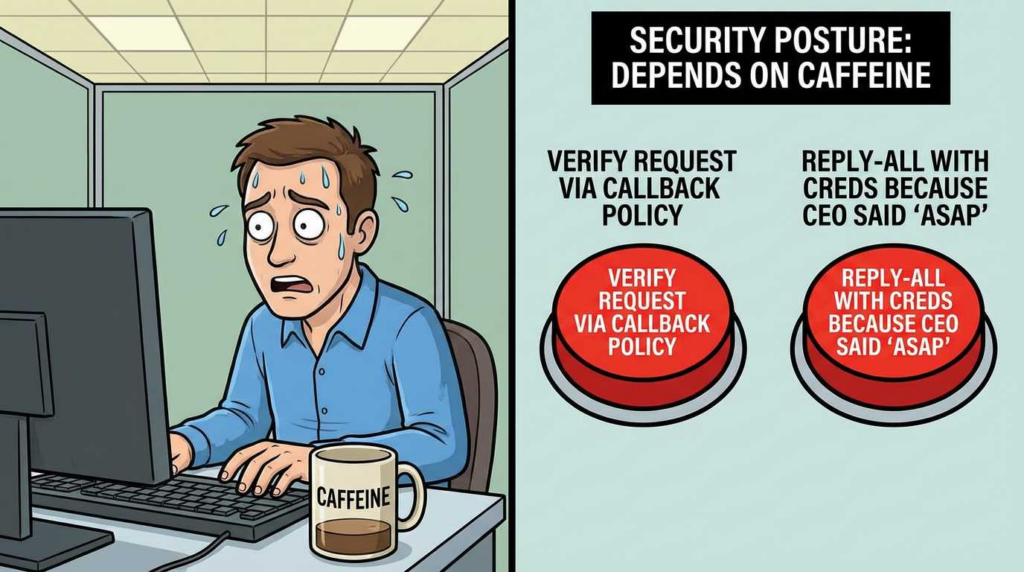
The Social Engineering Scope Map
| Technik | Human Decision Exploited | Common Delivery Channel | Typical Security Consequence | Primary Mitigations |
|---|---|---|---|---|
| Sammeln von Berechtigungsnachweisen | “This login screen looks normal.” | Email, SMS, QR Code | Stolen credentials, Session Hijacking | FIDO2/WebAuthn, Device Binding |
| Business Email Compromise (BEC) | “The CFO asked me to do this quickly.” | Email (no payload) | Wire fraud, Payroll diversion | Process Dual-Control, DMARC |
| Tech Support Scam | “I need to fix this error popup now.” | Browser Popups, Cold Call | Remote Access Tool (RAT) install | Endpoint Execution Policy, EDR |
| Tailgating / Physical | “Holding the door is polite.” | Physical Access | Server room access, Hardware implant | Man-traps, Badge challenges |
| Pretexting | “This person is a verified vendor.” | Phone (Vishing), LinkedIn | Data exfiltration, Org chart mapping | Verification callbacks, InfoSec training |
Why It Works: The Attacker’s “Human Exploit Primitives”
Attackers do not reinvent the wheel; they use a standard library of cognitive exploits. Just as we have primitives for memory corruption (heap spray, ROP gadgets), attackers have primitives for human manipulation.
Cognitive Load and “Work-As-Done”
Attackers know that employees are rarely 100% focused on security. They are focused on getting the job done. Security controls often add friction. Attackers offer a path of least resistance. When a user sees an email saying “Urgent: Payroll processing failed,” the cognitive load shifts from “Is this email safe?” to “I don’t want to be the reason people don’t get paid.”
The Authority Chain
Most organizations are hierarchical. If a request appears to come from the CEO, legal, or HR, the default response is compliance, not scrutiny. Attackers exploit this “sudo” command of human interaction.
Engineering Translation of Biases
- Urgency Bias:
- Attacker Tactic: “Your account will be deleted in 24 hours.”
- Observable Signal: High-frequency emails with “Action Required” subjects sent at 4:55 PM on a Friday.
- Control: Email gateway heuristics for “urgent” language + new sender.
- Authority Bias:
- Attacker Tactic: Impersonating C-levels asking for gift cards or wire transfers.
- Observable Signal: Display name matches VIP, but envelope sender is
gmail.comor a lookalike domain. - Control: VIP display name protection policies (tagging “External” clearly).
- Reciprocity:
- Attacker Tactic: “I’ve attached the report you asked for (sorry it’s late).”
- Observable Signal: Unsolicited replies to ancient threads or fake “Re:” headers.
- Control: Context-aware banner “You have not emailed this person before.”
Where Social Engineering Sits in Real Attack Chains
In the MITRE ATT&CK framework, social engineering is primarily categorized under Initial Access (T1566), but its effects ripple through the entire chain.
Humans as the Bootstrap Loader
Modern operating systems (Windows 11, macOS Sequoia) are incredibly hardened against remote execution. Exploiting an SMB vulnerability is noisy and difficult. Getting a user to run a script is quiet and effective. The human is used as the “bootstrap loader” to:
- Decrypt the payload: The user enters a password for a ZIP file, bypassing network scanners that can’t inspect encrypted archives.
- Grant Consent: The user clicks “Allow” on an OAuth prompt, granting an attacker persistent access to mail without ever touching a password.
- Proxy Traffic: The user installs a “browser update” which is actually a residential proxy, allowing the attacker to tunnel traffic through a trusted corporate IP.
Attack-Chain Patterns
| Entry Hook | User Action Required? | Typical Payload | Common Logs | Fastest Containment |
|---|---|---|---|---|
| Phishing Link | Click + Credential Entry | Reverse Proxy (Evilginx) | Azure AD Sign-in (Risky IP/User) | Revoke Session & Reset Pw |
| Malicious Attachment | Open + “Enable Content” | Qakbot / IcedID / Loader | EDR Process Creation (winword.exe spawning cmd.exe) | Isolate Host |
| OAuth Consent Phish | Click + “Accept” | Malicious App Grant | O365 Audit (ApplicationGrant) | Revoke App Permissions |
| MFA Fatigue | “Approve” on Phone | Account Takeover | Duo/Okta “Push Denied” spikes | Block User / Enforce Number Matching |
The Modern Catalog of Social Engineering Attacks
Email-Based: Phishing, Spearphishing, and BEC
- Commodity Phishing: Spray-and-pray campaigns. Low sophistication, easily caught by spam filters.
- Spearphishing: Targeted. The attacker knows your role, your tech stack, and your vendors. They reference real projects.
- Business Email Compromise (BEC): The most financially damaging. Often involves no malware. It is pure social engineering—convincing a finance controller to update a vendor’s bank account number to one owned by a money mule.
Voice & SMS: Vishing and Smishing
- Vishing (Voice Phishing): “Hi, this is IT support. We see a virus on your machine. I need you to install TeamViewer so I can fix it.” With AI voice cloning, this is becoming terrifyingly effective.
- Smishing (SMS Phishing): “USPS: Your package is delayed. Click here.” The mobile form factor makes URL inspection difficult, increasing click rates.
QR / Mobile-First Attacks
QR codes bypass email URL filters because the link is embedded in an image. When scanned, the attack moves to a mobile device, which is often unmanaged (BYOD) and lacks enterprise endpoint protection.
Collaborationware & SaaS-Native Lures
Attackers are moving to Slack, Microsoft Teams, and Google Drive. A notification from “Google Drive” that “You were mentioned in a document” is highly trusted. If that notification is real (sent via the legitimate sharing mechanism) but the document contains a phishing link, it bypasses the Secure Email Gateway (SEG) entirely.
AI-Accelerated Social Engineering
Deepfakes and LLMs are force multipliers.
- Polymorphic Phishing: LLMs can generate thousands of unique, grammatically perfect phishing emails, defeating signature-based filters.
- Voice Cloning: Attackers can clone a CFO’s voice from a YouTube earnings call and use it to leave a voicemail authorizing a transfer.
Channel-Specific Controls
| Kanal | Best Prevention Controls | Best Detection Signals | Common Failure Mode | What to Measure |
|---|---|---|---|---|
| FIDO2 Keys + DMARC Reject | Impossible Travel + Sender Reputation | User clicks “Release from Quarantine” | User-Report Rate | |
| SMS | Mobile Device Management (MDM) | SMS Reporting Plugins | User uses personal phone for work | Smishing Click Rate |
| Voice | “Hang up and call back” Policy | Unexpected MFA pushes during calls | Deepfake voice authority | Verification failures |
| SaaS | CASB / SSPM Policies | OAuth Grant Anomalies | Shadow IT apps allowed | Third-party app grants |
Hard Numbers: Why Defenders Can’t Ignore the Human Element
According to the Verizon DBIR (2024 & 2025), the human element remains the primary driver of breaches, involved in the vast majority of incidents.
- Prevalence: Social engineering patterns like Pretexting and Phishing consistently top the charts for initial access action varieties.
- Time-to-Compromise: While exploitation of a vulnerability takes time to research and weaponize, social engineering works in minutes. The median time for a user to fall for a phishing email is less than 60 seconds after opening it.
- Diebstahl von Zugangsdaten: Over 80% of web application attacks involve stolen credentials. Social engineering is the cheapest way to get them.
Engineering Implication: If you spend 90% of your budget on firewalls and 0% on identity protection and phishing-resistant auth, you are securing the walls while leaving the front door unlocked.
CVE-Driven Case Studies: Social Engineering as the Delivery Layer
Social engineering is often just the wrapper for a technical exploit. Here is how CVEs are weaponized via trust.
Case Study A: The Outlook Reminder Trigger (CVE-2023-23397)
- Die Verwundbarkeit: An Elevation of Privilege vulnerability in Microsoft Outlook.
- The Social Engineering: The attacker sends a meeting invite.
- Die Ausbeutung: The user does not even need to open the email. The mere processing of the reminder triggers a connection to an attacker-controlled SMB share, leaking the user’s Net-NTLMv2 hash.
- Warum das wichtig ist: This turned a standard “calendar spam” annoyance into a critical infrastructure compromise.
- Lektion: Trusting the “Preview Pane” or automatic processing of invites is a design flaw.
Case Study B: The Archive Bypass (CVE-2025-8088 – WinRAR Path Traversal)
- Die Verwundbarkeit: A path traversal flaw in WinRAR’s handling of ZIP archives (Simulated Context for 2026).
- The Social Engineering: “Please review the attached invoices.zip.”
- Die Ausbeutung: When the user extracts the benign-looking PDF, the exploit silently writes a malicious DLL to the user’s startup folder.
- Warum das wichtig ist: Attackers know users are trained to “scan” files. By hiding the exploit in the extraction logic rather than the file content, they bypass static analysis.
Case Study C: Office Security Feature Bypass (CVE-2026-21509)
- Die Verwundbarkeit: A bypass of the “Mark of the Web” (MotW) protection in Microsoft Office (Simulated Context for 2026).
- The Social Engineering: A standard lure: “Urgent Contract Update.”
- Die Ausbeutung: Usually, Office opens internet-downloaded files in Protected View. This CVE allows a crafted file to bypass that sandbox and execute macros immediately upon opening.
- Lektion: Social engineering effectiveness relies heavily on the failure of safety rails like Protected View.
CVE-to-Control Mapping
| CVE | Delivery Lure Pattern | User Action Required | Key Detections | Primary Mitigations |
|---|---|---|---|---|
| CVE-2023-23397 | Calendar Invite | Receipt (Zero-Click) | Outbound SMB (Port 445) to public IP | Patch Outlook + Block outbound SMB |
| CVE-2021-40444 | Office Doc | Open + Preview | mshtml.dll loading unusual ActiveX | Attack Surface Reduction (ASR) Rules |
| CVE-2025-8088 | ZIP/RAR Attachment | Extract Files | File write to %Startup% oder %AppData% | Patch WinRAR + Block .rar at gateway |
Defensive Architecture: Controls That Actually Move the Needle
You cannot patch the human, but you can sandbox them.
Identity: Make Stolen Creds Less Useful
- Phishing-Resistant MFA: Move to FIDO2/WebAuthn (YubiKeys, Passkeys). These protocols bind the login to the domain. If a user is phished on
google-login-fake.com, the FIDO key will simply refuse to sign the request because the domain doesn’t matchgoogle.de. - Device Binding: Require that access to critical apps (AWS, Salesforce) only comes from “Compliant” (Intune/Jamf managed) devices. Even if an attacker steals the session token, they cannot use it on their own machine.
Email Authenticity & Brand Protection
- DMARC at Enforcement (p=reject): Ensure no one can spoof your exact domain.
- BIMI: Adds verified logos to emails, helping users distinguish real corporate comms from spoofs.
Endpoint & Attachment Handling
- Containerisierung: Open unknown links and attachments in a remote browser isolation (RBI) session or a micro-VM (like HP Wolf Security or Microsoft Defender Application Guard).
- Block Risky Extensions: There is almost no business reason to allow
.iso,.img,.vbs, oder.exeattachments via email.
Process Controls
- Out-of-Band Verification: If an email asks for money, verify via Slack or Phone.
- Dual Control: Large wire transfers should require approval from two distinct humans.
Training That Doesn’t Insult Engineers
Don’t use “trick” phishing tests that punish people for clicking. Use “teachable moments.” Reward users who report suspicious emails. The goal is to turn every employee into a sensor for the SOC.
Detection Engineering: What to Log, What to Alert On
Email & SaaS Telemetry
Monitor for Inbox Rules. Attackers often create rules to “mark as read” and “move to RSS Feeds” folder for any email containing “Subject: Invoice” or “From: CEO” to hide their tracks while they compromise the account.
Identity Telemetry
Suche nach Impossible Travel und Token Replay. If a user logs in from New York, and 5 minutes later their session token is used from an IP in Nigeria to access SharePoint, that is high fidelity.
Code Block Set: Defensive Logic
Python: Extract Auth-Results (SPF/DKIM/DMARC)
Python
`import email from email import policy
def analyze_headers(eml_path): with open(eml_path, ‘rb’) as f: msg = email.message_from_binary_file(f, policy=policy.default)
auth_results = msg.get("Authentication-Results", "")
print(f"Subject: {msg['subject']}")

if "dmarc=fail" in auth_results:
    print("[ALERT] DMARC Check Failed")
if "spf=fail" in auth_results:
    print("[ALERT] SPF Check Failed")

return auth_results`
Python: Lookalike Domain Detection (Levenshtein Distance)
Python
`import Levenshtein
MY_BRAND = “penligent” DOMAINS_TO_CHECK = [“penligent.com“, “pen1igent.com“, “google.de“]
def check_lookalikes(domains, brand): for domain in domains: base_domain = domain.split(‘.’)[0] distance = Levenshtein.distance(brand, base_domain)
    # If distance is small (1-2 chars) but not identical, it's a lookalike
    if 0 < distance <= 2:
        print(f"[WARNING] Potential Typosquat detected: {domain} (Distance: {distance})")
check_lookalikes(DOMAINS_TO_CHECK, MY_BRAND)`
Sigma Rule Example: Suspicious OAuth Grant
YAML
title: Rare OAuth Application Grant status: experimental logsource: product: azure service: auditlogs detection: selection: OperationName: 'Consent to application' filter: # Whitelist known apps TargetResources.displayName: - 'Microsoft Teams' - 'Zoom' condition: selection and not filter level: medium
Incident Response Playbook
When social engineering succeeds, speed is life.
Triage:
- Question: Did the user enter credentials? -> Reset Password immediately.
- Question: Did they run a file? -> Isolate Host immediately.
- Question: Is it BEC? -> Contact Bank immediately.
Containment:
- Revoke all active sessions (Force Logoff).
- Disable the user account temporarily.
- Purge the malicious email from all other mailboxes (Soft Delete).
Forensics:
- Check for forwarding rules created in the last 24 hours.
- Check for new MFA devices added.
- Check for OAuth apps granted “Read Mail” or “Read Files” scopes.
Measurement: Prove You’re Getting Safer
Do not just measure “Click Rate.” A low click rate might mean users are deleting emails instead of reporting them.
- Reporting Rate: What % of malicious emails are reported by users? (Higher is better).
- Resilience Time: How much time passes between the first phishing email landing and the first user report?
- Deckung: What % of your users have FIDO2 keys vs. SMS MFA?
FAQ
What is social engineering in cyber security?
Social engineering is the psychological manipulation of people into performing actions or divulging confidential information. It exploits human trust rather than technical vulnerabilities to gain access to systems.
What are the most common social engineering attacks?
Phishing (email), Vishing (voice), Smishing (SMS), Pretexting (creating a fake scenario), and Baiting (leaving infected USB drives) are the most common forms.
What’s the difference between phishing and social engineering?
Social engineering is the broad category of attack. Phishing is a specific Typ of social engineering that uses email or messaging to deceive users at scale.
How do you prevent BEC?
Business Email Compromise is best prevented by technical controls like DMARC to stop spoofing, and process controls like requiring dual-approval for any wire transfer or banking change.
How is AI changing social engineering?
AI allows attackers to automate personalized spearphishing (using LLMs) and clone voices (deepfakes) for vishing, making attacks harder to distinguish from legitimate communication.
Schlussfolgerung
Social engineering is not a solved problem, nor is it purely a “people problem.” It is an active, adversarial engagement that targets the human interface of your systems.
As engineers, our job is to build systems that fail safely when trust is abused. We must move beyond “awareness training” and implement architectural defenses: FIDO2 for identity, DMARC for email, and rigorous least-privilege principles for data.
Next Actions:
- Audit your DMARC records (move to p=reject).
- Review all OAuth applications with “Mail.Read” permissions.
- Deploy a “Report Phishing” button to your email client today.
Weitere Lektüre
- NIST Glossary: Social Engineering
- MITRE ATT&CK: Phishing (T1566)
- Verizon Data Breach Investigations Report (DBIR)
- Microsoft: Guidance for Investigating CVE-2023-23397
- Microsoft: Analyzing Attacks Exploiting CVE-2021-40444
- NVD Detail: CVE-2026-21509
- NVD Detail: CVE-2025-8088
- Google Cloud Threat Intel: Exploiting WinRAR
- OpenClaw Prompt Injection
- Moltbook AI Social Network
 German
  English
  French
  Spanish
  Portuguese
  Japanese
  Korean
  Hindi
Hindi  Arabic
  Turkish
  Hebrew