
CVE-2026-54515 is not another Jackson gadget-chain remote code execution story. It is a narrower but still security-relevant jackson-databind flaw: under a specific annotation and feature combination, a field that a developer tried to keep unwritable with per-property @JsonIgnoreProperties can become writable again during case-insensitive deserialization. GitHub’s advisory describes the impact plainly: an application that enables case-insensitive matching and relies on per-property @JsonIgnoreProperties to keep a field unwritable may allow that field to be set from untrusted JSON, creating a mass-assignment-style write. (GitHub)
That distinction matters. CVE-2026-54515 should not be handled like a classic jackson-databind polymorphic deserialization gadget-chain issue. The public scoring and advisory language point to an integrity problem, not direct code execution. GitHub marks the advisory as Moderate with CVSS 3.1 score 5.3, and the vector shows network attack vector, low attack complexity, no privileges required, no user interaction, unchanged scope, no confidentiality impact, low integrity impact, and no availability impact. (GitHub)
The real business risk depends on which field becomes writable. If the reopened property is a harmless display preference, the practical impact may be low. If it is isAdmin, Rolle, tenantId, approvalStatus, creditLimit, priceOverride, workflowState, or an internal routing flag, the same library behavior can become an authorization or business-logic failure. NVD maps CVE-2026-54515 to CWE-915, which covers improper control over dynamically determined object attributes, and MITRE explains that unexpected modification of attributes intended only for internal use can lead to a vulnerability. (NVD) (CWE)
The first fix is simple: upgrade jackson-databind to a fixed version for your release line. The harder work is proving whether the vulnerable path existed in your application and whether it touched sensitive state. A scanner can identify a vulnerable dependency. It usually cannot prove that untrusted JSON reached a DTO where per-property @JsonIgnoreProperties and case-insensitive deserialization intersected.
CVE-2026-54515 at a glance
| Bereich | Einzelheiten |
|---|---|
| CVE | CVE-2026-54515 |
| Komponente | FasterXML jackson-databind |
| Primary packages | com.fasterxml.jackson.core:jackson-databind for Jackson 2.x and tools.jackson.core:jackson-databind for Jackson 3.x |
| Schwäche | CWE-915, Improperly Controlled Modification of Dynamically-Determined Object Attributes |
| Auslöser | Per-property @JsonIgnoreProperties kombiniert mit @JsonFormat(ACCEPT_CASE_INSENSITIVE_PROPERTIES) on the same contextual binding path |
| Main impact | A property intended to be ignored during deserialization can become writable from untrusted JSON |
| Practical risk class | Mass-assignment-style integrity issue |
| GitHub severity | Moderate, CVSS 3.1 score 5.3 |
| CISA ADP signal in NVD | Exploitation none, automatable yes, technical impact partial |
| Fixed versions named in GitHub Advisory | 2.18.9, 2.21.5und 3.1.4 |
| Notable version detail | NVD’s CPE analysis lists 2.22.0 as vulnerable, so teams on 2.22.0 should treat it as affected unless their vendor proves otherwise |
| First practical action | Upgrade, then search for DTOs where ignored properties and case-insensitive binding intersect |
The important word is “intersect.” Merely using Jackson does not prove exploitability. Merely having @JsonIgnoreProperties does not prove exploitability. Merely accepting JSON does not prove exploitability. The risky condition appears where an application receives untrusted JSON, uses an affected jackson-databind version, applies per-property ignore rules to keep a field unwritable, enables case-insensitive property matching on the same binding path, and then uses the resulting object in a security- or business-relevant workflow.
What broke inside jackson-databind
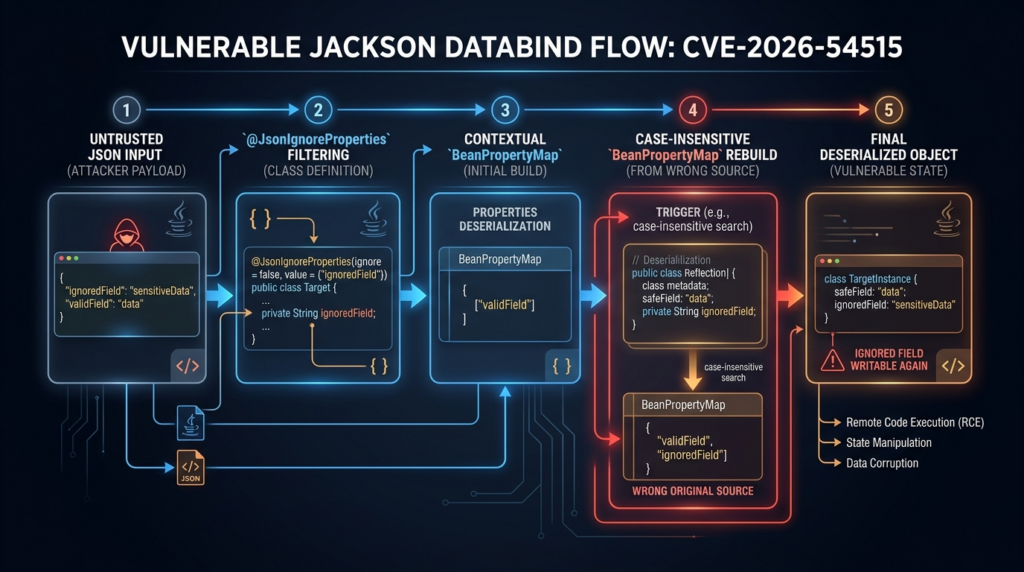
Jackson’s data-binding layer converts JSON into Java objects. A JSON key such as Nutzername maps to a Java property named Nutzername; a key such as adminKey Karten zu adminKey; and unknown or ignored properties are handled according to mapper settings, annotations, and deserializer context. In simple API code, this can look like a mechanical mapping step. Internally, it is a series of contextual decisions involving annotations, property maps, creator parameters, visibility rules, and feature overrides.
@JsonIgnoreProperties is one of the annotations developers use to control that mapping. Jackson’s own Javadoc says the annotation can suppress serialization of properties or ignore processing of JSON properties read during deserialization. The same documentation explains that the annotation can be applied to classes and properties, and that its value element names properties to ignore. (FasterXML)
The annotation also has subtle read and write semantics. Its allowGetters option can permit getters for ignored properties, and its allowSetters option can permit setters for ignored properties. By default, allowSetters is false, which means setters with matching names are ignored. (FasterXML) That default is exactly why developers may use @JsonIgnoreProperties("adminKey") or similar annotations to prevent a field from being set by client-controlled JSON.
The other half of the bug is case-insensitive property matching. JsonFormat.Feature.ACCEPT_CASE_INSENSITIVE_PROPERTIES overrides MapperFeature.ACCEPT_CASE_INSENSITIVE_PROPERTIES, allows case-insensitive matching of property names, and affects deserialization rather than serialization. (Adobe Developer) Developers enable it for compatibility when clients send inconsistent JSON casing, such as userName, UserName, oder USERNAME.
CVE-2026-54515 appears where these two behaviors interact. GitHub’s advisory says that in BeanDeserializerBase.createContextual(), per-property @JsonIgnoreProperties exclusions are applied by _handleByNameInclusion(), producing a contextual deserializer whose BeanPropertyMap has the ignored properties removed. The later per-property case-insensitivity block, triggered by @JsonFormat(ACCEPT_CASE_INSENSITIVE_PROPERTIES), rebuilds from this._beanProperties, the original unfiltered map, rather than from contextual._beanProperties, the filtered map. The rebuild then overwrites the filtered map, restoring the properties that had just been removed. (GitHub)
NVD describes the same root cause and result: the ignored property becomes writable again, and the vulnerability is fixed in patched jackson-databind releases. (NVD) The upstream patch is small but important because it corrects the source of the case-insensitive property map rebuild. The patch reference linked by NVD points to FasterXML’s commit 0e1b0b211f7a53baa62ba2f4c9bd006c7bf4d5fa, associated with the fix for issue #5962 and pull request #5964. (NVD)
Small patch, real security boundary. That is the core lesson. The application expected one property map after ignore rules were applied. The vulnerable code rebuilt a different map from an earlier source. A field that should have stayed out of the writable set came back.
Why this is not the usual Jackson RCE story
Jackson has a long security history, and many engineers still associate “Jackson vulnerability” with unsafe polymorphic deserialization, default typing, gadget chains, and remote code execution. That history is real, but it is not the right frame for CVE-2026-54515.
The public advisory does not say attacker-controlled JSON can instantiate arbitrary classes. It does not say a gadget chain can execute commands. It does not say default typing is involved. It says a field that was intended to be unwritable through @JsonIgnoreProperties can be set from untrusted JSON when case-insensitive matching is enabled in the vulnerable path. (GitHub)
That makes the issue closer to mass assignment and object property authorization than to classic deserialization RCE. OWASP’s API Security Top 10 describes Broken Object Property Level Authorization as a case where an API allows a user to read or change sensitive object properties they should not be able to access. OWASP notes that unauthorized access to object properties can cause data disclosure, data loss, or data corruption, and under some circumstances can lead to privilege escalation or account takeover. (OWASP-Stiftung)
This framing changes the remediation conversation. The correct message is not “Jackson lets attackers run code.” The correct message is: “In affected versions, a specific annotation and feature interaction can violate an application’s assumption that certain JSON properties are not writable.” That is less dramatic, but more useful. It tells engineers where to look, what to test, and why a medium CVSS score can still matter in high-value API flows.
A minimal example of the vulnerable assumption
Consider a nested DTO where the server wants clients to set a visible field, but not an internal one:
import com.fasterxml.jackson.annotation.JsonFormat;
import com.fasterxml.jackson.annotation.JsonIgnoreProperties;

class AdminDto {
    public String adminKey = "SERVER_DEFAULT";
    public String username;
}

class Container {
    @JsonIgnoreProperties("adminKey")
    @JsonFormat(with = JsonFormat.Feature.ACCEPT_CASE_INSENSITIVE_PROPERTIES)
    public AdminDto admin;
}
The intended behavior is easy to understand. A client can send admin.username, but should not be able to set admin.adminKey. Because case-insensitive matching is enabled, the client may be allowed to send Username, USERNAME, or other casing variants for normal properties. The security expectation is that adminKey stays ignored regardless of casing.
A test payload might look like this:
{
  "admin": {
    "AdminKey": "CLIENT_CONTROLLED",
    "username": "alice"
  }
}
The expected secure outcome is that Nutzername wird alice, while adminKey remains server-controlled. The vulnerable behavior described by GitHub and NVD is that the ignored property may be restored to the writable property map after case-insensitive rebuilding, allowing the client-controlled value to bind. (GitHub) (NVD)
A regression test should assert the security invariant, not merely the parsing behavior:
import static org.junit.jupiter.api.Assertions.assertFalse;

import com.fasterxml.jackson.annotation.JsonFormat;
import com.fasterxml.jackson.annotation.JsonIgnoreProperties;
import com.fasterxml.jackson.databind.ObjectMapper;
import org.junit.jupiter.api.Test;

class SensitiveFieldBindingTest {
    static class AccountUpdate {
        public String displayName;
        public boolean isAdmin = false;
    }

    static class RequestEnvelope {
        @JsonIgnoreProperties("isAdmin")
        @JsonFormat(with = JsonFormat.Feature.ACCEPT_CASE_INSENSITIVE_PROPERTIES)
        public AccountUpdate account;
    }

    @Test
    void clientJsonMustNotSetIgnoredSensitiveField() throws Exception {
        ObjectMapper mapper = new ObjectMapper();

        String payload = """
        {
          "account": {
            "displayName": "Alice",
            "IsAdmin": true
          }
        }
        """;

        RequestEnvelope parsed = mapper.readValue(payload, RequestEnvelope.class);

        assertFalse(parsed.account.isAdmin,
            "Client-controlled JSON must not set account.isAdmin");
    }
}
This is the kind of test worth keeping after the upgrade. It catches the exact class of security assumption that failed: a sensitive field must remain server-controlled even if a client sends a mixed-case version of the property name.
Exploitability conditions defenders should check
A realistic CVE-2026-54515 exposure requires a chain of conditions. A vulnerable dependency is necessary, but not enough.
| Zustand | Warum das wichtig ist | How to check |
|---|---|---|
| Affected jackson-databind version is present | The flaw lives in jackson-databind | Dependency tree, SBOM, image scan, shaded JAR review |
| Untrusted JSON reaches Jackson binding | No attacker-controlled JSON means no external trigger | Controller mappings, message consumers, webhooks, partner APIs |
Per-property @JsonIgnoreProperties is used | The bug concerns ignored properties on a contextual binding path | Source search for annotation usage on fields, classes, parameters, nested DTOs |
| Case-insensitive property matching is active | The vulnerable rebuild is triggered by case-insensitive matching | Search for ACCEPT_CASE_INSENSITIVE_PROPERTIES and shared mapper config |
| The ignored field is sensitive | Reopening a harmless field may not matter | Review fields such as Rolle, tenantId, isAdmin, approvalStatus, priceOverride |
| The bound object affects state | A parsed field only matters if it is used | Trace DTO-to-entity mapping, service logic, persistence, authorization |
| No later control overwrites the field | Downstream logic can neutralize the parser behavior | Check server-side assignment, allowlist mapping, explicit authorization checks |
The most common mistake is stopping after dependency scanning. If the vulnerable JAR exists but the application never combines per-property ignore rules and case-insensitive deserialization on untrusted input, the practical exposure may be limited. Conversely, if the vulnerable code path sits inside a self-service account update, tenant management flow, billing endpoint, marketplace approval workflow, or admin API, the business impact can exceed what a generic CVSS score suggests.
The mass-assignment connection
CVE-2026-54515 maps directly to an old API security failure: allowing client-controlled input to modify object attributes that should be internal. MITRE’s CWE-915 definition says the product receives input specifying multiple attributes, properties, or fields to initialize or update, but does not properly control which attributes can be modified. MITRE also notes that this weakness is commonly known through terms such as mass assignment, autobinding, or object injection. (CWE)
OWASP’s 2019 API Security Top 10 entry for Mass Assignment explains the practical API pattern: modern frameworks encourage automatic binding from client input into internal objects, and attackers can use that behavior to overwrite sensitive object properties that developers never intended to expose. OWASP lists permission-related properties, process-dependent properties, and internal properties as examples of fields that should not be client-controlled. (OWASP-Stiftung)
CVE-2026-54515 is not the same as a careless application that binds every request body directly into a database entity. The application may have tried to block the field with @JsonIgnoreProperties. The problem is that the library bug can break that assumption under the case-insensitive path. From the attacker’s perspective, however, the result may look similar: add a property to the JSON body, try case variants, and see whether the server accepts a field it should not.
| Ebene | Failure pattern | Beispiel | Primary fix |
|---|---|---|---|
| Library layer | Jackson restores an ignored property during case-insensitive rebuild | Ignored adminKey becomes writable | Upgrade jackson-databind |
| Binding layer | Client JSON binds into a broad internal object | PUT /users/me akzeptiert isAdmin | Use narrow request DTOs |
| Authorization layer | User can change a property they do not control | Host modifies total_stay_price | Field-level authorization |
| Persistence layer | ORM merge writes every bound field | Entity state changes without source trust review | Explicit allowlist mapping |
| Detection layer | Logs show only a successful request | No audit event for Rolle ändern | Sensitive-field audit events |
The lesson is not “never use Jackson annotations.” The lesson is that annotations should not be the only control protecting authority-bearing fields. A fixed Jackson version closes this bug. A better application design limits the damage from future parser, mapper, and framework behavior changes.
Affected versions and patch guidance
GitHub’s advisory currently lists affected ranges for com.fasterxml.jackson.core:jackson-databind als >= 3.1.0, < 3.1.4, >= 2.8.0, < 2.18.9und >= 2.19.0, < 2.21.5, with patched versions 3.1.4, 2.18.9und 2.21.5. It also lists tools.jackson.core:jackson-databind as affected from >= 3.1.0, < 3.1.4festgelegt in 3.1.4. (GitHub)
NVD’s change history currently includes CPE configuration for 2.8.0 up to but excluding 2.18.9, 2.19.0 up to but excluding 2.21.5, 3.0.0 up to but excluding 3.1.4, and a separate vulnerable CPE entry for 2.22.0. NVD also records the CISA ADP SSVC options as exploitation none, automatable yes, and technical impact partial. (NVD)
For operational purposes, treat the versions this way:
| Current version | Empfohlene Maßnahmen |
|---|---|
| 2.8.x through 2.18.8 | Upgrade to at least 2.18.9 if staying on the 2.18 line |
| 2.19.x through 2.21.4 | Upgrade to at least 2.21.5 if staying on the 2.21 line |
| 2.22.0 | Treat as affected based on NVD CPE data and upgrade or obtain vendor confirmation |
| 3.0.x through 3.1.3 | Upgrade to 3.1.4 |
| Vendor-shaded Jackson | Verify the embedded copy, not only your direct dependency |
| Framework-managed Jackson | Prefer a framework BOM or platform release that resolves a fixed jackson-databind version |
Do not assume a direct dependency override fixes every runtime copy. Java services often get Jackson through Spring Boot, Quarkus, Micronaut, Dropwizard, Kafka clients, cloud SDKs, logging integrations, API clients, or vendor libraries. Shaded copies can remain inside a fat JAR even after a top-level dependency changes.
Finding affected dependencies
For Maven projects, inspect the resolved dependency tree:
mvn -q dependency:tree \
  -Dincludes=com.fasterxml.jackson.core:jackson-databind,tools.jackson.core:jackson-databind
For Gradle projects, ask why the dependency exists and which version was selected:
./gradlew dependencyInsight \
  --dependency jackson-databind \
  --configuration runtimeClasspath
For SBOM review, search CycloneDX output:
jq -r '
  .components[]
  | select(.name == "jackson-databind")
  | [.group, .name, .version, .purl]
  | @tsv
' bom.json
For built artifacts, look for embedded Jackson classes and JARs:
find build target -type f \
  \( -name '*jackson-databind*.jar' -o -name '*jackson*.jar' \) \
  -print 2>/dev/null
For fat JARs, a quick shaded-copy check can help:
jar tf app.jar | grep -i 'jackson/databind\|fasterxml/jackson\|tools/jackson' | head -50
These commands do not prove exploitability. They prove inventory. That is the first step. The second step is code-path review.
Finding risky code paths
Start by searching for the two feature families that matter:
grep -RIn --include='*.java' \
  -e '@JsonIgnoreProperties' \
  -e 'ACCEPT_CASE_INSENSITIVE_PROPERTIES' \
  src/main src/test
Then search mapper configuration and framework customizers:
grep -RIn --include='*.java' \
  -e 'MapperFeature.ACCEPT_CASE_INSENSITIVE_PROPERTIES' \
  -e 'JsonFormat.Feature.ACCEPT_CASE_INSENSITIVE_PROPERTIES' \
  -e 'ACCEPT_CASE_INSENSITIVE_PROPERTIES' \
  src/main
The direct advisory path is per-property case-insensitive handling triggered by @JsonFormat(ACCEPT_CASE_INSENSITIVE_PROPERTIES). Still, reviewers should not ignore global case-insensitive mapper settings, because broad permissive parsing can create similar security assumptions even when the exact CVE path is absent.
Next, search for sensitive field names. This is noisy by design:
grep -RIn --include='*.java' \
  -e 'isAdmin' -e 'role' -e 'roles' -e 'tenantId' -e 'ownerId' \
  -e 'approved' -e 'approval' -e 'status' -e 'state' \
  -e 'price' -e 'balance' -e 'credit' -e 'limit' \
  -e 'internal' -e 'override' -e 'verified' \
  src/main
Use the results to prioritize review, not to declare findings automatically.
| Code pattern | Priorität | Reason |
|---|---|---|
@JsonIgnoreProperties on a nested field plus per-property @JsonFormat(ACCEPT_CASE_INSENSITIVE_PROPERTIES) | Hoch | Directly matches the advisory mechanics |
| Request DTO with sensitive ignored fields | Hoch | Field reopening may have business impact |
| Domain entity used directly as request body | Hoch | Risk exists even outside this CVE |
| Response-only DTO | Unter | CVE-2026-54515 is about deserialization writability |
| Test fixtures only | Unter | Useful for regression tests but less likely to be production-reachable |
| Message consumer receiving partner JSON | Medium to high | Queue input and partner input are not automatically trusted |
The review should end with a concrete statement: either the vulnerable pattern is absent, present but not externally reachable, present and externally reachable but not sensitive, or present and security-relevant.
Safe validation workflow
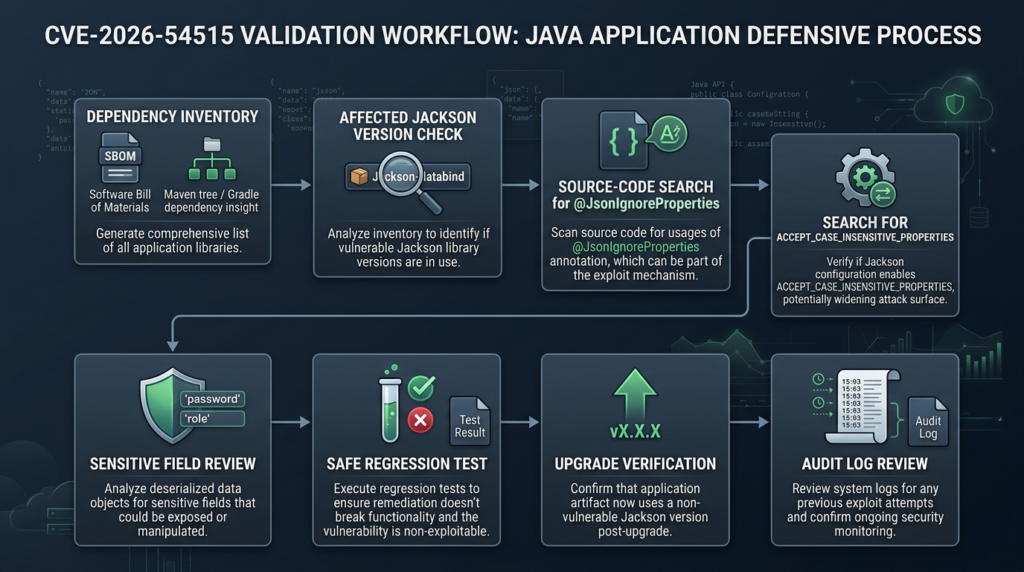
Do not validate this issue by mutating production user records or firing arbitrary JSON into live business flows. Build a safe validation path.
| Schritt | Evidence to collect | Good outcome |
|---|---|---|
| Confirm dependency | Maven or Gradle output, SBOM, image scan, shaded JAR check | You know the exact runtime version |
| Confirm fix path | BOM upgrade, direct upgrade, vendor patch, framework release | You know how the fixed version enters the build |
| Confirm annotation intersection | Source references to @JsonIgnoreProperties and case-insensitive binding | You know whether the code pattern exists |
| Confirm reachability | Endpoint, webhook, queue, partner API, admin route | You know whether untrusted JSON reaches it |
| Confirm field sensitivity | DTO and service logic review | You know whether reopened fields matter |
| Write regression tests | Exact-case, mixed-case, uppercase payload variants | The invariant is enforced after upgrade |
| Review logs | Request bodies, audit trails, domain events | You know whether incident review is needed |
| Retest after patch | Dependency tree plus behavior test | The fix is verified, not merely declared |
A good closure note for this CVE should not be a single scanner screenshot. It should say something like: “Service A resolved com.fasterxml.jackson.core:jackson-databind:2.21.3; endpoint /api/account/update binds external JSON into AccountUpdateEnvelope; nested account combines @JsonIgnoreProperties("isAdmin") und @JsonFormat(ACCEPT_CASE_INSENSITIVE_PROPERTIES); upgraded to 2.21.5; regression test confirms IsAdmin, ISADMINund isAdmin do not change the server-controlled field.”
For authorized testing programs, the evidence matters as much as the payload. Penligent positions its platform around AI-assisted penetration testing, CVE verification, evidence-first results, and controlled agentic workflows for authorized security testing, which is relevant to this kind of dependency-plus-code-path validation when teams need repeatable evidence rather than a one-off scanner result. (Sträflich)
Detection after possible exposure
There is no universal log line that says “CVE-2026-54515 was exploited.” The application sees JSON, binds an object, and proceeds. If the reopened field is accepted, the request may look like a normal 200 response unless request bodies or domain-level state changes are logged.
Detection should focus on sensitive fields and case variants.
| Signal | Warum das wichtig ist | Where to look |
|---|---|---|
IsAdmin, ISADMIN, TenantId, ApprovalStatus, PriceOverride | Attackers may try mixed-case variants when case-insensitive binding exists | API gateway logs, WAF logs, request-body samples |
| Sensitive field changes by low-privilege users | The practical impact is unauthorized object-property modification | Audit tables, event streams, admin logs |
| State changes through endpoints that should not expose the field | Indicates mass-assignment-style behavior | Endpoint logs correlated with database updates |
| Profile update plus role or tenant change | Normal-looking request with hidden field mutation | Domain audit and service logs |
| Post-upgrade regression failure | Indicates the invariant is still not enforced | CI and integration tests |
A simple log search might look like this:
zgrep -E '"(IsAdmin|isAdmin|ISADMIN|tenantId|TenantId|role|Role|approvalStatus|ApprovalStatus)"' \
  /var/log/api-gateway/access*.log.gz
For structured logs:
jq -r '
  select(.http.request.body != null)
  | select(
      (.http.request.body | test("(?i)\"(isAdmin|tenantId|role|approvalStatus|priceOverride|creditLimit)\""))
    )
  | [.timestamp, .user.id, .http.method, .url.path, .source.ip]
  | @tsv
' api-requests.jsonl
Do not treat every hit as exploitation. Some admin APIs legitimately accept sensitive fields. The goal is to find mismatches between endpoint intent and submitted properties. OWASP’s API3:2023 guidance explicitly notes that whether hidden properties can be changed may require crafting requests and analyzing responses, and that side-effect analysis may be needed if the target property is not returned in the API response. (OWASP-Stiftung)
Remediation, upgrade first
Upgrade jackson-databind first. GitHub identifies the upstream fix path through FasterXML issue #5962, pull request #5964, and commit 0e1b0b2, and NVD links the same patch and issue references. (GitHub) (NVD)
A Maven BOM update for a Jackson 2.21 line might look like this:
<dependencyManagement>
  <dependencies>
    <dependency>
      <groupId>com.fasterxml.jackson</groupId>
      <artifactId>jackson-bom</artifactId>
      <version>2.21.5</version>
      <type>pom</type>
      <scope>import</scope>
    </dependency>
  </dependencies>
</dependencyManagement>
A direct dependency override may look like this:
<dependency>
  <groupId>com.fasterxml.jackson.core</groupId>
  <artifactId>jackson-databind</artifactId>
  <version>2.21.5</version>
</dependency>
For Jackson 3.x, use the 3.x package coordinates:
<dependency>
  <groupId>tools.jackson.core</groupId>
  <artifactId>jackson-databind</artifactId>
  <version>3.1.4</version>
</dependency>
In framework-managed services, prefer the framework’s BOM or platform release where possible. A direct override may solve the vulnerability but introduce module version skew if jackson-core, jackson-annotationsund jackson-databind are no longer aligned. After the upgrade, rerun dependency resolution and integration tests.
Then harden the application design
Patching closes the known library flaw. It does not remove unsafe binding assumptions from the application. The durable fix is to reduce the number of sensitive fields that can ever be influenced by request JSON.
| Kontrolle | What it prevents | Beispiel |
|---|---|---|
| Separate request DTOs from domain entities | Prevents broad client input from reaching internal fields | UserProfileUpdateRequest enthält displayName, nicht Rolle |
| Explicit allowlist mapping | Prevents unexpected fields from being persisted | entity.setDisplayName(request.displayName()) |
| Server-side assignment | Keeps authority-bearing fields out of client control | entity.setTenantId(authenticatedTenantId) |
| Field-level authorization | Ensures only permitted users can modify sensitive properties | Only billing admins can change creditLimit |
| Regression tests | Catches future mapper behavior changes | Test isAdmin, IsAdminund ISADMIN variants |
| Audit events | Makes sensitive field changes visible | Emit ROLE_CHANGED oder TENANT_CHANGED events |
| Schema validation | Rejects unexpected fields at API boundary | JSON Schema with additionalProperties: false |
A safer request model looks like this:
record UserProfileUpdateRequest(
    String displayName,
    String email
) {}
Then the service layer maps only allowed fields:
void updateProfile(
    AuthenticatedUser caller,
    UserProfileUpdateRequest request,
    UserEntity entity
) {
    entity.setDisplayName(request.displayName());
    entity.setEmail(request.email());

    // Sensitive fields stay server-controlled.
    entity.setTenantId(caller.tenantId());

    // Role changes belong in a separate, audited admin workflow.
}
If an admin workflow genuinely needs to change a sensitive field, define it explicitly:
record AdminRoleChangeRequest(
    String targetUserId,
    boolean admin
) {}

void changeAdminRole(
    AuthenticatedUser caller,
    AdminRoleChangeRequest request
) {
    if (!caller.hasPermission("USER_ROLE_ADMIN")) {
        throw new ForbiddenException("Not allowed to change user roles");
    }

    audit.emit("ADMIN_ROLE_CHANGE_REQUESTED", caller.id(), request.targetUserId());
    userRepository.setAdminFlag(request.targetUserId(), request.admin());
}
This is more verbose than automatic binding into a broad entity, but it is much easier to reason about. It also makes future library bugs less dangerous because the client never has a path to authority-bearing fields in the first place.
Warum FAIL_ON_UNKNOWN_PROPERTIES is not enough
Some teams respond to mass assignment risk by enabling strict unknown-property handling. That is useful, but it does not fully address CVE-2026-54515.
The problem is not only that an unknown field is accepted. The problem is that a known field, already present in the Java type but intended to be ignored during deserialization, can re-enter the writable property map. If the Java class has isAdmin, then isAdmin is not unknown to Jackson. A strict unknown-property policy may reject madeUpField, but still fail to protect a known sensitive property if the property map says it is writable.
A useful regression matrix should include both sensitive known fields and unknown fields:
| Payload field | Expected result |
|---|---|
isAdmin | Must not be client-writable in non-admin flows |
IsAdmin | Same result as isAdmin |
ISADMIN | Same result as isAdmin |
iSaDmIn | Same result if case-insensitive binding remains enabled |
tenantId | Must be server-controlled unless endpoint explicitly allows tenant administration |
Rolle | Must require explicit authorization and audit |
unknownField | Rejected or ignored according to API schema policy |
The invariant is not “Jackson rejects one spelling.” The invariant is “this endpoint cannot change this sensitive field.”
Related Jackson CVEs to separate during triage
CVE-2026-54515 was disclosed alongside other jackson-databind issues. They are related because they involve data binding and deserialization boundaries, but they should not be collapsed into one generic “Jackson problem.”
| CVE | Feature area | Why it is related | Defender focus |
|---|---|---|---|
| CVE-2026-54512 | Polymorphic deserialization and PolymorphicTypeValidator | NVD describes a case where generic type parameters can bypass expected PTV validation | Review polymorphic typing, type identifiers, allowlists, and gadget risk |
| CVE-2026-54514 | InetSocketAddress binding | NVD describes eager DNS resolution during readValue for attacker-controlled host input | Search externally bound DTOs containing InetSocketAddress; monitor DNS side effects |
| CVE-2026-54515 | Per-property ignore plus case-insensitive binding | Ignored fields can become writable again | Search @JsonIgnoreProperties plus case-insensitive properties and sensitive fields |
| CVE-2026-54518 | @JsonView, @JsonUnwrapped, creator parameters | NVD describes view visibility not being consulted in a specific unwrapped creator path | Review view-based access assumptions and constructor-bound DTOs |
NVD describes CVE-2026-54512 as a jackson-databind issue where PolymorphicTypeValidator is the primary safety mechanism for polymorphic deserialization, and generic type parameters can affect validation in a way that allows nested type arguments to be resolved and populated. (NVD) That is a very different risk class from CVE-2026-54515.
NVD describes CVE-2026-54514 as an issue where binding untrusted JSON into a type containing an InetSocketAddress field can issue an attacker-chosen DNS query during readValue, before application-level validation or connect logic. (NVD) Again, that is not the same as ignored fields becoming writable.
This distinction is useful when communicating with engineers. A Jackson patch wave may contain RCE-like deserialization safety issues, SSRF-adjacent DNS side effects, and mass-assignment-style integrity bugs. Each needs its own reachability question.
Penligent’s Jackson-core write-up on GHSA-72hv-8253-57qq makes a similar point for a different Jackson issue: not every Jackson advisory is a jackson-databind gadget-chain story, and the right defense depends on where the risk lives in the JSON processing stack. (Sträflich) That distinction also applies to CVE-2026-54515.
Prioritätensetzung
A medium score should not be ignored automatically. It should be interpreted.
Prioritize CVE-2026-54515 quickly when:
- The service is internet-facing or reachable by low-trust authenticated users.
- The endpoint accepts JSON for account, tenant, billing, workflow, marketplace, or admin operations.
- The affected DTO contains ignored fields related to role, tenant, owner, approval, price, balance, entitlement, or internal status.
- The application maps request DTOs directly into entities.
- The service uses ORM merge-style updates.
- The application uses case-insensitive binding broadly for compatibility.
- Audit logs do not clearly record sensitive field changes.
- The vulnerable dependency is part of a shared platform used by many services.
Deprioritize, with written evidence, when:
- The vulnerable version is present but no untrusted JSON reaches jackson-databind.
- The annotation intersection is absent.
- The only occurrences are test fixtures or response-only models.
- Ignored fields are not sensitive and are overwritten server-side.
- The application already uses narrow request DTOs and allowlist mapping.
- The service has upgraded and regression tests confirm sensitive fields remain protected.
The practical severity is driven by reachability and field sensitivity. A low-integrity parser bug can become a meaningful business flaw if it controls money, privileges, tenant boundaries, approval state, or security policy.
Production remediation playbook
A concise response plan keeps the work concrete.
CVE-2026-54515 remediation playbook

Inventory:
  1. Generate Maven and Gradle dependency trees.
  2. Check SBOMs and container scan output.
  3. Inspect shaded JARs and vendor SDKs.
  4. Record package, version, artifact path, and owner.

Upgrade:
  1. Move Jackson 2.18.x users to 2.18.9 or later on that line.
  2. Move Jackson 2.21.x users to 2.21.5 or later on that line.
  3. Treat Jackson 2.22.0 as affected unless a vendor proves otherwise.
  4. Move Jackson 3.x users to 3.1.4 or later.
  5. Prefer framework-managed BOM updates when possible.

Code-path review:
  1. Search for @JsonIgnoreProperties.
  2. Search for ACCEPT_CASE_INSENSITIVE_PROPERTIES.
  3. Identify overlapping DTO paths.
  4. Mark sensitive ignored fields.
  5. Trace DTO-to-entity mapping and persistence.

Validation:
  1. Add regression tests for sensitive ignored fields.
  2. Include exact-case, mixed-case, and uppercase payloads.
  3. Confirm dependency resolution after build.
  4. Confirm the container image contains the fixed artifact.
  5. Retest endpoint behavior in staging.

Detection:
  1. Search logs for case-variant sensitive fields.
  2. Review audit events for unexpected sensitive-field changes.
  3. Investigate exposed endpoints with low-trust callers.
  4. Document whether incident review is required.

Closure:
  1. Attach version evidence.
  2. Attach code-path review notes.
  3. Attach regression test results.
  4. Attach post-upgrade dependency tree.
  5. Attach compensating controls or vendor statements.
This level of evidence prevents vague closure. It also helps separate services that merely carry a vulnerable dependency from services that had a reachable sensitive-field overwrite path.
Common response mistakes
The first mistake is treating every Jackson CVE as interchangeable. CVE-2026-54515 is not the same as a polymorphic type validation bypass, not the same as eager DNS resolution during binding, and not the same as a streaming parser denial-of-service bug. The affected feature and security consequence are specific.
The second mistake is relying on @JsonIgnoreProperties as an authorization mechanism. It is a useful serialization and deserialization control, but it does not know whether the authenticated user should be allowed to modify a field in a particular business workflow. Authorization belongs in service logic, policy checks, and field-level controls.
The third mistake is patching only direct dependencies. Shaded Jackson copies, framework-managed versions, vendor SDKs, and fat JARs can keep vulnerable code in runtime artifacts after the source tree looks fixed.
The fourth mistake is testing only one property spelling. Because the bug is tied to case-insensitive matching, tests should include isAdmin, IsAdmin, ISADMIN, and at least one mixed-case variant.
The fifth mistake is closing the finding because no public exploit is known. For a mass-assignment-style issue, the “exploit” may be a JSON body with an extra field. The hard part is not payload construction. The hard part is proving whether the field reaches sensitive state.
FAQ
Is CVE-2026-54515 remote code execution?
- No public advisory describes CVE-2026-54515 as direct remote code execution.
- The documented impact is that a field intended to be ignored during deserialization can become writable from untrusted JSON.
- The practical risk is integrity impact, especially when the reopened field controls authorization, tenant scope, billing, workflow, or internal state.
- Treat it as a mass-assignment-style binding issue, not as a classic Jackson gadget-chain RCE.
- Still patch quickly if the vulnerable path is reachable from low-trust users.
Which Jackson versions should I upgrade?
- GitHub lists fixed jackson-databind versions
2.18.9,2.21.5und3.1.4for the affected ranges shown in the advisory. (GitHub) - NVD’s current CPE analysis also lists
2.22.0as vulnerable, so teams on 2.22.0 should treat it as affected unless their vendor confirms a safe downstream fix. (NVD) - If you use a framework BOM, upgrade through the framework release when possible.
- If you use shaded or vendor-packaged Jackson, verify the embedded version rather than assuming a direct dependency override is enough.
- Rebuild and rescan runtime artifacts after patching.
What code pattern makes CVE-2026-54515 reachable?
- Look for per-property
@JsonIgnorePropertieson a field, class, constructor parameter, or nested DTO path. - Suche nach
@JsonFormat(with = JsonFormat.Feature.ACCEPT_CASE_INSENSITIVE_PROPERTIES). - Review shared
ObjectMapperconfiguration that enables case-insensitive property matching. - Prioritize externally reachable API endpoints, webhooks, message consumers, and partner integrations.
- Focus on ignored fields that affect role, tenant, approval, billing, ownership, workflow, or internal policy.
Can disabling case-insensitive properties mitigate the risk?
- Disabling case-insensitive property matching can reduce exposure to the vulnerable path.
- It is not a substitute for upgrading jackson-databind.
- A later refactor, framework setting, or local annotation can reintroduce case-insensitive binding.
- Patch first, then decide whether the feature belongs on each API surface.
- Keep regression tests for sensitive fields even if you disable the feature.
Can scanners prove exploitability?
- Scanners can usually identify affected package versions.
- Scanners usually cannot prove that untrusted JSON reaches the vulnerable binding path.
- Scanners usually cannot determine whether an ignored field affects authorization, billing, tenant scope, or workflow state.
- Use scanners for inventory and prioritization.
- Use code review and safe regression tests to prove or disprove practical exposure.
How should security teams prioritize it?
- Prioritize high when the affected service accepts low-trust JSON and contains sensitive ignored fields.
- Prioritize high for identity, billing, admin, marketplace, workflow, and multi-tenant services.
- Prioritize high when request DTOs are mapped directly into entities or persisted through broad merge operations.
- Prioritize lower when the annotation intersection is absent, unreachable, or only present in test fixtures.
- Do not defer solely because the CVSS score is moderate; field sensitivity decides business impact.
What should be tested after patching?
- Confirm the resolved jackson-databind version in the built runtime artifact.
- Test ignored sensitive fields with exact-case, mixed-case, and uppercase property names.
- Test nested DTOs, not only top-level request bodies.
- Test DTO-to-entity mapping to confirm sensitive fields are server-assigned or authorization-checked.
- Confirm containers, shaded JARs, and vendor SDKs do not contain old vulnerable copies.
- Review audit logs for unexpected sensitive-field changes during the exposure window.
Closing judgment
CVE-2026-54515 deserves precise handling. It is not a Log4Shell-class emergency, and calling it remote code execution would be inaccurate. It is also not a finding to dismiss simply because the public score is moderate. The bug breaks a specific and important developer expectation: a field removed by per-property @JsonIgnoreProperties should not come back into the writable property map because case-insensitive deserialization rebuilt that map from the wrong source.
The correct response is disciplined. Upgrade jackson-databind to a fixed version. Confirm the artifact that actually ships. Search for the annotation and feature intersection. Review whether ignored fields are security-sensitive. Add regression tests with case variants. Replace fragile automatic binding assumptions with narrow request DTOs, explicit allowlist mapping, server-side assignment, field-level authorization, and audit events.
Untrusted JSON should not be able to write fields the application intended to keep under server control. That is the real security boundary CVE-2026-54515 puts back on the table.
 German
  English
  French
  Spanish
  Portuguese
  Japanese
  Korean
  Hindi
Hindi  Arabic
  Turkish
  Hebrew