
CVE-2026-40058 is a high-severity local privilege escalation vulnerability affecting specific versions and configurations of the CrowdStrike Falcon sensor for Windows. The vulnerability is particularly notable because the component being abused is itself a defensive security mechanism: Falcon’s Microsoft Office malicious macro remediation capability.
CrowdStrike’s CVE record assigns CVE-2026-40058 a CVSS v3.1 score of 8.8, rated High, with the vector CVSS:3.1/AV:L/AC:L/PR:L/UI:N/S:C/C:H/I:H/A:H. The weakness is classified as CWE-367, Time-of-check Time-of-use race condition, commonly abbreviated as TOCTOU. An attacker who already has low-privileged local access may be able to manipulate the remediation workflow so that a privileged Falcon operation writes an attacker-controlled file into a protected Windows location. That arbitrary file-write primitive can then become a path to privilege escalation. (Tenable®)
The vulnerability was formally published as CVE-2026-40058 on September 15, 2026. However, the security community had already been discussing the underlying technique earlier in September under the name FalconFlank, after a researcher released a public proof of concept targeting CrowdStrike Falcon’s Office macro remediation behavior. CrowdStrike initially said it was investigating the report and advised customers to disable the relevant suspicious macro-removal policy while the investigation was underway. (Die Hacker-Nachrichten)
CrowdStrike has since released security updates. Organizations running Falcon Sensor for Windows should therefore treat CVE-2026-40058 primarily as a patching, configuration-validation, and threat-hunting problem rather than as an unpatched zero-day.
CrowdStrike security advisory for CVE-2026-40058
CVE-2026-40058 at a Glance
| Attribut | CVE-2026-40058 Details |
|---|---|
| CVE | CVE-2026-40058 |
| Vendor | CrowdStrike |
| Primary product | Falcon Sensor for Windows |
| Additional affected product | CrowdStrike Laroux Cleanup Tool |
| Art der Schwachstelle | Local privilege escalation |
| Underlying weakness | CWE-367 TOCTOU race condition |
| Security primitive | Arbitrary file write to protected locations |
| CVSS v3.1 | 8.8 High |
| Angriffsvektor | Local |
| Privileges required | Niedrig |
| User interaction | Keine |
| Main prerequisite | Microsoft Office File Malicious Macro Removal enabled |
| Public PoC | Yes, associated with FalconFlank |
| CISA KEV status as of September 17, 2026 | Not listed |
| Vendor fix | Available |
The most important word in this table is ..
CVE-2026-40058 should not be described as an unauthenticated Internet-facing CrowdStrike remote code execution vulnerability. An attacker first needs access to the Windows endpoint under a low-privileged security context. The vulnerability then provides a mechanism for crossing the privilege boundary toward SYSTEM-level execution.
That distinction substantially changes how defenders should model the threat.
At the same time, “local” does not mean insignificant. Privilege-escalation vulnerabilities are frequently used after an attacker has obtained initial code execution through phishing, credential theft, browser exploitation, malicious software, an exposed service, or another foothold. The privilege-escalation stage may be what converts a constrained compromise into full endpoint control.
What Exactly Is Vulnerable?
According to CrowdStrike’s published CVE information, CVE-2026-40058 exists when the Microsoft Office File Malicious Macro Removal Windows policy setting is enabled.
The affected functionality is intended to improve security. When Falcon identifies malicious Office content, the sensor can participate in remediation of malicious macros. Because endpoint protection software requires powerful operating-system permissions, parts of this cleanup process operate with privileges that ordinary users do not possess.
That privilege boundary is what makes the vulnerability important.
A low-privileged process cannot normally write arbitrary DLLs or other files into sensitive Windows directories. A security product running under a highly privileged account, however, may legitimately have permission to modify those areas while removing malicious content.
CVE-2026-40058 creates a situation in which an attacker can potentially influence what the privileged operation ultimately acts upon.
CrowdStrike describes the resulting impact as an arbitrary file write to protected locations from an unprivileged context, potentially resulting in local privilege escalation. (GitHub)
This is more precise than simply saying “Falcon gives attackers SYSTEM.”
The underlying primitive is a privileged file operation being redirected or manipulated. Turning that primitive into SYSTEM-level execution requires an additional execution path, although the publicly discussed FalconFlank research demonstrated that such a chain was practical.
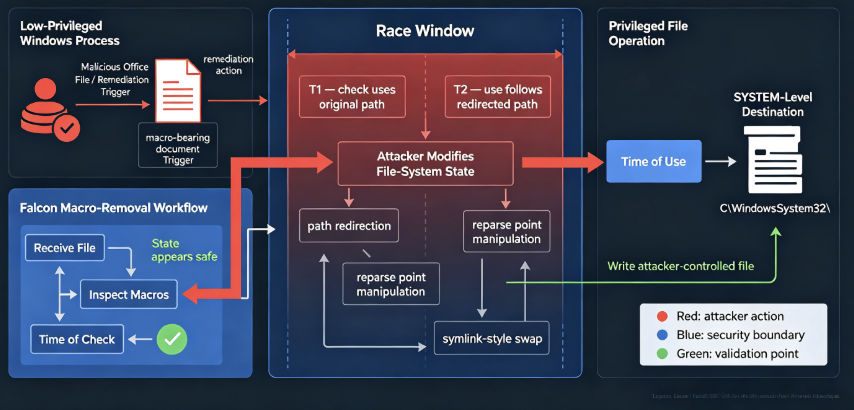
Understanding the TOCTOU Race Condition
CVE-2026-40058 is categorized under CWE-367: Time-of-check Time-of-use.
TOCTOU bugs occur when software verifies a resource at one point in time but uses the resource later, assuming nothing relevant has changed.
Conceptually, imagine privileged software performing the following logic:
Check:
Is this the expected file and location?

        ↓

Time passes

        ↓

Use:
Perform a privileged operation on that path
If an attacker can modify the relationship between the pathname and the underlying filesystem object during that interval, the privileged program may operate on something different from what it originally validated.
The vulnerable pattern becomes:
Trusted file/path validated
        ↓
Attacker changes filesystem state
        ↓
Privileged security process continues
        ↓
Operation reaches attacker-selected destination
The important security lesson is that the original validation itself does not necessarily need to be incorrect.
The problem is that the security assumptions established during validation are no longer guaranteed to remain true when the privileged operation occurs.
This class of weakness appears repeatedly in operating systems, installers, antivirus products, update mechanisms, temporary-file handlers, cleanup utilities, and other software that performs privileged filesystem operations on objects influenced by less-privileged users.
For CVE-2026-40058, researchers reported that the FalconFlank technique manipulates the filesystem during the macro-remediation workflow. Independent researchers at Vega reproduced the PoC in a controlled environment and described a chain involving attacker-controlled staging paths, filesystem redirection and a later privileged execution step. (Vega)
The defensive takeaway matters more than any one PoC implementation: when a SYSTEM-level security service interacts with attacker-influenced filesystem objects, pathname validation and subsequent privileged access must effectively be bound to the same trusted object.
Why an Arbitrary File Write Can Become SYSTEM Execution
An arbitrary file-write vulnerability is sometimes underestimated because “write” sounds less severe than “execute.”
On Windows, the difference may be very small.
If an attacker can cause a privileged process to write controlled content into a sensitive location, numerous privilege-escalation opportunities can become possible depending on what paths are reachable.
A target might include a DLL subsequently loaded by a privileged Windows component, a program used by a SYSTEM service, security-sensitive configuration data, or another resource consumed by a privileged execution path.
The public FalconFlank research reportedly demonstrated the concept by connecting the privileged file-write primitive with a SYSTEM-level execution mechanism. Vega’s lab reproduction observed an attack chain ending in execution under SYSTEM privileges after the malicious file had reached the relevant privileged path. (Vega)
This is also why the CVSS score includes high confidentiality, integrity, and availability impact.
Once arbitrary SYSTEM-level execution is achieved, the attacker is no longer constrained by ordinary user permissions.
Why CVE-2026-40058 Has a CVSS Score of 8.8
Some administrators may initially question why a local vulnerability receives an 8.8 rating.
The CVSS vector explains it:
CVSS:3.1/AV:L/AC:L/PR:L/UI:N/S:C/C:H/I:H/A:HAV:L means the attacker must execute locally rather than directly over the network.
AC:L indicates low attack complexity according to the vendor’s assessment.
PR:L means the attacker needs some privileges, but only a low-privileged context.
UI:N means another user does not have to perform an additional action to complete the exploit.
S:C represents changed scope, which contributes significantly to the final score because exploitation crosses an authorization boundary.
Finally, confidentiality, integrity and availability are all rated High.
That combination explains why a local vulnerability can still receive a high severity score. (Field Guide)
For enterprise defenders, the more useful question is therefore not simply “Is it remote?”
The question is:
What happens after an attacker compromises a standard Windows account on an affected endpoint?
If CVE-2026-40058 allows that attacker to transition reliably from a normal user to SYSTEM, the vulnerability becomes highly relevant to post-compromise attack chains.
CVE-2026-40058 Affected Versions
The CVE record provides considerably more precise version boundaries than the simplified statement that “Falcon 7.x and 8.x are affected.”
Organizations should compare actual sensor builds against the following ranges. (OpenCVE)
| Product branch | Betroffene Versionen | Fixed threshold |
|---|---|---|
| Falcon Sensor 8.10 | >= 8.10.0 and < 8.10.21408 | 8.10.21408 |
| Falcon Sensor 7.40 | >= 7.40.0 and < 7.40.21309 | 7.40.21309 |
| Falcon Sensor 7.39 | >= 7.39.0 and < 7.39.21113 | 7.39.21113 |
| Falcon Sensor 7.38 | >= 7.38.0 and < 7.38.21007 | 7.38.21007 |
| Falcon Sensor 7.37 | >= 7.37.0 and < 7.37.20912 | 7.37.20912 |
| Falcon Sensor 7.36 | >= 7.36.0 and < 7.36.20807 | 7.36.20807 |
| Falcon Sensor 7.35 | >= 7.35.0 and < 7.35.20712 | 7.35.20712 |
| Falcon Sensor 7.34 | >= 7.34.0 and < 7.34.20613 | 7.34.20613 |
| Falcon Sensor 7.33 | 7.33.x affected | Upgrade to a supported fixed branch |
| Falcon Sensor 7.32 LTS | >= 7.32.0 and < 7.32.20410 | 7.32.20410 |
| Windows 7 / Server 2008 R2 branch | >= 7.16.0 and < 7.16.18644 | 7.16.18644 |
| Laroux Cleanup Tool | >= 1.0.20 and < 1.4.70.0 | 1.4.70.0 |
CrowdStrike states that security updates are available for supported versions beginning with the 7.34 branch, the 7.32 LTS branch, and the 7.16 branch used for Windows 7/Windows Server 2008 R2 systems. (GitHub)
Version 7.33 is particularly important operationally because organizations should not simply wait for a hypothetical 7.33 hotfix. CrowdStrike’s published community guidance says affected unsupported releases should move to a supported, hotfixed sensor version. (Reddit)
Are All CrowdStrike Falcon Windows Systems Vulnerable?
No.
Three conditions should be separated.
First, the endpoint must be running an affected Falcon Sensor for Windows version.
Second, the relevant Microsoft Office File Malicious Macro Removal functionality must be enabled.
Third, an attacker still needs a local low-privileged foothold before exploiting the vulnerability.
Removing any one of those conditions changes exploitability.
That means an enterprise with CrowdStrike deployed on 50,000 Windows endpoints should not automatically conclude that all 50,000 devices have the same level of exposure.
Configuration inventory matters.
CrowdStrike also states that its Falcon sensors for macOS and Linux are not affected by CVE-2026-40058. The CVE record additionally distinguishes the affected Windows sensor branches from other Falcon sensor products. (GitHub)
FalconFlank and CVE-2026-40058
The name FalconFlank became associated with the vulnerability before CVE-2026-40058 was officially published.
On September 3, The Hacker News reported that researcher Chaotic Eclipse had released a proof of concept describing a CrowdStrike Falcon privilege-escalation vulnerability involving Office malicious macro remediation. CrowdStrike said at the time that it was investigating and advised organizations to disable the relevant policy setting. (Die Hacker-Nachrichten)
Security researchers at Vega subsequently reported that they reproduced FalconFlank in a lab environment.
Their analysis is particularly useful for defenders because it highlights a recurring problem with exploit detection: the most visually obvious part of an exploit is not always the most reliable telemetry point.
Vega observed behavior involving an attacker-writable staging area, filesystem manipulation, a malicious DLL, IPC through a named pipe, and execution associated with a privileged task. They also noted that some low-level filesystem behavior was less visible than defenders might expect, making correlated behavioral detection more useful than relying on a single write event. (Vega)
There is an important distinction here.
FalconFlank is a public proof of concept and research implementation. CVE-2026-40058 is the vendor-assigned vulnerability.
Defenders should avoid building detection exclusively around filenames or strings belonging to the original PoC. Those indicators can be changed trivially.
The underlying behavior is harder to disguise.
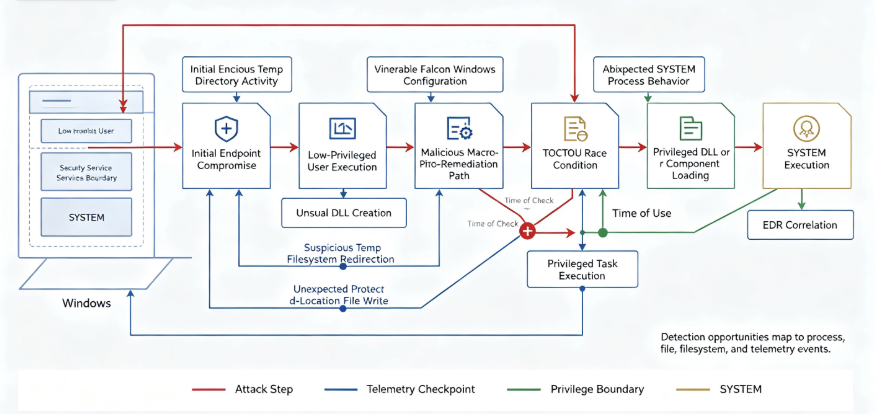
A Realistic Attack Chain
CVE-2026-40058 is best understood as a post-compromise privilege-escalation primitive.
A plausible enterprise attack sequence looks like this:
Initial compromise
        ↓
Low-privileged Windows execution
        ↓
Identify vulnerable Falcon configuration
        ↓
Trigger Office macro remediation path
        ↓
Exploit TOCTOU race
        ↓
Redirect privileged file operation
        ↓
Write attacker-controlled content
to protected location
        ↓
Trigger privileged loading/execution path
        ↓
SYSTEM privileges
        ↓
Credential access / persistence /
defense evasion / lateral movement
The first stage is crucial.
CVE-2026-40058 does not provide the original remote foothold.
Another vulnerability, phishing chain, stolen credential, malicious application, exposed remote-access service, or previously compromised process would normally provide that entry point.
This is typical of local privilege-escalation vulnerabilities. Their importance comes from what they enable after initial access.
Why a Vulnerability in an EDR Product Deserves Extra Attention
Privilege escalation vulnerabilities are concerning in any software, but endpoint security products occupy an unusually privileged position.
An EDR sensor requires deep access to operating-system activity. Depending on implementation, it may inspect processes, manipulate files, monitor kernel events, remediate threats, interact with protected areas of the filesystem and communicate with privileged services.
That authority is necessary for the product to defend the endpoint.
It also creates a security paradox.
The security control itself becomes part of the trusted computing base.
If an attacker can redirect one of its privileged remediation actions, the very permissions that make the EDR effective can amplify the vulnerability.
CVE-2026-40058 therefore illustrates an important endpoint-security design principle:
Security software should be threat-modeled as privileged attack surface, not merely as a defensive layer.
Installers, updaters, quarantine engines, remediation components, temporary-file workflows and privileged helper services deserve the same scrutiny as other SYSTEM-level Windows components.
Is CVE-2026-40058 Being Actively Exploited?
Public exploitation status requires careful wording.
There is unquestionably public exploit research associated with FalconFlank. The PoC was discussed publicly before CVE-2026-40058 received its identifier, and independent researchers reported reproducing the technique. (Die Hacker-Nachrichten)
That is different from confirmed malicious exploitation in production environments.
As of September 17, 2026, public CVE tracking sources do not show CVE-2026-40058 in the CISA Known Exploited Vulnerabilities catalog, and the CVE enrichment information cited by public databases does not establish confirmed exploitation in the wild. (UK Cyber Defence)
Therefore, the accurate description is:
A public proof of concept exists, but confirmed widespread in-the-wild exploitation has not been established by the available authoritative public evidence.
Security teams should not translate “not in KEV” into “safe to ignore.”
Public PoC availability substantially lowers the research barrier for attackers, particularly for a vulnerability whose vendor-rated attack complexity is low.
How Defenders Should Detect CVE-2026-40058 Exploitation
Detection should focus on the exploitation behavior rather than on the literal FalconFlank PoC.
For example, an unmodified proof of concept may leave recognizable filenames, staging directories, task names or named-pipe strings. Those indicators are useful during immediate incident response, but they are weak long-term detection anchors.
An attacker can rename most of them.
The more durable detection question is:
What operations must an attacker perform regardless of naming?
Vega’s FalconFlank analysis identified several useful behavioral themes, including unusual DLL staging under user-writable temporary paths, path structures that imitate protected Windows directories, suspicious interaction with a privileged execution path, and relationships between staged DLL activity and subsequent SYSTEM-level behavior. (Vega)
A practical detection model can therefore look like this:
| Telemetry area | Behavior worth investigating |
|---|---|
| File activity | DLL created under unusual user-writable staging directory |
| Path structure | Temp path imitating Windows/System32 or PowerShell directory structure |
| Filesystem behavior | Reparse-point, junction or unusual path-redirection activity |
| Privilege transition | User-context staging closely followed by SYSTEM execution |
| Scheduled tasks | Unexpected privileged task invocation near suspicious file activity |
| IPC | Unusual named-pipe creation from binaries executing under Temp or Downloads |
| DLL loading | SYSTEM process loading an unexpected or recently modified DLL |
| Process lineage | Low-privilege process activity immediately preceding privileged execution |
| Falcon policy | Host has Office malicious macro removal enabled and vulnerable sensor build |
No single one of these events proves exploitation.
Correlation is more valuable.
For example, a DLL appearing in a temporary directory is common. A scheduled task running as SYSTEM is also common.
A DLL staged in a suspicious path, followed by filesystem redirection behavior and then a privileged process loading a newly changed module during a Falcon remediation event is far more interesting.
Do Not Rely Only on FalconFlank IoCs
One common mistake after a public PoC appears is to write a detection for its filename and consider the problem solved.
That works only against someone running the original exploit without modification.
For CVE-2026-40058, obvious PoC artifacts should be considered high-confidence but low-durability indicators.
Behavioral indicators are generally more durable.
A mature hunt should therefore examine the relationship between low-privilege staging, privileged remediation, sensitive file modification and subsequent SYSTEM execution.
This principle extends well beyond CrowdStrike.
Attackers increasingly reuse the trusted capabilities of defensive products, update services and privileged Windows components instead of introducing obviously malicious privileged services themselves.
How to Verify Exposure Without Exploiting the Vulnerability
Organizations do not need to execute FalconFlank against production endpoints merely to determine whether systems require remediation.
Exposure verification should begin with configuration and version inventory.
Determine the Falcon Sensor version installed on each Windows endpoint, compare it with the vendor’s affected ranges, and identify whether Microsoft Office File Malicious Macro Removal is enabled.
The risk decision can then be represented simply:
Affected Falcon build?
        +
Macro-removal policy enabled?
        +
Windows endpoint?
        =
CVE-2026-40058 exposure requiring remediation
Organizations should separately inventory Laroux Cleanup Tool installations because the vendor states that the same underlying functionality affects the cleanup tool as well. (GitHub)
This type of non-invasive validation is preferable for fleet-wide assessment.
Exploit reproduction should be restricted to isolated, authorized test environments.
Patching CVE-2026-40058
The definitive remediation is to move to a patched CrowdStrike build.
For currently supported Falcon branches, administrators should deploy at least the corrected versions corresponding to their branch, such as 8.10.21408, 7.40.21309, 7.39.21113, 7.38.21007, 7.37.20912, 7.36.20807, 7.35.20712, 7.34.20613 or 7.32.20410.
Windows 7 and Windows Server 2008 R2 systems using the relevant 7.16 sensor branch require at least 7.16.18644 according to the CVE record.
The Laroux Cleanup Tool should be updated to at least 1.4.70.0. (OpenCVE)
Because sensor branches and enterprise deployment rings can differ, security teams should verify the target build against CrowdStrike’s current advisory rather than assuming that “automatic updates are enabled” means every endpoint has already received the fixed version.
Fleet state matters more than policy intent.
Temporary Mitigation
Before the final security updates were available, CrowdStrike advised customers to disable the Microsoft Office File Suspicious/Malicious Macro Removal Windows policy setting involved in the vulnerable remediation path.
The company also stated that customers remained protected through Cloud Anti-malware for Microsoft Office Files settings. (Die Hacker-Nachrichten)
Now that fixed versions are available, disabling functionality should not be treated as a permanent substitute for patching.
There is an important difference between removing the vulnerable execution path and correcting the underlying vulnerable software.
Enterprises should upgrade the sensor and then review whether the policy can safely be restored according to CrowdStrike’s current guidance.
Prioritizing the Vulnerability
CVE-2026-40058 should not be prioritized solely according to its numerical CVSS score.
Environmental context matters.
A vulnerable employee workstation with standard-user accounts, Office installed, the affected macro-remediation feature enabled and exposure to phishing may deserve a higher priority than an isolated Windows system where the relevant policy is disabled.
Likewise, servers on which an attacker reaching SYSTEM would obtain credentials or administrative control over important infrastructure deserve particular attention.
A useful prioritization equation is:
Technical severity
×
Affected version
×
Policy enabled
×
Likelihood of local foothold
×
Asset importance
×
Post-exploitation value
This provides a more accurate risk picture than treating every installation identically.
Why “Local Privilege Escalation” Can Still Be an Enterprise Emergency
Attack chains rarely consist of a single vulnerability.
A threat actor may begin with a browser exploit or stolen VPN credential that gives only constrained access.
Endpoint hardening and least privilege are supposed to prevent that initial foothold from immediately becoming complete system compromise.
A reliable LPE weakens that barrier.
Imagine an attacker who compromises a standard corporate user but cannot initially dump protected credentials, modify security-sensitive services or access administrative secrets.
A privilege-escalation vulnerability can transform that position.
Once SYSTEM-level execution is available, the attacker may attempt credential theft, security-control tampering, persistence, token abuse or movement toward other machines.
CVE-2026-40058 should therefore be evaluated as part of an attack chain rather than as an isolated bug.
The Broader Security Lesson From CVE-2026-40058
One of the most interesting aspects of CVE-2026-40058 is that the vulnerable behavior occurs inside software whose purpose is to stop malicious activity.
This is not unique to CrowdStrike.
Antivirus engines, EDR platforms, software deployment agents, backup agents, remote-management platforms and monitoring tools frequently run with extraordinary privileges.
Any time privileged software consumes data or filesystem objects that a normal user can influence, a potential privilege boundary exists.
The relevant questions for software designers include whether validation remains valid between check and use, whether symbolic links or junctions can redirect privileged operations, whether file handles rather than pathnames can be used to maintain object identity, whether the destination can change after validation, and whether cleanup operations can unexpectedly become privileged write primitives.
CVE-2026-40058 is therefore useful not only as a CrowdStrike vulnerability but also as a case study in privileged remediation architecture.
Why TOCTOU Bugs Remain Difficult to Eliminate
Race conditions are particularly challenging because the vulnerable program may appear perfectly safe when each individual step is examined independently.
The check can be correct.
The file path can initially be correct.
The privilege boundary can be intentional.
The failure emerges only because another actor changes shared system state between two operations.
Timing also makes testing difficult.
Some race conditions succeed inconsistently and may disappear during debugging. Others become significantly more reliable when attackers use operating-system synchronization primitives that allow them to control precisely when the target process reaches a particular filesystem operation.
That is one reason security testing of privileged Windows software should include adversarial manipulation of filesystem namespaces rather than relying only on ordinary functional testing.
Why EDR Self-Protection Does Not Automatically Prevent This Class of Bug
EDR products commonly implement tamper protection and other mechanisms designed to stop attackers from disabling the sensor.
CVE-2026-40058 highlights a different threat model.
The attacker does not necessarily need to stop Falcon.
Instead, the attacker attempts to make Falcon’s own trusted operation produce an unintended security-sensitive result.
This distinction is critical.
Traditional anti-tamper logic asks:
Can an attacker modify or terminate the security product?Confused-deputy and TOCTOU-style attacks ask:
Can an attacker make the privileged security product
perform the attacker's desired operation?
The second problem requires architectural controls around privileged operations, object identity and trust boundaries, not merely stronger process protection.
CVE-2026-40058 vs. a Traditional Windows LPE
A normal Windows privilege-escalation vulnerability may reside in the kernel, a Windows service, a driver or another operating-system component.
CVE-2026-40058 differs because the privileged deputy is a third-party endpoint security product.
That changes remediation responsibility but not the fundamental security model.
From the attacker’s perspective, the essential ingredients remain familiar:
Low privilege
+
Attacker-influenced resource
+
Privileged operation
+
Insufficiently protected transition
=
Privilege boundary bypass
The vendor can eliminate that equation by ensuring privileged Falcon operations cannot be redirected after validation.
Incident Response Considerations
If an organization suspects attempted exploitation before patch deployment, simply checking whether the sensor is now updated is not sufficient.
Patching stops future exploitation. It does not erase evidence of an earlier compromise.
Threat hunters should review endpoint telemetry covering the period during which the host ran an affected version with the vulnerable policy enabled.
The most relevant time windows are those containing suspicious local execution from user-writable paths, unusual filesystem redirection behavior, unexpected DLL creation, SYSTEM-level execution following user-context activity, and Falcon remediation events surrounding those behaviors.
Because some public research suggests that the underlying file operation may not always produce the most obvious telemetry, defenders should reconstruct the sequence around the suspected event rather than depend on one missing or present file-write event. (Vega)
Does Cloud Anti-Malware Fix CVE-2026-40058?
No.
This point can easily be misunderstood.
CrowdStrike’s statement that customers remain protected through Cloud Anti-malware for Microsoft Office Files refers to maintaining malware protection when the vulnerable macro-removal feature is disabled as a mitigation.
It does not mean cloud anti-malware somehow patches the TOCTOU vulnerability.
The security update fixes the vulnerable Falcon Sensor behavior.
The cloud anti-malware setting provides a defensive alternative while the risky feature is disabled.
Those are different controls.
Is Falcon for Linux Vulnerable?
According to CrowdStrike’s disclosure, Falcon Sensor for Linux is not affected by CVE-2026-40058.
The flaw concerns specific behavior in the Windows sensor’s Office malicious macro remediation path. (GitHub)
Is Falcon for macOS Vulnerable?
No, based on the vendor’s published CVE description.
CrowdStrike states that Falcon Sensor for Mac is not affected. (Tenable®)
Does CVE-2026-40058 Allow Remote Code Execution?
Not directly.
The CVSS attack vector is Local.
An attacker needs a local low-privileged execution context before exploiting CVE-2026-40058.
Calling it an unauthenticated remote RCE would therefore be inaccurate.
However, it can become a valuable second-stage exploit when combined with another technique providing initial access.
Does CVE-2026-40058 Require Administrator Privileges?
No.
That would defeat the purpose of the privilege-escalation vulnerability.
The vendor CVSS vector specifies Privileges Required: Low.
Its security significance comes from potentially allowing a low-privileged context to cause privileged file operations and ultimately cross into a much more powerful security context. (Field Guide)
Does Exploitation Require User Interaction?
The vendor’s CVSS vector specifies UI:N, meaning no additional user interaction is required once the attacker has the necessary local execution conditions. (Tenable®)
Again, that does not mean the initial compromise requires no interaction. It only describes exploitation of CVE-2026-40058 itself.
Is There a Public CVE-2026-40058 Exploit?
There is public proof-of-concept research associated with the underlying vulnerability under the name FalconFlank.
The PoC was disclosed before CVE-2026-40058 was formally assigned, which explains why some automated CVE databases may misleadingly report that no exploit is associated with the CVE identifier itself.
The chronology matters.
The public exploit research came first.
The CVE identifier came later.
The Hacker News documented the FalconFlank disclosure on September 3, and Vega reported reproducing the technique in a controlled environment. (Die Hacker-Nachrichten)
Is CVE-2026-40058 in CISA KEV?
As of September 17, 2026, public tracking sources do not show CVE-2026-40058 in the CISA Known Exploited Vulnerabilities catalog. (UK Cyber Defence)
KEV status can change when new exploitation evidence emerges, so organizations following risk-based vulnerability programs should continue monitoring the CVE even after patch deployment begins.
Final Assessment
CVE-2026-40058 is an unusual but important reminder that endpoint protection software is itself privileged software and therefore part of the endpoint attack surface.
The CrowdStrike Falcon vulnerability does not provide anonymous remote compromise. An attacker needs local low-privileged execution, an affected Windows sensor and the relevant Microsoft Office malicious macro-removal functionality enabled.
But once those prerequisites exist, the impact can be substantial.
The underlying CWE-367 TOCTOU race condition can allow a privileged Falcon remediation operation to become an arbitrary protected-location file write, potentially enabling the attacker to transition from a restricted user context to SYSTEM-level execution. CrowdStrike rates the issue 8.8 High, and public FalconFlank research demonstrates why defenders should take the flaw seriously. (OpenCVE)
The response path is comparatively clear now that patches exist: identify Windows endpoints running affected sensor builds, determine where the Office malicious macro-removal policy is enabled, update supported branches to the corrected builds, update Laroux Cleanup Tool installations to version 1.4.70.0 or later, and threat-hunt systems that remained exposed during the public-disclosure window.
The larger lesson extends beyond CVE-2026-40058.
A security control running as SYSTEM must be designed as though every low-privileged object it touches could be adversarial. When validation and privileged use become separated by even a small race window, a defensive operation can become an attacker’s privilege-escalation primitive.

 German
  English
  French
  Spanish
  Portuguese
  Japanese
  Korean
  Hindi
Hindi  Arabic
  Turkish
  Hebrew