
Citrix NetScaler administrators are dealing with another edge-device emergency.
On September 27, 2026, Citrix disclosed CVE-2026-88771, a critical remote code execution vulnerability affecting NetScaler ADC and NetScaler Gateway. The flaw is particularly serious because an attacker does not need valid credentials, does not need a user to click anything, and does not need administrators to enable an unusual feature. According to Citrix, all vulnerable NetScaler ADC and NetScaler Gateway deployments are affected, including systems running the default configuration. Citrix Support
That would already make CVE-2026-88771 a high-priority vulnerability. What changes the situation from routine patch management into incident response is one additional fact: Citrix has confirmed exploitation in the wild.
The company says exploitation of both CVE-2026-88771 and the related CVE-2026-88772 has been observed against unmitigated NetScaler deployments. CISA subsequently added both vulnerabilities to its Known Exploited Vulnerabilities catalog, describing them as critical zero-days capable of enabling remote code execution. GovDelivery
For organizations operating an Internet-facing NetScaler Gateway, this should therefore not be treated as a question of whether somebody will eventually develop an exploit. Attackers were already exploiting vulnerable appliances before the public disclosure.
What Is CVE-2026-88771?
CVE-2026-88771 is an improper input validation vulnerability, classified as CWE-20, in Citrix NetScaler ADC and NetScaler Gateway.
Citrix describes the consequence directly: an unauthenticated attacker can exploit the flaw to execute arbitrary commands on a vulnerable appliance. The vulnerability carries a CVSS v4.0 base score of 9.5, with network accessibility, no privileges required, no user interaction required, and potentially high confidentiality, integrity, and availability impact. Citrix Support
The basic vulnerability characteristics look like this:
| Attribut | CVE-2026-88771 |
|---|---|
| Produkt | Citrix NetScaler ADC / NetScaler Gateway |
| Art der Schwachstelle | Improper input validation |
| CWE | CWE-20 |
| Auswirkungen | Remote command execution |
| Authentication required | Nein |
| Benutzerinteraktion erforderlich | Nein |
| Network exploitable | Ja |
| Default configuration affected | Ja |
| CVSS v4.0 | 9.5 |
| Active exploitation | Confirmed |
| KAG KEV | Ja |
The unusual and dangerous part is the lack of a meaningful configuration prerequisite.
Many edge-device vulnerabilities only become exploitable when a particular VPN mode, authentication service, management interface, or optional protocol has been enabled. CVE-2026-88771 is different. Citrix explicitly states that the vulnerability affects all NetScaler ADC and NetScaler Gateway deployments and requires no additional feature to be enabled. Citrix Support
That dramatically broadens the population defenders need to investigate.
CVE-2026-88771 Is Already Being Exploited
The phrase “active exploitation” is sometimes used loosely in vulnerability reporting. In this case, the evidence is unusually strong.
Citrix itself states:
“Exploits of CVE-2026-88771 and CVE-2026-88772 on unmitigated NetScaler deployments have been observed.” Citrix Support
CISA added both vulnerabilities to its Known Exploited Vulnerabilities catalog on September 27, the same day the Citrix bulletin became public. The agency described the two vulnerabilities as critical zero-days that can independently lead to remote code execution. GovDelivery
CERT-FR went further in its September 28 alert, stating that exploitation began before fixes became available, which is consistent with the vulnerabilities being exploited as genuine zero-days rather than opportunistic attacks launched after public patch analysis. CERT-FR
Reports from the days immediately preceding disclosure also show how unusual the incident was. Citrix administrators said security providers and government cybersecurity organizations were privately contacting affected organizations and, in some cases, recommending that NetScaler systems be shut down while details were still being coordinated. BleepingComputer documented these warnings before Citrix formally disclosed the vulnerabilities. BleepingComputer
watchTowr publicly warned on September 26 that it was responding to credible information about multiple unpatched NetScaler RCE vulnerabilities being exploited in the wild. After Citrix’s disclosure, the company confirmed that the reports corresponded to CVE-2026-88771 and CVE-2026-88772. watchTowr
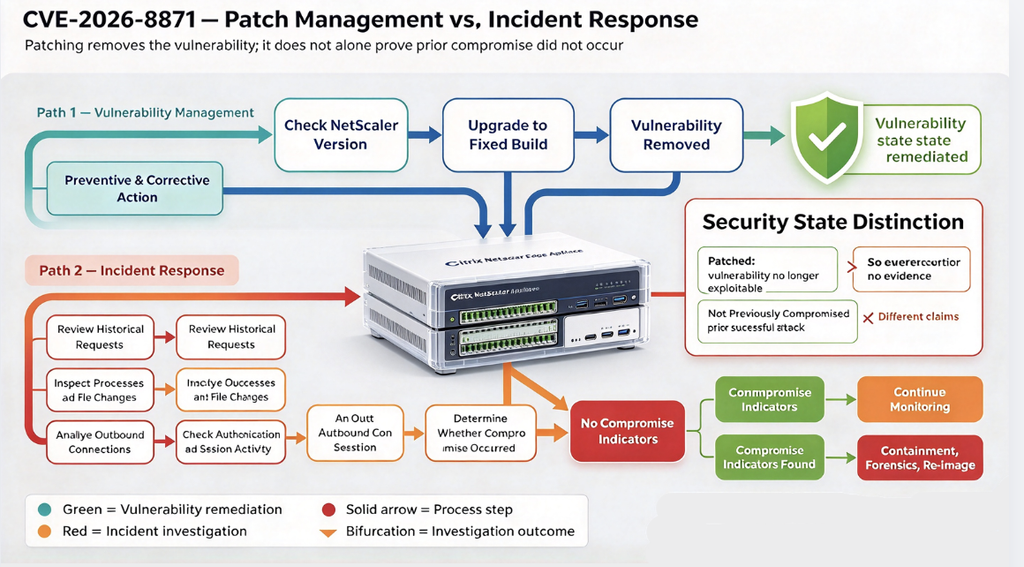
This matters operationally. If a NetScaler appliance was exposed during the zero-day window, installing the patch should not automatically be interpreted as proof that the appliance was never compromised.
Why NetScaler RCE Vulnerabilities Are So Dangerous
A remote code execution vulnerability in a browser extension or internal desktop application is serious. An unauthenticated RCE vulnerability in an Internet-facing gateway is a different category of problem.
NetScaler appliances commonly operate at the boundary between the public Internet and internal applications. Depending on the deployment, they may terminate TLS, provide VPN access, proxy authentication, distribute traffic, expose enterprise applications, or route requests toward systems that attackers cannot reach directly from the Internet.
That placement gives attackers two advantages.
First, the attack surface is reachable without first compromising a workstation. An attacker can target the perimeter directly.
Second, compromise occurs in infrastructure that organizations often trust deeply. Gateway appliances may see authentication traffic, session information, backend addresses and routing information that ordinary Internet hosts cannot access.
BleepingComputer describes NetScaler devices as attractive targets precisely because they commonly provide remote access and application-delivery services at the edge of enterprise environments. Compromising such a system can provide an initial foothold from which an attacker may attempt to reach internal infrastructure. BleepingComputer
This is also why edge vulnerabilities routinely attract sophisticated threat actors. Citrix itself noted in an August 2026 security discussion that highly resourced adversaries continue to focus substantial attention on perimeter infrastructure and may use zero-days, custom tooling and patient intrusion campaigns against those systems. Citrix
CVE-2026-88771 fits that threat model almost perfectly.
Affected Citrix NetScaler Versions
Citrix lists the following versions as vulnerable to CVE-2026-88771:
| Produkt | Vulnerable versions | Fixed version |
|---|---|---|
| NetScaler ADC 14.1 | Before 14.1-73.37 | 14.1-73.37 or later |
| NetScaler Gateway 14.1 | Before 14.1-73.37 | 14.1-73.37 or later |
| NetScaler ADC 13.1 | Before 13.1-64.23 | 13.1-64.23 or later |
| NetScaler Gateway 13.1 | Before 13.1-64.23 | 13.1-64.23 or later |
| NetScaler ADC 14.1 FIPS | Before 14.1-73.37 FIPS | 14.1-73.37 FIPS or later |
| NetScaler ADC 13.1 FIPS / NDcPP | Before 13.1-37.279 | 13.1.37.279 or later |
These affected-version boundaries come directly from Citrix’s CTX697096 security bulletin. Citrix Support
Secure Private Access Hybrid environments that use NetScaler instances are also affected and must upgrade the associated appliances.
Citrix’s advisory applies specifically to customer-managed NetScaler ADC and NetScaler Gateway deployments. Citrix-managed cloud services and Citrix-managed Adaptive Authentication are being updated by Cloud Software Group rather than by customers themselves. Citrix Support
CVE-2026-88771 vs CVE-2026-88772
The September advisory is slightly confusing because Citrix disclosed eight NetScaler vulnerabilities at once, and two of them are critical RCE vulnerabilities being exploited in the wild.
CVE-2026-88771 and CVE-2026-88772 should not be treated as the same bug.
CVE-2026-88771 is an improper input validation vulnerability allowing unauthenticated arbitrary command execution. It affects vulnerable NetScaler deployments without requiring an additional feature.
CVE-2026-88772 is a memory-overflow vulnerability capable of causing remote code execution or denial of service. Its exploitation requires DTLS to be enabled. Citrix notes that DTLS is enabled by default on VPN virtual servers. Citrix Support
Both received a CVSS v4.0 score of 9.5, both have been exploited in the wild, and both were added to CISA’s KEV catalog. GovDelivery
From a defensive perspective, however, CVE-2026-88771 is especially uncomfortable because administrators cannot simply audit a special configuration option and conclude that their system was never vulnerable.
What Does “Improper Input Validation” Mean Here?
Citrix has publicly classified CVE-2026-88771 as CWE-20, Improper Input Validation, but the vendor has not published the kind of low-level exploitation details that would allow us to reconstruct the vulnerable execution path with confidence.
That distinction is important.
It would be easy to see “improper input validation” plus “arbitrary commands” and immediately describe a specific command-injection mechanism. The public advisory does not establish that level of implementation detail.
What can be said safely is that some attacker-controlled input reaching a vulnerable NetScaler component is not validated correctly. Under exploitable conditions, the failure allows an unauthenticated remote attacker to cross a security boundary and cause arbitrary commands to execute on the appliance.
Conceptually, the attack path is therefore:
Internet
   |
   v
NetScaler exposed service
   |
   v
Attacker-controlled input
   |
   v
Insufficient input validation
   |
   v
Unsafe internal processing
   |
   v
Arbitrary command execution
   |
   v
Compromised edge appliance
The important security boundary is not simply malformed input. It is the transition from unauthenticated network data to command execution on a trusted perimeter device.
Until Citrix or independent researchers publish a full technical root-cause analysis, claims about the precise vulnerable endpoint, parsing primitive or command-construction path should be treated cautiously.
Why the CVSS Score Matters Less Than the Exploitation Status
CVE-2026-88771 has a CVSS v4.0 score of 9.5, which clearly places it in critical territory. But the most important risk signal is not 9.5.
It is KEV + unauthenticated RCE + default configuration + Internet-facing appliance.
CVSS estimates technical severity. It does not tell you whether attackers are currently using a vulnerability against production organizations.
CISA’s Known Exploited Vulnerabilities catalog fills part of that gap. CVE-2026-88771 was added to KEV on September 27, and U.S. federal agencies were given a remediation deadline of September 30, 2026. NVD
That extremely short window reflects the urgency of the situation.
For enterprise defenders, CVE-2026-88771 should therefore outrank many other vulnerabilities carrying the same nominal severity because exploitation is no longer hypothetical.
Patching Is Necessary, but It Is Not the Entire Incident Response
Citrix’s primary remediation is straightforward: upgrade vulnerable appliances.
NetScaler also provides a CVE Detection workflow through NetScaler Console. Citrix says organizations can search the security advisory dashboard for CVE-2026-88771, identify affected instances and initiate the relevant upgrade workflow from the impacted-instance view. NetScaler Documentation
That solves the vulnerability.
It does not necessarily solve a compromise that happened before the upgrade.
If a vulnerable NetScaler system was Internet-facing during the exploitation window, security teams should consider two separate questions:
Is the appliance still vulnerable?
und
Was the appliance already compromised?
Those are not equivalent questions.
A patch changes vulnerable code. It does not erase an attacker’s earlier actions, revoke credentials that may have been exposed, automatically remove every possible persistence mechanism, or explain anomalous outbound traffic that occurred before remediation.
That distinction becomes particularly important when exploitation began before the vendor released patches.
How to Investigate Possible CVE-2026-88771 Compromise
Citrix has made generic indicators of compromise available through NetScaler Console, according to reporting surrounding the advisory. BleepingComputer
Organizations should use those indicators, but investigations should not depend entirely on known IOC matching.
Zero-day investigations are difficult precisely because defenders may not yet know every payload, persistence method or post-exploitation technique used by different attackers.
Citrix’s separate compromise-response guidance recommends preserving evidence before aggressively changing a potentially compromised appliance. For VPX deployments, this includes taking a snapshot, documenting system time and timezone settings, preserving remote syslog and NetScaler Console logs, and collecting a technical support bundle that captures configuration and running-process information. Citrix Support
A reasonable forensic review should therefore examine multiple layers of evidence.
Administrators should inspect NetScaler access and system logs for unexpected requests around the suspected exploitation window, particularly requests from unusual source networks or patterns that do not match legitimate application traffic.
Process execution should also be reviewed where telemetry is available. Unexpected shell processes, interpreters, system utilities or unfamiliar child processes associated with network-facing services deserve investigation.
File-system changes are another useful signal. Recently created or modified scripts, configuration files, executables, scheduled jobs and web-accessible files can reveal persistence or tooling even where the original exploit request is no longer present in logs.
Outbound network connections should not be ignored. An attacker who achieves code execution on an edge appliance may establish command-and-control connectivity or use the device as a staging point toward internal systems.
Authentication infrastructure should also be reviewed. A gateway compromise creates a realistic possibility that session information or credentials handled by the appliance could become relevant to subsequent intrusion activity.
None of those signals alone proves exploitation of CVE-2026-88771. Together, however, they can help determine whether an appliance behaved differently during the zero-day window.
Do Not Confuse Vulnerability Scanning With Compromise Detection
This incident also exposes a common weakness in enterprise vulnerability management.
A vulnerability scanner may correctly report:
CVE-2026-88771: fixedafter an appliance has been upgraded.
An incident-response investigation asks a different question:
Was this appliance exploited before it was fixed?Those questions require different evidence.
Version inspection can establish whether a system is currently vulnerable.
Historical request logs, process telemetry, file changes, authentication events and network activity are needed to investigate whether somebody actually exploited it.
For CVE-2026-88771, organizations that were exposed during the zero-day period should therefore resist the temptation to close the incident ticket immediately after confirming a successful upgrade.
Defensive Validation After the Upgrade
Once remediation has been performed, security teams should validate the deployment rather than assuming the upgrade succeeded everywhere.
Large NetScaler environments frequently contain multiple appliances, HA pairs, disaster-recovery instances, staging infrastructure and forgotten Internet-facing systems. One outdated node may be enough to leave an exploitable path.
A basic inventory process can start by recording the software versions of every relevant instance and comparing them against Citrix’s minimum fixed builds.
Conceptually:
14.1 branch       >= 14.1-73.37
13.1 branch       >= 13.1-64.23
14.1 FIPS         >= 14.1-73.37 FIPS
13.1 FIPS/NDcPP   >= 13.1.37.279
NetScaler Console can also identify impacted instances through the CVE Detection view, and Citrix specifically recommends upgrading vulnerable systems through that workflow. NetScaler Documentation
Security teams should additionally re-run external asset discovery after patching. Internal CMDB records are not always sufficient for edge appliances because abandoned, migration-era or disaster-recovery instances may continue to resolve publicly even after administrators believe they are unused.
Internet Exposure Makes Timing Critical
The security community has repeatedly learned the same lesson from major edge-device vulnerabilities: once a patch becomes public, attackers can study the differences between vulnerable and corrected builds.
That can accelerate exploit development even when detailed vulnerability research has not yet been published.
CVE-2026-88771 is more concerning because attackers did not need that public patch analysis to begin exploitation. The vulnerability was already being used before Citrix publicly released the fixed builds.
Rapid7 characterized CVE-2026-88771 and CVE-2026-88772 as actively exploited zero-days and highlighted the particularly broad exposure of CVE-2026-88771 because vulnerable appliances can be attacked under their default configuration. Schnell7
The post-disclosure period can nevertheless increase risk further as additional actors learn about the issue.
There is rarely a meaningful reason to leave a vulnerable Internet-facing NetScaler appliance exposed merely because no exploit has been observed against that specific organization yet.
What Organizations Should Do Now
For defenders responsible for Citrix infrastructure, the response should begin with identification.
Locate every customer-managed NetScaler ADC and NetScaler Gateway instance, including externally exposed gateways, HA nodes, testing systems, disaster-recovery infrastructure and Secure Private Access Hybrid deployments that contain NetScaler instances.
Then verify the running build against Citrix’s fixed versions.
Any affected system should be upgraded to 14.1-73.37, 13.1-64.23, 14.1-73.37 FIPS, or 13.1.37.279 FIPS/NDcPP, depending on the deployed branch. Citrix Support
After remediation, investigate whether the appliance could have been accessible during the zero-day exploitation period.
Preserve forensic evidence before rebuilding suspicious systems. Review Citrix-provided IOCs, NetScaler Console telemetry, request logs, configuration modifications, processes, filesystem artifacts and outbound connections.
Where evidence suggests compromise, expand investigation beyond the NetScaler itself. Edge-device compromise should be treated as a possible entry point into the broader environment rather than an isolated appliance event.
Credential and session exposure may also justify defensive credential rotation depending on what investigators determine the attacker could access.
Why CVE-2026-88771 Deserves Immediate Attention
There are thousands of critical CVEs every year, and treating every CVSS 9.x vulnerability like an emergency eventually creates alert fatigue.
CVE-2026-88771 is not a vulnerability that requires that kind of theoretical prioritization debate.
Several high-confidence facts already line up:
Citrix confirms unauthenticated arbitrary command execution.
Citrix says default configurations are vulnerable.
No additional feature needs to be enabled.
Affected NetScaler systems are frequently placed at enterprise network boundaries.
Citrix has confirmed real-world exploitation.
CISA has placed the vulnerability in the KEV catalog.
Government cybersecurity authorities in multiple countries have issued alerts.
Fixed builds are available.
Taken together, those facts make the operational response relatively clear: vulnerable systems should be remediated rapidly, and organizations exposed before remediation should investigate for compromise rather than treating patch installation as the end of the incident. Citrix Support
CVE-2026-88771 and the Continuing Risk of Edge Infrastructure
CVE-2026-88771 is also another reminder that security appliances themselves have become strategic attack surfaces.
VPN gateways, application delivery controllers, firewalls and identity proxies are attractive precisely because defenders place them in trusted positions.
The stronger the security boundary an appliance controls, the more valuable exploitation of that appliance can become.
Traditional endpoint security architecture often assumes an attacker must first compromise a laptop or server before gaining meaningful access to the network. Vulnerabilities such as CVE-2026-88771 can reverse that sequence.
The perimeter becomes the initial compromised host.
From there, defenders have to think about authentication systems, internal routing, application backends and privileged administrative interfaces that were never intended to be directly accessible to an Internet attacker.
That is why edge-device vulnerabilities deserve continuous external validation rather than occasional inventory-based scanning. Knowing that a CVE exists is useful. Knowing which exact Internet-facing assets are vulnerable, whether they can actually be reached, whether exploitation attempts have occurred and whether suspicious post-exploitation behavior exists is far more valuable.
Frequently Asked Questions
What is CVE-2026-88771?
CVE-2026-88771 is a critical improper input validation vulnerability affecting Citrix NetScaler ADC and NetScaler Gateway. It can allow an unauthenticated remote attacker to execute arbitrary commands on a vulnerable appliance. Citrix Support
Is CVE-2026-88771 being actively exploited?
Yes. Citrix has confirmed exploitation against unmitigated NetScaler deployments, and CISA has added CVE-2026-88771 to the Known Exploited Vulnerabilities catalog. Citrix Support
Does CVE-2026-88771 require authentication?
No. Citrix classifies it as an unauthenticated remote code execution vulnerability.
Does a special NetScaler configuration need to be enabled?
No. According to Citrix, all affected NetScaler ADC and NetScaler Gateway deployments are vulnerable, including default configurations, and no additional feature is required. Citrix Support
What is the CVSS score for CVE-2026-88771?
Citrix assigns CVE-2026-88771 a CVSS v4.0 base score of 9.5.
What versions fix CVE-2026-88771?
Organizations should upgrade to the appropriate fixed branch: NetScaler ADC/Gateway 14.1-73.37 or later, 13.1-64.23 or later, NetScaler ADC 14.1-73.37 FIPS or later, oder 13.1.37.279 FIPS/NDcPP or later. Citrix Support
Is patching enough after CVE-2026-88771?
Patching removes the known vulnerability, but organizations whose appliances were exposed during the zero-day period should also investigate for previous compromise. Citrix provides separate guidance for preserving forensic evidence and investigating potentially compromised NetScaler systems. Citrix Support
Abschließende Überlegungen
CVE-2026-88771 is not simply another critical NetScaler CVE waiting for organizations to work through a normal patch cycle.
It is an unauthenticated remote code execution vulnerability affecting default NetScaler deployments, and attackers were exploiting it before public patches became available.
The immediate task is obvious: identify vulnerable NetScaler ADC and Gateway instances and upgrade them.
The more important second task is easier to miss: determine whether those appliances were exposed before remediation and whether there is evidence that somebody got there first.
For Internet-facing infrastructure, that difference—between patched und never compromised—is often where the real incident begins.

 German
  English
  French
  Spanish
  Portuguese
  Japanese
  Korean
  Hindi
Hindi  Arabic
  Turkish
  Hebrew