
A Linux kernel vulnerability that remained hidden in the virtualization subsystem for years has emerged as a significant security concern for system administrators, cloud infrastructure operators, and security researchers. Tracked as CVE-2026-74580 and publicly named Vghost, the flaw affects the Linux vhost subsystem and can allow attackers with access to certain virtualization device interfaces to escalate privileges to root. Under a narrower set of virtualization conditions, it can also enable a malicious virtual machine to corrupt memory belonging to its host’s QEMU process.
The vulnerability illustrates how a seemingly minor mistake in cache invalidation can undermine some of the most important security boundaries in modern computing. Rather than relying on a conventional buffer overflow in a network parser or a straightforward use-after-free condition, Vghost exploits an inconsistency between cached I/O address translations and the current configuration of a virtual device. Once the kernel begins trusting an outdated translation, memory operations can be redirected outside their intended boundaries.
The Linux kernel security team officially published CVE-2026-74580 on August 21, 2026. The vulnerability attracted renewed attention when Tencent Zhuque Lab published a detailed technical analysis on October 12, followed by a disclosure to the oss-security mailing list on October 14. That research demonstrated that the bug could be developed into a practical privilege-escalation primitive across multiple enterprise Linux distributions, while also providing evidence of a guest-triggered virtual machine escape vector.
According to the Linux kernel CVE announcement und Tencent Zhuque Lab’s technical research, the underlying problem lies in how vhost handles cached IOTLB mappings when virtual ring addresses or sizes change. The resulting vulnerability has a CVSS v3.1 base score of 8.8, classified as High severity.
What makes CVE-2026-74580 particularly important is the distinction between its two demonstrated exploitation scenarios. In the first, a local attacker who can access a vulnerable /dev/vhost-* device may obtain arbitrary kernel memory access and escalate to root. In the second, a guest running under specific vIOMMU and virtio configurations may influence the host’s vhost backend through legitimate virtual-device operations, eventually causing writes outside the guest’s assigned memory region.
These are not equivalent attack scenarios, and not every Linux server or virtual machine is exposed to both. Understanding that distinction is essential for assessing the actual risk and prioritizing remediation.
What Is CVE-2026-74580?
CVE-2026-74580 is a Linux kernel memory-access vulnerability caused by improper invalidation of cached I/O Translation Lookaside Buffer mappings in the vhost subsystem. It affects the handling of virtual ring metadata when a virtqueue is reconfigured.
The vulnerable code resides in drivers/vhost/vhost.c, a kernel source file responsible for important operations in the vhost framework. Vhost allows selected virtio device operations to be processed directly by the Linux kernel rather than routing every operation through a userspace virtual machine monitor such as QEMU. This reduces virtualization overhead and improves performance for workloads involving virtual networking, communication between virtual machines and hosts, and certain storage configurations.
However, performing these operations inside the kernel creates an important security requirement: memory addresses supplied through virtual-device interfaces must be correctly translated and validated before they are used. The system must ensure that a virtual queue cannot cause reads or writes outside the memory regions that were authorized for that device.
CVE-2026-74580 breaks this expectation because the kernel can continue using a previously validated translation after the virtual ring configuration has changed.
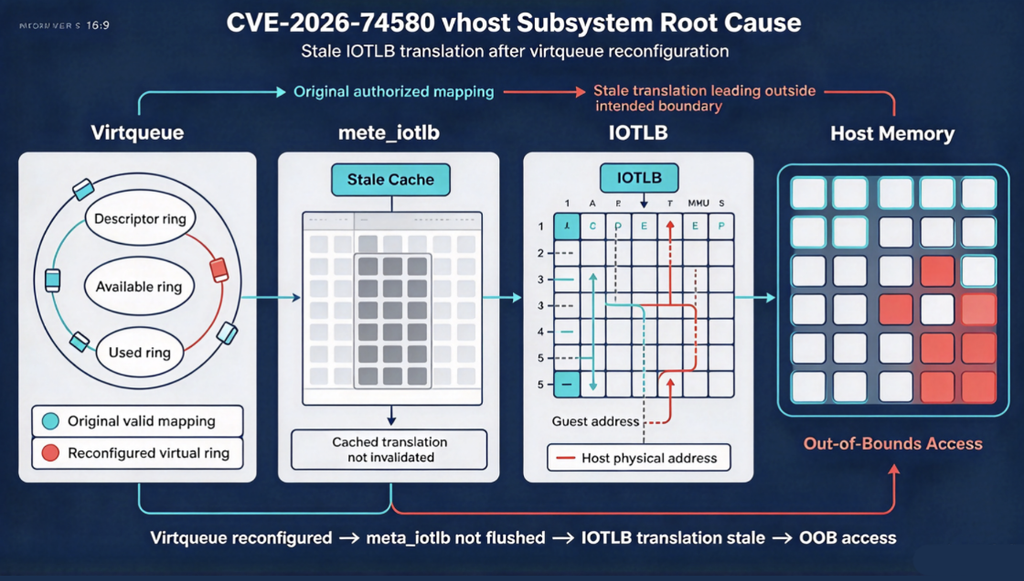
The affected metadata cache, vq->meta_iotlb[], stores translations for three fundamental components of a virtqueue: the descriptor ring, the available ring, and the used ring. These structures coordinate how buffers move between a virtio device driver and its backend. The cache exists for performance, allowing repeated accesses to avoid expensive translation and validation operations.
The problem occurs when the virtual ring configuration is updated through operations such as VHOST_SET_VRING_ADDR oder VHOST_SET_VRING_NUM. These operations can replace ring addresses or change ring sizes, but the vulnerable implementation does not properly invalidate the previously cached metadata mappings.
Consequently, later operations may treat an outdated mapping as valid even though it no longer corresponds to the virtual ring’s current address range.
The official CVE record describes the vulnerability as a failure to reset the virtual ring metadata cache during reconfiguration. The Red Hat security advisory additionally identifies the potential consequences as out-of-bounds memory access, information disclosure, data corruption, and denial of service.
The subsequent researcher analysis establishes that the actual security consequences can go considerably further than an ordinary crash.
Why the Linux vhost Subsystem Is Security-Critical
To understand Vghost, it helps to understand why the vhost subsystem exists in the first place.
Modern Linux virtualization commonly uses KVM for hardware-assisted virtualization and QEMU for device emulation and virtual machine management. Virtio provides a standardized mechanism through which guest operating systems communicate with virtualized devices efficiently. Instead of emulating every instruction or every device operation as though a physical device existed, virtio exposes optimized interfaces designed specifically for virtual environments.
The virtqueue is central to this architecture. It organizes communication between a guest driver and a device backend using shared ring structures. The descriptor ring identifies buffers involved in an operation, the available ring indicates which buffers have been submitted for processing, and the used ring records which operations have been completed.
In a conventional userspace device-emulation model, QEMU is heavily involved in processing this communication. With kernel-based vhost acceleration, substantial portions of the device data path can instead execute within the host kernel.
This provides measurable architectural advantages, particularly for high-throughput virtual networking. Reducing userspace transitions and unnecessary copying helps virtual machines process I/O more efficiently.
The performance optimization also creates a critical trust boundary. A virtual machine can influence virtual queue contents and device state, but it must not gain unrestricted access to the host kernel or host process memory. Vhost therefore depends on correct validation of buffer locations, virtual-device state, and address translations.
The IOTLB, or I/O Translation Lookaside Buffer, is part of that protection mechanism. It maintains mappings between I/O virtual addresses and memory regions accessible to a device. When an IOMMU-aware virtio device accesses a buffer, the system must establish that the supplied address belongs to an authorized mapping.
Vghost demonstrates what happens when those validations are made dependent on a cache whose lifetime is not correctly synchronized with the underlying device configuration.
The issue is especially relevant to cloud infrastructure because virtualization security depends on maintaining a strict separation between workloads with different trust levels. A flaw inside a kernel-accelerated virtualization backend can potentially undermine that separation even when application-level security controls are functioning correctly.
Technical Root Cause: A Stale IOTLB Metadata Cache
The underlying programming error in CVE-2026-74580 is a cache coherency failure. The kernel retains information describing an earlier virtual ring mapping and subsequently trusts it after the ring has been reconfigured.
Under normal conditions, the vhost subsystem checks whether a requested I/O memory region is valid before permitting access. The relevant logic includes the iotlb_access_ok() function, which can consult previously cached metadata mappings to avoid repeating validation.
A simplified representation of the vulnerable optimization looks like this:
if (vhost_vq_meta_fetch(vq, addr, len, type))
    return true;
The intended meaning is straightforward. If the metadata cache already contains a valid mapping for the requested region, the kernel can skip additional translation work.
That assumption is only safe while the cached entry still corresponds to the virtual ring’s current configuration.
Wenn VHOST_SET_VRING_ADDR changes the addresses of the descriptor, available, or used rings, the previously cached translation should no longer be trusted without revalidation. Similarly, changes introduced through VHOST_SET_VRING_NUM may alter the relevant memory region sizes.
In the vulnerable implementation, these reconfiguration paths fail to invalidate the cache.
The problem becomes particularly dangerous when a device IOTLB is attached. In this mode, certain address validation operations are intentionally deferred because the virtual ring addresses are guest I/O virtual addresses rather than ordinary host pointers. Functions such as vq_access_ok() may therefore return successfully during configuration, expecting proper validation to take place when the ring is actually accessed.
But if the metadata cache still contains an entry from the previous configuration, the later validation can be skipped as well.
This creates a condition in which both the initial configuration path and the eventual memory-access path accept an address without verifying that it remains within the intended mapping.
The affected translation can be represented conceptually as:
translated_address = map->addr + addr - map->start;The calculation itself is not inherently incorrect. It is a standard way to translate an address relative to a mapped region. The problem is that the cached mapping may no longer cover the new address.
Wenn addr falls outside the range associated with the old mapping, the arithmetic can produce a pointer outside the memory region originally validated by the kernel.
The resulting pointer can reach memory-copy operations used during virtqueue processing. As described in the upstream Linux kernel disclosure, functions including vhost_copy_to_user() und vhost_copy_from_user() can consume the stale translation without performing the required range validation again.
The security consequence is that a memory-access operation which appears legitimate at the virtual-device layer can ultimately reference memory outside the authorized IOTLB mapping.
This is why describing CVE-2026-74580 merely as a generic out-of-bounds vulnerability misses an important aspect of its design. The failure is not just that a pointer can become invalid. It is that an earlier validation result continues to be treated as authoritative after the conditions that made it valid have changed.
Why the Bug Survived for Years
The history of Vghost is particularly instructive because the vulnerability emerged from the interaction of separate kernel changes.
Tencent’s research traces the relevant behavior to an optimization introduced in Linux 4.11 in 2017, when metadata mapping information was cached to accelerate virtqueue operations. A later change associated with Linux 5.9 deferred certain GIOVA validation operations from the configuration phase to the memory-access phase.
Individually, both changes had legitimate engineering motivations. Caching frequently accessed translations improves performance, and deferring validation can be appropriate when address translation depends on runtime device state.
The unsafe behavior emerged because the two mechanisms relied on incompatible assumptions. One assumed a cached mapping could be reused, while the other assumed that validation would occur later. Following a virtual ring reconfiguration, the cached mapping could prevent that later validation from happening.
This is a recurring problem in systems programming: a security property may be preserved by each individual function under its local assumptions while failing across a longer sequence of state transitions.
Traditional code review can overlook such interactions when reviewers examine changes independently. Randomized fuzzing may also struggle to exercise the necessary sequence of configuration, cache population, reconfiguration, and subsequent memory access.
The official Linux kernel vulnerability record identifies commit f889491380582b4ba2981cf0b0d7d6a40fb30ab7 as the introduction point, while Tencent’s Vghost research explains the importance of the later deferred-validation change.
The broader security lesson is that cache invalidation should be treated as part of memory authorization, rather than solely as a performance or correctness concern.
How CVE-2026-74580 Enables Local Privilege Escalation
The most immediately concerning impact of CVE-2026-74580 is its ability to turn access to a vhost character device into kernel-level memory access. Under vulnerable conditions, an attacker who can open an affected device and interact with its control interface may be able to manipulate virtual ring state in a way that causes the kernel to read from or write to unintended memory addresses.
This is significantly more serious than an ordinary application crash. Linux relies on the separation between user space and kernel space to enforce system security. Applications operate with restricted privileges, while the kernel has authority over process credentials, memory management, hardware access, and other sensitive operations. If an attacker obtains a reliable primitive for accessing arbitrary kernel memory, many of those protections can potentially be bypassed.
The Vghost research demonstrates how the stale metadata cache can create both read and write capabilities. The descriptor ring is involved in fetching information about buffers submitted for processing, while the used ring records completed operations. Because both rely on the affected metadata translation mechanism, the vulnerability can influence memory accesses in different directions.
The researchers demonstrated that stale translations could be used to construct a kernel memory disclosure primitive and subsequently manipulate kernel memory. The resulting capabilities made it possible to bypass kernel address-space randomization and complete a local privilege-escalation chain.
Kernel Address Space Layout Randomization, commonly known as KASLR, attempts to make exploitation more difficult by randomizing the locations of important kernel code and data structures. Although KASLR does not prevent memory corruption itself, it can complicate attacks that depend on knowing the addresses of particular kernel objects.
A kernel memory disclosure primitive can undermine this protection by revealing information about the running kernel’s address layout. In the Vghost research, the team demonstrated a method of deriving the relevant address-space offset and then using the resulting knowledge in its privilege-escalation validation.
The researchers ultimately demonstrated execution with root privileges on multiple Linux distributions. Their findings were published in the October 14, 2026 oss-security disclosure, which describes the completed privilege-escalation chain and the affected vhost interfaces.
One important characteristic of this vulnerability is that successful exploitation does not necessarily require the attacker to win a complicated timing race. According to the researchers, the underlying memory-access condition follows from a predictable virtual-device state transition. The vulnerability therefore represents a different exploitation challenge from many race-condition or heap-layout-dependent kernel vulnerabilities.
That distinction matters operationally. Defenders should not assume that a vulnerability is difficult to exploit simply because it involves a specialized kernel subsystem. When a reliable memory-access primitive can be reached through an interface available to low-privileged users, the distance between initial access and full system compromise may be considerably shorter than expected.
Why Access to /dev/vhost Devices Matters
The local exploitation scenario depends heavily on access to vhost character devices, particularly /dev/vhost-net und /dev/vhost-vsock.
These interfaces are normally used by trusted virtualization software, but their permissions can vary between Linux distributions and deployment configurations. A device configured with permissions such as 0660 root:kvm generally restricts access to root and members of the relevant group. A device configured with 0666, however, can be opened by ordinary local users unless other security controls intervene.
Tencent’s validation found exactly this distinction across several enterprise Linux environments. The tested Ubuntu installation restricted access to the kvm group, while several other tested distribution images exposed /dev/vhost-vsock with world-accessible permissions.
This means that two servers running vulnerable kernels may have substantially different practical risk profiles. A server on which untrusted users cannot open vhost devices may have a reduced local attack surface. A shared development server that exposes those devices to ordinary accounts could provide a much more direct exploitation path.
Group membership also deserves attention. Adding an account to the kvm group is sometimes treated as a routine configuration step for virtualization development. On an unpatched system, however, group membership that grants access to affected vhost devices may carry much greater security implications.
Restricting device permissions is therefore an important interim control, but it does not remove the underlying vulnerability. It also does not address the distinct guest-triggered exploitation path discussed below.
CVE-2026-74580 VM Escape: Can a Guest Compromise Its Host?
The virtual machine escape implications of Vghost are especially relevant to organizations that depend on virtualization for workload isolation.
A VM escape occurs when activity controlled by a guest crosses a boundary that should separate the guest from the host environment. In a successful escape scenario, a malicious guest may be able to influence resources outside its assigned virtual machine, potentially including components of the host virtualization stack.
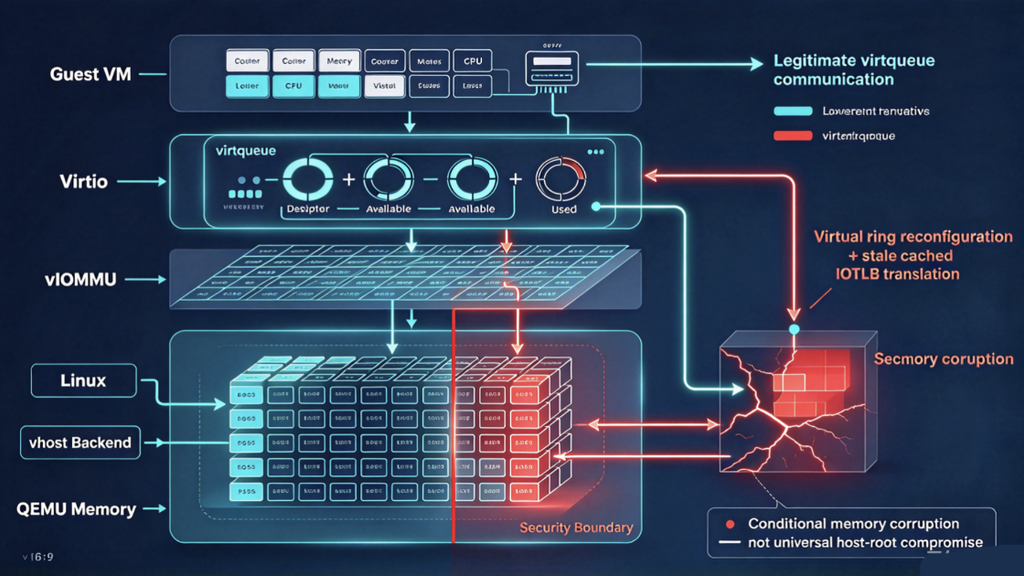
With CVE-2026-74580, the researchers demonstrated that certain guest-controlled virtio operations can cause QEMU to reconfigure a virtual ring while the host’s vhost backend retains an outdated IOTLB metadata mapping.
Ordinarily, the guest cannot directly invoke the host’s VHOST_SET_VRING_ADDR ioctl. That interface belongs to the host-side virtualization machinery. Nevertheless, virtual-device protocols provide legitimate mechanisms through which a guest can request changes in device state.
One relevant capability is VIRTIO_F_RING_RESET, which supports resetting individual virtqueues. In an affected configuration, QEMU may respond to a guest-controlled queue reset and reinitialization by updating the associated host-side vhost configuration.
If this occurs while the stale metadata cache remains populated, a subsequent virtqueue operation may use a translation associated with the previous memory mapping.
The critical security failure is that the resulting host virtual address may no longer point into the guest RAM region. Instead, it may reference another part of the QEMU process’s address space.
This matters because the vhost backend performs operations using memory mappings associated with the host’s virtual machine monitor. Guest RAM is typically backed by memory allocated within the QEMU process, but that process also contains its own internal data structures, device-management objects, and other memory regions.
A legitimate guest-originated operation should not be able to access those unrelated regions.
Vghost can violate that assumption.
Nach Angaben von Tencent Zhuque Lab’s technical analysis, the research team demonstrated an out-of-bounds write that reached the host QEMU process heap. The researchers further demonstrated corruption of QEMU control structures and manipulation of the process’s instruction pointer.
In the published experiment, the host QEMU process reached an attacker-influenced instruction-pointer value, demonstrating that the guest-controlled memory corruption had progressed beyond simply causing an invalid memory access.
This is strong evidence of a virtualization isolation failure. However, it is important to distinguish the demonstrated result from every possible downstream consequence.
The public research demonstrates QEMU memory corruption and control-flow hijacking in the tested configuration. It should not be interpreted as proof that every vulnerable guest can automatically obtain a fully privileged shell on the physical host, or that all hypervisor configurations are exploitable in the same way.
Achieving arbitrary code execution, escaping additional host process confinement, and obtaining host-level administrative privileges can involve separate security boundaries. Those steps depend on the deployment architecture, QEMU privileges, operating-system protections, and other environmental factors.
Nevertheless, gaining influence over a host virtual machine monitor’s control flow is a serious security event. Even when further privilege escalation is prevented, compromising or crashing the VMM can disrupt the protected guest and potentially expose data or resources handled by the virtualization process.
Which Virtualization Configurations Are Exposed?
The guest-triggered Vghost attack is not a universal vulnerability affecting every KVM virtual machine.
The research identifies a particular combination of virtualization features necessary for the demonstrated guest-to-host path. The virtualized device must use an affected kernel vhost backend, device-IOTLB translation must be active through a virtual IOMMU configuration, and the virtio device must enable the relevant IOMMU platform functionality. The demonstrated mechanism also relies on the guest being able to exercise the appropriate virtqueue reset behavior.
For example, a QEMU-based virtual network configuration might contain settings conceptually resembling the following:
-device intel-iommu

-device virtio-net-pci,netdev=net0,iommu_platform=on

-netdev tap,id=net0,vhost=on
These lines are configuration examples rather than a complete virtual machine launch command.
The important elements are intel-iommu, iommu_platform=on, and the kernel-backed vhost=on networking backend. Their presence is not sufficient by itself to prove exploitability, but together they identify an environment that warrants closer investigation when the host kernel lacks the fix.
The Tencent research further identifies VIRTIO_F_RING_RESET as an essential part of the demonstrated guest-triggered state transition.
Administrators should therefore avoid two opposite mistakes. The first is assuming that every guest on a Linux KVM host can exploit CVE-2026-74580. The second is assuming that virtual machines are unaffected because the vulnerability’s official scoring identifies a local attack vector.
The CVSS local attack vector reflects the underlying vhost interface and its exploitation characteristics. It does not eliminate the possibility that an attacker controlling a guest may cause the host’s virtual machine monitor to exercise the vulnerable interface on the guest’s behalf.
Die Tencent Cloud advisory documents the virtualization configuration requirements and recommends kernel updates for exposed systems. It also states that Tencent Cloud’s CVM environment was assessed as not exposed to the described VM escape configuration. That vendor-specific conclusion should not be generalized to unrelated cloud providers or privately operated virtualization clusters.
Affected Linux Kernel Versions and Fixed Releases
The Linux kernel security team identifies Linux 4.11 as the version in which the relevant vulnerable behavior was introduced. The affected code subsequently propagated through multiple kernel development and stable branches.
Determining whether a particular Linux system is vulnerable requires more than checking whether its kernel version falls into a broad historical interval. Linux distributions frequently maintain customized kernels and backport security fixes without changing the upstream version number in an obvious way.
For example, an enterprise distribution may continue using a kernel labeled 5.14 while incorporating security fixes developed for much later upstream Linux releases. Conversely, an older vendor image may remain vulnerable even when its distribution has already released a corrected package.
The following table lists the first fixed releases identified by the Linux kernel CVE team for the corresponding upstream stable branches.
| Linux Kernel Branch | First Fixed Upstream Release | Upstream Status |
|---|---|---|
| 5.10 | 5.10.265 | Fixed |
| 5.15 | 5.15.216 | Fixed |
| 6.1 | 6.1.183 | Fixed |
| 6.6 | 6.6.152 | Fixed |
| 6.12 | 6.12.104 | Fixed |
| 6.18 | 6.18.45 | Fixed |
| 7.1 | 7.1.9 | Fixed |
| 7.2 | 7.2 | Fixed |
These are upstream remediation milestones, not a universal list of minimum safe package versions for every Linux distribution.
The authoritative reference is the Linux kernel CVE announcement, which identifies the affected source file, introduction commit, and stable-branch fixes.
One important implication of this version history is that systems running enterprise-maintained kernels should be checked against their vendor’s security advisory rather than classified solely by comparing the output of uname -r with the table above.
The Linux kernel security team also discourages treating isolated commit cherry-picking as the preferred production remediation strategy. Where practical, administrators should use a complete, supported kernel release that includes the vulnerability fix and associated stability testing.
Real-World Exploitation Validation Across Linux Distributions
One reason CVE-2026-74580 deserves serious attention is that its impact has been demonstrated across several production-oriented Linux distributions rather than exclusively in a specially constructed research kernel.
Tencent’s security researchers reported successful local privilege escalation using a common x86-64 exploitation approach across five enterprise Linux environments. Their testing included Ubuntu 26.04 LTS, Red Hat Enterprise Linux 9.8, Amazon Linux 2023, Microsoft Azure Linux 3.0, and Oracle Linux 10.2.
The tested Ubuntu kernel was 7.0.0-28-generic, where access to the relevant vhost device was restricted to members of the kvm group. In that environment, the research demonstrated escalation from a group-authorized local user to root.
The tested RHEL 9.8 environment used kernel 5.14.0-687.5.3.el9_8.x86_64. The researchers reported that its /dev/vhost-vsock node was accessible to ordinary users, making the local privilege-escalation scenario particularly concerning.
The Amazon Linux environment used a 6.1-based kernel, while Azure Linux used a 6.6-based kernel and Oracle Linux used a 6.12-based kernel. The team reported successful root-level exploitation on each tested image.
These results demonstrate practical exploitability across different kernel families and vendor packaging models. They do not establish that every installation of those distributions remains vulnerable today.
That distinction is particularly important because multiple vendors had already published fixes by the time the detailed October 2026 research became public.
Die Amazon Linux security tracker, for example, lists fixes released on August 31, 2026 for affected Amazon Linux kernel packages. Oracle also published security information through its Oracle Linux errata system.
Ubuntu’s CVE-2026-74580 security tracker, last updated October 13, 2026, listed its primary Linux kernel packages for Ubuntu 24.04 LTS and 26.04 LTS as vulnerable with remediation work in progress. It also identified a fixed package for the standard Ubuntu 22.04 LTS kernel.
As of October 15, 2026, administrators should therefore check the status of the actual kernel package and distribution release installed on each host. A statement that a particular distribution is affected or patched may be misleading unless the package version and advisory date are also considered.
Why Distribution Testing Changes the Risk Assessment
Security teams often assess vulnerabilities using a combination of CVSS severity, known exploitation activity, technical complexity, and asset criticality.
In the case of Vghost, the demonstrated cross-distribution reproducibility provides useful evidence about exploitation reliability. The underlying condition is not limited to one vendor’s nonstandard code path. It originates in shared Linux kernel functionality used across multiple distributions.
The permissions of the affected vhost device are another important differentiator. A vulnerability requiring access to a device restricted to trusted virtualization administrators has a different immediate exposure profile from one reachable through a world-accessible character device.
This creates a practical priority distinction. A vulnerable host that allows low-privileged users to open /dev/vhost-vsock may warrant particularly urgent attention, even if it is not currently running guest configurations associated with the VM escape scenario.
Conversely, a dedicated virtualization host may restrict local device access appropriately but still require remediation because it runs untrusted guests under the vulnerable vIOMMU configuration.
The risk assessment must therefore consider both local device permissions and guest-to-host virtualization behavior.
CVE-2026-74580 Severity and CVSS Score Explained
CVE-2026-74580 carries a CVSS v3.1 base score of 8.8, placing it in the High severity category.
The Linux kernel CVE record uses the following vector:
CVSS:3.1/AV:L/AC:L/PR:L/UI:N/S:C/C:H/I:H/A:HThe local attack vector reflects that exploitation involves local access to the relevant vhost interface rather than a directly network-exposed service accepting malicious packets. Low attack complexity indicates that the vulnerability does not inherently depend on winning an unusually difficult race or satisfying a highly unpredictable condition.
The low privileges requirement reflects the attacker’s need for an appropriate starting level of access. Crucially, that does not necessarily mean root access. On systems exposing affected vhost devices to ordinary users, the effective access requirement can be satisfied by a low-privileged local account.
The changed-scope assessment reflects the security-boundary implications, while the confidentiality, integrity, and availability components account for the potentially serious consequences of memory access outside intended boundaries.
Different Linux vendors may assign different severity scores according to their own impact assessments. Red Hat, for example, lists a CVSS v3 score of 8.7 for its products, while Amazon Linux lists 7.8 in its advisory. These differences do not negate the underlying vulnerability or the upstream 8.8 assessment.
For incident-response and vulnerability-management purposes, the CVSS score should be treated as a starting point rather than a complete measure of business risk.
A virtualization server hosting sensitive workloads or untrusted tenants can justify faster remediation than an isolated Linux machine with the affected functionality unavailable.
Is There a Public CVE-2026-74580 Exploit?
Public proof-of-concept information is available for CVE-2026-74580.
In the October 14 disclosure, Tencent’s researchers linked to a public security research repository containing material associated with the vulnerability.
The researchers also published technical explanations and demonstrations covering local privilege escalation and the guest-triggered QEMU memory corruption scenario.
The existence of a public PoC significantly changes the defensive context. Before the detailed research was published, some administrators may have encountered CVE-2026-74580 only as a relatively obscure kernel advisory. The later publication provides additional information about the vulnerability’s exploitability and identifies practical exposure conditions.
At the same time, a public proof of concept is not the same as confirmed exploitation in the wild.
As of October 15, 2026, the reviewed official advisories and researcher disclosures do not establish a confirmed campaign of real-world attacks exploiting CVE-2026-74580. That is a statement about the available evidence, not a guarantee that exploitation has never occurred.
Security teams should separate three different levels of evidence: the existence of vulnerable code, the demonstrated ability to exploit that code in a controlled environment, and verified malicious exploitation against production systems.
For Vghost, the first two are firmly supported by public technical documentation. The third requires separate incident evidence.
Organizations should not delay patching merely because confirmed real-world exploitation has not been established. The combination of a public PoC, demonstrated privilege escalation, and sensitive virtualization attack surfaces provides sufficient justification for proactive remediation.
How to Detect CVE-2026-74580 on Linux
Determining whether a Linux host is exposed to CVE-2026-74580 should begin with a non-invasive inventory of the running kernel, relevant kernel functionality, device permissions, and installed security updates.
These checks do not exploit the vulnerability. Their purpose is to identify systems requiring closer investigation and confirm whether relevant attack surfaces are accessible.
Check the Running Linux Kernel
The first step is to identify the running kernel:
uname -rFor additional operating-system context, administrators can inspect the distribution release metadata:
cat /etc/os-releaseThe kernel version should be compared with the applicable upstream fix and the distribution vendor’s security advisory.
However, administrators must avoid assuming that every version numerically below an upstream fixed release is vulnerable. Vendor backports are common, especially in enterprise Linux environments.
For Debian-based systems, kernel package information can be collected using:
dpkg-query -W 'linux-image*' 2>/dev/nullFor RPM-based systems, a comparable inventory can be obtained with:
rpm -qa | grep '^kernel'These commands identify installed packages. They do not independently prove whether a kernel contains the Vghost fix.
An accurate determination requires checking the distribution’s security metadata, changelog, or published advisory.
Check Whether vhost Functionality Is Available
Because the vulnerability resides in the vhost subsystem, the next step is to determine whether the relevant functionality is enabled.
On distributions that expose the running kernel configuration through /boot, the following command can be used:
grep -E '^CONFIG_VHOST' "/boot/config-$(uname -r)"Some systems provide the configuration through /proc/config.gz instead:
zcat /proc/config.gz 2>/dev/null | grep -E '^CONFIG_VHOST'A configuration value of y generally means the feature was built into the kernel, while m indicates that it was configured as a loadable module.
An enabled configuration option alone does not prove that the vulnerable interface is currently reachable. It indicates that the system may support the relevant subsystem and warrants additional examination.
Administrators can also check currently loaded modules:
lsmod | grep -E '^vhost'No result from this command does not necessarily mean the feature is absent. Some kernel functionality can be built in rather than dynamically loaded, and the relevant modules may load later when virtualization services start.
Inspect vhost Device Permissions
The most useful local exposure check is often the actual permissions of vhost character devices.
The following read-only command enumerates matching device nodes and displays their permissions:
for device in /dev/vhost-*; do
    [ -e "$device" ] || continue
    stat -c '%a %U:%G %n' "$device"
done
Representative output might look like this:
660 root:kvm /dev/vhost-net
660 root:kvm /dev/vhost-vsock
These permissions indicate that access is normally restricted to the owner and group, subject to additional operating-system access controls.
A more concerning configuration would be:
666 root:kvm /dev/vhost-vsockHere, an ordinary local user may be permitted to open the device.
The practical risk still depends on the running kernel and additional confinement mechanisms, but world-accessible permissions should be treated as a strong signal for further investigation.
Administrators should inspect all exposed vhost device nodes rather than checking only /dev/vhost-net. Depending on the deployment, relevant device interfaces can include vhost-vsock, vhost-scsi, and vhost-vDPA devices.
It is also important to inspect group membership and container device assignments. A host may have appropriately restrictive filesystem permissions while granting untrusted processes access through group membership, device passthrough, or inherited open file descriptors.
Check Which Processes Are Using vhost Devices
Where available, standard Linux tools can help identify processes with relevant device files open.
Zum Beispiel:
sudo lsof /dev/vhost-net /dev/vhost-vsock 2>/dev/nullThis can reveal virtualization processes or other programs currently interacting with these interfaces.
The absence of output does not prove the system is safe. A vulnerable device may remain accessible even when it is not currently open, and some environments may require different inspection methods for device nodes created dynamically.
The purpose of this check is to improve asset understanding, not to serve as a definitive vulnerability detector.
A more reliable remediation assessment should combine the running kernel’s package identity, vendor patch status, actual device exposure, and applicable virtualization settings.
How to Check Whether a KVM Host Is Exposed to VM Escape
Assessing the VM escape scenario requires examining the virtualization configuration rather than simply inspecting the Linux kernel.
The relevant question is whether untrusted guests can influence an affected vhost backend through a virtual device operating in device-IOTLB mode.
For QEMU-based environments, administrators should determine whether the virtual machine uses a kernel-backed vhost device, whether a virtual IOMMU is configured, and whether the corresponding virtio device enables iommu_platform.
A basic inspection of running QEMU processes can begin with:
ps -eo pid,args | grep '[q]emu-system'When QEMU is launched with conventional command-line parameters, its arguments may expose configuration elements such as:
-device intel-iommu
-device virtio-net-pci,...,iommu_platform=on
-netdev tap,...,vhost=on
These parameters should be analyzed together within the configuration of the same virtual machine and device.
A match for a single parameter does not establish that the full vulnerable configuration is present. Likewise, an incomplete or transformed process command line may not expose all effective virtualization settings.
For environments managed by libvirt, administrators can inspect the managed guest definitions:
virsh list --allThe XML configuration for a selected domain can then be examined using:
virsh dumpxml <domain-name>The administrator should inspect the guest’s IOMMU definition, virtio device models, backend driver configuration, and any additional command-line arguments passed to QEMU.
Because the guest-triggered vulnerability also depends on relevant virtqueue reset behavior, a complete assessment may require confirmation of negotiated virtio features and the specific QEMU and kernel configuration in use.
Large cloud or virtualization environments should perform this assessment systematically rather than examining only a few representative guests.
Virtual machine definitions, orchestration templates, and host configuration policies often provide a more scalable starting point than manually reviewing individual processes.
Why Kernel Version Scanning Alone Is Not Enough
A common weakness in vulnerability-management programs is their reliance on simplified version comparisons.
For CVE-2026-74580, checking the upstream Linux version is useful, but it is not sufficient to establish exposure.
A Linux distribution may incorporate the upstream fix as a backported patch while retaining its existing kernel version family. In such a case, a naive scanner might classify the host as vulnerable even though the underlying defect has been corrected.
The reverse problem can also occur. A system may belong to a distribution that has published a security update, yet still be running an older kernel because the update has not been installed or the machine has not restarted.
This is particularly relevant for virtualization hosts, where administrators may defer kernel restarts to avoid interrupting running workloads.
A properly installed kernel package does not automatically mean that the running kernel contains the fix.
Security teams should therefore distinguish the installed kernel packages from the actual kernel currently executing. They should also identify whether the vendor’s remediation depends on a conventional reboot, a supported live-patching mechanism, or a specific kernel maintenance workflow.
Die Amazon Linux advisory is a useful example of why package-level information matters. It lists both conventional kernel fixes and relevant live-patching packages for supported environments.
Those remediation paths are meaningful only when evaluated against the precise package versions and active kernel state of the affected system.
How to Fix CVE-2026-74580
The definitive remediation for CVE-2026-74580 is to run a Linux kernel containing the upstream fix or an equivalent vendor backport.
The upstream correction is associated with commit:
de845981da67a6b049080c87e605130b0c30adc5
The patch can be examined directly in the Linux kernel source repository.
Conceptually, the change ensures that the metadata mapping cache is invalidated when virtual ring configuration information is replaced.
The corrected behavior includes a call to:
__vhost_vq_meta_reset(vq);By clearing stale metadata mappings during vring reconfiguration, the kernel forces subsequent accesses to go through the appropriate IOTLB validation path instead of accepting an outdated cached translation.
This correction addresses the underlying trust problem rather than simply blocking one known exploitation technique.
For most production systems, installing the supported vendor kernel update is preferable to attempting to apply an isolated source patch manually.
The update process should include an appropriate maintenance window, validation of virtualization workloads, and confirmation that the system is actually running the corrected kernel afterward.
For ordinary Ubuntu or Debian systems, this typically involves the distribution’s standard package-management workflow. For RHEL-derived systems, administrators should follow the relevant vendor security advisory and kernel package guidance. Enterprise virtualization environments may additionally need coordinated host maintenance and workload migration.
An update should not be considered complete merely because the package manager reports that a newer kernel has been installed.
Restrict Access to vhost Device Nodes
Until a kernel update can be deployed, reducing access to vhost character devices is a useful defense against the local privilege-escalation scenario.
Access should be limited to trusted virtualization processes and explicitly authorized administrative accounts. Untrusted users should not be able to open sensitive vhost interfaces merely because they have local shell access.
On systems where a trusted kvm group is used, an appropriate policy may restrict access to the owner and authorized group rather than allowing world access.
Allerdings, 0660 root:kvm should not be treated as a universal secure configuration. The group itself must be trusted, and the access model must match the deployment’s virtualization architecture.
Organizations should also inspect device access within containers. Passing host vhost device nodes into an untrusted container can extend the reachable attack surface beyond the host’s normal interactive user accounts.
It is important to recognize the limitations of permission-based mitigation. Changing a device node’s permissions does not revoke file descriptors that processes have already opened. Nor does it necessarily prevent a malicious guest from triggering a vulnerable host-side device reconfiguration indirectly through QEMU.
For these reasons, device permission restrictions should be considered temporary risk reduction rather than a complete substitute for patching.
Disable Unnecessary vhost Functionality
On Linux systems that do not require kernel-accelerated virtio device backends, disabling unused vhost functionality can further reduce exposure.
Die Red Hat advisory describes disabling the vhost module on systems where it is not required.
This mitigation must be implemented carefully because vhost acceleration may be essential to the performance or operation of existing virtual machines.
Disabling or unloading vhost modules can interfere with virtual networking, storage, and host-guest communication. In some configurations, virtual machines may fail to start or may experience significant performance changes.
Administrators should therefore verify workload dependencies before making module-level changes. On active virtualization hosts, a supported kernel update is generally the more appropriate long-term solution.
Reduce Exposure to the Guest-Triggered Path
For virtualized environments that cannot immediately deploy a corrected kernel, operators should evaluate whether affected vhost devices need to be presented behind a virtual IOMMU with iommu_platform enabled.
Removing a necessary component of the demonstrated guest-triggered configuration can reduce exposure, but such changes should not be treated as universally safe or complete without testing.
Virtual IOMMU functionality can be required by particular workloads, device models, and guest security architectures. Changing these features can affect device compatibility and performance.
Administrators should also consider that a platform-specific configuration mitigation does not repair the faulty cache invalidation in the kernel itself.
In environments hosting untrusted workloads, the safer remediation priority remains updating the host kernel to a version containing the fix.
Detection and Monitoring for Enterprise Security Teams
CVE-2026-74580 poses an operational challenge because the vulnerable behavior occurs through low-level kernel and virtualization interfaces rather than conventional network requests.
An organization cannot reliably detect this vulnerability by searching HTTP access logs for a recognizable exploit string. The relevant activity may involve local device operations, virtual ring reconfiguration, IOTLB translation behavior, and memory accesses executed by kernel-backed virtualization workers.
For the local privilege-escalation scenario, security teams should pay attention to unexpected access to vhost character devices, especially by processes that do not normally participate in virtualization management.
A low-privileged account opening /dev/vhost-vsock on a shared server may deserve investigation when that account has no legitimate virtualization responsibilities.
However, device access by itself is not evidence of an exploit. Legitimate QEMU and virtualization-management processes routinely interact with these interfaces.
The distinction between normal and suspicious behavior depends on process identity, execution context, device ownership, and the relationship between the process and the virtual machines it manages.
For the guest-triggered scenario, useful investigative signals may include unexplained crashes of QEMU processes, abnormal virtual-device reset activity, host-side memory corruption reports, and kernel warnings associated with vhost operations.
None of these indicators is unique to CVE-2026-74580. A QEMU crash can have many unrelated causes, and successful exploitation may not necessarily generate an obvious or reliable log entry.
Security teams should therefore avoid claiming that a simple log filter or process-monitoring rule can definitively detect Vghost exploitation.
A more reliable defensive strategy combines kernel patch verification, configuration inventory, controlled device access, and behavioral monitoring for unexpected virtualization process activity.
Organizations with advanced Linux tracing capabilities can investigate relevant kernel events and vhost interactions, but production instrumentation should be designed to avoid excessive performance overhead or disrupting legitimate virtual-machine workloads.
The best defensive outcome is to eliminate the vulnerable code path before exploit detection becomes necessary.
CVE-2026-74580 and Container Security
Although Vghost is most directly associated with Linux virtualization, its local privilege-escalation implications also deserve attention in containerized environments.
Containers typically share the host kernel rather than running a fully independent kernel as conventional virtual machines do. This means that a kernel vulnerability can potentially affect the security assumptions of container workloads if the relevant attack surface is accessible from inside the container.
However, CVE-2026-74580 should not automatically be described as a universal Docker or Kubernetes container escape.
The important question is whether an untrusted container can reach the affected host vhost interfaces.
A normally confined container without access to the relevant host device nodes has a different exposure profile from a privileged container or a workload that receives explicit vhost device passthrough.
Some containerized virtualization environments legitimately require access to KVM and associated virtualization devices. These deployments may include infrastructure services that launch virtual machines from containers or provide virtualized workload management.
Such configurations deserve additional scrutiny because they can blur the boundary between a container’s filesystem namespace and sensitive host device interfaces.
Container runtime policies, Linux device cgroups, mandatory access-control systems, and actual device assignments all influence reachability.
For Kubernetes operators, this means reviewing workloads that request privileged execution, host device mounts, or device-plugin access to virtualization interfaces. The presence of a privileged workload is not proof that Vghost is exploitable, but it can identify an environment where host kernel attack surfaces deserve closer review.
Restricting device passthrough is an important defense, while the kernel update remains necessary to eliminate the underlying vulnerability.
Implications for AI Sandboxes and Cloud Infrastructure
The VM escape implications of CVE-2026-74580 extend beyond conventional enterprise virtualization.
Increasingly, organizations use virtual machines and related isolation technologies to execute code generated or supplied by AI agents. Coding assistants, automated software testing systems, browser automation platforms, and AI-driven development environments may need to execute code that has not been manually reviewed.
Isolated execution environments are often used to contain the consequences of that untrusted code.
In a secure design, code running inside a sandbox should not be able to read host memory, modify the virtual machine monitor, or access unrelated workloads.
Vghost highlights why the integrity of the underlying virtualization stack matters so much for such systems.
If a sandbox uses a vulnerable host kernel and meets the specific guest-triggered configuration requirements, the security boundary may be weaker than the isolation model assumes.
This does not mean that every AI agent sandbox is vulnerable to CVE-2026-74580. Sandbox implementations vary significantly. Some rely on conventional virtual machines, others use microVMs or containers, and each architecture exposes a different set of kernel and device interfaces.
The correct conclusion is more specific: virtualization isolation must be evaluated at the implementation level, including the host kernel, device backends, memory translation mechanisms, and the configuration of guest-visible features.
Security-sensitive infrastructure should also account for the possibility that an attacker may deliberately target the isolation layer rather than the application running inside it.
This is particularly relevant to services that execute arbitrary customer code, process untrusted binaries, or provide multi-tenant computing environments.
Where untrusted code execution is a normal product feature, kernel and hypervisor patch management should be treated as a core security responsibility rather than a secondary system-administration task.
What Makes Vghost Different From Other Linux Kernel Vulnerabilities?
Linux kernel security advisories cover many different categories of defects, including use-after-free conditions, integer overflows, out-of-bounds memory accesses, authorization failures, and concurrency problems.
Vghost is distinctive because its core failure involves the relationship between state transitions and cached authorization information.
The relevant memory mapping was valid at an earlier point in time. The vulnerability emerges when the system changes the underlying configuration without invalidating the cached information used to authorize later operations.
This kind of bug can be difficult to detect because many individual functions behave correctly when viewed independently. The unsafe condition only becomes visible when multiple operations are considered as part of one stateful sequence.
From a security-engineering perspective, it demonstrates a broader principle: cache consistency is not merely a performance concern when cached values influence access-control decisions.
An authorization decision is only meaningful while the conditions supporting it remain valid.
If an address range, object ownership relationship, device configuration, or memory mapping changes, any cached decision derived from the previous state must be reconsidered.
The fact that CVE-2026-74580 affected code introduced years earlier also illustrates the importance of reviewing long-lived subsystems when their surrounding assumptions evolve.
A feature added for performance in one kernel version may interact unexpectedly with a validation change introduced years later.
This is why kernel vulnerability research cannot rely exclusively on searching for obviously dangerous library calls or isolated memory operations. Meaningful security analysis often requires understanding how multiple subsystems cooperate over time.
The Role of AI-Assisted Vulnerability Research
The discovery and validation process behind Vghost is also notable because TencentOS researchers reported using an AI-assisted security research system known as Corvus AI.
According to Tencent Zhuque Lab, the system identified the relevant vulnerability during a research workflow that involved source-code analysis and subsequent verification. The researchers also described using Tencent Hunyuan’s Hy4-preview model in the broader process of exploit validation and patch assessment.
The significance of this result is not simply that AI was involved in finding a kernel bug. The more consequential observation is that automated analysis was applied to a vulnerability whose security implications depended on relationships between separate kernel operations.
Understanding the bug required reasoning about the lifetime of cached metadata, virtual-device reconfiguration, deferred IOTLB validation, and the consequences of using a stale translation.
Those relationships are not captured by a single suspicious line of source code.
The researchers reported that their workflow progressed beyond identifying a potentially unsafe pattern and into validating the resulting security consequences across multiple Linux environments.
At the same time, one published research result should not be interpreted as proof that AI systems can independently and reliably discover arbitrary kernel vulnerabilities. The strength of the Vghost finding comes from its technical reproducibility, public kernel patch, and demonstrated security impact.
For defenders, the broader lesson is that advances in automated vulnerability research may increase the importance of rapidly converting vulnerability intelligence into production remediation.
Once an exploitable condition is publicly understood, organizations need accurate asset inventories, timely kernel updates, and clear ownership of virtualization infrastructure to reduce the window of exposure.
Frequently Asked Questions About CVE-2026-74580
Is CVE-2026-74580 a Linux zero-day vulnerability?
CVE-2026-74580 was assigned and publicly disclosed in August 2026, and upstream fixes were identified before the detailed October research became widely available. As of October 15, 2026, the reviewed sources do not establish that attackers exploited it in the wild before a fix was available. It is therefore more accurate to describe Vghost as a publicly disclosed Linux kernel vulnerability with demonstrated exploitation techniques rather than an actively exploited zero-day.
Can CVE-2026-74580 be exploited remotely?
The documented direct exploitation path requires access to affected local vhost interfaces, and its CVSS vector identifies a local attack. The guest-triggered path is different: an attacker controlling a guest may be able to cause QEMU to exercise the vulnerable host interface under specific virtualization conditions. That does not mean a remote attacker can exploit an arbitrary Linux server simply by sending a network packet.
Does CVE-2026-74580 affect all Linux servers?
No. The presence of historically affected kernel code does not mean that every system exposes an exploitable attack surface. Actual risk depends on whether the running kernel contains the fix, whether relevant vhost functionality is available, who can access affected device nodes, and whether the virtualization configuration supports the guest-triggered path. Systems without reachable affected functionality can have substantially reduced exposure.
Can CVE-2026-74580 lead to root access?
Yes. Tencent’s researchers demonstrated local privilege escalation to root across multiple Linux distributions. The documented local attack requires access to vulnerable vhost interfaces and an environment in which the relevant memory-access behavior can be exercised.
Does Vghost allow a virtual machine to escape to the host?
The researchers demonstrated a guest-triggered memory corruption path into the host QEMU process and subsequent control-flow hijacking under specific vIOMMU and virtio configurations. This establishes a meaningful VM escape vector. It does not establish automatic full host compromise for every vulnerable deployment.
Which Linux versions fix CVE-2026-74580?
The upstream Linux kernel CVE announcement identifies 5.10.265, 5.15.216, 6.1.183, 6.6.152, 6.12.104, 6.18.45, 7.1.9, and 7.2 as the first fixed releases for those branches. Distribution-maintained kernels may include backported fixes under different package version numbers, so administrators should consult the applicable vendor advisory.
Is a proof of concept available?
Yes. Public research material and a PoC repository were referenced in the October 14, 2026 oss-security disclosure. Organizations should treat the publication of practical exploit research as an additional reason to prioritize remediation, while avoiding the assumption that public PoC availability proves active malicious exploitation.
How can organizations protect their virtualization infrastructure?
The most effective protection is to install a supported kernel containing the fix and verify that it is running. Until remediation is complete, organizations should restrict access to vhost device nodes, avoid passing sensitive virtualization devices to untrusted containers, and assess whether guest configurations expose the specific vIOMMU-based attack path. These controls reduce exposure but should not replace kernel patching.
Final Assessment: Why CVE-2026-74580 Matters
CVE-2026-74580 demonstrates how an overlooked cache invalidation bug inside the Linux virtualization stack can have consequences far beyond its apparent implementation complexity.
The vulnerability originates in stale IOTLB metadata mappings maintained by the vhost subsystem. When virtual ring configurations change without invalidating those mappings, subsequent memory operations can bypass the validation expected to protect authorized memory ranges.
Public research has demonstrated two serious consequences. The first is local privilege escalation through affected vhost device interfaces, enabling low-privileged users with sufficient device access to obtain root privileges on vulnerable systems. The second is a guest-triggered memory corruption path that can cross the virtual machine boundary and affect the host QEMU process under specific virtualization configurations.
The importance of the vulnerability is reinforced by its cross-distribution reproducibility, the availability of public proof-of-concept research, and the widespread use of Linux virtualization in cloud and enterprise environments.
For defenders, the remediation strategy should be straightforward in principle: identify vulnerable running kernels, verify actual access to vhost devices, assess guest-to-host exposure where applicable, and deploy supported kernel updates containing the upstream fix.
The broader lesson is that isolation boundaries depend on far more than the existence of a hypervisor or a memory protection mechanism. They depend on the correctness of the software that translates addresses, validates access, caches metadata, and responds to changes in virtual-device state.
Vghost shows how those assumptions can fail when cached information outlives the configuration that made it trustworthy.
For organizations operating Linux virtualization infrastructure, CVE-2026-74580 should be treated as a high-priority patch-management and exposure-assessment issue, particularly wherever untrusted local users, virtualization device access, or untrusted guest workloads intersect with vulnerable host kernels.
 German
  English
  French
  Spanish
  Portuguese
  Japanese
  Korean
  Hindi
Hindi  Arabic
  Turkish
  Hebrew