
PentAGI vs Penligent is a choice about how your team wants to run and govern AI-assisted security testing. PentAGI is a serious option for teams that want to operate a self-hosted agent platform. Penligent should be evaluated against the assessment workflow and deployment commitments your organization needs. Neither “open source” nor “managed” establishes that a finding is correct.
The useful comparison follows a complete engagement: configure the environment, set boundaries, supervise execution, preserve evidence, hand results to engineers, and retest. This article is published by Penligent and reviews official documentation as of October 17, 2026. It does not claim independent comparative performance measurements.
What PentAGI currently documents
Die official PentAGI repository describes a self-hosted multi-agent system with autonomous and assistant-guided workflows, Docker-based tool execution, configurable model providers, and persistent assessment data. It also distinguishes community functionality from enterprise reporting and other additions. Describing it as a tool that simply runs unattended without operator involvement would be inaccurate.
Penligent’s current product and plan descriptions list team controls and CI/CD under Team, and on-premises deployment with a private model gateway under Enterprise. Evaluate those commitments at the plan level rather than assuming Penligent requires a single deployment model.
| Bereich | PentAGI documentation | Penligent documentation |
|---|---|---|
| Operating starting point | Self-hosted multi-agent platform | Product workflow with plan-specific deployment |
| Human involvement | Autonomous and assistant-guided modes | Human context and direction described |
| Execution and model routing | Docker tooling and configurable providers | Confirm routing for the chosen deployment |
| Reporting | Community and enterprise scope differ | PDF/Markdown reporting described |
| Organization controls | Review edition and configuration | Team/Enterprise scope differs |
The table describes public scope, not an assertion of feature parity. For either product, ask the supplier or project to demonstrate the exact workflow you need. In particular, distinguish reports available in a community deployment from deliverables offered in an enterprise package.
Self-hosting is an ownership decision
Operating your own platform can make customization and internal integration easier to control. It also gives your team responsibility for the host, dependencies, credentials, backups, upgrades, and recovery. Assign those responsibilities before the first assessment. An impressive initial deployment is difficult to sustain when nobody owns failed jobs or expiring credentials.
Prepare a deployment record with the code revision, enabled services, model endpoints, execution network, storage locations, and update policy. Keep optional integrations visible in that record. A small installation can grow into a distributed data path as observability, search, memory, or remote execution services are added.
This is why self-hosting alone should not be treated as a guarantee of private processing. Follow the data. If an external model receives tool output, the fact that the web interface runs on your server does not change that transfer. Conversely, a private deployment proposal should be judged by its actual configuration and contract, not dismissed because the supplier also offers a hosted service.
Control should be tested while something goes wrong
An operator dashboard is most useful when a run becomes uncertain. In a pilot, deliberately expire a test session or make an allowed endpoint temporarily unavailable. Observe whether the workflow recognizes the failure, preserves progress, and gives the operator enough context to recover. Do not use a real production outage for this exercise.
Also rehearse a stop request during a harmless task. Record how quickly execution stops and what happens to queued work. A visible pause button and an enforceable boundary are related but different properties. Require the demonstration to cover background tasks and any independently running tools, not just the conversation shown on screen.
Set network and credential boundaries outside the agent as well as in its instructions. For example, provide only the dedicated staging accounts and network reach required by the authorized assessment. This reduces the consequences of an incorrect action and makes the scope easier to audit. It is an evaluation principle for both candidates, not evidence of a defect in either one.
A Docker boundary does not settle the whole assessment
Containerized execution can help separate tools and package dependencies, but a deployment still needs decisions about privileges, mounted files, egress, and reachable targets. Review those settings with the people responsible for the environment. Do not use the word “sandbox” as a substitute for understanding what the execution context can access.
Keep model credentials separate from target credentials, and decide how each is rotated and revoked. Ask whether reports or transcripts can contain secrets and how redaction is handled. Verify restoration and deletion on a small synthetic project before the deployment accumulates sensitive assessment history.
Preserved output must become reviewable evidence
Persistent tool logs are useful, but they are not automatically a defensible finding. For a suspected tenant-boundary failure, a reviewer still needs the account role, object ownership, relevant request and response, expected policy, and reason the result establishes impact. Store a stable reference to that proof rather than only a conversational summary.
Have someone outside the original run reproduce one issue from the report. Time how long they need, note every missing prerequisite, and record whether the evidence survives account cleanup or an environment reset. A report that depends on an operator’s memory is fragile even when the original investigation was technically correct.
Test export against the actual recipient’s needs. A developer may need concise reproduction steps and a clear affected build; a security lead may need scope and unresolved coverage gaps; an auditor may need a durable record of authorization and review. One long transcript rarely serves all three equally well.
Separate penetration testing from campaign emulation
PentAGI’s documented capability boundaries distinguish its current pentesting workflows from a CALDERA-style breach-and-attack simulation system with predefined campaigns. That distinction matters when defining the procurement objective.
If your requirement is a repeatable adversary-emulation campaign, specify the required sequence, telemetry, and success criteria explicitly. Do not assume that an agent capable of issuing security-tool commands provides a maintained campaign library. Similarly, do not infer campaign coverage from Penligent’s general assessment description. Ask each candidate to demonstrate the actual use case.
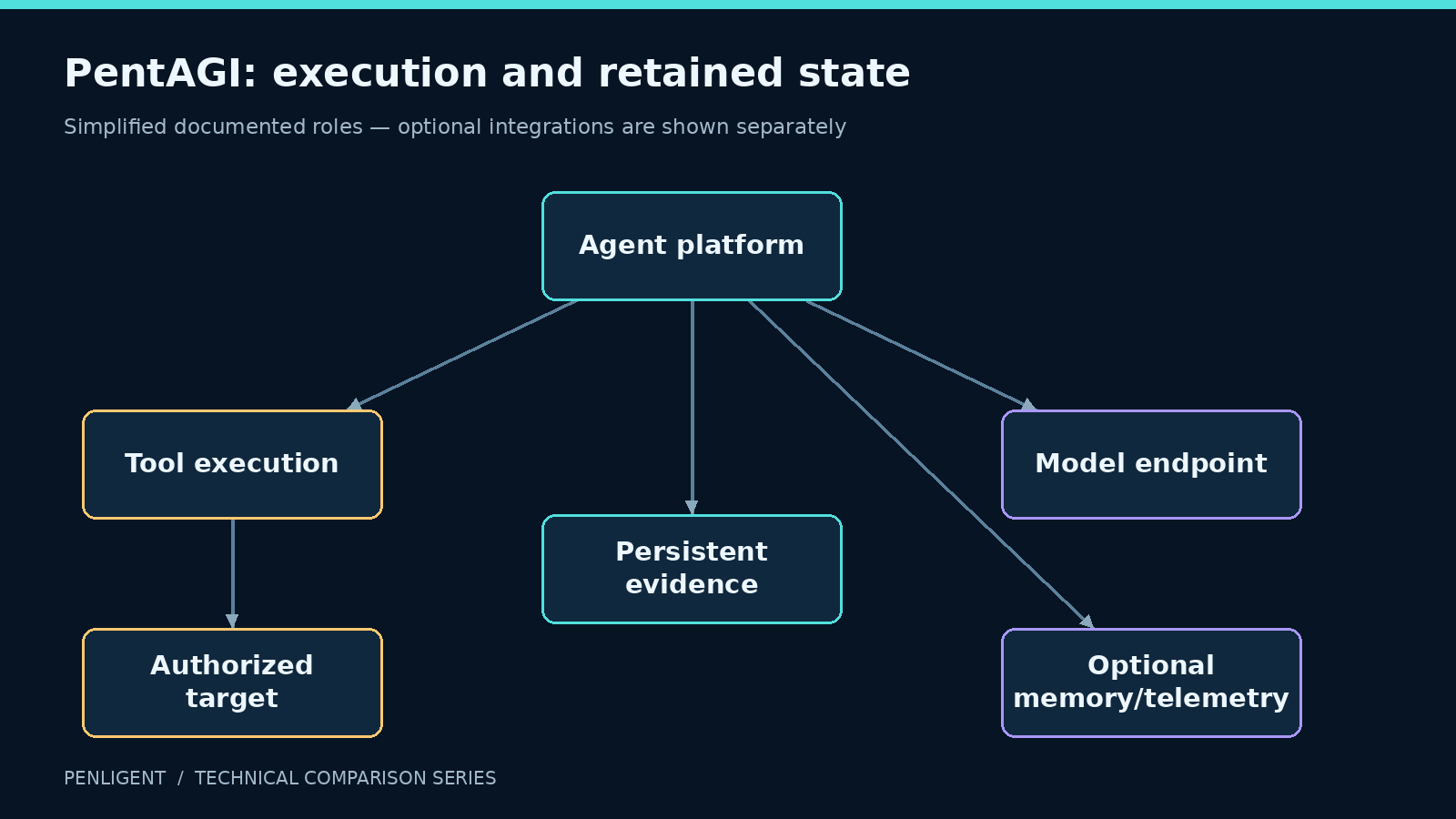
PentAGI’s persistent state is part of the security design
PentAGI’s architecture and deployment documentation describes PostgreSQL-backed command and output retention, optional graph-based memory, and observability integrations. The operational consequence is that an assessment has a life beyond the execution container. Restarting a tool environment does not necessarily remove the evidence, memory, or diagnostic records created during the run.
For a self-hosted deployment, classify the stored material before adding real targets. A command log may reveal internal hostnames or filenames; a response may contain synthetic or real account data; a memory entry may preserve a conclusion for future work. Decide which material can be reused across projects and which must remain restricted to a single engagement. Do not assume that useful persistence is automatically appropriate reuse.
Include backup and restoration in the pilot. Restore a synthetic completed assessment into an isolated environment and check whether its evidence remains associated with the correct target and role. A backup that restores database rows but loses attached artifacts may preserve a convincing report without the proof needed to review it. Record the restoration boundary and unresolved dependencies.
When assessing Penligent’s proposed deployment, ask the equivalent questions about retained evidence and project access. The comparison should follow the data through the offered architecture, not assume that persistence is inherently better or worse when operated by a vendor. The requirement is a clear, enforceable lifecycle for assessment material.
Optional agent supervision changes the configuration being compared
Execution monitoring and planning are configuration choices, not interchangeable synonyms for a human reviewer. In the current PentAGI README, monitoring is described as a beta mechanism for detecting repetitive or unproductive execution and invoking additional guidance. Treat its enabled state as an experimental condition rather than assuming every deployment uses the same behavior.
A useful pilot contains a benign dead end. For example, make an allowed documentation endpoint return a stable error and observe whether the workflow repeatedly pursues it, changes strategy, or requests help. Record the actions and resource consumption before recovery. This tests progress management without creating a dangerous failure or supplying a real exploit path.
If supervision improves a run, preserve the configuration that produced the improvement. Do not compare that run with another candidate using a different time budget or with essential context withheld. Conversely, if the added guidance consumes more resources, record that cost rather than treating every intervention as free. The buyer needs to understand the tradeoff in the intended deployment.
A human reviewer still has a different responsibility: determining whether the observed behavior establishes a vulnerability and whether the action remains within authorization. Automated recovery can help a run progress while leaving those judgments unresolved. Keep progress supervision, scope enforcement, and finding acceptance as separate evaluation questions.
Tool breadth does not define the reachable assessment surface
A container with familiar security utilities can be valuable, but a tool inventory says little about which application states are reachable. Browser access, credentials, network routes, and supplied business context determine the actual assessment surface. Evaluate those prerequisites before interpreting a missed issue as a reasoning failure.
Take a hypothetical internal application reachable only through a staging network. A tool may run successfully while testing only the login page because the protected route is inaccessible. Another may reach the API but use the wrong tenant identity. Preserve a coverage record that identifies what was actually reached, with evidence of role and state. A broad list of attempted commands is not an equivalent record.
For a platform that can select different execution images or tools, record the image and relevant configuration used for each run. Changes to those components can affect behavior independently of the model. A stable evaluation keeps those variables fixed until there is a specific reason to change them, then records the new condition separately.
Do not reward an agent for aggressive exploration outside the permitted target. A useful result stays within scope and reports a boundary it cannot cross. The comparison should value an accurate statement of incomplete coverage over a larger activity count that cannot be connected to the authorized objective.
Observability and finding evidence serve different readers
System metrics can explain why a run is slow, traces can explain where a request failed, and model traces can help investigate a reasoning loop. A finding report serves another purpose: proving the security consequence to someone responsible for a fix. Keep these artifacts connected without confusing their roles.
For one synthetic finding, ask an operator to locate its execution evidence from the report, then locate the associated operational trace. Time both tasks. The first measures reviewability; the second measures supportability. A platform may be strong at one and awkward at the other. Record that distinction instead of collapsing both into an “observability” checkbox.
Diagnostic access can also be broader than report access. A support dashboard might expose prompts or response fragments that the final report redacts. Review access to the diagnostic system under the actual deployment, including any optional integrations. Redacting a PDF does not remove sensitive content from upstream stores.
For a vendor-operated proposal, request a description of who can access diagnostic material and how support access is approved and logged. For a self-hosted proposal, assign the same responsibility internally. The hosting model changes the organization holding that responsibility, but it does not eliminate it.
Make report acceptance independent of export format
The current PentAGI documentation explicitly describes web, clipboard, Markdown, and PDF report paths while withholding a claim of supported JSON flow-report export. That is a useful boundary for integration planning. Do not assume a documented general API also guarantees a particular report-export schema.
A PDF is useful for a stable delivery, while Markdown can be easier to review and adapt. Neither format establishes that the underlying result is correct. Test the content: scope, tested build, affected role, proof, impact, reproduction, remediation, and unresolved limitations. A format conversion should preserve those relationships rather than flattening the evidence into a long narrative.
If the team needs to create issue-tracker records, define the required fields independently of the report format. Then demonstrate the supported integration or document the manual transformation. Include attachment handling, redaction, stable identifiers, and retest association. This is more useful than treating an API as a promise of effortless integration.
| Artifact | Primary reader | Acceptance question |
|---|---|---|
| Execution log | Assessment operator | Can the action and result be reconstructed? |
| Operational trace | Platform owner | Can a failure be located and recovered? |
| Finding report | Remediation engineer | Can the impact be reproduced and assigned? |
| Retest record | Security reviewer | Was the same condition reached and checked? |
| Closeout record | Engagement owner | Are retained evidence and revoked access accounted for? |
A self-hosted pilot needs an exit exercise
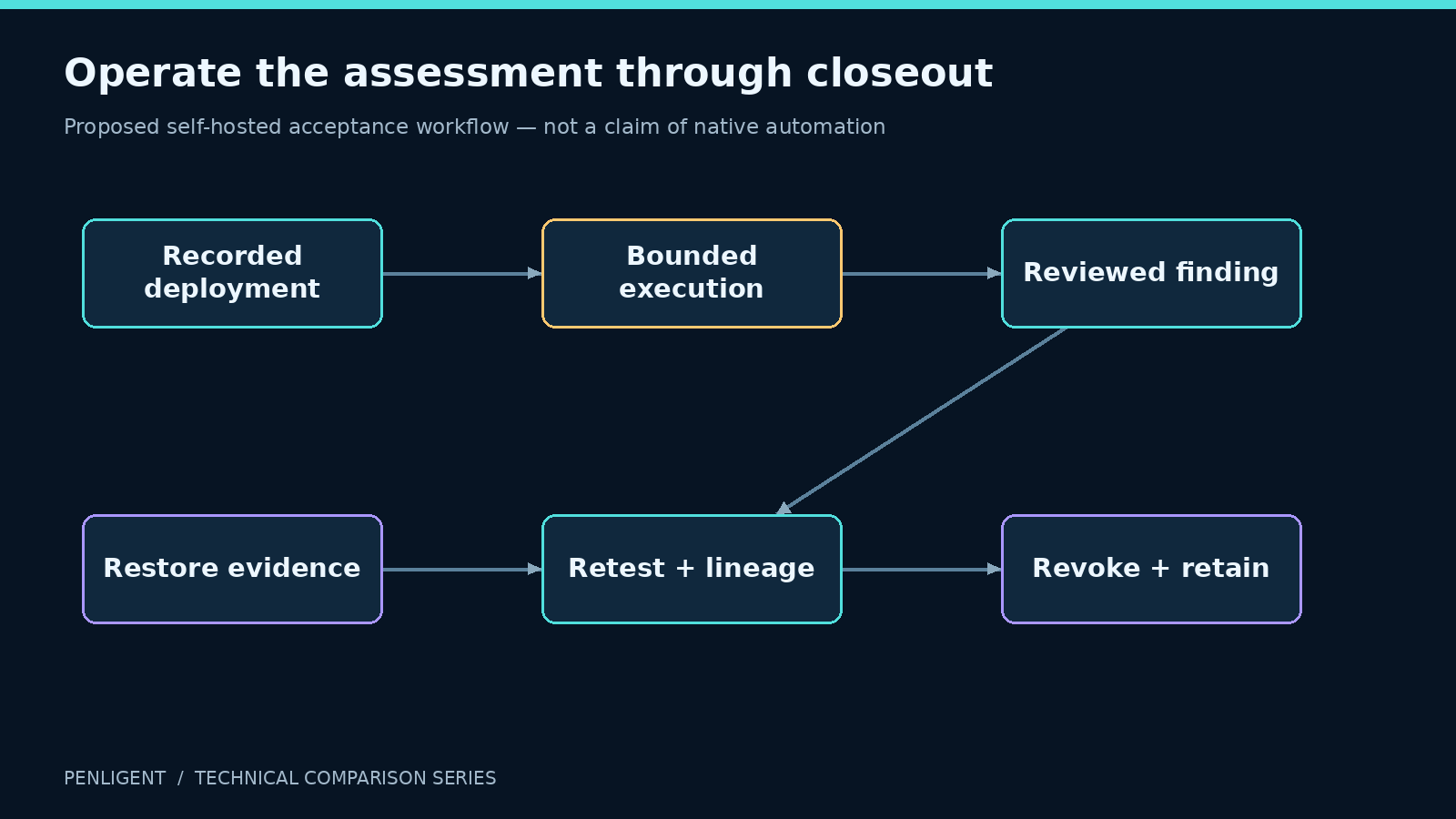
Before expanding the deployment, test how the organization would stop using it. Export a synthetic completed assessment, revoke target credentials, remove a platform user, and verify the expected retention and deletion behavior. Check backups and optional integrations separately. This reveals ownership gaps that a successful installation will not show.
Write down which artifacts must remain for legitimate review and which should be removed. A report may need to survive while temporary browser state and execution credentials should not. Keep the policy specific enough that an operator can apply it without deciding the retention rule anew for every run.
For an enterprise agreement, carry those requirements into the deployment and support discussion. A private deployment may satisfy network constraints while still needing an agreed update and recovery process. A community deployment may offer flexibility while leaving those procedures entirely with the customer. The comparison is strongest when it makes that division explicit.
Finally, run a small upgrade and rollback exercise using only synthetic data. Confirm that the chosen evidence remains readable and associated with the right project. Count the operator time and unresolved compatibility issues. The sustainable choice is a platform the team can maintain throughout its lifecycle, including the point at which it must recover, migrate, or retire it.
Memory reuse needs a project boundary
A successful technique from one assessment may be useful in another, but the evidence supporting it can contain target-specific information. Separate reusable methodology from credentials, customer data, and conclusions that depend on an earlier environment. Persistent memory should not make a later report appear to have observed a condition that was only present in a previous project.
Use two synthetic projects to evaluate the intended boundary. Give each a distinct tenant and a different expected access rule. Ask the operator to show which context belongs to the active project, then review whether the resulting evidence refers only to that project’s accounts and state. This is an acceptance exercise, not a claim about a confirmed cross-project defect.
If the deployment deliberately shares knowledge, document what is shared and who may approve it. A reusable testing note may be appropriate where raw responses are not. Check deletion against the actual stores involved so removing a visible project does not become an unsupported assumption about all derived records.
The same principle applies when retaining prior Penligent assessment material. Ask how the proposed deployment separates projects and how a reviewer can distinguish fresh observations from earlier context. The hosting model should not determine the standard of proof for a new finding.
Choose the responsibility model you can sustain
PentAGI merits a trial when your team wants to operate and adapt the platform and can maintain its surrounding services. Penligent merits a trial when its offered assessment and organizational workflow match your requirements. A private-deployment requirement should trigger a configuration discussion with either route, rather than an automatic conclusion based on product labels.
Use a short authorized engagement as the deciding exercise. Include an authenticated task, an interruption, an independently reviewed finding, and a retest. Record both security outcomes and the work needed to keep the system running. The right platform is the one your team can govern while still producing evidence that engineers can act on.

 German
  English
  French
  Spanish
  Portuguese
  Japanese
  Korean
  Hindi
Hindi  Arabic
  Turkish
  Hebrew