
CVE-2026-1731 is exactly the kind of vulnerability that turns that mental model into an incident. The NVD and CVE record describe a critical pre-authentication remote code execution condition: an unauthenticated attacker can send specially crafted requests and execute operating system commands in the context of the product’s “site user.” (NVD)
BeyondTrust’s own advisory (BT26-02) adds the piece defenders actually need: a clear vendor timeline, confirmation that exploitation attempts were observed, and the reality that patch outcomes differ between cloud-managed and self-hosted deployments depending on update service configuration. (BeyondTrust)
And the strongest operational signal for blue teams: CVE-2026-1731 is listed in CISA’s Known Exploited Vulnerabilities (KEV) Catalog, meaning there is evidence of active exploitation. (CISA)
If you operate BeyondTrust Remote Support / Privileged Remote Access (or you inherit it through an acquisition, a managed service, or a “temporary” vendor arrangement), treat this as a “prove you’re not exposed” event, not a “we’ll patch in the next window” task.
Why this one pulls clicks: the CTR phrases defenders keep responding to
You asked for the highest-click phrases around this topic. We can’t directly read Google Search Console CTR for the whole internet, but we kann do something close enough for editorial strategy: look at what the highest-signal publishers and threat intel vendors converge on for headlines and ledes—because that convergence is a proxy for what readers actually click and share.
Across BleepingComputer, Rapid7, GreyNoise, Arctic Wolf, and mainstream security press, the same “click magnets” repeat:
- “critical” / “CVSS 9.9” (severity anchor) (Schnell7)
- “pre-auth” / “unauthenticated” (no-credentials panic factor) (NVD)
- “remote support” / “appliance” / “internet-exposed” (everyone recognizes the blast radius) (BleepingComputer)
- “actively exploited” / “KEV” / “patch now” (operational urgency, not theory) (CISA)
- “PoC released → scanning within 24 hours” (the pattern defenders have learned to fear) (GreyNoise)
That’s why this article leans into those terms in a factual way, without sensationalism: they map to what a real on-call engineer needs to decide in the first 30 minutes.
What CVE-2026-1731 actually is: a command injection path to pre-auth RCE
The most defensible baseline is simple and boring—because it comes from the canonical records:
- Product scope: BeyondTrust Remote Support (RS) and certain older versions of Privileged Remote Access (PRA). (NVD)
- Vulnerability class: OS command injection leading to OS command execution (“RCE” in effect). (NVD)
- Attack precondition: No authentication; crafted requests are enough. (NVD)
- Auswirkungen: command execution in the context of the product’s site user; from there, defenders should assume typical post-exploitation: persistence, credential theft, lateral movement. (CVE)
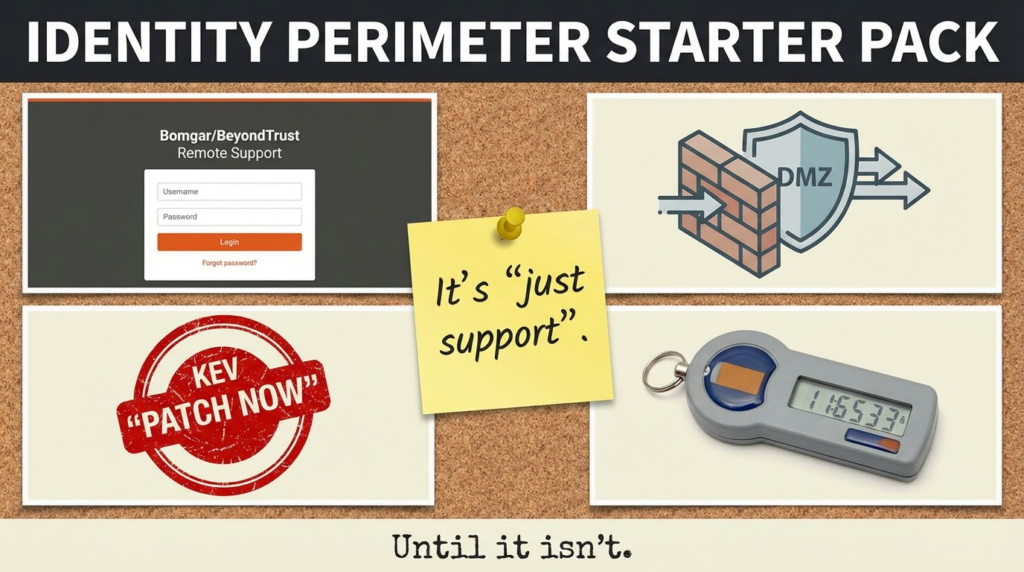
The key takeaway isn’t the CWE label; it’s the operational geometry: a remote support gateway is often placed where it can “see” both the internet and privileged internal surfaces. That makes “pre-auth RCE” qualitatively worse here than it would be on an internal-only service.
“Bomgar” matters because environments don’t rename their assumptions
BeyondTrust has an official “Bomgar is now BeyondTrust” brand page, and they still use phrasing like “BeyondTrust Remote Support (formerly Bomgar)” across materials. (BeyondTrust)
In real environments, you’ll see:
- DNS names and certificates that still include bomgar.
- Runbooks titled “Bomgar maintenance.”
- Firewall objects named “BOMGAR-RS.”
- SIEM parsers that tag logs as Bomgar.
That’s why your keyword CVE-2026-1731 bomgar is not just SEO—it’s how incident responders actually find the right thing at 2 a.m.
Vendor timeline: what BeyondTrust confirmed vs what you must verify yourself
BeyondTrust’s BT26-02 advisory includes a concrete timeline that matters for incident response scoping—especially if you’re trying to answer: “Were we exposed during an exploitation window?” (BeyondTrust)
From the vendor’s stated milestones:
- Late January detection of anomalous activity on a single Remote Support appliance, followed by researcher validation, triage, root cause work, and patch development. (BeyondTrust)
- Feb 6, 2026: advisory and CVE publication; email notification to self-hosted customers not already patched. (BeyondTrust)
- Feb 10, 2026: exploitation attempt observed; additional notification sent. (BeyondTrust)
Two implications follow:
- “We’re cloud-hosted” is not a full answer—your specific update service state still matters. Some deployments are automatically updated, others require manual action. (BeyondTrust)
- If your instance was internet-exposed in the days after disclosure, you should treat it like the classic pattern: PoC appears, scanning spikes, opportunistic exploitation follows. GreyNoise explicitly describes reconnaissance after PoC posting. (GreyNoise)
KEV changes your playbook: this is no longer “patch when convenient”
CISA’s KEV catalog listing is the strongest public signal you can point to when you need emergency change approval. (CISA)
In practical terms, KEV inclusion means:
- You should assume active adversaries are using automation to find exposed RS/PRA systems.
- “We have no evidence of compromise” is not a reason to delay—evidence often arrives after the attacker has moved on.
- Die richtige Frage lautet: Can we produce proof of remediation and proof of non-compromise?
This guide is built around producing that proof.
Exposure first: find every RS/PRA instance you own, plus the ones you forgot you own
A surprising number of incidents happen because the team patches the “main” appliance but misses:
- an old DR instance,
- a staging environment promoted to production during an outage,
- a regional instance owned by IT support,
- a vendor-managed instance attached to your identity environment.
Start with two inventories: inside-out und outside-in.
Inside-out inventory (CMDB, DNS, certificates, EDR)
Look for strings: bomgar, beyondtrust, remote support, PRA, privileged remote access.
Pull certificate transparency and internal CA logs if you can; “bomgar” in CN/SAN is common in older deployments.
Outside-in inventory (internet exposure)
GreyNoise and other observers have discussed scanning/recon behavior after PoC release; you should assume opportunistic scanners are doing the same to you. (GreyNoise)
At minimum, list every public IP and check:
- which hosts answer on 443/8443/other RS-related listener ports in your environment,
- whether those listeners correspond to RS/PRA.
Defensive-only validation script (no exploitation): enumerate candidate hosts, capture TLS subject/issuer, HTTP headers, and landing page fingerprints for analyst review.
#!/usr/bin/env bash
# beyondtrust_rs_inventory.sh
# Defensive inventory helper: collects TLS + HTTP fingerprints for review.
# Does NOT attempt exploitation.

set -euo pipefail

INPUT="${1:-targets.txt}"
OUTDIR="${2:-bt_rs_inventory_$(date +%Y%m%d_%H%M%S)}"
mkdir -p "$OUTDIR"

while read -r host; do
  [[ -z "$host" ]] && continue
  safe="$(echo "$host" | tr '/:' '__')"
  echo "[*] $host"

  # TLS certificate details
  echo | openssl s_client -servername "$host" -connect "$host:443" 2>/dev/null \\
    | openssl x509 -noout -subject -issuer -dates > "$OUTDIR/${safe}_tls.txt" || true

  # HTTP headers + small body snippet
  curl -k -sS -D "$OUTDIR/${safe}_headers.txt" "<https://$>{host}/" \\
    -o "$OUTDIR/${safe}_body.html" --max-time 10 || true

  # Hash body snippet for dedupe
  if [[ -f "$OUTDIR/${safe}_body.html" ]]; then
    shasum -a 256 "$OUTDIR/${safe}_body.html" > "$OUTDIR/${safe}_body.sha256" || true
  fi
done < "$INPUT"

echo "[+] Results in: $OUTDIR"
This kind of artifact is what you attach to a change ticket or an incident record: it proves you enumerated exposure, and it gives responders something to diff later.
Patch reality: “updated” is not the same as “not vulnerable”
Multiple sources agree on the high-level affected range (RS and PRA versions up to specific releases), but the vendor advisory is still your primary authority for patch mechanics and what “patched” means for your deployment type. (BeyondTrust)
Here’s a practical matrix you can paste into a ticket.
| Deployment type | What you should verify | Action you can prove |
|---|---|---|
| Cloud / vendor-managed | Was the instance automatically patched by BeyondTrust update service? | Export system status/version screenshot + advisory reference |
| Self-hosted with update service enabled | Did the update service apply the BT26-02 update? | Confirm installed build + update logs + reboot/maintenance record |
| Self-hosted without automatic updates | Are you still on an affected version? Was patch manually applied? | Change record + package hash + version check output |
| Legacy versions outside direct patch path | Are you on versions that must upgrade before patch? | Upgrade plan + evidence of migration completion |
Vendor guidance around “automatic update service enabled” vs manual patching is called out in reporting and advisories, and it’s the line auditors will ask you about. (Arctic Wolf)
If you want something more defensible than “the UI says we’re updated,” pull a version/build artifact in a repeatable way.
Example evidence capture (defensive):
#!/usr/bin/env bash
# capture_bt_evidence.sh
# Store basic evidence files for IR: system time, network listeners, running processes, config inventory paths (no secrets).
set -euo pipefail

OUT="bt_evidence_$(hostname)_$(date +%Y%m%d_%H%M%S)"
mkdir -p "$OUT"

date -Is > "$OUT/time.txt"
uname -a > "$OUT/uname.txt" 2>/dev/null || true
whoami > "$OUT/user.txt" 2>/dev/null || true

ss -lntup > "$OUT/listeners.txt" 2>/dev/null || netstat -an > "$OUT/listeners.txt" || true
ps auxww > "$OUT/processes.txt" 2>/dev/null || true

# If you have documented safe paths for logs/configs, copy file lists (not contents) for chain-of-custody.
# Adjust these paths to your environment documentation.
find /var/log -maxdepth 2 -type f -printf "%TY-%Tm-%Td %TT %p\\n" 2>/dev/null | head -n 2000 > "$OUT/log_index_sample.txt" || true

tar -czf "${OUT}.tar.gz" "$OUT"
echo "[+] Wrote ${OUT}.tar.gz"
This is the kind of disciplined, non-invasive collection that helps you later—without crossing into “how to exploit it.”
Hunting: what to look for if your appliance was internet-exposed during the window
Once KEV is involved, “patch and move on” is insufficient. (CISA)
You need a compromise assessment that matches how these systems get abused in the wild: web requests → command execution → process spawn → outbound C2 → credential access.
Threat intel vendors observed or discussed suspicious activity tied to exploitation attempts and PoC-triggered interest; use that as a forcing function to hunt systematically. (Arctic Wolf)
Practical hunt hypotheses
- Unusual POST/WS traffic to RS/PRA endpoints, especially new user agents, high error rates, or bursts from single IPs.
- Process tree anomalies on the appliance: web service spawning shell utilities, scripting engines, or network tools.
- New scheduled tasks/cron entries or persistence artifacts.
- Outbound connections from the appliance to rare destinations shortly after suspicious inbound bursts.
SIEM starter queries (generic)
You will need to adapt to your log schema. The point is to create a reproducible hunt pack you can hand to the SOC.
Splunk (example):
index=proxy OR index=web
( host="*beyondtrust*" OR host="*bomgar*" OR url="*beyondtrust*" OR url="*bomgar*" )
| stats count dc(src_ip) as uniq_src values(user_agent) as uas by host, url, method, status
| sort -count
Microsoft Sentinel / KQL (example):
let suspiciousHosts = dynamic(["bomgar","beyondtrust","remotesupport"]);
union CommonSecurityLog, AzureDiagnostics
| where tostring(Computer) has_any (suspiciousHosts) or tostring(DeviceName) has_any (suspiciousHosts)
| summarize Count=count(), SrcIPs=dcount(SourceIP), UAs=make_set(UserAgent, 50) by Computer, RequestURL, Method, ResponseCode
| order by Count desc
Elastic (KQL-like, conceptual):
(host.name : *bomgar* or host.name : *beyondtrust*) and
(http.request.method : "POST" or url.path : *ws* or url.path : *websocket*)
These are deliberately non-specific: you should anchor them to Ihr RS/PRA request paths and log fields.
The uncomfortable but correct posture: if it was exposed, assume compromise until disproven
A lot of incident writeups fail because teams treat “exploitation attempt observed” as “someone else’s problem.” The vendor timeline includes exploitation attempts after disclosure. (BeyondTrust)
GreyNoise describes reconnaissance behavior quickly following PoC publication. (GreyNoise)
Arctic Wolf discusses observing malicious activity tied to suspected exploitation against self-hosted deployments. (Arctic Wolf)
Those three facts together support a conservative stance:
If your self-hosted RS/PRA was internet-reachable during the disclosure-to-patch window, the right workflow is:
- patch/mitigate immediately,
- rotate credentials and keys that could be exposed through appliance compromise,
- run a forensic triage on the appliance and adjacent identity infrastructure,
- check for downstream access patterns (VPN, SSO, PAM, directory services, privileged sessions).
This is where many orgs get burned: they patch the gateway but forget that the gateway is a bridge.
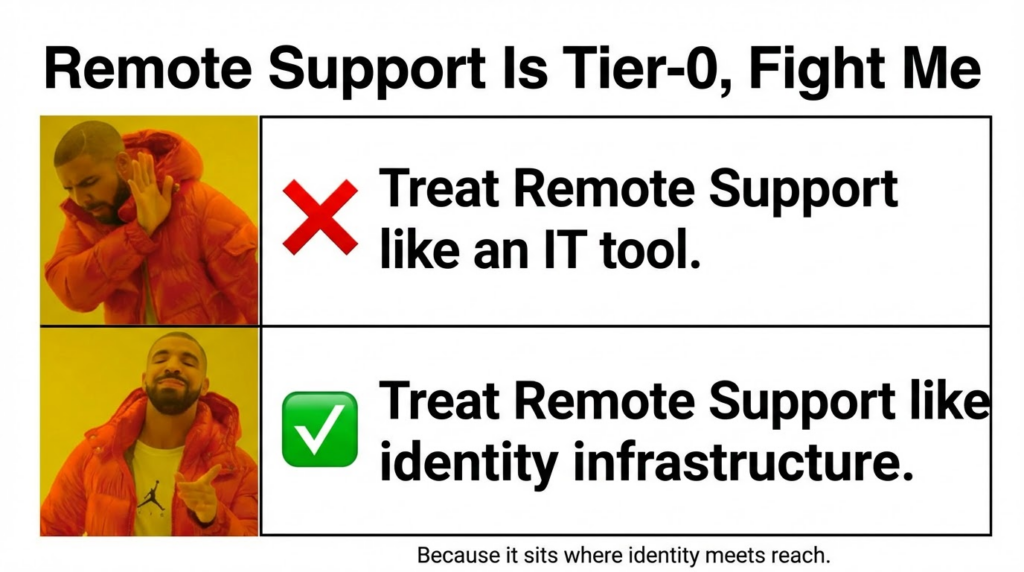
Hardening: treat Remote Support like a Tier-0 identity system, not an IT convenience tool
One of the most useful reframes from the coverage ecosystem is: this class of product behaves less like “a support tool” and more like “an internet-facing identity service.” That’s not marketing; it’s topology. (Schnell7)
A defensible hardening baseline looks like this:
- Remove direct internet exposure where possible. Put it behind a VPN, a ZTNA broker, or at least strict source IP allowlists.
- Separate admin plane from user plane. Admin UI should not be reachable from the same exposure path as end-user remote support entry.
- Require strong auth for administrators (phishing-resistant MFA).
- Network segmentation: the appliance should not have broad east-west reach; make it request-only to the minimum internal services required.
- Egress control: block outbound internet except to known update services and required destinations; log all allowed egress.
- Continuous validation: don’t just “patch”—verify build, verify configuration, verify observed traffic returns to baseline.
Related CVEs you should understand if you want the full picture
When a vulnerability hits a remote support appliance, defenders immediately ask: “Is this similar to prior BeyondTrust incidents?” That question matters because attackers reuse playbooks, and defenders reuse mitigations.
GreyNoise and security press discuss the relationship of CVE-2026-1731 to prior BeyondTrust vulnerabilities, including references to CVE-2024-12356 in the context of the same endpoint class and historical exploitation narratives. (GreyNoise)
This is not about mixing stories; it’s about learning the defensive lesson: patches that touch exposed gateway endpoints must be validated deeply, and you should monitor for follow-on variants.
If you run security like a business, the output you need is not “we patched.” It’s:
- evidence that the vulnerable surface is not reachable,
- evidence that the correct builds are installed,
- evidence that compromise is unlikely (or, if likely, evidence that you contained it).
That’s exactly where an AI-driven penetration testing and validation workflow can help—ohne turning into exploit content. In practice, you can use Penligent-style automation to (1) inventory external attack surface, (2) run safe verification checks (headers, versions, exposure paths, auth boundaries), and (3) produce an evidence-first report your SOC and auditors can accept. The goal is to compress the time between “advisory dropped” and “we can prove we’re safe.”
In incident mode, the highest leverage move is often not a single test—it’s an orchestrated sequence: enumerate assets → confirm exposure → validate patch line → hunt logs for anomalous traffic → document everything. A platform approach makes that repeatable across regions and business units, which is the difference between one team being safe and the enterprise being safe.
Referenzen
- NVD — CVE-2026-1731: https://nvd.nist.gov/vuln/detail/CVE-2026-1731 (NVD)
- CVE.org — CVE-2026-1731 record: https://www.cve.org/CVERecord?id=CVE-2026-1731 (CVE)
- BeyondTrust advisory BT26-02: https://www.beyondtrust.com/trust-center/security-advisories/bt26-02 (BeyondTrust)
- “Bomgar is Now BeyondTrust”: https://www.beyondtrust.com/brand/bomgar (BeyondTrust)
- CISA Known Exploited Vulnerabilities (KEV) catalog: https://www.cisa.gov/known-exploited-vulnerabilities-catalog (CISA)
- Rapid7 analysis (ETR): https://www.rapid7.com/blog/post/etr-cve-2026-1731-critical-unauthenticated-remote-code-execution-rce-beyondtrust-remote-support-rs-privileged-remote-access-pra/ (Schnell7)
- GreyNoise: “Reconnaissance has begun…” https://www.greynoise.io/blog/reconnaissance-beyondtrust-rce-cve-2026-1731 (GreyNoise)
- Arctic Wolf update: https://arcticwolf.com/resources/blog/update-arctic-wolf-observes-threat-campaign-targeting-beyondtrust-remote-support-following-cve-2026-1731-poc-availability/ (Arctic Wolf)
- BleepingComputer coverage (patch/exploitation): https://www.bleepingcomputer.com/news/security/critical-beyondtrust-rce-flaw-now-exploited-in-attacks-patch-now/ (BleepingComputer)
- https://www.penligent.ai/hackinglabs/cve-2026-1731-beyondtrust-when-remote-support-behaves-like-an-internet-facing-identity-system/ (Sträflich)
- https://www.penligent.ai/hackinglabs/cve-2026-1731-the-beyondtrust-rs-pra-pre-auth-rce-you-must-triage-like-an-internet-exposed-identity-system/ (Sträflich)
 German
  English
  French
  Spanish
  Portuguese
  Japanese
  Korean
  Hindi
Hindi  Arabic
  Turkish
  Hebrew