
CVE-2026-43456 is a type confusion vulnerability in the Linux kernel bonding driver. The defect appears when a bond directly inherits packet-header callbacks from a non-Ethernet slave device, such as a GRE tunnel, and later invokes those callbacks with the bond device as their context. The callback is valid, but the object passed to it is not the object type the callback expects.
That distinction matters. A GRE header function expects netdev_priv(dev) to return tunnel-specific private data. When the same function receives a bond device, netdev_priv(dev) instead returns a struct bonding. The function then reads or modifies bond-private memory as though it were a tunnel object. The resulting incompatible-type access can corrupt packet metadata, produce an invalid memory operation, and crash the kernel.
The public Linux record demonstrates a kernel BUG involving ipgre_header(), packet_sendmsg()und pskb_expand_head(). Independent researchers subsequently showed that the same primitive could be developed into local privilege escalation in a Google kernelCTF target. Their work was manually accepted as exploiting the claimed vulnerability. This elevates CVE-2026-43456 beyond a theoretical type mismatch or an availability-only bug, while still leaving important limits around prerequisites, kernel configuration, distribution backports, and exploit portability. (nvd.nist.gov)
CVE-2026-43456 is not a conventional remote vulnerability. An unauthenticated attacker cannot normally compromise a Linux server merely by sending a GRE packet over the Internet. The published trigger requires the ability to create and configure virtual network interfaces, represented by CAP_NET_ADMIN in the relevant network namespace. On systems that permit unprivileged user namespaces, however, an ordinary local process may be able to obtain capabilities inside a newly created user namespace and use them over a network namespace owned by that user namespace. The process remains unprivileged in the parent namespace, but it still interacts with the same host kernel. (脆弱性診断(セキュリティ診断)のGMOサイバーセキュリティ byイエラエ)
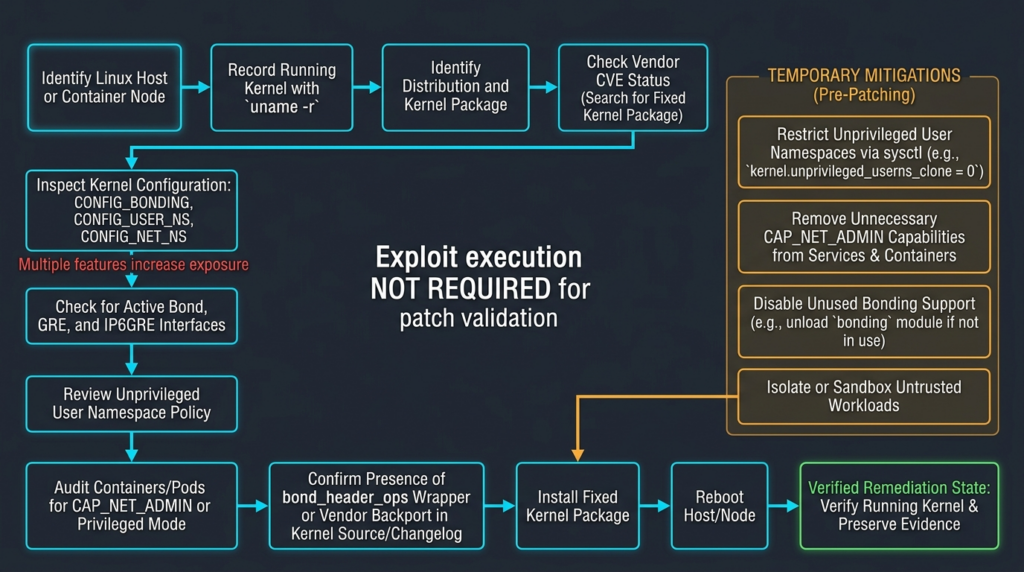
For defenders, the correct response is not to run a public exploit against every server. The reliable approach is to establish the running kernel, identify the vendor package and backport status, examine whether bonding and namespace features are reachable, install the vendor’s fixed kernel, reboot into it, and retain evidence that the patched kernel is actually running.
CVE-2026-43456 at a glance
| Feld | Practical meaning |
|---|---|
| Schwachstelle | CVE-2026-43456 |
| Affected subsystem | Linux net/bonding |
| Grundlegende Ursache | A bond copied a slave device’s header_ops and invoked those callbacks with the bond device |
| Klasse der Anfälligkeit | Type confusion caused by incompatible private device layouts |
| Directly demonstrated failure | Kernel BUG, invalid memory operation, and denial of service |
| Higher demonstrated impact | Local privilege escalation in a controlled Google kernelCTF target |
| Main prerequisite | Local ability to configure the required network devices, including CAP_NET_ADMIN in the relevant namespace |
| Remote exposure | Not a normal unauthenticated remote-packet vulnerability |
| Introducing commit | 1284cd3a2b740d0118458d2ea470a1e5bc19b187 |
| Main upstream fix | 950803f7254721c1c15858fbbfae3deaaeeecb11 |
| Upstream affected baseline | Linux 2.6.24 and later affected branches until their respective fixes |
| Fixed stable versions recorded upstream | 6.12.78, 6.18.19, and 6.19.9 |
| Mainline fix point | Linux 7.0 includes the original fix |
| kernel.org CNA score | CVSS 3.1 score 7.8, High |
| Primary remediation | Install a vendor kernel containing the fix and boot into it |
| Temporary exposure reduction | Restrict unprivileged user namespaces, remove unnecessary CAP_NET_ADMIN, or disable bonding when operationally safe |
The NVD record identifies Linux 2.6.24 as the beginning of the affected semantic version range. It records 6.12.78, 6.18.19, 6.19.9, and 7.0 as unaffected fix points for their corresponding upstream lines. It also lists four stable-tree patch commits because the same logical repair was applied to multiple maintained branches. Those numbers are useful for upstream kernels, but they are not sufficient to assess a distribution kernel. Vendors frequently backport security fixes while retaining an older-looking release number. (nvd.nist.gov)
Why Linux bonding creates a difficult object boundary
Linux bonding combines multiple lower-level network interfaces into one logical interface. Depending on the configured mode, the bond may provide active-passive failover, load distribution, or link monitoring. The kernel documentation describes the result as a single logical bonded interface whose behavior depends on its mode and whose lower-level members provide the actual links. Most major distributions make the bonding driver available as a kernel module, and modern configurations generally use iproute2 or sysfs rather than the obsolete ifenslave workflow. (docs.kernel.org)
A simplified relationship looks like this:
Application or socket operation
            |
            v
       bond device
            |
      active slave
            |
      GRE, IP6GRE, IPoIB,
      Ethernet, or another
      lower-level device
Every Linux network interface is represented by a struct net_device. That common object carries interface state, addresses, feature flags, callbacks, queue information, and other fields that generic networking code needs.
Drivers also need private state that generic code does not understand. A bond needs information about its active slave, member interfaces, monitoring state, mode, and failover behavior. A GRE tunnel needs tunnel addresses, encapsulation settings, keys, header lengths, and routing-related state. The kernel allocates driver-specific private storage adjacent to or associated with the net_device, and the driver accesses it through netdev_priv().
Conceptually:
struct net_device *dev = ...;
struct bonding *bond = netdev_priv(dev);
is correct only when dev is a bond device. Likewise:
struct ip_tunnel *tunnel = netdev_priv(dev);
is correct only when dev is a device whose private allocation really contains a struct ip_tunnel.
The compiler cannot automatically prove that the runtime dev matches the private type chosen by the callback. The safety contract is maintained by the networking subsystem’s object relationships and by calling each driver callback with the device that owns the expected private data.
CVE-2026-43456 broke that contract.
The vulnerable design copied behavior without preserving context
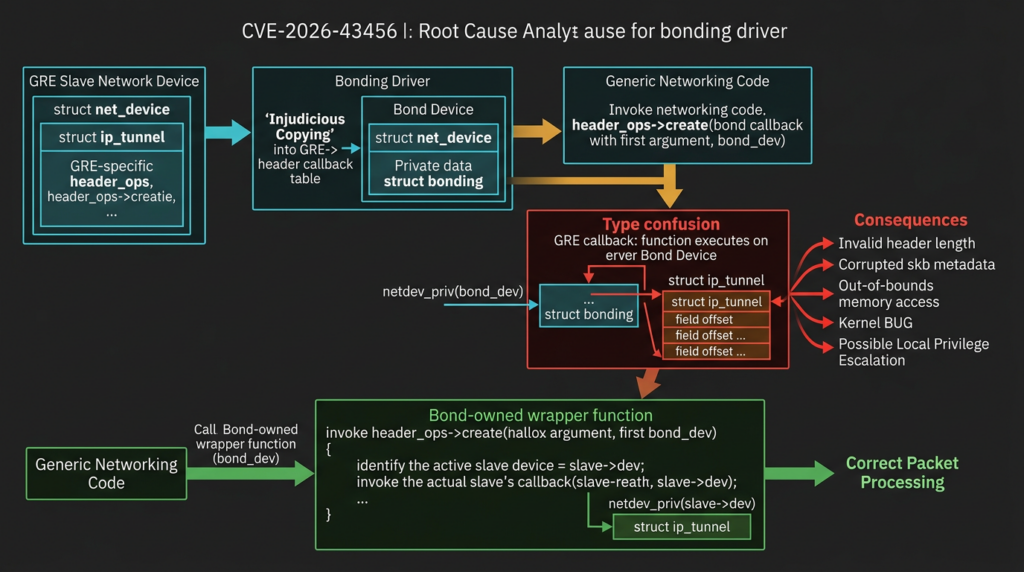
The problem came from an old bonding change intended to improve support for nontraditional slave types. The introducing commit added the following assignment in bond_setup_by_slave():
bond_dev->header_ops = slave_dev->header_ops;
The original commit described the change as copying header_ops from the slave to the bonding device for IP over InfiniBand support. The line entered the kernel in code that researchers date to 2007 and remained present for almost nineteen years before the security implications were fully developed. (GitHub)
At first glance, the assignment appears reasonable. If a bond presents the same link-layer behavior as its active member, reusing the member’s header operations avoids duplicating protocol-specific logic.
The problem is that a callback table is not necessarily context-free.
header_ops contains function pointers used for link-layer header creation and parsing. A simplified version might look like:
struct header_ops {
    int (*create)(
        struct sk_buff *skb,
        struct net_device *dev,
        unsigned short type,
        const void *daddr,
        const void *saddr,
        unsigned int len
    );

    int (*parse)(
        const struct sk_buff *skb,
        unsigned char *haddr
    );
};
Some implementations use only fields available in the common struct net_device. Others call netdev_priv(dev) and assume the returned storage has a particular driver-specific type.
Copying a function pointer from one object to another does not copy that function’s object invariants. The bond acquired a method written for a tunnel device, but it did not become a tunnel object. Its private storage remained a struct bonding.
The vulnerable dispatch can be reduced to this model:
1. GRE device owns gre_header_ops
2. Bond copies gre_header_ops
3. Generic networking code calls bond->header_ops->create
4. The create callback receives bond_dev
5. GRE callback executes netdev_priv(bond_dev)
6. Returned bytes contain struct bonding
7. GRE callback treats them as struct ip_tunnel
The callback address is legitimate. Control-flow integrity based solely on whether the destination is a valid function would not detect the semantic mismatch. The failure is in the dynamic type of the object supplied to that function.
The researchers’ root-cause analysis shows the relevant private structures are fundamentally incompatible. Early fields of struct bonding include pointers such as the bond device and current active slave. A tunnel private structure begins with a different set of pointers, linkage fields, namespace state, and protocol parameters. Reading one as the other converts unrelated bond state into tunnel flags, lengths, addresses, and pointers. (脆弱性診断(セキュリティ診断)のGMOサイバーセキュリティ byイエラエ)
How the type confusion reaches a kernel failure
The public CVE record includes a crash in pskb_expand_head() reached from ipgre_header(). The stack proceeds through packet-socket transmission logic, including packet_sendmsg(), before the kernel detects an invalid state. The advisory explains that a non-Ethernet device such as a GRE tunnel can be enslaved to a bond, after which the bond’s copied header callback is invoked with the bond device. (nvd.nist.gov)
A simplified vulnerable path is:
User-controlled network setup
        |
        v
GRE interface becomes bond slave
        |
        v
bond_setup_by_slave copies GRE header_ops
        |
        v
Packet operation targets bond device
        |
        v
dev_hard_header invokes ipgre_header
        |
        v
ipgre_header receives bond_dev
        |
        v
netdev_priv returns struct bonding
        |
        v
Callback interprets it as struct ip_tunnel
        |
        v
Incorrect metadata and memory operations
        |
        v
Kernel BUG, corruption, or exploitable primitive
The most important engineering lesson is that the failure may appear far away from its cause.
The root cause is a callback assignment during device setup. The visible failure may occur later during packet allocation, headroom expansion, header construction, or skb processing. Debugging only the crashing allocation function can therefore lead investigators in the wrong direction. The allocation code may be operating correctly given its inputs; the inputs became nonsensical because a protocol callback read fields from the wrong private object.
This distance also helps explain why fuzzing was important. The researchers reported discovering the issue through a syzkaller crash and then performing a difficult root-cause analysis. They noted that AI assisted materially with that analysis, while also expressing skepticism that an AI system could have independently discovered and completed the full vulnerability chain without human direction. (脆弱性診断(セキュリティ診断)のGMOサイバーセキュリティ byイエラエ)
Why the patch uses a wrapper rather than another copied callback
The upstream repair removes the direct assignment:
bond_dev->header_ops = slave_dev->header_ops;
and replaces it with a bond-owned callback table:
bond_dev->header_ops =
    slave_dev->header_ops ? &bond_header_ops : NULL;
The new bond_header_ops contains wrapper functions implemented by the bonding driver. The create wrapper obtains the bond’s private data, identifies the current active slave under RCU protection, reads the slave’s own callback table, and invokes the slave callback with slave->dev. (GitHub)
The central change is not merely adding an extra function call. It restores the correct object identity:
ret = slave_ops->create(
    skb,
    slave->dev,
    type,
    daddr,
    saddr,
    len
);
Before the fix, the effective call was conceptually:
slave_ops->create(skb, bond_dev, ...);
After the fix, it is:
slave_ops->create(skb, slave_dev, ...);
That one argument determines what netdev_priv() returns.
The wrapper also handles the dynamic nature of a bond. An active slave can change during failover. Caching one slave’s callbacks indefinitely without resolving the current active device could introduce stale behavior. The patched code enters an RCU read-side critical section, dereferences curr_active_slave, reads that device’s header_ops, and performs the delegated operation while the relationship is protected.
The repair belongs in the bonding driver because bonding created the invalid object-method combination. Modifying every GRE, IP6GRE, IPoIB, and future non-Ethernet callback to detect whether it received a bond would spread a bonding-specific workaround throughout unrelated drivers. It would also be easy to miss another callback that relies on private state. The upstream commit explicitly places the correction at the root cause: bonding must not blindly expose a slave callback while passing an incompatible bond object. (GitHub)
Kernel crash and local root are different claims
The initial security record directly supports an availability impact. It contains a reproducible kernel BUG and a call trace demonstrating that the type confusion reaches an invalid kernel operation.
A local privilege escalation claim requires considerably more.
To turn a crash into root access, an attacker generally needs a controlled memory effect rather than an unpredictable failure. The attacker must understand what fields the confused callback reads, which values can be influenced through the bond object, what kernel objects are adjacent, how packet buffers are allocated, and whether a corrupted field can produce a useful read or write primitive.
Modern kernel exploitation may also require dealing with mitigations such as:
- Kernel address-space layout randomization
- Supervisor mode execution protection
- Supervisor mode access prevention
- Kernel heap hardening
- Randomized allocator behavior
- Control-flow integrity on supported builds
- Restricted unprivileged namespaces
- Different structure layouts between configurations
- Vendor-specific patches
- Architecture-specific implementation details
The researchers who submitted the vulnerability to kernelCTF reported that their final exploit completed in less than one second with a success rate above 99 percent in their target environment. Google’s public security-research repository applied a label stating that the submission exploited the claimed vulnerability and passed manual verification. Those are meaningful results, but they describe a carefully engineered exploit against a defined kernelCTF target, not a universal success rate for every vulnerable Linux host. (脆弱性診断(セキュリティ診断)のGMOサイバーセキュリティ byイエラエ)
Their public analysis describes multiple stages, including an address disclosure, manipulation of skb-related state, and precise construction of virtual device relationships. They emphasize that a stable exploit required a complex series of steps despite the root cause being a single erroneous assignment. (脆弱性診断(セキュリティ診断)のGMOサイバーセキュリティ byイエラエ)
That leads to a defensible impact statement:
CVE-2026-43456 is a locally reachable Linux kernel type confusion with a directly demonstrated crash path and a publicly validated privilege-escalation exploit for at least one controlled target.
It does not justify these broader statements without additional evidence:
- Every affected kernel is trivially exploitable.
- The same binary exploit works across all distributions.
- A remote attacker can trigger it without local execution.
- Public proof of concept establishes active malicious exploitation.
- Failure of one exploit attempt proves a host is safe.
Public exploitability and confirmed in-the-wild exploitation are separate questions. The primary sources cited here establish the former in a research environment; they do not by themselves establish a malicious campaign.
The role of CAP_NET_ADMIN
The researchers list CAP_NET_ADMIN as a triggering requirement. Linux defines this capability as permitting network administration operations including interface configuration, route changes, firewall administration, promiscuous mode changes, and other network controls. (脆弱性診断(セキュリティ診断)のGMOサイバーセキュリティ byイエラエ)
On a traditional server with user namespaces disabled, an ordinary user normally cannot create arbitrary bond and GRE devices. Requiring CAP_NET_ADMIN may therefore substantially limit reachability.
The analysis changes when user namespaces are available.
A process creating a new user namespace starts with a full set of capabilities inside that new namespace. Those capabilities do not grant corresponding power in the parent namespace. A user who is UID 1000 outside can be UID 0 inside while remaining unprivileged against resources governed by the parent. (man7.org)
A network namespace isolates network devices, protocol stacks, routing tables, firewall rules, ports, and related networking state. When a network namespace is owned by a newly created user namespace, capabilities held in that user namespace can authorize operations over resources governed by the network namespace. (man7.org)
The boundary can be summarized as follows:
Initial user namespace
    Unprivileged UID 1000
             |
             | creates allowed user namespace
             v
Child user namespace
    UID 0 with namespace-scoped capabilities
             |
             | owns a new network namespace
             v
Child network namespace
    CAP_NET_ADMIN can configure virtual links
             |
             | all namespaces still use
             v
Shared host Linux kernel
The process does not become host root simply by creating the namespace. It cannot use namespace-scoped capabilities to administer unrelated parent-namespace interfaces or load arbitrary kernel modules. However, it can exercise kernel code paths exposed to its namespace. If one of those paths contains a memory-safety bug, the vulnerability may cross the logical isolation boundary because the kernel itself is shared.
This is why “requires CAP_NET_ADMIN” must be interpreted in context. It can mean:
- Host-level
CAP_NET_ADMINon a system without usable user namespaces - Container-granted
CAP_NET_ADMIN - Capability inside an attacker-created user and network namespace
- Capability inherited by a privileged networking service
- Capability available to a CI or sandbox workload
The realistic question is not merely whether the user’s current shell shows CAP_NET_ADMIN. It is whether the user can create or enter a namespace in which the kernel authorizes the required network-device operations.
Reachability across common environments
| Umwelt | Likely ability to reach the vulnerable path | What defenders must verify |
|---|---|---|
| Single-user workstation with unprivileged user namespaces enabled | Potentially reachable by a compromised desktop process | Kernel patch status, namespace policy, bonding availability |
| Multi-user Linux server with user namespaces enabled | Higher concern because an ordinary account may exercise namespace-scoped networking code | User namespace controls, local shell exposure, kernel package |
| Server with unprivileged user namespaces disabled | More restricted, though privileged services or administrators may remain able to trigger it | Which services hold CAP_NET_ADMIN, whether containers are privileged |
| Default restricted container | Often limited, but runtime and namespace configuration vary | Effective capabilities, seccomp, user namespace mode, host kernel |
Container with CAP_NET_ADMIN | Increased reachability inside its network namespace | Host kernel status, available link types, runtime restrictions |
| Privileged container | High-risk trust boundary for this and many other kernel bugs | Eliminate privileged mode where possible and patch host kernel |
| Rootless container environment | May depend on unprivileged user namespaces by design | Host patch status is preferable to disabling required platform features |
| Kubernetes Pod with all capabilities dropped | Reduced reachability, not a substitute for a kernel fix | Node kernel, admission policies, exceptions granted to networking Pods |
| CNI, VPN, packet-capture, or network-debug Pod | Often receives broader network privileges | Exact capability set, privileged status, node placement |
| Shared CI runner | Potentially important if jobs can create user namespaces or receive network capabilities | Runner isolation model, kernel version, job policy, tenancy |
| Dedicated appliance using active bonds | Vulnerable code may be active in normal operations | Patch without disrupting bonded management or production links |
A container image does not carry its own independent Linux kernel under ordinary container isolation. Updating the image’s packages may improve user-space security but does not repair a vulnerable host kernel. The host or node kernel must contain the CVE-2026-43456 fix.
Virtual machines are different. A conventional VM has its own guest kernel. The guest must be assessed and patched independently, while the cloud or virtualization provider remains responsible for its host layer.
Affected upstream versions
The kernel.org CNA data recorded by NVD identifies these upstream fix boundaries:
| Upstream branch | First recorded fixed release |
|---|---|
| 6.12.y | 6.12.78 |
| 6.18.y | 6.18.19 |
| 6.19.y | 6.19.9 |
| Mainline | 7.0 |
The affected semantic range begins at Linux 2.6.24 because that is the release associated with the introducing change. Multiple stable-tree commit hashes are listed because fixes are applied separately to maintained branches. (nvd.nist.gov)
These boundaries should not be used as a naive shell comparison:
# This is not a reliable vulnerability decision by itself.
uname -r
A distribution may ship a kernel named 6.1.x that contains the fix through backporting. Conversely, a custom development kernel with a higher local version string may have diverged before the correction.
A reliable assessment uses several pieces of evidence:
- The running kernel release and build.
- The distribution and kernel package version.
- The vendor’s CVE status or security advisory.
- The vendor changelog or source package.
- Presence of the equivalent
bond_header_opswrapper. - Confirmation that the system booted the updated kernel.
Distribution status must be treated as a dated snapshot
Distribution trackers change as maintainers publish packages. The following information reflects the source pages available in July 2026 and should not replace a fresh vendor check during remediation.
Ubuntu’s CVE page was last updated on July 10, 2026. It rated the issue High with a CVSS score of 7.8. At that snapshot, Ubuntu 26.04 LTS was marked not affected, while the main kernels for Ubuntu 24.04 LTS, 22.04 LTS, 20.04 LTS, and several older supported lines were listed as vulnerable or work in progress. Hardware-enablement kernels had their own statuses, which demonstrates why checking only the distribution release name is insufficient. (Ubuntu)
The Debian tracker snapshot listed bullseye and bookworm source packages as vulnerable, while trixie packages and newer forky or sid packages were marked fixed. It also recorded specific fixed source-package versions for trixie and unstable. (security-tracker.debian.org)
SUSE’s page showed a mixture of pending overall status and released package updates. It listed multiple July 2026 advisories and fixed package versions for affected products. A fleet using SUSE must therefore match each installed product and kernel flavor to the relevant advisory rather than interpreting the page’s single overall label. (SUSE)
| Vendor source | Example status from the cited snapshot | Operational lesson |
|---|---|---|
| Ubuntu | Different status across 26.04, 24.04, 22.04, older releases, and HWE kernels | Match the exact package and kernel flavor |
| Debian | bullseye and bookworm vulnerable, trixie and newer lines fixed in the cited tracker state | Do not assume all Debian releases share one status |
| SUSE | Security advisories and fixed packages available while some overall tracking remained pending | Use the product-specific package table |
| Custom kernel | No distribution guarantee | Inspect source, commits, configuration, and build provenance |
Teams should record the date on which they checked the vendor source. “Vendor page said vulnerable” and “vendor page said fixed” are time-dependent observations, not permanent attributes.
Why CVSS scores differ
The kernel.org CNA assigns CVE-2026-43456 a CVSS 3.1 base score of 7.8 with local attack vector, low attack complexity, low privileges required, no user interaction, unchanged scope, and High impact to confidentiality, integrity, and availability. NVD displays that CNA score but had not supplied a separate NVD score in the cited record. (nvd.nist.gov)
Ubuntu also rates the issue 7.8 and High. SUSE’s public page, however, displays a 5.5 assessment with no confidentiality or integrity impact and High availability impact. (Ubuntu)
The discrepancy does not necessarily mean one side misunderstood the source code. It reflects different impact interpretations.
An availability-focused assessment can be based on the directly reported kernel crash. A higher assessment can incorporate the potential for memory corruption to become local privilege escalation, which kernelCTF researchers demonstrated in a specific target.
CVSS also does not describe an organization’s entire risk. Two hosts with the same CVE can have very different priorities:
- A single-purpose appliance with no untrusted local code
- A shared university shell server
- A Kubernetes worker accepting third-party workloads
- A developer workstation that runs untrusted build scripts
- A public CI runner
- A network appliance whose management interface depends on bonding
- A hardened server with unprivileged user namespaces disabled
- A node running privileged networking containers
A practical priority model should consider:
Risk priority =
    vulnerable running kernel
  × local code execution exposure
  × namespace or capability reachability
  × workload trust level
  × exploit consequence
  × recovery difficulty
CVSS remains useful for normalization, but it should not override evidence about the actual host.
Safe PoC demonstrating the callback type confusion
The following program is a user-space teaching example. It does not use Linux bonding, does not create virtual interfaces, does not enter a namespace, and does not interact with kernel memory. It cannot reproduce the kernel crash or provide privilege escalation.
Its only purpose is to show the design error: a callback written for one private object type is copied to another object and then invoked with the wrong device context.
#include <inttypes.h>
#include <stdint.h>
#include <stdio.h>
#include <string.h>

struct device;

typedef void (*create_fn)(struct device *dev);

struct header_ops {
    create_fn create;
};

struct tunnel_priv {
    uint64_t tunnel_cookie;
    uint64_t header_room;
};

struct bond_priv {
    uint64_t bond_cookie;
    struct device *active_slave;
};

struct device {
    const char *name;
    void *priv;
    const struct header_ops *ops;
};

/*
 * This function represents a callback that expects dev->priv
 * to contain struct tunnel_priv.
 *
 * memcpy is used so the toy program can display the incompatible
 * interpretation without dereferencing an invalid pointer or
 * deliberately crashing.
 */
static void tunnel_header_create(struct device *dev)
{
    struct tunnel_priv interpreted = {0};

    memcpy(&interpreted, dev->priv, sizeof(interpreted));

    printf(
        "callback device=%-10s cookie=0x%016" PRIx64
        " header_room=%" PRIu64 "\n",
        dev->name,
        interpreted.tunnel_cookie,
        interpreted.header_room
    );
}

static const struct header_ops tunnel_ops = {
    .create = tunnel_header_create,
};

/*
 * Vulnerable design:
 * the bond has copied the tunnel callback and calls it with
 * the bond device.
 */
static void vulnerable_dispatch(struct device *bond_dev)
{
    bond_dev->ops->create(bond_dev);
}

/*
 * Fixed design:
 * a bond-owned wrapper identifies the active slave and calls
 * the slave callback with the slave device.
 */
static void fixed_dispatch(struct device *bond_dev)
{
    struct bond_priv *bond = bond_dev->priv;
    struct device *slave = bond->active_slave;

    if (slave && slave->ops && slave->ops->create)
        slave->ops->create(slave);
}

int main(void)
{
    struct tunnel_priv tunnel_state = {
        .tunnel_cookie = UINT64_C(0x54554e4e454c0001),
        .header_room = 128,
    };

    struct device tunnel_dev = {
        .name = "gre-demo",
        .priv = &tunnel_state,
        .ops = &tunnel_ops,
    };

    struct bond_priv bond_state = {
        .bond_cookie = UINT64_C(0x424f4e4400000001),
        .active_slave = &tunnel_dev,
    };

    /*
     * This copied callback models the vulnerable assignment:
     *
     * bond_dev->header_ops = slave_dev->header_ops;
     */
    struct device bond_dev = {
        .name = "bond-demo",
        .priv = &bond_state,
        .ops = tunnel_dev.ops,
    };

    puts("Vulnerable dispatch");
    vulnerable_dispatch(&bond_dev);

    puts("\nFixed wrapper dispatch");
    fixed_dispatch(&bond_dev);

    return 0;
}
Compile and run it locally:
cc -O2 -Wall -Wextra -Wpedantic \
  toy_bond_type_confusion.c \
  -o toy-bond-type-confusion

./toy-bond-type-confusion
A typical result looks like:
Vulnerable dispatch
callback device=bond-demo  cookie=0x424f4e4400000001 header_room=140725219473392

Fixed wrapper dispatch
callback device=gre-demo   cookie=0x54554e4e454c0001 header_room=128
The exact large number in the vulnerable line will vary because it is derived from the bytes containing the active-slave pointer. The important observation is that the tunnel callback receives bond-demo and interprets bond-private bytes as tunnel fields.
The fixed path calls the same callback. The callback code does not change. Only the object supplied to it changes, and the expected header_room value becomes correct.
This models the essential upstream repair:
Bad:
    slave callback plus bond device

Good:
    bond wrapper
        -> resolve active slave
        -> slave callback plus slave device
The example intentionally omits every kernel exploitation component. It does not model skb corruption, address disclosure, heap layout, KASLR bypass, or a write primitive. Those stages are unnecessary for understanding the root cause and would make the example inappropriate for routine defensive validation.
Do not use exploit success as a patch test
A public crash trigger or kernelCTF exploit is a poor fleet-assessment tool.
Running it on a vulnerable host may:
- Panic the kernel
- Interrupt storage or network operations
- Corrupt transient workload state
- Terminate every container on the node
- Trigger failover
- Damage availability evidence
- Produce an ambiguous result if the exploit is target-specific
- Violate authorization or change-management controls
Running it on a patched host may still fail for reasons unrelated to the patch. The exploit may expect a particular architecture, allocator behavior, kernel configuration, structure layout, mitigation state, or device support.
A failed exploit therefore means only that one exploit attempt failed under one set of conditions. It does not prove that the vulnerable code is absent.
Patch verification should answer a narrower, reproducible question:
Does the running kernel contain the upstream fix or a vendor-equivalent backport?
Non-destructive host inventory
Start by recording the running kernel:
uname -a
uname -r
cat /proc/version
Identify the operating system and release:
cat /etc/os-release
On Debian and Ubuntu systems, record installed kernel image packages:
dpkg-query -W -f='${Package}\t${Version}\n' \
  'linux-image-*' 2>/dev/null | sort
On RPM-based systems:
rpm -q kernel kernel-core 2>/dev/null
On SUSE systems:
rpm -q kernel-default 2>/dev/null
These commands establish package identity. They do not by themselves prove that the newest installed package is running.
Compare the active release:
uname -r
with the package owning the active kernel image or module tree. On a systemd host, boot information can also help:
journalctl -b 0 -k | head -n 30
If a fixed package was installed after the last boot, the vulnerable kernel may still be active.
Check whether bonding is built or available
A distribution kernel often provides bonding as a module, but it may also be built into a custom kernel.
Check the running configuration when available:
config="/boot/config-$(uname -r)"

if test -r "$config"; then
    grep -E '^CONFIG_(BONDING|USER_NS|NET_NS)=' "$config"
else
    echo "Kernel config not available at $config"
fi
Possible bonding results include:
CONFIG_BONDING=m
or:
CONFIG_BONDING=y
m means module support. y means the driver is built into the kernel and cannot be removed with rmmod.
Check whether the module is loaded:
lsmod | awk '$1 == "bonding" { print }'
Query module metadata:
modinfo bonding 2>/dev/null
List configured bond interfaces:
ip -details link show type bond
A JSON form is easier to process at scale:
ip -details -json link show type bond 2>/dev/null
Look for relevant tunnel devices:
ip -details link show type gre
ip -details link show type ip6gre
The absence of an active bond lowers immediate exposure but does not prove the vulnerable path is unreachable. A module may be auto-loaded when a process creates a device. An attacker with the required namespace permissions may also create virtual devices that did not exist during inventory.
Check namespace exposure
On distributions that implement the kernel.unprivileged_userns_clone control:
sysctl kernel.unprivileged_userns_clone 2>/dev/null
Also record the namespace limit:
sysctl user.max_user_namespaces 2>/dev/null
Check the compiled feature:
grep '^CONFIG_USER_NS=' "/boot/config-$(uname -r)" 2>/dev/null
grep '^CONFIG_NET_NS=' "/boot/config-$(uname -r)" 2>/dev/null
Interpret the results carefully:
CONFIG_USER_NS=ymeans the kernel supports user namespaces.kernel.unprivileged_userns_clone=0may prevent ordinary users from creating them on distributions supporting that sysctl.- A positive
user.max_user_namespacesdoes not prove every process can successfully create one. - LSM rules, seccomp filters, container runtime policy, and distribution patches may add restrictions.
- Rootless container platforms may require user namespaces for normal operation.
- A process may already run inside a namespace created by a more privileged service.
Inspect the current process’s capability masks:
grep -E '^Cap(Inh|Prm|Eff|Bnd|Amb):' /proc/self/status
Wenn capsh is installed:
capsh --print
For a running process:
pid=1234

grep -E '^(Name|Uid|Gid|NSpid|CapInh|CapPrm|CapEff|CapBnd|CapAmb):' \
  "/proc/$pid/status"
Namespace identities can be inspected with:
readlink /proc/self/ns/user
readlink /proc/self/ns/net
and for another process:
readlink "/proc/$pid/ns/user"
readlink "/proc/$pid/ns/net"
These observations help determine whether a suspicious process shares the host network namespace, operates in an isolated namespace, or has a capability set that deserves investigation.
Confirm the source-level repair
For an upstream or vendor source tree, search for the wrapper:
grep -R -n \
  'static const struct header_ops bond_header_ops' \
  drivers/net/bonding
Then inspect the assignment in bond_setup_by_slave():
grep -R -n -A20 -B10 \
  'bond_setup_by_slave' \
  drivers/net/bonding/bond_main.c
A fixed implementation should use a bond-owned callback table and should delegate to the active slave using the slave’s device context.
In an upstream Git repository:
git log --all --oneline --grep='bonding: fix type confusion in bond_setup_by_slave'
Check whether a particular branch contains the main fix:
git branch --contains \
  950803f7254721c1c15858fbbfae3deaaeeecb11
A vendor backport may use a different commit hash. Absence of the upstream hash is therefore not definitive. Search by patch content, commit subject, vendor changelog, or source-package diff.
The relevant invariant is:
slave_ops->create(skb, slave->dev, ...);
rather than:
slave_ops->create(skb, bond_dev, ...);
Build an evidence-based vulnerability decision
| Beweise | What it establishes | What it does not establish |
|---|---|---|
uname -r | Running kernel release string | Vendor backport status |
| Installed kernel package | A package is present on disk | That the package is currently booted |
| Vendor CVE page | Vendor’s status for a package or release | Status of a custom or third-party kernel |
| Upstream commit present | Source contains that exact commit | Runtime is using the built artifact |
| Equivalent wrapper code present | Logical fix appears in source | Correct deployment and reboot |
| Bonding module unloaded | Module is not currently active | Module cannot be loaded later |
| No bond interface exists | No bond was observed during inventory | An authorized process cannot create one |
| User namespaces disabled | One common low-privilege route is restricted | Privileged services cannot reach the bug |
| Public exploit fails | One exploit failed in one environment | Kernel is patched |
| New kernel booted | Updated kernel is running | Vendor package necessarily contains this fix unless advisory confirms it |
A high-confidence result combines vendor status, package identity, runtime version, and post-reboot confirmation.
Detection and threat hunting
Patching should remain the primary control. Detection is useful for identifying attempted triggering, exploitation research on unauthorized systems, and affected hosts that have already produced kernel faults.
Search kernel logs for the public crash-path indicators:
journalctl -k \
  --grep='ipgre_header|ip6gre_header|pskb_expand_head|packet_sendmsg|KASAN|kernel BUG|Oops'
For the current boot:
journalctl -b 0 -k \
  --grep='ipgre_header|ip6gre_header|pskb_expand_head|KASAN|kernel BUG|Oops'
On systems without persistent journal storage:
dmesg --color=never |
  grep -E 'ipgre_header|ip6gre_header|pskb_expand_head|packet_sendmsg|KASAN|kernel BUG|Oops'
A matching call trace deserves investigation, but individual function names are not independently malicious. GRE traffic and packet sockets have legitimate uses. The stronger signal is a kernel fault containing several relevant frames in a compatible sequence.
Capture surrounding context:
journalctl -k --since '30 minutes ago' --no-pager
Correlate the fault with:
- User logins
- Container launches
- CI job identifiers
- Namespace creation
- Network-interface creation
- Capability changes
- Module loading
- Unexpected root processes
- Reboots or watchdog events
Monitor administrative tools as a supplemental signal
An audit rule can record execution of common network and module tools:
sudo auditctl -w /usr/sbin/ip \
  -p x \
  -k network-admin-tool

sudo auditctl -w /usr/sbin/modprobe \
  -p x \
  -k kernel-module-tool
Search the events:
sudo ausearch -k network-admin-tool
sudo ausearch -k kernel-module-tool
These rules are incomplete. A program can communicate with rtnetlink directly without executing /usr/sbin/ip, and a module may be loaded by system components. Treat command execution as context, not as complete prevention or detection.
Watch for unusual virtual-device activity
A defensive telemetry system can record rtnetlink operations that create or modify:
bondgregretapip6greip6gretapdummyveth
The most relevant behavior is not one legitimate bond. It is an unusual sequence by an untrusted process, especially when combined with:
- Creation of a user namespace
- Creation of a network namespace
- Acquisition of namespace-scoped
CAP_NET_ADMIN - A burst of virtual links
- Packet-socket activity
- A kernel warning or Oops
- Unexpected privilege changes
Researchers reported that their stable exploit required carefully engineered virtual-device relationships. Defenders should not turn those public research details into a rigid detection signature, because exploit implementations can vary and legitimate network labs can also create many virtual links. Behavioral correlation is more durable than checking one exact interface count. (脆弱性診断(セキュリティ診断)のGMOサイバーセキュリティ byイエラエ)
Investigate container capability grants
For Docker:
docker inspect \
  --format '{{.Name}} privileged={{.HostConfig.Privileged}} capadd={{json .HostConfig.CapAdd}}' \
  $(docker ps -q)
For Kubernetes, review Pod security contexts:
kubectl get pods -A -o json |
  jq -r '
    .items[] |
    .metadata.namespace as $ns |
    .metadata.name as $pod |
    .spec.containers[] |
    [
      $ns,
      $pod,
      .name,
      (.securityContext.privileged // false),
      ((.securityContext.capabilities.add // []) | join(","))
    ] |
    @tsv
  '
Prioritize Pods that are:
- Privileged
- Granted
NET_ADMIN - Using host networking
- Running untrusted or user-submitted code
- Scheduled on shared nodes
- Acting as general-purpose debugging environments
A privileged or network-administration workload is not proof of exploitation. It is a reachability factor that increases the urgency of host-kernel patching.
Primary remediation
The durable correction is a kernel containing the vendor-equivalent of the upstream bonding wrapper fix.
On Debian or Ubuntu systems, the normal high-level workflow is:
sudo apt update
sudo apt full-upgrade
sudo reboot
After reboot:
uname -r
dpkg-query -W -f='${Package}\t${Version}\n' \
  'linux-image-*' 2>/dev/null | sort
On Fedora or RHEL-family systems, follow the vendor advisory and update the kernel package:
sudo dnf upgrade --refresh kernel kernel-core
sudo reboot
On SUSE systems:
sudo zypper refresh
sudo zypper patch --category security
sudo reboot
These are general package-management examples, not substitutes for the relevant vendor advisory. Kernel package names, maintenance channels, live-patching services, and reboot procedures differ across products.
After reboot, verify:
uname -a
journalctl -b 0 -k | head -n 30
For managed fleets, collect at least:
- Host or node identifier
- Distribution
- Installed fixed package
- Running kernel
- Boot timestamp
- Vendor advisory or CVE status
- Reboot or live-patch evidence
- Remaining compensating controls
- Exception owner and expiration date
Do not close remediation merely because the fixed package appears in package inventory. A machine that has not rebooted normally continues executing the old kernel.
Temporary mitigation by restricting user namespaces
The researchers recommend disabling unprivileged user namespace creation as one possible mitigation when immediate patching is unavailable. On systems implementing the relevant sysctl:
sudo sysctl -w kernel.unprivileged_userns_clone=0
To persist the setting:
printf '%s\n' \
  'kernel.unprivileged_userns_clone = 0' |
  sudo tee /etc/sysctl.d/99-restrict-unprivileged-userns.conf

sudo sysctl --system
This can remove a common path by which an ordinary user obtains namespace-scoped capabilities for a newly created network namespace. It is not equivalent to patching the bug, because services or containers already holding the required privilege may remain able to reach the code. (脆弱性診断(セキュリティ診断)のGMOサイバーセキュリティ byイエラエ)
The compatibility impact can be significant. Rootless Docker, rootless Podman, sandboxing systems, build tools, browser isolation mechanisms, and developer workflows may depend on user namespaces. The research disclosure specifically notes likely disruption to rootless Docker. (脆弱性診断(セキュリティ診断)のGMOサイバーセキュリティ byイエラエ)
Before changing the setting:
- Inventory rootless containers and sandboxed applications.
- Test the change in a representative environment.
- Establish an exception process.
- Apply the restriction through configuration management.
- Monitor failed namespace-creation attempts.
- Keep the control temporary and patch the kernel.
Some distributions use different controls. Do not assume that an absent kernel.unprivileged_userns_clone key means unprivileged namespace creation is impossible.
Temporary mitigation by disabling bonding
If bonding is not required, blocking the module can remove the vulnerable subsystem from a modular kernel.
First determine whether any active interface depends on it:
ip -details link show type bond
cat /proc/net/bonding/* 2>/dev/null
ip route show
Also confirm whether the management connection, default route, storage network, cluster heartbeat, or high-availability path uses a bond.
If bonding is unused and provided as a module, a persistent block can be configured:
printf '%s\n' \
  'install bonding /bin/false' \
  'blacklist bonding' |
  sudo tee /etc/modprobe.d/disable-bonding.conf
An unused loaded module can be removed:
sudo modprobe -r bonding
The researchers provide a similar module-blocking mitigation. (脆弱性診断(セキュリティ診断)のGMOサイバーセキュリティ byイエラエ)
Do not unload bonding blindly over SSH. If the active management path uses a bond, removing the module may immediately disconnect the host and disrupt production traffic.
This mitigation also has limits:
- It does not work when bonding is built into the kernel.
- It can break failover and throughput configurations.
- A future configuration change may reintroduce the module.
- It does not repair the vulnerable code.
- It may be unsuitable for network appliances and virtualization hosts.
Record the mitigation as an expiring exception, not as a permanent substitute for the fixed kernel.
Remove unnecessary container capabilities
A container generally should not receive CAP_NET_ADMIN unless it genuinely performs network administration.
For Docker, prefer dropping all capabilities and adding back only those required:
docker run \
  --cap-drop=ALL \
  --security-opt=no-new-privileges \
  your-image:tag
Vermeiden:
docker run --privileged your-image:tag
and scrutinize:
docker run --cap-add=NET_ADMIN your-image:tag
For Kubernetes:
apiVersion: v1
kind: Pod
metadata:
  name: restricted-example
spec:
  containers:
    - name: app
      image: example/app:1.0
      securityContext:
        privileged: false
        allowPrivilegeEscalation: false
        capabilities:
          drop:
            - ALL
Dropping capabilities reduces reachability but does not alter the vulnerable host kernel. A runtime bug, a privileged sidecar, an overly permissive CNI component, or a separate namespace route may still expose kernel attack surfaces.
Patch every node that may schedule untrusted workloads.
Prioritization for shared systems
CVE-2026-43456 deserves the highest operational priority on systems where low-trust users can execute native code and interact with kernel namespaces.
Beispiele hierfür sind:
- Shared shell servers
- Public or multi-tenant CI runners
- Security research labs
- University compute hosts
- Build farms processing third-party repositories
- Kubernetes nodes running customer-controlled workloads
- Developer platforms executing package installation scripts
- Desktop fleets exposed to malicious document or browser chains
- Container hosts offering rootless workloads
- Network test systems where users receive
CAP_NET_ADMIN
The vulnerability may be less reachable on a dedicated appliance with no untrusted local execution and tightly controlled administrative access. That does not make the appliance unaffected. It changes the probability component of risk, while the impact of a kernel crash may remain severe.
Network appliances require special care because bonding may be essential to availability. A mitigation that disables bonding can be more disruptive than the immediate exploit risk. Patch planning should include console access, failover validation, redundant routing, and rollback.
Common assessment mistakes
Assuming an unloaded module means the host is safe
lsmod is a point-in-time observation. A process may trigger module auto-loading, and a custom kernel may have bonding built in. Check kernel configuration, module policy, and device-creation permissions.
Assuming no physical bond means the bug is unreachable
The published analysis uses virtual networking constructs. The relevant question is whether an attacker can create the needed devices, not whether an administrator configured a physical production bond.
Treating CAP_NET_ADMIN as equivalent to host root
Capabilities are namespace-relative. A process may lack host privileges while holding a full capability set inside a new user namespace and authority over its network namespace. (man7.org)
Comparing only the numeric kernel version
Distribution backports invalidate simple comparisons. Use vendor package status and source-level evidence.
Installing an update without rebooting
The old kernel remains in memory. Verify the active kernel after reboot or obtain explicit evidence that a vendor live patch covers this CVE.
Treating a kernel crash as proof of successful privilege escalation
A crash confirms serious unsafe behavior but not necessarily controlled root access. Investigate for privilege changes and persistence separately.
Treating exploit failure as proof of safety
Public exploits often depend on a specific target. Patch presence is a better test.
Updating container images instead of nodes
Containers share the host kernel. The host or VM guest kernel must be fixed.
Blocking the ip command
ip is only one user-space client for netlink. A program can make equivalent requests directly.
Selecting the lowest CVSS score without context
Vendor scores reflect different impact assumptions. The existence of a manually validated kernelCTF privilege-escalation submission should be part of risk analysis even when a product-specific score emphasizes availability. (SUSE)
Related Linux kernel vulnerabilities
CVE-2026-43456 is easier to prioritize when compared with other local kernel vulnerabilities. The comparison also shows why defenders should separate vulnerability class, reachability, and exploitation consequence.
| CVE | Grundlegende Ursache | Main demonstrated risk | Relationship to CVE-2026-43456 |
|---|---|---|---|
| CVE-2026-43456 | Bond invokes copied header callback with an incompatible private device type | Kernel crash and demonstrated local privilege escalation in a kernelCTF target | Central issue |
| CVE-2026-31419 | Race in bonding broadcast transmission can double-consume an skb and cause use-after-free | Kernel memory corruption and local impact | Same bonding subsystem, different memory-safety mechanism |
| CVE-2024-1086 | Use-after-free in nf_tables verdict handling | Local privilege escalation | Another networking path where namespace reachability affects local attack surface |
| CVE-2022-0847 | Pipe-buffer flags were not initialized correctly, permitting writes into page-cache pages | Unprivileged local privilege escalation | Shows a different route from a kernel data-handling bug to root |
CVE-2026-31419
CVE-2026-31419 is another 2026 vulnerability in Linux bonding, but it is not the same bug. It concerns bond_xmit_broadcast(), which reused the original skb for what it believed was the last slave while cloning it for other slaves. Concurrent changes to the slave list could alter which device appeared last during iteration, causing the original skb to be consumed twice and producing a use-after-free. The correction makes the last-element decision against a stable pre-snapshot count. (nvd.nist.gov)
Its relevance is architectural. Bonding handles mutable collections of devices, packet ownership, callbacks, and concurrent failover. CVE-2026-31419 is a lifetime and concurrency problem; CVE-2026-43456 is an object-type and callback-context problem. Finding one class does not imply the other has been fixed.
CVE-2024-1086
CVE-2024-1086 is a use-after-free in the Linux nf_tables subsystem that can be exploited for local privilege escalation. The flaw involved verdict handling that could lead to double freeing under a crafted condition. NVD recommends upgrading beyond the referenced correction commit. (nvd.nist.gov)
Both CVE-2024-1086 and CVE-2026-43456 demonstrate why network-related kernel code is not necessarily remote-only. Local processes can exercise complex networking APIs through namespaces, netlink, packet sockets, and virtual devices. Restricting unnecessary namespace and capability access reduces exposure, but patching remains the reliable solution.
CVE-2022-0847
CVE-2022-0847, widely known as Dirty Pipe, resulted from improper initialization of pipe-buffer flags. An unprivileged local user could use stale flags to write into page-cache pages backed by read-only files and thereby escalate privileges. (nvd.nist.gov)
Dirty Pipe did not depend on bonding or a confused callback. Its significance here is operational: a kernel bug that appears to concern an internal data structure can cross directly into system integrity when an unprivileged process can shape the affected object. Defenders should assess the entire path from local API reachability to kernel memory effect rather than classifying bugs only by subsystem name.
Evidence-driven validation with AI assistance
The disclosure of CVE-2026-43456 offers a measured view of AI in vulnerability research. The researchers reported that AI helped significantly during root-cause analysis, especially because the crash site and the callback assignment that caused it were far apart. They did not claim that an autonomous model independently discovered and completed the exploit; they remained skeptical that current systems could do so end to end. (脆弱性診断(セキュリティ診断)のGMOサイバーセキュリティ byイエラエ)
That distinction should also govern enterprise validation. A tool-connected AI system can help correlate kernel versions, vendor trackers, configuration files, namespace policy, module state, source diffs, and reboot evidence. It should not automatically download and run a public kernel exploit merely because a scanner found a matching version string.
Plattformen wie Sträflich are most useful in this setting when automation preserves scope, records evidence, separates hypotheses from confirmed findings, and keeps destructive actions behind explicit controls. The related Penligent analysis, AI Vulnerability Discovery Is an Orchestration Problem, makes the same practical distinction between a model suggesting a vulnerability and a controlled workflow turning that hypothesis into reproducible evidence.
For CVE-2026-43456, an appropriate automated workflow would:
- Inventory the running kernel and distribution package.
- Query the current vendor status.
- Inspect bonding and namespace configuration.
- Determine whether untrusted workloads can obtain relevant capabilities.
- Search source or changelogs for the equivalent fix.
- Propose a non-destructive remediation.
- Collect post-reboot evidence.
- Re-evaluate exposure without executing a privilege-escalation payload.
The result should be an auditable finding such as:
Host: worker-17
Running kernel: 6.1.176-1-amd64
Vendor status at assessment time: vulnerable
CONFIG_BONDING: module
Bonding loaded: no
Unprivileged user namespaces: enabled
Untrusted CI jobs: yes
Temporary control: none
Remediation: install fixed vendor kernel and reboot
Validation required: confirm wrapper backport and active kernel
That is more useful than a report that says only “CVE detected” or “exploit failed.”
A practical remediation workflow
Phase one — Establish exposure
Record:
uname -a
cat /etc/os-release
grep -E '^CONFIG_(BONDING|USER_NS|NET_NS)=' \
  "/boot/config-$(uname -r)" 2>/dev/null
lsmod | grep '^bonding'
ip -details link show type bond
sysctl kernel.unprivileged_userns_clone 2>/dev/null
sysctl user.max_user_namespaces 2>/dev/null
Identify:
- Local users
- Untrusted workloads
- Containers with
NET_ADMIN - Privileged Pods
- Rootless container requirements
- Active bonded links
- Kernel package source
- Vendor patch availability
Phase two — Select the corrective action
Preferred:
Vendor-fixed kernel plus reboot
Temporary controls:
Restrict user namespaces
Remove unnecessary NET_ADMIN
Disable unused bonding module
Move untrusted workloads to patched nodes
Temporary controls should be selected according to workload compatibility. A server that depends on a bond should not use module removal. A rootless-container platform may not tolerate namespace disabling.
Phase three — Deploy safely
For a critical bonded server:
- Confirm console or out-of-band access.
- Validate redundant network paths.
- Install the fixed kernel.
- Confirm bootloader selection.
- Schedule reboot.
- Verify bond recovery.
- Verify routes and service health.
- Confirm the running kernel.
- Preserve logs and package evidence.
For Kubernetes:
- Patch a small node pool.
- Drain representative nodes.
- Reboot into the fixed image.
- Validate CNI and storage behavior.
- Confirm kernel versions through node inventory.
- Expand rollout.
- Prevent scheduling on unpatched nodes.
- Review privileged networking workloads.
Phase four — Verify closure
A closure record should state:
Vendor advisory:
Fixed package:
Install timestamp:
Reboot timestamp:
Running kernel:
Source-level fix evidence:
Namespace policy:
Bonding status:
Container capability exceptions:
Validation owner:
If live patching is used, obtain explicit vendor documentation that the applied live patch covers CVE-2026-43456. “Live patch service enabled” is not enough.
Frequently asked questions
Is CVE-2026-43456 remotely exploitable?
- It is not described as a conventional unauthenticated remote vulnerability.
- The documented trigger requires local control over virtual network-device configuration and
CAP_NET_ADMINin the relevant namespace. - An attacker may first gain local execution through another vulnerability, a compromised account, a malicious build, or an untrusted container workload.
- GRE traffic reaching a server is not by itself evidence that an external sender can trigger the vulnerable setup.
- Public kernelCTF validation demonstrates local privilege-escalation potential, not a direct Internet attack path. (脆弱性診断(セキュリティ診断)のGMOサイバーセキュリティ byイエラエ)
Does an attacker need root or CAP_NET_ADMIN?
- The published trigger requires
CAP_NET_ADMIN. - The attacker does not necessarily need host root.
- A process creating an allowed user namespace receives capabilities inside that namespace.
- Those capabilities may authorize network administration in a network namespace owned by the user namespace.
- Capabilities in the child namespace do not grant ordinary administrative power over the parent namespace.
- Because all namespaces share the same kernel, a kernel memory-safety flaw may still permit escalation beyond the namespace boundary.
- Systems disabling unprivileged user namespaces can substantially reduce one low-privilege route, but privileged services and containers may remain exposed. (man7.org)
How can I tell whether my Linux host is patched?
- Record the running kernel with
uname -r. - Identify the exact distribution kernel package.
- Check the current vendor CVE page or security advisory.
- Do not rely only on upstream numeric version comparison because vendors backport fixes.
- When source is available, look for
bond_header_opswrappers that invoke a slave callback withslave->dev. - Confirm that the updated kernel is running after reboot.
- Treat an installed but inactive kernel as incomplete remediation.
- Do not use exploit failure as proof that the patch is present.
Is a container able to exploit the host kernel?
- Containers normally share the host kernel.
- A vulnerable host kernel can therefore be relevant to code running inside a container.
- Reachability depends on capabilities, namespaces, runtime policy, available network-device operations, seccomp, and kernel configuration.
- Containers granted
CAP_NET_ADMINor privileged mode deserve priority review. - Rootless environments may expose namespace-scoped kernel interfaces while intentionally avoiding host-level root.
- Updating the container image does not repair the node kernel.
- Patch the host or Kubernetes worker node even when the vulnerable package does not appear inside the container.
Can I mitigate the issue by unloading the bonding module?
- Yes, disabling an unused modular bonding driver can reduce exposure.
- First confirm that no production, management, storage, cluster, or failover interface depends on a bond.
- Do not remove the module remotely when the current connection may traverse a bonded interface.
- The approach does not work if
CONFIG_BONDING=ybuilt the driver into the kernel. - Blocking the module is a temporary control, not a code fix.
- Continue with the vendor kernel update and reboot.
Why do vendors assign different CVSS scores?
- The kernel.org CNA and Ubuntu use a 7.8 High score that includes High confidentiality, integrity, and availability impact.
- SUSE’s cited page displays a 5.5 assessment focused on availability.
- The public crash directly proves denial of service.
- The kernelCTF submission demonstrates that a controlled target could be exploited for privilege escalation.
- Vendors may consider their kernel configuration, default namespace policy, product exposure, and confirmed impact.
- Use the score as one input; prioritize according to local execution exposure and actual reachability. (nvd.nist.gov)
Should defenders run the public kernelCTF exploit?
- Not on production systems.
- Exploit execution can crash the kernel or interrupt every workload on a node.
- A target-specific exploit may fail on a vulnerable kernel because of configuration or layout differences.
- Failure does not prove the host is fixed.
- Prefer vendor advisory checks, package evidence, source-level patch inspection, and post-reboot verification.
- Limit exploit research to an isolated, authorized lab with disposable systems and clear safety controls.
- For routine fleet management, a non-destructive evidence chain is more accurate and operationally safer.
The practical priority
CVE-2026-43456 survived for years because the vulnerable assignment looked like a reasonable reuse of a lower-level device’s behavior. The callback itself was valid, and normal bonding configurations did not necessarily expose an obvious failure. The danger appeared only when protocol-specific code received an object whose private storage had a completely different type.
The upstream fix is correspondingly precise: bonding now owns the exposed callback and delegates to the active slave with the active slave’s device context.
Defenders should treat the vulnerability as a serious local kernel risk, especially on shared systems, container nodes, CI infrastructure, developer platforms, and hosts that allow untrusted code to create namespaces. The fastest reliable path is to install the vendor-fixed kernel, boot into it, and verify the backport. Namespace restrictions, capability reduction, and disabling unused bonding support can reduce exposure while patching proceeds, but none is as dependable as removing the defective callback path from the running kernel.
 German
  English
  French
  Spanish
  Portuguese
  Japanese
  Korean
  Hindi
Hindi  Arabic
  Turkish
  Hebrew