
There are critical vulnerabilities that deserve attention because their CVSS score is high, and then there are vulnerabilities where the score is almost the least interesting part of the story. CVE-2026-76504 falls into the second category. The vulnerability affects Cisco Catalyst SD-WAN Manager, formerly known as vManage, and allows an unauthenticated remote attacker to bypass an API authentication boundary and obtain access with the privileges of the admin user. Cisco assigned the issue a CVSS 3.1 base score of 9.8, but the more important detail is that this is not a theoretical attack path waiting for someone to weaponize it. Cisco’s Product Security Incident Response Team says it became aware of active exploitation in September 2026, and the vulnerability was subsequently added to CISA’s Known Exploited Vulnerabilities catalog. Cisco
Cisco disclosed CVE-2026-76504 on September 30, 2026. The official CVE record names it the Cisco Catalyst SD-WAN Manager System Account Authorization Bypass Vulnerability and classifies the underlying weakness as CWE-177, Improper Handling of URL Encoding or Hex Encoding. Cisco’s own security advisory describes the problem somewhat more operationally: API session-based authentication does not correctly handle URI encoding in certain HTTP requests. Because of that discrepancy, a specially constructed request can avoid an authentication rule that was supposed to protect a specific API endpoint. If the request succeeds, the attacker reaches the API as the admin user without first supplying legitimate administrator credentials. CVE
That makes CVE-2026-76504 particularly uncomfortable for defenders because almost every favorable condition is on the attacker’s side. The CVSS vector is CVSS:3.1/AV:N/AC:L/PR:N/UI:N/S:U/C:H/I:H/A:H: the attack is network reachable, has low attack complexity, requires no prior privileges and needs no interaction from an administrator or end user. Cisco also says the vulnerability affects Catalyst SD-WAN Manager regardless of system configuration. In other words, this is not a flaw that disappears because a rarely used feature has been disabled. If an affected Manager is running and an adversary can reach the relevant interface, defenders need to assume that the authentication boundary itself is vulnerable. Cisco
Why CVE-2026-76504 Matters More Than a Typical Web Authentication Bypass
It is tempting to read “authentication bypass” and mentally classify CVE-2026-76504 alongside a compromised administration panel. That understates the security significance of the product being attacked. Cisco Catalyst SD-WAN Manager is a centralized management component of a distributed networking environment. Administrators use it to operate and monitor the SD-WAN deployment and manage configuration across the environment. It therefore sits much closer to the network’s management and orchestration layer than an ordinary application dashboard.
That distinction changes the threat model. The confirmed impact documented by Cisco is administrator-level API access. Cisco has not said that CVE-2026-76504 by itself provides operating-system root access or arbitrary command execution, and defenders should resist turning an already serious vulnerability into a more dramatic claim that the evidence does not support. But unauthorized administrator access to a centralized SD-WAN management system is already a severe security event. It places an attacker across a trust boundary that normally separates an unknown remote system from the management functions used to administer enterprise networking infrastructure. Cisco
This is one reason Rapid7 recommended treating affected internet-facing systems as an emergency remediation case rather than waiting for the next routine patch window. Rapid7 notes that Cisco confirmed exploitation in the wild and recommends not only upgrading vulnerable systems but also investigating exposed systems for evidence that exploitation may already have occurred. That second part matters. Once a pre-authentication vulnerability has been exploited before an organization installs the patch, installing the patch closes the original entry point but does not retroactively prove that the system was never accessed. Schnell7
The timing reinforces that concern. Cisco publicly disclosed the vulnerability on September 30, while stating that PSIRT had already become aware of active exploitation during September. Security publications have consequently described CVE-2026-76504 as a zero-day. Whether an organization prefers that label or simply calls it an actively exploited authentication bypass, the operational conclusion is the same: defenders cannot safely assume that disclosure day was the beginning of the exposure window. BleepingComputer
How CVE-2026-76504 Bypasses Authentication
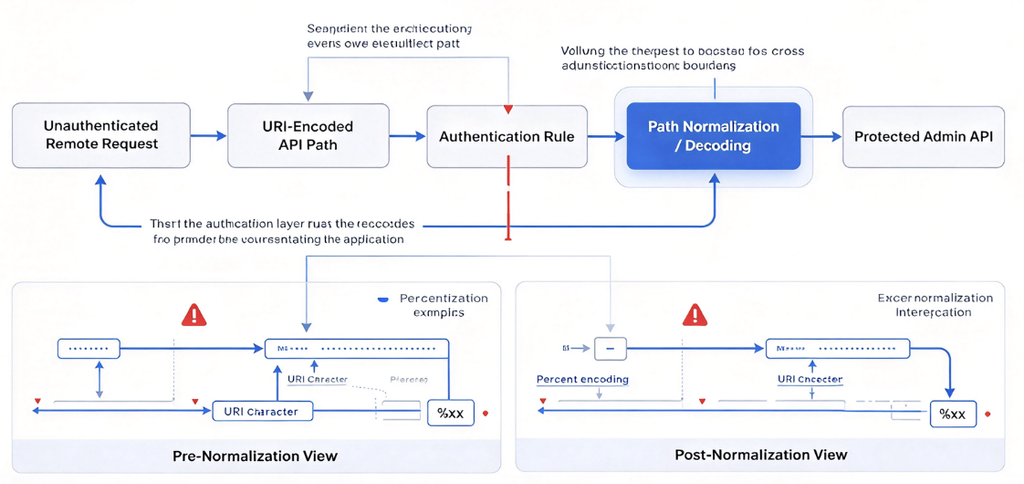
The technical idea behind CVE-2026-76504 is surprisingly simple. Web applications frequently make security decisions based on a requested URI. A security component might recognize a particular path as requiring authentication, inspect the request, and then allow another component to decode or route that request. If two parts of the request-processing chain do not interpret URL encoding in exactly the same way, the security layer can end up evaluating one representation of a path while the application ultimately processes another.
Cisco does not publicly describe every internal parsing step involved in CVE-2026-76504, so it would be speculative to claim a particular reverse-proxy or application-server implementation is responsible. What Cisco does confirm is sufficient to understand the vulnerability class: improper URI encoding handling lets a crafted HTTP request bypass the authentication rule intended to restrict a particular API endpoint. The CVE record maps this directly to CWE-177. CVE
Cisco’s published indicators provide an unusually useful glimpse into what this looks like on a real system. Its example shows a request associated with j_security_check in which the letter j has been represented using the URI-encoded value %6a. The resulting path therefore appears in logs as an encoded variation of the normal login handler. The crucial detail, however, is Cisco’s warning immediately around this IOC: %6a is only an example. Cisco says the vulnerability can be triggered when any single character in the request is encoded. Cisco
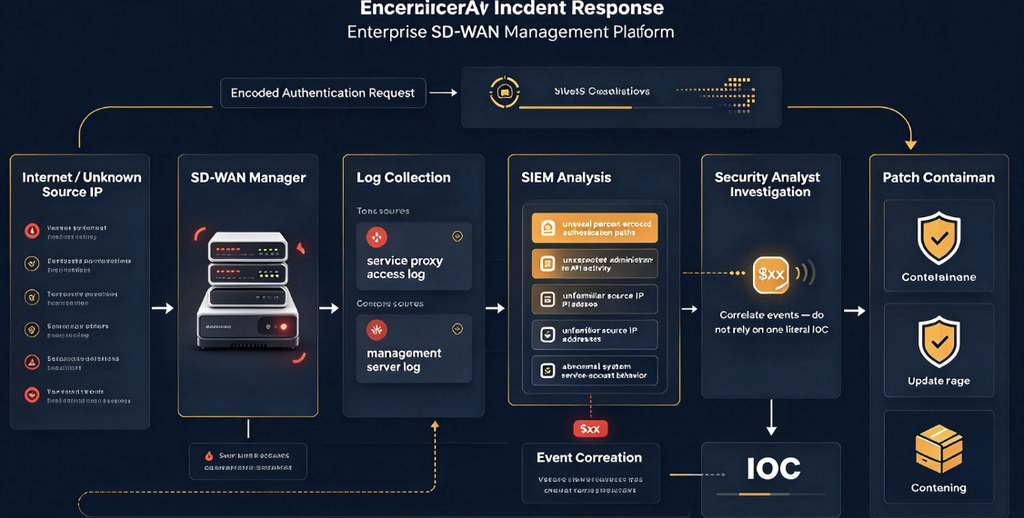
That small sentence has a large implication for detection engineering. A rule that looks only for the literal string /%6a_security_check will catch Cisco’s example and may catch some real attacks, but it is not a complete detector for CVE-2026-76504. An attacker does not have to copy the exact representation in the advisory. Detection should instead look more broadly for unexpected percent-encoded characters in requests resolving to or associated with the relevant authentication handler, particularly where the source is not an authorized management host.
This is a recurring lesson in normalization vulnerabilities. Security teams often receive one IOC and turn it into one exact string match. That works when the IOC is a fixed malware hash or a hard-coded command-and-control address. It works much less reliably when the vulnerability itself exists because multiple textual representations can resolve to the same semantic resource. In that situation, normalization-aware detection is much more valuable than a single literal pattern.
CVE-2026-76504 Severity and Vulnerability Details
The basic facts around CVE-2026-76504 are unusually clear because Cisco is both the vendor and CNA for the vulnerability.
| Einzelheiten | CVE-2026-76504 |
|---|---|
| Produkt | Cisco Catalyst SD-WAN Manager |
| Former product name | Cisco SD-WAN vManage |
| Art der Schwachstelle | Authentication/authorization bypass through improper URI encoding handling |
| CWE | CWE-177 |
| CVSS 3.1 | 9.8 Critical |
| Angriffsvektor | Netzwerk |
| Privileges required | Keine |
| User interaction | Keine |
| Successful impact | API access with admin-user privileges |
| Active exploitation | Confirmed by Cisco |
| KAG KEV | Ja |
| Workaround | No complete workaround |
| Vendor fix | Upgrade to a fixed release |
Cisco’s advisory is the primary source security teams should continue to monitor because fixed-release and mitigation information may be updated as an incident develops. The current advisory can be found through Cisco’s CVE-2026-76504 security advisory. CISA has also placed CVE-2026-76504 in its Known Exploited Vulnerabilities Catalog. Cisco
Which Cisco Catalyst SD-WAN Versions Are Affected?
Cisco says Catalyst SD-WAN Manager is vulnerable regardless of system configuration and provides fixed releases for each maintained software branch. Organizations should not interpret the following versions merely as recommendations; Cisco describes them as the first releases containing the vulnerability fix. Cisco
| Cisco Catalyst SD-WAN release | First fixed release |
|---|---|
| Earlier than 20.9 | Migrate to a fixed release |
| 20.9 | 20.9.10.1 |
| 20.12 | 20.12.8.2 |
| 20.15 | 20.15.6.1 |
| 20.18 | 20.18.4.1 |
| 26.1 | 26.1.2.1 |
| 26.2 | 26.2.1 |
Customers running releases older than 20.9 therefore should not look for a backported fix within the old branch; Cisco’s instruction is to migrate to an appropriate fixed release. Organizations also need to account for normal SD-WAN component compatibility when planning that migration rather than treating the Manager upgrade as an isolated software update. Cisco links its control-component compatibility and upgrade matrices directly from the security advisory for this reason. Cisco
Cisco-hosted environments are handled differently. Cisco says the vulnerability has been addressed in Cisco SD-WAN Cloud, Cisco Managed, Release 20.15.605, and that customers using the managed cloud service do not need to take action to apply that particular software fix themselves. Customers can check remediation status or the running software version through the service GUI. Cisco
There Is No Complete Workaround for CVE-2026-76504
One of the most important lines in Cisco’s advisory is also one of the easiest to overlook: there are no workarounds that address the vulnerability. Restricting network exposure can reduce the attack surface, but it does not repair the vulnerable authentication logic. Cisco therefore repeatedly recommends upgrading to one of the fixed releases. Cisco
For on-premises environments, Cisco recommends preventing access from unsecured networks such as the public internet whenever possible. Where remote access is necessary, organizations should restrict connections to known, trusted hosts and place Catalyst SD-WAN control components behind filtering devices. Cisco specifically discusses firewall filtering and hardening of SD-WAN control components as mitigations. These controls are valuable because a remote vulnerability becomes substantially harder to exploit if an attacker cannot reach the vulnerable interface in the first place, but Cisco appropriately treats them as mitigations rather than permanent remediation. Cisco
Cisco has also released a Live Protect Shield for CVE-2026-76504. This is worth distinguishing from a traditional workaround. Cisco says the shield is intended to provide temporary security coverage while organizations plan upgrades, but it explicitly characterizes the shield as temporary partial protection and states that upgrading to a fixed software release remains the only way to remediate the vulnerability. Cisco also warns of a potential side effect: a legitimate user employing URI encoding may be unable to log in while the shield is active. Cisco
That gives security teams a sensible hierarchy of controls. A shield can help reduce risk during emergency change planning. Firewall restrictions can shrink the reachable attack surface. Monitoring can increase the chance of discovering exploitation. None of those makes an affected software release non-vulnerable. The end state should still be a fixed release.
CVE-2026-76504 Is Already Being Exploited in the Wild
The phrase “exploited in the wild” is sometimes used loosely in vulnerability coverage, but here it comes directly from Cisco. The vendor states that Cisco PSIRT became aware of active exploitation in September 2026 and strongly recommends upgrading to a fixed release. Cisco
CISA reached the same operational conclusion. CVE-2026-76504 was added to the Known Exploited Vulnerabilities catalog on September 30, 2026. CISA’s catalog describes it as a Cisco Catalyst SD-WAN Manager hex-encoding vulnerability capable of giving an unauthenticated remote attacker administrator privileges and set October 3, 2026 as the remediation due date for the applicable federal requirements. CISA also marks whether known ransomware campaigns are associated with KEV entries; for CVE-2026-76504, publicly available KEV data currently lists ransomware use as unknown, not confirmed. CISA
Neither Cisco nor CISA has publicly attributed the exploitation to a named threat actor in the material available at the time of writing. Cisco has also not publicly provided a complete intrusion chain showing precisely what attackers did after obtaining access through CVE-2026-76504. Those unknowns matter. Defenders should separate what has been demonstrated from what is merely plausible: active exploitation is confirmed; administrator-level API access is confirmed; a specific campaign owner, ultimate objective and standardized post-exploitation chain are not yet publicly established in Cisco’s advisory. SecurityWeek
How to Hunt for CVE-2026-76504 Exploitation
Cisco provides two concrete places defenders should investigate. The first is the Catalyst SD-WAN Manager service proxy access log:
/var/log/nms/containers/service-proxy/serviceproxy-access.log
Cisco recommends looking for entries related to j_security_check that originate from unknown or unauthorized IP addresses. In its published example, the suspicious request is a POST request whose path contains an encoded character rather than the ordinary literal form of the authentication handler. Cisco
The second source is:
/var/log/nms/vmanage-server.log
Here, Cisco tells customers to review entries associated with j_security_check, particularly cases involving user names beginning with viptela-reserved-. Cisco notes that these are system service accounts, so the mere presence of such an account should not automatically be interpreted as compromise. The suspicious combination is the context: an unexpected encoded authentication request, an unauthorized source and activity inconsistent with the organization’s normal management traffic. Cisco
A simple first-pass hunt can therefore search for encoded requests associated with the authentication path without hard-coding only %6a. For example, defenders working on a copy of their logs might use a broad pattern such as:
grep -Ei 'POST /[^ ]*%[0-9a-fA-F]{2}[^ ]*security_check' \
  /var/log/nms/containers/service-proxy/serviceproxy-access.log
A second review can surface authentication-handler and system-account activity from the application log:
grep -Ei 'j_security_check|viptela-reserved-' \
  /var/log/nms/vmanage-server.log
Those commands are triage helpers, not definitive compromise detectors. Cisco explicitly warns that some of the documented IOC patterns may occur during normal operations, which means analysts need to correlate hits against known management IP addresses, administrator activity, timestamps, successful response codes and other telemetry. Cisco
A SIEM rule should follow the same principle. Instead of looking for only one exact encoded string, normalize or decode URI paths where possible and compare the decoded destination with the authentication endpoint. Alert more aggressively when an encoded representation comes from an IP address that has never legitimately administered the Manager, especially if the request is followed by privileged API activity.
The distinction between attempted exploitation und successful exploitation is also important. An internet scanner can send a suspicious request without gaining meaningful access. Conversely, concentrating exclusively on obviously malicious payloads may cause defenders to miss activity that looks syntactically ordinary after the authentication bypass succeeds. Investigators should therefore extend their timeline beyond the initial request and inspect what happened immediately afterward.
Do Not Stop the Investigation at the IOC
There is a natural temptation during a high-priority CVE response to run one grep command, find nothing and conclude that the environment is clean. CVE-2026-76504 is exactly the kind of vulnerability where that approach can fail.
First, Cisco’s example uses %6a, but Cisco specifically states that any one encoded character in the request can be used to exploit the vulnerability. An attacker aware of the public IOC can trivially avoid using the exact example defenders are searching for. Cisco
Second, internet-facing management systems generate considerable legitimate and illegitimate HTTP traffic. An IOC should therefore be interpreted in context. Source IP reputation, whether the address belongs to an approved administrator or VPN egress point, the timing of the request and subsequent administrative actions all matter.
Third, logs are only useful if they still exist. Cisco recommends external log collection as part of its broader hardening guidance precisely because an organization investigating an event needs historical visibility. Retaining management-plane logs outside the affected system also reduces dependence on evidence stored on the system being investigated. Cisco
Finally, patching changes the future state of the system but does not answer the historical question. If an internet-accessible Manager ran a vulnerable version during a period of confirmed exploitation, the relevant incident-response question is not simply “Are we patched now?” It is also “Was the authentication boundary crossed before we patched?”
What to Do If You Find Suspicious CVE-2026-76504 Activity
Cisco explicitly invites customers who need help determining whether Catalyst SD-WAN Manager has been compromised to open a case with Cisco Technical Assistance Center. Cisco recommends opening the TAC case as Severity 3 with CVE-2026-76504 in the title. Before doing so, Cisco encourages customers to run the request admin-tech command so that the resulting admin-tech data can be supplied to TAC for analysis. Cisco
That evidence-collection step should happen before an investigation destroys useful state wherever operationally feasible. Security teams dealing with a suspected compromise generally want to preserve the relevant logs, configuration state, timestamps and other diagnostic data before making changes that could overwrite information. The objective is not to postpone remediation indefinitely; it is to avoid turning an exploitable system into a freshly patched system with no record of whether it was exploited.
After evidence has been preserved, the vulnerable Manager should be upgraded to a fixed release. Internet exposure should also be reviewed independently of the patch. A management interface that does not need to be globally reachable should not become globally reachable again simply because this particular CVE has been closed.
Why Internet Exposure Is So Important
Cisco’s advisory specifically calls out Catalyst SD-WAN Manager systems with ports exposed to the internet as being at risk of compromise. That does not mean internally reachable systems can be ignored. An attacker already present on a corporate network may still be able to reach a vulnerable management interface. But internet exposure dramatically changes the likelihood of opportunistic exploitation because it removes the need for an initial foothold elsewhere. Cisco
For that reason, exposure reduction should be treated as an architectural security measure rather than a temporary reaction to CVE-2026-76504. Management systems should ideally be reachable only through controlled administrative paths, with restrictive firewall policy, authenticated remote-access infrastructure, dedicated management networks or comparable controls appropriate to the environment.
Cisco’s own hardening recommendation reflects this design principle. The vendor advises preventing access from unsecured networks, allowing only known trusted hosts where connectivity is required, protecting control components with filtering devices and monitoring web traffic for unexpected activity. Cisco
None of these measures eliminates the need to patch. What they do is reduce the probability that the next remotely exploitable management-plane vulnerability becomes immediately accessible to every attacker scanning the internet.
CVE-2026-76504 Is Part of a Larger Cisco SD-WAN Security Pattern
CVE-2026-76504 does not arrive in isolation. Cisco Catalyst SD-WAN has already faced several serious security incidents during 2026, including authentication and authorization problems affecting high-trust SD-WAN components. Rapid7 notes that CVE-2026-76504 is separate from the earlier critical unauthenticated peering vulnerabilities CVE-2026-20127 and CVE-2026-20182, even though all of them raise the same strategic concern: attackers have strong incentives to target centralized SD-WAN infrastructure. Schnell7
That history is useful because it changes how organizations should think about asset prioritization. A vulnerability scanner may produce thousands of critical CVEs across an enterprise. Treating every CVSS 9.8 or 10.0 entry identically is not realistic. Systems such as SD-WAN managers and controllers deserve additional weighting because they occupy unusually powerful positions in the network architecture. The same remote authentication flaw on a low-trust application server and on the control or management layer of a WAN do not create identical incident-response problems.
Penligent previously examined this broader trust problem in its coverage of CVE-2026-20127 and the SD-WAN control-plane trust problem. That earlier vulnerability had a different root cause and should not be confused with CVE-2026-76504, but the defensive principle carries forward: SD-WAN security should be designed around the assumption that compromise of a management or control component has significance far beyond a single exposed service. Sträflich
The same pattern can also be seen outside SD-WAN. The recent Cisco ISE vulnerability CVE-2026-76460 involved another high-value network-security management component and was also reported as actively exploited. Penligent’s earlier analysis of CVE-2026-76460 and Cisco ISE authentication bypass exploitation provides useful context for why exposed administrative APIs have become such valuable targets. Sträflich
A Practical Remediation Sequence for CVE-2026-76504
For organizations responding today, the sequence matters.
Start by identifying every Catalyst SD-WAN Manager deployment and its exact software branch. Do not rely solely on an old CMDB entry; verify the version against the actual deployment. Determine whether each management interface is reachable from the public internet, reachable from broad internal networks or limited to a dedicated trusted management path.
Before destroying evidence, collect relevant diagnostic information and preserve the serviceproxy-access.log und vmanage-server.log data covering the exposure period. Search broadly for encoded variants associated with j_security_check and investigate source IP addresses rather than treating the literal %6a example as the entire IOC. If anything appears suspicious, preserve the timeline and consider involving Cisco TAC before assuming that an upgrade alone has resolved the incident. Cisco
Next, reduce reachability. Remove unnecessary public exposure and restrict administration to trusted sources. Organizations able to use Cisco’s Live Protect Shield can evaluate it as a temporary protection during the change process, while remembering Cisco’s warning that it is only partial protection.
Then upgrade to the appropriate fixed release: 20.9.10.1, 20.12.8.2, 20.15.6.1, 20.18.4.1, 26.1.2.1 or 26.2.1 depending on the current branch. Systems older than 20.9 need migration to a supported fixed release rather than remaining on the old branch. Cisco
Finally, validate both sides of the remediation. Confirm that the running software is actually the expected fixed version, and separately confirm that investigation of the pre-patch exposure period did not reveal suspicious administrative activity. Those are different questions. Passing the first does not automatically answer the second.
What CVE-2026-76504 Teaches About URL Normalization Security
The technical root cause also offers a broader application-security lesson. URL encoding looks mundane, but authentication systems frequently depend on string comparisons and routing decisions. Whenever one security layer evaluates an unnormalized path while another component later decodes or canonicalizes it, the application risks creating two different answers to what should be one question: “Which resource is this request actually accessing?”
A secure design should make authentication and authorization decisions against a canonical representation of the requested resource. Equivalent representations should resolve to the same security policy. The same principle applies to path traversal protections, reverse proxies, Web Application Firewalls, API gateways and access-control middleware. Attackers routinely search for disagreements between layers because those disagreements can turn simple encoding differences into security-boundary failures.
CVE-2026-76504 is a particularly instructive example because the result is not a minor routing oddity. Cisco says the encoding discrepancy can move an unauthenticated request across an authentication boundary and place the attacker in an administrator context. CVE
For security engineers testing their own applications, that suggests a useful defensive testing strategy: authentication controls should be validated not only against the expected literal path but also against equivalent encoded and normalized representations. That validation belongs in the software development and API-security lifecycle long before an application reaches production.
Why CVSS Alone Does Not Explain the Urgency
A CVSS score of 9.8 already places CVE-2026-76504 near the top of conventional vulnerability queues, but three contextual factors make it more urgent than the number alone suggests.
The first is exploitation status. Cisco has confirmed active attacks, eliminating the uncertainty that surrounds thousands of high-scoring CVEs that may never see meaningful exploitation. Cisco
The second is privilege. Successful exploitation provides access with admin-user privileges rather than merely exposing low-value information.
The third is asset role. Catalyst SD-WAN Manager is centralized management infrastructure. Compromise of such infrastructure creates a much larger investigative problem than compromise of an isolated endpoint.
CISA’s decision to add CVE-2026-76504 to KEV captures the first factor particularly well. KEV inclusion is based on evidence of real-world exploitation, which is why many vulnerability-management programs use the catalog as a prioritization signal alongside CVSS rather than relying on severity scores alone. CVE-2026-76504 was added on September 30 with a remediation date of October 3 for the relevant federal requirements. CISA
Frequently Asked Questions About CVE-2026-76504
What is CVE-2026-76504?
CVE-2026-76504 is a critical authentication and authorization bypass vulnerability affecting Cisco Catalyst SD-WAN Manager. Improper handling of URI encoding can allow an unauthenticated remote request to bypass an authentication rule protecting an API endpoint, resulting in API access with admin-user privileges. Cisco rates the vulnerability 9.8 Critical under CVSS 3.1 and maps it to CWE-177. CVE
Is CVE-2026-76504 being exploited in the wild?
Yes. Cisco says its PSIRT became aware of active exploitation in September 2026. CISA added CVE-2026-76504 to its Known Exploited Vulnerabilities catalog on September 30, 2026. Cisco
Does CVE-2026-76504 require authentication?
No. Cisco’s CVSS vector lists privileges required as none, and the vulnerability specifically allows an unauthenticated remote attacker to bypass the affected authentication control. Cisco
Does CVE-2026-76504 provide root access or remote code execution?
Cisco’s advisory does nicht describe the direct result as root operating-system access or arbitrary remote code execution. The documented result is authentication bypass followed by API access with the privileges of the admin user. Those privileges are already significant, but defenders should avoid attributing additional capabilities to the CVE unless Cisco or subsequent technical research establishes them. Cisco
What is the CVE-2026-76504 exploit mechanism?
The vulnerability results from improper handling of URI encoding. Cisco’s published IOC demonstrates an encoded character in the path associated with j_security_check, allowing the request to bypass the authentication rule protecting the endpoint. Importantly, Cisco says its %6a example is only one possible representation and that any one encoded character in the request may be used to trigger the vulnerability. Cisco
Is there a CVE-2026-76504 workaround?
There is no complete workaround. Cisco recommends reducing access from unsecured networks and provides a Live Protect Shield that offers temporary partial protection, but Cisco explicitly states that upgrading to a fixed release is the way to remediate the vulnerability. Cisco
What versions fix CVE-2026-76504?
The first fixed releases are 20.9.10.1, 20.12.8.2, 20.15.6.1, 20.18.4.1, 26.1.2.1 and 26.2.1 for their respective branches. Releases earlier than 20.9 should migrate to a fixed release. Cisco also says Cisco SD-WAN Cloud, Cisco Managed, has been addressed in Release 20.15.605. Cisco
How can I detect CVE-2026-76504 exploitation?
Cisco recommends reviewing /var/log/nms/containers/service-proxy/serviceproxy-access.log for suspicious requests associated with j_security_check from unauthorized IP addresses and reviewing /var/log/nms/vmanage-server.log for related activity, including relevant calls involving viptela-reserved- service accounts. Detection should not depend exclusively on %6a because other characters can be encoded. Cisco
Should I patch if my SD-WAN Manager is not internet-facing?
Yes. Restricting internet exposure substantially reduces external attack surface, but it does not remove the vulnerable code. Cisco says the vulnerability affects Catalyst SD-WAN Manager regardless of configuration and recommends upgrading affected deployments to fixed software. Cisco
CVE-2026-76504 Should Be Treated as an Incident Question, Not Just a Patch Question
The most important thing about CVE-2026-76504 is not that its CVSS score is 9.8. It is the combination of conditions around it: remote reachability, no authentication requirement, administrator-level impact, a management-plane target, confirmed active exploitation and no configuration change that actually removes the underlying vulnerability.
For organizations with an affected Cisco Catalyst SD-WAN Manager exposed to the internet, the appropriate response is therefore broader than installing an update. Reduce exposure, preserve the evidence that still exists, inspect Cisco’s documented log sources for both the published IOC and alternative encoded forms, investigate suspicious administrative activity, deploy the appropriate fixed release and validate that the system remains clean afterward. If the evidence is ambiguous, Cisco explicitly provides a path for customers to submit admin-tech data to TAC for review. Cisco
Most importantly, do not interpret the patch as proof that nothing happened before the patch. Cisco knew of active exploitation during September 2026, and CISA has placed the flaw in KEV. In an environment where a vulnerable management interface was remotely accessible, the question is no longer simply whether an attacker könnte have exploited CVE-2026-76504. The defensible question is whether the available telemetry can show that they did—or did not—cross that authentication boundary before remediation. Cisco


 German
  English
  French
  Spanish
  Portuguese
  Japanese
  Korean
  Hindi
Hindi  Arabic
  Turkish
  Hebrew