
CVE-2026-84782 is an OpenSSL DTLS handshake flaw that can expose process memory or interrupt an application. The practical question is whether an affected OpenSSL implementation handles DTLS in the application you actually run. A vulnerable library somewhere on a machine is an inventory finding; a reachable DTLS implementation using that library is a stronger exposure finding. Keeping those two conclusions separate makes patch decisions faster and reports more defensible.
OpenSSL’s September 29 security advisory rates the issue High and identifies an out-of-bounds read during handshake retransmission. It is not an advisory about breaking TLS encryption, stealing every server’s private key, or gaining a shell. The right response combines a supported update with evidence that the relevant running application uses it.
For an individual developer, a small hosting operation, or a security tester, the most useful work is often local: identify the binary, establish whether DTLS is enabled, map its library dependency to the correct vendor notice, and verify the replacement process. A remote HTTPS request cannot answer all of those questions. The procedures below deliberately separate facts, defensive observations, and educational demonstrations.
CVE-2026-84782 at a glance
| Frage | Verified answer | Operational consequence |
|---|---|---|
| Betroffene Komponente | OpenSSL DTLS handshake retransmission | Find the application that implements DTLS, not just the web server. |
| Schwäche | Out-of-bounds read, CWE-125 | Confidentiality and availability require separate assessment. |
| Vendor severity | Hoch | Prioritize a reachable affected deployment. |
| Published | September 29, 2026 | A rising search query does not make the disclosure new today. |
| Confirmed impact categories | Heap-memory disclosure and denial of service | Do not relabel the issue as confirmed remote code execution. |
| FIPS boundary | The affected code is outside the FIPS module | A FIPS configuration is not proof that the surrounding application is unaffected. |
The factual entries above follow the OpenSSL vulnerability record. The operational consequences are defensive interpretations: they describe how to investigate a deployment without claiming that a particular product, customer, or network has been exploited.
There is no universal network banner that settles this finding. A service may conceal its library version; another may advertise a version unrelated to the process implementing DTLS. Treat discovery results as pointers to ownership and configuration evidence. A report that names a CVE but cannot identify its execution path is not ready to dictate an emergency change.
Affected OpenSSL versions and the correct patch target
Die upstream advisory’s upgrade instructions identify the following branch-specific releases. These are the fixes named for this vulnerability, rather than a promise that each release remains the newest or best-supported choice when you read this page. Prefer a currently supported release containing the fix, subject to your application’s compatibility requirements.
| OpenSSL branch named by upstream | Fix named in the advisory | Important qualification |
|---|---|---|
| 4.0 | 4.0.3 | Use the fixed release or a later supported release in the branch. |
| 3.6 | 3.6.5 | Confirm the application actually loads the replacement library. |
| 3.5 | 3.5.9 | Check separately for vendor-maintained package builds. |
| 3.4 | 3.4.8 | Do not compare this branch numerically with another branch. |
| 3.0 | 3.0.23 | Listed in the premium-support section of the advisory. |
| 1.1.1 | 1.1.1zj | Listed in the premium-support section; confirm access and lifecycle. |
| 1.0.2 | 1.0.2zs | Listed in the premium-support section; plan a supported migration. |
A distribution package and an upstream release answer different questions. The upstream table tells a source-build maintainer which branch release includes the repair. A Linux distribution may maintain its own package revisions and issue security updates for a supported operating-system release. For example, Ubuntu’s USN-8847-1 supplies its own release and package guidance. Apply the notice matching the operating system and package origin rather than replacing a managed library with an arbitrary tarball.
Record the complete package revision. Dropping the distribution suffix from a ticket can erase exactly the information needed to distinguish an unpatched package from a maintained build. Conversely, a new-looking upstream number is insufficient if the application vendors a private copy. The source of the dependency is part of the finding, not administrative decoration.
For a source build, preserve the source release, build options, installation prefix, and final artifact identity. For a packaged application, preserve the repository origin and the vendor security notice. For a container, preserve the image digest and the application build. These records are not interchangeable. An operating-system update on the host does not establish the contents of a separately built container image.
Do not treat an omitted historical branch as a positive assurance. If your dependency is outside the branches explicitly addressed by the current advisory, consult its maintainer and support policy. An absence from a concise release table is not an independent code audit. An unsupported dependency needs a migration decision even when a scanner cannot confidently classify this particular CVE.
Why the vulnerable path is DTLS, not every HTTPS connection
Start with the protocol in the actual application. The vendor’s description of CVE-2026-84782 concerns DTLS handshake processing. The presence of OpenSSL in an HTTPS stack does not establish that the DTLS code path is reachable. A useful assessment therefore needs two maps: the software dependency map and the protocol-processing map. Neither replaces the other.
Consider a developer maintaining a web dashboard and a separate communications service. Both may be delivered together and have the same owner, but the dashboard’s TCP listener may have no role in the communications service’s datagram handshake. Testing the dashboard and marking the complete installation safe would leave the second service unexplained. Testing the second service and marking the dashboard vulnerable would overstate the evidence in the opposite direction.
The same reasoning applies to intermediaries. A frontend can terminate one transport while forwarding another, or it can operate only as a pass-through for traffic the backend parses. The important boundary is where the handshake is implemented. If an intermediary never performs the affected operation, its certificate or HTTP response headers cannot describe the backend’s library state.
Client software deserves an explicit entry in the inventory. A dependency investigation that searches only for listening servers can miss applications that initiate sessions. The upstream patch includes client and server regression coverage, as shown in the OpenSSL repair and test description. That is a reason to examine both roles; it is not a claim that every client is externally reachable or equally easy to attack.
Use configuration evidence to resolve the role before choosing a test. An application owner should be able to identify the relevant module, startup configuration, and expected peer population. Where those answers are missing, label the state unknown and assign an owner. Unknown is a useful operational category because it preserves work that still needs doing. Calling an unknown service either vulnerable or safe makes the inventory look complete while reducing its value.
A UDP listener is a discovery clue, not a CVE result. Other protocols use datagrams, and an observed port alone does not establish OpenSSL, DTLS, a vulnerable build, or the triggering state. Conversely, a process may initiate datagram sessions without a persistent listener visible in a quick snapshot. Avoid turning one convenient observation into a verdict about an entire application.
The failure is shared state across a suspended write
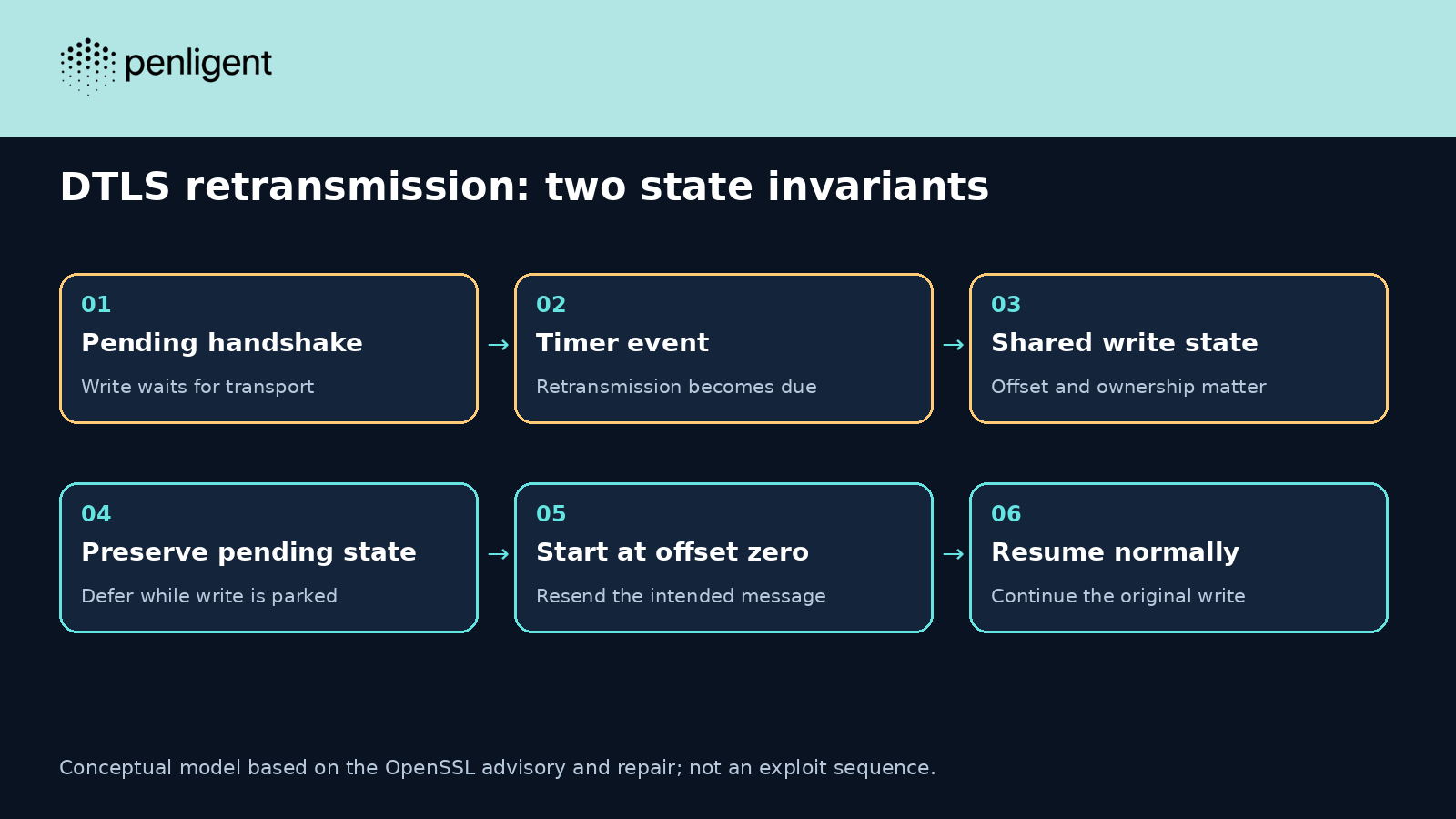
The mechanism is easiest to understand as an ownership problem. OpenSSL can be partway through emitting one handshake message when transport backpressure requires it to wait. If retransmission work reuses the same state before the original write can resume, the program must preserve both the correct message position and the unfinished operation’s bookkeeping. Those are separate obligations.
Die official advisory describes a retransmitted message using a stale position from a different suspended write. It also describes retransmission disturbing state required to resume that write. Depending on the resulting read and build behavior, the documented outcomes include disclosure or process failure. The important distinction is between sending the wrong bytes and corrupting the continuation state; fixing only one does not explain the complete repair.
In the upstream patch, one change resets the retransmission offset and another prevents retransmission while a handshake write remains parked. The accompanying regression work exercises suspended writes and timer events in both endpoint roles. This combination matters to maintainers evaluating a backport: a patch that merely looks like a bounds check may not preserve the intended state transitions.
The application-facing meaning of a suspended operation is documented separately. OpenSSL’s SSL_get_error documentation explains that WANT_READ and WANT_WRITE can indicate incomplete operations that should be retried under the appropriate conditions. A retry indication is not inherently a security failure. It is an ordinary execution state that must retain correct ownership of the data and progress needed for continuation.
That distinction changes the way a developer reads telemetry. Counting every WANT_WRITE as a vulnerability event would confuse normal backpressure with a specific defect. Ignoring the state entirely would make a lab unable to explain why its test never reaches the relevant interleaving. The useful observation is a sequence: what operation was pending, what event ran next, and whether continuation preserved its intended state.
There is also a difference between a true concurrent race and an interleaving across callbacks. A timer and a later retry can produce harmful state reuse even when application code does not launch simultaneous threads. This article uses a sequential educational model below so readers can inspect that idea without assuming that the CVE requires a particular threading architecture. The actual implementation must still be assessed against the upstream code and application integration.
The best technical question is therefore not “How many packets trigger it?” Publicly verified information does not justify a universal answer. Ask which state is active when retransmission becomes eligible, who owns the reusable buffer, and whether the deployed patch prevents an unfinished write from being overwritten. These questions lead to reproducible engineering evidence instead of an unreliable recipe copied from an unverified exploit repository.
What the impact statement does and does not establish
A memory-disclosure finding establishes a confidentiality concern; it does not identify every secret that might exist in a particular process. The OpenSSL record describes heap data potentially reaching the peer. Determining whether a real deployment exposed credentials, session material, or other sensitive data requires evidence about that process and the observed bytes. Do not convert a possible impact category into a claim of confirmed credential theft.
For risk assessment, ask what data the DTLS-handling process is permitted to hold and how it is separated from other work. A narrowly scoped service account and a small process boundary can reduce the amount of valuable state available to an attacker. They do not repair the library. Record those controls as factors in impact and containment rather than as an alternative patch status.
Availability needs a different measurement. A process exit may affect one disposable worker, all sessions on an appliance, or a larger dependency chain, depending on the application’s architecture. A restart policy can hide visible downtime while still dropping users and consuming operational effort. Describe the actual service boundary instead of repeating the CVSS label as if it measured your deployment’s outage.
The advisory does not establish remote code execution. An out-of-bounds read, a process abort, and arbitrary code execution are different outcomes with different evidentiary requirements. A dramatic title that combines them would make the article less useful to the people deciding whether to isolate a service or rotate credentials. Keep the severity attached to the documented defect and explain the local consequence separately.
This research did not establish a verified exploitation campaign for this CVE. The vendor advisory and patch used here provide a technical basis for remediation, not a complete view of all activity on the Internet. Absence of a confirmed incident in these sources is not proof that exploitation has never occurred. It is a boundary on what this article can responsibly claim.
Build an exposure record before running a network test
An exposure record should connect a named application to a named dependency and a named protocol path. Start with one service you own rather than a sweep of every machine. Record its deployment identifier, responsible person, executable or image, and expected peers. This small amount of preparation prevents a later result from being attached to the wrong asset.
There are three useful confidence levels. At the first, an inventory tool finds an OpenSSL dependency. At the second, local configuration or application documentation establishes that the service uses DTLS through that dependency. At the third, deployment evidence establishes which build is running and whether it contains the repair. Keep each level visible. A dependency finding can be valid even when reachability remains unknown.
The dependency record should also state whether the application uses a system library, a bundled shared object, or a static build. These packaging choices change who can ship the repair. They do not change the basic requirement to connect the application to its actual code. When the packaging is unknown, ask the maintainer for a build manifest instead of assuming the operating system controls every copy.
For a small application, a brief record can be enough: service name, artifact digest, library origin, DTLS configuration, ingress path, vendor notice, planned action, and verification owner. The record becomes more valuable when each statement links to an observation. A screenshot of a dashboard may support deployment identity; a package query may support a package revision; neither independently establishes the network execution path.
Separate negative findings by their scope. “No DTLS configured in this application build” is different from “No UDP socket observed at the time of inspection.” The first can be a meaningful configuration conclusion if supported by complete evidence. The second is only a point-in-time observation. Neither should be silently expanded into “The organization is not affected.”
| Evidence collected | Reasonable conclusion | Conclusion it cannot support alone |
|---|---|---|
| OpenSSL entry in an SBOM | A dependency requires classification. | The affected DTLS path is remotely reachable. |
| Application configuration enabling DTLS | The relevant protocol is part of the deployment. | The process uses an affected OpenSSL build. |
| Vendor notice and full package revision | The installed package can be assessed against vendor guidance. | Every running process has loaded it. |
| Process identity and loaded-library evidence | A specific process can be associated with a library artifact. | No private static copy exists elsewhere. |
| A successful normal handshake | A tested path is functional under those conditions. | The CVE cannot be triggered. |
| A crash during testing | The application failed and needs investigation. | CVE-2026-84782 caused the failure. |
This evidence ladder is a proposed assessment method, not a vendor detection signature. Its purpose is to make conclusions proportional to their support. That matters when a developer needs to decide between an immediate service restart, a scheduled image rebuild, and a vendor inquiry. All three may be appropriate, but they should follow the evidence attached to the specific application.
Local inventory commands and their limits
Run these read-only examples on systems and processes you administer. They collect local inventory; they do not exploit or remotely test the CVE. Start with the OpenSSL executable selected by your current shell. The official openssl version command reference documents the version and build-information options. Preserve the full output together with the collection time.
# Local inventory only: this identifies the CLI selected by this shell.
command -v openssl
openssl version -a

# Debian/Ubuntu package inventory, where these package names exist.
dpkg-query -W -f='${binary:Package}\t${Version}\n' openssl libssl3 libssl3t64 2>/dev/null

# RPM-based package inventory, where these packages exist.
rpm -q openssl openssl-libs
Some package names will not exist on a given release, and an absent package is not an error to conceal. Keep that observation and use the names documented for your platform. Do not run every platform’s package command and merge the output into an apparently universal result. The operating system, repository, architecture, and package revision must remain associated.
The shell executable may not be the library used by your service. A developer could install a newer CLI in a personal tools directory while the service still loads an older system library. Another application could ship its own copy under an application directory. Therefore, treat the CLI result as a starting point and compare it with the service’s own build and runtime evidence.
On a Linux host, an authorized operator can inspect the mapped files for a known process. The following example takes a PID supplied by the operator; it does not discover or access a remote target. Permissions and process namespaces can limit the result. A restricted view should be recorded as incomplete, not interpreted as evidence that no dependency exists.
# Replace 12345 with the PID of your own application.
# Review the selected PID before running the command.
app_pid=12345
ps -p "$app_pid" -o pid,lstart,args
rg 'libssl|libcrypto' "/proc/$app_pid/maps"
A mapped path helps connect a running process to a shared object, but it still needs interpretation. Preserve the artifact identity and package origin. A file marked deleted may indicate that a process retains a previously mapped object after an on-disk replacement. An absence of matching paths does not exclude static linking, alternate library names, a different namespace, or an implementation that is not OpenSSL.
For containers, conduct inventory inside the actual deployed artifact or its approved inspection environment. Running a package query on the host does not inspect the container filesystem. Likewise, rebuilding an image tag does not prove that every replica uses the new digest. Record the deployment’s resolved image identity and verify the replacement instances after rollout.
For desktop applications and appliances, prefer the publisher’s supported inventory interface. Do not replace a bundled cryptographic library by copying files into an installation directory. Such a change can produce an unsupported or inconsistent application without proving that the relevant component uses the replacement. Ask for the affected product build and the supported update path.
The commands should leave you with an evidence bundle, not an automatic verdict. A complete bundle can include CLI output, package inventory, process start time, mapped-library paths, application configuration, and the corresponding vendor notice. If two records disagree, keep the disagreement visible. Resolving it is usually more valuable than running another generic vulnerability scan.
A safe offline model of the stale-offset problem
The following Python program is an educational state model. It does not load OpenSSL, implement DTLS, send packets, read arbitrary process memory, or reproduce CVE-2026-84782. Its purpose is to demonstrate why a retransmission must use the correct starting position and why a suspended write should retain ownership of its state. All displayed bytes are deliberately chosen toy data.
Save the program as dtls_state_model.py and run it with Python 3. It has no third-party dependencies. The model contains two independent mistakes: reusing another message’s position and replacing state while the original write is pending. The corrected model defers work while parked, then starts a retransmission from its own beginning.
from dataclasses import dataclass

@dataclass
class State:
    buffer: bytes
    offset: int
    pending: bool

# These strings are ordinary literals, never captured memory.
queued_message = b"HELLO"
parked_message = b"LARGER_HANDSHAKE"


def wrong_offset_demo():
    state = State(buffer=parked_message, offset=3, pending=True)
    state.buffer = queued_message
    observed = state.buffer[state.offset:]
    print("wrong offset:", observed.decode())
    assert observed != queued_message


def wrong_ownership_demo():
    state = State(buffer=parked_message, offset=3, pending=True)
    saved = (state.buffer, state.offset, state.pending)
    state.buffer = queued_message
    state.offset = 0
    # Resetting the offset alone still replaced a pending write's state.
    print("pending state preserved:", saved == (
        state.buffer, state.offset, state.pending))
    assert saved != (state.buffer, state.offset, state.pending)


def guarded_retransmit(state, queued):
    if state.pending:
        return "deferred", None
    state.buffer = queued
    state.offset = 0
    return "sent", state.buffer[state.offset:]


def corrected_demo():
    state = State(buffer=parked_message, offset=3, pending=True)
    saved = (state.buffer, state.offset, state.pending)
    status, data = guarded_retransmit(state, queued_message)
    assert status == "deferred" and data is None
    assert saved == (state.buffer, state.offset, state.pending)
    print("guarded while pending:", status)
    # The model now represents completion of the original write.
    state.pending = False
    status, data = guarded_retransmit(state, queued_message)
    assert status == "sent" and data == queued_message
    print("after continuation:", data.decode())


wrong_offset_demo()
wrong_ownership_demo()
corrected_demo()
print("PASS: both modeled invariants checked")
wrong offset: LO
pending state preserved: False
guarded while pending: deferred
after continuation: HELLO
PASS: both modeled invariants checked
The first output is intentionally mundane. The model produces the suffix of a known string because an offset belonging to another message was retained. Python’s slice operation remains memory safe, so the example cannot demonstrate an out-of-bounds read. That limitation is a feature of the teaching model: it exposes the logical error without giving readers a memory-disclosure tool.
The second output shows why resetting a position alone is insufficient. A pending operation still expects its original buffer and progress. Replacing them changes what a later continuation means, even if the replacement message starts at offset zero. This is a general state-management lesson, not a claim that the Python objects correspond exactly to OpenSSL’s internal structures.
The corrected case checks two invariants. When the original operation is pending, retransmission does not modify its state. When retransmission becomes eligible, it starts at its own first byte. A regression test that checks only the final output can miss the first invariant. A test that checks only preservation can miss a wrong starting position when retransmission later proceeds.
Do not use the demonstration as proof that a product is patched. It never executes the product’s implementation. Its value is to help application owners and reviewers discuss the repair precisely and design appropriate tests in an isolated engineering environment. Real verification still requires the supported update and evidence about the running application.
Designing a regression test that answers a real question
A meaningful regression test should name the invariant before it names the tool. For this class of bug, the useful questions concern preservation of a parked write, correct progress when that write resumes, and valid retransmission after it becomes eligible. A single successful handshake covers ordinary functionality but cannot establish that all of those states were exercised.
Die upstream repair includes dedicated DTLS regression work. Maintainers reviewing a backport should use that work as a reference rather than inventing an unrelated “TLS check.” Preserve the exact source revision, test invocation, build configuration, and result. A result without the revision cannot establish which implementation was tested.
Application integration tests should add their own boundary checks. A library test can validate library behavior, but it cannot decide whether your event loop schedules retries correctly or whether your application treats an incomplete operation as a fatal error. Those are separate questions. A good test plan states which layer each test addresses and avoids claiming coverage outside it.
Use an isolated development environment with disposable data. Introduce only the controlled conditions required by an approved test design, keep packet capture scope narrow, and stop if the application behaves unexpectedly. There is no need to expose a deliberately vulnerable build to the public Internet to understand the state transition. A lab that cannot be isolated is a reason to rely on supported patch evidence, not to test more aggressively in production.
Compare more than pass and fail. Record whether the intended branch was reached, whether normal communication resumed, and whether unexpected alerts or process exits occurred. A test can pass because it never reached the interesting state. Instrumentation or a maintainer’s test assertion can distinguish that from a genuine validation of the repair.
Keep security verification and capacity benchmarking separate. A heavily loaded service can fail for many reasons, and a timing-sensitive failure under stress is not automatically this CVE. Establish a normal baseline first. If a test produces an unexplained crash, preserve it as a failure requiring diagnosis rather than forcing it into the vulnerability category you expected to find.
Keep the test fixtures under version control with the application when practical. A fixture should identify its expected state transitions and the reason each assertion exists, so a future refactor cannot silently remove the important condition while preserving a passing test. Review failures as evidence about a specific invariant rather than as a general score for the application. Also keep laboratory build settings separate from production settings: a diagnostic build can expose a failure differently, and an observation from that build should retain its context. This makes the regression useful after the immediate security update, when a maintainer needs to decide whether a later change preserves the same behavior.
Patch the application, not just the package list
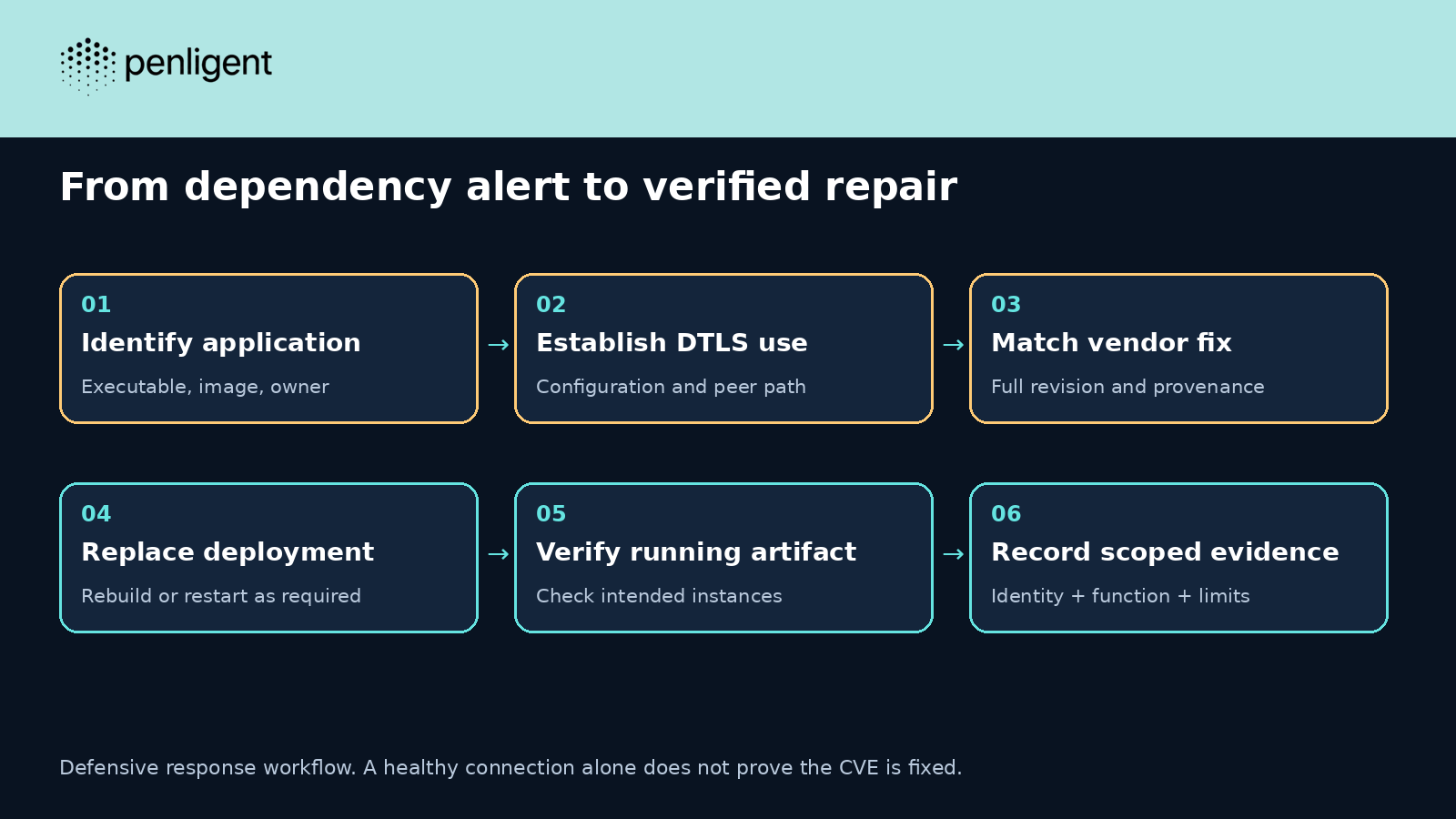
Remediation is a dependency replacement followed by a deployment verification. Begin with the maintainer responsible for the affected artifact. For a distribution-managed library, use the distribution’s supported security update. For an application bundle, use the application publisher’s repair. For a source build, use a supported upstream release containing the fix and rebuild the dependent application when its linkage requires that.
The specific package action depends on the platform and support channel. Ubuntu’s security notice provides a concrete example of release-specific remediation instructions. Do not transplant package revisions from one operating-system release into another. A vendor-supported build can contain the fix without matching the upstream version string a scanner expects, so retain the vendor notice alongside the package evidence.
Before changing a production service, establish a rollback artifact and the criteria for using it. A rollback to a known vulnerable build reintroduces the security issue; it should therefore be paired with a documented containment decision and a new repair deadline. Availability recovery and security closure are different states. A healthy service running the old dependency is operationally recovered but not remediated.
For a dynamically linked service, replacing the library file does not by itself establish the contents of a process that was already running. Plan the supported service restart or replacement and verify the new process afterward. For a statically linked service, the dependent executable normally needs a rebuilt artifact rather than a system-library replacement. Confirm the packaging with the maintainer instead of guessing from a file extension.
A container rollout has an additional trap: an updated base image is only an input to a build. The deployed application must actually be rebuilt and replaced. Record the old and new immutable image identities, inspect the new artifact, and verify that all intended instances moved to it. A mutable tag that now resolves differently does not describe replicas already launched from its previous contents.
For a solo developer, the workflow can stay small. Maintain one issue containing the affected service, update source, build identifier, restart time, and verification result. Attach the raw local inventory output and a short explanation of DTLS use. That is more useful than a large report that repeats the CVE description but cannot establish which application instance changed.
| Deployment type | Primary repair owner | Evidence needed after the change |
|---|---|---|
| System-packaged shared library | Operating-system maintainer and service operator | Fixed package revision, replacement process, and service check. |
| Application-bundled shared library | Application publisher | Updated product build and bundled dependency evidence. |
| Static application build | Application build owner | Rebuilt executable, dependency provenance, and new deployment identity. |
| Containerized service | Image builder and deployment owner | Patched image digest and rollout evidence for intended replicas. |
| Managed appliance or hosted service | Service provider or appliance vendor | Product-specific status, maintenance scope, and supported verification. |
These are deployment responsibilities, not claims that all products in the categories are affected. The exposure investigation must first establish OpenSSL and DTLS use. Once it does, the packaging model determines the repair route. Keeping that order avoids both unnecessary changes to unrelated services and incomplete changes to the real affected application.
Temporary containment should name the boundary it controls
If an immediate update is unavailable, identify the exact path you can restrict. Disabling an unused DTLS feature or limiting access to known required peers may reduce exposure in a deployment where those controls are supported and effective. Treat such measures as locally evaluated containment, not as an OpenSSL-published workaround or proof of remediation.
Document what remains reachable after the control. “Restricted traffic” is too vague to assess. State the service, allowed sources, transport, enforcement point, and verification method. If a client application initiates sessions to untrusted peers, a server-side inbound rule may not address that path. The containment must match the endpoint role established during inventory.
A web application firewall rule written for HTTP is not evidence that the affected DTLS-handling component is protected. Before relying on any intermediary, establish whether the relevant traffic traverses it and whether it enforces a control on that protocol. A control that operates on a different path can be useful for other threats while providing no supported assurance for this finding.
A restart policy also has a narrower purpose than a patch. It can improve recovery from a process failure, but it does not explain whether confidentiality was affected or whether repeated failures remain possible. Preserve availability monitoring, but do not close the vulnerability because the process comes back automatically. Recovery behavior belongs in the service-impact assessment.
A temporary decision needs an expiry or review condition. For example, a team might restrict an unnecessary service until the vendor supplies a supported application build, then remove the restriction only after verification. Record who owns that follow-up and what evidence will permit it. Otherwise, temporary measures tend to become undocumented permanent architecture.
Do not weaken certificate verification or cryptographic settings to make a compatibility test pass after updating. That would change the security properties of the service while obscuring the original issue. Investigate the compatibility failure with the maintainer, preserve its evidence, and use a supported configuration. A successful connection achieved by removing validation is not a successful repair verification.
Verify the running state and the business function separately
A closure test should establish two things: the intended dependency is present in the deployed application, and the application still performs its required function. Neither implies the other. A fixed image can fail to start; a healthy service can still use the old artifact. Keep the security check and the functionality check distinct in the change record.
Start by comparing immutable identities. Confirm the executable, package revision, or image digest against the approved repair artifact. Then associate that identity with the replacement process or managed service instance. A timestamp alone is weaker evidence because an old build can also start recently. Where possible, retain both identity and start time so the record explains what changed and when.
Next, exercise the service’s supported normal workflow with test data. Verify connection establishment, expected application behavior, and clean completion. This is a functional smoke test, not a vulnerability trigger. State that limitation in the evidence. It helps reviewers understand why normal communication was tested without assuming that the test proves the absence of a memory-safety defect.
For a deployment with multiple replicas, verify the scope explicitly. A successful check against one instance does not establish that the rollout reached another region, a standby node, or an old worker. Define the intended population before sampling. If complete verification is unavailable, record the sampled scope and the remaining uncertainty rather than describing the entire service as checked.
Compare failure signals before and after replacement. Application restarts, handshake failures, and user-visible interruptions can reveal a bad rollout or an existing reliability issue. They cannot alone attribute a crash to this CVE. If the replacement changes those signals, preserve the timing and deployment identity so engineering can distinguish a library change from a simultaneous configuration or traffic change.
A good closure statement is specific: “The named service uses the vendor-fixed application build, replacement instances were verified, and the normal test workflow passed.” A weak statement is “The scanner is green.” The scanner can be a supporting observation, but it should not carry facts about library provenance and application state that it did not measure.
Detection: useful signals without an invented signature
The primary sources used here do not provide a universal production detection rule. Do not label an ordinary DTLS retransmission, packet loss event, or WANT_WRITE result as an exploit signature. Those observations can occur in legitimate operation. Detection should correlate application behavior, network context, and implementation evidence before assigning a cause.
Begin with telemetry you already collect: process exits, crash reports, service restart counts, and handshake error metrics. Associate each signal with a build identity and time window. An alert saying only “OpenSSL error” gives an investigator little basis for distinguishing a peer disconnect, configuration problem, malformed traffic, or memory-safety failure.
If packet capture is authorized and necessary, scope it to the affected service and a bounded period. Record the capture point because encrypted traffic and intermediaries can limit what is observable. A capture that never sees the endpoint’s handshake cannot establish what that endpoint transmitted. Protect captured data as potentially sensitive evidence, especially when the investigation concerns possible unintended disclosure.
Crash evidence should include the executable build, loaded library identities, relevant symbols when available, and the circumstances preceding failure. A stack trace that passes through a cryptographic library is a lead, not a CVE diagnosis. Several unrelated defects and integration mistakes can produce failures during secure communication. Correlating the failure with the documented state transition is the harder and more useful work.
Do not collect real secrets to make a demonstration convincing. Use synthetic data in an isolated lab, minimize production capture, and restrict access to evidence. If an investigation identifies actual sensitive material, follow the organization’s incident process. The testing goal is to understand and repair a boundary failure, not to broaden the exposure while proving that it exists.
There is value in a clearly written negative result. “No matching crash observed during this monitoring period” describes what the telemetry shows. “No exploitation occurred” claims far more. Keep the observation, the collection window, and the visibility limits together. This discipline prevents a quiet dashboard from being mistaken for comprehensive evidence about confidentiality.
When to treat the finding as an incident
A dependency alert alone usually begins vulnerability management. Evidence of unexpected memory disclosure, a suspicious failure sequence, or credible vendor notification can justify an incident investigation. The transition should follow a documented trigger. It should not depend on how dramatic the vulnerability name sounds or whether a search term is rising.
For suspected disclosure, preserve the relevant artifacts before they are replaced or aged out, subject to the service’s operational needs. Record the application version, process identity, affected peers, time window, and available observations. Do not delay containment indefinitely to obtain a perfect capture. The incident owner should balance evidence preservation and continued exposure using the actual service context.
Credential rotation should follow the plausible scope of exposure. If an investigation establishes that a process held sensitive credentials and that unintended disclosure occurred, rotation may be appropriate. If the only evidence is an old library in an unused feature, a claim that all credentials were stolen is unsupported. The report should connect the decision to evidence and uncertainty instead of treating every memory bug as the same incident.
Record what cannot be reconstructed. An application may not log enough to determine whether a particular handshake exposed data. That gap does not establish compromise, and it does not establish safety. An honest investigation can close with bounded uncertainty after containment and repair, provided the responsible owner accepts the residual risk and documents the reasoning.
Three deployment decisions worked through
A developer finds an old library in a personal project
Imagine a developer who receives a dependency alert for an application image. The image includes OpenSSL, but the developer does not know whether the application uses DTLS. The first action is to identify the dependency’s origin and the application’s configured protocol features. Rebuilding immediately may be sensible maintenance, but the initial report should still distinguish an affected component from demonstrated external exposure.
If the project uses only a different protocol path, document that conclusion with the relevant configuration and build evidence, then apply the supported dependency update through the normal process. Do not write “exploitable DTLS memory leak” in a bug report simply because the package appears in an image. That wording asserts reachability the investigation has not established and makes future triage harder.
If DTLS is enabled, identify which component performs it and how peers reach it. Update the image through its maintainer-supported path, replace the application instance, and test its normal function. The closing evidence should name the new artifact and the tested configuration. The developer can then explain both why the change was prioritized and what the verification actually demonstrated.
A small operator updates the host but not the service
In a second illustrative case, an operator installs the operating system’s security packages and sees the expected version in a shell. The application has been running continuously since before the update. The package evidence supports an on-disk repair, but the running-service evidence is incomplete. The next action is to follow the supported replacement procedure and inspect the resulting process.
This is an ownership problem as much as a tooling problem. The person authorized to install packages may not own the service’s maintenance window. Assign both actions in the same change record so the handoff is explicit. A vulnerability ticket should not close automatically when the package task completes if a required application replacement remains open.
If restarting reveals a compatibility failure, preserve the failure and follow the rollback criteria. Do not silently leave half the instances on the previous artifact. Record the remaining population, any temporary containment, and the next repair action. A mixed deployment can be manageable, but it must not be described as uniformly fixed.
A tester receives a version-only scanner result
In the third case, a tester is asked to validate a scanner finding against an owned service. The result lists a CVE and a guessed version, but it does not identify the application’s dependency source. The tester should first obtain local or vendor evidence. Repeatedly sending ordinary handshakes will not turn a guessed version into proof about a private library copy.
The report can retain the scanner observation while qualifying its confidence. State that the component association is unverified, request the relevant build record, and avoid an unsupported severity escalation. If the owner supplies a vendor-fixed package revision, attach the advisory and explain why a version-only comparison was insufficient. If the owner supplies an affected build with DTLS enabled, prioritize the supported repair.
None of these examples describes an observed incident or benchmark. They are decision exercises showing how the same CVE can lead to different next actions when the evidence differs. The common requirement is traceability from the finding to an application, from the application to its dependency, and from the repair to the running replacement.
Automate evidence collection without automating the conclusion
Automation is most useful where the inputs and expected outputs are explicit. A task can collect approved inventory commands, record an image identity, compare package evidence with a maintained policy, and assemble a report. It should retain raw observations and identify unavailable checks. A generated explanation should never replace an observation that the tool did not actually make.
For a solo tester, keep the workflow bounded to an owned application. State the approved target, allowed local inspection, prohibited disruptive tests, and the evidence needed to finish. A successful workflow returns an assessment with unresolved questions where appropriate. It does not keep probing until it produces the dramatic answer suggested by a vulnerability title.
Penligent can be considered as part of an authorized testing workflow, but a product-generated report still needs the same evidence boundaries. Do not treat an AI assessment as independent proof that CVE-2026-84782 is reachable or repaired. Keep the application inventory, vendor notice, deployment identity, and human review available alongside any automated output.
A useful automation acceptance test asks whether another person could reproduce the conclusion from the attached records. If the report says an update was verified, it should identify the artifact and observation supporting that statement. If a step lacked permission or tooling, the report should say so. This is a stronger measure of value than how many tool names appear in a transcript.
The accompanying product video shows a general testing workflow. It is not a demonstration of exploiting this OpenSSL CVE, a dedicated DTLS detector, or proof of a particular patch state.
An evidence-based closure record
A compact closure record should answer what was affected, what changed, and what remains uncertain. Keep its statements testable. Instead of “OpenSSL issue resolved,” identify the application build, dependency source, vendor repair reference, deployment completion time, and verification scope. The purpose is to let a later reviewer understand the decision without reconstructing a chat conversation.
Preserve the original observation as well as the final state. If the initial finding was based on an imprecise version match, note how it was corrected. If the application was genuinely affected, retain the relationship between the old artifact and the replacement. Both cases teach the next investigation something useful; deleting the uncertainty from the history makes future automation less trustworthy.
Use separate fields for installed state, running state, and protocol configuration. A single boolean called “patched” hides distinctions that matter during maintenance. The installed state can be fixed while the running state is unknown. The running build can be verified while a forgotten replica remains outside scope. Recording these distinctions prevents premature closure without requiring a complicated process.
Any exception should name an owner, a review date, and the reason a supported repair is unavailable. Keep containment separate from the desired final state. If the vendor cannot provide a maintained build, migration becomes a product and reliability decision as well as a security task. Avoid representing indefinite use of an unsupported dependency as a completed fix.
For independent consultants, precise wording also improves communication with customers. A customer can act on “replace these two service instances and attach the new image digests.” They cannot reliably act on “OpenSSL is dangerous.” The value of the assessment lies in identifying the decision and its supporting evidence, not in repeating the most alarming possible impact.
Frequently asked questions
What is CVE-2026-84782?
- It is the OpenSSL DTLS retransmission issue described in the vendor vulnerability record. It concerns a stale buffer position and interference with a suspended write. Assess the relevant application path before claiming deployment exposure.
Does every HTTPS server using OpenSSL need to be marked exploitable?
- No. An OpenSSL dependency alone does not establish reachability of the affected DTLS path. Inventory the actual protocol implementation and configuration. Keep general dependency maintenance separate from a claim of demonstrated exploitability.
Can I verify the fix using only openssl version?
- No. That command identifies the executable selected by your shell. You also need the relevant package or application vendor status and evidence connecting the running application to the repaired artifact. Bundled and static dependencies require their own verification.
Is a distribution package vulnerable because its upstream number looks old?
- Not necessarily. Compare the complete package revision with the security notice for that distribution release. Do not discard the package suffix, and do not substitute another release’s update instructions. The local dependency origin determines which maintainer’s evidence applies.
Does using a FIPS provider remove the application risk?
- Do not use that as an assurance. The advisory places the affected code outside the FIPS module boundary. Evaluate the surrounding application’s DTLS path and supported update separately.
Is the Python example a working exploit?
- No. It is an offline model using literal strings and memory-safe slicing. It demonstrates state ownership and offset handling. It does not load OpenSSL, exchange datagrams, reveal memory, or establish that a real deployment is affected.
Should I rotate every credential after finding this CVE?
- Base that decision on the affected process, credible disclosure evidence, and incident scope. A dependency alert is not proof of credential theft. Where exposure is suspected, preserve evidence and let the incident owner assess rotation alongside containment and repair.
What evidence is enough to close the repair?
- Identify the supported fixed artifact, verify the relevant running instances use it, and check the required application workflow. Record the scope, time, and remaining limitations. A successful normal handshake alone is a functionality observation, not a complete security verification.
Resolve the dependency and the running path
CVE-2026-84782 rewards precise investigation. Establish the DTLS implementation, choose the update from the maintainer responsible for that artifact, and verify the running replacement. Preserve enough evidence for another person to distinguish an installed repair, a completed deployment, and an unresolved question. That is what turns a rising vulnerability name into a useful engineering action.
 German
 English
 French
 Spanish
 Portuguese
 Japanese
 Korean
 Hindi
 Arabic
 Turkish
 Hebrew