
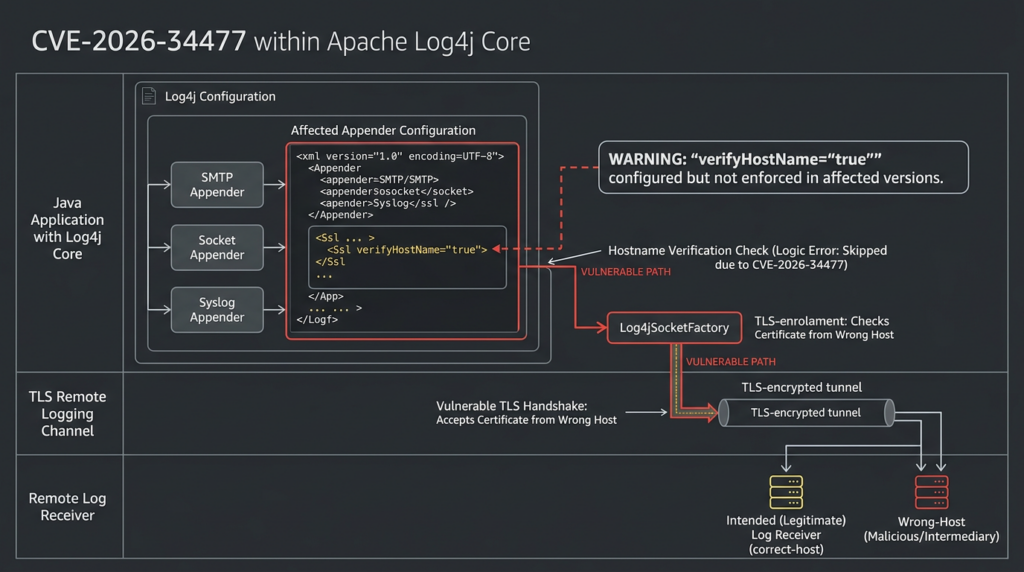
CVE-2026-34477 is not another Log4Shell. It is narrower, quieter, and easier to misjudge. The flaw sits in Apache Log4j Core’s TLS configuration path for remote logging appenders. When a vulnerable application uses an SMTP, Socket, or Syslog appender with a nested <Ssl> element, the verifyHostName attribute can appear in configuration without actually being honored. In practical terms, a team may believe it has enabled TLS hostname verification for remote log delivery while the affected Log4j runtime still accepts a certificate whose identity does not match the intended log receiver. Apache lists the issue as a medium-severity Log4j Core vulnerability, with affected versions [2.12.0, 2.25.4) y 3.0.0-alpha1 through 3.0.0-beta3, and fixed version 2.25.4. (Apache Logging Services)
That difference matters. CVE-2021-44228 turned attacker-controlled log data into remote code execution in many real deployments. CVE-2026-34477 turns remote logging into a trust-boundary problem. The vulnerable behavior does not appear merely because a Java application includes log4j-core. It matters when the application sends logs over TLS to a remote SMTP, Socket, or Syslog destination and relies on Log4j’s verifyHostName setting to reject the wrong endpoint. Apache’s advisory says exploitation requires a network-based attacker who can present a certificate issued by a CA trusted by the appender’s configured trust store, or by the default Java trust store if no custom trust store is configured. (Apache Logging Services)
A medium CVSS score should not make defenders dismiss it. Remote logs often contain stack traces, service names, internal hostnames, request IDs, session-adjacent metadata, authentication events, operational evidence, and incident-response context. If the wrong endpoint can receive or redirect that stream, the exposure is not just “some log lines.” It is a loss of trust in telemetry. For security teams, the right response is not panic. The right response is dependency inventory, configuration review, path validation, trust-store reduction, and an upgrade to Log4j Core 2.25.4 or later.
Fast facts for defenders
| Campo | Verified state |
|---|---|
| CVE | CVE-2026-34477 |
| Producto | Apache Log4j Core |
| Componente afectado | TLS configuration used by SMTP, Socket, and Syslog appenders with nested <Ssl> configuración |
| Versiones afectadas | Log4j Core [2.12.0, 2.25.4) y 3.0.0-alpha1 through 3.0.0-beta3 |
| Versión corregida | Log4j Core 2.25.4 |
| Weakness classes | NVD lists CWE-295, and Apache lists CWE-297 for certificate host mismatch validation |
| CVSS signal | Apache CVSS 4.0 score 6.3, Medium |
| Riesgo primario | Man-in-the-middle interception or redirection of remote log traffic under specific conditions |
| Required attacker condition | Ability to intercept or redirect the connection and present a certificate trusted by the appender trust store or default Java trust store |
| No afectados | HTTP Appender, according to Apache, because it uses a separate hostname verification path and verifies host names by default |
| First-line remediation | Upgrade Apache Log4j Core to 2.25.4 or later |
NVD shows the CVE was published on April 10, 2026, last modified on June 17, 2026, and sourced from Apache Software Foundation. NVD also records CISA-ADP SSVC options indicating “exploitation: none,” “automatable: no,” and “technicalImpact: partial” as of the listed SSVC timestamp. That does not prove no one will ever exploit it; it means public prioritization data should be read as context rather than as a substitute for local exposure analysis. (NVD)
What actually breaks
TLS has two different jobs that engineers sometimes collapse into one phrase. It encrypts traffic, and it authenticates the peer. Encryption protects the bytes in transit from passive observers. Peer authentication answers a different question: is the other endpoint really the service I meant to connect to?
Hostname verification is the part of TLS identity checking that compares the name the client intended to reach with the names presented in the server certificate. If an application connects to logs.example.internal, the certificate should be valid for logs.example.internal, not merely signed by some trusted CA for an unrelated name. Without hostname verification, a client can accept a certificate that is cryptographically valid but belongs to the wrong service.
Apache’s Log4j network appender documentation exposes this distinction through the Ssl component. The Ssl configuration includes a verifyHostName boolean attribute. The same page documents the HTTP Appender separately, with a verifyHostName default of verdadero and a description stating that the X.509 certificate hostname is compared with the requested hostname and the connection fails on mismatch. (Apache Logging Services)
CVE-2026-34477 exists because the documented security expectation for the nested <Ssl> path did not match the affected runtime behavior. Apache states that the verifyHostName configuration attribute was introduced in Log4j Core 2.12.0 but was silently ignored through 2.25.3 when configured through the <Ssl> element. The dangerous word is “silently.” A configuration that fails closed is inconvenient but visible. A configuration that looks secure and does nothing is worse because it creates false confidence.
A typical vulnerable-looking configuration might resemble this:
<Configuration status="WARN">
  <Appenders>
    <Socket name="REMOTE_SYSLOG"
            host="logs.example.internal"
            port="6514"
            protocol="SSL">
      <Rfc5424Layout appName="billing-api"
                     facility="LOCAL0"
                     enterpriseNumber="18060"
                     newLineEscape="\n"/>
      <Ssl verifyHostName="true">
        <TrustStore location="/etc/billing/logging-truststore.p12"
                    password="${env:LOG_TRUSTSTORE_PASSWORD}"/>
      </Ssl>
    </Socket>
  </Appenders>

  <Loggers>
    <Root level="info">
      <AppenderRef ref="REMOTE_SYSLOG"/>
    </Root>
  </Loggers>
</Configuration>
An operator reading this file would reasonably believe hostname verification is enabled for the remote TLS logging channel. In affected Log4j Core versions, that assumption may be wrong. The risk is not that TLS disappears. The risk is that TLS may authenticate only to “some certificate chain the client trusts,” not to the intended log receiver identity.
Why this is a trust-boundary vulnerability, not a generic Log4j emergency
The most common mistake is to treat every Log4j CVE like Log4Shell. That leads to bad prioritization in both directions. Some teams overreact to the word “Log4j” and open a production incident before checking whether the vulnerable path is reachable. Other teams underreact to the word “medium” and miss the fact that remote telemetry is a security-sensitive data flow.
CVE-2026-34477 sits between those extremes. It is not a universal unauthenticated RCE. It is not triggered by logging an attacker-controlled string. It does not mean every application with log4j-core is exploitable from the internet. It does mean that organizations using remote TLS logging with affected appenders should verify whether their apparent hostname validation was ever active.
Apache’s advisory narrows the attack conditions. A network-based attacker may be able to perform a man-in-the-middle attack only when an SMTP, Socket, or Syslog appender is in use, TLS is configured through a nested <Ssl> element, and the attacker can present a certificate issued by a CA trusted by the appender’s trust store or the default Java trust store. Apache also states that the HTTP Appender is not affected because it uses a separate verifyHostname attribute and verifies host names by default. (Apache Logging Services)
That condition set changes the response. A public-facing application that uses Log4j only for local file logging does not suddenly expose a remote interception path because of this CVE. A backend service that forwards audit events over TLS to a central syslog receiver across a flat internal network deserves closer review. A product that bundles affected Log4j Core but does not configure the affected appenders may create scanner noise but not the full CVE-2026-34477 attack chain.
The incomplete-fix chain from CVE-2025-68161
CVE-2026-34477 is easier to understand if you start with CVE-2025-68161. Apache describes CVE-2025-68161 as missing TLS hostname verification in the Socket Appender. A man-in-the-middle attacker could intercept or redirect log traffic if they could sit between the client and log receiver and present a certificate trusted by the Socket Appender’s trust store or default Java trust store. Apache advised users to upgrade Log4j Core to 2.25.3 for that earlier issue and, for earlier versions, reduce risk by restricting the trust store used by the Socket Appender. (Apache Logging Services)
CVE-2026-34477 is the uncomfortable follow-up. Apache says the fix for CVE-2025-68161 was incomplete. It addressed hostname verification when enabled through the log4j2.sslVerifyHostName system property, but not when configured through the verifyHostName attribute of the <Ssl> element. That is exactly the kind of partial remediation that gives defenders a false sense of closure: the bug class was known, a patch shipped, but one supported configuration path remained broken. (Apache Logging Services)
This history changes how teams should read the advisory. The issue is not only “upgrade from vulnerable version to fixed version.” It is also “validate that the specific configuration mechanism you rely on is actually honored.” Security controls can exist in documentation, configuration files, release notes, and code comments while still being absent in the runtime path that matters.
The public GitHub issue trail reinforces that point. In issue #4061, a user reported that, when using Log4j 2.25.3 after addressing CVE-2025-68161, the ComponentBuilder API failed to recognize verifyHostName as a valid attribute for a nested Ssl component. The issue body notes that Log4j2Plugins.dat contained Ssl but did not contain verifyHostName, suggesting plugin metadata was not correctly updated for that configuration path. (GitHub)
The fix landed in PR #4075. The pull request description says it updates usage of SslConfiguration#createSSLConfiguration to the four-parameter factory method introduced in Log4j 2.12.0, so newer configuration parameters are correctly propagated during SSL configuration creation. The reviewed changes include moving @PluginFactory to the four-parameter factory, adding tests to verify verifyHostName is recognized through plugin metadata, and adding TLS SocketAppender tests for hostname verification behavior. (GitHub)
The lesson is broader than Log4j. Any security fix with multiple configuration surfaces needs tests for each surface. A system property path, an XML attribute path, a JSON configuration path, and a programmatic builder path may all look like one feature to the operator. They may not be one code path to the framework.
Affected and unaffected deployments
A practical CVE-2026-34477 assessment should start with four questions:
| Question | Por qué es importante |
|---|---|
Es org.apache.logging.log4j:log4j-core present in an affected version range? | Without affected Log4j Core, this CVE does not apply. |
| Is the application using SMTP, Socket, or Syslog appender for remote logging? | The vulnerability is tied to specific remote appender paths, not all logging. |
Is TLS configured through a nested <Ssl> element? | The broken path is the nested Ssl configuration attribute path. |
Is the environment relying on verifyHostName to prevent wrong-host certificates? | The security failure is that this setting can be silently ignored in affected versions. |
| Can an attacker influence the network path and present a trusted certificate? | The attack is a man-in-the-middle scenario, not a simple remote request exploit. |
Log4j’s Socket Appender writes output to a remote destination using TCP or UDP sockets and can optionally secure communication with TLS. Apache’s documentation also notes that TCP and TLS variants write to the socket as a stream and do not expect a response from the target destination. That matters operationally because log delivery paths may fail or behave unexpectedly without an application-level acknowledgment model. (Apache Logging Services)
The Syslog Appender inherits the remaining configuration attributes and nested elements from the Socket Appender and the chosen layout, so a TLS-backed Syslog path can fall into the same review scope. Apache’s examples show Syslog configurations with nested <Ssl> elements and trust-store settings. (Apache Logging Services)
The SMTP Appender also supports TLS parameters through nested Ssl configuration. Apache’s example uses smtpProtocol="smtps" and a nested <Ssl> element with KeyStore y TrustStore. That makes SMTP appender configurations relevant when they send security or audit events through TLS. (Apache Logging Services)
The HTTP Appender is the important exception. Apache says CVE-2026-34477 does not affect HTTP Appender users because HTTP Appender uses a separate verifyHostname attribute, was not subject to this bug, and verifies host names by default. (Apache Logging Services)
Why certificate trust stores decide the real blast radius
The attacker condition in the advisory includes a key phrase: “trusted by the appender’s configured trust store, or by the default Java trust store if none is configured.” That is not a minor implementation detail. It is one of the main reasons this vulnerability can be high-value in some environments and low-risk in others.
A tightly scoped trust store that contains only an internal CA dedicated to the logging receiver leaves less room for a wrong service certificate to be accepted. A broad trust store that inherits the default Java CA set expands the set of certificates that may pass chain validation. CVE-2026-34477 is specifically about hostname validation, not CA validation. But if hostname validation is absent, CA validation becomes too coarse: “signed by someone I trust for something” can be mistaken for “this is my log receiver.”
NIST SP 800-52 Rev. 2 guidance emphasizes trust anchor store discipline, including that trust anchor stores should contain only trust anchors for CAs that issue certificates under acceptable policies. Apache’s CVE-2025-68161 advisory points to the same kind of trust-store narrowing as a risk-reduction measure for affected remote logging paths. (Publicaciones del NIST)
For defenders, this means the priority order is not only version-based. A vulnerable version with a dedicated private trust store and a tightly controlled network path is not the same operational risk as the same vulnerable version using the default Java trust store across a broad internal network. Both should be patched. The second deserves more urgent review.
Realistic attack and abuse scenarios
The most plausible attack does not look like an internet-wide scanner firing a payload at a web form. It looks like a network-position attacker exploiting trust assumptions inside infrastructure.
Scenario 1, remote syslog inside a flat network
A Java application sends audit logs to syslog.internal.example on TCP 6514 using a Log4j Socket or Syslog appender with TLS. The configuration includes <Ssl verifyHostName="true">, so the operations team believes the application will reject any certificate not valid for the syslog receiver. The application runs a vulnerable Log4j Core version.
An attacker who has compromised a host on the same network segment or can redirect DNS or routing for the log receiver presents a certificate that chains to a CA trusted by the application’s default Java trust store. If hostname verification is not enforced, the appender may accept the attacker’s endpoint even though the certificate identity does not match syslog.internal.example.
The attacker can now receive log events meant for the real collector. Depending on the application, those logs may contain user identifiers, service tokens accidentally written to logs, stack traces, authorization failures, request metadata, feature flags, or incident evidence. Even if the attacker cannot modify the application, they may gain enough observability to plan follow-on attacks.
Scenario 2, SMTP appender for security alerts
A service uses Log4j’s SMTP Appender to send high-severity security events to an internal mailbox or alert processor. The SMTP path uses SMTPS and a nested Ssl element. If the appender accepts a wrong-host certificate because hostname verification is ignored, an attacker with network position may intercept alert emails or redirect them away from the intended mailbox.
This is less common than local logging, but it is not imaginary. SMTP appenders often exist in older enterprise applications, admin portals, or high-signal security event paths. The risk is not mass exploitation. The risk is that a targeted attacker suppresses or captures the very evidence defenders expect to receive.
Scenario 3, log integrity loss during incident response
During an incident, defenders reconstruct events from centralized logs. If an attacker could previously impersonate a logging receiver, the team must ask uncomfortable questions. Were log events captured by the wrong endpoint? Were events dropped? Did the application continue operating under the belief that remote logging was intact? Were downstream SIEM alerts affected?
CVE-2026-34477’s Apache CVSS vector includes low vulnerable-system confidentiality impact and low subsequent-system integrity impact. That scoring reflects a constrained vulnerability, not a harmless one. Logs have evidentiary value. When the log channel’s endpoint identity is wrong, the incident record becomes weaker.
How to find vulnerable Log4j Core in real systems
Start with dependency inventory. Do not stop there.
For Maven projects:
mvn -q dependency:tree | grep -i "org.apache.logging.log4j:log4j-core"
For Gradle projects:
./gradlew dependencies --configuration runtimeClasspath | grep -i "log4j-core"
For unpacked application directories:
find /opt /srv /app -type f -name "log4j-core-*.jar" 2>/dev/null
For a fat JAR:
jar tf app.jar | grep -i "log4j-core"
For container images exported to a local filesystem:
grep -R --binary-files=without-match -n "log4j-core" ./image-rootfs 2>/dev/null | head
find ./image-rootfs -type f -name "log4j-core-*.jar" 2>/dev/null
For SBOM-driven inventory, search package URLs:
jq -r '.components[]? | select(.purl? | test("pkg:maven/org.apache.logging.log4j/log4j-core")) | [.name, .version, .purl] | @tsv' sbom.cdx.json
Dependency inventory answers only the first question: is the library present? CVE-2026-34477 requires configuration and reachability. A service that has log4j-core-2.17.2.jar but only logs to local files may still need an upgrade for lifecycle hygiene, but it does not automatically have a remote TLS hostname verification exposure. A service that sends audit logs over TLS to a remote syslog collector does.
How to inspect Log4j configuration for the affected path
Look for three things together: affected appender type, nested Ssl, and hostname verification assumptions.
# Common Log4j configuration files
find . -type f \( \
  -name "log4j2.xml" -o \
  -name "log4j2.properties" -o \
  -name "log4j2.yaml" -o \
  -name "log4j2.yml" -o \
  -name "log4j2.json" \
\) -print
Search for the relevant appender types:
grep -R -n -E "<(Socket|Syslog|SMTP)\b|appender\..*\.type\s*=\s*(Socket|Syslog|SMTP)|\b(Socket|Syslog|SMTP):" .
Search for nested TLS configuration:
grep -R -n -E "<Ssl\b|ssl\.type\s*=\s*Ssl|\bSsl:" .
Search for hostname verification settings:
grep -R -n -i -E "verifyHostName|verifyHostname|sslVerifyHostName" .
For XML, a risky pattern may look like this:
<Syslog name="SYSLOG"
        host="syslog.local"
        port="6514"
        format="RFC5424">
  <Ssl verifyHostName="true">
    <TrustStore location="truststore.p12"
                password="${env:TRUSTSTORE_PASSWORD}"/>
  </Ssl>
</Syslog>
For properties syntax, look for:
appender.0.type = Syslog
appender.0.name = SYSLOG
appender.0.host = syslog.local
appender.0.port = 6514
appender.0.ssl.type = Ssl
appender.0.ssl.ts.type = TrustStore
appender.0.ssl.ts.location = /etc/app/truststore.p12
appender.0.ssl.ts.password = ${env:TRUSTSTORE_PASSWORD}
appender.0.ssl.verifyHostName = true
The exact property names may vary by configuration style and version. Do not rely only on one grep pattern. Review the appender documentation, the generated effective configuration, and runtime behavior.
Programmatic configuration deserves special review
CVE-2026-34477 is not only an XML problem. The public issue that led into the fix involved the ComponentBuilder API. The reporter attempted to create an Ssl component and add verifyHostName="true" programmatically for a Syslog or Socket appender, but Log4j 2.25.3 reported that Ssl contained an invalid element or attribute verifyHostName. The reporter also checked plugin metadata and found Ssl but not verifyHostName. (GitHub)
That means mature reviews should include code as well as configuration files. Search for builder-based Log4j configuration:
grep -R -n -E "ConfigurationBuilderFactory|newComponent\(\"Ssl\"\)|newAppender\(\".*(Socket|Syslog|SMTP)" src/ .
A simplified Java pattern might look like this:
ConfigurationBuilder<BuiltConfiguration> builder =
    ConfigurationBuilderFactory.newConfigurationBuilder();

ComponentBuilder<?> ssl = builder.newComponent("Ssl")
    .addAttribute("protocol", "TLS")
    .addAttribute("verifyHostName", "true");

AppenderComponentBuilder appender = builder.newAppender("SYSLOG", "Syslog")
    .addAttribute("host", "syslog.local")
    .addAttribute("port", 6514)
    .addComponent(ssl);
In affected versions, the problem is not that the operator forgot the control. The problem is that the control may not be recognized or propagated correctly through the relevant plugin factory path. That is why merely seeing verifyHostName in code or config is not enough evidence of safety.
Safe validation without attacking your own logging pipeline
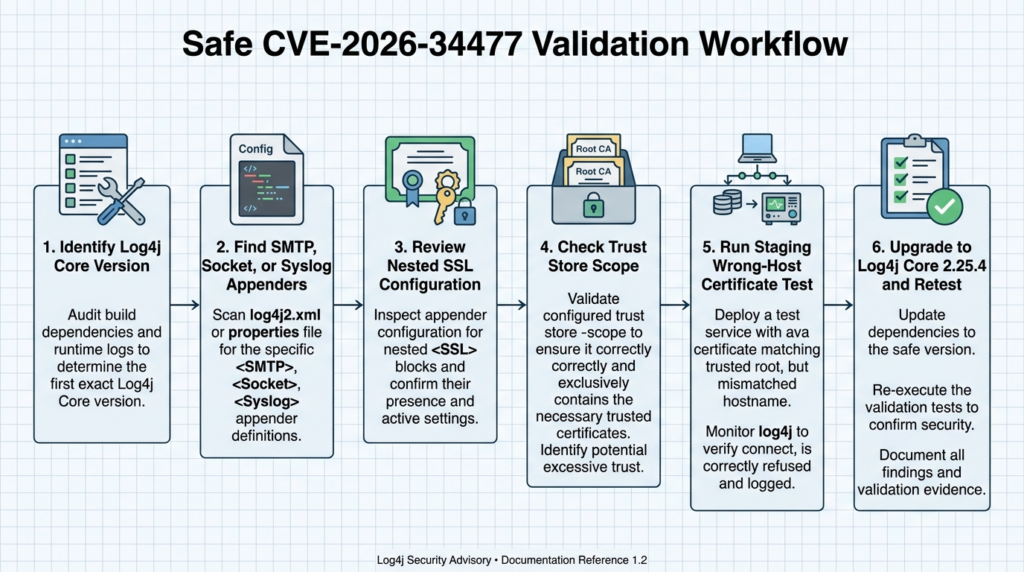
Do not perform a live man-in-the-middle test against production log traffic. Do not redirect production logs to a fake receiver. Do not issue certificates for unauthorized names. Do not intercept sensitive log streams just to prove a point.
A safe validation workflow should be staged and evidence-driven:
| Paso | Objetivo | Safe evidence |
|---|---|---|
| Confirm version | Identify whether Log4j Core is in the affected range | Build files, SBOM, JAR filename, Maven tree, runtime classpath |
| Confirm appender | Determine whether SMTP, Socket, or Syslog appender is used | Log4j configuration, programmatic builder code, effective runtime config |
| Confirm TLS path | Verify nested <Ssl> or equivalent configuration | Config file, appender docs, startup logs |
| Confirm hostname assumption | Identify whether the service relies on verifyHostName | Config, code review, Java system properties |
| Confirm trust store | Determine how broad the accepted CA set is | keytool -list, trust-store path, Java defaults |
| Reproduce safely | Test in a staging environment with non-sensitive logs | Controlled mismatch certificate and local test receiver |
| Remediate | Upgrade and reduce trust-store scope | Version evidence, restart evidence, passing mismatch test |
A staging mismatch test can be useful when done carefully. The purpose is not to capture real logs. The purpose is to prove that a client fails when a certificate is validly signed but issued for the wrong host.
In a lab, you can create two hostnames:
intended receiver: logs.test.local
certificate name: wrong.test.local
A correct client connecting to logs.test.local should reject a certificate valid only for wrong.test.local, even if the certificate chains to a trusted lab CA. A vulnerable or incorrectly configured path may accept it.
Java TLS debug can help, but it is noisy:
java \
  -Djavax.net.debug=ssl,handshake \
  -Dlog4j2.debug=true \
  -jar app-under-test.jar
Use it in a small staging reproduction, not in busy production services. It can expose sensitive handshake and configuration details in logs.
To inspect a trust store:
keytool -list \
  -keystore /etc/app/logging-truststore.p12 \
  -storetype PKCS12
To inspect a receiver certificate:
openssl s_client \
  -connect logs.example.internal:6514 \
  -servername logs.example.internal \
  -showcerts </dev/null
That command helps you view the certificate chain presented by the receiver. It does not prove Log4j is enforcing hostname verification. It is one piece of evidence in a broader validation process.
Remediation that actually closes the issue
The clean fix is to upgrade Apache Log4j Core to 2.25.4 or later. Apache explicitly lists 2.25.4 as the fixed version for CVE-2026-34477. GitHub Advisory Database also lists affected versions as >= 2.12.0, < 2.25.4 y >= 3.0.0-alpha1, <= 3.0.0-beta3, with patched version 2.25.4. (Apache Logging Services)
For Maven:
<dependencyManagement>
  <dependencies>
    <dependency>
      <groupId>org.apache.logging.log4j</groupId>
      <artifactId>log4j-bom</artifactId>
      <version>2.25.4</version>
      <scope>import</scope>
      <type>pom</type>
    </dependency>
  </dependencies>
</dependencyManagement>
Then depend on Log4j modules without pinning mismatched versions:
<dependency>
  <groupId>org.apache.logging.log4j</groupId>
  <artifactId>log4j-core</artifactId>
</dependency>
For Gradle:
dependencies {
    implementation platform("org.apache.logging.log4j:log4j-bom:2.25.4")
    implementation "org.apache.logging.log4j:log4j-core"
}
After the upgrade, rebuild and confirm the runtime artifact, not only the source file:
mvn -q dependency:tree | grep -i "log4j-core"
find target -type f -name "log4j-core-*.jar" -print
For containerized deployments, rebuild the image and check the running container:
docker run --rm your-image:patched sh -c 'find / -type f -name "log4j-core-*.jar" 2>/dev/null'
For emergency risk reduction before a full upgrade, HeroDevs notes that on 2.25.3 a temporary measure is to set -Dlog4j2.sslVerifyHostName=true, because that system-property pathway was introduced for CVE-2025-68161 and is separate from the broken <Ssl verifyHostName="true"> attribute parsing path. That should be treated as a temporary control, not a reason to stay on a vulnerable release. (HeroDevs)
Example JVM flag:
java -Dlog4j2.sslVerifyHostName=true -jar app.jar
This workaround should be paired with configuration review and a planned upgrade. It should not be used as a blanket justification for leaving affected Log4j Core versions in production.
Hardening beyond the patch
Patch first, but do not stop at the patch. CVE-2026-34477 exposes a weak point in many logging architectures: teams often protect the application endpoint more carefully than the telemetry endpoint. That is backward. Logs carry evidence. Evidence needs integrity and correct destination identity.
Recommended hardening actions:
| Controlar | What to do | Why it helps |
|---|---|---|
| Use a narrow trust store | Include only the CA or certificate chain needed for the logging receiver | Reduces the chance that a wrong but publicly trusted certificate is accepted |
| Prefer private or enterprise CA for internal log receivers | Issue receiver certificates under a controlled internal trust chain | Limits trust to organizational logging infrastructure |
| Use mTLS where appropriate | Require both client and server authentication | Makes impersonation harder and improves receiver-side control |
| Segment logging traffic | Restrict which hosts can connect to log receivers | Reduces opportunities for network-position attacks |
| Monitor DNS and routing changes | Alert on unexpected changes for log receiver names | Helps detect redirection attempts |
| Avoid logging secrets | Treat log streams as sensitive but never as safe for credentials | Limits damage if logs are exposed |
| Validate runtime config | Confirm effective appender configuration after deployment | Prevents false assurance from stale or unused config files |
| Test mismatch behavior in staging | Prove that wrong-host certificates fail | Turns assumed TLS identity into evidence |
A good trust store is small. If the application sends logs only to syslog.internal.example, the trust store should not need dozens or hundreds of public CAs. The fewer trust anchors the appender accepts, the fewer certificates an attacker can use if hostname validation fails elsewhere in the stack.
What scanners get right and wrong
Software composition analysis tools are valuable here. They can find affected log4j-core versions across build files, containers, fat JARs, and vendor bundles. They cannot always tell whether the vulnerable appender path is reachable.
That distinction creates two common errors:
| Scanner result | Bad interpretation | Better interpretation |
|---|---|---|
log4j-core affected version found | “The service is exploitable.” | “The service needs configuration and reachability review.” |
| No public exploit found | “We can ignore it.” | “Exploitability is constrained, but remote log trust still needs validation.” |
| HTTP Appender present | “All TLS logging is affected.” | “HTTP Appender is excluded by Apache for this CVE; verify other appenders.” |
| Vendor package uses backported fix | “Version string must be vulnerable.” | “Check vendor advisory and patch provenance.” |
| Local file logging only | “Patch is unnecessary.” | “Exploit path may be absent, but dependency hygiene and vendor support still matter.” |
Debian’s tracker is a useful reminder that downstream package status may differ from upstream version matching. It lists source package status across releases and notes fixed or not-affected states for certain Debian package contexts. That does not override Apache’s upstream advisory for your custom application, but it does show why enterprise triage should combine upstream CVE data, vendor advisories, package metadata, and actual runtime configuration. (Security Tracker)
How CVE-2026-34477 compares to nearby Log4j issues
Log4j’s recent and historical CVEs show that “logging vulnerability” is not one category. Different bugs touch different parts of the logging pipeline: message lookup, appender configuration, layout escaping, TLS identity, log injection, and downstream parsing.
| CVE | Core issue | Why it is relevant | Clase práctica |
|---|---|---|---|
| CVE-2021-44228 | JNDI lookup leading to attacker-controlled remote code execution | It made Log4j a global emergency because attacker-controlled log data could become code execution | Logging libraries can become application attack surface |
| CVE-2021-45046 | Incomplete fix for Log4Shell in certain non-default configurations | It showed that first patches can miss important edge paths | Validate mitigations, not just version numbers |
| CVE-2021-45105 | Self-referential lookup recursion causing denial of service | It shifted focus from RCE to availability in logging evaluation | Non-RCE Log4j issues can still be operationally serious |
| CVE-2021-44832 | JDBC Appender RCE in certain configurations when an attacker can control logging configuration | It tied appender configuration to code execution risk | Configuration authority is a high-value security boundary |
| CVE-2020-9488 | Improper certificate host mismatch validation in SMTP Appender and related SslConfiguration uso | It is an earlier hostname-verification failure in Log4j TLS behavior | TLS identity bugs have appeared before in logging paths |
| CVE-2025-68161 | Missing TLS hostname verification in Socket Appender | It is the direct predecessor to CVE-2026-34477 | Partial fixes must cover every supported configuration path |
| CVE-2026-34477 | verifyHostName silently ignored through nested <Ssl> attribute path | It is the current remote logging trust issue | Configured security controls need runtime proof |
| CVE-2026-34478 | Log injection in Rfc5424Layout due to silent configuration incompatibility | It affects stream-based syslog services and newline escaping assumptions | Log integrity depends on layout behavior as well as transport |
| CVE-2026-34479 | Silent log event loss in Log4j1XmlLayout due to XML forbidden characters | It affects bridge and compatibility usage | Legacy compatibility layers can create modern observability gaps |
| CVE-2026-34480 | Silent log event loss in XmlLayout due to unescaped XML 1.0 forbidden characters | It affects downstream XML log processing | A log can be “written” but still unusable by the system that needs it |
Apache’s security page lists CVE-2026-34478, CVE-2026-34479, and CVE-2026-34480 near CVE-2026-34477, all fixed in 2.25.4, with different impacts around log injection, malformed XML, and silent log event loss. (Apache Logging Services) The shared theme is not “Log4j equals RCE.” The shared theme is that logging pipelines are security infrastructure. They must preserve confidentiality, destination identity, integrity, and parseability.
Why remote logs are more sensitive than teams admit
Security teams often say, “Do not log secrets,” and then treat logs as low-risk because secrets are not supposed to be there. That is not enough.
Logs can reveal:
| Data type | Por qué es importante |
|---|---|
| Internal service names | Helps attackers map architecture |
| Stack traces | Reveals frameworks, file paths, class names, and failure modes |
| User IDs and tenant IDs | Enables targeting and correlation |
| Request IDs | Helps reconstruct business workflows |
| Authentication failures | Reveals account discovery and brute-force patterns |
| Authorization decisions | Shows where access control boundaries exist |
| Feature flags | Reveals hidden functionality or rollout state |
| Cloud resource names | Aids lateral movement planning |
| Error messages from integrations | May expose tokens, endpoints, or partner systems |
| Incident markers | Shows what defenders detected and when |
Even when individual fields are not secrets, the aggregate stream can be intelligence. A man-in-the-middle attack against remote logging is therefore not just a confidentiality bug. It can become an operational visibility bug. If the attacker can capture, redirect, or interfere with logging delivery, defenders may lose the record they need most.
Evidence collection and retesting workflow
A strong remediation record for CVE-2026-34477 should include more than a ticket that says “bumped Log4j.” Capture evidence that answers the questions a reviewer, auditor, or incident commander would ask later.
Useful evidence includes:
1. Application or service name
2. Owner team
3. Build artifact or container image digest
4. Previous Log4j Core version
5. New Log4j Core version
6. Appender types in use
7. Whether SMTP, Socket, or Syslog appenders are configured
8. Whether nested Ssl configuration is present
9. Trust store path and trust anchor scope
10. Whether Java default trust store is used
11. Whether hostname verification is enabled after upgrade
12. Whether wrong-host certificate test fails in staging
13. Deployment timestamp
14. Restart or rollout evidence
15. Residual risk and owner sign-off
A compact internal report might look like this:
Service: billing-api
Artifact: registry.example.com/payments/billing-api@sha256:...
Previous Log4j Core: 2.25.3
Remediated Log4j Core: 2.25.4
Remote appender: Syslog over TLS to logs.example.internal:6514
Configuration path: log4j2.xml nested <Ssl verifyHostName="true">
Trust store: /etc/billing/logging-truststore.p12, internal logging CA only
Validation:
- Runtime classpath confirms log4j-core-2.25.4.jar
- Staging mismatch certificate for wrong.test.local rejected
- Correct receiver certificate accepted
- No production MITM or log interception performed
Residual risk:
- No default Java trust store fallback observed
- Network ACL restricts log receiver access to approved service subnets
This style of evidence prevents two failure modes. It stops teams from closing the ticket based only on a dependency scan, and it stops teams from running unsafe proof-of-concept activity in production.
In authorized environments where teams already use agent-assisted testing, this is also where workflow orchestration can help. Penligent’s public Log4j writing has already framed CVE-2025-68161 as a remote logging trust problem rather than a generic Log4j panic, and Penligent’s product positioning centers on controlled AI-assisted penetration testing, validation, and reporting for authorized security work. For a CVE-2026-34477 workflow, that kind of tool-assisted process is most useful when it keeps scope locked, gathers dependency and configuration evidence, separates safe validation from destructive interception, and produces a report a human reviewer can defend. (Penligente)
Common mistakes during remediation
Mistake 1, treating verifyHostName="true" as proof of safety
For this CVE, that attribute is part of the problem statement. In affected versions, the attribute may be silently ignored in the nested <Ssl> path. It is evidence that the operator intended to enable hostname verification. It is not proof that hostname verification occurred.
Mistake 2, relying only on log4j-api
Applications using log4j-api sin log4j-core do not exercise Log4j Core appenders. But many applications pull in both. Check the runtime classpath and packaged artifacts, not only the top-level dependency file.
Mistake 3, forgetting vendor bundles
Java applications often contain shaded or repackaged dependencies. Commercial products may bundle Log4j in plugin directories, agent directories, installers, or embedded service folders. A source repository scan may miss what ships.
Mistake 4, assuming internal networks are safe
The attack requires network position, but internal network position is not rare after initial compromise. Flat networks, shared Kubernetes clusters, weak DNS controls, transparent proxies, and misconfigured service meshes can all make internal traffic easier to influence than architecture diagrams suggest.
Mistake 5, leaving the default Java trust store in place
If the appender does not need broad public CA trust, do not give it broad public CA trust. Use a narrow trust store for internal log receivers.
Mistake 6, patching without retesting
The fix should be verified. In staging, a wrong-host certificate should fail. The correct receiver certificate should succeed. That is stronger evidence than a version string alone.
Mistake 7, confusing HTTP Appender with all remote appenders
Apache excludes HTTP Appender from this issue because it uses a separate hostname verification path. Do not waste time forcing the CVE onto HTTP Appender while missing Syslog, Socket, or SMTP paths.
Prioritization model
Not every finding deserves the same urgency. A useful model combines affected version, appender usage, network exposure, trust-store breadth, and data sensitivity.
| Prioridad | Environment profile | Medidas recomendadas |
|---|---|---|
| Critical internal priority | Affected Log4j Core, TLS Syslog or Socket appender, broad trust store, sensitive security or audit logs, weakly controlled internal network path | Upgrade immediately, narrow trust store, validate wrong-host rejection in staging, review log receiver access |
| Alta | Affected Log4j Core, TLS SMTP appender for security alerts, default Java trust store, reachable across shared network zones | Upgrade quickly, replace broad trust store, consider mTLS, verify alert delivery |
| Medio | Affected Log4j Core, remote TLS appender present, narrow internal CA trust store, restricted network path | Patch in near-term maintenance, document exposure conditions, retest after upgrade |
| Bajo | Affected Log4j Core present, no SMTP, Socket, or Syslog appender configured, local file logging only | Upgrade for hygiene, close scanner finding with configuration evidence |
| Needs vendor review | Affected Log4j Core appears in a third-party product | Check vendor advisory, product configuration, backported fixes, and support guidance |
The key is to avoid both scanner absolutism and scanner denial. A vulnerable package is a signal. Reachable remote TLS logging is the risk path.
Operational checklist
Use this checklist as a practical runbook.
Inventory
[ ] Identify all services containing org.apache.logging.log4j:log4j-core.
[ ] Confirm exact runtime versions, including fat JARs and containers.
[ ] Identify vendor products bundling Log4j Core.

Configuration
[ ] Search for SMTP, Socket, and Syslog appenders.
[ ] Search for nested Ssl elements or equivalent properties/YAML/JSON config.
[ ] Search for programmatic ConfigurationBuilder usage.
[ ] Identify use of verifyHostName or log4j2.sslVerifyHostName.

Exposure
[ ] Identify remote log receiver hostnames and ports.
[ ] Confirm whether TLS is used.
[ ] Identify network paths between application and receiver.
[ ] Check whether DNS, proxy, service mesh, or routing could redirect traffic.

Trust
[ ] Identify configured trust store.
[ ] Confirm whether default Java trust store is used.
[ ] List trust anchors and remove unnecessary CAs.
[ ] Prefer private CA or pinned internal trust chain where appropriate.

Remediation
[ ] Upgrade Log4j Core to 2.25.4 or later.
[ ] Rebuild and redeploy artifacts.
[ ] Confirm runtime classpath after deployment.
[ ] Restart services that load Log4j at startup.

Validation
[ ] In staging, confirm correct receiver certificate succeeds.
[ ] In staging, confirm wrong-host certificate fails.
[ ] Confirm logs reach the intended receiver after patching.
[ ] Capture evidence for audit and future incident review.
PREGUNTAS FRECUENTES
Is CVE-2026-34477 another Log4Shell?
- No. CVE-2026-34477 is not a general-purpose remote code execution flaw like CVE-2021-44228.
- It is a TLS hostname verification issue in Apache Log4j Core’s remote logging configuration path.
- The main risk is man-in-the-middle interception or redirection of remote log traffic when SMTP, Socket, or Syslog appenders use nested
<Ssl>configuration. - It still matters because logs can contain sensitive operational and security evidence.
Which Log4j versions are affected by CVE-2026-34477?
- Apache lists affected Log4j Core versions as
[2.12.0, 2.25.4)y3.0.0-alpha1through3.0.0-beta3. - Apache lists Log4j Core
2.25.4as the fixed version. - GitHub Advisory Database also lists patched version
2.25.4. - Vendor-packaged software may use backported fixes, so check the vendor advisory when Log4j is bundled inside a product.
Am I vulnerable if I only use local file logging?
- Usually, the full CVE-2026-34477 attack path is not reachable if the application only logs locally and does not use SMTP, Socket, or Syslog appenders over TLS.
- You should still upgrade affected Log4j Core versions for dependency hygiene and supportability.
- Keep evidence showing that no affected remote appender is configured, especially if a scanner opens a ticket.
- Recheck runtime configuration, not just source files, because deployed artifacts can differ from repositories.
Does setting verifyHostName="true" fix the issue?
- Not on affected versions. The vulnerability is that the
verifyHostNameattribute can be silently ignored when configured through the nested<Ssl>element. - The reliable fix is to upgrade Log4j Core to
2.25.4or later. - On Log4j Core
2.25.3, setting-Dlog4j2.sslVerifyHostName=truemay reduce risk as a temporary workaround, but it should not replace upgrading. - After patching, validate in staging that a wrong-host certificate is rejected.
How can I verify exposure without intercepting production logs?
- Confirm whether an affected Log4j Core version is present.
- Review Log4j configuration for SMTP, Socket, or Syslog appenders with nested
Ssl. - Identify whether the application uses a default Java trust store or a narrow custom trust store.
- Build a staging test with non-sensitive logs and a controlled wrong-host certificate.
- Do not run a production MITM test or redirect real log traffic to a fake receiver.
Is the HTTP Appender affected?
- Apache says the HTTP Appender is not affected by CVE-2026-34477.
- The HTTP Appender uses a separate hostname verification attribute and verifies host names by default.
- Do not assume that all remote logging is affected.
- Focus review on SMTP, Socket, and Syslog appenders using nested
<Ssl>configuration.
What should security teams do after upgrading?
- Confirm the runtime classpath contains Log4j Core
2.25.4or later. - Rebuild and redeploy containers or application packages rather than only changing source dependencies.
- Review trust stores and remove unnecessary public or broad CA trust.
- Validate in staging that wrong-host certificates fail.
- Save evidence of version, configuration, trust-store scope, validation result, and deployment time.
Closing judgment
CVE-2026-34477 is a good test of security maturity because it rewards precision. Treating it like Log4Shell wastes effort. Treating it like a harmless medium finding ignores the role remote logs play in detection, audit, and incident response.
The practical question is simple: do any of your Java services use affected Log4j Core versions to send logs over TLS through SMTP, Socket, or Syslog appenders while relying on verifyHostName for endpoint identity? If yes, upgrade to Log4j Core 2.25.4 or later, narrow the trust store, validate hostname mismatch failure in staging, and preserve the evidence. If no, document why the affected path is not reachable and still plan the dependency update. The value is not only closing one CVE. It is proving that the telemetry path your defenders rely on is actually talking to the host it claims to trust.


 Spanish
  English
  German
  French
  Portuguese
  Japanese
  Korean
  Hindi
Hindi  Arabic
  Turkish
  Hebrew