
CVE-2026-34486 is an Apache Tomcat cluster-security vulnerability caused by a regression in the fix for an earlier cryptographic flaw. The affected code could pass a received cluster message to downstream interceptors even after decryption failed, undermining the protection expected from Tomcat’s EncryptInterceptor.
The vulnerability is important, but its scope is much narrower than headlines such as “all Tomcat servers are remotely exploitable” would suggest. It affects exactly three upstream Apache Tomcat releases: 11.0.20, 10.1.53, and 9.0.116. Apache corrected the issue in Tomcat 11.0.21, 10.1.54, and 9.0.117.
More importantly, the vulnerable path belongs to the Apache Tribes clustering stack. A Tomcat deployment must use clustering, configure the EncryptInterceptor, and expose the relevant cluster communication path for the issue to become practically reachable. An ordinary standalone Tomcat server that only serves web traffic over HTTP or HTTPS does not automatically satisfy those conditions.
CVE-2026-34486 at a Glance
| Campo | Detalles |
|---|---|
| CVE | CVE-2026-34486 |
| Producto | Apache Tomcat |
| Componente | Apache Tribes EncryptInterceptor |
| Clase de vulnerabilidad | Missing Encryption of Sensitive Data |
| Primary CWE | CWE-311 |
| Versiones afectadas | Tomcat 11.0.20, 10.1.53, and 9.0.116 |
| Versiones fijas | Tomcat 11.0.21, 10.1.54, and 9.0.117 |
| Reported to Apache | March 26, 2026 |
| Public disclosure | 9 de abril de 2026 |
| Published severity | High, CVSS 3.1 score 7.5 |
| Published vector | CVSS:3.1/AV:N/AC:L/PR:N/UI:N/S:U/C:H/I:N/A:N |
| Confirmed impact | Loss of cluster-traffic confidentiality |
| Directly affected traffic | Tomcat cluster messages processed through EncryptInterceptor |
The official CVE record classifies CVE-2026-34486 as missing encryption of sensitive data and maps it to CWE-311. Published scoring assigns a CVSS 3.1 score of 7.5, with high confidentiality impact but no assigned integrity or availability impact.
This distinction matters. The authoritative records support a serious confidentiality finding. They do not, by themselves, establish that every affected deployment permits remote code execution, arbitrary session forgery, or full server takeover.
What Is the Tomcat EncryptInterceptor?
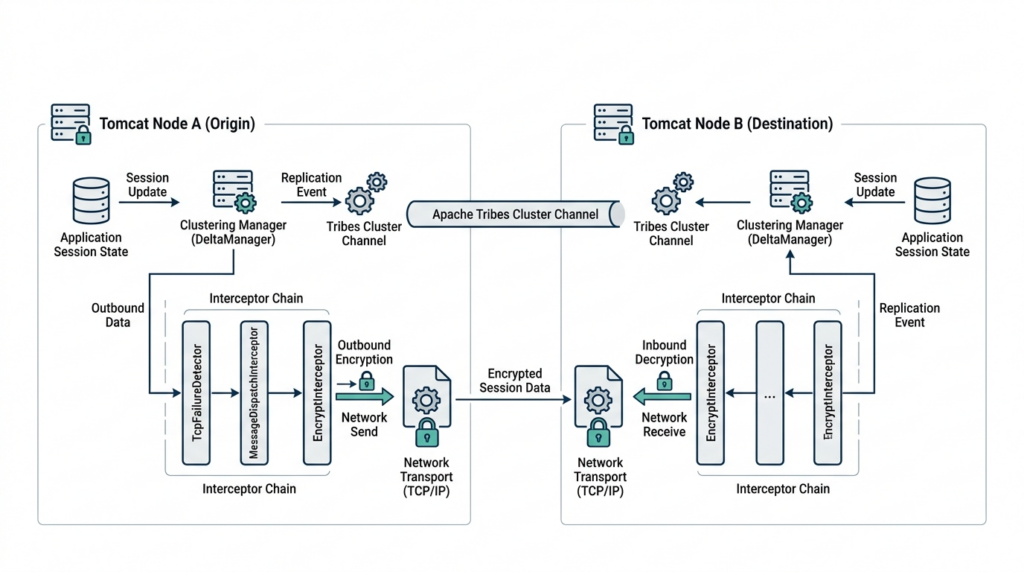
Apache Tomcat includes a clustering framework called Apache Tribes. Tomcat clusters can use Tribes to exchange membership information and application-related messages between nodes. One important use case is session replication: when an application needs sessions to remain available across multiple Tomcat instances, session state can be transferred between cluster members.
En EncryptInterceptor is an optional channel interceptor that adds encryption to messages traveling between those nodes. Apache describes it as protecting channel messages carrying session data and other cluster information between members.
A simplified message flow looks like this:
Application session state
          |
          v
Tomcat clustering manager
          |
          v
Apache Tribes channel
          |
          v
Configured channel interceptors
          |
          v
EncryptInterceptor
          |
          v
Cluster network transport
          |
          v
Receiving Tomcat node
On the sending node, messages move through the configured interceptor chain in definition order. On the receiving node, messages move through that chain in reverse order. The encryption interceptor therefore occupies a security-sensitive boundary: outbound messages should be encrypted before transmission, and inbound messages should be decrypted and validated before downstream cluster components process them.
Apache’s configuration guidance states that the EncryptInterceptor must be the final interceptor in the effective chain, except for the special interaction with TcpFailureDetector. When TcpFailureDetector is present, EncryptInterceptor must be defined immediately before it so that the intended ordering is preserved in both sending and receiving directions.
Correct placement is necessary because encryption is not merely an attribute added to a packet. It is part of a processing chain. If a message can reach later components without successfully passing the cryptographic boundary, the interceptor no longer provides the security guarantee its configuration implies.
Why Tomcat Cluster Traffic Can Be Sensitive
Tomcat cluster traffic may contain replicated session state and other internal messages. The sensitivity of that data depends on the application, its session-management design, and which objects the application stores in distributed sessions.
Potential examples include:
- Session identifiers or session-management metadata
- Authentication and authorization state
- Shopping-cart or workflow state
- Tenant or account context
- User preferences
- Application-specific serialized session attributes
Not every Tomcat application stores secrets in sessions, and teams should not assume that every cluster packet contains credentials. However, replicated session state is internal application data and should not be treated as harmless network noise.
Apache’s clustering security model assumes that cluster traffic runs over a secure and trusted network. Its security documentation warns against operating the cluster over an insecure or untrusted network. A correctly configured EncryptInterceptor can add confidentiality and integrity protection, although it does not eliminate every network risk, particularly denial-of-service attacks.
CVE-2026-34486 matters because affected deployments could believe this encryption boundary was being enforced when a failure path allowed messages to continue through the chain.
The Relationship Between CVE-2026-34486 and CVE-2026-29146
CVE-2026-34486 was introduced by the remediation for CVE-2026-29146.
The earlier vulnerability involved the cryptographic mode used by the EncryptInterceptor. Apache documented that the interceptor used CBC by default and was vulnerable to a padding-oracle attack. Apache’s fix expanded cryptographic handling, recommended AES/GCM/NoPadding, added algorithm restrictions, and changed error-handling behavior.
The key sequence was:
- Older Tomcat releases used
AES/CBC/PKCS5Paddingas the default for backward compatibility. - Apache addressed the padding-oracle weakness associated with that behavior.
- The patch changed the placement of a downstream message-forwarding call.
- That change caused messages to continue to the next interceptor even when decryption raised a
GeneralSecurityException. - Apache corrected the regression in the immediately following release for each maintained branch.
This is a classic patch-regression pattern. The first fix strengthened one part of the cryptographic implementation but unintentionally weakened the control flow around decryption failure.
The Root Cause: Failure-Open Control Flow
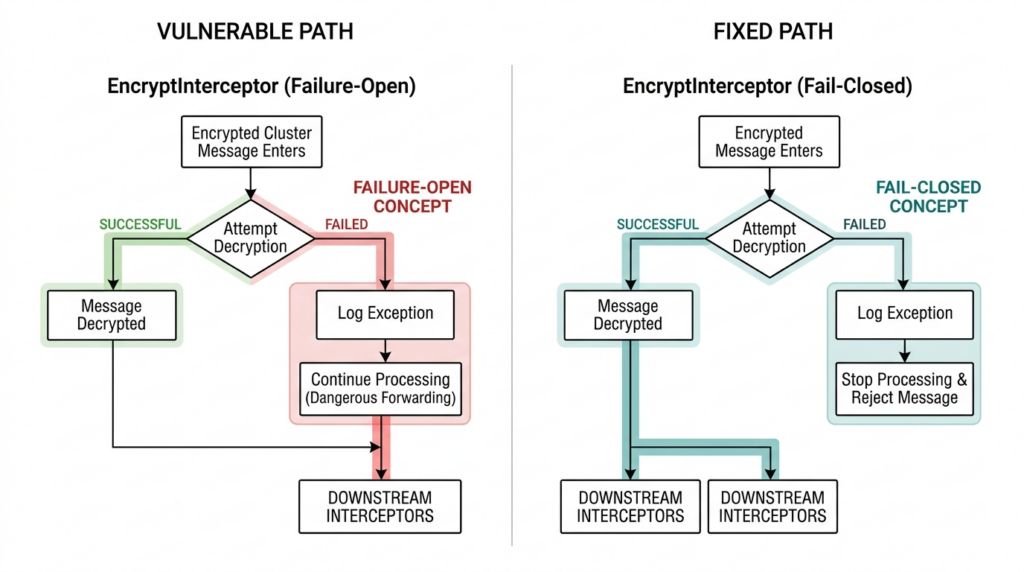
The most important technical detail in CVE-2026-34486 is not an obscure weakness in the AES algorithm. It is the location of one method call.
The vulnerable logic can be represented as follows:
try {
    byte[] decrypted = decrypt(message);
    replaceMessageData(decrypted);
} catch (GeneralSecurityException exception) {
    logDecryptionFailure(exception);
}

forwardMessageToNextInterceptor();
In this arrangement, forwardMessageToNextInterceptor() executes regardless of whether decryption succeeds.
When decryption succeeds, the message data is replaced with decrypted content and passed onward as expected. When decryption fails, the exception is logged—but execution still reaches the downstream forwarding call.
In the affected patch, super.messageReceived(msg) was moved from inside the successful decryption block to a position after the exception handler.
The corrected logic is equivalent to:
try {
    byte[] decrypted = decrypt(message);
    replaceMessageData(decrypted);

    forwardMessageToNextInterceptor();
} catch (GeneralSecurityException exception) {
    logDecryptionFailure(exception);
}
Now the message is forwarded only after decryption completes successfully. If decryption fails, processing stops at the encryption boundary.
Apache implemented this correction in separate branch-specific commits:
| Tomcat branch | Fix commit |
|---|---|
| Tomcat 11 | 1fab40cc |
| Tomcat 10.1 | 55f3eb91 |
| Tomcat 9 | 776e12b3 |
Each patch moves super.messageReceived(msg) back inside the try block. The code change is only one added line and one removed line in EncryptInterceptor.java, but the semantic effect is significant: decryption failure changes from a logging event followed by continued processing to a fail-closed condition.
Why Logging an Error Was Not Enough
A common defensive programming mistake is to treat an exception log as equivalent to rejecting the operation.
It is not.
A security control must define what happens after failure. In the vulnerable versions, the interceptor recognized that decryption failed and produced an error, but the message-processing pipeline continued. The system therefore detected the security failure without enforcing the required security decision.
The distinction can be expressed simply:
Detection:
"Decryption failed."

Enforcement:
"Because decryption failed, the message must not continue."
CVE-2026-34486 occurred because the first statement was implemented but the second guarantee was not maintained.
Cryptographic boundaries should generally fail closed. Failed decryption, failed authentication tags, invalid message formats, rejected nonces, and replay-detection failures should prevent the protected object from reaching components that assume verification has already succeeded.
Versiones afectadas y corregidas
Apache’s upstream affected-version range is unusually narrow.
| Product branch | Affected version | First fixed version | Medidas recomendadas |
|---|---|---|---|
| Apache Tomcat 11 | 11.0.20 | 11.0.21 | Upgrade to 11.0.21 or later |
| Apache Tomcat 10.1 | 10.1.53 | 10.1.54 | Upgrade to 10.1.54 or later |
| Apache Tomcat 9 | 9.0.116 | 9.0.117 | Upgrade to 9.0.117 or later |
The official Apache security pages identify only those individual versions as affected. The affected versions are also associated with the Maven components org.apache.tomcat:tomcat y org.apache.tomcat:tomcat-tribes.
This means a scanner that reports broad ranges such as “all Tomcat 9 versions before 9.0.117” is not accurately representing this specific regression. Older releases may be affected by CVE-2026-29146 or other vulnerabilities, but they were not all affected by CVE-2026-34486.
Release and Disclosure Timeline
| Date | Event |
|---|---|
| February 22, 2026 | CVE-2026-29146 was reported to the Tomcat security team |
| March 20–23, 2026 | Releases containing the earlier remediation were prepared across maintained branches |
| March 26, 2026 | The CVE-2026-34486 regression was reported to the Tomcat security team |
| April 2, 2026 | Tomcat 10.1.54 fixed CVE-2026-34486 |
| April 3, 2026 | Tomcat 9.0.117 fixed CVE-2026-34486 |
| April 4, 2026 | Tomcat 11.0.21 fixed CVE-2026-34486 |
| 9 de abril de 2026 | Apache publicly disclosed the vulnerability |
Is Every Apache Tomcat Server Vulnerable?
No.
A server is not practically exposed to CVE-2026-34486 merely because it runs Apache Tomcat.
The relevant conditions include:
- The installation contains one of the three affected upstream versions.
- Tomcat clustering is enabled.
- The Apache Tribes channel is in use.
EncryptInterceptoris configured in the cluster channel.- An attacker can reach, influence, or observe the applicable cluster communication path.
A standalone Tomcat instance without a configured cluster does not process session-replication messages through this interceptor.
Similarly, discovering Tomcat on TCP port 8080 does not prove that the Tribes cluster receiver is reachable. The ordinary HTTP connector and the cluster transport are different communication paths.
A responsible assessment must therefore distinguish between:
Tomcat web service detected
and:
Affected Tomcat version confirmed
+ clustering enabled
+ EncryptInterceptor configured
+ cluster transport identified
+ relevant network reachability established
Only the second evidence chain supports a meaningful CVE-2026-34486 exposure finding.
Realistic Attack Preconditions
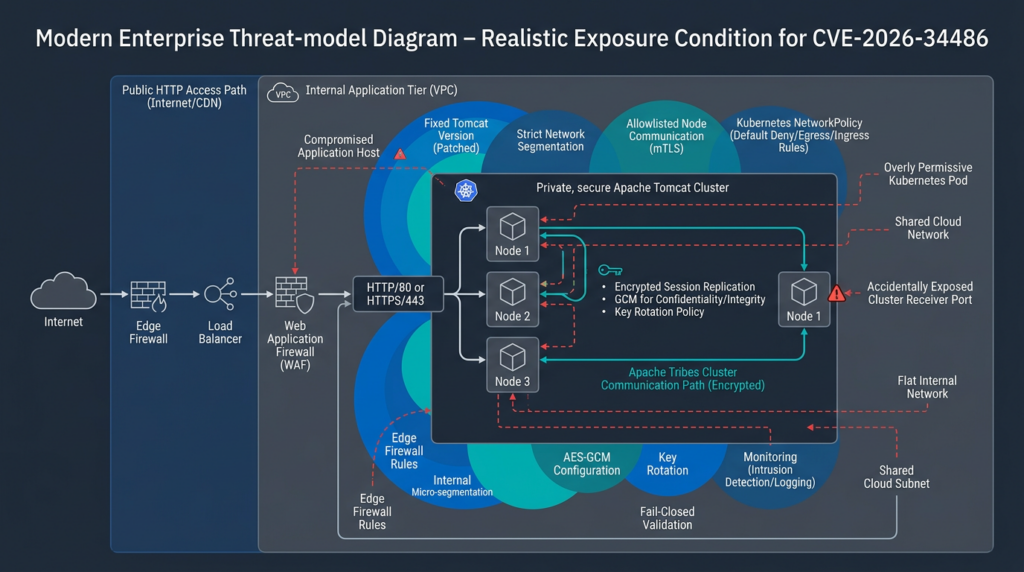
The published CVSS vector rates the attack vector as network-accessible, with low attack complexity, no required privileges, and no user interaction. The official impact rating assigns high confidentiality impact while leaving integrity and availability at none.
However, “network” in CVSS does not necessarily mean “reachable through the public website.”
The attacker would need a path to the cluster receiver or another position that permits interaction with cluster communications. Depending on the deployment, that path might exist through:
- A flat internal network
- A compromised application host
- An exposed cluster receiver port
- An overly broad Kubernetes network policy
- A shared cloud subnet
- A misconfigured security group
- An untrusted workload connected to the cluster VLAN
- A compromised node with lateral network access
Tomcat’s own documentation assumes that cluster traffic runs over a trusted network. This architectural assumption reduces exposure when teams correctly isolate the cluster plane, but it also means that segmentation failures can turn an internal-only condition into a realistic lateral-movement opportunity.
What Could Be Exposed?
The authoritative vulnerability description focuses on missing encryption of sensitive data. The bypass may allow sensitive information in affected cluster traffic to remain unprotected or become available to an attacker capable of observing the relevant communication path.
Potentially exposed information depends on the application and the cluster messages being transmitted. It may include session-state information or other application-specific values sent through the Tribes channel.
The correct conclusion is not that CVE-2026-34486 automatically leaks every password, token, or private record stored by the application. Instead, the vulnerability breaks an expected encryption boundary. Any sensitive information present in affected cluster messages should be considered potentially exposed to a network actor capable of observing the relevant traffic.
Security teams should examine:
- What types of sessions are replicated
- Whether authentication state is stored in sessions
- Whether access tokens or refresh tokens are stored as session attributes
- Whether the application serializes customer or tenant data into sessions
- Whether cluster traffic crosses shared or untrusted network infrastructure
- Whether packet-capture capabilities exist on adjacent hosts
- Whether historical network telemetry can identify suspicious cluster-plane access
Does CVE-2026-34486 Allow Remote Code Execution?
The official CVE description does not classify CVE-2026-34486 as remote code execution.
The published CVSS vector assigns confidentiality impact only:
C:H / I:N / A:N
That scoring does not establish arbitrary message execution, session manipulation, code execution, or full node compromise.
The source-code flaw does show that a message could continue through the interceptor chain after a decryption exception. However, the ultimate handling of any continued message depends on the surrounding Tribes configuration, message format, downstream interceptors, and cluster listeners.
Without a verified, configuration-specific path demonstrating a stronger impact, defenders should report the confirmed vulnerability as an encryption bypass and confidentiality risk.
A finding should not be upgraded to RCE merely because:
- The target runs Tomcat
- The affected class belongs to the cluster stack
- Another Tomcat cluster vulnerability has previously enabled code execution
- A third-party page uses “RCE” in its title
- A generic scanner assigns a critical severity
Impact claims must be tied to reproducible evidence from the assessed environment.
Why CVE-2026-29146 and CVE-2026-34486 Must Be Evaluated Together
Teams should not handle these vulnerabilities as unrelated entries.
The version relationship creates three main states:
| Deployment state | Main concern |
|---|---|
| Version before the CVE-2026-29146 fix | Potential exposure to the earlier padding-oracle weakness |
| Exactly 11.0.20, 10.1.53, or 9.0.116 | Exposure to CVE-2026-34486 |
| At or above 11.0.21, 10.1.54, or 9.0.117 | Both upstream issues corrected, subject to proper configuration |
This makes downgrading a poor mitigation strategy. Moving from an affected CVE-2026-34486 version to an older release may remove the regression while restoring exposure to CVE-2026-29146 or other known vulnerabilities.
The remediation direction is forward: upgrade to a fixed, supported release and review the effective encryption configuration.
How to Detect CVE-2026-34486
Detection should combine four evidence categories:
Version evidence
      +
Cluster configuration
      +
Component reachability
      +
Behavioral or patch evidence
A version string alone is useful for triage, but it is not a complete exposure assessment.
1. Identify the Effective Tomcat Version
For a standalone installation, administrators can use the bundled version script:
"$CATALINA_HOME/bin/version.sh"
On Windows:
"%CATALINA_HOME%\bin\version.bat"
The output should be collected from the actual runtime environment rather than inferred only from a public HTTP response.
For containerized deployments, inspect the running image rather than only the repository’s current Dockerfile:
docker exec <container-name> \
  sh -c '$CATALINA_HOME/bin/version.sh'
For Kubernetes:
kubectl exec -n <namespace> <pod-name> -- \
  sh -c '$CATALINA_HOME/bin/version.sh'
The vulnerable upstream versions are:
11.0.20
10.1.53
9.0.116
2. Search for EncryptInterceptor Configuration
Search the effective Tomcat configuration directories:
grep -Rni --include='*.xml' \
  'org\.apache\.catalina\.tribes\.group\.interceptors\.EncryptInterceptor' \
  "$CATALINA_BASE/conf" "$CATALINA_HOME/conf" 2>/dev/null
Also search deployment templates, mounted ConfigMaps, configuration-management repositories, and container entrypoint scripts. A runtime configuration may be generated from templates and may not match the base image’s original server.xml.
A typical configuration entry resembles:
<Interceptor
    className="org.apache.catalina.tribes.group.interceptors.EncryptInterceptor"
    encryptionAlgorithm="AES/GCM/NoPadding"
    encryptionKey="HEX_ENCODED_KEY_FROM_SECURE_STORAGE" />
Do not copy a real cluster key into assessment notes, tickets, command history, or source-control repositories.
3. Confirm That Clustering Is Enabled
Look for a configured <Cluster> element, such as an implementation based on:
org.apache.catalina.ha.tcp.SimpleTcpCluster
Then identify the channel, membership, receiver, sender, and interceptor definitions.
A configuration file containing the word EncryptInterceptor is not always proof that the active runtime uses it. The configuration may be commented out, overridden, mounted from another path, or associated with an inactive profile.
4. Identify the Cluster Receiver
Review the <Receiver> configuration to determine:
- Listener address
- Listener port or automatic port range
- Binding interface
- Network namespace
- Firewall exposure
- Kubernetes Service exposure
- Security-group rules
- Host-network behavior
- Whether traffic crosses nodes, availability zones, or shared networks
Do not assume the cluster transport uses the HTTP connector’s address or port.
5. Check Maven and Embedded Dependencies
The affected packages include:
org.apache.tomcat:tomcat
org.apache.tomcat:tomcat-tribes
For Maven projects:
mvn dependency:tree \
  -Dincludes=org.apache.tomcat:tomcat,org.apache.tomcat:tomcat-tribes
For Gradle:
./gradlew dependencies | grep -iE 'tomcat|tomcat-tribes'
Also inspect shaded JARs, vendor distributions, application-server bundles, and container layers.
6. Account for Vendor Backports
Enterprise Linux and application-server vendors may backport the patch without changing the upstream-looking version in the way a generic scanner expects.
Version-only scanners can therefore report false positives when a vendor has applied a security backport while retaining an older base version.
For vendor packages, check:
- Distribution package release
- Vendor erratum
- Vendor build number
- Backport status
- Installed RPM or DEB changelog
- Container vendor advisory
- Source-package patch records
A finding should not be closed solely because the visible upstream version appears old, nor should it be confirmed solely because the version appears to match.
Safe Validation Without an Exploit Payload
CVE-2026-34486 can be validated defensively without attempting to inject a malicious cluster message.
A safe workflow should focus on proving the vulnerable code path and confirming that decryption failures fail closed.
Phase 1: Establish Version and Configuration Evidence
Collect:
Tomcat runtime version
Tomcat distribution source
Clustering enabled or disabled
EncryptInterceptor present or absent
Encryption algorithm
Interceptor ordering
Cluster receiver address and port
Relevant firewall or network-policy rules
If the runtime is not one of the three affected versions, the upstream CVE-2026-34486 condition is not present, although other Tomcat security issues may still require review.
Phase 2: Build an Isolated Two-Node Test
Clone the production configuration into an isolated staging environment using synthetic data.
The test environment should contain:
- Two non-production Tomcat nodes
- The same relevant Tribes configuration
- No real customer sessions
- A synthetic application session marker
- Packet capture limited to the laboratory network
- Centralized logging for both nodes
Do not perform intentional decryption-failure testing against a live production cluster. Cluster-message disruption can affect session availability and user traffic.
Phase 3: Establish a Normal Baseline
Create a synthetic session value such as:
CVE34486-LAB-NON-SENSITIVE-MARKER
Trigger normal replication between the two nodes and confirm:
- The session reaches the second node
- The marker is not visible as cleartext in the captured cluster traffic
- No decryption errors are logged
- The session remains available after node switching
The marker must not contain credentials or production data.
Phase 4: Trigger a Controlled Decryption Failure
In the isolated environment, temporarily configure one node with a different test encryption key.
This should cause messages from the other node to fail decryption.
On a fixed release, the expected behavior is:
Decryption failure logged
Message rejected
Synthetic session not replicated
No downstream acceptance of the failed message
The source-code correction for CVE-2026-34486 places downstream forwarding inside the successful decryption block, so a fixed version should stop processing after the exception.
Restore the matching test keys immediately after the experiment.
Phase 5: Repeat After Upgrade
Repeat the same synthetic test after upgrading to:
Tomcat 11.0.21 or later
Tomcat 10.1.54 or later
Tomcat 9.0.117 or later
Record:
- Package or binary hash
- Runtime version
- Configuration hash
- Relevant log excerpts
- Packet-capture timestamp
- Session-replication result
- Change-ticket identifier
This produces defensible remediation evidence without using a weaponized message or touching customer data.
Network Detection Opportunities
Network monitoring cannot always identify CVE-2026-34486 exploitation with a simple signature, because the relevant ports and message patterns depend on the deployment.
Defenders can still monitor the cluster plane for anomalies.
Useful signals include:
- New source addresses connecting to cluster receiver ports
- Cluster traffic originating outside approved node subnets
- Sudden increases in decryption-failure logs
- Unexpected connection attempts from application pods
- Traffic from development or user-accessible networks to cluster receivers
- New listeners created after configuration changes
- Packet captures showing recognizable synthetic or application data in cleartext
- Cluster messages arriving from nodes not present in the approved inventory
- Security-group or network-policy changes that broaden receiver exposure
An increase in decryption errors is not proof of exploitation. It may be caused by a key mismatch, rolling upgrade, stale node, clock problem, algorithm mismatch, or interceptor-order error. It should nevertheless be investigated because failed cryptographic processing is security-relevant.
Log Review
Search Tomcat logs for encryption and cluster-related errors:
grep -RniE \
  'EncryptInterceptor|decrypt|decryption|GeneralSecurityException|tribes|cluster' \
  "$CATALINA_BASE/logs" 2>/dev/null
In centralized logging platforms, correlate decryption failures with:
- Source IP addresses
- Cluster membership changes
- Rolling deployments
- Key rotations
- Configuration updates
- Pod rescheduling
- Network-policy modifications
- Session-replication failures
Because CVE-2026-34486 logs the decryption exception before continuing, vulnerable nodes may still leave error evidence. The existence of a log entry therefore does not prove that the failed message was safely rejected.
Remediación
The primary remediation is to upgrade.
| Current version | Minimum upstream target |
|---|---|
| 11.0.20 | 11.0.21 or later |
| 10.1.53 | 10.1.54 or later |
| 9.0.116 | 9.0.117 or later |
Because newer security releases may be available, organizations should normally move to the latest supported release in their chosen branch rather than stopping at the first version that fixed this single CVE.
Do Not Treat Disabling Logs as Mitigation
Suppressing decryption errors does not change message-processing behavior.
The problem is not excessive logging. The problem is that the failed message can proceed beyond the interceptor in the affected implementation.
Do Not Downgrade to an Older Vulnerable Release
Downgrading from 10.1.53 to 10.1.52, for example, may remove this specific regression but restore exposure to CVE-2026-29146 and other fixed issues.
Use a forward upgrade.
Temporarily Isolate the Cluster Plane
When immediate upgrading is impossible, reduce reachability:
- Allow cluster traffic only between approved node addresses
- Block access from user, office, development, and CI networks
- Restrict Kubernetes traffic with namespace and pod selectors
- Remove public load balancers or NodePorts from cluster receivers
- Use host firewalls and cloud security groups
- Prevent untrusted workloads from joining the cluster subnet
- Monitor denied connection attempts
Network isolation reduces the number of actors capable of reaching the vulnerable component, but it does not correct the code defect.
EncryptInterceptor Hardening After the Upgrade
Upgrading corrects CVE-2026-34486, but the cluster still requires secure configuration.
Prefer AES-GCM
Apache recommends:
AES/GCM/NoPadding
The documented default may remain AES/CBC/PKCS5Padding for backward compatibility, while GCM is the preferred choice.
A representative configuration is:
<Interceptor
    className="org.apache.catalina.tribes.group.interceptors.EncryptInterceptor"
    encryptionAlgorithm="AES/GCM/NoPadding"
    encryptionKey="HEX_ENCODED_KEY_FROM_SECURE_STORAGE" />
The exact key-delivery mechanism should be designed around the deployment environment. Do not commit a shared cluster key directly into a public repository, baked container layer, or broadly readable ConfigMap.
Verify Interceptor Ordering
The encryption interceptor must be the final effective interceptor, except for the documented TcpFailureDetector interaction.
A representative ordering is:
<Interceptor
    className="org.apache.catalina.tribes.group.interceptors.MessageDispatchInterceptor" />

<Interceptor
    className="org.apache.catalina.tribes.group.interceptors.EncryptInterceptor"
    encryptionAlgorithm="AES/GCM/NoPadding"
    encryptionKey="HEX_ENCODED_KEY_FROM_SECURE_STORAGE" />

<Interceptor
    className="org.apache.catalina.tribes.group.interceptors.TcpFailureDetector" />
En TcpFailureDetector is used, EncryptInterceptor should appear immediately before it so that the effective message flow remains correct.
Manage Clock Skew
The interceptor uses message timestamps as part of its replay protection. Clock skew between nodes should be minimized or valid messages may be rejected. The documented replay window is limited, so cluster nodes should use reliable time synchronization and alert on significant divergence.
Rotate Cluster Keys
After a suspected exposure, rotate the encryption key after upgrading all nodes.
A coordinated rotation plan should account for:
- Rolling-upgrade compatibility
- Temporary mixed-key states
- Session continuity
- Restart sequencing
- Secret-distribution delays
- Log monitoring
- Rollback behavior
A key rotation performed without coordination can generate decryption failures and disrupt session replication.
Minimize Replicated Sensitive Data
Applications should avoid storing unnecessary secrets in session objects.
Review whether sessions contain:
- Long-lived access tokens
- Refresh tokens
- Password-equivalent material
- Private encryption keys
- Full payment data
- Large customer records
- Sensitive internal objects unrelated to session continuity
Encryption is important, but data minimization reduces impact when any transport or key-management control fails.
Patch Verification in Container and Kubernetes Environments
Containerized deployments introduce additional places where stale Tomcat versions can survive.
Compruébalo:
- Base-image digest
- Application-image digest
- Running pod image ID
- Init containers
- Sidecars containing Tomcat libraries
- Cached images on cluster nodes
- Helm chart values
- Private-registry mirrors
- Vendor-provided application images
- Embedded Tomcat dependencies
After rebuilding, confirm that workloads actually rolled out:
kubectl rollout status deployment/<deployment-name> -n <namespace>
Then verify the runtime inside a newly started pod:
kubectl exec -n <namespace> <pod-name> -- \
  sh -c '$CATALINA_HOME/bin/version.sh'
Do not treat a successful image build as proof that the production workload is running the corrected code.
Why Version-Only Scanning Produces Bad Findings
CVE-2026-34486 is a strong example of why vulnerability management requires contextual validation.
A scanner may detect:
Server: Apache-Coyote/1.1
or infer a Tomcat release from an error page. That may be enough to create an inventory lead, but it does not prove:
- The exact runtime version
- That clustering is enabled
- That Apache Tribes is active
- That
EncryptInterceptoris configured - That the cluster transport is reachable
- That a vendor backport is absent
- That the affected code path can be exercised
A strong finding should include:
Runtime version:
10.1.53

Cluster enabled:
Yes

EncryptInterceptor:
Present in active GroupChannel configuration

Cluster receiver:
Bound to 0.0.0.0 on the internal node network

Reachability:
Accessible from non-cluster application namespace

Patch evidence:
Affected upstream control flow present

Recommended action:
Upgrade to supported 10.1.54+ release and restrict receiver access
This evidence is much more useful than a banner-only statement reading “Tomcat CVE detected.”
Prioritization Guidance
CVE-2026-34486 should receive higher priority when:
- The exact affected version is confirmed
- Cluster traffic traverses shared infrastructure
- The receiver listens on all interfaces
- Network segmentation is weak
- Untrusted workloads can reach cluster nodes
- Session state contains authentication material
- Cluster keys have not been rotated
- Decryption errors have appeared unexpectedly
- The deployment operates in a multi-tenant environment
- Packet-capture access exists on adjacent systems
Priority may be lower when:
- Clustering is not configured
- En
EncryptInterceptoris not present - The installed package contains a verified vendor backport
- Cluster traffic is limited to a tightly controlled private network
- The runtime has already been upgraded
- The affected Tomcat libraries are present but unused
Lower priority does not mean no action. An affected version should still be upgraded, particularly because the same release window contains fixes for multiple Tomcat security issues.
Safe CVE Verification With Penligent
CVE-2026-34486 illustrates why CVE validation should not stop at product fingerprinting. A reliable workflow must distinguish an HTTP-facing Tomcat service from the internal clustering component, collect runtime and configuration evidence, and verify remediation without turning a production environment into an exploit laboratory.
Penligent’s AI pentesting workflow is designed around evidence-backed validation rather than treating a detected version as proof of exploitability. For this specific vulnerability, the safest automation boundary is inventory and evidence collection: identify the Tomcat build, locate the active cluster configuration, map the receiver’s network exposure, review interceptor ordering, and confirm the fixed version after remediation.
Any deliberate decryption-failure experiment should remain in an isolated, authorized staging environment. The goal should be to confirm whether the security boundary fails closed, not to inject arbitrary messages into a production cluster.
A practical validation workflow can include:
- Confirm the exact Tomcat runtime version.
- Identify whether Apache Tribes clustering is active.
- Locate the effective
EncryptInterceptorconfiguration. - Map the cluster receiver and allowed network sources.
- Verify the cryptographic algorithm and interceptor ordering.
- Check whether a vendor backport is present.
- Upgrade to a fixed release.
- Re-run the same checks and retain evidence of remediation.
This evidence-based approach reduces false positives while giving security teams a defensible record of why a deployment was considered affected, not affected, or successfully remediated.
Incident-Response Considerations
If an organization confirms that an affected cluster was reachable from untrusted networks, upgrading should be accompanied by a limited incident review.
The review should include:
- Identify the time window during which the affected release was deployed.
- Determine which networks could observe or reach cluster traffic.
- Review firewall, flow-log, and Kubernetes network-policy history.
- Examine decryption-failure logs.
- Identify which application sessions and attributes were replicated.
- Assess whether secrets or reusable tokens were present in those sessions.
- Rotate the cluster encryption key.
- Invalidate exposed authentication material where evidence justifies it.
- Retest encryption and message rejection after remediation.
- Preserve the evidence and assumptions used in the impact decision.
Do not automatically force a global credential reset without understanding what information traveled through the cluster channel. Response actions should be proportional to the confirmed data and exposure path.
Frequently Asked Questions
What is CVE-2026-34486?
CVE-2026-34486 is an Apache Tomcat vulnerability in which an error introduced by the fix for CVE-2026-29146 allowed the EncryptInterceptor security boundary to be bypassed. Apache classifies it as missing encryption of sensitive data.
Which Tomcat versions are affected?
Only these upstream versions are listed as affected:
Apache Tomcat 11.0.20
Apache Tomcat 10.1.53
Apache Tomcat 9.0.116
Which versions fix CVE-2026-34486?
The first upstream fixed versions are:
Apache Tomcat 11.0.21
Apache Tomcat 10.1.54
Apache Tomcat 9.0.117
Organizations should normally upgrade to the latest supported security release in their branch.
Does It Affect Tomcat 8.5 or Tomcat 7?
The official CVE-2026-34486 record does not list Tomcat 8.5 or Tomcat 7 as affected. The regression was associated with the specific 2026 releases identified by Apache.
Older unsupported branches may have separate cryptographic, clustering, or configuration risks and should not be assumed secure merely because this CVE does not list them.
Is Clustering Enabled on Every Tomcat Installation?
No. The vulnerability belongs to the clustering stack and becomes relevant when the affected component and configuration are actually used.
Is the HTTP Port the Vulnerable Cluster Port?
Not necessarily. The normal HTTP or HTTPS connector and the Apache Tribes cluster transport are separate paths. Investigators must inspect the cluster receiver configuration.
Does Disabling EncryptInterceptor Solve the Problem?
Disabling encryption removes the vulnerable component but also removes the confidentiality and integrity protection it was intended to provide. It is not a sound general remediation where cluster traffic requires protection.
Upgrade the affected version and maintain correctly configured encryption.
Can a WAF Block CVE-2026-34486?
A traditional web application firewall monitoring HTTP requests is unlikely to address the cluster communication path unless the cluster traffic has been routed through that device in an unusual architecture.
Network segmentation and upgrading are more relevant controls.
Is CVE-2026-34486 a Public Internet RCE?
The official record describes missing encryption of sensitive data, not generic Internet-facing remote code execution. The published CVSS vector assigns high confidentiality impact and no integrity or availability impact.
Can a Vulnerability Scanner Confirm the Issue?
A scanner can identify a potentially affected version, but complete validation requires confirming clustering, EncryptInterceptor, effective package status, and network reachability.
Should Organizations Downgrade to Remove the Regression?
No. Older versions may remain exposed to CVE-2026-29146 and other vulnerabilities. Upgrade to a fixed supported release.
Is Changing to AES-GCM Enough Without Upgrading?
No. AES-GCM is the recommended algorithm, but CVE-2026-34486 is also a control-flow error in message handling. The affected code must be patched.
Should the Cluster Key Be Rotated?
Key rotation is advisable after confirmed exposure, especially when affected traffic crossed networks that were not fully trusted. Coordinate rotation across all nodes to avoid replication failures.
Lessons for Security Engineering
CVE-2026-34486 offers several broader lessons.
First, cryptographic security depends on control flow as much as algorithm selection. A strong cipher does not help when failed decryption does not stop processing.
Second, security patches require regression testing of failure behavior. Testing only successful encryption and decryption would not necessarily reveal this flaw. A complete test suite should verify that invalid ciphertext, wrong keys, corrupted authentication tags, stale timestamps, duplicate nonces, and unsupported algorithms are rejected without reaching downstream consumers.
Third, vulnerability reachability matters. The presence of a class or package is not equivalent to an exploitable deployment. Configuration, network placement, interceptor ordering, vendor backports, and actual component use must all be considered.
Fourth, internal traffic deserves the same architectural discipline as public traffic. Cluster networks often carry highly trusted messages. Treating them as automatically secure because they are “internal” creates a dangerous dependency on perfect segmentation.
Finally, fixes should fail closed. When decryption or authentication fails, the safe default is to reject the message—not log an error and continue.
Final Take
CVE-2026-34486 is a high-severity Apache Tomcat encryption-bypass vulnerability, but it is also a narrowly scoped patch regression.
The issue affects exactly Tomcat 11.0.20, 10.1.53, and 9.0.116. It occurs in the Apache Tribes EncryptInterceptor path, where a decryption exception could be logged while the message still continued to downstream processing. Apache fixed the problem by moving message forwarding back inside the successful decryption block.
Security teams should avoid both underreaction and exaggeration.
Do not dismiss the issue simply because the cluster plane is internal. Session-replication traffic can contain sensitive application state, and internal networks are not always trustworthy.
At the same time, do not describe every Internet-facing Tomcat server as vulnerable or claim unverified remote code execution. Confirm the exact version, active cluster configuration, interceptor use, receiver exposure, and vendor patch status.
The correct response is straightforward:
Upgrade the affected Tomcat release.
Verify the effective runtime version.
Confirm EncryptInterceptor ordering.
Prefer AES/GCM/NoPadding.
Restrict the cluster network.
Protect and rotate cluster keys.
Test that decryption failures fail closed.
Retain evidence of successful remediation.
The most important lesson is contained in the tiny patch itself: a cryptographic control is only as strong as the decision made when verification fails.
 Spanish
  English
  German
  French
  Portuguese
  Japanese
  Korean
  Hindi
Hindi  Arabic
  Turkish
  Hebrew