
CVE-2026-33824 is a critical remote code execution vulnerability in the Windows Internet Key Exchange service extensions. At first glance, its CVSS 3.1 score of 9.8 already makes it difficult to ignore: exploitation can occur over the network, requires no existing privileges, needs no user interaction, and can compromise confidentiality, integrity, and availability. The underlying weakness is a double free in the Windows IKE Extension, classified as CWE-415. (Mondoo)
The risk has become substantially more concrete since Microsoft patched the vulnerability in April 2026. On August 18, 2026, CISA added CVE-2026-33824 to its Known Exploited Vulnerabilities catalog, formally moving it from a severe theoretical exposure into the category of vulnerabilities known to be exploited in real attacks. CISA lists an August 21, 2026 remediation due date for affected federal systems. (CISA)
There is also unusually useful public technical analysis of the flaw. TrendAI researchers, writing through the Zero Day Initiative, traced the vulnerability to IKEv2 fragmented-message processing inside ikeext.dll. Their analysis shows that improper ownership of a heap pointer during fragmented IKE_AUTH reassembly can cause the same allocation to be released twice. A remote attacker can reach that path before peer authentication completes, making pre-authentication remote code execution an appropriate description of the security boundary being crossed. (thezdi.com)
For organizations operating Windows-based VPN gateways, IPsec infrastructure, remote-access systems, or servers reachable over IKEv2, CVE-2026-33824 should now be treated as a patch-first vulnerability rather than merely another high CVSS entry.
CVE-2026-33824 at a Glance
| Atributo | CVE-2026-33824 |
|---|---|
| Vulnerabilidad | Windows Internet Key Exchange Service Extensions RCE |
| Componente | Windows IKE Extension / IKEEXT |
| Debilidad | Double Free |
| CWE | CWE-415 |
| CVSS 3.1 | 9.8 Critical |
| Vector de ataque | Red |
| Attack complexity | Bajo |
| Privileges required | Ninguno |
| Interacción con el usuario | Ninguno |
| Authentication required | No successful peer authentication required |
| Relevant protocol | IKEv2 / IPsec |
| Primary network exposure | UDP 500 and UDP 4500 |
| Potential impact | IKEEXT crash or arbitrary code execution |
| Execution context | IKEEXT service, SYSTEM context according to technical analysis |
| Microsoft patch release | April 14, 2026 |
| CISA KEV | Yes, added August 18, 2026 |
| Active exploitation | Confirmed |
| Definitive remediation | Install applicable Microsoft security update |
NVD describes the vulnerability succinctly as a double free in Windows IKE Extension that allows an unauthorized attacker to execute code over the network. Its CVSS vector is AV:N/AC:L/PR:N/UI:N/S:U/C:H/I:H/A:H. (NVD)
That combination is what makes CVE-2026-33824 particularly important. The affected parser is not hidden behind a normal application login page. It is part of a network-facing security protocol implementation whose job is itself to negotiate authentication and encrypted communications.
What Is the Windows IKE Extension?
Windows implements Internet Key Exchange and AuthIP functionality through the IKE and AuthIP IPsec Keying Modules, whose service name is IKEEXT.
Microsoft documents IKEEXT as the Windows service hosting the IKE and AuthIP keying modules used for authentication and key exchange in IPsec. Stopping the service prevents IKE and AuthIP key exchange with peer systems and can break environments dependent on IPsec. (Microsoft Aprende)
In a simplified architecture:
Remote VPN / IPsec Peer
        |
        | UDP 500 / UDP 4500
        v
+---------------------------+
| Windows IKEEXT            |
| IKE / AuthIP key exchange |
+---------------------------+
        |
        | establishes SAs
        v
+---------------------------+
| Windows IPsec             |
+---------------------------+
        |
        v
Encrypted network traffic
IKEv2 is defined by RFC 7296. The protocol typically operates over UDP ports 500 and 4500 and is responsible for negotiating cryptographic parameters and establishing the security associations later used by IPsec. (IETF Datatracker)
That location in the network stack explains why CVE-2026-33824 matters disproportionately on machines functioning as VPN or IPsec endpoints. If the vulnerable IKEv2 responder is reachable from an untrusted network, attacker-controlled protocol messages can reach IKEEXT before a normal application authentication boundary is involved.
Why CVE-2026-33824 Is a Pre-Authentication Vulnerability
Calling a vulnerability “pre-auth RCE” can sometimes be misleading, especially when a protocol performs several cryptographic exchanges before an application-level identity check.
For CVE-2026-33824, however, the label is technically meaningful.
An ordinary IKEv2 connection begins broadly like this:
Initiator                                  Responder
    |                                          |
    |----------- IKE_SA_INIT ---------------->|
    |<---------- IKE_SA_INIT -----------------|
    |                                          |
    |------------- IKE_AUTH ----------------->|
    |<------------ IKE_AUTH ------------------|
    |                                          |
    |        authenticated IKE SA              |
IKE_SA_INIT negotiates cryptographic algorithms and establishes keying material. Actual peer authentication happens later through IKE_AUTH.
IKEv2 fragmentation adds another layer. RFC 7383 defines fragmentation of encrypted IKEv2 messages into Encrypted Fragment, or SKF, payloads. Because those fragments are protected, the peers must already have derived the IKE encryption and integrity keys. This means IKE_SA_INIT itself cannot use IKE-level fragmentation, while later encrypted exchanges such as IKE_AUTH can. (IETF Datatracker)
CVE-2026-33824 sits precisely in this transition.
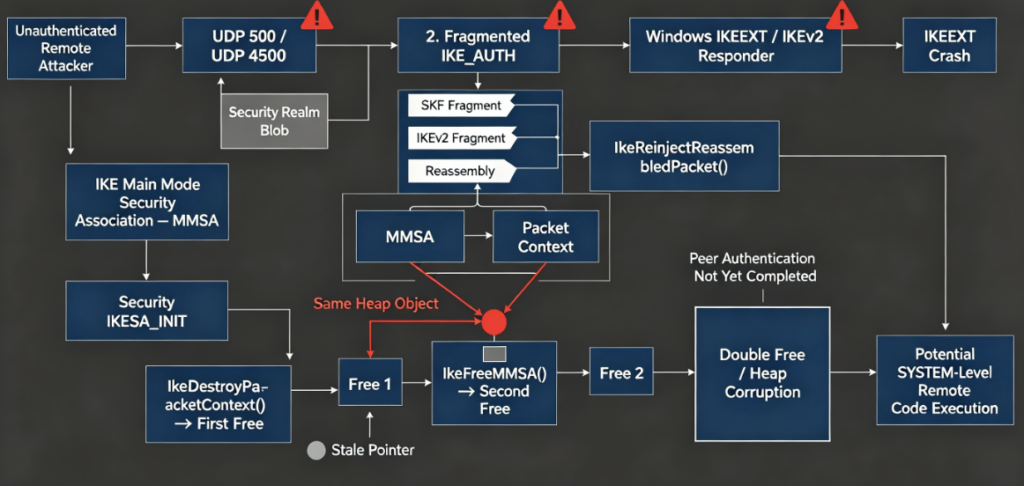
TrendAI’s analysis says an unauthenticated attacker can first send a crafted IKE_SA_INIT, then send two or more encrypted fragments containing an invalid IKE_AUTH message. Reassembling those fragments reaches the vulnerable Windows ownership-handling path and ultimately causes the same heap allocation to be freed twice. (thezdi.com)
Conceptually:
Attacker
   |
   | 1. IKE_SA_INIT
   v
Windows IKEEXT
   |
   | Cryptographic state created
   | Peer identity is NOT yet authenticated
   |
Attacker
   |
   | 2. Fragmented IKE_AUTH
   |    SKF #1
   |    SKF #2
   |    ...
   v
Fragment reassembly
   |
   v
Pointer ownership bug
   |
   v
Double free
   |
   +--> IKEEXT crash
   |
   +--> potentially arbitrary code execution
The important security distinction is therefore:
Cryptographic state exists, but trusted peer identity has not yet been established.
An attacker does not need legitimate VPN credentials, a valid enterprise account, or an already authenticated IPsec session to reach the vulnerable path. This interpretation follows from the combination of the IKEv2 protocol state machine and the specific exploitation sequence documented by TrendAI. (Iniciativa Día Cero)
The Root Cause: A Double Free During IKEv2 Fragment Reassembly
Microsoft classifies CVE-2026-33824 as a double-free vulnerability. The deeper public reverse engineering provides much more useful context about what is actually freed twice.
TrendAI analyzed IKEEXT.DLL and traced the issue to ownership handling of a heap-allocated blob associated with the IKE Main Mode Security Association, or MMSA. (thezdi.com)
The vulnerable sequence can be reduced to six important steps.
1. A Security Realm Vendor ID Creates a Heap Allocation
During IKE_SA_INIT, Microsoft’s IkeHandleSecurityRealmVendorId() processing allocates a blob associated with a Security Realm Vendor ID and stores its pointer in the MMSA structure.
At this point, the MMSA effectively owns that allocation.
Conceptually:
MMSA {
    ...
    security_realm_blob = allocated_heap_object;
}
This is not Microsoft’s source code; it is a simplified representation of the ownership relationship described in the published reverse engineering. (thezdi.com)
2. IKE_AUTH Arrives as Multiple Encrypted Fragments
The attacker then supplies a fragmented IKE_AUTH message.
RFC 7383 calls these Encrypted Fragment payloads. Windows collects the individual fragments and reconstructs the original IKE message before higher-level processing continues. (IETF Datatracker)
TrendAI identifies IkeReinjectReassembledPacket() as the Windows function involved in this reassembly path. (thezdi.com)
3. Windows Copies the MMSA Fields
During reassembly, IkeReinjectReassembledPacket() copies a range of MMSA fields into another structure.
The important mistake is that the pointer to the Security Realm blob is copied rather than ownership being clearly transferred or a new allocation being created.
The situation becomes approximately:
MMSA.security_realm_blob
          |
          +----------------+
                           |
                           v
                      heap object
                           ^
                           |
          +----------------+
          |
PacketContext.security_realm_blob
Now two logical structures refer to the same allocation.
4. The Pointer Remains a Shallow Copy
TrendAI found that another reassembly buffer is deep-copied correctly, while the Security Realm blob pointer remains a shallow copy.
That distinction is critical.
A deep copy would produce:
Object A --> Allocation A
Object B --> Allocation B
A shallow copy creates:
Object A -----+
              |
              v
          Allocation A
              ^
              |
Object B -----+
A shallow copy is not inherently vulnerable. It becomes dangerous when both owners later believe they are responsible for destroying the same allocation.
That is what happens here. (thezdi.com)
5. The First Free Happens During Packet Context Destruction
When the queued work item is processed, IkeDestroyPacketContext() releases the Security Realm blob through WfpMemFree.
The heap allocation is now freed.
But the original MMSA still contains the stale pointer.
MMSA.security_realm_blob ----> freed memory
6. MMSA Cleanup Frees It Again
Later, cleanup of the Main Mode Security Association reaches IkeFreeMMSA(), which attempts to release the same pointer.
The same heap allocation is therefore freed a second time. (thezdi.com)
Simplified:
allocate(P)

MMSA.ptr = P

PacketContext.ptr = MMSA.ptr

free(PacketContext.ptr)   // first free

...

free(MMSA.ptr)            // second free
This is the fundamental CVE-2026-33824 bug.
Why a Double Free Can Become Remote Code Execution
A double free first manifests as a memory-safety violation, not automatically as code execution.
If the allocator immediately detects the corrupted state, the most visible result may simply be termination of the affected service. This is why TrendAI notes that exploitation can result in an IKEEXT crash or potentially arbitrary code execution. (thezdi.com)
The security concern is what can happen between the two frees or as the corrupted allocator state is subsequently reused.
A generic double-free exploitation model looks like:
Heap allocation A
      |
      v
First free
      |
      v
Allocator believes A is reusable
      |
      +---- attacker influences subsequent allocations
      |
      v
Second free / corrupted allocator state
      |
      v
Memory corruption
      |
      +---- crash
      |
      +---- corrupted object / pointer
      |
      +---- controlled execution path
Modern Windows includes multiple exploit mitigations intended to make heap corruption substantially more difficult to convert into dependable arbitrary code execution. CVE-2026-33824 should therefore not be described as though every malformed IKE packet immediately produces a stable SYSTEM shell.
But that uncertainty does not make the vulnerability merely a denial-of-service issue.
Microsoft explicitly classified the flaw as remote code execution, NVD assigns complete confidentiality, integrity and availability impact, and the vulnerable code executes in the security context of IKEEXT. TrendAI states successful exploitation can result in arbitrary code execution under the IKEEXT service’s SYSTEM context. (Iniciativa Día Cero)
The correct interpretation is:
CVE-2026-33824 provides a remotely triggerable pre-authentication memory-corruption primitive that Microsoft considers capable of RCE. Reliability will depend on the exploit, target build and Windows exploit mitigations.
That is substantially more accurate than either extreme of “just a crash” or “send one packet and instantly get SYSTEM.”
What an Attack Against CVE-2026-33824 Looks Like
The public technical analysis provides enough information to describe the attack chain without requiring speculative exploit details.
┌─────────────────────┐
│ Remote attacker     │
│ No VPN credentials  │
└──────────┬──────────┘
           │
           │ UDP 500 / 4500
           ▼
┌─────────────────────────────┐
│ Windows IKEEXT              │
│ IKEv2 responder             │
└──────────┬──────────────────┘
           │
           │ Crafted IKE_SA_INIT
           ▼
┌─────────────────────────────┐
│ MMSA created                │
│ Security Realm blob stored  │
└──────────┬──────────────────┘
           │
           │ fragmented IKE_AUTH
           ▼
┌─────────────────────────────┐
│ SKF fragment reassembly     │
│ IkeReinjectReassembledPacket│
└──────────┬──────────────────┘
           │
           │ shallow pointer copy
           ▼
┌─────────────────────────────┐
│ Packet context              │
│ and MMSA reference same ptr │
└──────────┬──────────────────┘
           │
           ▼
        First free
           │
           ▼
       MMSA cleanup
           │
           ▼
       Second free
           │
           ▼
┌─────────────────────────────┐
│ Heap corruption             │
├─────────────────────────────┤
│ Crash OR potential RCE      │
│ SYSTEM security context     │
└─────────────────────────────┘
The network component matters. RFC 7296 specifies UDP 500 and 4500 for IKE, and TrendAI specifically recommends monitoring both ports when detecting exploitation of CVE-2026-33824. (IETF Datatracker)
Which Windows Systems Are at Risk?
CVE-2026-33824 affects multiple supported Windows client and server branches for which Microsoft shipped April 2026 fixes.
The affected/fixed-product mapping reported from Microsoft’s April release includes the following. (Lobo Ártico)
| Windows branch | April 2026 security update |
|---|---|
| Windows Server 2025 | KB5082063 |
| Windows Server 2022 23H2 | KB5082060 |
| Windows Server 2022 | KB5082142 |
| Windows Server 2019 | KB5082123 |
| Windows Server 2016 | KB5082198 |
| Windows 11 26H1 | KB5083768 |
| Windows 11 25H2 | KB5083769 |
| Windows 11 24H2 | KB5082063 |
| Windows 11 23H2 | KB5082052 |
| Windows 10 22H2 | KB5082200 |
| Windows 10 21H2 | KB5082200 |
| Windows 10 1809 | KB5082123 |
| Windows 10 1607 | KB5082198 |
Administrators should still use Microsoft’s Security Update Guide and their actual OS servicing branch as the source of truth rather than blindly checking for one KB number. Windows cumulative servicing means later security updates can supersede the April package.
More importantly, installed Windows version and practical exposure are not the same thing.
A vulnerable workstation behind a firewall with no reachable IKE service does not present the same immediate attack surface as an internet-facing Windows VPN endpoint accepting IKEv2 from arbitrary addresses.
Prioritization should therefore account for at least three variables:
Risk =
    Vulnerable Windows build
  × IKEv2 enabled / reachable
  × Untrusted network exposure
Systems where all three are true deserve emergency treatment.
Internet-Facing VPN Infrastructure Is the Highest-Priority Exposure
The vulnerability becomes particularly dangerous when Windows is functioning as an IKEv2 responder.
Examples can include:
- Windows-based VPN gateways
- Remote Access / Always On VPN infrastructure
- IPsec gateway systems
- Site-to-site Windows IPsec endpoints
- Servers using IKEv2-based network isolation policies
- Hosts allowing IKE from broad or untrusted networks
Microsoft’s own documentation confirms that IKEEXT hosts the IKE key exchange functionality used by IPsec, while Microsoft VPN troubleshooting documentation identifies UDP 500 and 4500 as required IKE ports. (Microsoft Aprende)
That does no mean every Windows endpoint with the IKEEXT service installed is automatically internet exploitable.
Reachability matters.
A useful exposure model is:
| Situación | Practical priority |
|---|---|
| Internet-facing IKEv2 responder, unpatched | Emergency |
| IKEv2 reachable from large partner/customer networks | Crítica |
| Internal IKE/IPsec endpoint, unpatched | Alta |
| IKEEXT installed but ports blocked externally | Patch promptly |
| Fully patched system | Verify patch and continue monitoring |
CVE-2026-33824 Has Now Been Exploited in the Wild
The vulnerability’s threat status changed materially between April and August.
When Microsoft released the fix on April 14, Rapid7 reported Microsoft’s exploitability assessment as Explotación menos probable, with the flaw not publicly disclosed at that time. (Rápido7)
That historical assessment is now obsolete for operational prioritization.
Palo Alto Networks Unit 42 subsequently documented a Chinese-speaking threat actor maintaining and using exploit tooling across several vulnerabilities. For CVE-2026-33824 specifically, Unit 42 recorded manual active exploitation involving reverse-shell callback attempts against three IKE VPN endpoints. (Unidad 42)
An important distinction is necessary here.
The same Unit 42 investigation involved AI-assisted and autonomous exploitation activity using systems such as DeepSeek and Hermes Agent. However, Unit 42’s own table classifies CVE-2026-33824 activity as manual, not autonomous. (Unidad 42)
Therefore, statements such as:
“AI autonomously exploited CVE-2026-33824 against hundreds of Windows VPN servers”
would not be supported by the report.
The defensible statement is:
Unit 42 observed manual exploitation activity targeting CVE-2026-33824, including reverse-shell callback attempts against three IKE VPN endpoints, within a broader campaign that also used AI-assisted offensive workflows.
That distinction matters when evaluating both the vulnerability and the broader implications of agentic attack automation.
Then, on August 18, 2026, CISA formally added CVE-2026-33824 to the KEV catalog. (CISA)
For defenders, the timeline now looks like this:
| Date | Development |
|---|---|
| April 14, 2026 | Microsoft publishes security update for CVE-2026-33824 |
| April 14, 2026 | Vulnerability disclosed as critical CVSS 9.8 RCE |
| April 2026 | Microsoft initially assesses exploitation as less likely |
| April 22–23, 2026 | Detailed IKEv2 fragmentation and double-free analysis becomes public through ZDI/TrendAI |
| July 30, 2026 | Unit 42 publishes evidence of active attempts against IKE VPN endpoints |
| August 18, 2026 | CISA adds CVE-2026-33824 to KEV |
| August 21, 2026 | CISA-listed federal remediation due date |
The ZDI technical analysis and later Unit 42 observations illustrate a pattern defenders should increasingly expect: a vulnerability can move from vendor patch to deep public technical understanding and then into real attack operations within a relatively short period. (Iniciativa Día Cero)
Is CVE-2026-33824 Wormable?
The vulnerability has characteristics commonly associated with wormable-class flaws:
- remote network attack vector
- no existing privileges required
- no user interaction
- no successful peer authentication required
- potential SYSTEM-context code execution
Rapid7 highlighted the rarity and significance of unauthenticated RCE against modern Windows systems when discussing CVE-2026-33824. (Rápido7)
But “wormable” must be used carefully.
A vulnerability is not automatically a worm merely because it is remotely exploitable without authentication. A self-propagating worm additionally requires reliable exploitation, automated target discovery, payload execution and propagation logic.
There is currently a major difference between:
Potentially automatable remote RCE
y
Observed self-propagating worm outbreak.
CVE-2026-33824 clearly satisfies the first risk category. The currently cited public evidence should not be stretched into a claim that a WannaCry-style self-propagating Windows IKE worm has already been observed.
How to Check Whether IKEEXT Is Running
Administrators can begin exposure triage without sending exploit traffic to systems.
On Windows PowerShell:
Get-Service IKEEXT
A running service may appear similar to:
Status   Name      DisplayName
------   ----      -----------
Running  IKEEXT    IKE and AuthIP IPsec Keying Modules
You can gather additional configuration information with:
Get-CimInstance Win32_Service `
    -Filter "Name='IKEEXT'" |
    Select-Object Name, State, StartMode, PathName
This establishes whether the component is present and active, but service status alone does not establish remote exploitability.
The next question is reachability.
Check UDP 500 and UDP 4500 Exposure
On modern Windows builds, PowerShell can enumerate UDP endpoints:
Get-NetUDPEndpoint |
    Where-Object {
        $_.LocalPort -eq 500 -or
        $_.LocalPort -eq 4500
    } |
    Select-Object LocalAddress, LocalPort, OwningProcess
Administrators can also inspect relevant network configuration using:
Get-NetIPsecRule
and:
Get-NetIPsecMainModeRule
The important operational question is not merely:
“Is UDP 500 open?”
It is:
“Which interfaces and external networks can reach UDP 500 or UDP 4500 on this Windows host, and is that exposure actually required?”
IKE uses UDP 500 and 4500 according to the IKEv2 specification and Microsoft’s own Windows VPN documentation. (IETF Datatracker)
Check Windows Patch State
Because cumulative updates supersede older packages, checking only for the exact April KB is insufficient several months after disclosure.
A basic inventory can begin with:
Get-ComputerInfo |
    Select-Object WindowsProductName,
                  WindowsVersion,
                  OsBuildNumber
Recent hotfix information can be reviewed with:
Get-HotFix |
    Sort-Object InstalledOn -Descending |
    Select-Object -First 20 `
        HotFixID,
        Description,
        InstalledOn
Enterprise vulnerability management should resolve the current build against Microsoft’s applicable security-update baseline rather than relying solely on a static list of April packages.
Network Detection for CVE-2026-33824
Network monitoring is especially valuable because the vulnerability exists in a network protocol parser before normal authentication.
TrendAI provides unusually specific defensive guidance.
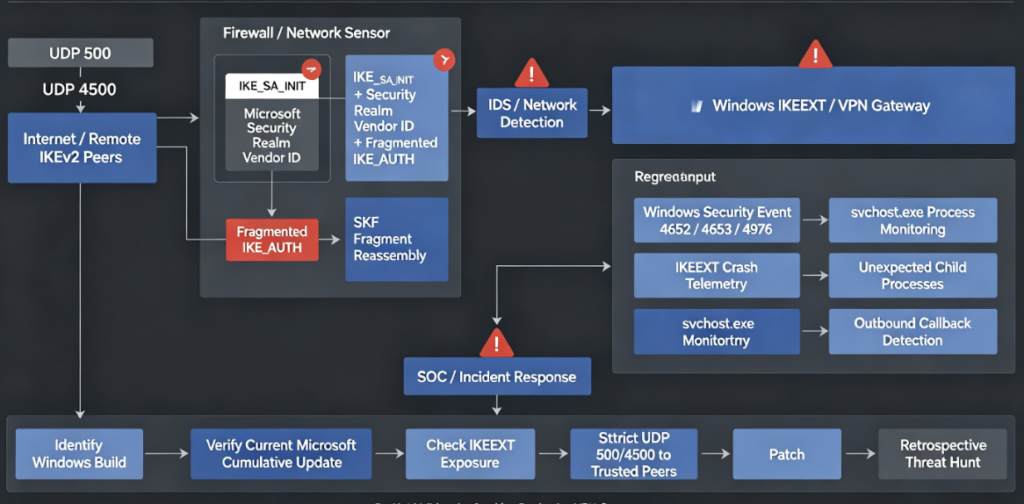
Detection should monitor IKE traffic on UDP ports 500 and 4500 and correlate two events in the same IKE session:
- an
IKE_SA_INITrequest containing the Microsoft Security Realm Vendor ID; - a subsequent fragmented
IKE_AUTHrequest.
Neither event should be treated as sufficient evidence by itself. The sequence matters. (thezdi.com)
A conceptual detection pipeline would therefore look like:
UDP 500 / 4500
      |
      v
Parse IKEv2
      |
      v
IKE_SA_INIT observed
      |
      +--> Security Realm Vendor ID present?
                   |
                   v
          Track IKE session
                   |
                   v
       fragmented IKE_AUTH?
                   |
                   v
             HIGH ALERT
For traffic using UDP 4500, defenders also need to account for NAT traversal encapsulation. TrendAI notes the four-byte non-ESP marker preceding IKE packets on port 4500, which shifts packet-content offsets relative to port 500. (thezdi.com)
This is one reason a simple static byte match is less robust than a protocol-aware IDS implementation.
Windows Event Logs Can Provide Supporting Signals
Microsoft documents several Windows Security events relevant to IPsec and IKE negotiations.
Of particular interest is Event ID 4976, generated when IPsec receives an invalid negotiation packet during Main Mode negotiation. Microsoft notes that persistent occurrences may indicate a network problem or an attempt to modify or replay the negotiation. (Microsoft Aprende)
Other useful events include:
- 4650 — IPsec Main Mode SA established
- 4651 — Main Mode SA established using certificate authentication
- 4652 — Main Mode negotiation failed
- 4653 — Main Mode negotiation failed
- 4976 — invalid Main Mode negotiation packet
- 5049 — IPsec Security Association deleted
- 5453 — negotiation failed because IKEEXT was not started
Microsoft notes that the relevant auditing is not necessarily enabled by default, so event availability varies by configuration. (Microsoft Aprende)
A defensive query can begin with:
Get-WinEvent -FilterHashtable @{
    LogName = 'Security'
    Id      = 4652,4653,4976
} -ErrorAction SilentlyContinue |
Select-Object TimeCreated, Id, Message
Event ID 4976 should no be treated as a standalone IOC for CVE-2026-33824. Invalid IKE negotiations have many legitimate causes.
It becomes more meaningful when correlated with:
external source IP
        +
UDP 500/4500 traffic
        +
IKE fragmentation
        +
multiple failed negotiations
        +
IKEEXT instability
        +
unexpected post-event process/network activity
Endpoint Detection After a Suspected Exploitation Attempt
Network telemetry captures the initial protocol behavior. EDR telemetry is necessary to determine whether memory corruption transitioned into meaningful post-exploitation.
Defenders should investigate suspicious activity following abnormal IKE traffic, particularly:
- unexpected termination or restart of the service host containing IKEEXT
- application or system crash telemetry involving
ikeext.dll - unusual child processes associated temporally with the affected
svchost.exe - unexpected command interpreters
- outbound connections to previously unseen infrastructure
- credential-access behavior
- creation of persistence mechanisms
- security-control tampering
The Unit 42 observations make outbound callback activity especially relevant because the documented actor attempted reverse-shell callbacks against IKE VPN targets. (Unidad 42)
Again, the callback is an observed campaign behavior rather than a universal characteristic of exploitation.
Hunting Should Focus on the Sequence, Not a Single IOC
A strong CVE-2026-33824 hunt correlates several layers:
[Internet source]
       |
       v
UDP 500/4500
       |
       v
Suspicious IKEv2 negotiation
       |
       v
Fragmented IKE_AUTH
       |
       v
IKE negotiation failure / crash
       |
       v
svchost / IKEEXT anomaly
       |
       v
Unexpected outbound connection
       |
       v
Command execution / persistence
This approach is more resilient than looking for one static IP address or payload hash.
Threat actors can change infrastructure quickly. The vulnerable protocol behavior and affected execution boundary are more durable hunting anchors.
Do Not Validate CVE-2026-33824 by Crashing Production VPN Servers
Organizations often want proof that a critical vulnerability is genuinely exploitable in their environment.
For CVE-2026-33824, verification deserves particular care because the vulnerability is a memory-corruption flaw in a network infrastructure service.
A naive “scanner” that sends the malformed fragmented sequence and treats a service crash as confirmation is effectively attempting to trigger the vulnerability.
On production VPN infrastructure, that can create real availability impact.
A safer validation strategy is:
1. Identify Windows version/build
            |
            v
2. Determine applicable Microsoft security update
            |
            v
3. Verify installed servicing level
            |
            v
4. Determine whether IKEEXT is operational
            |
            v
5. Map UDP 500/4500 reachability
            |
            v
6. Review network/firewall restrictions
            |
            v
7. Inspect historical IKE telemetry
            |
            v
8. Use isolated authorized lab only for active reproduction
This produces evidence of exposure without deliberately exercising the corrupting code path on business-critical infrastructure.
How to Mitigate CVE-2026-33824
There are two different categories of response: remediation y attack-surface reduction.
They should not be confused.
Install Microsoft’s Security Update
Patching is the definitive remediation.
Microsoft shipped security updates for affected Windows branches in April 2026, and TrendAI explicitly states that vendor update installation is the only way to fully remediate the vulnerability. (Iniciativa Día Cero)
Because it is now August 2026, organizations should generally deploy the currently supported cumulative update rather than intentionally pinning themselves to the original April package.
Block UDP 500 and 4500 Where IKE Is Not Required
For systems that do not need IKE, Microsoft-associated mitigation guidance recommends blocking inbound UDP 500 and 4500. Cisco Talos and the ZDI analysis both highlighted this mitigation when the vulnerability was disclosed. (Blog Cisco Talos)
Conceptually:
Internet
   |
   X UDP 500
   X UDP 4500
   |
Windows host
This eliminates the relevant network path for systems where IKE serves no legitimate business purpose.
Restrict IKE to Known Peers When It Is Required
Blocking the ports entirely is obviously not viable for a functioning IKEv2 VPN gateway.
For those environments, restrict access to known peer addresses where architecture permits.
Known VPN peer ───────────────┐
                             │
                             v
                       UDP 500/4500
                             |
                       Windows IKEEXT

Unknown Internet hosts ──X───┘
ZDI specifically lists restricting inbound UDP 500/4500 to known peer addresses as an interim mitigation for systems requiring IKE. (thezdi.com)
This is particularly useful for site-to-site VPNs with predictable peer addresses.
It is less practical for consumer-style remote-access VPN deployments where users connect from arbitrary networks, reinforcing why patch deployment is indispensable.
Should You Disable IKEEXT?
Disabling the service may remove the relevant functionality, but it should not be presented as a universally safe remediation.
Microsoft documents that stopping IKEEXT disables IKE and AuthIP key exchange and can cause IPsec failures. (Microsoft Aprende)
Therefore:
IKE not used at all
    -> service/network exposure reduction may be reasonable

IKE/IPsec required
    -> do not casually disable IKEEXT
    -> patch and restrict exposure instead
On critical Windows networking infrastructure, availability and network-security dependencies should be reviewed before modifying the service.
Why Firewall Restrictions Are Still Valuable After Patching
Security updates remove the known vulnerable implementation, but unnecessary exposure remains unnecessary exposure.
An internet-facing parser for a complex security protocol represents a durable attack surface even after CVE-2026-33824 is fixed.
This does not imply the patched IKE implementation is currently vulnerable. It is simply standard attack-surface management.
A mature configuration should aim for:
Required service?
      |
   +--+--+
   |     |
  No    Yes
   |     |
Block   Restrict to
ports   minimum required
        sources/interfaces
Patch management and network minimization solve different problems and should be applied together.
Why CVE-2026-33824 Is More Dangerous Than Its CVSS Score Alone Suggests
CVSS 9.8 already communicates extreme technical severity, but several contextual factors make this vulnerability particularly valuable to attackers.
First, the flaw exists inside infrastructure that may sit directly at a network perimeter.
Second, no valid VPN account is required to reach the vulnerable path.
Third, exploitation happens before a normal user-authentication workflow succeeds.
Fourth, successful exploitation occurs in a highly privileged Windows service context according to the technical analysis.
Fifth, active exploitation is no longer theoretical: both Unit 42 observations and CISA’s August 18 KEV addition provide real-world evidence. (Unidad 42)
This produces a particularly unfavorable defender equation:
Remote reachability
       +
No prior authentication
       +
No user interaction
       +
Privileged service
       +
Memory corruption
       +
Observed exploitation
       =
Patch-first exposure
The CISA KEV Addition Changes Vulnerability Prioritization
When CVE-2026-33824 was disclosed in April, organizations might reasonably have weighed Microsoft’s “Exploitation Less Likely” assessment alongside internal exposure.
That is no longer an appropriate basis for deferring remediation.
CISA added the vulnerability to its Known Exploited Vulnerabilities catalog on August 18, 2026. (CISA)
CISA issued BOD 26-04 in June 2026 to update federal vulnerability-remediation prioritization and reinforce risk-driven treatment of vulnerabilities such as those in KEV. (CISA)
For non-federal organizations, KEV is not automatically a regulatory deadline. But it remains valuable threat intelligence: someone has moved beyond theoretical exploitability.
That is precisely the evidence vulnerability-management programs should use when deciding which systems jump ahead of ordinary patch queues.
Recommended Enterprise Response
A practical enterprise response can be organized around exposure first.
Priority 1: Internet-Facing IKEv2 Systems
Immediately identify Windows systems accepting IKEv2 from the internet.
Verifícalo:
OS branch
current patch level
IKEEXT status
UDP 500 exposure
UDP 4500 exposure
authorized peer ranges
VPN function
EDR coverage
network telemetry
These should receive the highest remediation priority.
Priority 2: Partner-Exposed IPsec Systems
Site-to-site IPsec endpoints may not be reachable from the entire internet but can still be exposed to large or semi-trusted partner networks.
Confirm peer allowlists and patch status.
Priority 3: Internal IKE/IPsec Systems
Internal-only exposure reduces the initial remote attack surface but does not eliminate risk after an attacker establishes a foothold.
Internal systems should therefore still be patched rather than permanently deferred.
Priority 4: Systems Where IKE Is Unnecessary
Remove unnecessary reachability.
If business requirements do not include IKE/IPsec, firewall restrictions can eliminate an entire protocol attack surface in addition to applying the update.
Frequently Asked Questions About CVE-2026-33824
Is CVE-2026-33824 a real remote code execution vulnerability?
Yes. Microsoft and NVD classify it as remote code execution, caused by a double free in Windows IKE Extension. Successful exploitation can potentially execute arbitrary code over the network. (NVD)
Does exploitation require authentication?
No successful peer authentication is required.
The publicly documented trigger proceeds from IKE_SA_INIT into fragmented IKE_AUTH, reaching the vulnerable processing path before normal IKE peer authentication completes. (Iniciativa Día Cero)
Does an attacker need user interaction?
No. The CVSS vector specifies UI:N. (Mondoo)
Does an attacker need an existing Windows account?
No. The CVSS vector specifies PR:N, and the documented attack is network based. (Mondoo)
Which ports are relevant?
IKE normally uses UDP 500 and UDP 4500. (IETF Datatracker)
Is port 4500 always malicious?
No.
UDP 4500 is normal for IKEv2 NAT traversal. Its presence is not an IOC.
Detection must inspect protocol behavior and correlate the relevant IKE exchanges rather than alerting on ordinary IKE traffic.
Is every Windows PC remotely exploitable from the internet?
No.
The affected Windows component may be installed broadly, but practical remote exploitation depends on the vulnerable IKEv2 processing path being reachable.
A machine behind appropriate firewall restrictions does not have the same external exposure as an internet-facing Windows VPN gateway.
Can I just block UDP 500 and 4500?
If the machine does not need IKE, blocking those ports is a useful mitigation.
If the machine provides IKEv2/IPsec services, blocking the ports will disrupt legitimate connectivity. Patch the system and restrict inbound peers where possible. (thezdi.com)
Is disabling IKEEXT safe?
Not universally.
Microsoft warns that stopping IKEEXT disables IKE/AuthIP key exchange and can cause IPsec failures. (Microsoft Aprende)
Was CVE-2026-33824 exploited as a zero-day?
The chronology does not support describing the April disclosure itself as a known exploited zero-day.
Microsoft patched the flaw on April 14 and initially categorized exploitation as less likely. Evidence of attack activity emerged later, and CISA added it to KEV on August 18. (Rápido7)
Is CVE-2026-33824 actively exploited now?
Yes. CISA’s KEV addition means known exploitation has been established, and Unit 42 separately documented manual attack activity against IKE VPN endpoints. (cisa.gov)
Did AI autonomously exploit CVE-2026-33824?
The public Unit 42 evidence does not establish that.
Although the broader threat actor used AI-driven attack workflows, Unit 42 explicitly categorizes CVE-2026-33824 exploitation as manual. (Unidad 42)
Is there a public proof of concept?
Public repositories and exploit references now exist around the CVE, but the existence of code labelled with a CVE number does not prove that it delivers reliable SYSTEM-level RCE across supported Windows versions. The stronger evidence for prioritization is the technical root-cause analysis, Microsoft’s RCE classification, Unit 42’s observed attack activity and CISA’s KEV designation. (Vulners)
Is CVE-2026-33824 wormable?
Its attack characteristics make automated remote exploitation plausible, but “wormable” should not be confused with evidence of an existing self-propagating worm.
There is currently a distinction between a remotely automatable vulnerability and a demonstrated autonomous Windows worm.
Final Assessment
CVE-2026-33824 deserves attention for more than its 9.8 CVSS score.
The vulnerability breaks a particularly important security assumption: the component responsible for establishing secure, authenticated IPsec communications contains a remotely reachable memory-corruption flaw that can be triggered before the remote peer has successfully authenticated.
The technical chain is now reasonably well understood. A crafted IKE_SA_INIT establishes the state necessary to proceed into encrypted IKE processing. Fragmented IKE_AUTH messages then reach Windows’ reassembly logic. Improper ownership of a Security Realm blob causes a shallow-copied heap pointer to be released by one context and later released again during MMSA cleanup. The resulting double free can crash IKEEXT or provide the memory corruption necessary for arbitrary code execution in its privileged security context. (thezdi.com)
The threat picture has also changed since April.
Microsoft patched the vulnerability on April 14, 2026. Detailed reverse engineering followed. Unit 42 subsequently observed manual exploitation attempts targeting Windows IKE VPN endpoints. On August 18, CISA added CVE-2026-33824 to its Known Exploited Vulnerabilities catalog. (Lobo Ártico)
For defenders, the response is straightforward: identify Windows systems exposing IKEv2, prioritize internet-facing VPN and IPsec infrastructure, install current Microsoft security updates, restrict UDP 500 and 4500 to required peers wherever possible, and hunt for suspicious IKE fragmentation followed by IKEEXT instability or unexpected post-exploitation behavior.
CVE-2026-33824 is no longer a vulnerability to keep on a watch list.
For an unpatched Windows IKEv2 responder reachable from an untrusted network, it is an active-exploitation remediation priority.


 Spanish
  English
  German
  French
  Portuguese
  Japanese
  Korean
  Hindi
Hindi  Arabic
  Turkish
  Hebrew