
On August 28, 2026, JFrog disclosed CVE-2026-82329, a critical authentication vulnerability affecting multiple JFrog Artifactory release branches. The vulnerability is particularly serious because JFrog says that, under the default configuration, an unauthenticated attacker with network access may be able to obtain administrative privileges. JFrog classifies the flaw as CWE-287 Improper Authentication, while the CVE record assigns it a CVSS v3.1 score of 9.8 out of 10. (JFrog Docs)
The official advisory is available through the JFrog Security Advisories page, while JFrog separately documents the security releases in its Artifactory Self-Managed Release Notes.
This is not a conventional vulnerability where an attacker must first steal a valid developer account and then exploit a secondary authorization flaw. The CVSS vector is:
CVSS:3.1/AV:N/AC:L/PR:N/UI:N/S:U/C:H/I:H/A:HThat translates to a network-reachable attack with low complexity, no privileges required, no user interaction, and potentially high impact to confidentiality, integrity, and availability. (OpenCVE)
For ordinary web software, administrative compromise is already severe. For Artifactory, the implications can extend much further because artifact repositories frequently sit inside the software supply chain between developers, build systems, CI/CD infrastructure, container pipelines, internal package consumers, and production deployments.
CVE-2026-82329 should therefore be treated not merely as an Artifactory login vulnerability, but as a potential software supply-chain control-plane compromise.
CVE-2026-82329 at a Glance
| Atributo | Detalles |
|---|---|
| CVE | CVE-2026-82329 |
| Producto | JFrog Artifactory |
| Vulnerabilidad | Authentication bypass / improper authentication |
| CWE | CWE-287 |
| Gravedad | Crítica |
| CVSS v3.1 | 9.8 |
| Vector de ataque | Red |
| Attack Complexity | Bajo |
| Privilegios requeridos | Ninguno |
| Interacción con el usuario | Ninguno |
| Confidentiality Impact | Alta |
| Integrity Impact | Alta |
| Availability Impact | Alta |
| Published | August 28, 2026 |
| Primary security consequence | Potential administrative access |
| Required position | Network access to affected Artifactory |
| Default configuration | JFrog says the weakness may be exploitable under default configuration |
| Cloud | JFrog says affected Cloud environments have been fortified |
| Self-Hosted | Upgrade to the fixed version for the deployed release branch |
These characteristics come directly from JFrog’s CNA submission and vendor security advisory. (JFrog Docs)
Which JFrog Artifactory Versions Are Affected?
The official CVE record provides the clearest machine-readable version boundaries.
| Gama afectada | Fixed boundary |
|---|---|
< 7.111.21 | 7.111.21 |
7.117.0 – < 7.117.28 | 7.117.28 |
7.125.0 – < 7.125.20 | 7.125.20 |
7.133.0 – < 7.133.29 | 7.133.29 |
7.146.0 – < 7.146.38 | 7.146.38 |
7.161.0 – < 7.161.20 | 7.161.20 |
The JFrog CNA data explicitly represents these ranges with lessThan constraints. For example, the 7.161 branch begins at 7.161.0 and remains affected while the version is lower than 7.161.20. The same pattern applies to the other maintained branches. (OpenCVE)
JFrog’s Self-Managed release history independently confirms that 7.161.20, 7.146.38, 7.133.29 and 7.125.20, among the branch-specific fixes, were released on August 28 with a security fix described as “Potential authentication bypass leading to administrative access in Artifactory.” (JFrog Docs)
This exact-version distinction matters.
Por ejemplo:
7.161.19  -> affected
7.161.20  -> fixed boundary

7.146.36  -> affected
7.146.38  -> fixed boundary

7.133.28  -> affected
7.133.29  -> fixed boundary

7.125.19  -> affected
7.125.20  -> fixed boundary

7.117.27  -> affected
7.117.28  -> fixed boundary
An organization saying “we patched Artifactory last week” is therefore not enough.
The exact running version must be verified.
A Recent Artifactory Version Can Still Be Vulnerable
CVE-2026-82329 also demonstrates a common weakness in enterprise patch management: recency is not the same as remediation.
JFrog released Artifactory 7.161.19 on August 25, 2026. That release already contained security fixes for CVE-2026-70551 and CVE-2026-70550. Only three days later, Artifactory 7.161.20 was released with the CVE-2026-82329 fix. (JFrog Docs)
A system upgraded to 7.161.19 on August 25 could therefore appear extremely current while still falling below the CVE-2026-82329 security boundary.
The same general problem appears across other branches.
Security teams should not use:
Last patch dateas a proxy for:
CVE-2026-82329 remediatedThe correct evidence is the product version actually running on every Artifactory instance.
Why the CVSS 9.8 Rating Matters
The 9.8 score is not simply a vendor severity label. Its component metrics explain why defenders should take the vulnerability seriously.
AV:N means the vulnerable attack surface is reachable through a network path rather than requiring local access.
AC:L indicates low attack complexity.
PR:N means exploitation does not begin with a valid authenticated account.
UI:N means another user does not need to open a malicious file, follow a link, approve a prompt, or perform some other victim action.
The final impact metrics are:
C:H
I:H
A:H
indicating high potential impact to confidentiality, integrity, and availability. (OpenCVE)
The distinction between authentication and authorization is important here.
An authorization vulnerability generally asks:
The user is authenticated.
Are they allowed to perform this action?
An authentication vulnerability asks something more fundamental:
Has the system correctly established who this actor is at all?CVE-2026-82329 is categorized under the second problem.
That is why an attack path may conceptually change from:
Valid user
    |
    v
Authorization weakness
    |
    v
Higher privileges
a:
Unauthenticated network client
    |
    v
Authentication weakness
    |
    v
Administrative security context
Removing the initial credential barrier dramatically changes the exposure model.
What CWE-287 Improper Authentication Means
CVE-2026-82329 is classified as CWE-287 Improper Authentication.
At a general level, CWE-287 describes a situation in which software does not adequately prove that an actor claiming an identity is actually entitled to that identity.
Importantly, CWE-287 describes a class of security weakness, not the exact implementation error responsible for this particular CVE.
Improper authentication vulnerabilities can theoretically arise from many different design mistakes: incorrect session validation, an alternative request path skipping authentication, trust in unvalidated identity information, token-verification mistakes, inconsistent authentication state between components, or other identity-validation failures.
But none of those examples should automatically be attributed to CVE-2026-82329.
That leads to an important limitation in the current public disclosure.
The Exact CVE-2026-82329 Exploit Mechanism Is Not Yet Public
As of August 31, 2026, JFrog’s public advisory explains the vulnerability’s security outcome but does not publish the precise vulnerable endpoint, HTTP request, authentication primitive, parsing behavior, token structure, session condition, header combination, or source-code defect that triggers the authentication bypass. (JFrog Docs)
That distinction is critical for technically accurate reporting.
There is currently insufficient evidence to state that CVE-2026-82329 specifically depends on:
JWT manipulation
forged access tokens
anonymous tokens
SAML
OIDC
remember-me cookies
reverse-proxy headers
Docker bearer tokens
path traversal
path normalization
Access service token parsing
API-key confusion
session fixation
One of those mechanisms could eventually prove relevant, but that has not been established in JFrog’s current public disclosure.
A technically responsible description is therefore:
Unauthenticated network request
              |
              v
Affected Artifactory instance
              |
              v
Improper authentication condition
              |
              v
Authentication boundary fails
              |
              v
Administrative privilege context
Anything more specific currently risks turning speculation into false technical detail.
This matters particularly because JFrog has published several other Artifactory authentication and authorization CVEs during 2026. Borrowing their root causes and attaching them to CVE-2026-82329 would produce an inaccurate vulnerability analysis.
CVE-2026-82329 Is Not CVE-2026-68760
For example, JFrog disclosed CVE-2026-68760 earlier in August as a separate “Potential Remember-Me Authentication Bypass.”
JFrog describes that issue as allowing an unauthenticated user to bypass authentication under specific cache conditions. (JFrog Docs)
That language is materially different from CVE-2026-82329.
The existence of a separate remember-me authentication vulnerability means researchers should be particularly careful not to assume that CVE-2026-82329 is simply another manifestation of the same cache or cookie behavior.
Likewise, CVE-2026-66014 was described as an internal request authentication weakness potentially allowing privilege escalation under specific conditions, while CVE-2026-42016 involved incorrect authorization validation of a token’s signature/issuer versus its scope. JFrog describes each separately and gives each its own affected-version matrix. (JFrog Docs)
A useful comparison is:
| CVE | JFrog description | Debilidad |
|---|---|---|
| CVE-2026-82329 | Potential authentication bypass leading to administrative access | CWE-287 |
| CVE-2026-68760 | Potential Remember-Me authentication bypass under specific cache conditions | CWE-287 |
| CVE-2026-66014 | Internal request authentication weakness may allow privilege escalation | CWE-287 |
| CVE-2026-42016 | Token authorization validation weakness | CWE-863 |
This cluster of security fixes does not prove a common root cause.
Instead, it reinforces why CVE-specific verification must rely on the actual vendor disclosure rather than extrapolating from neighboring vulnerabilities.
Why Artifactory Administrative Access Is a Supply-Chain Problem
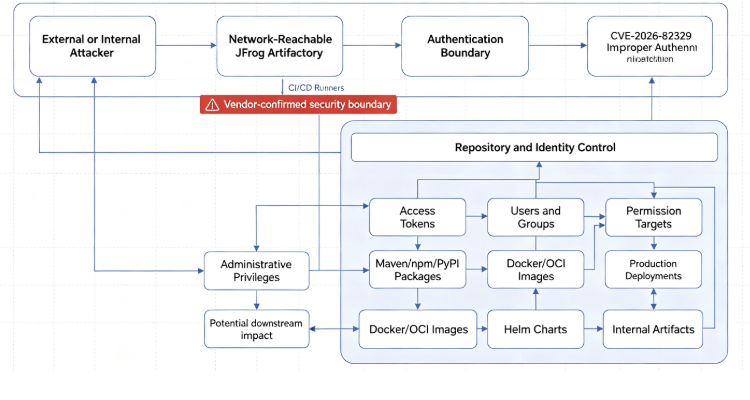
Artifactory often occupies a privileged position inside software delivery infrastructure.
A simplified architecture might look like:
Developers
    |
    v
Git repositories
    |
    v
Build systems
    |
    v
CI runners
    |
    v
+----------------------+
|   JFrog Artifactory  |
+----------------------+
    |
    +--> Maven
    |
    +--> npm
    |
    +--> PyPI
    |
    +--> NuGet
    |
    +--> Docker / OCI
    |
    +--> Helm
    |
    +--> Generic binaries
    |
    v
Release pipeline
    |
    v
Production
An ordinary content-management system administrator may control pages and application settings.
An Artifactory administrator can sit close to something much more sensitive: the integrity boundary of software that other machines trust.
That is why the I:H portion of CVSS deserves particular attention.
A supply-chain-oriented incident investigation must consider whether unauthorized administrative access could have affected repository content, users, groups, permission targets, access tokens, repository configuration, or artifacts subsequently consumed by CI/CD infrastructure.
The CVE record itself only confirms the possibility of administrative privilege acquisition; it does not claim that all of these post-exploitation actions have been observed. (OpenCVE)
They are downstream consequences defenders should model once administrative control may have been lost.
A Realistic CVE-2026-82329 Attack Model
Because the exact exploit request remains undisclosed, it would be misleading to publish a fake CVE-specific PoC.
The useful approach is instead to model the verified security boundary and likely post-compromise impact:
Phase 1: Discovery

Reachable Artifactory instance
             |
             v

Phase 2: Exposure assessment

Affected Artifactory build
             |
             v

Phase 3: Authentication attack

CVE-2026-82329 condition
             |
             v

Phase 4: Privilege transition

Unauthenticated
      ->
Administrative context
             |
             v

Phase 5: Post-compromise opportunities

Identity configuration
Repository permissions
Access tokens
Artifact integrity
Repository configuration
             |
             v

Phase 6: Downstream risk

CI/CD
Developer environments
Container builds
Production deployments
The CVE-specific portion is the transition from an unauthenticated network caller toward administrative privileges.
The stages afterward are an incident-response impact model.
That distinction should remain explicit.
Default Configuration Is One of the Most Important Details
JFrog says the authentication weakness may be exploitable under default configuration. (JFrog Docs)
That wording changes the defensive calculation.
Many enterprise vulnerabilities require a rare optional plugin, legacy feature, unusual reverse-proxy configuration, debug interface, weak custom role, or deliberately enabled anonymous functionality.
JFrog does not describe CVE-2026-82329 that way.
This means an administrator cannot reasonably conclude:
"We run a normal configuration,
so this probably does not affect us."
In this case, a normal configuration is precisely within the vendor’s stated risk model.
Does Disabling Anonymous Access Stop CVE-2026-82329?
There is no public evidence demonstrating that disabling Artifactory’s Anonymous Access feature fixes CVE-2026-82329.
This is a critical semantic distinction.
En unauthenticated attacker means the attack starts without valid user credentials.
Anonymous Access, by contrast, is an intentional Artifactory feature controlling whether unauthenticated users receive permitted repository access.
Those concepts are related to authentication state but are not equivalent.
Therefore:
Anonymous Access disableddoes not establish:
CVE-2026-82329 mitigatedJFrog’s documented remediation for Self-Hosted environments is to upgrade to a fixed release, not merely to change the Anonymous Access setting. (JFrog Docs)
This is especially worth emphasizing because the preceding Artifactory 7.133.27 release notes discussed a different set of vulnerabilities that could become critical when Anonymous Access was enabled. CVE-2026-82329 is disclosed separately and specifically says default configuration may be affected. (JFrog Docs)
How to Check the Artifactory Version Safely
The safest first step is not exploit reproduction.
It is version identification.
JFrog officially exposes an Artifactory System API:
/artifactory/api/system/versionThe API returns the current Artifactory version, revision and installed add-ons. JFrog documents the endpoint through its official Get Artifactory Version API reference. (JFrog Docs)
An authorized administrator can query it with existing credentials:
curl -s \
  -u "$JFROG_USER:$JFROG_PASSWORD" \
  "https://artifactory.example.com/artifactory/api/system/version"
Or, in an environment where an approved access token is already available:
curl -s \
  -H "Authorization: Bearer $JFROG_TOKEN" \
  "https://artifactory.example.com/artifactory/api/system/version"
JFrog also documents several additional ways to identify the product version: through the Service Status page in the UI, through the product version properties file, and through Artifactory startup logs. (JFrog)
For a Self-Hosted system, the local product-version property can provide especially strong evidence:
$JFROG_HOME/artifactory/app/artifactory.product.version.propertiesThe important detail from JFrog’s documentation is that administrators should distinguish the Artifactory Product Version from individual microservice versions. The CVE remediation decision should be tied to the correct product release rather than an unrelated component’s version number. (JFrog)
A Safe Version-Assessment Script
For organizations managing multiple instances, the comparison can be automated without attempting the actual authentication bypass.
from packaging.version import Version

def assess_cve_2026_82329(version_string):
    v = Version(version_string)

    affected_ranges = [
        (Version("0"), Version("7.111.21")),
        (Version("7.117.0"), Version("7.117.28")),
        (Version("7.125.0"), Version("7.125.20")),
        (Version("7.133.0"), Version("7.133.29")),
        (Version("7.146.0"), Version("7.146.38")),
        (Version("7.161.0"), Version("7.161.20")),
    ]

    for start, fixed in affected_ranges:
        if start <= v < fixed:
            return {
                "version": version_string,
                "status": "affected",
                "fixed_boundary": str(fixed),
            }

    return {
        "version": version_string,
        "status": "not matched to published affected range",
    }


for version in [
    "7.111.20",
    "7.117.27",
    "7.125.19",
    "7.133.28",
    "7.146.36",
    "7.161.19",
    "7.161.20",
]:
    print(assess_cve_2026_82329(version))
There is one operational caveat.
The CNA describes a default status of unaffected with specific affected ranges rather than describing every possible numerical version between the listed branches as vulnerable. (OpenCVE)
For production vulnerability-management logic, security teams should therefore mirror the vendor’s actual range semantics rather than inventing assumptions about unlisted development or branch versions.
Exposure Is More Than a Version Number
Version matching answers:
Could this software build be affected?It does not automatically answer:
Can an attacker reach it?An Artifactory instance reachable from the public internet deserves the highest initial urgency because CVE-2026-82329 is network reachable and requires no existing privileges.
But an internal deployment is not automatically safe.
An attacker with an existing foothold in a developer workstation, CI runner, Kubernetes workload, VPN account, jump host or compromised internal application could potentially reach an Artifactory service that is inaccessible directly from the internet.
The relevant graph is:
Attacker
   |
   +--> Internet-facing Artifactory
   |
   or
   |
   +--> Compromised internal foothold
                |
                v
        Internal Artifactory
The security question is therefore not simply “Is Artifactory public?”
It is:
Which security zones can initiate connections to Artifactory?Internet Exposure Should Be Checked Across Every Deployment
Large organizations frequently have more than one Artifactory environment.
Production may be properly restricted while a forgotten development, migration, disaster-recovery or staging instance remains reachable.
The dangerous pattern is:
Primary Artifactory
    -> patched
    -> monitored
    -> restricted

Old migration Artifactory
    -> forgotten
    -> exposed
    -> vulnerable
A vulnerability-management exercise should therefore enumerate the complete Artifactory estate rather than patching only the hostname everyone knows.
Asset discovery should correlate DNS, reverse proxies, load balancers, Kubernetes ingress configuration, cloud inventories, CMDB entries and developer documentation where available.
Cloud Versus Self-Hosted Remediation
JFrog gives different guidance for its Cloud and Self-Hosted environments.
For affected JFrog Cloud environments, the vendor says the environments have already been fortified and no action is required for cloud instances. (JFrog Docs)
For Self-Hosted Artifactory, JFrog instructs customers to upgrade to the fixed version applicable to the release branch.
That means the remediation boundary can be summarized as:
| Despliegue | Required action |
|---|---|
| JFrog Cloud | Vendor says affected environments have already been fortified |
| Self-Hosted | Upgrade to the relevant fixed Artifactory release |
| Unknown deployment ownership | Establish whether the instance is vendor-managed or customer-managed before closing the finding |
A cloud customer’s remediation task may therefore be primarily evidence and incident review.
A Self-Hosted customer’s task starts with patch deployment.
Patching Should Come Before Exploit Curiosity
For a critical authentication bypass with a vendor-provided patch, an enterprise should not delay remediation while waiting for a public exploit.
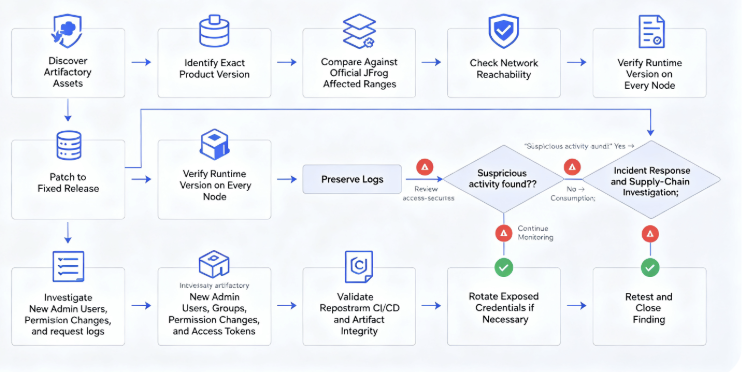
A safer sequence is:
Identify affected instance
        |
        v
Patch / upgrade
        |
        v
Verify running version
        |
        v
Preserve historical logs
        |
        v
Review administrative changes
        |
        v
Investigate repository activity
        |
        v
Assess credential/token exposure
        |
        v
Validate artifact integrity where necessary
This is particularly important because authentication-bypass bugs can have a short path from vulnerability disclosure to automated scanning once enough technical details become public.
As of August 31, public sources reviewed for this article do no provide a reliable, verified CVE-2026-82329 exploitation recipe. GitHub’s advisory currently reproduces the vendor description and CVSS information rather than a PoC, while OpenCVE currently reports a low EPSS value and does not mark the CVE as KEV. (GitHub)
That is useful threat context.
It is not a reason to postpone patching.
CVSS Severity and Exploit Probability Are Different Questions
CVE-2026-82329 is a good example of why security teams should not treat CVSS, EPSS, public PoC availability and known exploitation as interchangeable metrics.
CVSS asks:
How severe could successful exploitation be?EPSS asks a different statistical question:
How likely is exploitation in the near term
based on the model and available signals?
Known exploitation asks:
Do we have evidence attackers are already using it?Public exploit availability asks:
Is reusable technical exploitation material available?A vulnerability can therefore simultaneously be:
CVSS 9.8
+
No currently verified public PoC
+
Low current EPSS
without contradiction.
GitHub’s advisory was showing an EPSS estimate of roughly 0.377% when reviewed, while still assigning the CVSS 9.8 Critical severity inherited from the CVE data. (GitHub)
Those numbers will change independently over time.
The operational conclusion should not be “low EPSS means ignore the vulnerability.”
An unauthenticated administrative bypass on a software-distribution system still has sufficiently serious downside that an affected, reachable Self-Hosted instance warrants rapid remediation.
What Should Defenders Hunt for After Patching?
Patching eliminates the known vulnerable software state.
It does not prove that nothing happened before the patch.
JFrog maintains an Audit Trail Log specifically for operations involving security-sensitive identities and permissions.
JFrog documents that this log records creation, update and deletion events involving users, groups, permission targets and access tokens. Starting with Artifactory 7.131.0, it also records updates to Access configuration settings. The log is stored at:
$JFROG_HOME/artifactory/var/log/access-security-audit.logJFrog’s official documentation is available in the Audit Trail Log reference. (JFrog Docs)
This makes access-security-audit.log one of the highest-value evidence sources when investigating potential administrative compromise.
Investigating access-security-audit.log
The investigation should establish a baseline of known administrative actions and then identify unexplained deviations.
JFrog documents fields including the date, Trace ID, user IP, acting user, logged principal, entity name, event type, event and changed data. (JFrog Docs)
That enables incident responders to correlate:
who
+
from which IP
+
changed what
+
at what time
+
under which trace
Useful defensive searches can begin with ordinary text-processing tools.
Por ejemplo:
LOG="$JFROG_HOME/artifactory/var/log/access-security-audit.log"

grep -Ei \
  'user|group|permission|token|admin|access' \
  "$LOG"
A time-bounded review may look like:
awk '$0 >= "2026-08-20" && $0 <= "2026-09-01"' \
  "$JFROG_HOME/artifactory/var/log/access-security-audit.log"
The exact filtering should be adapted to the actual JFrog log format and SIEM ingestion pipeline.
The goal is not to search for a magic CVE-specific string.
At present, there is no public JFrog indicator stating:
"This exact request means CVE-2026-82329 exploitation."Instead, defenders should look for consequences inconsistent with legitimate administrative activity.
Artifactory Access Logs Provide Another Evidence Layer
JFrog separately documents artifactory-access.log, which records security-related events together with source IP and contextual information. Examples include accepted or rejected login events and artifact download, browsing and deployment activity. (JFrog Docs)
The documented location is:
$JFROG_HOME/artifactory/var/artifactory/log/artifactory-access.logThe access log can help investigators answer questions such as whether unusual source addresses accessed repositories, whether unexpected identities appeared, whether artifact deployment occurred during suspicious periods, or whether download patterns changed suddenly. (JFrog Docs)
Because CVE-2026-82329 is an authentication vulnerability, correlation matters more than any one log line.
A suspicious sequence might conceptually look like:
Unknown source IP
      |
      v
Unusual request activity
      |
      v
Unexpected privileged identity event
      |
      v
Repository modification
      |
      v
Artifact consumed downstream
Each transition should be supported by actual logs before it is presented as evidence.
Request Logs Are Important for Authentication Investigation
JFrog’s logging guidance states that request logs include fields such as timestamp, Trace ID, remote address, username, HTTP method, request URL, response status, content lengths, duration and user agent. (JFrog)
This provides useful raw material for reconstructing suspicious request sequences.
An important JFrog-specific detail is that request logs may label requests differently depending on authentication state and whether Anonymous Access is configured.
JFrog explains that non_authenticated_user can represent requests without credentials when Anonymous Access is disabled, as well as attempts that supplied invalid credentials. When Anonymous Access is enabled, credential-free requests may instead be logged as anonymous. (JFrog)
That means defenders should avoid a simplistic detection rule such as:
username == anonymous
    ->
CVE exploitation
or:
username == non_authenticated_user
    ->
CVE exploitation
Both identities can occur for legitimate or failed unauthenticated traffic.
Detection must correlate request behavior with security events and post-authentication consequences.
Trace IDs Can Help Reconstruct the Event Chain
JFrog emphasizes Trace IDs in its log-analysis guidance because they allow individual requests to be followed across services. (JFrog)
For a suspected authentication-bypass incident, this is especially useful.
A defender may begin with an unexplained privileged change:
access-security-audit.logextract the associated Trace ID, and then correlate it against:
request logs
access logs
service logs
reverse-proxy logs
WAF logs
load-balancer logs
The goal is to turn an isolated suspicious event into a timeline.
Por ejemplo:
2026-08-29 03:14:02
External IP reaches Artifactory

2026-08-29 03:14:03
Request receives unexpected privileged context

2026-08-29 03:14:06
Access token created

2026-08-29 03:16:41
Repository configuration changed

2026-08-29 03:20:15
Artifact deployed
This timeline is illustrative, not a known CVE-2026-82329 indicator.
But it demonstrates the evidentiary standard incident responders should aim for.
Access Token Review Matters After Administrative Compromise
JFrog’s Audit Trail Log explicitly records access-token creation, updates and deletion. (JFrog Docs)
That makes token review particularly important if administrators have reason to believe unauthorized administrative access may have occurred.
An attacker who obtains temporary administrative capability does not necessarily need to remain dependent on the original vulnerability.
Conceptually:
Authentication bypass
       |
       v
Temporary admin capability
       |
       v
Persistent credential or token
       |
       v
Patch deployed
       |
       v
Attacker still has valid access
This is a generic post-compromise persistence model, not evidence that CVE-2026-82329 specifically creates tokens automatically.
But it explains why patching alone may be insufficient when compromise is suspected.
Security teams may need to invalidate unexplained access tokens, inspect service identities and reassess credentials that could have been accessed by an unauthorized administrator.
Repository Integrity Can Be More Important Than Server Integrity
The instinctive incident-response question is often:
Was malware installed on the Artifactory server?For a software repository, that is not enough.
An attacker may gain more leverage by compromising an artifact than by leaving an obvious server-side implant.
The more important questions can include:
Were artifacts overwritten?
Were new versions uploaded?
Did checksums change?
Were package metadata or repository settings changed?
Were remote repositories redirected?
Were container images replaced?
Did builds consume suspicious artifacts?
If the answer to any of these is yes, the investigation may need to expand beyond Artifactory.
The downstream dependency graph could include:
Artifactory
     |
     +--> CI runner
     |
     +--> developer workstation
     |
     +--> Docker build
     |
     +--> Kubernetes deployment
     |
     +--> release image
     |
     +--> production host
That is why a repository-control vulnerability can become a supply-chain incident.
Artifact Hashes Are Valuable Incident-Response Evidence
Where organizations already maintain artifact signing, checksums, SBOMs or build provenance, those systems become valuable during CVE-2026-82329 investigation.
Suppose a known-good build recorded:
SHA-256:
a8c...trusted-hash...
while the currently stored artifact produces:
SHA-256:
91f...unexpected-hash...
That discrepancy requires investigation regardless of whether malware was discovered on the Artifactory operating system.
The strongest repository-integrity architecture avoids trusting the repository itself as the sole source of truth.
Independent signing or provenance systems can provide evidence even when the repository’s administrative plane is potentially untrusted.
CI/CD Secrets Expand the Blast Radius
Artifactory is frequently integrated with CI/CD through machine identities.
Depending on the architecture, the platform may interact with:
CI service accounts
repository credentials
access tokens
container registries
remote package repositories
build-info systems
deployment infrastructure
Administrative compromise therefore raises a secondary question:
Which secrets were accessible, modifiable, or reusable from the compromised trust boundary?
The answer depends heavily on local architecture.
This is why incident response should not blindly rotate every credential in the organization, nor should it rotate nothing.
Credential rotation should follow an exposure graph.
If a credential could have been viewed, generated, replaced, exported or abused through administrative control, its trustworthiness may need to be re-established.
Patch Verification Must Check the Runtime
A change ticket saying “Artifactory upgraded” is not sufficient evidence that remediation succeeded.
JFrog’s own post-upgrade guidance recommends verifying the Artifactory version after an upgrade and checking the broader health of services, authentication, repositories, permissions, plugins, logs, configuration and critical build pipelines. (JFrog)
For CVE-2026-82329, the closure evidence should therefore include the actual runtime product version.
Por ejemplo:
Before:
Artifactory 7.161.19

Upgrade:
7.161.20 deployed

After:
GET /artifactory/api/system/version
-> 7.161.20

Result:
Published vulnerable range no longer matched
The same principle should be applied to every node in a high-availability deployment.
A single stale node can undermine the remediation conclusion.
HA Environments Need Node-Level Validation
JFrog Artifactory can be deployed in multi-node environments.
Therefore, a load-balanced URL returning a patched system does not automatically prove that every backend node is patched.
Operationally, defenders should establish:
Load balancer
      |
  +---+---+
  |       |
Node A   Node B
7.161.20 7.161.19
If traffic can still reach Node B, the deployment should not be treated as fully remediated.
JFrog’s version documentation distinguishes product versions and service/node information and provides ways to inspect service status. (JFrog)
For critical CVEs, patch verification should therefore be node aware.
Safe CVE Verification Is Better Than Blind Exploitation
CVE-2026-82329 is a strong example of why vulnerability verification should not be reduced to:
CVE exists
    ->
download random PoC
    ->
run against production
As of August 31, the exact exploit mechanics are not publicly documented by JFrog.
A sensible validation workflow can still produce high-confidence results:
CVE intelligence
       |
       v
Asset identification
       |
       v
Product version
       |
       v
Network reachability
       |
       v
Configuration context
       |
       v
Exposure classification
       |
       v
Patch
       |
       v
Runtime version verification
       |
       v
Security log review
       |
       v
Incident conclusion
That is already substantially more useful than a scanner result saying:
JFrog detected
CVE-2026-82329 maybe present
Version Detection Is Not the Same as Exploit Confirmation
A vulnerability scanner may report:
Artifactory 7.161.19 detected
        +
CVE affected range matched
        =
Critical finding
That finding is useful and, for patch prioritization, may already be sufficient.
But technically it proves:
candidate exposurerather than:
successful authentication bypassA mature security report should preserve that distinction.
| Pruebas | Appropriate conclusion |
|---|---|
| Product fingerprint only | Artifactory detected |
| Version matches affected range | Candidate vulnerable |
| Version + reachable network path | Exposed candidate vulnerable |
| Controlled non-destructive behavioral proof | Vulnerable behavior validated |
| Administrative transition demonstrated in authorized lab | Exploitability demonstrated |
| Post-compromise artifacts found | Potential or confirmed incident |
Collapsing every row into “confirmed exploitation” creates bad security data.
Likewise, treating the first row as proof the system is safe would also be wrong.
Evidence-Driven CVE Verification With Penligent
This is also where an agentic penetration-testing workflow can be more useful than simple signature scanning.
Penligent’s public product material describes workflows around finding vulnerabilities, verifying findings, executing authorized tests and preserving evidence, rather than treating every version match as an automatically confirmed vulnerability. (Penligente)
For CVE-2026-82329, an appropriate authorized workflow would begin with asset identification, Artifactory version collection, branch comparison and network-reachability analysis. Because JFrog has not publicly disclosed the exploit primitive, a production assessment should avoid inventing or blindly attempting an unverified authentication-bypass payload.
The useful automation boundary is instead:
Target
   |
   v
Identify JFrog Artifactory
   |
   v
Collect version evidence
   |
   v
Compare official CVE ranges
   |
   v
Evaluate reachability
   |
   v
Review security configuration
   |
   v
Collect audit evidence
   |
   v
Patch
   |
   v
Retest
   |
   v
Generate evidence-backed report
Penligent has previously described this distinction between vulnerability detection and evidence-backed CVE verification in its technical material. Penligent’s CVE verification workflow example The broader agentic penetration-testing platform is available through Penligent AI Pentesting. (Penligente)
The important part is not having an AI system claim:
"I found the CVE."It is having a system preserve an evidence chain showing exactly why a target is considered vulnerable, patched, inconclusive or compromised.
What a Strong CVE-2026-82329 Finding Should Contain
A useful vulnerability finding might read conceptually like this:
Target:
artifactory.example.com

Product:
JFrog Artifactory

Observed version:
7.161.19

Official affected range:
7.161.0 <= version < 7.161.20

Network reachability:
HTTPS reachable from approved external test network

Vendor severity:
Critical

CVSS:
9.8

Authentication:
Vendor states no privileges required

Validation status:
Candidate vulnerable based on exact version and reachability.
No destructive exploit attempted because public exploit mechanics
were not available and production exploitation was unnecessary.

Remediation:
Upgrade to 7.161.20 or newer applicable supported release.

Post-remediation evidence:
Runtime version confirmed as fixed.
Audit logs reviewed for suspicious administrative changes.
That is a defensible security artifact.
It preserves facts, uncertainty and remediation evidence separately.
Do Not Build Detection Around a Fake PoC
A recurring problem after critical CVEs are disclosed is that security blogs invent a plausible exploit endpoint and then defenders build signatures around it.
That can create false confidence.
Suppose a speculative article claims:
POST /some/admin/api
X-Fake-Auth: administrator
and a SOC subsequently writes a WAF rule matching that request.
If the real CVE uses a completely different authentication path, the organization has built a detection rule for an exploit that never existed while the actual vulnerability remains exposed.
For CVE-2026-82329, detection engineering should currently focus on high-confidence evidence:
affected Artifactory version
network exposure
unexplained administrative changes
new access tokens
identity changes
permission changes
repository configuration changes
unexpected artifact deployment
suspicious request sequences
Once JFrog or a credible research team publishes technical exploit details, defenders can add CVE-specific HTTP detections.
Why a WAF Is Not a Replacement for the Patch
Without knowing the exact triggering request, a WAF has limited ability to reliably block CVE-2026-82329.
A generic WAF may still provide useful protection against unrelated attacks and may generate valuable HTTP telemetry.
But:
WAF presentdoes not establish:
authentication bypass preventedThe same applies to MFA.
MFA is extremely valuable for normal administrator authentication.
But an authentication bypass is concerning precisely because the attacker may be crossing the authentication boundary incorrectly.
If exploitation does not require the normal login workflow, strengthening that normal login workflow is not necessarily a fix for the underlying vulnerability.
The vendor patch remains the authoritative remediation.
Network Segmentation Still Helps
Although network segmentation does not repair vulnerable authentication logic, it can materially reduce reachable attack paths.
Por ejemplo:
Internet
   X
   |
Artifactory

Allowed:
CI runners
approved developer networks
administrative jump hosts
is generally a stronger exposure model than:
Internet
   |
   v
Artifactory login page
This is especially relevant during emergency patch deployment.
If a maintenance window genuinely prevents immediate upgrade, temporarily restricting network reachability can reduce exposure while remediation is being prepared.
It should be documented as a compensating control, not described as equivalent to the vendor fix.
Reverse Proxies Should Preserve Investigation Evidence
Many enterprise Artifactory instances sit behind NGINX, Apache HTTP Server, Kubernetes ingress controllers, cloud load balancers or dedicated WAF infrastructure.
Those layers can contain evidence not preserved inside Artifactory.
Useful correlation fields can include:
source IP
forwarded IP
timestamp
HTTP method
request path
status code
user agent
request size
TLS metadata
rate patterns
If possible, historical reverse-proxy logs covering the vulnerable exposure period should be preserved before routine retention deletes them.
This becomes more important if Artifactory’s own logs are incomplete.
What to Do If Suspicious Administrative Activity Is Found
If log review identifies unexplained administrative behavior during the vulnerable period, the incident should no longer be treated as routine vulnerability management.
The investigation boundary may need to move from:
"Was Artifactory vulnerable?"a:
"What trust did Artifactory control,
and what could have been changed?"
That usually means examining identity changes, tokens, repository configuration, modified or newly uploaded artifacts, build activity, downstream consumption and secrets reachable through Artifactory’s administrative context.
The timeline should be based on evidence rather than assumptions about what a hypothetical attacker “would probably do.”
Patch Validation Should Include Application Functionality
Artifactory is often critical infrastructure.
Emergency upgrades can therefore create pressure to avoid testing.
That is risky in the opposite direction.
After upgrading, teams should verify both security state and operational state:
Correct product version
Authentication works
Expected users can log in
Unauthorized users remain rejected
Repositories are available
Downloads work
Deployments work
CI pipelines can resolve dependencies
Container pulls work
Permissions remain correct
Plugins remain compatible
Logging remains active
JFrog’s own post-upgrade checklist emphasizes version verification, service status, connectivity, authentication, repositories, permissions, plugin compatibility, logs, configuration and critical build pipelines. (JFrog)
A security patch that breaks the build pipeline will quickly create pressure to roll back.
A tested security patch is much more durable.
Why CVE-2026-82329 Deserves Emergency Prioritization Even Without a Public PoC
A common vulnerability-prioritization model considers several inputs:
| Factor | CVE-2026-82329 |
|---|---|
| Gravedad | Crítica |
| CVSS | 9.8 |
| Remote | Sí |
| Authentication required | No |
| Interacción con el usuario | No |
| Attack complexity | Bajo |
| Default configuration | Potentially affected |
| Privilege gained | Administrative |
| Product role | Software artifact infrastructure |
| Vendor patch | Available |
| Public root cause | Limitado |
| Verified widespread exploitation | Not established in reviewed public sources |
The absence of a mature public PoC mainly changes threat-intelligence confidence.
It does not change the vulnerability’s technical impact.
More importantly, a patch already exists.
The cost-benefit equation therefore favors remediation.
CVE-2026-82329 and the Broader Artifactory Security Pattern
CVE-2026-82329 did not arrive in isolation.
JFrog’s 2026 advisories include vulnerabilities affecting authentication, authorization, repository metadata, cache integrity, token handling, remote repository behavior and privileged operations. (JFrog Docs)
For defenders, the lesson is not necessarily that Artifactory is uniquely insecure.
Large, privileged infrastructure products expose broad security surfaces because they combine:
identity
authorization
repositories
package protocols
remote fetching
tokens
metadata
build information
administration
integrations
The more security boundaries a product owns, the more dangerous a failure in the central authentication layer can become.
This also reinforces the value of staying on the newest supported security patch within the deployed branch instead of applying only individual headline CVEs.
Vulnerability Management Should Track Branches, Not Just Major Versions
An inventory saying:
Artifactory 7is nearly useless for CVE-2026-82329.
Even:
Artifactory 7.161is insufficient.
The relevant distinction is:
7.161.19 vs 7.161.20The same applies across the other affected maintenance branches.
A good CMDB or vulnerability-management system should therefore preserve at least:
product
major version
minor version
patch version
deployment type
network exposure
owner
environment
last verified timestamp
Otherwise, security teams may discover that their inventory cannot answer the most basic remediation question when a critical patch arrives.
Final Remediation Matrix
| Situación | Recommended response |
|---|---|
| Self-Hosted version matches affected CNA range | Upgrade immediately to the relevant fixed branch or newer supported release |
| Internet-facing vulnerable instance | Highest remediation priority; restrict exposure while patching if possible |
| Internal vulnerable instance | Patch rapidly; evaluate reachable internal attack paths |
| JFrog Cloud | JFrog says affected Cloud environments have already been fortified |
| Patched but previously exposed | Preserve and review relevant logs |
| Suspicious privileged changes discovered | Escalate to incident response |
| Unexplained access tokens | Validate ownership and revoke/rotate where appropriate |
| Artifact integrity uncertain | Compare against trusted hashes, signatures, provenance and build records |
| HA deployment | Confirm every node is running a fixed version |
| No public PoC found | Do not interpret as evidence the affected system is safe |
Frequently Asked Questions
What is CVE-2026-82329?
CVE-2026-82329 is a critical authentication vulnerability in JFrog Artifactory. JFrog says that under default configuration, an unauthenticated attacker with network access may obtain administrative privileges. (JFrog Docs)
How severe is CVE-2026-82329?
The CVE has a CVSS v3.1 score of 9.8 Critical, using the vector:
CVSS:3.1/AV:N/AC:L/PR:N/UI:N/S:U/C:H/I:H/A:H(OpenCVE)
Does CVE-2026-82329 require authentication?
According to JFrog’s CNA description and CVSS vector, no existing privileges are required. (OpenCVE)
Does the attacker need user interaction?
No. The CVSS vector specifies UI:N, or no user interaction. (OpenCVE)
Can CVE-2026-82329 provide administrator privileges?
JFrog explicitly describes the vulnerability as a potential authentication bypass leading to administrative access and says an unauthenticated network attacker may obtain administrative privileges. (JFrog Docs)
Is JFrog Cloud affected?
JFrog says affected Cloud environments have already been fortified and no action is required for cloud instances. Self-Hosted environments require upgrading to the applicable fixed release. (JFrog Docs)
Is disabling Anonymous Access enough?
JFrog has not documented disabling Anonymous Access as the fix for CVE-2026-82329. The recommended Self-Hosted remediation is upgrading to a fixed version. (JFrog Docs)
Is there a public CVE-2026-82329 PoC?
As of August 31, 2026, the reliable sources reviewed for this article do not provide a verified public exploitation recipe. GitHub’s advisory currently contains the CVE description and severity information, while OpenCVE does not currently mark the vulnerability as KEV. (GitHub)
That status can change quickly after disclosure.
What is the exact CVE-2026-82329 root cause?
JFrog currently classifies the flaw as CWE-287 Improper Authentication but has not publicly documented the precise vulnerable endpoint or complete authentication-bypass mechanism. (JFrog Docs)
Claims about a specific JWT, header, cookie, token, API or authentication provider should therefore be treated as unverified unless backed by later technical disclosure.
Conclusión
CVE-2026-82329 is one of the highest-priority Artifactory vulnerabilities disclosed in 2026 because it combines network reachability, low attack complexity, no authentication requirement and potential administrative access.
Its severity becomes even more important when Artifactory’s position in the software supply chain is considered.
The immediate technical problem is:
Unauthenticated attacker
        ->
Authentication bypass
        ->
Administrative privileges
But the enterprise security problem can become:
Administrative compromise
        ->
Repository trust compromised
        ->
Artifact or identity integrity uncertain
        ->
CI/CD trust uncertain
        ->
Downstream software trust uncertain
JFrog has already published branch-specific fixed releases and says affected Cloud environments have been fortified. Self-Hosted administrators should therefore verify their exact product version against the official JFrog CVE-2026-82329 advisory y el Artifactory Self-Managed release history rather than waiting for public exploit code. (JFrog Docs)
For systems that were reachable while vulnerable, patching should be followed by evidence-based review of security audit logs, access tokens, users, groups, permissions, repository modifications and artifact integrity. JFrog’s Audit Trail Log documentation y Artifactory Access Log documentation provide the foundation for that investigation. (JFrog Docs)
Most importantly, defenders should resist two opposite mistakes.
The first is inventing an exploit mechanism that JFrog has not disclosed.
The second is assuming that the absence of a public PoC makes a CVSS 9.8 unauthenticated administrative bypass in software-supply-chain infrastructure safe to defer.
Neither conclusion is supported by the evidence.
The right response is simpler:
Discover
   ->
Verify the exact version
   ->
Assess reachability
   ->
Patch
   ->
Verify the runtime
   ->
Review security evidence
   ->
Validate repository integrity
   ->
Retest
That produces something much more valuable than a vulnerability alert: a defensible answer to whether CVE-2026-82329 actually created risk in the environment, whether that risk has been eliminated, and whether there is any evidence that the Artifactory trust boundary was compromised.

 Spanish
  English
  German
  French
  Portuguese
  Japanese
  Korean
  Hindi
Hindi  Arabic
  Turkish
  Hebrew