
CVE-2025-53521 has become one of the most important F5 BIG-IP vulnerabilities for defenders to revisit in 2026—not because it was newly discovered, but because the security community’s understanding of the flaw changed dramatically after its original disclosure.
F5 originally disclosed CVE-2025-53521 on October 15, 2025. At the time, the issue was treated primarily as a denial-of-service vulnerability affecting BIG-IP Access Policy Manager. Months later, new information obtained in March 2026 showed that the consequences were substantially more severe: specially crafted traffic could trigger remote code execution without authentication when a BIG-IP APM access policy was configured on a virtual server. F5 subsequently revised the vulnerability’s severity, and UK authorities warned organizations to take immediate action. (National Cyber Security Centre)
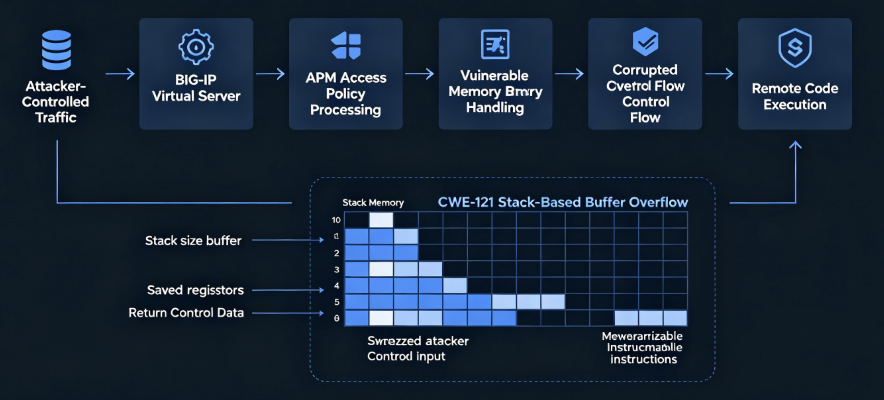
The vulnerability is now rated Crítica, with a CVSS v3.1 score of 9.8 and CVSS v4.0 score of 9.3. The current CVE record identifies it as a CWE-121 stack-based buffer overflow, with network accessibility, low attack complexity, no privileges required, and no user interaction required. (OpenCVE)
More importantly, this is no longer a theoretical risk.
F5 confirmed exploitation of vulnerable BIG-IP systems, and CISA added CVE-2025-53521 to its Known Exploited Vulnerabilities catalog on March 27, 2026. CISA classified exploitation as active and the technical impact as total. Federal agencies were given a remediation deadline of March 30, 2026—an unusually short remediation window reflecting the urgency surrounding the vulnerability. (OpenCVE)
For organizations running BIG-IP APM at the network edge, the question is therefore no longer simply:
“Are we vulnerable?”
The more important questions are:
Were we vulnerable when exploitation began, and have we already been compromised?
CVE-2025-53521 at a Glance
| Atributo | CVE-2025-53521 |
|---|---|
| CVE | CVE-2025-53521 |
| Vendor | F5 |
| Producto | BIG-IP |
| Affected module | Access Policy Manager |
| Clase de vulnerabilidad | Stack-based buffer overflow |
| CWE | CWE-121 |
| Impacto | Ejecución remota de código |
| Authentication required | No |
| Vector de ataque | Red |
| Attack complexity | Bajo |
| Interacción con el usuario | Ninguno |
| CVSS v3.1 | 9.8 Critical |
| CVSS v4.0 | 9.3 Critical |
| CISA KEV | Sí |
| Confirmed exploitation | Sí |
| Original disclosure | October 15, 2025 |
| KEV addition | March 27, 2026 |
The official vulnerability description is deceptively short: when an APM access policy is configured on a virtual server, specially crafted malicious traffic can cause remote code execution. F5 notes that software releases already beyond End of Technical Support were not evaluated. (NCSC NL)
That configuration requirement matters.
This is not simply “every F5 appliance on the Internet is automatically exploitable.” The vulnerable attack surface involves BIG-IP APM and a virtual server using an APM access policy.
However, this configuration is precisely what many enterprises deploy to expose authentication portals, remote access services and protected applications to external users.
That makes CVE-2025-53521 especially dangerous.
Why CVE-2025-53521 Is So Serious
The CVSS score alone does not fully explain the operational risk.
An unauthenticated RCE in an Internet-facing edge device sits near the top of the vulnerability-prioritization hierarchy.
BIG-IP APM commonly operates before the application itself. It can enforce authentication, authorization and access policies for services behind the device. F5 documentation describes APM access profiles as configurations that determine the security checks a client must pass before being granted access to protected applications. (F5 Cloud Docs)
Conceptually, the architecture may look like this:
Internet
   |
   v
+--------------------------+
| F5 BIG-IP Virtual Server |
|                          |
| APM Access Policy        |
+--------------------------+
           |
           v
 Authentication / Access
           |
           v
+--------------------------+
| Internal Applications    |
| APIs / VPN / Services    |
+--------------------------+
Normally, APM is one of the systems deciding whether an external client should be trusted.
CVE-2025-53521 potentially turns that security boundary itself into the initial compromise point.
Instead of:
Attacker
   |
Authentication
   |
Authorization
   |
Protected Application
the security problem becomes:
Attacker
   |
   | crafted network traffic
   v
Vulnerable BIG-IP APM
   |
   v
Remote Code Execution
The authentication control is no longer necessarily protecting the vulnerable component because exploitation occurs before the attacker needs legitimate credentials.
This is why the CVSS v3.1 vector is:
CVSS:3.1/AV:N/AC:L/PR:N/UI:N/S:U/C:H/I:H/A:HThe important components are:
AV:N  Network reachable
AC:L  Low attack complexity
PR:N  No privileges required
UI:N  No user interaction
C:H   High confidentiality impact
I:H   High integrity impact
A:H   High availability impact
F5’s CVSS v4.0 assessment similarly gives the vulnerability a Critical 9.3 rating. (OpenCVE)
The Most Important Part of the CVE-2025-53521 Story: It Was Originally a DoS
The timeline of CVE-2025-53521 is unusually important because it demonstrates why vulnerability management cannot treat the original CVE description as permanently authoritative.
October 15, 2025: Initial disclosure
F5 originally published CVE-2025-53521 during its October 2025 security disclosures.
At that point, the vulnerability was understood primarily as a denial-of-service condition. Reporting at the time associated it with a CVSS score around 7.5.
Organizations that patched immediately were already protected by the fixes released for the affected branches.
Organizations that prioritized vulnerabilities primarily according to known impact, however, might reasonably have put a DoS vulnerability below authentication bypasses and remote code execution vulnerabilities.
That assumption later became dangerous.
March 2026: New information changes the threat model
In March 2026, F5 received additional information indicating that the vulnerability could be exploited for code execution.
The flaw was reclassified as an unauthenticated RCE and its CVSS v3.1 rating increased to 9.8. (Lectura oscura)
The UK National Cyber Security Centre subsequently warned organizations to take immediate action, explicitly describing CVE-2025-53521 as an unauthenticated RCE and confirming that F5 was aware of active exploitation. (National Cyber Security Centre)
March 27, 2026: CISA adds CVE-2025-53521 to KEV
CISA added the vulnerability to its Known Exploited Vulnerabilities catalog on March 27.
CISA’s associated SSVC assessment labels:
Exploitation: Active
Automatable: Yes
Technical Impact: Total(OpenCVE)
That dramatically changes vulnerability prioritization.
A theoretical CVSS 9.8 vulnerability and a CVSS 9.8 vulnerability with confirmed real-world exploitation are not operationally equivalent.
The second requires incident-response thinking, not merely patch-management thinking.
CVE-2025-53521 Affected Versions
The current CVE record identifies the following vulnerable BIG-IP APM branches:
| BIG-IP APM branch | Vulnerable releases | Fixed release |
|---|---|---|
| 15.1.x | 15.1.0 through 15.1.10.x before fix | 15.1.10.8 |
| 16.1.x | 16.1.0 through 16.1.6 | 16.1.6.1 |
| 17.1.x | 17.1.0 through 17.1.2 | 17.1.3 |
| 17.5.x | 17.5.0 through 17.5.1.x before fix | 17.5.1.3 |
These fixed releases are confirmed both by the current CVE data and F5’s BIG-IP release documentation. (NCSC NL)
Organizations should generally move to the latest supported security release in their branch rather than treating the minimum fixed release as the long-term target.
One particularly important caveat is that End of Technical Support releases were not evaluated.
Therefore, the absence of an unsupported version from F5’s affected-version table should never be interpreted as evidence that the release is safe.
How to Check Your BIG-IP Version
BIG-IP administrators can use tmsh to inspect software version information.
Por ejemplo:
tmsh show sys versionF5’s TMSH documentation confirms that the show version command reports the BIG-IP software release and applied hotfix information. (F5 Cloud Docs)
The response should be compared against the affected-version ranges.
Por ejemplo:
15.1.x  -> minimum fixed version 15.1.10.8
16.1.x  -> minimum fixed version 16.1.6.1
17.1.x  -> minimum fixed version 17.1.3
17.5.x  -> minimum fixed version 17.5.1.3
Version checking is only the first step.
Administrators also need to determine whether the appliance actually exposes an APM-backed virtual server.
F5 provides TMSH commands for listing APM access profiles, including:
tmsh list apm profile accessThe official BIG-IP TMSH reference documents list access y show running-config access for examining APM access-profile configuration. (F5 Cloud Docs)
Inventory should therefore answer at least three questions:
1. Which BIG-IP versions are deployed?
2. Which systems have APM enabled?
3. Which Internet-accessible virtual servers use APM access profiles?
An asset inventory that only records “F5 BIG-IP” without recording enabled modules and exposed services is insufficient for vulnerabilities such as CVE-2025-53521.
What Is the Technical Root Cause?
The current vulnerability record classifies CVE-2025-53521 as:
CWE-121: Stack-Based Buffer Overflow. (OpenCVE)
A stack-based buffer overflow occurs when software writes more data into a stack-allocated memory region than that region was designed to hold.
Conceptually:
void parse_request(char *input) {
    char buffer[64];

    // Unsafe conceptual example
    copy_without_correct_bounds(buffer, input);
}
If input handling fails to enforce appropriate bounds, attacker-controlled data can overwrite adjacent stack memory.
A simplified memory representation looks like:
Higher memory
+----------------------+
| Function state       |
+----------------------+
| Return information   |
+----------------------+
| Saved registers      |
+----------------------+
| Local buffer         | <-- expected input
|                      |
+----------------------+
Lower memory
Excessive attacker-controlled input may conceptually become:
+----------------------+
| overwritten state    |
+----------------------+
| overwritten control  |
+----------------------+
| attacker-controlled  |
+----------------------+
| oversized input      |
+----------------------+
Whether a particular buffer overflow becomes exploitable for code execution depends on many implementation details, architecture characteristics and mitigations.
That distinction probably explains part of why CVE-2025-53521’s security impact initially appeared closer to a crash/DoS condition before additional evidence demonstrated RCE capability.
The public vendor description deliberately does not provide the network payload necessary to weaponize the vulnerability.
For defenders, the crucial fact is simpler: specially crafted traffic reaching a virtual server using an APM access policy can trigger the vulnerable condition.
Why the DoS-to-RCE Reclassification Matters
Security teams frequently prioritize vulnerabilities according to something like:
Asset criticality
        ×
Exploitability
        ×
Business impact
        ×
Threat intelligence
CVE-2025-53521 changed dramatically across that equation.
The original interpretation looked approximately like:
Internet-facing BIG-IP
       +
Network-triggerable bug
       +
Denial of Service
The revised interpretation became:
Internet-facing BIG-IP
       +
No authentication
       +
Low complexity
       +
Remote Code Execution
       +
Confirmed exploitation
Those are fundamentally different incident classes.
A DoS vulnerability primarily raises an availability concern.
An RCE vulnerability potentially raises all three elements of the CIA triad:
Confidentiality
Integrity
Availability
Once exploitation is confirmed in the wild, historical exposure also becomes relevant.
An organization that patched CVE-2025-53521 on March 29 cannot automatically conclude that the system is trustworthy.
If the appliance was vulnerable and accessible on March 25, compromise could theoretically have occurred before remediation.
This is why the UK NCSC explicitly recommended investigating affected systems for compromise regardless of when they were updated. (National Cyber Security Centre)
That recommendation is one of the most important defensive details surrounding CVE-2025-53521.
Active Exploitation Changes the Response Strategy
Patch management normally follows a workflow similar to:
Discover CVE
    ↓
Determine exposure
    ↓
Prioritize
    ↓
Test patch
    ↓
Deploy
    ↓
Close ticket
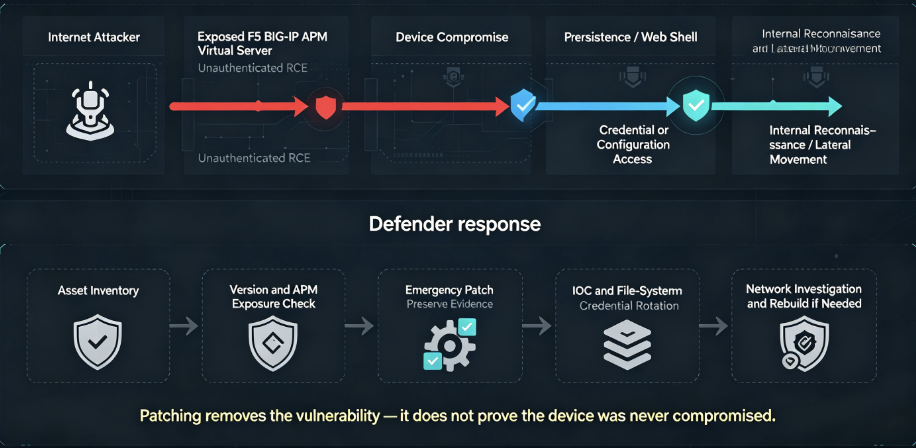
For CVE-2025-53521, organizations that operated an exposed vulnerable system should instead think more like:
Identify exposure
      ↓
Patch immediately
      ↓
Preserve evidence
      ↓
Search for indicators of compromise
      ↓
Review historical activity
      ↓
Validate system integrity
      ↓
Investigate downstream access
      ↓
Restore/rebuild if compromise is suspected
The difference is subtle but important.
Patching removes a vulnerability. It does not remove an attacker who exploited the vulnerability before the patch was installed.
The Canadian Centre for Cyber Security specifically directed organizations to evaluate potential compromise and referenced F5’s dedicated indicators-of-compromise guidance for the incident. (Canadian Centre for Cyber Security)
What Has Been Observed in Real-World Exploitation?
Public reporting on the exact exploitation mechanics remains intentionally limited.
F5 confirmed exploitation, while multiple security advisories reported that attackers were using the flaw against vulnerable APM environments.
Arctic Wolf reported that F5 had observed unauthenticated remote threat actors exploiting the vulnerability and deploying web shells. It also noted that Internet-exposed APM virtual servers represented the highest-risk systems. (Lobo Ártico)
That attack pattern is consistent with the broader strategic value of edge-device RCE vulnerabilities.
A conceptual post-exploitation chain could look like:
Internet
   |
   v
Vulnerable BIG-IP APM
   |
   v
Remote Code Execution
   |
   +----> persistence
   |
   +----> credential discovery
   |
   +----> configuration access
   |
   +----> internal reconnaissance
   |
   +----> lateral movement attempts
This is a threat model, not a reproduction of any specific exploit chain.
The critical security lesson is that edge devices frequently occupy privileged network positions. Compromise of the appliance may therefore have implications beyond the appliance itself.
CVE-2025-53521 and MITRE ATT&CK
The Center for Internet Security maps exploitation of CVE-2025-53521 to:
T1190 — Exploit Public-Facing Application
under the Acceso inicial tactic. (CIS)
That is an appropriate defensive model.
A vulnerable APM virtual server is effectively a public-facing entry point.
Attackers do not need:
phishing
stolen credentials
MFA bypass
malicious attachments
user interaction
if the vulnerable network service itself can provide execution.
That is exactly why network-edge RCE vulnerabilities are so heavily targeted.
How Defenders Should Hunt for CVE-2025-53521 Compromise
Because exploitation was confirmed before many organizations understood that the vulnerability provided RCE, retrospective investigation is essential.
Defenders should begin with the vendor-provided indicators of compromise rather than relying solely on generic signatures.
F5 published dedicated IOC guidance referenced as K000160486, and government advisories explicitly recommend reviewing it when evaluating potentially affected devices. (Canadian Centre for Cyber Security)
Beyond vendor IOCs, defenders should investigate several categories of activity.
Unexpected file creation
Look for recently created or modified files in locations that normally change infrequently.
Prioritize unusual:
web-accessible files
scripts
startup files
configuration changes
temporary executables
shell-related artifacts
File timestamps alone are not definitive because sophisticated attackers can alter metadata.
Unexpected processes
Investigate processes that are inconsistent with normal BIG-IP operations, especially those appearing around suspicious inbound connections.
Look for unusual:
parent-child process relationships
shell execution
network utilities
new background processes
unexpected outbound connections
Suspicious outbound traffic
An Internet-facing appliance normally receives large volumes of inbound traffic.
Unexpected outbound connections may therefore be particularly valuable.
Questions include:
Did the BIG-IP device contact previously unseen IP addresses?

Did it establish long-lived outbound connections?

Did traffic occur on unusual ports?

Did DNS behavior change?

Was outbound activity synchronized with suspicious inbound requests?
Authentication anomalies
Although exploitation itself does not require authentication, post-exploitation activity may interact with administrative or internal services.
Revisión:
new administrator accounts
unexpected configuration changes
unusual login sources
changes to authentication configuration
privilege changes
API activity
Configuration drift
Compare current configuration against known-good baselines.
Security teams should investigate unexplained modifications to:
virtual servers
APM profiles
iRules
authentication services
management settings
network configuration
certificates
scheduled operations
An attacker maintaining access to an edge appliance may prefer configuration-based persistence because it can blend into legitimate administrative activity.
Why Network Detection Alone Is Not Enough
It is tempting to search for a single CVE-2025-53521 IDS signature and consider the investigation finished.
That approach is risky.
Exploit payloads for memory-corruption vulnerabilities can vary. Attackers may also modify delivery mechanisms after public detection rules become available.
A stronger detection architecture combines:
Network telemetry
+
BIG-IP logs
+
System telemetry
+
File integrity monitoring
+
Configuration monitoring
+
Threat intelligence
Por ejemplo:
                Internet
                   |
                   v
             Network Logs
                   |
        +----------+----------+
        |                     |
        v                     v
BIG-IP Request Logs      IDS / NDR
        |                     |
        +----------+----------+
                   |
                   v
             SIEM / Analytics
                   |
       +-----------+-----------+
       |                       |
       v                       v
System anomalies        IOC correlation
       |                       |
       +-----------+-----------+
                   |
                   v
              Investigation
The objective is not merely detecting one known exploit string.
The objective is detecting the consequences of unexpected code execution.
Immediate Mitigation for CVE-2025-53521
The primary remediation is straightforward:
Upgrade to a fixed BIG-IP version immediately.
Minimum fixed releases are:
15.1.10.8
16.1.6.1
17.1.3
17.5.1.3(NCSC NL)
For systems that cannot immediately be upgraded, reducing public exposure may lower risk, but network controls should not be treated as equivalent to installing the vendor fix.
When dealing with an unauthenticated network RCE that has already been exploited, compensating controls are inherently weaker than eliminating the vulnerable code path.
A Practical Enterprise Response Plan
For an organization discovering CVE-2025-53521 exposure today, the response should start with asset inventory.
Find every F5 BIG-IP deployment, including:
production appliances
HA pairs
disaster recovery systems
staging environments
forgotten remote-access gateways
secondary data centers
cloud-hosted BIG-IP instances
Then identify the version and enabled modules.
Next, determine whether APM profiles are attached to reachable virtual servers.
Internet-exposed APM services should receive the highest priority.
Upgrade vulnerable systems to supported fixed releases.
But do not stop there.
If a vulnerable instance was previously Internet-accessible, review F5’s indicators of compromise and investigate historical logs for the period during which the system was exposed.
If compromise is suspected, treat the appliance as an incident-response asset rather than simply applying another patch.
That may require:
isolating the affected device
preserving evidence
rotating credentials
reviewing certificates and secrets
investigating adjacent systems
rebuilding from trusted software
restoring validated configuration
monitoring for recurrence
The appropriate scope depends on what investigators discover.
Why CVE-2025-53521 Is Especially Relevant to Large Enterprises
BIG-IP devices frequently sit directly on important network boundaries.
They may front:
enterprise authentication portals
VPN infrastructure
internal web applications
business-critical APIs
remote employee access
partner applications
administrative services
This gives an attacker compromising an edge appliance a potentially valuable position.
The vulnerability therefore combines three characteristics attackers consistently value:
reachability + lack of authentication + privileged infrastructure position.
The UK NCSC specifically noted that BIG-IP APM is commonly used in large enterprises while urging organizations to take immediate mitigation action. (National Cyber Security Centre)
This is not simply another web application CVE.
It is an edge-infrastructure vulnerability affecting a product whose job is often to control who can reach sensitive applications in the first place.
The Security Lesson: Re-Evaluate Old CVEs When Their Threat Intelligence Changes
CVE-2025-53521 demonstrates a weakness in vulnerability-management programs built exclusively around the CVSS score recorded when a CVE first enters the database.
The lifecycle looked approximately like this:
October 2025

CVE disclosed
      |
      v
DoS interpretation
      |
      v
Organizations assign priority
Months later:
March 2026

New exploitation evidence
      |
      v
Impact revised to RCE
      |
      v
Critical severity
      |
      v
Active exploitation confirmed
      |
      v
CISA KEV
Organizations that never reassessed the vulnerability could be operating under assumptions that were months out of date.
Mature vulnerability management should therefore treat CVE intelligence as dynamic.
Important triggers for automatic reprioritization include:
CVSS increases
impact changes
public PoC release
vendor advisory updates
CISA KEV addition
active exploitation reports
new ransomware association
new affected products
new detection guidance
A CVE should not disappear permanently into a vulnerability backlog simply because someone triaged it six months earlier.
CVE-2025-53521 Also Shows Why Patch Verification Matters
Another subtle lesson concerns patch verification.
F5 had already released fixes associated with the vulnerability when it was originally understood as a DoS issue. Those same fixed branches later became the remediation path for the RCE issue. (Lobo Ártico)
Organizations that promptly installed the original security releases were therefore in a stronger position when the vulnerability was reclassified.
This illustrates something security teams sometimes overlook:
Patching should be validated by build number, not by intention.
“Operations said the F5 was patched” is not sufficient.
Evidence should look more like:
Asset: vpn-gateway-01
BIG-IP branch: 17.1.x
Observed version: 17.1.3
Minimum CVE-2025-53521 fixed version: 17.1.3
Result: fixed
or:
Asset: vpn-gateway-02
BIG-IP branch: 16.1.x
Observed version: 16.1.6
Minimum fixed version: 16.1.6.1
Result: vulnerable
Notice how small the version difference is in the second example.
For security-sensitive infrastructure, that distinction matters.
Patch First, Then Validate That the Attack Surface Has Actually Disappeared
A robust validation process should verify the entire chain:
Asset discovered
      ↓
Version identified
      ↓
APM configuration identified
      ↓
Exposure confirmed
      ↓
Upgrade deployed
      ↓
New version independently verified
      ↓
External service retested
      ↓
IOC investigation completed
      ↓
Monitoring continues
The goal is to avoid a false sense of security created by a patch ticket being marked complete while another HA node, disaster recovery appliance or forgotten edge instance remains vulnerable.
Automated exposure validation can be particularly valuable here because enterprise F5 environments often contain multiple virtual servers and different policy configurations.
Any active validation should, of course, be performed only against systems you own or are authorized to test.
Does CVE-2025-53521 Have a Public Exploit?
The distinction between known exploitation y public exploit availability is important.
By late March 2026, exploitation in the wild had been confirmed independently of whether a reliable public proof-of-concept was broadly available. Arctic Wolf reported at the time that it had not identified a publicly available PoC, even though real attackers were already exploiting the vulnerability. (Lobo Ártico)
This is a useful reminder that defenders should never interpret:
"No GitHub PoC found"as:
"The vulnerability cannot be exploited."Threat actors may possess private exploit chains months before working public code appears.
CISA KEV inclusion is therefore generally much more important for prioritization than the existence of a copy-and-paste exploit repository.
Is CVE-2025-53521 a Zero-Day?
Terminology matters here.
CVE-2025-53521 was publicly disclosed and patched in October 2025. Its known impact was later revised after real exploitation information emerged.
Calling the vulnerability simply a “new zero-day discovered in March 2026” would therefore be misleading.
The more accurate description is:
a previously disclosed BIG-IP APM vulnerability whose impact was later reclassified from denial of service to unauthenticated remote code execution, with confirmed exploitation in the wild.
That wording captures what makes the incident unusual without overstating what is publicly known.
PREGUNTAS FRECUENTES
What is CVE-2025-53521?
CVE-2025-53521 is a critical stack-based buffer overflow affecting F5 BIG-IP Access Policy Manager. When an APM access policy is configured on a virtual server, specially crafted malicious network traffic may result in remote code execution. (OpenCVE)
Is CVE-2025-53521 remotely exploitable?
Yes. The CVSS vector specifies a network attack vector, low attack complexity, no required privileges and no required user interaction.
Does CVE-2025-53521 require authentication?
No.
It is classified as an unauthenticated remote code execution vulnerability. (National Cyber Security Centre)
Is CVE-2025-53521 being exploited?
Exploitation has been confirmed. F5 acknowledged exploitation, and CISA added the vulnerability to the Known Exploited Vulnerabilities catalog on March 27, 2026. (Canadian Centre for Cyber Security)
What is the CVSS score?
CVE-2025-53521 has:
CVSS v3.1: 9.8 Critical
CVSS v4.0: 9.3 Critical(OpenCVE)
What vulnerability type is CVE-2025-53521?
The current CVE record identifies the vulnerability as CWE-121: Stack-Based Buffer Overflow. (OpenCVE)
Which F5 BIG-IP versions fix CVE-2025-53521?
The minimum fixed releases are:
BIG-IP 15.1.x → 15.1.10.8
BIG-IP 16.1.x → 16.1.6.1
BIG-IP 17.1.x → 17.1.3
BIG-IP 17.5.x → 17.5.1.3(NCSC NL)
Should I investigate if I already patched?
Yes, if the appliance was vulnerable and exposed before the upgrade.
The UK NCSC specifically recommended compromise investigation on affected systems regardless of when they were updated. (National Cyber Security Centre)
Is disabling public management access enough?
No.
Reducing management-interface exposure is good general BIG-IP hardening, but CVE-2025-53521 concerns an APM access policy attached to a virtual server. Organizations should apply the vendor-provided fixed release rather than treating management-interface restrictions as remediation.
Final Assessment
CVE-2025-53521 deserves priority not simply because it carries a 9.8 CVSS score, but because almost every important real-world risk multiplier is present at the same time.
It is network accessible.
It requires no authentication.
It requires no user interaction.
Its attack complexity is rated low.
It affects security infrastructure commonly deployed at enterprise network boundaries.
Its impact includes remote code execution.
And, most importantly, exploitation has already been confirmed. (OpenCVE)
The unusual history of CVE-2025-53521 makes the vulnerability even more instructive. A bug first understood primarily as a denial-of-service condition in October 2025 was later shown to support unauthenticated RCE. By March 2026 it had entered CISA’s Known Exploited Vulnerabilities catalog.
For defenders, the correct response is therefore broader than simply installing a security update.
Organizations should identify every BIG-IP APM deployment, determine whether vulnerable APM-backed virtual servers were externally reachable, upgrade to a supported fixed release, verify the upgrade independently, examine F5’s published indicators of compromise and investigate historical exposure.
The most important distinction is this:
A patched BIG-IP appliance may no longer be vulnerable to CVE-2025-53521. That does not prove the appliance was never compromised while it was vulnerable.
For an unauthenticated edge-device RCE with confirmed exploitation, remediation and compromise assessment should be treated as two separate security tasks.
 Spanish
  English
  German
  French
  Portuguese
  Japanese
  Korean
  Hindi
Hindi  Arabic
  Turkish
  Hebrew