
The Broadcom WPS vulnerability called WPSplinter is a problem in a legacy Wi-Fi provisioning implementation, not a weakness that can be resolved simply by choosing a longer wireless password. The immediate question for a router owner is whether the exact device and firmware still expose the affected WPS Monitor parser. A matching brand, a Broadcom chipset, or a disabled checkbox provides useful context, but none independently answers that question.
Quentin Kaiser presented the research at Hexacon on October 16, 2026. His technical disclosure describes related fragment-reassembly failures on eCos and Linux platforms and demonstrations against selected ISP devices. The associated WPSplinter information page says a nearby attacker can reach the parser without knowing the network key or completing normal WPS enrollment. These are researcher-published findings; device-specific remediation still needs confirmation from the manufacturer or ISP responsible for the firmware.
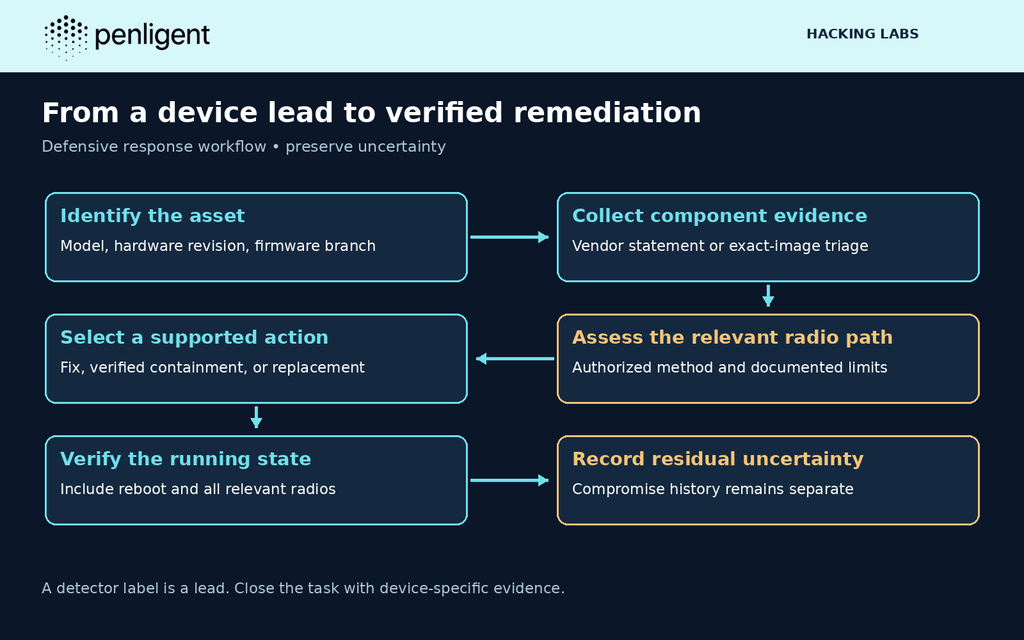
The practical response has three parts: identify the implementation, establish what a mitigation actually disables, and obtain a supported firmware or replacement decision. Keep those questions separate from whether the router has already been compromised. Component detection can support an exposure assessment, but it is not a forensic certificate.
Research status reviewed October 20, 2026. WPSplinter is a researcher-assigned name. The reviewed disclosure does not supply a CVE identifier for this issue. Do not substitute a similarly named Broadcom vulnerability, invent a placeholder identifier, or treat absence from a CVE-based scanner as evidence of safety.
The short decision guide for router owners
| What you know | What it establishes | What to do next |
|---|---|---|
| Your exact device and firmware appear in the research | There is relevant published evidence to investigate | Ask the OEM or ISP for issue-specific remediation and verify the installed build |
| Only the brand or chipset matches | A component relationship may exist | Identify hardware revision, firmware branch, and WPS implementation |
| WPS is disabled in the dashboard | A configuration setting was changed | Confirm whether the affected parser is actually disabled on every radio |
| A fingerprint says LIKELY_VULNERABLE | The observed behavior matches a candidate implementation | Preserve the result and obtain firmware-level or vendor confirmation |
| A fingerprint says INCONCLUSIVE | The test did not establish a usable classification | Investigate test limitations; do not label the device fixed |
| A vendor confirms the relevant fix for your installed build | A device-specific remediation statement exists | Verify that build is running and record any remaining limitations |
For a home user, the first useful action is usually a precise support request rather than an exploit test. Photograph the label privately, record the firmware version from the administration interface, and identify whether the ISP or the retail manufacturer controls updates. Serial numbers and account identifiers should remain in the support channel rather than a public forum post.
If your connection depends on ISP-managed equipment, do not assume that replacing the wireless function also replaces the modem, optical terminal, telephony, or television service. Establish which function is exposed and which functions a supported alternative can take over. A technically sound mitigation that disconnects essential services without a recovery plan is not a complete operational answer.
What WPSplinter does and does not mean
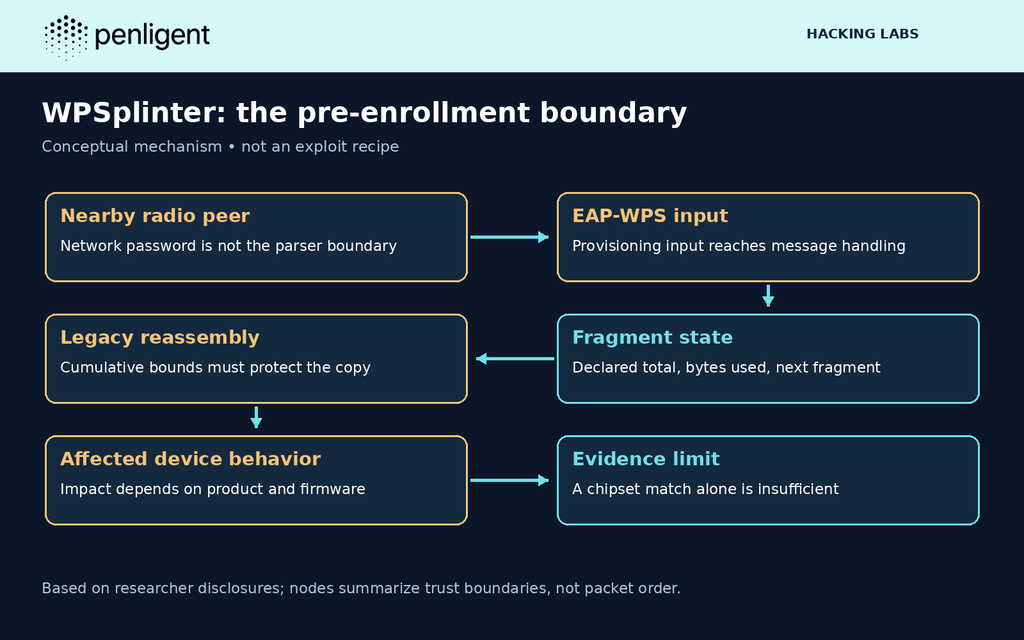
The name groups research concerning Broadcom’s legacy WPS Monitor software. WPS is a provisioning mechanism; EAP-WPS messages are part of the exchange used during enrollment. The relevant weakness concerns how fragments are accumulated into a destination buffer. The security boundary is reached before possession of the normal Wi-Fi network password establishes trust.
That distinction explains why the issue matters even where users believe their wireless credentials are strong. A password can protect the normal network-access decision while a pre-enrollment parser remains reachable. Fixing the password does not repair the parser’s length accounting. Conversely, identifying a parser defect does not establish that every authentication mechanism, radio, or management interface on the device is vulnerable in the same way.
The public research covers different operating environments, including eCos and Linux. They should not be collapsed into a single universal exploit recipe. Firmware layout, compiler output, memory protections, service privileges, and product integration can change the consequences. The report’s demonstrations establish behavior on selected targets; extrapolation to another product requires additional evidence.
En researcher’s presentation provides the technical context for the two platform paths. It is a stronger basis for understanding the mechanism than a headline saying all Broadcom routers can be taken over. Where this guide proposes a response workflow or a local teaching example, that material is an analytical aid, not a claim that the same code appears in any router firmware.
There are three particularly important exclusions. This is not ordinary password guessing. It is not proof that every internet user can reach the vulnerable path from anywhere in the world. It is not a basis for declaring every device from a listed vendor compromised. Each of those interpretations replaces a specific technical boundary with a broader assertion that the evidence does not establish.
Why fragment reassembly creates a dangerous boundary
A fragmented message has more than one length. There is the length declared for the overall message, the number of bytes received so far, the size of the next fragment, and the actual capacity of the destination buffer. A safe implementation must keep those quantities consistent across the entire exchange. Checking one fragment in isolation leaves the cumulative write unaccounted for.
Consider a receiver with a fixed-size destination. The first fragment may fit, and its declared overall length may appear plausible. A later fragment can still exceed the remaining space. Before a copy, the receiver needs to establish both that the fragment fits the allocation and that it does not overrun the intended logical message. Those are related but different checks: a large allocation does not make a malformed message valid.
The subtraction form of a capacity check is useful when writing fixed-width arithmetic. Instead of assuming that used + incoming cannot overflow, establish that used is already within capacity and compare incoming con capacity - used. The same discipline applies to the declared total. An integer that has already been corrupted or accepted from an inconsistent state must not become the basis of a trusted pointer calculation.
State matters as much as length. A fragment that belongs to a previous exchange, a duplicate, or a changed peer must not be appended to a new message merely because a counter exists. Error handling should invalidate the partially assembled state. Otherwise, one malformed exchange can influence a later apparently valid exchange and make the eventual failure difficult to reproduce or diagnose.
This is a general secure-parser explanation. The published WPSplinter description identifies inadequate bounds on reassembled EAP-WPS fragments, but it does not justify treating a simplified teaching receiver as the source of the actual firmware bug. Product-specific implementation details belong to the research and the exact firmware being reviewed.
A safe local example of cumulative bounds checking
The following Python example processes byte strings entirely in memory. It opens no wireless interface, constructs no protocol frames, contacts no device, and provides no exploit payload. Its purpose is to make the cumulative-length invariant testable. Python does not reproduce a native memory corruption condition; the example demonstrates validation logic only.
class AssemblyError(ValueError):
    pass


def assemble_fragments(fragments, declared_total, capacity=64):
    if not isinstance(declared_total, int) or declared_total <= 0:
        raise AssemblyError("invalid declared total")
    if declared_total > capacity:
        raise AssemblyError("declared total exceeds capacity")

    result = bytearray()
    for fragment in fragments:
        if not isinstance(fragment, bytes):
            raise AssemblyError("fragment must be bytes")
        used = len(result)
        if len(fragment) > capacity - used:
            raise AssemblyError("fragment exceeds remaining capacity")
        if len(fragment) > declared_total - used:
            raise AssemblyError("fragment exceeds declared message")
        result.extend(fragment)

    if len(result) != declared_total:
        raise AssemblyError("incomplete message")
    return bytes(result)


assert assemble_fragments([b"ab", b"cd"], 4) == b"abcd"
assert assemble_fragments([b"a" * 32, b"b" * 32], 64) == (
    b"a" * 32 + b"b" * 32
)
An implementation review should ask where those checks occur relative to the copy and whether every copy path uses them. Validating a field when the exchange begins does not help if another path later overwrites that field or appends data without consulting it. The useful unit of review is the complete state transition, not the presence of a comparison instruction somewhere in the binary.
The example also rejects incomplete messages. That is a protocol-consistency decision, not a complete defense against every resource-exhaustion problem. A real receiver additionally needs bounded lifetime, bounded concurrent state, and a rule for abandoning work when a peer stops sending. A receiver can remain memory-safe yet be operationally fragile if it allocates unlimited partial exchanges.
For a firmware engineer, useful tests include an exactly full destination, a total smaller than the received data, an unfinished exchange, and a new exchange after rejection. Test the error path as carefully as the success path. A bounds check that returns an error but leaves a stale pointer or an apparently authenticated session behind has not established a clean boundary.
For a defender, this example explains why a UI setting or a version string is indirect evidence. The required property is that untrusted input cannot reach an unsafe copy in the deployed implementation. A vendor can establish that by fixing the parser, removing the component, or demonstrably removing its reachable path. A dashboard alone does not show which of those happened.
Affected devices: read the evidence at firmware granularity
En community device inventory is useful for prioritization, but its entries have different levels of detail. Some provide a model and a version bound; others use broad labels or leave firmware coverage unresolved. A community row should be recorded with its source date, not transformed into an unconditional statement covering every revision ever sold under that product name.
| Example from the research | Published scope | What remains to establish locally |
|---|---|---|
| Askey TCG3000 | Demonstrated in the research and listed in the inventory | Exact installed hardware and ISP firmware build |
| Arcadyan VRV9517 | Inventory includes a firmware bound through v6.00.18 | Whether the local branch corresponds to that evidence and whether a later fix applies |
| Netgear CG3100 and CG3700-family equipment | Relevant models appear in the research | Exact model suffix, operator customization, and installed component |
| Sagemcom F@ST equipment | Selected deployed products are discussed | The specific product, firmware branch, and WPS implementation |
| Huawei, Tenda, or other entries with incomplete version detail | Inventory is a lead rather than a universal firmware statement | A vendor response or exact-image analysis |
| A Broadcom product absent from the list | No conclusion follows from omission | Whether it includes the legacy component at all |
Treat the manufacturer name, retail label, ISP label, board identifier, and firmware version as separate fields. An operator may rebrand a product; a vendor may change internals without changing the familiar family name; a regional branch may incorporate changes unavailable elsewhere. These are common reasons that an apparently precise model-only inventory still produces wrong conclusions.
Record a photograph or administrative export for your own evidence, but minimize personal data in any shared copy. A public serial number can identify the subscriber or create a support-account risk. The model and firmware branch are usually enough for an initial public discussion; the ISP can request private identifiers through its authenticated support process.
The phrase “all versions” in a research inventory requires particular care. It can mean all versions the contributor considered, not that every past and future release was tested. Preserve the original qualification and ask which firmware image or test supports it. When a later vendor update becomes available, reassess that build rather than continuing to repeat the old row without a date.
An accurate assessment can end with “unknown.” That is preferable to turning an absent device entry into “not affected” or turning a chipset match into “confirmed vulnerable.” An unknown state should have an owner, a next action, and a temporary exposure decision. Without those, uncertainty tends to become a permanent unexamined exception.
Why disabling WPS may not settle the issue
En researcher’s FAQ explicitly cautions that a configuration toggle may not fully disable the vulnerable parser. That does not mean every WPS switch is ineffective. It means the effect must be established for the exact firmware. Different products may disable enrollment, stop advertisement, reject selected exchanges, or terminate the service entirely.
Those outcomes have different security meanings. A control that prevents a user from completing normal enrollment might still leave an earlier parser reachable. A control that stops the service but is reversed on reboot is temporary. A control applied to one radio may not cover another band, guest interface, extender, or operator-managed access point.
Do not use a missing WPS advertisement as a complete proof of absence. Advertising behavior and parser reachability are not identical properties. A test tool may depend on an advertised field to select its target or interpret the result; when that field is missing, the tool can lose the ability to classify rather than establish that the underlying software is safe.
Ask the OEM or ISP a question that can be answered technically: does this firmware stop or replace the legacy WPS Monitor implementation, and is the affected EAP-WPS processing path unreachable after the setting is disabled? Request a build identifier and the scope of the statement. “WPS is off by default” is less useful than a statement about the component and the input path.
For immediate risk reduction, a supported way to disable the affected wireless radios may remove the relevant over-the-air exposure, but verify that the radios actually stop transmitting and that the configuration survives restart. An ISP gateway may have additional managed wireless functions. Document which ones were checked instead of assuming the main SSID represents the entire radio configuration.
Do not present a setting change as a patch unless it repairs the defect. A mitigation reduces or blocks exposure under specified conditions; a fix changes the affected implementation. Both can be useful, but they require different follow-up. A temporary mitigation should have a review date so the eventual firmware or replacement decision does not disappear from the task list.
What bridge mode and a separate access point can change
A separate access point can be part of a response when the gateway’s wireless implementation is the relevant exposure. The engineering question is whether the legacy radio path remains active, not whether a new access point has a different brand. Leaving the old gateway’s wireless radios running while adding another network does not remove the original surface.
Bridge mode is similarly product-specific. It changes some routing and service behavior, but it is not a universal guarantee that all radio functions or provisioning services are disabled. Confirm the supported configuration with the ISP. Some subscriptions depend on functions such as voice or television that may not survive an arbitrary mode change.
An alternative design should account for administration as well as client traffic. Record how to reach the old gateway after the change, who maintains the new access point, which updates are automatic, and how to recover if the connection fails. A replacement that is installed once and never updated creates another future lifecycle problem.
For a small office, separate guest access from internal assets and keep gateway management restricted. These controls can limit the consequences of network access or a compromised service; they do not repair the affected parser. A radio-level code-execution concern and a LAN segmentation concern intersect, but they are not interchangeable remediation tasks.
For a home user, prioritize a design that is maintainable. A complicated arrangement with several unsupported firmware components may be harder to verify than an ISP-provided replacement with a clear support commitment. Document the product and update path you actually intend to keep operating, rather than selecting a replacement only because it is absent from the current research list.
A defensible assessment has four evidence levels
| Assessment level | Pruebas | Appropriate conclusion | Inappropriate conclusion |
|---|---|---|---|
| Component lead | Vendor strings, chipset information, or a model-list match | Relevant implementation may be present | Device is definitely exploitable |
| Candidate behavior | A reproducible, scoped implementation fingerprint | Observed behavior supports further review | Every build of the product is vulnerable |
| Firmware-specific confirmation | Reviewed vulnerable path or vendor confirmation for the exact build | The identified firmware is affected under the established conditions | Every device using the same chipset is affected |
| Remediation verification | Fixed build or removed path, with independent supporting checks | The specified exposure is addressed within the test scope | The device has never been compromised or has no other vulnerabilities |
These levels are an assessment framework, not an official vendor severity scale. Their purpose is to prevent a useful detection signal from acquiring more certainty as it moves through a spreadsheet, ticket, and executive summary. Preserve the original observation and the analyst’s interpretation as separate fields.
For example, a firmware scan may identify strings associated with WPS Monitor. That is a reason to inspect the binary and seek a vendor statement. It does not establish that an unsafe path is reachable in the running configuration. The reverse is also true: a scanner that misses the string pattern may simply be looking at a different architecture, build, or compressed component.
The most useful ticket states what would change the decision. “Await vendor confirmation” should specify the firmware branch and the requested component information. “Await laboratory review” should identify the exact artifact and the question the review must answer. This makes it possible to close the task without turning a general research lead into an indefinite incident declaration.
Static firmware triage without touching a live radio
The research repository provides YARA rules for Broadcom WPS Monitor. Static triage can be useful when you have a legally obtained firmware image and a controlled analysis environment. Begin with provenance: the vendor URL, model, hardware revision, image filename, acquisition date, and a cryptographic hash.
A firmware image is untrusted input to extraction tools. Work in an isolated environment and avoid running extracted programs. The objective is to inspect a copy of the device software, not to install unknown binaries on your workstation. Extraction success also does not prove completeness: embedded filesystems, compressed sections, or multiple processor images can leave relevant components outside the directory you scanned.
The following commands operate on local files. Replace the paths with a firmware image and extracted directory you are authorized to analyze. Obtain the current rules from the research repository, review them, and record the repository revision used. No command below transmits wireless frames or attempts to compromise a router.
# Record the exact local firmware artifact.
sha256sum ./vendor-firmware.bin
file ./vendor-firmware.bin

# After supported extraction in an isolated analysis environment:
find ./extracted-firmware -type f -name '*wps*' -print

# The rule file should be a reviewed local copy from the research repository.
yara -w -r ./broadcom_wps_monitor.yar ./extracted-firmware
The current rule set distinguishes broad component recognition from a narrower candidate associated with the fragment-reassembly path. The rule source is important because rule names and matching conditions can evolve. Do not translate the word “vulnerable” in a detector name directly into a final device verdict.
Compiler optimizations, architecture differences, and patched code that retains familiar strings can affect a match. Document which rule matched which file and preserve the file hash. Then identify what additional evidence connects that candidate to the deployed firmware. A concise result such as “candidate component found; path review pending” is more useful than an unsupported high-confidence exploitability label.
When the firmware is unavailable, do not manufacture a static conclusion from a similar product’s image. Ask the vendor for the correct artifact, a supported component inventory, or a statement covering the installed build. An assessment can remain provisional while immediate exposure controls are applied. Evidence collection and temporary containment do not need to wait for each other to be perfectly complete.
Wireless fingerprinting is an active test
The research includes a wireless fingerprinting implementation. Its purpose is to distinguish implementation behavior. It should not be described as a passive scan: it transmits protocol traffic and depends on the wireless adapter, driver, channel, target state, and responses.
Use active testing only within a defined authorization boundary. A home SSID may coexist with neighbors’ networks on the same channel; a shared office may have several access points with similar names. Identify the intended device rather than assuming the first visible SSID is the target. Protect any captured traffic as private evidence because it may contain information about other nearby networks.
A useful scope record identifies the owner, device, BSSID, bands, physical site, test window, allowed actions, and stop conditions. The presence of a public script does not establish that the operator has permission to use it against nearby equipment. Where the device is ISP-managed, involve the service provider before testing behavior that could affect availability.
The result is an implementation-family observation. It does not reproduce every exploitation condition, establish code execution, or show that an update removed all risk. A differential response can be valuable evidence, but the interpretation should remain bounded by what the probe actually sends and observes.
Do not keep increasing test intensity when a tool produces no answer. A failure to find a target can be caused by an unsupported monitor-mode path, channel handling, capture permissions, or a driver that reports a capability it does not implement usefully. Resolve the measurement problem before changing the conclusion about the device.
Interpret fingerprint results without overstating them
| Result or observation | Defensible interpretation | Follow-up |
|---|---|---|
| LIKELY_VULNERABLE | Candidate legacy implementation behavior was observed | Correlate exact firmware and source evidence |
| PATCHED_HOSTAPD | Behavior classified as the alternate implementation by this tool | Verify firmware provenance and vendor remediation; do not generalize to every security issue |
| INCONCLUSIVE | The test did not establish the required distinction | Record why, check the measurement path, and retain uncertainty |
| No WPS advertisement | One expected discovery signal is absent | Do not equate absent advertisement with unreachable parser |
| No frames captured | The collection path may be ineffective | Check adapter, driver, permissions, and channel conditions |
| Different results across bands | Radios or configurations may differ | Treat each observed interface as a separate assessment target |
The repository’s examples are examples, not predictions for your network. Device state can change during enrollment or after a restart. A result should include the tool revision and the tested configuration so another reviewer can understand what was measured. If a later tool version changes the classifier, preserve both records rather than silently replacing the earlier conclusion.
Evidence should also include negative conditions. Record whether the expected advertisement was present, whether a target response arrived, and whether the tool had enough information to make the classification. A single final string omits the reasons that could make the result weak. The raw supporting observations are what let an analyst distinguish a useful negative from a failed experiment.
Where a vendor statement and a fingerprint appear to disagree, do not resolve the disagreement by selecting the more reassuring answer. Confirm that both refer to the same hardware, firmware, radio, and configuration. Ask whether the fingerprint recognizes a family characteristic that survives a fix. A classification tool and a code review answer related but different questions.
Questions to send to the manufacturer or ISP
An effective support request avoids asking only whether the device is “secure.” That question is too broad to close. Refer to the research by name, include the exact local firmware information, and ask about the legacy WPS Monitor implementation and its reachable fragment-reassembly path.
Subject: WPSplinter assessment for my installed gateway firmware

Device model:
Hardware revision:
Installed firmware build:
ISP or retail firmware branch:
Wireless bands and enabled interfaces:

Does this build include Broadcom's legacy WPS Monitor implementation?
Does the installed build address the EAP-WPS fragment-reassembly issue
described by Quentin Kaiser on October 16, 2026?

If fixed, please provide the fixed build and the applicable hardware scope.
If mitigated, what input path is disabled, on which radios, and does the
mitigation survive a restart or remote configuration update?

If no supported fix is available, what replacement or service migration
is offered, and which voice/TV/management functions must be preserved?
Keep the reply with the assessment record. A generic response about changing the Wi-Fi password does not answer the parser question. Ask for escalation when the first-line answer addresses a different issue. This is particularly important when the absence of a CVE prevents a support system from finding a standard vulnerability record.
Avoid sending complete packet captures or firmware dumps in an initial public request. They may contain network identifiers, credentials, or proprietary material. Start with the minimum information needed to identify the build and use an authenticated private channel for anything more sensitive. A support process should not create a second security problem while investigating the first.
A mitigation matrix that preserves the distinctions
| Proposed action | Potential value | Important limitation | Closure evidence |
|---|---|---|---|
| Apply an issue-specific supported firmware update | Can fix or remove the affected implementation | A generic “latest” label may not identify the relevant change | Installed build plus vendor scope statement |
| Disable WPS in the UI | May reduce provisioning exposure | Parser may remain active or reachable | Device-specific technical confirmation and configuration verification |
| Disable affected wireless radios | Can remove the relevant radio path when fully effective | Other bands or managed interfaces may remain active | Observed radio state and restart persistence |
| Add a separate access point | Provides an alternative wireless service | Old gateway radios can remain exposed | Supported configuration showing the old surface is disabled |
| Use bridge mode | May support a redesigned deployment | Does not universally disable all wireless functionality | ISP-supported behavior and verification |
| Change the Wi-Fi password | Useful after possible credential exposure | Does not repair pre-enrollment memory safety | Credential action recorded separately from patch state |
| Replace unsupported equipment | Removes dependence on an unmaintained product | Replacement still needs a supported lifecycle | Hardware retirement and a verified replacement baseline |
Use the matrix to avoid treating every reasonable security action as a direct fix. Password rotation and segmentation can be useful while leaving the vulnerable parser unchanged. A firmware change can repair the parser while leaving an already exposed credential valid. The response is complete only when each relevant concern has its own evidence and owner.
For an organization with several sites, temporary mitigations need expiration and review. Track which sites have confirmed firmware, which have disabled radios, and which await replacement. A count of “tickets closed” can hide materially different residual risks. A more useful view shows the evidence state and the date at which the temporary arrangement must be reconsidered.
If compromise is suspected, separate recovery from patching
The public disclosure establishes vulnerability research, not a universal infection signature. An unstable router, an unexpected DNS setting, or a strange management account can have several causes. Preserve the observation and its time rather than attributing it automatically to WPSplinter. At the same time, do not let uncertainty about attribution prevent reasonable containment of a device you no longer trust.
For ISP-managed gateways, coordinate evidence preservation and replacement with the operator. A factory reset may destroy logs or configuration useful to the investigation, and a remote reprovisioning process may restore settings you intended to remove. Establish what the operator can preserve and what a replacement will change before treating the operation as a verified clean recovery.
For equipment you administer, consider the information and authority the gateway holds: wireless credentials, administrative accounts, DNS settings, VPN configuration, and access to downstream management services. Do not assume every secret has been exposed, but make the review proportional to the evidence and the privileges available to the compromised component.
Credential rotation should follow restoration of a trusted management path. Changing a password through an interface that may still be controlled by an attacker does not establish a durable improvement. Record which credentials were changed and which external systems depend on them so that recovery does not silently break service or leave a reused credential elsewhere.
An application-layer AI pentesting workflow can help organize authorized assessment evidence and retesting, but this radio-level firmware problem requires different instrumentation. Penligent should not be represented as a dedicated WPSplinter detector without a documented and validated capability. The right tool is the one that can observe the boundary in question and produce evidence that supports the intended conclusion.
How to document a verified fix
Start with the artifact that changed. A new firmware version, a component replacement, and a supported radio shutdown are different remediation methods. Record the old and new state, the vendor statement, and the test that confirms the relevant behavior. Avoid a closure note that says only “updated” without identifying what now runs.
A useful before-and-after record includes the exact device identity, build, radio configuration, observation time, and collection method. If the method is an implementation fingerprint, describe that limit. If the method is firmware review, identify the reviewed image and hash. If a vendor statement is the main evidence, preserve its date and hardware scope.
Retest after the restart or provisioning event that could undo the change. Some settings are persisted locally while others are re-applied by the operator. A mitigation verified only before a reboot may not describe the normal running configuration. Where the device has several bands or guest functions, verify each relevant one rather than assuming a shared result.
Do not treat a clean retest as proof that an earlier compromise never happened. Remediation verification establishes a current condition within a defined scope. Historical investigation is a separate task involving retained logs, configuration changes, operator telemetry, and other evidence. The difference matters when deciding whether to rotate credentials, restore devices, or notify affected parties.
The supply-chain lesson is about support boundaries
The researcher describes a long interval between older component changes and the devices still deployed in 2026. That observation illustrates a common embedded-system problem: the silicon vendor, SDK maintainer, OEM, ISP, and subscriber have different update responsibilities and support windows. A fix at one layer does not prove that a deployed retail image incorporates it.
When evaluating a replacement, ask who can ship the relevant firmware and for how long. Source availability can help investigation but does not by itself produce a maintained production build. A product with an upstream alternative component still needs an integration, testing, signing, and distribution path to reach the installed fleet.
This is why a CVE identifier is useful but not sufficient. A catalog can coordinate tracking, yet the real closure decision still concerns a concrete implementation and build. Conversely, an issue without an identifier can remain important when credible research and device evidence establish exposure. Use a stable internal issue name and source references while the public identification situation remains unresolved.
The practical purchasing criterion is supportability. A documented lifecycle, a reliable update channel, and a vendor capable of answering component questions can matter more than an attractive feature count. For managed gateways, include the replacement process and service dependencies in that evaluation. Security maintenance is part of the product, not a separate favor after deployment.
Three deployment cases that change the response
The following cases are hypothetical decision examples. They are not reports of additional affected products, laboratory reproductions, or customer incidents. Their purpose is to show how the same research can lead to different next actions when evidence, ownership, and service dependencies differ.
An ISP gateway with an uncertain firmware branch
A subscriber sees a familiar model family in a news story, but the administration page exposes only an ISP-specific build string. The gateway also provides a phone service. The tempting shortcut is to buy a replacement router immediately and assume the problem is solved. That skips two decisions: whether the installed branch contains the component and whether the replacement can preserve the subscribed services.
The subscriber first records the model, hardware revision, displayed build, and wireless configuration. The ISP is asked whether the build addresses the specific EAP-WPS reassembly issue, not merely whether it is the latest available package. If the answer remains unknown, the subscriber requests a supported temporary radio configuration or replacement path. The uncertainty is explicit rather than hidden behind a green update indicator.
If a separate access point is used temporarily, the old gateway’s affected wireless functions must be addressed as well. The new access point does not sanitize traffic already reaching the old radio parser. The resulting record should state which radios were disabled, how that was verified, whether voice service still works, and who will confirm the permanent firmware or hardware change.
The case is closed only after the agreed state is observed on the installed device. A support promise that a firmware rollout is scheduled is a pending action. A completed download is a delivery event. A verified running build with a documented issue-specific scope is stronger remediation evidence. Keeping these events separate prevents a future reader from interpreting an intention as a completed fix.
A small business with several apparently identical access points
A small business has five units from the same product family. Three were purchased together, one is a replacement, and one is managed by the building operator. A model-only inventory suggests that one test could represent all five. The ownership and procurement history make that inference unsafe: hardware revisions, firmware branches, and management policies may differ.
The business creates one row per physical unit and records the controlling party. It groups units only after confirming the relevant identity fields. A representative firmware review can inform prioritization, but the deployed configuration still needs to be checked on each unit. The building-managed device is not silently included in an active wireless test just because staff use its SSID.
Temporary controls are assigned to the right owner. Internal staff can change the units they administer; the building operator must authorize work on its equipment. Where continued wireless service is essential, a maintenance window and rollback plan are part of the response. If an unfamiliar setting appears after remote management runs, the configuration history is reviewed rather than assuming the previous mitigation remained effective.
The final report separates verified fixed units, temporarily contained units, and unresolved units. An average firmware age or a fleet-wide “patched” checkbox would obscure the one device whose state remains unknown. The useful deliverable is a small, precise list of exceptions with owners and review dates, not a broad claim that the vendor has been dealt with.
A firmware laboratory with a positive detector result
A reviewer obtains the exact firmware image and a component detector matches a binary. The laboratory can reproduce the match and has preserved the image hash. This is useful evidence, but it still sits short of a complete vulnerability conclusion. The reviewer needs to understand what matched, what version of the rules was used, and whether the relevant input reaches the suspected path.
The next step is to inspect the conditions around the candidate operation. A string-only match establishes less than a source-supported unsafe copy. A code pattern may survive a patch or vary with the compiler. The reviewer records each inference rather than writing “confirmed vulnerable” merely because a rule name includes that phrase. If the binary cannot be understood sufficiently, the report remains a candidate finding with clear limits.
After a vendor supplies a new image, the same rules are run as a regression observation, not a sole acceptance gate. A remaining match may reflect retained component strings rather than a failed fix. A disappearing match may reflect a build change rather than removal of the unsafe path. Firmware provenance, vendor scope, and the relevant validation logic must be considered together.
The most valuable laboratory output is therefore not the detector’s final word. It is the chain of evidence connecting an exact image, a component, a reachable behavior, and a fix. That chain lets an operator decide what can safely remain deployed without having to trust an unexplained classification.
Build a regression plan around failure handling
For teams maintaining a parser, the safe local example can be expanded into a regression matrix without constructing a wireless exploit. Define expected results for well-formed input and rejection behavior for malformed input. Tests should exercise boundaries on an isolated implementation or a teaching model; they are not permission to send malformed exchanges to production equipment.
| Local test case | Expected result | Property under examination |
|---|---|---|
| Message assembled from two valid fragments | Exact original message | Correct accumulation |
| Message exactly fills the permitted capacity | Accepted without an extra write | Boundary precision |
| Declared total exceeds capacity | Rejected before accumulation | Allocation and length agreement |
| Received bytes exceed the declared total | Rejected before the offending copy | Logical-message bounds |
| Exchange ends before declared total | Incomplete result, not a valid message | Completion state |
| Rejected exchange followed by a valid exchange | No stale state influences the new exchange | Error-path reset |
| Fragment belongs to another exchange | Rejected or handled in its own bounded state | Context separation |
| Peer stops sending | State is retired within defined limits | Resource lifetime |
Do not infer that every row corresponds to a separate vulnerability reported in the research. This is a general defensive review plan derived from the obligations of a fragmented-message receiver. Its value is that it tests what a fix must preserve, including clean rejection and restart behavior, rather than checking only that a previously successful demonstration now fails.
The exact implementation may impose constraints beyond the teaching model. For example, an empty fragment can have a protocol-specific meaning, and a transport layer may perform separate fragmentation before the WPS message is reassembled. Document the layer being tested so that a passing unit test is not mistaken for coverage of the complete wireless stack.
Use independent expected results. If the test calculates its expected size using the same unchecked expression as the production function, both can agree while remaining wrong. Review the acceptance condition in plain language, then test a boundary on either side. An exact-capacity case and a one-byte-over case are a useful pair because they reveal off-by-one decisions that broad random data can miss.
Retain the regression results with the build that will actually ship. Testing a developer’s instrumented binary is informative, but it does not identify the signed image delivered to a subscriber. Link source revision, toolchain, package, hardware scope, and deployment build. That is the bridge between a repaired function and a defensible fleet-remediation statement.
Keep the exposure record useful as information changes
A living assessment needs a few stable fields: asset identity, firmware branch, implementation evidence, reachability evidence, remediation method, and verification limits. Keep source date and observation date separate. A research page updated today may describe a test performed earlier; a firmware installed today may have been released before the issue was understood.
Avoid merging exposure and compromise into one status. A router can be affected without evidence of intrusion, contained without being patched, fixed after a period of uncertain exposure, or replaced while investigation remains open. A single red-or-green field cannot represent those states. Separate columns let an owner prioritize work without overstating either safety or compromise.
Asset reference: gateway-01
Model and hardware revision: verified locally
Firmware branch and running build: recorded from the device
Component evidence: candidate / confirmed / absent / unknown
Radio-path evidence: method, interface, time, and limitations
Vendor statement: date, build, and applicable hardware scope
Exposure decision: permitted operation / temporary containment / retired
Remediation action: update / component change / disabled path / replacement
Verification: actual running state and post-restart result
Historical investigation: separate task and evidence limits
Next review: owner and date
When new community data appears, update the interpretation while preserving the earlier observation. A device that was unknown yesterday can become a candidate today without the original analyst having made an error. The error would be pretending that the earlier unknown state was a verified negative. Good records make that evolution legible.
This approach also reduces unnecessary repeat work. If the exact firmware hash, rule revision, and result already exist, the next reviewer can examine what changed instead of collecting the same artifacts again. Repeat collection when the artifact or environment changed, or when the earlier method cannot answer the current question. Repetition without a new question creates activity but little additional confidence.
What an internet firewall result cannot tell you
A common assessment mistake is to begin with an external port scan and use the absence of an exposed administration page as the answer to a wireless vulnerability. The measurements concern different paths. A firewall can restrict traffic arriving through the WAN while a nearby radio peer interacts with a provisioning parser. A clean WAN result should remain a WAN result.
The same distinction applies to a VPN running on the device. Encrypting selected application traffic can protect that traffic under its own assumptions, but it does not repair memory handling in a separate wireless component. Do not turn a useful network control into a guarantee about a layer it does not govern. Record the control’s intended boundary and assess the affected path independently.
An endpoint security agent on a laptop also observes a different part of the environment. It might detect consequences reaching the laptop, but that is not the same as inspecting the gateway’s firmware or demonstrating the absence of a radio-side defect. A lack of endpoint alerts does not close the router exposure question. Nor does a router problem automatically prove that every attached endpoint is compromised.
For a report reviewer, the test is simple: can the supplied evidence observe the behavior named in the conclusion? If a report declares a WPS parser fixed but includes only a screenshot of a closed internet port, ask for the missing link. If it declares network-wide compromise from a component-string match, ask for the additional evidence of access and impact. Matching the conclusion to the measurement is the central quality control in this assessment.
These boundaries help decide where an AI assistant is useful. It can compare inventories, organize vendor replies, explain logs, or draft a scoped test plan. It cannot transform an unrelated observation into direct evidence. Every conclusion still needs an artifact from the relevant layer, with a method another reviewer can understand and a limitation they can see.
Frequently asked questions
Does WPSplinter require the Wi-Fi password?
- The research describes a reachable pre-enrollment parser without knowledge of the network key.
- The attacker still needs access to the relevant wireless path; do not reinterpret the finding as an arbitrary internet attack.
Is every Broadcom router affected?
- No such conclusion follows from a chipset or vendor match alone.
- Establish the deployed software implementation, hardware revision, firmware branch, and relevant reachable behavior.
Does turning WPS off fix it?
- Do not assume so. The setting may not fully remove the parser.
- Ask the OEM or ISP what the setting disables on the exact firmware and verify that the intended state persists.
What is the CVE number?
- The reviewed research presents WPSplinter as a researcher-assigned name and reports that Broadcom declined to register a CVE.
- Track the research and vendor updates rather than attaching an unrelated Broadcom CVE to the issue.
Can a normal web vulnerability scan detect it?
- A web scan does not establish the behavior of a radio-level WPS parser.
- Firmware triage and authorized wireless implementation testing answer different questions and require their own evidence limits.
Does a YARA match prove exploitation is possible?
- No. A match is a candidate indicator that must be connected to the exact binary and reachable path.
- Compiler changes and retained strings can affect the result; no match is not a universal proof of absence.
Should I replace the router immediately?
- Seek an issue-specific supported update or a verified temporary control first, while accounting for exposure and service needs.
- If the product has no credible maintained path, replacement may be the durable answer. Confirm ISP dependencies before changing equipment.
Can the device be declared clean after a firmware update?
- A fixed running build addresses a current software condition.
- It does not establish that no earlier compromise occurred. Investigate suspicious history and handle credentials separately where warranted.
Close the issue with evidence, not a checkbox
The strongest response to WPSplinter is a statement tied to a device and a build: which implementation was present, what changed, how the relevant exposure was checked, and what remains unknown. That record is more durable than a generic “WPS disabled” screenshot or an unqualified detector label.
For a home owner, that may mean a precise ISP confirmation and a supported replacement. For a fleet operator, it means firmware-level inventory, a controlled validation method, and a remediation record for each branch. In both cases, the aim is the same: remove the affected path and preserve enough evidence to explain why the resulting state can be trusted.


 Spanish
 English
 German
 French
 Portuguese
 Japanese
 Korean
 Hindi
 Arabic
 Turkish
 Hebrew