
CVE-2026-15409 is a critical server-side request forgery vulnerability in the WorkPlace interface of SonicWall Secure Mobile Access 1000 appliances. It allows an unauthenticated remote attacker to make the appliance establish connections to unintended destinations. Research published after the vendor advisory shows that the vulnerable WebSocket proxy can be abused to reach services listening only on the appliance’s loopback interface, turning an internet-facing remote-access gateway into a tunnel toward its own internal control plane. (NVD)
This is not a theoretical severity-rating exercise. SonicWall confirmed active exploitation, Rapid7 reported observing targeted zero-day attacks before public disclosure, and CISA added CVE-2026-15409 to the Known Exploited Vulnerabilities Catalog on July 14, 2026. CISA set July 17, 2026 as the remediation deadline for covered federal organizations under its current risk-based vulnerability directive and forensic-triage requirements. (SonicWall)
The vulnerability is especially dangerous because it affects infrastructure that already sits at a privileged network boundary. An SMA1000 appliance accepts connections from remote users, communicates with internal identity systems, brokers access to corporate applications, and processes authentication and session data. An attacker who controls the appliance may gain a far more useful position than an attacker who compromises an ordinary public website.
Rapid7’s technical analysis connects CVE-2026-15409 to CVE-2026-15410, a second vulnerability in the SMA1000 control environment. The first issue provides unauthenticated access to localhost-only services through a WebSocket tunnel. The second issue can be used through a vulnerable hotfix-removal workflow to execute a staged script with root privileges. Rapid7 reported observing the first-stage SSRF in real attacks and documented a path from the exposed WorkPlace interface to operating-system command execution. (Rápido7)
Defenders should therefore treat an affected internet-facing appliance as both a patching emergency and a potential incident-response case. Installing the fixed build closes the known entry point, but it does not invalidate stolen credentials, remove malicious configuration routes, reset exposed TOTP secrets, or prove that the device was not compromised before the update.
CVE-2026-15409 at a Glance
| Campo | Confirmed information |
|---|---|
| CVE | CVE-2026-15409 |
| Vendor | SonicWall |
| Producto | Secure Mobile Access 1000 Series |
| Componente vulnerable | WorkPlace interface and its WebSocket proxy behavior |
| Clase de vulnerabilidad | Server-side request forgery |
| CWE | CWE-918 |
| Authentication required | No |
| Vector de ataque | Red |
| Interacción con el usuario | Ninguno |
| CVSS 3.1 score | 10.0 from CISA ADP |
| NVD independent score | Not yet provided on the reviewed NVD record |
| Estado de explotación | Confirmed active exploitation |
| CISA KEV added | July 14, 2026 |
| Fecha límite CISA | July 17, 2026 |
| Primary technical effect | Tunnel traffic from the external WorkPlace interface to unintended destinations, including localhost-only services |
| Fixed 12.4 branch | 12.4.3-03453 or later |
| Fixed 12.5 branch | 12.5.0-02835 or later |
| Vendor workaround | No general workaround published |
| Required response | Patch, preserve evidence, hunt for compromise, and rebuild if compromise is found |
The NVD record describes the issue as an SSRF in the SMA1000 Appliance WorkPlace interface through which a remote unauthenticated attacker can cause the appliance to make requests to an unintended location. The same record lists CWE-918 and displays a CISA ADP CVSS 3.1 vector of AV:N/AC:L/PR:N/UI:N/S:C/C:H/I:H/A:H, producing the maximum base score of 10.0. NVD had not yet published its own independent score on the page reviewed on July 16, 2026. (NVD)
That distinction matters. A score shown on an NVD page is not always an NVD-authored assessment. Here, the source is CISA ADP. The urgency, however, does not depend on which organization calculated the number. Confirmed exploitation, an unauthenticated internet-facing entry point, a practical path to local services, and the role of the affected appliance provide more than enough evidence for emergency treatment.
Disclosure and Response Timeline
| Date | Event | Operational meaning |
|---|---|---|
| Before July 14, 2026 | Rapid7 MDR observed targeted exploitation of internet-facing SMA1000 appliances | The vulnerabilities were used as zero-days before public disclosure |
| July 14, 2026 | SonicWall published the advisory and fixed builds | Customers received a vendor-confirmed patch path |
| July 14, 2026 | SonicWall confirmed active exploitation | Normal maintenance scheduling was no longer appropriate |
| July 14, 2026 | CISA added CVE-2026-15409 and CVE-2026-15410 to KEV | Exploitation met CISA’s evidence threshold |
| July 14, 2026 | SonicWall added the conf.json indicator | Defenders received a configuration-level compromise artifact |
| July 15, 2026 | SonicWall corrected the API route notation in its IOC list | Searches must use /__api__/login, not the earlier single-underscore form |
| July 15, 2026 | Rapid7 published technical analysis and observed attack behavior | Defenders received details about localhost tunneling, privilege escalation, credential theft, and lateral movement |
| July 17, 2026 | CISA remediation due date for covered federal organizations | Patch and forensic triage must be handled on an emergency schedule |
SonicWall’s product notice was published on July 14 and updated on July 15. It identifies the two vulnerabilities, states that they are being actively exploited, lists the exact affected builds, provides fixed builds, and instructs organizations to perform forensic analysis instead of treating patch installation as the end of the response. (SonicWall)
The vendor’s change log is operationally important. SonicWall corrected an IOC path from an earlier spelling to /__api__/login. A hunt using the wrong number of underscores may silently miss the route the vendor intended defenders to find. SonicWall also added /var/lib/unit/conf.json as a configuration artifact on July 14. (SonicWall)
Rapid7’s July 15 report materially expanded the public understanding of the issue. It explained that the vulnerable /wsproxy endpoint can create a netcat-like TCP tunnel to attacker-selected hosts and ports, including localhost. It also documented the relationship between that capability and local services reachable on the appliance. (Rápido7)
Why an SMA1000 Compromise Is More Serious Than an Ordinary Web Flaw
Remote-access appliances are designed to cross security boundaries. They accept traffic from untrusted networks and provide controlled access to trusted resources. To perform that role, they often maintain direct connectivity to identity providers, directory services, internal application networks, logging infrastructure, and administrative systems.
The SMA1000 is therefore not merely a website that happens to be reachable from the internet. It is part of the organization’s access-control plane. It may process credentials, session records, directory queries, multifactor-authentication data, and policy decisions. A successful attack can affect both the appliance and the systems that trust it.
Rapid7 reported that attackers used compromised appliances as an initial-access platform and extracted high-value credentials, active session databases, and TOTP seed configurations. The researchers then observed anomalous Active Directory authentication originating from the appliance’s internal IP address without a corresponding active VPN tunnel. (Rápido7)
That behavior illustrates a central risk of edge-device compromise: internal monitoring may treat the appliance as trusted infrastructure. A domain controller receiving an authentication request from a known remote-access gateway may not apply the same suspicion it would apply to an unknown workstation. Network controls that block direct internet access to internal services do not help when the request originates from an already-approved internal interface.
The appliance can also become a visibility gap. Traditional endpoint detection agents may not be available or supported on specialized network appliances. Security teams may have extensive telemetry from Windows, macOS, Linux servers, and cloud workloads while retaining only limited logs from the device that provides remote access to all of them.
For that reason, incident response must extend beyond the appliance logs. Identity events, domain-controller records, firewall flows, DNS logs, VPN session databases, privileged-account activity, and configuration backups all become part of the evidence set.
How Server-Side Request Forgery Changes the Source of a Request
In a normal client-server interaction, the external user connects directly to the intended service. The destination sees the user’s network address, the network path crosses expected controls, and the service can apply authentication and authorization based on the actual connection.
In SSRF, the attacker convinces a server to make a second request. The external client controls some aspect of the destination, protocol, host, port, path, or request body, but the vulnerable server performs the outbound connection.
The effective flow becomes:
External attacker
        |
        | HTTPS or WebSocket request
        v
Internet-facing SMA1000 WorkPlace
        |
        | Server-originated connection
        v
Localhost service or internal destination
The target does not see the external attacker as the network peer. It sees the SMA1000 appliance. Any security decision based on source network location, loopback origin, internal routing, or implicit trust can therefore be undermined.
A basic SSRF may allow only a single HTTP request. The attacker might supply a URL and receive the fetched response. Other variants are blind: the attacker cannot directly read the response but can infer success through timing, DNS callbacks, status differences, or side effects.
CVE-2026-15409 is more consequential because the vulnerable functionality is a WebSocket proxy. According to Rapid7, it can provide a bidirectional TCP tunnel to a selected host and port. That gives an attacker a channel for interacting with protocols that were never intended to be exposed through the public WorkPlace interface. (Rápido7)
A bidirectional tunnel can preserve protocol state, exchange multiple messages, receive responses, and communicate with non-HTTP services. It is closer to an application-level port forward than to a one-shot URL fetch.
The Vulnerable WebSocket Trust Boundary
A WebSocket connection begins as an HTTP request and then upgrades to a persistent full-duplex connection. A successful upgrade typically returns HTTP status 101, meaning that the server is switching protocols.
HTTP 101 is not malicious by itself. Legitimate WebSocket applications generate it routinely. In the context of this incident, the detection value comes from the combination of:
- A request to
/wsproxy - An attacker-controlled or suspicious host value
- A destination associated with localhost or another unintended service
- A successful HTTP 101 upgrade
- Follow-on activity involving local services, configuration changes, or authentication anomalies
Rapid7 reported that the proxy accepts host and port values and can establish connections to loopback services. Its analysis specifically discussed local services on ports 1050 and 8188. The report described the feature as a netcat-like TCP tunnel. (Rápido7)
The underlying design failure is not simply that a URL parameter exists. A remote-access product may legitimately need to broker connections. The failure is that untrusted input can select a destination outside the intended security policy.
A secure proxy must define destinations through an allowlist or a server-side mapping that the user cannot arbitrarily override. It must resolve names and validate the resulting addresses, reject loopback and prohibited private ranges where appropriate, control ports and protocols, and repeat validation after redirects or resolution changes.
The common but weak approach is to reject literal strings such as 127.0.0.1 while allowing everything else. That can fail because loopback and local destinations have multiple representations:
127.0.0.1
127.1
0.0.0.0
localhost
::1
::ffff:127.0.0.1
A DNS name resolving to a loopback address
An address that changes after the validation step
The correct defense must operate on parsed and resolved addresses, not only the user-supplied text.
Why Localhost Services Cannot Treat Localhost as Authentication
Services bound to 127.0.0.1 are not automatically secure. Loopback binding reduces network exposure, but it does not prove the identity or authorization of the process connecting to the service.
If another internet-facing component can proxy attacker-controlled traffic to localhost, the network boundary disappears. The local service receives a connection from the same machine and may assume that only trusted software can reach it.
This pattern appears repeatedly in high-impact appliance and cloud attacks:
- A public component contains SSRF, proxy abuse, request smuggling, or path traversal.
- The attacker reaches a localhost-only management service.
- The internal service has weaker authentication because developers considered it private.
- The attacker invokes privileged operations through the public component.
Security controls must therefore be layered. Local management services should authenticate requests independently, authorize each operation, bind privileges to a specific client identity, and reject unsafe input even when the connection originates from loopback.
Mutual TLS, signed service tokens, narrowly scoped Unix domain sockets, peer-credential checks, and capability-based APIs can reduce the risk. None should be replaced by the assumption that “localhost equals trusted.”
The Relationship Between CVE-2026-15409 and CVE-2026-15410
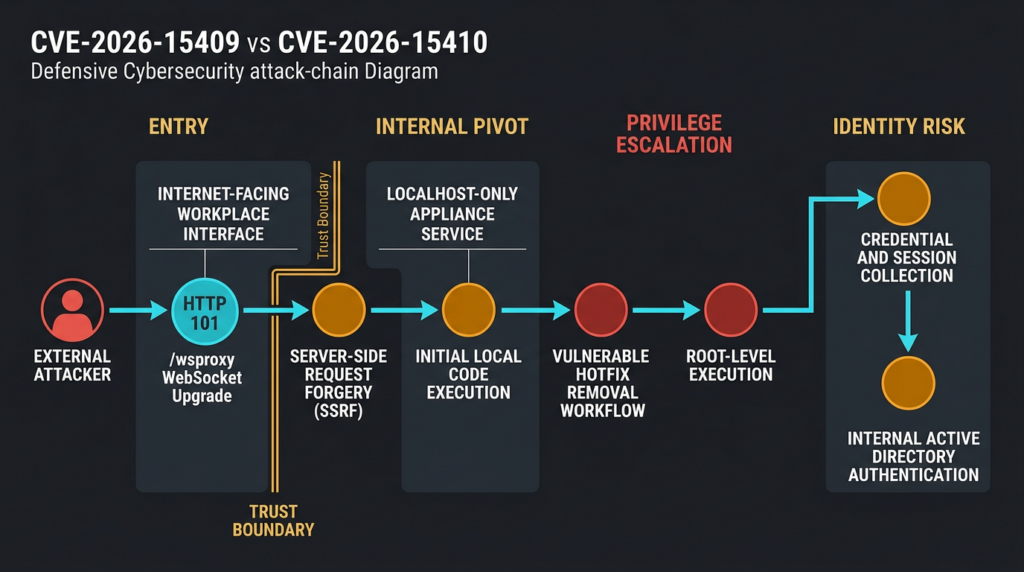
CVE-2026-15409 provides a route into the appliance’s local service environment. CVE-2026-15410 affects the hotfix-removal workflow and can lead to root command execution when an attacker can reach and abuse the relevant service.
SonicWall’s public notice describes CVE-2026-15410 as remote code execution with a CVSS score of 7.2. NVD and security reporting characterize it as a post-authentication code-injection issue in the Appliance Management Console under specific conditions. (SonicWall)
Rapid7’s technical analysis is more specific. It describes a path-traversal weakness in a remove_hotfix workflow. An attacker who can access the local control service can provide a path that points outside the expected rollback directory, causing a staged script to be made executable and run as root. (Rápido7)
The combined sequence can be summarized without reproducing the exploit:
| Escenario | Vulnerability or behavior | Security consequence |
|---|---|---|
| 1 | Public access to WorkPlace | Attacker reaches the internet-facing appliance |
| 2 | Abuse of /wsproxy | Attacker controls the proxy destination |
| 3 | CVE-2026-15409 | WebSocket traffic is tunneled to localhost-only services |
| 4 | Interaction with a local appliance service | Attacker reaches a service not intended for internet exposure |
| 5 | Initial code execution path | Attacker gains execution in a lower-privileged appliance context |
| 6 | CVE-2026-15410 | Hotfix-removal path handling is abused |
| 7 | Root execution | Attacker gains full control of the appliance |
| 8 | Credential and session collection | Identity material is exposed |
| 9 | Internal authentication | Compromised appliance becomes a pivot into the corporate network |
Rapid7 stated that it observed CVE-2026-15409 being exploited as the first stage. It also developed and documented a complete chain that reaches root execution. Help Net Security reported, based on information from SonicWall, that the two vulnerabilities were being used together in observed attacks. (Rápido7)
Early coverage was less definitive about whether the issues had been chained in every observed case. That distinction remains useful: the existence of a working chain does not mean every attacker used exactly the same sequence, local service, persistence method, or post-exploitation action.
For defensive purposes, however, separating the vulnerabilities too strictly would be a mistake. A /wsproxy indicator should trigger review for hotfix-removal abuse, root-level activity, altered routes, credential access, and internal authentication. A suspicious hotfix-removal entry should trigger a search backward for WebSocket access and perimeter probing.
What Rapid7 Observed After Exploitation
Rapid7 reported active and targeted exploitation of internet-facing SMA1000 appliances before SonicWall’s public disclosure. The affected devices were used as stealthy initial-access points, with attackers executing operating-system commands through the appliance rather than entering through a conventional user VPN session. (Rápido7)
The reported post-exploitation activity included collection of:
- High-value credentials
- Active session databases
- TOTP multifactor-authentication seed configurations
- Information useful for accessing the internal environment
The researchers then observed authentication attempts against internal Active Directory infrastructure. These connections originated from the internal IP address of the compromised SMA1000 appliance and did not correspond to a normal active VPN tunnel. (Rápido7)
Rapid7 also reported unusual workstation names associated with some of those authentications, including names that did not match the affected organization’s managed inventory. The authentication context involved the appliance’s integrated LDAP service account. (Rápido7)
These observations create several high-value detection opportunities:
- Authentication from the appliance’s internal IP without an active remote-access session.
- A workstation or client name that does not appear in asset inventory.
- Use of the LDAP integration account outside its normal query pattern.
- Authentication directly to domain controllers rather than expected directory-query behavior.
- Unusual bursts of logons after
/wsproxyexploitation. - Privileged or interactive operations performed by an account normally used only for directory integration.
These are behavioral signals, not universal signatures. Rapid7 described what it observed in specific investigations. Other attackers may use different infrastructure, different account names, different local services, or different lateral-movement techniques.
Credential Theft Changes the Recovery Plan
A device rebuild restores the appliance software, but it does not make copied secrets disappear.
If an attacker obtained a user password, administrator password, LDAP service-account secret, active session token, or TOTP seed, that material remains useful after the vulnerable appliance has been patched or replaced. Recovery must therefore include identity remediation.
SonicWall explicitly instructs affected organizations to change user and administrator passwords and reset TOTP tokens when indicators of compromise are present. It also instructs customers to re-image physical appliances or redeploy virtual appliances rather than trusting an in-place cleanup. (SonicWall)
The response scope should be based on what the appliance could access during the compromise window. At minimum, teams should identify:
- Local SMA1000 administrator accounts
- Directory or LDAP bind accounts
- Users with active remote-access sessions
- Accounts whose credentials were cached or processed by the appliance
- TOTP enrollments associated with the affected environment
- API credentials and certificates stored in the appliance configuration
- Service accounts used for logging, monitoring, backup, or management
- Accounts observed in post-compromise authentication logs
Password rotation should follow dependency mapping. Resetting a service-account password without updating dependent systems can cause an outage. Delaying rotation until every dependency is understood, however, can leave attackers with valid access. Incident commanders should coordinate identity, network, appliance, and application owners rather than assigning the task only to the VPN team.
Affected SonicWall SMA1000 Versions
SonicWall lists the following products as affected:
- SMA 6210
- SMA 7210
- SMA 8200v
- CMS deployments across supported hypervisors
The affected builds are:
| Firmware branch | Affected build |
|---|---|
| 12.4.3 | 12.4.3-03245 |
| 12.4.3 | 12.4.3-03387 |
| 12.4.3 | 12.4.3-03434 |
| 12.5.0 | 12.5.0-02283 |
| 12.5.0 | 12.5.0-02624 |
| 12.5.0 | 12.5.0-02800 |
The fixed versions are:
| Firmware branch | Fixed build |
|---|---|
| 12.4.3 | 12.4.3-03453 or later |
| 12.5.0 | 12.5.0-02835 or later |
These version numbers come directly from SonicWall’s product notice. (SonicWall)
A check that records only 12.4.3 o 12.5.0 is insufficient. The security state depends on the complete build and hotfix suffix. Two appliances reporting the same major and minor version may have different exposure depending on their platform-hotfix level.
Asset inventory should therefore capture:
Product family
Hardware or virtual model
Firmware branch
Full build number
Platform-hotfix build
Management role
External hostname
External IP
Internal IP
WorkPlace exposure
AMC or CMC exposure
Last confirmed update time
Log retention period
Configuration backup dates
Do not assume that a node is safe because it is described as a standby, disaster-recovery, test, migration, or decommissioning system. If it is powered on, routable, and running an affected build, it belongs in the response scope.
Rapid7 states that the issues do not affect the SMA 100 Series or SonicWall firewall SSL VPN functionality. This distinction is important because “SMA100” and “SMA1000” refer to different product lines. (Rápido7)
CISA KEV Changes the Prioritization Decision
The Known Exploited Vulnerabilities Catalog is not a list of every high-scoring vulnerability. Inclusion indicates that CISA has evidence of exploitation and considers the vulnerability relevant to operational risk.
CISA added CVE-2026-15409 on July 14, 2026 and set July 17 as the due date for covered federal organizations. The NVD record reproduces CISA’s required action: apply vendor mitigations, comply with BOD 26-04 risk-based guidance, perform the required forensic triage, and discontinue use if mitigations are unavailable. (NVD)
The same record displays CISA’s Stakeholder-Specific Vulnerability Categorization values:
- Exploitation: active
- Automatable: yes
- Technical impact: total
Those values do not mean every exposed system has been compromised. They mean defenders should assume that exploitation is practical, repeatable enough to automate, and capable of producing severe consequences. (NVD)
Private organizations may not be legally bound by the federal directive, but the technical evidence is the same. A sensible private-sector priority model should include:
| Condición | Prioridad |
|---|---|
| Affected build, internet-facing, IOC present | Critical incident |
| Affected build, internet-facing, logs incomplete | Critical exposure with uncertain compromise |
| Affected build, internet-facing, no IOC found | Emergency patch and hunt |
| Affected build, restricted external access | Emergency patch and review access logs |
| Fixed build installed after exposure period | Hunt the pre-patch window |
| Fixed build installed before known attack period | Verify evidence, configuration, and exposure history |
| Product identified but build unknown | Treat as potentially affected until verified |
| No appliance found in inventory | Validate with network and certificate discovery before closing |
The due date should not be treated as a safe waiting period. It is a maximum deadline for covered agencies, not a recommendation to postpone remediation until July 17.
Why Patching Alone Is Not Sufficient
Patching changes the future behavior of the vulnerable component. It does not reconstruct the past.
An organization can install the fixed build successfully and still have:
- A malicious route in
conf.json - A stolen administrator password
- A copied TOTP seed
- A compromised LDAP service account
- An active session created before patching
- A modified configuration
- A backdoor placed outside the vulnerable code path
- An attacker operating from another internal host
- Missing evidence due to log rotation
- A configuration backup created after compromise
SonicWall’s response instructions explicitly require forensic analysis. If indicators are present, the vendor recommends re-imaging physical appliances or redeploying virtual appliances, changing user and administrator passwords, and resetting TOTP tokens. (SonicWall)
Help Net Security reported SonicWall emphasizing that patching alone is insufficient and that customers should review logs and follow the vendor’s recovery instructions. (Ayuda a la seguridad de la red)
The correct mental model is:
Patch = stop the known entry path
Hunt = determine whether the path was used
Contain = stop current attacker activity
Rebuild = restore a trustworthy appliance
Rotate = invalidate copied identity material
Monitor = detect continued access elsewhere
A clean vulnerability scan after patching answers only one question: whether the known vulnerable build remains installed. It does not answer whether the device was compromised.
Immediate Response During the First 24 Hours
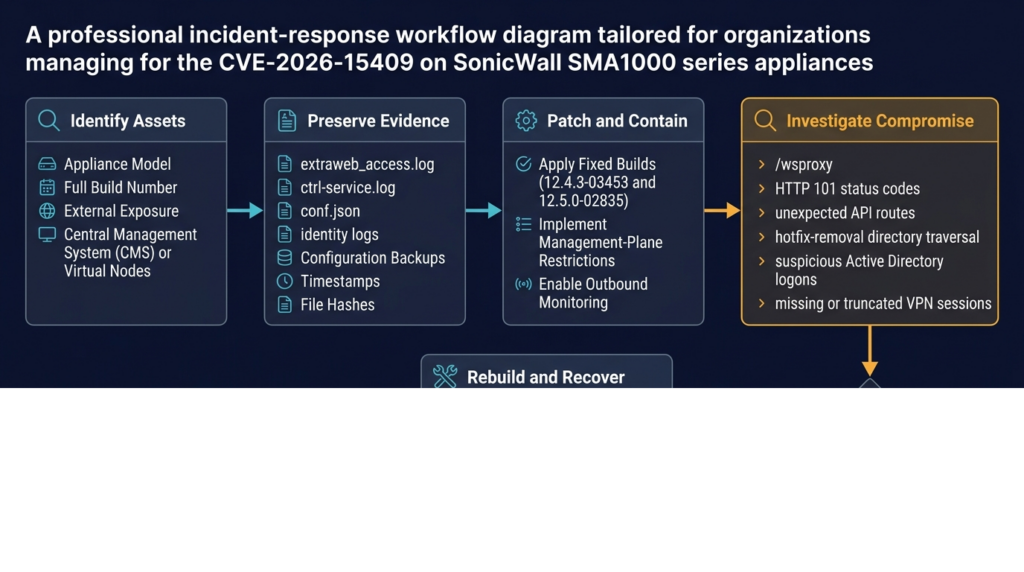
Establish ownership and incident severity
Assign an incident owner with authority to coordinate network, identity, appliance, legal, communications, and business-continuity decisions. Do not leave the response entirely within a routine patch-management queue.
Record the following facts immediately:
- Exact appliance models
- Full firmware builds
- External IP addresses and hostnames
- Internal interfaces and routing
- Management interfaces
- Identity integrations
- Internet exposure history
- Date and time of the last known safe update
- Log retention and export capabilities
- Configuration backup dates
- Current business dependency on remote access
An internet-facing affected build should be handled as an emergency even before an IOC is found.
Preserve volatile and historical evidence
Before making unnecessary changes, export the evidence that may disappear during reboot, patching, log rotation, rebuild, or cleanup.
Preserve:
extraweb_access.log
ctrl-service.log
/var/lib/unit/conf.json
Authentication logs
Administrator audit logs
System events
Configuration exports
Hotfix history
Firewall flow logs
Reverse proxy logs
DNS logs
Domain controller security logs
VPN session records
Identity-provider events
Relevant packet captures, if already available
Calculate hashes of exported evidence:
mkdir -p evidence/hashes

find evidence -type f -print0 |
  sort -z |
  xargs -0 sha256sum > evidence/hashes/sha256.txt
This command does not prove that the source appliance was uncompromised, but it records the integrity of the exported copies after collection.
Record system time and time-zone information. Correlation fails easily when the appliance logs UTC, a domain controller logs local time, and a SIEM normalizes events to a third zone.
Apply the vendor hotfix
Upgrade affected appliances to:
12.4.3-03453 or later
12.5.0-02835 or later
Use the official MySonicWall distribution and follow the vendor-supported upgrade procedure. SonicWall did not publish a general workaround that can replace the fixed build. Rapid7 likewise states that no workaround is available. (SonicWall)
Verify the complete version after the update. Do not rely solely on a successful upgrade message.
Restrict exposure during the response
Where business continuity permits:
- Remove unnecessary internet exposure.
- Restrict access to approved source networks.
- Separate the management plane from the user-facing portal.
- Block direct management access from the internet.
- Limit appliance egress to documented dependencies.
- Increase monitoring of traffic from the appliance’s internal IP.
- Temporarily restrict high-risk service-account privileges.
- Prepare an alternate remote-access path before rebuilding.
Access restrictions are containment measures, not substitutes for the patch.
Start identity containment in parallel
Do not wait for the appliance investigation to finish before mapping secrets at risk.
Identify the LDAP integration account, administrator accounts, active users, TOTP enrollments, API keys, certificates, and service credentials. Prepare a rotation sequence so that confirmed compromise can trigger immediate revocation without improvisation.
Decide whether the appliance is trustworthy
An appliance with a confirmed IOC should not be treated as clean because the suspicious file or route has been removed.
Follow SonicWall’s recovery guidance:
- Re-image physical appliances.
- Redeploy virtual appliances.
- Rotate user and administrator passwords.
- Reset TOTP tokens.
- Restore only from a trustworthy configuration source. (SonicWall)
SonicWall warns that configuration backups should predate the December hotfix builds listed in its notice. If an older trusted backup does not exist, the configuration should be closely audited for tampering. (SonicWall)
Official Indicators of Compromise
SonicWall’s advisory lists several appliance-level indicators.
Unexpected API routes
Search extraweb_access.log for successful requests to:
/__api__/login
/__api__/logout
The vendor identifies HTTP 200 responses for these paths as indicators requiring investigation. SonicWall corrected the route spelling on July 15, so hunters should use two underscores before and after api. (SonicWall)
Example local search:
grep -nE '"?(/__api__/login|/__api__/logout)([? /"]|$)' extraweb_access.log |
  grep -E '(^|[[:space:]])200([[:space:]]|$)'
Log formats differ. Validate which field contains the HTTP status before relying on this expression.
Suspicious WebSocket proxy access
SonicWall instructs customers to inspect /wsproxy requests containing suspicious host parameters and returning HTTP 101. (SonicWall)
A basic triage search is:
grep -n '/wsproxy' extraweb_access.log |
  grep -E '(^|[[:space:]])101([[:space:]]|$)' |
  grep -Ei 'host=([^& ]*localhost|0\.0\.0\.0|127\.|::1|::ffff:127\.)'
This is a triage query, not a complete detector. Encoding, alternative address representations, log escaping, and attacker-controlled DNS names may evade simple text matching.
Rapid7 reported additional patterns involving /wsproxy, a characteristic negative identifier fragment, HTTP 101, and suspicious loopback representations. It noted values such as 0.0.0.0, localhost, and IPv4-mapped IPv6 loopback addresses as high-signal examples. (Rápido7)
Hotfix-removal path traversal
SonicWall identifies ctrl-service.log entries containing hotfix removal and a path-traversal name as a compromise indicator. (SonicWall)
A safe search:
grep -ni 'hotfix removal' ctrl-service.log |
  grep -E '(\.\./|%2e%2e|%252e%252e)'
Rapid7 reported that exploited systems showed the hotfix-removal utility receiving traversal sequences that pointed to attacker-staged shell scripts. (Rápido7)
A match should be treated as high severity. Legitimate hotfix names should not need to traverse outside the designated rollback directory.
Modified Unit configuration
Inspecciona:
/var/lib/unit/conf.json
SonicWall and Rapid7 identify routes for /__api__/login o /__api__/logout in this file as suspicious because they are not expected in legitimate configurations. (SonicWall)
Do not edit the live file before preserving a copy:
cp --preserve=all /var/lib/unit/conf.json evidence/conf.json
sha256sum evidence/conf.json
grep -nE '/__api__/(login|logout)' evidence/conf.json
Run commands only through supported administrative access and according to the organization’s incident-response procedure. If direct shell access is not supported, open a SonicWall support case rather than improvising changes on the appliance.
Additional Behavioral Indicators
Static IOC searches should be combined with behavior.
Rapid7 recommends looking for:
- Repeated WorkPlace enumeration
- Requests to
/auth1.html - Generic path and file probes
- Authentication API activity
- Access to temporary session database paths
- Active Directory logons from the appliance IP
- Unusual workstation names
- No corresponding VPN session
- Use of the integrated LDAP account outside normal behavior (Rápido7)
A useful detection chain is:
Suspicious /wsproxy request
        +
HTTP 101
        +
Localhost-like target
        |
        v
Hotfix-removal traversal or unexpected API route
        |
        v
Sensitive file or session access
        |
        v
AD logon from appliance internal IP
        |
        v
No matching VPN session
No single event must appear in every compromise. The value comes from correlation.
A Python Log Triage Script
The following script analyzes exported log files. It does not connect to an appliance, send network traffic, or test the vulnerability.
#!/usr/bin/env python3

from __future__ import annotations

import argparse
import re
from pathlib import Path
from typing import Iterable

WS_PROXY = re.compile(r"/wsproxy", re.IGNORECASE)
STATUS_101 = re.compile(r"(?:^|\s)101(?:\s|$)")
STATUS_200 = re.compile(r"(?:^|\s)200(?:\s|$)")
API_ROUTE = re.compile(r"/__api__/(?:login|logout)", re.IGNORECASE)
LOOPBACK_TARGET = re.compile(
    r"(?:host=|destination=|target=)"
    r"[^&\s]*(?:localhost|0\.0\.0\.0|127\.|::1|::ffff:127\.)",
    re.IGNORECASE,
)
HOTFIX_REMOVAL = re.compile(r"hotfix removal", re.IGNORECASE)
TRAVERSAL = re.compile(r"(?:\.\./|%2e%2e|%252e%252e)", re.IGNORECASE)


def read_lines(path: Path) -> Iterable[tuple[int, str]]:
    with path.open("r", encoding="utf-8", errors="replace") as handle:
        for number, line in enumerate(handle, start=1):
            yield number, line.rstrip("\n")


def inspect_access_log(path: Path) -> list[str]:
    findings: list[str] = []

    for number, line in read_lines(path):
        if API_ROUTE.search(line) and STATUS_200.search(line):
            findings.append(
                f"{path}:{number}: successful unexpected API route: {line}"
            )

        if (
            WS_PROXY.search(line)
            and STATUS_101.search(line)
            and LOOPBACK_TARGET.search(line)
        ):
            findings.append(
                f"{path}:{number}: WebSocket proxy to local target: {line}"
            )

    return findings


def inspect_control_log(path: Path) -> list[str]:
    findings: list[str] = []

    for number, line in read_lines(path):
        if HOTFIX_REMOVAL.search(line) and TRAVERSAL.search(line):
            findings.append(
                f"{path}:{number}: hotfix removal with traversal: {line}"
            )

    return findings


def main() -> int:
    parser = argparse.ArgumentParser(
        description="Offline triage for exported SonicWall SMA1000 logs."
    )
    parser.add_argument("--access-log", type=Path)
    parser.add_argument("--control-log", type=Path)
    args = parser.parse_args()

    findings: list[str] = []

    if args.access_log:
        if not args.access_log.is_file():
            parser.error(f"Access log does not exist: {args.access_log}")
        findings.extend(inspect_access_log(args.access_log))

    if args.control_log:
        if not args.control_log.is_file():
            parser.error(f"Control log does not exist: {args.control_log}")
        findings.extend(inspect_control_log(args.control_log))

    if not args.access_log and not args.control_log:
        parser.error("Provide at least one exported log file.")

    if findings:
        print("\n".join(findings))
        return 2

    print("No configured patterns were found.")
    print("This result does not prove that the appliance was not compromised.")
    return 0


if __name__ == "__main__":
    raise SystemExit(main())
Run it only against exported evidence:
python3 sma1000_log_triage.py \
  --access-log evidence/extraweb_access.log \
  --control-log evidence/ctrl-service.log
A zero-result output is not a clean bill of health. Logs may be incomplete, rotated, altered, stored elsewhere, or formatted differently.
Splunk-Style Detection Queries
Adjust field names to match the parser.
Suspicious successful WebSocket proxy
index=network_appliance
source="*extraweb_access.log"
uri_path="/wsproxy"
status=101
| where match(lower(uri_query),
    "host=.*(localhost|0\\.0\\.0\\.0|127\\.|::1|::ffff:127\\.)")
| table _time src_ip uri_path uri_query status user_agent
Unexpected API routes
index=network_appliance
source="*extraweb_access.log"
status=200
(uri_path="/__api__/login" OR uri_path="/__api__/logout")
| table _time src_ip uri_path status user_agent
Hotfix-removal traversal
index=network_appliance
source="*ctrl-service.log"
"hotfix removal"
("../" OR "%2e%2e" OR "%252e%252e")
| table _time host _raw
Domain logons sourced from the appliance
index=windows EventCode=4624 Logon_Type=3
Source_Network_Address IN ("<SMA_INTERNAL_IP_1>", "<SMA_INTERNAL_IP_2>")
| stats count
    values(Account_Name) as accounts
    values(Workstation_Name) as workstations
    by _time Source_Network_Address ComputerName
Correlate the last query with the VPN session table. Authentication from the appliance IP is not automatically malicious; the alert becomes stronger when no remote-access session, scheduled integration job, or approved administrative operation explains it.
Microsoft Sentinel KQL Example
let SmaInternalIPs = dynamic([
    "10.10.20.15",
    "10.10.20.16"
]);
SecurityEvent
| where EventID == 4624
| where LogonType == 3
| where IpAddress in (SmaInternalIPs)
| project
    TimeGenerated,
    Computer,
    TargetAccount = Account,
    IpAddress,
    WorkstationName,
    AuthenticationPackageName,
    LogonProcessName
| order by TimeGenerated desc
A second dataset should identify normal VPN sessions:
let SmaInternalIPs = dynamic([
    "10.10.20.15",
    "10.10.20.16"
]);
let SuspiciousLogons =
    SecurityEvent
    | where EventID == 4624
    | where LogonType == 3
    | where IpAddress in (SmaInternalIPs)
    | project
        LogonTime = TimeGenerated,
        Account,
        IpAddress,
        WorkstationName,
        Computer;
let VpnSessions =
    SmaVpnSession_CL
    | project
        SessionStart = TimeGenerated,
        SessionEnd = todatetime(SessionEnd_s),
        Account = User_s,
        ApplianceIP = ApplianceIP_s;
SuspiciousLogons
| join kind=leftouter VpnSessions on Account
| where isnull(SessionStart)
    or LogonTime < SessionStart
    or LogonTime > SessionEnd
| project LogonTime, Account, IpAddress, WorkstationName, Computer
This is an example correlation pattern. Real deployments must account for clock skew, session-table delay, shared accounts, service accounts, failover nodes, and ingestion gaps.
A Safe Local PoC for Understanding the SSRF Boundary
A working SonicWall exploit is not necessary to understand the security failure. Rapid7 has published technical material and a validation PoC, but reproducing its device-specific command chain against production systems would create unnecessary operational and legal risk. (Rápido7)
The following toy lab runs entirely on one developer machine. It demonstrates a public-facing proxy that accepts an arbitrary destination and can therefore reach a service bound only to 127.0.0.1.
It does not contain:
- SonicWall-specific endpoint parameters
- An SMA1000 exploit
- Authentication bypass material
- Erlang protocol code
- A hotfix-removal payload
- Path traversal
- Ejecución de comandos
- Internet scanning
Lab assumptions
Use only a disposable local environment. The simulated internal service returns a fixed educational message. It performs no privileged action.
Install the dependency:
python3 -m venv .venv
source .venv/bin/activate
python3 -m pip install aiohttp
Local-only internal service
Save as internal_service.py:
#!/usr/bin/env python3

from aiohttp import web


async def status(request: web.Request) -> web.Response:
    return web.json_response(
        {
            "service": "toy-local-admin",
            "binding": "127.0.0.1",
            "message": "This service was not intended for external access.",
        }
    )


app = web.Application()
app.router.add_get("/status", status)

web.run_app(app, host="127.0.0.1", port=9100)
Run it:
python3 internal_service.py
The service listens only on loopback:
curl http://127.0.0.1:9100/status
Intentionally vulnerable fetch proxy
Save as vulnerable_proxy.py:
#!/usr/bin/env python3

from __future__ import annotations

from aiohttp import ClientSession, web


async def fetch(request: web.Request) -> web.Response:
    target = request.query.get("url")

    if not target:
        raise web.HTTPBadRequest(text="Missing url parameter")

    async with ClientSession() as session:
        async with session.get(target, timeout=3) as response:
            body = await response.text()
            return web.Response(
                text=body,
                status=response.status,
                content_type=response.content_type,
            )


app = web.Application()
app.router.add_get("/fetch", fetch)

web.run_app(app, host="0.0.0.0", port=8080)
Run it in the same isolated lab:
python3 vulnerable_proxy.py
The dangerous behavior can now be demonstrated locally:
curl \
  'http://127.0.0.1:8080/fetch?url=http://127.0.0.1:9100/status'
The client did not connect directly to the internal service through the exposed interface. It instructed the proxy to connect on its behalf. The local-only service sees a request originating from the machine that hosts the proxy.
This toy example uses HTTP rather than WebSocket tunneling, so it is less capable than the behavior Rapid7 documented for CVE-2026-15409. The security lesson is the same: a server-side network feature must not accept arbitrary destinations from an unauthenticated user.
A safer implementation
Save as restricted_proxy.py:
#!/usr/bin/env python3

from __future__ import annotations

import asyncio
import ipaddress
import socket
from urllib.parse import urlsplit

from aiohttp import ClientSession, web

ALLOWED_SCHEMES = {"https"}
ALLOWED_PORTS = {443}
ALLOWED_HOSTS = {
    "updates.example.test",
}


async def resolve_addresses(hostname: str, port: int) -> set[ipaddress._BaseAddress]:
    loop = asyncio.get_running_loop()

    results = await loop.getaddrinfo(
        hostname,
        port,
        type=socket.SOCK_STREAM,
    )

    addresses: set[ipaddress._BaseAddress] = set()

    for family, _, _, _, sockaddr in results:
        raw_address = sockaddr[0]
        addresses.add(ipaddress.ip_address(raw_address))

    return addresses


def address_is_prohibited(address: ipaddress._BaseAddress) -> bool:
    return any(
        [
            address.is_loopback,
            address.is_private,
            address.is_link_local,
            address.is_multicast,
            address.is_reserved,
            address.is_unspecified,
        ]
    )


async def validate_target(raw_url: str) -> str:
    parsed = urlsplit(raw_url)

    if parsed.scheme not in ALLOWED_SCHEMES:
        raise web.HTTPForbidden(text="Scheme is not allowed")

    if not parsed.hostname:
        raise web.HTTPBadRequest(text="URL has no hostname")

    hostname = parsed.hostname.rstrip(".").lower()
    port = parsed.port or 443

    if hostname not in ALLOWED_HOSTS:
        raise web.HTTPForbidden(text="Hostname is not allowed")

    if port not in ALLOWED_PORTS:
        raise web.HTTPForbidden(text="Port is not allowed")

    addresses = await resolve_addresses(hostname, port)

    if not addresses:
        raise web.HTTPForbidden(text="Hostname did not resolve")

    if any(address_is_prohibited(address) for address in addresses):
        raise web.HTTPForbidden(text="Resolved address is prohibited")

    return raw_url


async def fetch(request: web.Request) -> web.Response:
    raw_url = request.query.get("url")

    if not raw_url:
        raise web.HTTPBadRequest(text="Missing url parameter")

    target = await validate_target(raw_url)

    timeout = 3

    async with ClientSession() as session:
        async with session.get(
            target,
            timeout=timeout,
            allow_redirects=False,
        ) as response:
            body = await response.text()
            return web.Response(
                text=body,
                status=response.status,
                content_type=response.content_type,
            )


app = web.Application()
app.router.add_get("/fetch", fetch)

web.run_app(app, host="0.0.0.0", port=8081)
The safer design combines several controls:
- HTTPS-only policy
- Server-maintained hostname allowlist
- Port allowlist
- DNS resolution before connection
- Rejection of loopback, private, link-local, reserved, multicast, and unspecified addresses
- Redirects disabled unless every redirect target is independently validated
- Short timeout
- No arbitrary protocol tunneling
A production proxy needs additional controls, including connection pooling policy, DNS rebinding resistance, IPv6 handling, proxy environment-variable control, request-header filtering, response-size limits, audit logging, rate limits, and authentication.
The strongest design is often to avoid accepting a URL at all. A client can request a logical destination identifier, and the server can map it to a fixed backend:
{
  "destination": "approved-update-service"
}
The application then selects the host and port from trusted configuration rather than from user input.
Detecting the Vulnerability Without Exploiting Production
When active exploitation is confirmed and exact vulnerable builds are known, invasive exploitation is usually the wrong production validation method.
A safer validation hierarchy is:
- Identify the product.
- Retrieve the full build through an authenticated administrative interface.
- Compare it with the vendor’s affected-version matrix.
- Confirm whether WorkPlace was internet-accessible.
- Search logs and configuration for IOC evidence.
- Install the fixed hotfix.
- Verify the complete fixed build.
- Re-run non-destructive configuration and version checks.
- Use an isolated lab for exploit reproduction only when necessary.
Do not run a public PoC against arbitrary internet hosts. Do not use search-engine results as authorization. Do not assume that a customer domain, a bug-bounty program, or a general penetration-testing contract includes permission to exploit a production VPN appliance.
A WebSocket or privilege-escalation test may interrupt active remote sessions, trigger a reboot, alter configuration, create files, or expose credentials. The technical possibility of testing does not make the test operationally appropriate.
Automated validation platforms can still add value through asset correlation, authorized version checks, log collection, evidence preservation, retest tracking, and report generation. A workflow built around a system such as Penligente should be constrained to explicitly authorized assets and should default to non-destructive checks for an actively exploited perimeter vulnerability. The evidence chain should distinguish a vulnerable version, an IOC match, a lab reproduction, and confirmed production compromise rather than collapsing them into one result.
Interpreting HTTP 101 Correctly
HTTP 101 means the server agreed to switch from HTTP to another protocol, commonly WebSocket. It is necessary for a successful WebSocket connection but is not sufficient evidence of exploitation.
A useful triage table is:
| Observation | Interpretation |
|---|---|
/wsproxy with HTTP 101 and approved destination | May be legitimate |
/wsproxy with HTTP 101 and localhost | High suspicion |
/wsproxy with HTTP 101 and loopback IPv6 | High suspicion |
/wsproxy with HTTP 101 and unknown external host | Investigate policy and session context |
/wsproxy with HTTP 400 or 403 | Attempt may have failed, but still review |
| HTTP 101 on an unrelated application path | Not specific to this CVE |
/wsproxy followed by hotfix traversal | Strong chain evidence |
/wsproxy followed by AD logons from appliance IP | Strong compromise evidence |
A failed attempt may still matter. It can indicate reconnaissance, exploit development, incorrect attacker assumptions, or a partially patched node.
False Negatives and Missing Evidence
The absence of a listed IOC does not prove the absence of exploitation.
Possible reasons include:
- The relevant log was rotated.
- Logging was disabled or incomplete.
- The attacker altered the log.
- A failover node contains the evidence.
- Events were written to an external collector.
- The organization searched the incorrect API route spelling.
- The attacker used a different localhost representation.
- The attacker accessed a different local service.
- The attack failed before producing later-stage artifacts.
- Timestamps were normalized incorrectly.
- The device was rebuilt before evidence collection.
- The available IOC list reflects only currently observed techniques.
A negative result should be expressed accurately:
No listed indicators were found in the available evidence for the reviewed
time range. This does not establish that exploitation did not occur.
Do not state:
The appliance was not compromised.
unless the investigation supports that stronger conclusion.
False Positives and Context
Detection rules can also over-alert.
A legitimate remote-access workflow may use /wsproxy and return HTTP 101. An administrator may perform authorized hotfix operations. The appliance may generate expected directory authentication from its internal IP.
The differentiating context includes:
- The destination host and port
- The source IP
- The user agent
- The authenticated user
- The associated remote-access session
- The hotfix name
- The presence of traversal sequences
- Whether the route exists in a known-good configuration
- Whether the workstation name is managed
- Whether the account normally performs the observed operation
- Whether activity falls inside a documented maintenance window
Path traversal in a hotfix name is not a normal administrative pattern. A route for the unexpected API paths in conf.json is also substantially stronger than a generic WebSocket event.
Network Controls That Reduce SSRF Impact
Patching is mandatory, but architecture determines whether the next proxy flaw becomes a full compromise.
Restrict appliance egress
A remote-access gateway should not have unrestricted outbound access merely because it needs to connect to several internal services.
Document and allow only required destinations:
- Identity providers
- Directory servers
- Approved application networks
- DNS resolvers
- NTP sources
- Update services
- Logging collectors
- Monitoring systems
- Administrative dependencies
Block unnecessary access to:
- Domain controllers beyond required directory protocols
- Management networks
- Cloud metadata addresses
- Development services
- Database administration ports
- Container and orchestration APIs
- Hypervisor management
- General internet destinations
Egress restrictions may not stop access to services on the same appliance, but they reduce post-compromise movement.
Monitor the appliance as a workload
Create detections for:
- New destination ports
- First-time internal destinations
- Direct domain-controller connections
- Interactive authentication
- Large outbound transfers
- DNS lookups unrelated to normal operation
- Connections during unusual hours
- Service-account use outside documented patterns
- Traffic without a corresponding user session
Separate management and user planes
The WorkPlace interface and administrative functions should not share unnecessary trust. Management access should be restricted to dedicated networks, strong administrator authentication, and controlled jump hosts.
Local control services should enforce their own authentication and authorization. A request originating from the appliance itself should not bypass those checks.
Protect integration accounts
LDAP and directory integration accounts should have the minimum privileges required for their function. They should not be domain administrators, should not permit interactive logon, and should be monitored for use outside the appliance’s normal directory-query pattern.
Application Design Lessons From CVE-2026-15409
Never expose an arbitrary TCP proxy to unauthenticated users
A generic TCP tunnel is more dangerous than a narrowly defined application request. It allows interaction with protocols the public application was never designed to parse or secure.
Validate the final network destination
Validation must occur after parsing and resolution. The code must evaluate every resolved IP, not only the original hostname.
Repeat validation
Revalidate after redirects and before new connections. DNS and routing results can change between validation and use.
Do not rely on blacklists
Blocking a few strings is not enough. Use an allowlist of approved destinations, ports, and protocols.
Authenticate local services
Loopback binding is a network-exposure control, not an authentication mechanism.
Limit service privileges
A proxy process should not run with access to every local administrative service. Local services should not execute maintenance scripts as root based on weakly validated names.
Make dangerous workflows non-generic
A hotfix-removal function should select only server-discovered hotfix identifiers. It should not accept a filesystem path from the request.
A safe pattern is:
Client requests rollback of hotfix ID 2026-07-001
Server looks up that exact ID in an internal database
Server resolves a fixed path under the rollback directory
Server verifies ownership, signature, and expected hash
Server invokes a fixed executable with structured arguments
The request should never select an arbitrary script.
The Historical SMA1000 Context
CVE-2026-15409 is not the first critical vulnerability to affect the SMA1000 control plane.
CVE-2025-23006 was a pre-authentication deserialization vulnerability in the SMA1000 Appliance Management Console and Central Management Console. SonicWall’s advisory described it as an unauthenticated remote command-execution issue, and CISA added it to KEV in January 2025. (SonicWall PSIRT)
The relationship is operational rather than merely historical:
- Both affect security infrastructure at the network edge.
- Both involve management or control-plane functionality.
- Both can provide unauthenticated attackers with a path toward command execution.
- Both demonstrate why remote-access appliances require continuous asset and patch visibility.
- Both show that perimeter devices should be included in compromise assessment, not only vulnerability scanning.
A team that patched CVE-2025-23006 should not assume the same update protects against CVE-2026-15409. Each advisory has its own affected and fixed builds.
Similarly, defenders should not merge the SMA1000, SMA100, and SonicOS product families into one vulnerability record. Related vendor names and overlapping remote-access functions do not imply shared code, shared exposure, or shared patches.
Common Response Mistakes
Checking only the major firmware version
12.4.3 is not enough. Record the full build and platform-hotfix suffix.
Treating a successful patch as proof of no compromise
The patch removes the known vulnerable behavior. It does not reconstruct the pre-patch timeline.
Searching only the vendor’s first IOC spelling
SonicWall corrected the API route notation. Search the corrected route and document which version of the advisory was used. (SonicWall)
Deleting suspicious configuration before collecting it
Preserve a copy and hash it. The modified route may be crucial evidence.
Restoring the newest configuration backup
The newest backup may have been created after compromise. SonicWall specifically warns about backup trust and recommends using an appropriately old backup or auditing the configuration closely. (SonicWall)
Rotating only administrator passwords
User credentials, LDAP integration secrets, session material, and TOTP seeds may also be exposed.
Looking only for external attacker IPs
Post-exploitation traffic may originate from the appliance’s internal IP. Rapid7’s reported AD activity followed that pattern. (Rápido7)
Assuming every HTTP 101 is malicious
Correlate path, destination, source, session, and follow-on behavior.
Running the exploit against production to gain certainty
Version evidence, IOC evidence, and behavioral evidence are usually safer. A production exploit can change state, disrupt service, or expose real secrets.
Ignoring a standby or CMS node
All affected physical, virtual, central-management, test, and recovery systems must be accounted for.
A Decision Matrix for Recovery
| Evidence state | Medidas recomendadas |
|---|---|
Confirmed malicious route in conf.json | Treat as compromised, rebuild, rotate credentials and TOTP |
| Hotfix-removal traversal in logs | Treat as root compromise |
Suspicious /wsproxy plus AD activity | Treat as likely compromise and escalate |
Suspicious /wsproxy sólo | Preserve evidence, investigate deeply, patch immediately |
| Affected build with incomplete logs | Patch and treat compromise status as unknown |
| Affected build with complete logs and no IOC | Patch, continue behavior-based review, document limitations |
| Fixed build installed after prior internet exposure | Hunt the full pre-patch period |
| Fixed build installed before any internet exposure | Verify configuration and retain evidence of the state |
| Unknown build | Assume potentially affected until verified |
Questions Security Leaders Should Ask
Technical responders need management support for decisions that can disrupt remote access. Leaders should ask:
- Do we know every SMA1000 appliance and its full build?
- Which nodes were internet-facing before July 14?
- How far back do appliance and identity logs go?
- Can we distinguish appliance-originated AD traffic from user VPN sessions?
- Which secrets are stored or processed by the appliance?
- Do we have a trusted configuration backup?
- Can the business tolerate a rebuild?
- Is an alternate remote-access service available?
- Who owns TOTP reset communication?
- Have legal and communications teams been informed of the potential identity exposure?
- Are managed-service providers operating any appliances on our behalf?
- Have we checked disaster-recovery and migration environments?
- Can we prove the fixed build is installed?
- What evidence would cause us to expand the incident scope?
- Who has authority to declare the appliance trustworthy again?
PREGUNTAS FRECUENTES
What is CVE-2026-15409?
- CVE-2026-15409 is a server-side request forgery vulnerability in the SonicWall SMA1000 WorkPlace interface.
- It can be exploited remotely without authentication or user interaction.
- Rapid7 reported that the affected WebSocket proxy can tunnel traffic to localhost-only services.
- The vulnerability has a CISA ADP CVSS 3.1 score of 10.0.
- SonicWall and CISA have confirmed active exploitation. (NVD)
Is CVE-2026-15409 being actively exploited?
- Yes. SonicWall states that the vulnerability is being actively exploited in the wild.
- Rapid7 reported observing targeted exploitation before public disclosure.
- CISA added the vulnerability to KEV on July 14, 2026.
- Organizations should investigate the pre-patch period rather than treating the issue as a preventive patch only. (SonicWall)
Which SonicWall versions are affected?
- SMA1000 builds 12.4.3-03245, 12.4.3-03387, and 12.4.3-03434 are affected.
- Builds 12.5.0-02283, 12.5.0-02624, and 12.5.0-02800 are affected.
- The impacted product list includes SMA 6210, SMA 7210, SMA 8200v, and relevant CMS deployments.
- Administrators must check the complete build number, not only the 12.4.3 or 12.5.0 branch. (SonicWall)
What versions fix CVE-2026-15409?
- Upgrade the 12.4 branch to 12.4.3-03453 or later.
- Upgrade the 12.5 branch to 12.5.0-02835 or later.
- Obtain the hotfix through the official SonicWall customer channel.
- Verify the full build after installation.
- SonicWall has not published a general workaround that replaces the update. (SonicWall)
Does installing the hotfix prove the appliance is safe?
- No. The hotfix prevents the known vulnerable behavior but does not prove that exploitation did not occur earlier.
- A compromised device may contain altered routes, stolen credentials, copied TOTP seeds, or attacker-created persistence.
- SonicWall requires forensic analysis and recommends rebuilding the appliance when an IOC is found.
- Identity remediation must be performed when compromise is confirmed. (SonicWall)
How can defenders detect exploitation?
- Search
extraweb_access.logpara/__api__/logino/__api__/logoutreturning HTTP 200. - Search for
/wsproxyrequests with suspicious host values and HTTP 101. - Search
ctrl-service.logparahotfix removalcombined with path traversal. - Inspect
/var/lib/unit/conf.jsonfor unexpected API routes. - Look for AD logons from the appliance’s internal IP without a matching VPN session.
- Correlate log events rather than relying on one string match. (SonicWall)
Can CVE-2026-15409 lead to root command execution?
- CVE-2026-15409 directly provides unintended access to local services through a WebSocket tunnel.
- Rapid7 demonstrated that this access can support initial code execution against a local service.
- CVE-2026-15410 can then be used through the vulnerable hotfix-removal workflow to execute a script as root.
- The full chain is more severe than considering the SSRF in isolation. (Rápido7)
Is a public PoC available?
- Rapid7 states that a Python validation PoC for CVE-2026-15409 is publicly available.
- Its report also says a Metasploit module for the chain was in development at publication time.
- Public availability does not authorize testing against third-party or production systems.
- Production validation should prioritize authenticated version checks, IOC review, and non-destructive evidence collection.
- Full exploit reproduction belongs in an isolated lab with explicit authorization. (Rápido7)
What should an organization do when an IOC is found?
- Treat the appliance as compromised.
- Preserve logs, configuration, identity records, and network evidence.
- Re-image a physical appliance or redeploy a virtual appliance.
- Change user and administrator passwords.
- Rotate directory and service-account credentials based on exposure.
- Reset TOTP tokens.
- Restore only from a trusted configuration source.
- Hunt for internal authentication and lateral movement from the appliance IP. (SonicWall)
Final Assessment
CVE-2026-15409 is a critical boundary failure in an appliance whose purpose is to enforce network boundaries. The vulnerable WorkPlace WebSocket proxy allows an unauthenticated external client to redirect the appliance’s own connectivity toward localhost-only services. Rapid7’s analysis shows how that capability can be combined with CVE-2026-15410 to reach root execution and how compromised appliances were used to collect identity material and move toward Active Directory. (Rápido7)
The correct response has four inseparable parts: identify every affected build, install the fixed hotfix, investigate the pre-patch exposure window, and restore trust in both the appliance and the credentials it handled.
A clean patch status without forensic review is incomplete. A clean IOC search with incomplete logs is inconclusive. A rebuilt appliance without credential rotation may leave the attacker with valid access. A password reset without reviewing internal authentication may miss an established foothold.
The highest-priority actions are to verify the complete firmware build, preserve evidence, search the corrected IOC paths, review /wsproxy and hotfix-removal activity, correlate domain logons with VPN sessions, and follow SonicWall’s rebuild and identity-reset guidance whenever compromise is indicated.

 Spanish
  English
  German
  French
  Portuguese
  Japanese
  Korean
  Hindi
Hindi  Arabic
  Turkish
  Hebrew