
CVE-2026-21510: When the Prompt Doesn’t Show Up What a Windows Shell Trust-Boundary Failure Means in Practice
1) Treat it as a trust-boundary failure, not “just another Patch Tuesday item”
NVD characterizes CVE-2026-21510 as a protection mechanism failure in Windows Shell that lets an attacker bypass a security feature. It carries a CVSS v3.1 base score of 8.8 (network-reachable, low complexity, no privileges required; user interaction remains).(NVD)
That’s already a serious profile. What pushes it into “drop everything” territory is the operational context:
- Microsoft has flagged exploitation, and multiple Patch Tuesday roundups list it as actively exploited / zero-day class.(BleepingComputer)
- CISA added it to the Vulnerabilidades explotadas conocidas (KEV) catalog with a remediation due date of 2026-03-03 (a real prioritization lever inside organizations).(NVD)
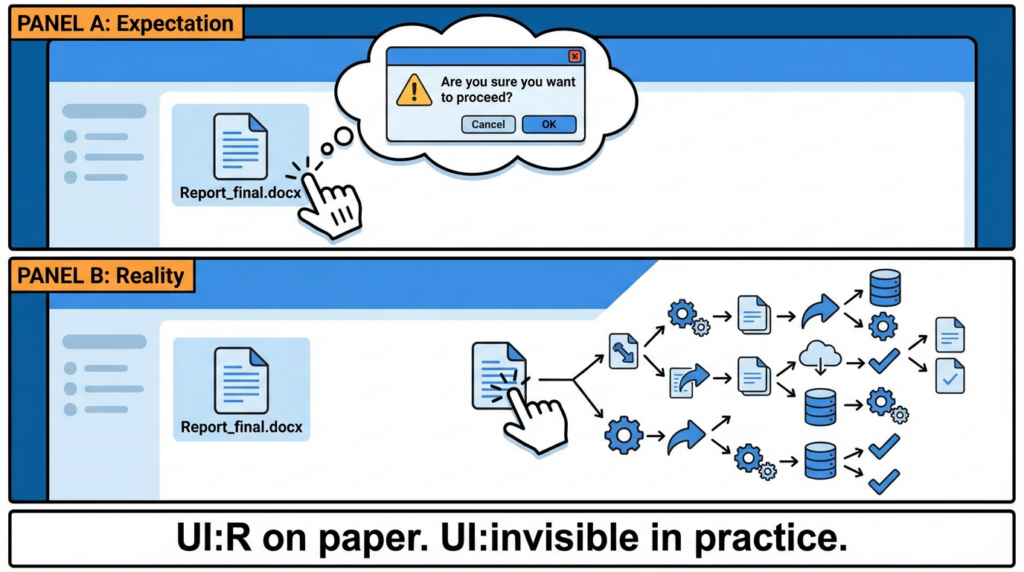
ZDI’s Patch Tuesday review makes the defender-relevant point bluntly: even though Microsoft labels it as a “feature bypass,” in practical terms it’s close to one-click execution because the safety boundary you expect (SmartScreen / prompts) doesn’t reliably appear.(Zero Day Initiative)
2) The real damage: SmartScreen / MOTW / Shell prompts stop being a dependable line of defense
Most endpoint programs implicitly rely on a chain of friction:
- MOTW (Zone.Identifier) signals “this came from the Internet.”
- SmartScreen and shell prompts add “are you sure?” moments at the exact point users make mistakes.
For CVE-2026-21510, the “cost” of exploitation is lower because the user never gets the psychological speed bump.
Sophos quotes Microsoft’s description: an attacker could bypass SmartScreen and Shell prompts, allowing attacker-controlled content to execute without warning or user consent, and it affects all supported Windows (client and server).(sophos.com)
Rapid7 frames related risk in terms of trust markings and “Mark-of-the-Web” realities in enterprise pipelines (where tags can be lost through common workflows).(Rápido7)
3) Likely delivery patterns: links and shortcuts are the cheap, scalable carrier
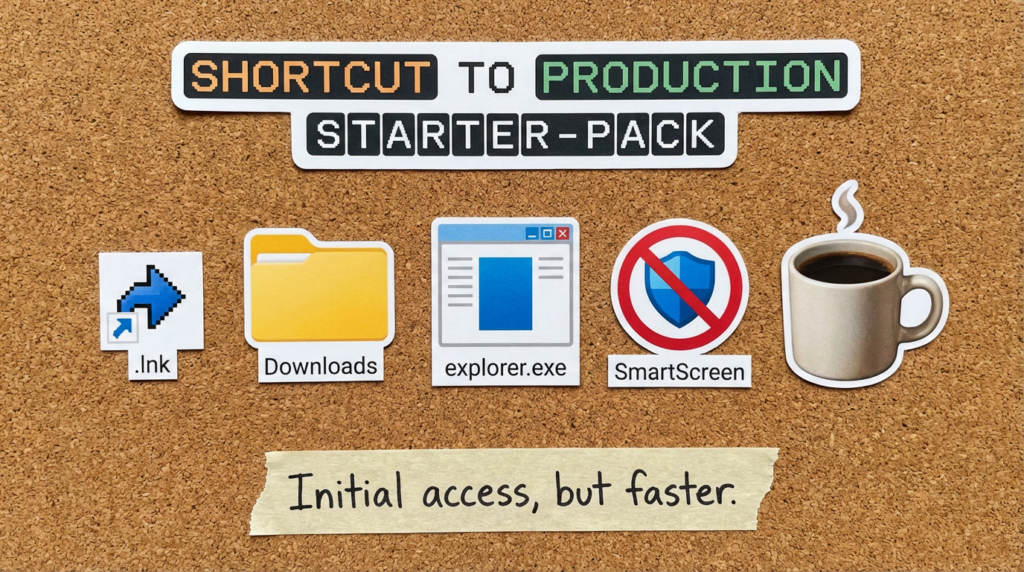
Across reporting, the recurring exploitation narrative is consistent: convince the user to open a malicious link or shortcut file (often discussed in the context of .lnk) and the normal warnings don’t show.(SecurityWeek)
This doesn’t mean the CVE is the whole intrusion. It means it’s a reliability booster for initial access:
- fewer user-reported “weird warning” moments
- fewer early IR tickets
- easier mass-targeting because “one click” is a scalable requirement
That is exactly why it shows up alongside other exploited February 2026 issues in major Patch Tuesday roundups.(BleepingComputer)
4) Related CVEs worth modeling alongside CVE-2026-21510
These aren’t filler. They’re how real-world attackers build chains: bypass → execute → escalate.
| CVE | Componente | Clase | Por qué es importante |
|---|---|---|---|
| CVE-2026-21510 | Windows Shell | Security feature bypass (exploited) | Suppresses safety prompts, making initial access more reliable.(NVD) |
| CVE-2026-21513 | MSHTML framework | Security feature bypass (exploited) | Often discussed in the same “file / shortcut / rendering” orbit during Feb 2026 Patch Tuesday.(BleepingComputer) |
| CVE-2026-21514 | Microsoft Word | Security feature bypass (exploited) | Document open workflows remain a prime initial access vector.(SecurityWeek) |
| CVE-2026-21519 | Gestor de ventanas de escritorio | EoP (exploited) | Common post-compromise move to elevate privileges.(Tenable®) |
| CVE-2026-21525 | RasMan | DoS (exploited) | Not always core, but exploited status signals attacker attention.(Tenable®) |
5) “Top CTR terms” in the wild: what people are actually clicking on
Publicly, you can’t see true Google CTR per query without owning the Search Console/ads data. But you puede infer what’s pulling clicks by looking at how the top security publishers frame the story.
For Feb 2026, the high-click intent cluster is consistent across BleepingComputer, Sophos, Rapid7, Tenable, CrowdStrike, SecurityWeek:
- “actively exploited / zero-day”
- “SmartScreen / security prompt bypass”
- “Patch Tuesday fixes X zero-days”(BleepingComputer)
Those phrases match how engineers triage: Is it exploited? Does it hit endpoints? What do I patch first?
We’ve integrated that same intent into this piece, but kept it engineering-first: actionable detection, verification, and durable controls.
6) Prioritization: patching is necessary — “provable remediation” is the goal
Use a 3-signal triage triangle rather than CVSS alone:
- Exploit reality (KEV + exploited in the wild + low-friction UI)(NVD)
- Exposure (user populations with heavy external file flow: finance, sales, HR, support)
- Ingress paths (Downloads, web cache, sync folders, VDI redirection, shared drives)
Your two audit-grade questions should be:
- Can we pruebe our MOTW/SmartScreen trust chain still behaves correctly after patching?
- If the prompt is bypassed, what second-line controls still prevent execution (ASR/WDAC/app control/EDR containment)?
7) Validation you can defend: check trust markings, not just “patch installed”
7.1 MOTW (Zone.Identifier) inventory in common ingress folders
# Inventory suspicious files lacking MOTW (Zone.Identifier) in common ingress folders
$paths = @(
  "$env:USERPROFILE\\Downloads",
  "$env:USERPROFILE\\Desktop",
  "$env:USERPROFILE\\Documents"
)

$exts = @("exe","dll","js","vbs","ps1","cmd","bat","lnk","url","hta","msi","iso","img","zip")

$results = foreach ($p in $paths) {
  if (Test-Path $p) {
    Get-ChildItem -Path $p -Recurse -File -ErrorAction SilentlyContinue |
      Where-Object { $exts -contains $_.Extension.TrimStart(".").ToLower() } |
      ForEach-Object {
        $zone = Get-Content -Path ($_.FullName + ":Zone.Identifier") -ErrorAction SilentlyContinue
        [PSCustomObject]@{
          Path = $_.FullName
          Extension = $_.Extension
          HasMOTW = [bool]$zone
          ZoneId = ($zone | Select-String "ZoneId" | ForEach-Object { $_.ToString() }) -join ";"
          LastWriteTime = $_.LastWriteTime
        }
      }
  }
}

$results | Sort-Object HasMOTW, LastWriteTime -Descending | Select-Object -First 200
Rapid7’s Patch Tuesday write-up explicitly situates the month’s risk around exploitation signals and MOTW realities in enterprise workflows (where “marking” can be lost).(Rápido7)
8) Detection engineering: build reusable “LNK/Explorer execution-chain” primitives
8.1 Sigma template
title: Suspicious Child Process Spawned by Explorer After LNK Open
id: 3b1d2a52-6b9b-4cc1-9b5e-21510-template
status: experimental
description: Detects suspicious process execution spawned by explorer.exe that often follows malicious LNK execution chains (SmartScreen / prompt bypass context).
references:
  - <https://nvd.nist.gov/vuln/detail/CVE-2026-21510>
  - <https://www.cisa.gov/known-exploited-vulnerabilities-catalog>
author: detection-engineering
date: 2026/02/16
logsource:
  product: windows
  service: sysmon
detection:
  selection_parent:
    ParentImage|endswith: '\\explorer.exe'
  selection_suspicious_child:
    Image|endswith:
      - '\\powershell.exe'
      - '\\pwsh.exe'
      - '\\cmd.exe'
      - '\\wscript.exe'
      - '\\cscript.exe'
      - '\\mshta.exe'
      - '\\rundll32.exe'
      - '\\regsvr32.exe'
      - '\\bitsadmin.exe'
  selection_user_paths:
    CommandLine|contains:
      - '\\Users\\'
      - '\\Downloads\\'
      - '\\AppData\\Local\\Temp\\'
  condition: selection_parent and selection_suspicious_child and selection_user_paths
falsepositives:
  - Rare: legitimate scripting from Downloads
level: high
tags:
  - attack.initial_access
  - attack.execution
This is durable because it doesn’t depend on a specific exploit; CVE-2026-21510 simply makes the chain more reliable.(Zero Day Initiative)
8.2 Microsoft Defender KQL hunting examples
// Explorer spawning script interpreters or LOLBins from user-writable paths
DeviceProcessEvents
| where InitiatingProcessFileName =~ "explorer.exe"
| where FileName in~ ("powershell.exe","pwsh.exe","cmd.exe","wscript.exe","cscript.exe","mshta.exe","rundll32.exe","regsvr32.exe")
| where ProcessCommandLine has_any ("\\\\Users\\\\", "\\\\Downloads\\\\", "\\\\AppData\\\\Local\\\\Temp\\\\")
| project Timestamp, DeviceName, AccountName, InitiatingProcessFileName, FileName, ProcessCommandLine, FolderPath, InitiatingProcessCommandLine
| order by Timestamp desc
// LNK files created in common ingress folders
DeviceFileEvents
| where FileName endswith ".lnk"
| where FolderPath has_any ("\\\\Downloads\\\\", "\\\\Desktop\\\\", "\\\\AppData\\\\Local\\\\Temp\\\\", "\\\\INetCache\\\\")
| project Timestamp, DeviceName, AccountName, ActionType, FolderPath, FileName, SHA256
| order by Timestamp desc
The emphasis on links/shortcuts is consistent across Patch Tuesday reporting.(SecurityWeek)
9) Hardening: assume prompts can fail, and design for “execution still blocked”
Start with the highest ROI moves:
- strengthen ASR / script control for high-risk user groups
- block high-risk interpreters/LOLBins from user-writable paths
- raise EDR severity on “Downloads → Explorer → script/LOLBins” chains
Think of it as building a second line behind SmartScreen/MOTW, not replacing them.
For teams pushing “provable remediation,” the pain is rarely understanding the CVE — it’s turning validation into repeatable evidence. Platforms like Penligent (AI-driven pentest + verification workflows) can help operationalize that: standardize environment baselines, validation steps, and evidence capture so “we fixed it” becomes a defensible artifact, not a hope.
Also, the difference between “feature bypass” and “effectively one-click execution” changes how you prioritize. ZDI explicitly calls out that practical classification gap.(Zero Day Initiative)
Referencias
https://nvd.nist.gov/vuln/detail/CVE-2026-21510 (NVD)
https://www.cve.org/CVERecord?id=CVE-2026-21510 (cve.org)
https://www.cisa.gov/known-exploited-vulnerabilities-catalog (CISA)
https://www.cisa.gov/news-events/alerts/2026/02/10/cisa-adds-six-known-exploited-vulnerabilities-catalog (CISA)
https://www.thezdi.com/blog/2026/2/10/the-february-2026-security-update-review (Zero Day Initiative)
https://www.rapid7.com/blog/post/em-patch-tuesday-february-2026/ (Rápido7)
https://www.sophos.com/en-us/blog/februarys-patch-tuesday-assumes-battle-stations (sophos.com)
https://www.bleepingcomputer.com/news/microsoft/microsoft-february-2026-patch-tuesday-fixes-6-zero-days-58-flaws/ (BleepingComputer)
https://www.securityweek.com/6-actively-exploited-zero-days-patched-by-microsoft-with-february-2026-updates/ (SecurityWeek)
https://www.crowdstrike.com/en-us/blog/patch-tuesday-analysis-february-2026/ (CrowdStrike)
https://www.tenable.com/blog/microsofts-february-2026-patch-tuesday-addresses-54-cves-cve-2026-21510-cve-2026-21513 (Tenable®)
https://www.penligent.ai/hackinglabs/cve-2026-21510-poc-the-smartscreen-moment-that-never-happens/ (penligent.ai)
https://www.penligent.ai/hackinglabs/notepad-rce-when-a-lightweight-app-learns-markdown-it-inherits-browser-sized-risk/ (penligent.ai)
 Spanish
  English
  German
  French
  Portuguese
  Japanese
  Korean
  Hindi
Hindi  Arabic
  Turkish
  Hebrew