
CVE-2026-88771 is a critical, actively exploited remote code execution vulnerability affecting Citrix NetScaler ADC and NetScaler Gateway. The flaw allows an unauthenticated attacker to execute arbitrary commands on vulnerable appliances, including systems using the default configuration. Citrix disclosed the vulnerability on September 27, 2026, assigned it a CVSS v4.0 score of 9.5, and confirmed that exploitation had already occurred against unmitigated deployments.
The vulnerability is particularly dangerous because NetScaler appliances frequently sit between the public Internet and enterprise applications, authentication infrastructure, and remote access services. Successful exploitation can give an attacker control over a network device positioned at a sensitive trust boundary. Both Citrix’s original security advisory y CISA’s September 27 alert confirm the seriousness of the incident.
Subsequent technical research has made the situation considerably more interesting. On September 28, CERT-EU published an investigation connecting suspicious NetScaler HTTP and system logs with unsafe shell-command processing. Its findings provide a much clearer explanation of how attacker-controlled log data could become executable input.
The operational response has also evolved. Additional NetScaler vulnerabilities disclosed in early October mean administrators must distinguish between the patches that originally fixed CVE-2026-88771 and newer security updates addressing separate flaws. Organizations that upgraded in September should verify their current exposure rather than assuming the first emergency patch resolved every subsequent NetScaler issue.
What Is CVE-2026-88771?
CVE-2026-88771 is an improper input validation vulnerability classified as CWE-20. According to Citrix, the flaw permits unauthenticated remote command execution against affected NetScaler ADC and NetScaler Gateway deployments.
The official CVSS v4.0 vector is:
CVSS:4.0/AV:N/AC:L/AT:P/PR:N/UI:N/VC:H/VI:H/VA:H/SC:H/SI:H/SA:H
The vector identifies a network-accessible vulnerability requiring no privileges or user interaction. It also records additional attack requirements, a distinction that matters when interpreting the technical behavior described by researchers.
In particular, an attack requirement is not the same thing as an optional administrator-enabled feature. Citrix states that all deployments running affected versions meet the relevant configuration preconditions, including default configurations. The attack may still depend on particular internal execution conditions before malicious input reaches the vulnerable code path.
This difference is important because it prevents two misleading conclusions. The vulnerability is not limited to a special NetScaler VPN configuration, but neither should every malicious request be assumed to have immediately achieved command execution.
The main characteristics are:
| Atributo | Confirmed information |
|---|---|
| CVE | CVE-2026-88771 |
| Vendor | Citrix / NetScaler |
| Affected products | NetScaler ADC y NetScaler Gateway |
| Debilidad | CWE-20, Improper Input Validation |
| Impacto | Unauthenticated remote command execution |
| CVSS v4.0 | 9.5 Critical |
| Interacción con el usuario | Ninguno |
| Existing privileges | Ninguno |
| Special feature required | No |
| Exploitation in the wild | Confirmed |
| CISA KEV | Added September 27, 2026 |
| Initial disclosure | September 27, 2026 |
Citrix’s confirmation of active exploitation is especially significant. The vulnerability was not merely assigned a critical score based on its theoretical impact. Attackers had already demonstrated the ability to exploit vulnerable infrastructure.
CISA also added CVE-2026-88771 to its Known Exploited Vulnerabilities catalog, establishing a clear basis for prioritizing remediation independently of the CVSS score.
Affected NetScaler Versions and the Original Security Fixes
Citrix identified affected versions in security bulletin CTX697096.
| Product and branch | Vulnerable versions | Minimum fix for CVE-2026-88771 |
|---|---|---|
| NetScaler ADC and Gateway 14.1 | Earlier than 14.1-73.37 | 14.1-73.37 |
| NetScaler ADC y Gateway 13.1 | Earlier than 13.1-64.23 | 13.1-64.23 |
| NetScaler ADC 14.1 FIPS | Earlier than 14.1-73.37 FIPS | 14.1-73.37 FIPS |
| NetScaler ADC 13.1 FIPS and NDcPP | Earlier than 13.1-37.279 | 13.1.37.279 |
These are the minimum builds addressing the original September vulnerability, not necessarily the latest recommended builds for an environment with additional exposure.
Secure Private Access Hybrid deployments that rely on customer-managed NetScaler instances are also affected when those instances run vulnerable builds. Citrix-managed cloud services and Citrix-managed Adaptive Authentication follow the provider’s update process instead of the customer-managed appliance remediation process.
Administrators should also identify unsupported NetScaler branches, including legacy installations that cannot receive the relevant security updates. A system does not become safe merely because it falls outside the currently supported version matrix.
The authoritative source for these boundaries is Citrix NetScaler Security Bulletin CTX697096.
How CVE-2026-88771 Was Exploited According to CERT-EU
The most technically valuable public investigation comes from CERT-EU.
In its September 28 research, Taking ‘execute logging’ a bit too literally, CERT-EU described how investigators connected abnormal requests, crafted log entries, and NetScaler diagnostic script behavior.
The findings are important because they move beyond the generic description of improper input validation. They show how information originally treated as operational logging data could become dangerous when another component processed that information with insufficient separation between data and executable shell syntax.
Suspicious Data in HTTP Request Logs
The investigation began with unusual activity discovered in NetScaler logs. Researchers identified repeated HTTP requests carrying encoded command content in the User-Agent field.
An HTTP User-Agent is normally descriptive metadata supplied by a client. Applications and intermediaries commonly record it for troubleshooting, analytics, and security investigations. However, it remains attacker-controlled input and should never be treated as trusted simply because it appears inside a server log.
CERT-EU observed that malicious requests used an identifiable marker associated with encoded payload content. Its investigation indicated that the supplied commands were intended to alter appliance configuration and enable deployment of a web-accessible PHP shell.
The crucial observation was not that Base64 encoding itself creates a vulnerability. Encoding merely allows attackers to represent command text in a form that may be convenient to transport or store.
The security failure appears when a later processing step interprets attacker-controlled text as executable instructions.
The Second Stage Involved Diagnostic Log Processing
CERT-EU’s researchers subsequently examined suspicious NetScaler system log entries containing references to packet-processing engine heartbeat failures.
Their investigation led to a NetScaler diagnostic script named ns_monuploadd_err.pl.
According to the published analysis, the script collected relevant information from system logs and incorporated extracted values into shell-command processing. The implementation allowed attacker-influenced log content to cross from an untrusted data source into an execution context.
This establishes the central security issue: content that should remain an inert log entry could influence command execution when consumed by a privileged diagnostic workflow.
The research also identified behavior in which the script selected the most recent matching log entry. That helped explain the large number of repeated malicious requests observed by investigators.
Rather than assuming each request directly executed a command, the evidence suggests attackers were attempting to position their crafted data for consumption when the relevant diagnostic process ran.
This distinction is consistent with the need for specific execution conditions reflected in the CVSS vector.
The Trust Boundary Failure
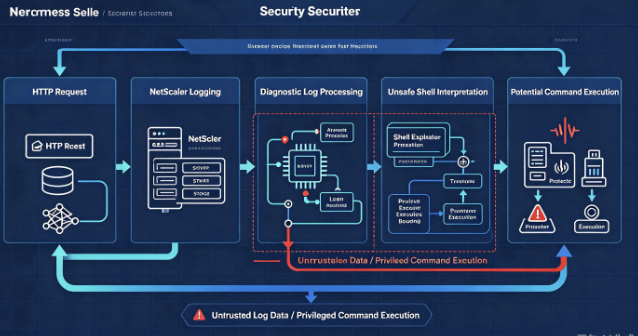
The mechanism described by CERT-EU can be understood as a sequence of trust-boundary transitions:
Untrusted network request
Attacker-controlled HTTP metadata
NetScaler logging system
Records request data and system events
Diagnostic log processing
Extracts fields from log records
Unsafe command construction
Untrusted data reaches shell-command interpretation
Potential arbitrary command execution
Execution on the vulnerable appliance
Conceptual illustration based on CERT-EU’s investigation; not an executable exploit or a vendor-confirmed complete code path.
The vulnerable behavior illustrates a broader class of command-injection problems. Logging systems are sometimes treated as inherently trustworthy because the information has already been written to a local file. But logging does not sanitize attacker-controlled input or change the input’s original trust level.
If a diagnostic tool extracts text from a log and inserts it into a shell command without appropriate protection, the attacker may indirectly influence a process that was never intended to be accessible from the network.
This is why command injection does not always appear as a vulnerable web endpoint executing a shell command immediately after receiving a request. The dangerous operation may happen later, inside a separate system-management process.
CERT-EU’s findings are a research-based account of the observed exploitation path. They should not be interpreted as proof that every possible exploitation technique or every affected NetScaler internal code path has been publicly documented.
What Attackers Attempted After Exploitation
CERT-EU’s investigation also described the intended behavior of malicious commands found in the request logs.
The observed command content targeted NetScaler’s web-serving configuration and was designed to enable PHP execution and place a web shell in a web-accessible location.
This matters because arbitrary command execution on an edge device can quickly become a persistence and remote-access problem.
A web shell is not necessarily a large, sophisticated malware implant. Depending on its implementation, it can provide an attacker with a way to send additional commands through ordinary-looking HTTP communication after the initial exploitation path has been patched.
Investigators should therefore distinguish between three types of evidence.
The first is evidence of attempted exploitation, such as suspicious requests and crafted log data. The second is evidence that the vulnerable command-execution path actually ran. The third is evidence of post-exploitation changes, including unauthorized configuration modifications, unexpected files, and suspicious outbound traffic.
A request containing a malicious-looking string is not sufficient by itself to establish successful compromise. Conversely, missing request logs do not establish that compromise never occurred.
A mature investigation correlates all three evidence categories rather than relying on one indicator.
CVE-2026-88771 Detection and Threat Hunting
The CERT-EU findings give defenders several practical investigation opportunities, particularly when historical HTTP and appliance logs have been retained.
The most useful signals are abnormal log content associated with the attack, suspicious diagnostic events, and unauthorized changes consistent with the post-exploitation behavior researchers observed.
Examine Historical HTTP and Authentication Logs
Investigators should first preserve available logs and work from forensic copies whenever possible.
CERT-EU recommends searching for suspicious packet-engine heartbeat messages and correlating them with HTTP log records containing the markers used in the observed attacks. The researchers also recommend examining unusually encoded User-Agent values and checking relevant web-server configuration changes.
An initial read-only investigation of copied logs could use:
grep -nEi \
  'PPE.*missed too many heartbeats|INDEX:|php_engine' \
  ./evidence/netscaler/*.log
This is an illustrative offline log-search example, not a validated detection rule or vulnerability scanner. It assumes the investigator has already exported logs into a local evidence directory and that the available filenames match the example.
The search does not execute suspicious strings. It simply identifies candidate records for review.
Each expression has limitations. Heartbeat-related errors can occur during legitimate operational failures. A distinctive marker might appear in benign test data or quoted material. References to php_engine may also have legitimate administrative explanations.
More importantly, attackers may use different strings, encoding schemes, or post-exploitation techniques. The absence of these exact patterns cannot establish that a system was never exploited.
Any suspicious event should be correlated with its timestamp, request source, appliance identity, available system events, and subsequent configuration changes.
Inspect Web-Server Configuration Integrity
Because the CERT-EU investigation identified malicious attempts to modify web-server configuration, defenders should compare the current configuration with a trusted baseline.
A useful investigation examines whether relevant files changed unexpectedly, whether those changes align with an authorized maintenance window, and whether new web-accessible executable files appeared during the suspected compromise period.
File timestamps alone are insufficient because system maintenance, upgrades, and attacker activity can modify them. Cryptographic hashes, preserved configuration backups, file-content differences, and the surrounding event timeline are more useful when combined.
Investigators should also examine unexplained scheduled tasks, startup scripts, unfamiliar processes, and unusual outbound connections.
These are not exclusive indicators of CVE-2026-88771. They are broader signs of possible appliance compromise and may be relevant even if an adversary used a different initial exploit.
Correlate Events Across Multiple Sources
NetScaler appliances often interact with authentication services, application backends, management infrastructure, and external monitoring systems.
A comprehensive investigation should consider whether suspicious appliance activity aligns with unexpected authentication events, changes to service-account use, access to internal systems, or unusual administrative connections.
Where logs are available, investigators can build a timeline connecting the earliest suspected malicious request, abnormal appliance events, potential command execution, subsequent file changes, and outbound network activity.
This timeline is especially important when assessing whether post-exploitation activity continued after the original vulnerability was patched.
En Canadian Centre for Cyber Security’s updated alert reinforces the need to preserve appliance logs, support bundles, network evidence, and suspicious files before making disruptive recovery changes.
Using NetScaler Console for Compromise Assessment
Citrix provides an Indicators of Compromise detection capability through NetScaler Console.
According to the official NetScaler Console documentation, the feature allows administrators to run compromise detection from the Security Advisory interface and review the results for managed appliances.
Possible results include Potentially Compromised, No Compromise Detected, Skipped, Failed to Execute, and Execution in Progress.
The feature can help identify appliances requiring further investigation, but its limitations are important.
Citrix states that the detection logic can be updated as new indicators become available. It also explicitly warns that IOC information does not cover every possible attacker technique and may fail to identify actual compromises.
As documented on September 30, the capability requires product-usage telemetry and does not support NetScaler BLX.
Accordingly, a result indicating that no compromise was detected should not be treated as definitive forensic clearance. It means the scan did not identify a compromise according to the logic and evidence available to that feature.
For appliances that were Internet-facing during active exploitation, a negative IOC scan is one piece of evidence rather than the end of the investigation.
CVE-2026-88771 vs CVE-2026-88772 and the October NetScaler Vulnerabilities
One source of confusion in this incident is the number of NetScaler security advisories released within a short period.
Citrix originally disclosed eight vulnerabilities on September 27, including CVE-2026-88771 and CVE-2026-88772. Both were actively exploited and could independently lead to remote code execution, but their underlying weaknesses and configuration requirements differ.
Additional vulnerabilities disclosed in October introduced further patching considerations.
| Vulnerabilidad | Main impact | Important conditions |
|---|---|---|
| CVE-2026-88771 | Unauthenticated remote command execution | Affected NetScaler builds, including default configurations |
| CVE-2026-88772 | Memory overflow leading to RCE or DoS | DTLS enabled, including its default use on relevant VPN virtual servers |
| CVE-2026-88779 | Memory overflow leading to DoS | SAML SP or IdP configuration |
| CVE-2026-107406 | Memory overflow leading to RCE or DoS | SAML SP or IdP configuration, with version-specific conditions |
The distinction is operationally important. A configuration change that removes the precondition for one vulnerability should not be assumed to mitigate another.
For example, disabling DTLS where appropriate may change exposure to CVE-2026-88772, but it is not a remediation for CVE-2026-88771.
Likewise, the SAML-related vulnerabilities disclosed in October are separate security issues rather than evidence that the original September RCE vulnerability was never fixed.
The authoritative sources are Citrix CTX697096, Citrix CTX697174y Citrix CTX697191.
Why the September Patch May No Longer Be Sufficient
On October 8, Citrix published a separate advisory for CVE-2026-107406, a critical memory-overflow vulnerability affecting certain NetScaler deployments configured for SAML authentication.
The newly disclosed issue has a CVSS v4.0 score of 9.5 and can lead to remote code execution or denial of service under the applicable conditions.
For some previously updated NetScaler builds, the new vulnerability affects configurations operating as SAML identity providers. For older builds, the advisory also identifies exposure involving SAML service-provider configurations. Administrators must therefore evaluate both the installed version and the relevant SAML role.
Citrix recommends the following builds for CVE-2026-107406:
| Product and branch | Recommended build in October 8 advisory |
|---|---|
| NetScaler ADC and Gateway 14.1 | 14.1-73.46 or later |
| NetScaler ADC y Gateway 13.1 | 13.1-64.29 or later |
| NetScaler ADC 14.1 FIPS | 14.1-73.46 FIPS or later |
| NetScaler ADC 13.1 FIPS and NDcPP | 13.1.37.283 or later |
An administrator who installed 14.1-73.37 or 13.1-64.23 in September may have resolved CVE-2026-88771 while still needing another update for the later SAML vulnerability, depending on the configuration.
This does not mean that CVE-2026-88771 remained exploitable after its original fix. It means patch compliance must be assessed against all applicable advisories, not only the first CVE that prompted an emergency upgrade.
Organizations should review the October 8 Citrix security bulletin for CVE-2026-107406 before determining their final remediation requirements.
Patching CVE-2026-88771 Does Not Eliminate Historical Compromise
A patched appliance and a clean appliance are not necessarily the same thing.
Installing the corrected NetScaler firmware removes the known vulnerable behavior addressed by that release. It does not automatically establish that no attacker executed commands before the upgrade.
If malicious activity occurred while the appliance was vulnerable, the attacker may already have modified local configuration, installed persistent access, obtained credentials, or interacted with connected services.
Those possibilities do not establish that every affected organization was compromised. They explain why confirmed exploitation creates an incident-response obligation beyond ordinary patch verification.
Citrix addresses this issue in its official guidance, Steps to Take if NetScaler ADC is Suspected to be Compromised.
The guidance recommends evidence preservation, device isolation, credential revocation, investigation of connected systems, and restoration from trustworthy software and configurations when compromise is suspected.
For virtual appliances, a forensic snapshot may preserve valuable evidence. Citrix also recommends documenting the system time, timezone, and NTP configuration, which helps investigators correlate appliance activity with external logs.
Core dumps and other diagnostic evidence may be relevant, but collection procedures can have operational consequences. Citrix notes that generating certain Packet Engine core dumps causes a warm restart. Such actions should be coordinated through incident-response and change-management processes rather than performed casually on a production gateway.
Organizations should also preserve remote syslog records and any existing NetScaler Console evidence. Local logs may be incomplete, rotated, or modified during an intrusion, making independent telemetry particularly valuable.
When Credentials and Certificates Need Attention
A compromised NetScaler appliance may have access to authentication-related secrets, service credentials, certificates, or information passing through configured gateway services.
Citrix’s compromise-response guidance includes changing relevant service-account secrets, revoking affected credentials and certificates, investigating connected systems, and rotating appropriate keys during restoration.
These actions should follow an assessment of the appliance’s actual role and the available evidence. Administrators should not assume every credential in the broader enterprise was exposed, but neither should they restrict the investigation to the appliance’s local administrator password.
If the appliance was involved in VPN authentication, application access, or identity integration, the scope of potential credential exposure may extend to systems beyond the NetScaler itself.
A Practical Remediation and Validation Workflow
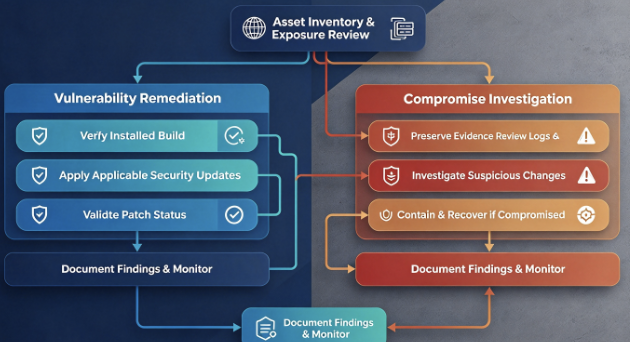
The most effective response separates asset identification, vulnerability remediation, compromise investigation, and recovery assurance into distinct activities.
First, identify all relevant NetScaler appliances. That includes production gateways, load balancers, HA peers, disaster-recovery environments, test appliances, and instances used in Secure Private Access Hybrid deployments.
The inventory should include each appliance’s actual software build, management ownership, exposed services, authentication integrations, and network accessibility. Relying solely on a CMDB entry or hostname list can miss appliances introduced during migrations or retained as standby systems.
Next, compare the deployed builds against Citrix’s applicable security advisories. Confirm that the installed firmware resolves CVE-2026-88771 and any additional vulnerabilities relevant to that deployment, including the October SAML-related issues.
After upgrading, verify that every relevant appliance and HA member is running the intended build. An upgrade record is not a substitute for checking the actual installed version.
For appliances exposed during the confirmed exploitation period, preserve and review historical evidence. Use the observed CERT-EU indicators as investigation leads, combine them with Citrix’s available IOC detection, and examine configuration integrity and connected-system activity.
Where evidence suggests successful compromise, follow an incident-response process that includes containment and recovery from a trusted state. Simply deleting a suspicious file may not be sufficient if an attacker gained extensive access to the appliance or authentication environment.
Finally, document the difference between remediation evidence and compromise-assessment evidence.
A strong closure record identifies the affected assets, fixed builds, relevant configuration conditions, exposure history, investigation findings, containment decisions, and remaining uncertainty.
This prevents the common mistake of closing an incident solely because a vulnerability scan no longer reports the original CVE.
Common Detection and Response Mistakes
One mistake is treating unusual Base64-encoded User-Agent data as definitive proof of exploitation. Such activity can justify investigation, especially when it aligns with known malicious behavior, but defenders must establish whether the suspicious input actually reached the relevant execution path and whether there were subsequent signs of compromise.
Another mistake is assuming that the absence of public exploit code means exploitation was impossible. CVE-2026-88771 was already being exploited before defenders had complete public technical documentation. CISA KEV inclusion and vendor confirmation are stronger operational indicators than the availability of a downloadable PoC.
A third mistake is checking only the September patch baseline. The October disclosures demonstrate why administrators need an advisory-aware approach to patch management. The original fix for CVE-2026-88771 does not automatically prove that a SAML-enabled deployment is protected against CVE-2026-107406.
Finally, administrators may rely too heavily on a single IOC tool or detection query. Citrix itself warns that IOC coverage is incomplete. Absence of a match should be interpreted alongside exposure history, log availability, configuration integrity, and independent forensic evidence.
Frequently Asked Questions
Is CVE-2026-88771 a confirmed zero-day?
Yes. Citrix confirmed exploitation of CVE-2026-88771, and CISA identified it as an actively exploited zero-day when adding it to the Known Exploited Vulnerabilities catalog on September 27, 2026.
Does CVE-2026-88771 require authentication?
No. Citrix describes it as an unauthenticated remote command execution vulnerability. Affected default NetScaler ADC and Gateway configurations do not require an additional feature to be enabled.
What is the technical root cause?
Citrix classifies the issue as improper input validation, CWE-20. CERT-EU subsequently documented an exploitation mechanism involving malicious log data and unsafe shell-command processing in a diagnostic workflow. That investigation provides meaningful technical evidence but should not be treated as a complete vendor-published root-cause analysis of every possible exploitation path.
How can administrators determine whether a NetScaler was compromised?
They should correlate suspicious HTTP and system logs, configuration changes, potential persistence artifacts, process activity, and outbound connections. Citrix’s IOC detection capability provides another source of evidence, but a negative result does not conclusively prove that the appliance was never compromised.
Which version fixes CVE-2026-88771?
The original minimum fixed versions are 14.1-73.37, 13.1-64.23, 14.1-73.37 FIPS, and 13.1.37.279 FIPS/NDcPP, depending on the product branch. Administrators should also evaluate later Citrix advisories and install newer applicable security builds.
Is the October SAML vulnerability the same as CVE-2026-88771?
No. CVE-2026-107406 is a separate memory-overflow issue with SAML-related configuration and version requirements. Systems patched for CVE-2026-88771 may still require additional remediation for CVE-2026-107406.
Is patching sufficient if the appliance was exposed before September 27?
Not necessarily. Patching addresses the known vulnerability, but it does not establish that exploitation never occurred. Organizations with potentially exposed appliances should assess historical compromise and follow the vendor’s incident-response guidance where appropriate.
Final Assessment
CVE-2026-88771 demonstrates why security appliances must be treated as potential attack surfaces rather than assumed to be trustworthy because of their defensive role.
The vulnerability combined unauthenticated remote command execution, affected default configurations, and confirmed exploitation against NetScaler infrastructure. CERT-EU’s investigation added a valuable technical lesson: attacker-controlled logging data can become dangerous when privileged diagnostic processes fail to preserve the separation between data and executable commands.
The subsequent October disclosures reinforce a second lesson. Vulnerability remediation is a continuing process, particularly for Internet-facing infrastructure that has already attracted attacker attention. An appliance may be patched against one CVE while remaining exposed to a different issue with its own configuration requirements.
For security teams, the practical objective is therefore broader than reaching a particular firmware version. They need to establish which assets were exposed, confirm that all applicable vulnerabilities are remediated, investigate credible signs of previous exploitation, and restore confidence in the integrity of systems that sit at the edge of the enterprise network.
The distinction between no longer vulnerable and not previously compromised remains the central defensive question in the CVE-2026-88771 response.
 Spanish
  English
  German
  French
  Portuguese
  Japanese
  Korean
  Hindi
Hindi  Arabic
  Turkish
  Hebrew