
CVE-2026-93674: Critical Langflow RCE Vulnerability Exposes AI Agent Infrastructure
A critical remote code execution vulnerability in Langflow has raised fresh concerns about the security of infrastructure used to build and operate AI agents. Tracked as CVE-2026-93674, the flaw affects Langflow OSS versions 1.0.0 through 1.12.2 and carries a CVSS 3.1 severity score of 9.8 out of 10. Successful exploitation could allow a remote attacker to execute arbitrary code in the context of a vulnerable Langflow service, potentially exposing credentials, application data, connected systems, and the underlying execution environment.
The vulnerability was publicly recorded on October 7, 2026, and is covered by an IBM security bulletin addressing multiple vulnerabilities in Langflow OSS. IBM recommends upgrading to version 1.12.3, which includes security changes designed to prevent several classes of unauthorized code execution, sandbox bypass, and access-control failures.
What makes CVE-2026-93674 particularly important is the environment in which it appears. Langflow is not simply a conventional web application. It is a Python-based framework for constructing AI workflows, connecting language models to tools, integrating external services, and deploying agent-powered applications. A compromised Langflow instance may therefore provide an attacker with access to more than the application itself. Depending on the configuration, it can place API credentials, automated workflows, internal data sources, and systems used by AI agents at risk.
The vulnerability also illustrates a deeper problem with developer platforms that dynamically inspect or execute Python code: a function intended to validate untrusted input can become an execution primitive if it crosses the boundary between analyzing code and running it.
What Is CVE-2026-93674?
CVE-2026-93674 is a critical code-injection vulnerability affecting Langflow OSS, the open-source AI application development framework maintained by the Langflow project. The official vulnerability description identifies improper handling of special elements associated with OS commands as the underlying security problem, creating a path to arbitrary code execution by a remote attacker.
According to the National Vulnerability Database record and IBM’s advisory, the vulnerability is classified as CWE-94, Improper Control of Generation of Code. The CVSS vector specifies a network-accessible, low-complexity attack that requires neither prior privileges nor user interaction.
| Vulnerability attribute | Detalles |
|---|---|
| ID CVE | CVE-2026-93674 |
| Affected product | Langflow OSS |
| Gravedad | Crítica |
| CVSS v3.1 score | 9.8 |
| Tipo de vulnerabilidad | Code injection / Remote Code Execution |
| CWE classification | CWE-94 |
| Versiones afectadas | 1.0.0 through 1.12.2 |
| Versión corregida | 1.12.3 |
| Vector de ataque | Red |
| Privileges required | None, according to CVSS |
| Interacción con el usuario | Ninguno |
| Public disclosure | October 7, 2026 |
| Medidas recomendadas | Upgrade to 1.12.3 or later |
The complete CVSS vector is:
CVSS:3.1/AV:N/AC:L/PR:N/UI:N/S:U/C:H/I:H/A:H
These characteristics are particularly concerning because they describe a vulnerability with potentially severe consequences across confidentiality, integrity, and availability. The absence of required privileges in the CVSS assessment means that the vulnerability is not limited to scenarios involving an already compromised administrator account. However, actual exploitability still depends on the application’s deployment configuration, reachable interfaces, and the conditions required by the relevant code path.
A critical CVSS score should not be confused with evidence that attackers are already exploiting the issue in production. The distinction matters when evaluating CVE-2026-93674, because public technical reproduction and confirmed in-the-wild exploitation are different forms of evidence.
Why Langflow Is an Attractive Target for Attackers
To understand the security implications of CVE-2026-93674, it is necessary to look at how Langflow operates.
Langflow is an open-source framework for building AI applications using a visual development interface. Developers can connect language models, data sources, vector databases, APIs, and executable components into workflows that can be deployed as services. The framework supports applications ranging from retrieval-augmented generation systems to autonomous AI agents capable of interacting with external tools.
Como el official Langflow documentation explains, the platform supports Python-based customization, agent development, and Model Context Protocol integrations. These features provide developers with substantial flexibility, but they also expand the security responsibilities of the application server.
In a conventional web application, a remote code execution vulnerability might allow an attacker to compromise the application process and access its immediate resources. In an AI agent orchestration platform, the compromised process may also have access to external model providers, stored API credentials, business workflows, and connected data services.
Consider an enterprise deployment where Langflow coordinates several AI agents responsible for processing documents, querying an internal knowledge base, and sending information to external systems. The Langflow server may need credentials for a language model provider, a vector database, an object storage service, and an internal API. If an attacker gains arbitrary code execution with the privileges of that server process, those integrations become potential paths for further compromise.
The attacker does not necessarily need to manipulate an AI model or create a malicious prompt. Exploiting the application infrastructure below the agent layer may be enough to bypass the intended application-level controls.
This is an important distinction. Prompt injection attempts to influence an AI system through untrusted instructions or content. CVE-2026-93674 concerns a software vulnerability that can allow code execution inside the platform itself. The resulting security impact can be much more direct.
Technical Analysis: How CVE-2026-93674 Works
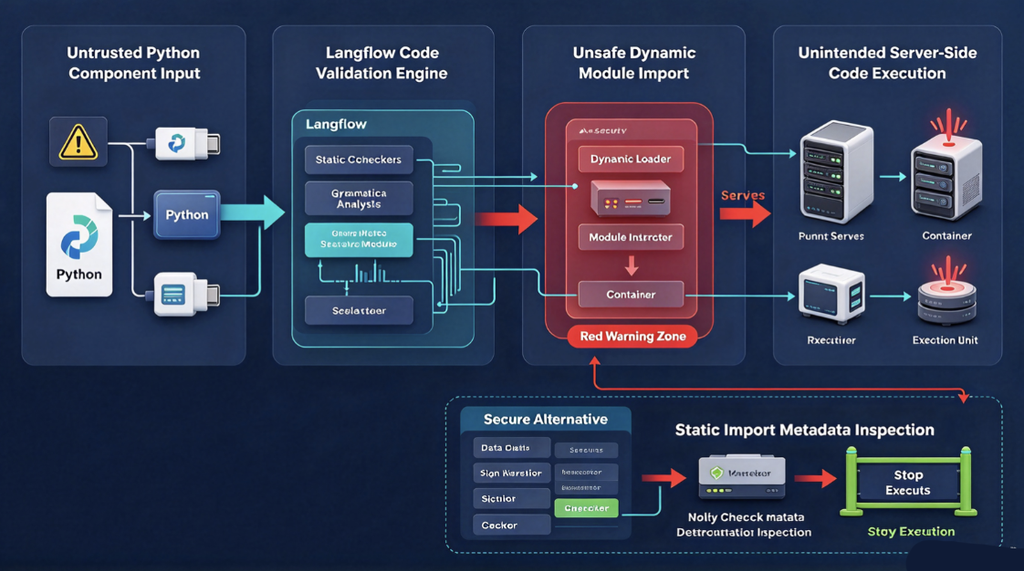
The official IBM advisory describes CVE-2026-93674 as an arbitrary code execution vulnerability resulting from improper neutralization of special elements associated with OS commands. It does not, however, provide a complete per-endpoint exploit walkthrough.
A more detailed technical explanation comes from a public reproduction published by Pruva, which examined Langflow’s code-validation behavior and compared vulnerable version 1.12.2 with fixed version 1.12.3.
That research associates CVE-2026-93674 with an unsafe import-handling mechanism in Langflow’s Python code-validation functionality. The proposed mapping is supported by a corresponding upstream security fix, although IBM’s bulletin does not explicitly map every listed CVE to an individual Git commit. This distinction is important when evaluating the precise root cause.
The problem with executing imports during validation
Python applications frequently analyze source code before allowing it to be stored, compiled, or executed. A typical validation operation might inspect syntax, identify imports, or verify that referenced packages exist.
These operations are not equivalent.
Parsing Python source code into an abstract syntax tree can be performed without executing the source. Importing a Python module, however, can execute statements defined at the top level of that module.
According to the upstream Langflow security commit 461506a, an earlier implementation of the validation function used importlib.import_module() while checking imported packages.
A simplified illustration of the problematic design looks like this:
import importlibdef validate_import(module_name): try: importlib.import_module(module_name) return True except ModuleNotFoundError: return FalseThe issue is not that Python imports are inherently unsafe. They are a normal part of Python application development. The problem arises when an import operation is performed on module names influenced by untrusted input during a process that is expected to perform validation rather than execution.
Calling importlib.import_module() may load the requested module and execute its top-level initialization code. If an attacker can influence which module is imported and control the contents of a module accessible to the application, validation can become an unintended execution path.
In Langflow, this distinction matters because the platform supports dynamic Python components and source-code validation as part of its development workflow.
The vulnerable behavior demonstrates a security boundary failure: data submitted for inspection could cause execution inside the server process.
Why AST parsing alone is not the vulnerability
Python’s ast module provides functionality for parsing source code into an abstract syntax tree. Developers commonly use it to inspect imports, function definitions, expressions, and other syntactic constructs.
Por ejemplo:
import astsource = """import jsondef process_data(value): return value"""tree = ast.parse(source)for node in ast.walk(tree): if isinstance(node, ast.Import): for alias in node.names: print(alias.name)This example inspects the structure of the supplied source without running the functions defined inside it.
The dangerous transition occurs when a validation system moves from static inspection to dynamic execution. If an application uses an import operation to determine whether an imported package is available, it may inadvertently execute code while performing what appears to be a harmless check.
In the relevant Langflow security update, the maintainers changed the validation behavior to use importlib.util.find_spec() for top-level package lookup rather than importing the module directly.
The distinction can be summarized as follows:
| Operation | Intended behavior | Security implication |
|---|---|---|
ast.parse() | Parse Python source into an AST | Does not execute parsed source |
ast.walk() | Inspect AST nodes | Does not execute parsed source |
importlib.import_module() | Import and initialize a module | May execute module-level code |
importlib.util.find_spec() | Locate module import metadata | Can avoid loading the target module when restricted to top-level lookup |
There is an important subtlety in the final row. find_spec() is not universally free of side effects: resolving a dotted module name can import its parent package. The Langflow patch deliberately checks only the top-level package name to avoid that behavior.
En upstream patch includes regression tests demonstrating that the validation operation no longer executes code inside a module placed on a writable Python import path.
How multiple weaknesses could contribute to exploitation
The import-validation issue is only one part of the technical scenario described in the independent reproduction.
Pruva’s research also examined the interaction between Langflow’s custom-component functionality, its code-security scanner, and the validation operation. In the tested configuration, the researchers reported that custom-component handling could be used to introduce a Python module into a location accessible to the Langflow process. A subsequent validation operation could then trigger execution of that module.
This illustrates the broader risk of combining several individually useful platform capabilities without preserving strict boundaries between them. A component-authoring feature may legitimately process Python source, and a validator may legitimately inspect module dependencies. Together, however, they must not permit untrusted users to turn an inspection operation into execution of server-side code.
The same upstream security commit also introduced stricter checks for filesystem-related Python functionality, including certain uses of pathlib, ioy codecs. These changes addressed routes through which code could reach filesystem operations despite existing scanner restrictions.
The result was not merely a change to one dangerous function. It was a broader attempt to prevent untrusted component source from reaching execution-sensitive operations through alternative Python APIs.
Does CVE-2026-93674 Require Authentication?
One of the most consequential details in the official CVSS assessment is the privileges-required field.
CVE-2026-93674 is assigned PR:N, indicating that prior privileges are not required under the assessed attack conditions. The vulnerability also has an attack complexity rating of Low and a user interaction rating of None.
This does not mean that every Langflow deployment will expose the same unauthenticated attack surface.
Langflow has several authentication and deployment settings that affect who can access the visual editor, API endpoints, and administrative functionality.
An important example is LANGFLOW_AUTO_LOGIN, which controls automatic login behavior. According to the Langflow authentication documentation, the application default is True, while official Langflow Docker images set the variable to falso.
When automatic login is enabled, users of the visual editor can be automatically signed into a shared superuser environment. However, Langflow’s documentation also states that API requests generally continue to require API-key authentication unless additional authentication-skipping functionality is enabled.
In other words, automatic editor login and unrestricted API access should not be treated as identical configurations.
The independent reproduction reports that an exposed deployment using the application-default auto-login behavior could support an unauthenticated exploitation path. The researchers tested that scenario against a vulnerable 1.12.2 container and compared the results with a fixed 1.12.3 deployment.
That research provides evidence of a practical exploit path under the tested conditions. It does not establish that every installation, including configurations with enforced authentication and restricted networking, is exploitable through exactly the same sequence.
For defenders, the correct approach is to evaluate both the installed version and the effective deployment configuration. An application that is not reachable from the public internet may have lower exposure, but it can still be vulnerable to an attacker who gains access to the relevant internal network.
CVE-2026-93674 Proof of Concept and Exploitation Status
Public proof-of-concept information has become available for CVE-2026-93674, but the different forms of evidence need to be interpreted carefully.
En Pruva reproduction report, published on October 9, 2026, describes testing against vulnerable and patched Langflow container images. The researchers reported successful remote execution in the vulnerable environment and verified that the corresponding execution path no longer worked after upgrading to version 1.12.3.
In the reported test, the vulnerable application executed code with the privileges of the Langflow service account. The fixed version prevented the same validation-triggered execution behavior. This is useful evidence because it connects a specific application behavior to an upstream code change and a practical version-level remediation.
However, it is also necessary to distinguish a reproduction of a vulnerability from evidence of an attack against a real organization.
As of October 12, 2026, the public sources reviewed for this article did not establish confirmed in-the-wild exploitation of CVE-2026-93674. The CISA-provided SSVC enrichment associated with the CVE, dated October 8, recorded exploitation as none, while identifying the issue as automatable and capable of total technical impact.
The absence of confirmed exploitation should not be interpreted as proof that no exploitation has occurred. It simply means that publicly confirmed incidents were not established by the sources examined.
Another complication is that not every public repository labeled with this CVE necessarily demonstrates the same underlying vulnerability. The Pruva analysis identifies a third-party proof of concept targeting an MCP-related execution path and cautions that it appears to correspond to a different, earlier Langflow security issue.
This is a recurring challenge in vulnerability intelligence. Proof-of-concept repositories, automated vulnerability databases, and detection templates may reuse identifiers even when the underlying technical behavior differs.
Security teams should therefore verify that any detection rule or reproduction procedure actually targets the code path associated with CVE-2026-93674 rather than relying solely on its filename or repository description.
The practical conclusion is straightforward: there is public technical evidence that the vulnerability is exploitable in a tested configuration, but confirmed widespread exploitation should not be claimed without additional evidence.
What Could an Attacker Do After Exploiting CVE-2026-93674?
The immediate impact of CVE-2026-93674 is arbitrary code execution within the security context of the vulnerable Langflow process. The full consequences depend on how the application is deployed, which resources the service can access, and the privileges assigned to the underlying operating-system account.
In an AI development environment, the surrounding infrastructure can make this kind of compromise especially damaging.
Access to API credentials and secrets
Langflow applications often rely on API credentials to access external model providers, databases, storage systems, and other services.
If those credentials are accessible to the compromised application process, an attacker may be able to retrieve or misuse them. The exposure could include provider tokens, service credentials, application secrets, or other sensitive configuration values.
The impact is not limited to the financial cost of unauthorized model API consumption. Credentials may also authorize access to business data or internal infrastructure. In environments where the same credentials are reused across development and production workflows, a single compromised application can create risk beyond its original deployment boundary.
Credential access is a potential consequence of the process compromise, not a separately confirmed outcome of a known CVE-2026-93674 attack.
Manipulation of AI agent workflows
An attacker with access to the application’s executable environment may be able to modify files, interfere with application components, or affect stored workflow definitions.
This could alter the behavior of AI agents without necessarily producing an obvious prompt injection signature.
For example, an attacker who gains the necessary filesystem or application-level access could attempt to modify a component responsible for preprocessing documents or calling an external API. Subsequent agent executions might then process information differently from the workflow originally approved by its developer.
The threat is particularly difficult to evaluate in environments where AI workflows are frequently updated and where custom Python components are a routine part of development.
Normal application changes and malicious modifications can look similar unless the organization maintains reliable audit trails, version control, and deployment integrity checks.
Access to connected data systems
Retrieval-augmented generation applications may connect Langflow to vector databases, document repositories, internal search services, or structured databases.
When those integrations rely on credentials accessible to the server process, a successful compromise may provide opportunities to access connected information.
An attacker might attempt to retrieve sensitive documents, query internal databases, or misuse application permissions. Whether those activities succeed depends on the permissions granted to the compromised service and the security controls enforced by the downstream systems.
The central lesson is that an AI agent platform should not receive broader access to organizational data than its workflows actually require.
Persistence and lateral movement
Remote code execution can also provide a starting point for additional compromise.
Depending on operating-system restrictions and the resources available to the process, an attacker may attempt to introduce persistent changes, access internal services, or abuse credentials found in the application environment.
A containerized Langflow deployment is not automatically protected against these outcomes. Containers can limit the scope of compromise, but their effectiveness depends on runtime privileges, mounted volumes, filesystem permissions, network policies, and host isolation.
A vulnerable service running as a non-root user inside a tightly restricted container is generally a different risk from one running with privileged access, writable host mounts, or broad internal connectivity.
These are potential post-exploitation scenarios, not evidence that they have occurred in attacks involving CVE-2026-93674.
How to Check Whether Your Langflow Instance Is Vulnerable
The most reliable initial verification is to identify the installed Langflow version and compare it with the affected range published by IBM.
For a Python-based installation, administrators can inspect the installed package metadata:
python -m pip show langflowAlternatively, use Python’s package metadata interface:
from importlib.metadata import version, PackageNotFoundErrortry: installed_version = version("langflow") print("Installed Langflow version:", installed_version)except PackageNotFoundError: print("Langflow is not installed in this Python environment.")These commands do not exploit the vulnerability or interact with vulnerable application endpoints. They simply report the version installed in the selected Python environment.
The version should then be compared against the official affected range.
| Versión instalada | CVE-2026-93674 status |
|---|---|
| 1.0.0–1.9.x | Affected within IBM’s declared range |
| 1.10.x | Affected |
| 1.11.x | Affected |
| 1.12.0 | Affected |
| 1.12.1 | Affected |
| 1.12.2 | Affected |
| 1.12.3 | Versión corregida |
| Later releases | Outside the declared affected range, assuming the upstream fix is retained |
The affected version information comes directly from the IBM security bulletin, which recommends Langflow 1.12.3 as the remediation release.
For Docker deployments, identifying the version used in the actual running container is essential. A development environment might have a patched Python package while its production container continues to run an older image.
Administrators can begin by listing running containers and checking their image references:
docker ps --format \
"table {{.Names}}\t{{.Image}}\t{{.Status}}"
They should also inspect container image digests, deployment manifests, and release records. An image tag alone is not always sufficient evidence of which application code is running.
For Kubernetes deployments, the same principle applies. Image versions should be verified across all namespaces, workloads, and replicas that run Langflow.
kubectl get deployments -A -o wideA patched deployment object does not prove that every old pod has been replaced. Rollout status and the images actually running in the cluster should also be checked.
Organizations with several Langflow environments should include development, staging, demonstration, and internal AI experimentation systems in their inventory. An exposed experimental deployment may contain valuable API credentials even if it is not officially classified as production infrastructure.
How to Fix CVE-2026-93674
The vendor-recommended fix is to upgrade Langflow OSS to version 1.12.3 or later.
IBM’s official security advisory explicitly identifies this version as the required remediation and does not list a vendor-supported workaround that replaces patching.
For standard Python installations, the package can be upgraded with:
python -m pip install --upgrade "langflow>=1.12.3"For environments that require an exact, controlled version, administrators can instead pin the patched release:
python -m pip install "langflow==1.12.3"The appropriate command depends on the deployment’s dependency-management approach. Environments using uv, Poetry, Docker, or another package manager should update their lockfiles and build definitions rather than modifying a running environment outside the normal deployment process.
After upgrading, verify the installed version:
python -m pip show langflowAdministrators should then restart or redeploy the service, verify application functionality, and confirm that all running instances use patched code.
What changed in Langflow 1.12.3?
The upstream Langflow 1.12.3 release, published on September 22, 2026, includes a substantial collection of security-related fixes.
Among those changes is pull request #15201, which updates the code scanner and prevents the validate_code functionality from executing imports during package validation.
The change is significant because it removes a dangerous behavior from a function intended to inspect code.
The release also includes improvements to restrictions on filesystem operations, component execution, cache handling, SSRF protection, and other application security boundaries. These changes address several independently reported issues, so not every security modification in the release should be attributed specifically to CVE-2026-93674.
A successful remediation process should establish three things: the application is running a release containing the fix, the deployment configuration does not unnecessarily expose code-execution functionality, and the environment shows no indicators of compromise from the period when a vulnerable version was running.
Recommended Langflow Security Hardening
Upgrading fixes the identified vulnerability, but a secure Langflow deployment also requires deliberate configuration.
En official Langflow authentication and component-hardening documentation provides several settings that can reduce exposure, especially in environments where users should not have unrestricted access to Python execution.
A security-conscious configuration might include:
LANGFLOW_AUTO_LOGIN=false
LANGFLOW_SKIP_AUTH_AUTO_LOGIN=false

LANGFLOW_ENABLE_SIGNUP=false
LANGFLOW_ENABLE_SUPERUSER_CLI=false

LANGFLOW_ALLOW_CUSTOM_COMPONENTS=false
LANGFLOW_BLOCK_CODE_INTERPRETER_COMPONENTS=true
LANGFLOW_RESTRICT_LOCAL_FILE_ACCESS=true
These are hardening examples rather than universal defaults. The appropriate configuration depends on the purpose of the deployment, its authentication architecture, and whether custom components or code-execution tools are required.
For instance, disabling custom components may interfere with workflows that depend on user-defined Python code. Such a restriction is appropriate for environments where users are not intended to author executable components, but it may not be suitable for every developer workspace.
Similarly, disabling automatic login requires administrators to configure valid credentials and verify that authentication-dependent integrations continue to operate.
Several additional controls are important even after upgrading.
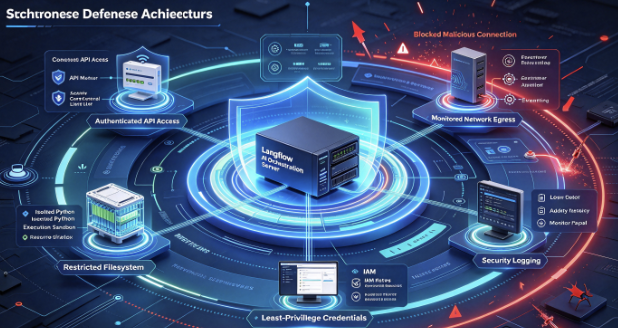
Restrict network exposure. Langflow development interfaces and administrative APIs should not be publicly accessible unless there is a specific operational requirement. Private network connectivity, authentication gateways, and carefully defined firewall rules can substantially reduce attack opportunities.
Use least-privilege service identities. The operating-system account running Langflow should have only the permissions needed to operate the application. It should not have unrestricted access to host filesystems, container orchestration credentials, or unrelated application secrets.
Limit outbound connectivity. An AI workflow may legitimately call language model providers and selected business APIs, but it should not automatically inherit unrestricted network access. Egress controls can help contain the consequences of a compromised service.
Protect credentials independently. API keys should be scoped to the services and operations needed by specific workflows. Credentials with organization-wide privileges should not be placed into every development instance simply for convenience.
Isolate untrusted execution. Multi-user environments should not assume that application-level code filtering is equivalent to a strong execution sandbox. Untrusted user-generated Python code should be subject to appropriately isolated execution environments.
These measures are complementary to patching. They can reduce the likelihood and impact of exploitation, but they should not be presented as substitutes for the vendor’s fix.
Detecting Possible CVE-2026-93674 Exploitation
Detecting exploitation requires more than checking whether a suspicious HTTP request was received. The application supports legitimate Python development and validation workflows, so some activity involving code submission may be normal.
A useful detection strategy combines application logs, authentication events, filesystem monitoring, and runtime process telemetry.
The independent technical reproduction identifies code-validation and custom-component operations as relevant areas for investigation. Administrators can review access to endpoints such as /api/v1/validar/código y /api/v1/custom_component, particularly when requests originate from unexpected clients or are associated with unusual errors.
The presence of a request to either endpoint is not sufficient to establish exploitation. A legitimate developer action may generate similar traffic.
What matters is whether the request fits the expected behavior of the application and whether it correlates with suspicious effects inside the server environment.
Application-level indicators
Unexpected code-validation activity deserves closer inspection when it comes from unfamiliar IP addresses, occurs outside normal development hours, or appears in an environment where code-authoring functionality is rarely used.
Repeated HTTP 500 responses associated with code-validation requests may also be useful supporting evidence. In the published reproduction, an exception generated during unexpected module execution was reflected in a server response. Other attacks may produce different responses, so a specific HTTP status should not be treated as a universal signature.
Monitoring should also consider authentication behavior. An exposed single-user environment with automatic login enabled presents a different investigative context from a system in which all users authenticate individually.
Forensic review should preserve the relationship between request identity, timestamps, routes, response codes, and any associated server-side exceptions.
Filesystem and Python runtime indicators
The technical reproduction depends on executing Python code in the application environment. Unexpected changes to Python modules, installed packages, or writable import paths may therefore be important indicators.
Security teams should investigate unexplained module files appearing in application-controlled Python directories, especially when their creation coincides with unusual component-authoring or validation activity.
File integrity monitoring can help identify these changes, but it needs an appropriate baseline. Langflow environments may legitimately install dependencies or update components during development.
The strongest signals are changes that do not correspond to an approved deployment, package installation, or developer action.
Process execution indicators
If an attacker obtains arbitrary code execution, the process may interact with the operating system in ways unrelated to normal Langflow activity.
Defenders can examine whether the Langflow service launches unexpected child processes, accesses sensitive files, or initiates network connections that are inconsistent with the application’s approved integrations.
A suspicious process tree, unexplained credential access, and unusual outbound connections become more meaningful when correlated with application events.
The detection objective should be to identify the effect of unauthorized code execution rather than rely exclusively on a known proof-of-concept payload.
Example Detection Workflow for Security Teams
A practical investigation can begin with application access logs and a defined period of exposure.
For example, if a Langflow deployment was upgraded on October 10 but had been running 1.12.2 before that date, investigators should review relevant activity during the vulnerable deployment window. The exact review period should be based on when the vulnerable instance became accessible, not simply on the CVE publication date.
A basic log search can identify requests to the relevant validation endpoint:
grep -F "/api/v1/validate/code" \
    /var/log/nginx/access.log
A similar search can identify custom-component requests:
grep -F "/api/v1/custom_component" \
    /var/log/nginx/access.log
These are examples for environments that use Nginx access logs and have retained the relevant request information. Other deployments may require searches in application logs, reverse-proxy telemetry, API gateway logs, or centralized observability platforms.
Investigators should examine the request origin, authentication context, response code, timing, and nearby activity rather than treating every matching request as malicious.
Where runtime telemetry is available, correlating those requests with unexpected Python module creation and process execution can provide stronger evidence.
A simple detection hypothesis might be expressed as:
| Señal | Interpretation | Confidence |
|---|---|---|
| Requests to the code-validation endpoint | Potentially normal development activity | Bajo |
| Repeated validation errors from an unusual client | Suspicious behavior requiring investigation | Medio |
| Unexpected Python module creation near validation events | Possible preparation for unintended execution | Medium to high |
| Unexplained command execution by the Langflow process | Strong evidence of unexpected runtime behavior | Alta |
| Correlated validation activity, file changes, and unauthorized execution | Potential exploit chain | Alta |
These are investigative heuristics, not a validated detection signature for CVE-2026-93674. Their reliability depends on the deployment and the quality of available telemetry.
Security teams should also compare their detection logic against the actual upstream patch and controlled test results. A rule that detects a different Langflow vulnerability may still be useful, but it should not be labeled as a definitive CVE-2026-93674 detector without evidence.
What to Do If You Suspect a Langflow Instance Was Compromised
When there is credible evidence of unauthorized code execution, simply upgrading the package may not be sufficient.
An attacker who executed code inside the vulnerable service could potentially have accessed secrets, modified files, or created additional means of access. Patching prevents exploitation through the fixed behavior, but it does not automatically reverse actions taken before remediation.
Incident responders should preserve relevant logs and forensic evidence before rebuilding an affected environment, provided that doing so does not create unacceptable ongoing risk.
They should review the identity and privileges of the Langflow process, inspect unexpected filesystem changes, and determine which application credentials were accessible during the possible compromise period.
Credentials associated with external AI providers, databases, object storage, and internal APIs should be considered for rotation when evidence suggests that they could have been exposed.
The investigation should also examine the integrity of stored workflows and custom components. A successful compromise may leave changes that continue to affect application behavior even after the original vulnerability has been patched.
Where compromise is confirmed, redeploying the application from a trusted image and restoring verified application data is generally more reliable than assuming the existing runtime remains trustworthy.
The required response should be proportional to the evidence. A vulnerable software version alone does not prove that an incident occurred, while the absence of an obvious malicious process does not rule out earlier compromise.
CVE-2026-93674 and the Broader Langflow Security Update
CVE-2026-93674 was disclosed as part of a larger set of Langflow vulnerabilities addressed by IBM.
En October 2026 security bulletin includes multiple issues involving code execution, access controls, file handling, sensitive-data exposure, and other security boundaries.
Several of these vulnerabilities are relevant to the larger attack surface of AI agent development platforms.
| CVE | Vulnerability category | CVSS 3.1 |
|---|---|---|
| CVE-2026-93674 | Remote code execution / code injection | 9.8 |
| CVE-2026-104334 | Improper control of code generation | 9.8 |
| CVE-2026-97676 | Authenticated code execution / sandbox escape | 8.8 |
| CVE-2026-97655 | Code execution through incomplete code-security blocklist | 8.8 |
| CVE-2026-97677 | Path traversal and file access violations | 8.1 |
| CVE-2026-93679 | Resource exhaustion during ZIP extraction | 4.3 |
These are separate vulnerability identifiers, even though they affect the same product family and are addressed in the same broader security release.
The presence of multiple code-execution and sandbox-related issues is important because complex development platforms often expose several mechanisms for processing executable content. Fixing one unsafe import operation does not necessarily eliminate every possible way for untrusted source to reach an execution-sensitive function.
The Langflow 1.12.3 release reflects this complexity. Its security changes extend beyond code validation to address filesystem restrictions, component handling, caching, authorization-related behavior, and connectivity controls.
For security teams, the broader update should be treated as an opportunity to reassess the platform’s overall exposure rather than merely remove one CVE from a vulnerability scanner report.
Why This Vulnerability Matters for AI Agent Security
CVE-2026-93674 is especially relevant to discussions about AI agent security because it exposes a weakness at the infrastructure level rather than inside a language model.
Much of the recent attention around AI security has focused on prompt injection, malicious tool outputs, poisoned documents, and attacks that manipulate an agent’s decision-making process. These threats are important, but they do not represent the complete attack surface.
AI agents depend on ordinary software systems. They run on servers, authenticate to APIs, parse files, execute code, and communicate with databases. Vulnerabilities in those components can undermine the security of the entire AI application regardless of how well the language model resists malicious instructions.
A Langflow server can orchestrate agent workflows that interact with external systems, making the relationship between application privileges and agent capabilities particularly important.
The platform may be designed to allow developers to create powerful workflows. That does not mean every person who can submit a request to the platform should gain the same execution capabilities as the server.
The fundamental challenge is separating the authority to describe a workflow from the authority to execute arbitrary operations in the application environment.
An agent developer may need to configure an API call, but that should not automatically provide access to unrelated environment variables. A user may need to validate Python source, but that should not permit unexpected execution during the validation step. A workflow may need to read uploaded documents, but that does not imply that it should have access to arbitrary server files.
These distinctions are familiar principles in application security, yet they become more difficult to enforce when a platform intentionally combines user-defined code, third-party integrations, and autonomous execution.
Why code scanners are not full execution sandboxes
The Langflow security changes also highlight a broader limitation of source-code filtering.
A blocklist-based scanner attempts to identify dangerous operations by inspecting code before it executes. This approach can prevent many obvious misuse cases, but Python offers numerous ways to reach similar functionality through different modules and APIs.
The relevant upstream security update addressed alternative filesystem interfaces and unsafe import behavior, illustrating why filtering a narrow set of function names is not equivalent to removing the underlying capability.
A robust design separates static validation from runtime execution and provides independent controls around the process that executes untrusted code.
This may involve isolated containers or processes, restricted filesystem access, carefully controlled module imports, minimal environment credentials, and network egress restrictions.
In high-risk or multi-tenant environments, execution isolation should be treated as an architectural requirement rather than an optional improvement to source-code scanning.
The importance of privilege boundaries
AI application platforms often combine three forms of authority: the permissions of the human user, the permissions of the application server, and the permissions carried by the agent’s connected tools.
These forms of authority should not automatically collapse into one another.
An authenticated user should not gain unrestricted server execution merely because they can create a workflow. An agent should not be able to read every secret accessible to the application environment solely because one component requires access to a particular service.
Similarly, a public API used to submit or validate workflow data should not implicitly inherit all the privileges necessary to operate the development environment.
The risk illustrated by CVE-2026-93674 is that a weakness in one boundary can make other controls irrelevant. Once the server begins executing attacker-influenced Python code, restrictions implemented only at the workflow or model level may no longer provide meaningful protection.
Lessons for Developers Building AI Agent Platforms
The technical issues surrounding CVE-2026-93674 provide several lessons for developers building their own AI orchestration frameworks.
The first is that validation and execution must remain separate operations. Code inspection should not invoke untrusted modules merely to determine whether their imports are valid. Where package resolution is necessary, developers should use approaches that avoid module initialization and test those assumptions explicitly.
The second is that code-security checks should be designed around capabilities rather than isolated function names. Blocking one API does not necessarily prevent access to the same underlying resource through a different interface.
The third is that authentication must be considered alongside the authority granted after authentication. A developer account that can submit Python source should not automatically be equivalent to a trusted server administrator.
The fourth is that runtime privileges should reflect the minimum necessary requirements of the application. Even a successful code-execution exploit should encounter additional boundaries before reaching production secrets, sensitive data stores, or internal infrastructure.
Finally, security regression tests should verify the absence of dangerous effects, not only the presence of expected error messages.
The Langflow patch includes tests designed to confirm that module validation does not execute unexpected module initialization code. This type of test addresses the underlying security property: validation must not produce side effects associated with code execution.
That is a stronger engineering objective than simply checking whether a particular exploit string is rejected.
Frequently Asked Questions About CVE-2026-93674
Is CVE-2026-93674 a critical vulnerability?
Yes. CVE-2026-93674 has a CVSS 3.1 base score of 9.8 and is classified as Critical. The score reflects a network-accessible vulnerability that requires no prior privileges or user interaction under the assessed conditions and may have severe effects on confidentiality, integrity, and availability.
Which Langflow versions are vulnerable to CVE-2026-93674?
According to IBM, Langflow OSS versions 1.0.0 through 1.12.2 are affected. Version 1.12.3 is the vendor-recommended fixed release. Administrators should verify the actual version running in their Python environment, container, or deployment rather than relying solely on configuration files.
Is CVE-2026-93674 an unauthenticated RCE vulnerability?
The official CVSS vector specifies that no prior privileges are required. A public technical reproduction also reports remote code execution without credentials in a tested configuration using automatic login. Actual exposure depends on deployment settings, authentication controls, and network accessibility.
Is there a public proof of concept for CVE-2026-93674?
Yes. Public research describes a reproduced code-execution path and compares its behavior against vulnerable and patched releases. However, public repositories carrying the CVE identifier should be evaluated carefully because some may describe different Langflow execution paths.
Is CVE-2026-93674 being actively exploited?
As of October 12, 2026, the sources examined for this article do not establish confirmed in-the-wild exploitation. Public technical reproduction demonstrates exploitability under tested conditions, but this is not equivalent to a confirmed real-world attack campaign.
How do I patch CVE-2026-93674?
Upgrade Langflow OSS to version 1.12.3 or later, following the vendor’s official guidance. After upgrading, verify the installed version, redeploy affected services, review authentication settings, and investigate potentially suspicious activity during the period when vulnerable software was running.
Can CVE-2026-93674 affect AI agents and their data?
Yes, potentially. A vulnerable Langflow server may have access to AI workflows, credentials, APIs, and connected data services. Successful code execution with the privileges of the server process could expose resources accessible to that process. The actual impact depends on deployment architecture and privilege boundaries.
Is CVE-2026-93674 a prompt injection vulnerability?
No. CVE-2026-93674 is classified as a code-injection vulnerability and concerns execution within the Langflow application environment. Prompt injection, by contrast, generally involves manipulating model behavior through untrusted instructions or content. Both are relevant to AI security, but they involve different technical mechanisms.
Reflexiones finales
CVE-2026-93674 demonstrates how a security weakness in a conventional software operation can create serious consequences when it appears inside an AI development platform.
The official vulnerability carries a critical 9.8 CVSS score and affects Langflow OSS versions 1.0.0 through 1.12.2. Public technical analysis describes a code-validation issue in which Python module imports could trigger execution during what should have been an inspection operation. The upstream 1.12.3 release includes changes intended to prevent that behavior, alongside a broader collection of security improvements.
The immediate priority for organizations operating affected Langflow deployments is to upgrade to a fixed release, verify that all running instances are patched, and assess whether the vulnerable service was unnecessarily exposed.
For teams building AI agent platforms, the more lasting lesson is architectural. AI workflows increasingly depend on executable components, external tools, and privileged service connections. Those capabilities are valuable, but they must operate within clear boundaries.
A language model does not need to be tricked for an AI application to be compromised. Sometimes the most consequential vulnerability is in the infrastructure that gives the agent its tools.
CVE-2026-93674 is therefore both a critical patching priority and a reminder that AI agent security begins with the security of the software executing the workflows.

 Spanish
  English
  German
  French
  Portuguese
  Japanese
  Korean
  Hindi
Hindi  Arabic
  Turkish
  Hebrew