
Security teams rarely suffer from a complete lack of security tools. They suffer from incomplete visibility.
A company may have an accurate inventory of production applications, approved cloud accounts, managed laptops, and registered domains while still exposing forgotten staging systems, temporary API gateways, old management panels, vendor-hosted portals, abandoned subdomains, development services, and infrastructure inherited through acquisitions. These systems may not appear in the configuration management database. They may not be covered by the vulnerability scanner. In some cases, the team responsible for them may no longer exist.
FOFA is useful because it approaches the problem from the outside.
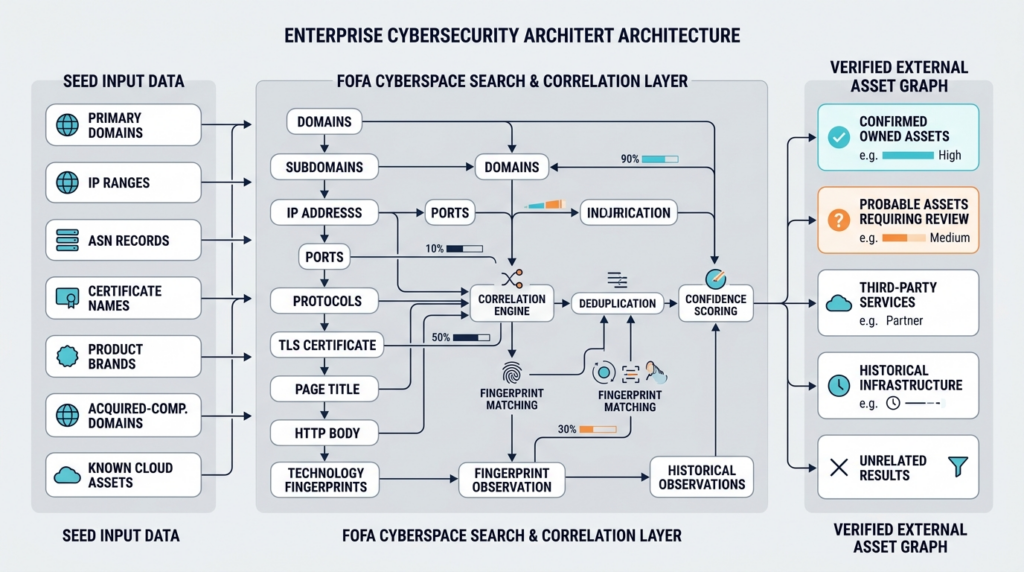
Instead of asking what an organization believes it owns, FOFA searches the observable characteristics of public Internet services. Those characteristics can include domains, IP addresses, ports, protocols, certificates, page titles, HTTP bodies, headers, product fingerprints, autonomous system information, and other metadata collected through cyberspace mapping.
FOFA describes itself as a global cyberspace mapping search engine. Its official materials say it continuously detects public Internet assets and has accumulated information covering billions of assets and hundreds of thousands of fingerprint rules. FOFA also describes public-facing asset inventory, vulnerability impact analysis, product distribution research, and attack-surface review as important use cases. (FOFA)in perspective is valuable, but it creates a second problem: search results are not security findings.
A domain match does not prove ownership. A certificate match does not prove that a system is still controlled by the organization named in the certificate. A detected product does not prove that its version is vulnerable. A banner does not prove that the underlying software has not been patched. An indexed service may already be offline, may belong to a third party, or may have changed since FOFA last observed it.
The mature use of FOFA is therefore not:
Search for vulnerable products and immediately test every result.
It is:
Discover candidate assets, establish ownership confidence, identify meaningful exposure, obtain authorization, and perform the least invasive validation necessary to support a defensible conclusion.
This distinction is central to attack surface management, vulnerability triage, penetration testing, incident response, and continuous security validation.
Penligent now includes paid FOFA capability inside its security-testing workflow. This integration allows teams to move from FOFA-backed discovery to asset correlation, controlled verification, evidence preservation, remediation guidance, and retesting without treating every search result as an automatically approved target.
The result is a workflow in which FOFA supplies external visibility while Penligent helps convert that visibility into governed security action.
What Is FOFA?
FOFA is a search engine for publicly observable Internet assets.
A conventional web search engine primarily organizes pages and content for human consumption. A cyberspace search engine organizes hosts, services, protocols, certificates, banners, web applications, devices, and infrastructure characteristics.
FOFA’s official beginner documentation uses a map analogy. Internet addresses are similar to buildings visible on a map: the service can observe aspects of the external structure, but it does not automatically reveal what exists inside a private network. FOFA’s primary mapping target is the public Internet. (GitHub)at FOFA may index information such as:
| Observable property | Security value |
|---|---|
| Domain and hostname | Identifies public names associated with services |
| IP address | Connects domains and services to reachable infrastructure |
| Port | Indicates where a service was observed |
| Protocol | Helps distinguish HTTP, TLS, SSH, database and other services |
| Page title | Finds branded portals and recurring application interfaces |
| HTTP body | Identifies unique text, templates and application components |
| HTTP headers | Reveals server behavior, middleware or product clues |
| TLS certificate | Connects domains, organizations and infrastructure |
| Product fingerprint | Suggests the software or device exposed by a service |
| ASN and organization | Helps identify infrastructure ranges and hosting relationships |
| FID or similar feature grouping | Finds assets with related observable characteristics |
| Observation time | Helps determine whether the information may be stale |
FOFA should be understood as an intelligence source, not as a source of unquestionable truth.
Its data helps a security team formulate better questions:
- Which externally visible systems may be associated with our organization?
- Are there domains or services our internal inventory does not contain?
- Did a retired product remain reachable?
- Are management interfaces exposed on public networks?
- Do our certificates reveal forgotten infrastructure?
- Which public services appear to use a product affected by a new vulnerability?
- Has a supposedly remediated exposure disappeared or changed?
- Are third-party systems displaying our brand or certificate information?
- Which findings deserve active validation?
Those questions are more useful than simply asking how many FOFA results match a keyword.
Why Internal Asset Inventories Become Incomplete
Most organizations do not intentionally maintain an inaccurate asset inventory. The problem is that modern infrastructure changes faster than ownership records.
A developer creates a temporary environment for testing. A vendor deploys a customer portal. A regional office registers a domain. An acquisition brings in infrastructure managed by another team. A cloud migration leaves the previous service reachable. A load balancer is replaced but not decommissioned. A certificate is copied to a new host. A proof-of-concept application becomes business-critical without entering the formal asset-management process.
Each event seems manageable in isolation. Over several years, however, these events create an external attack surface that no single database fully represents.
The public Internet may therefore contain several categories of assets.
Known and managed assets
These systems are present in the official inventory, have owners, receive patches, and are covered by monitoring and testing.
Known but weakly managed assets
The organization knows the systems exist, but ownership, patching responsibility, logging, or security testing may be unclear.
Unknown organizational assets
These systems belong to the organization but are missing from the current inventory.
Third-party services
The systems are operated by a supplier, SaaS provider, managed service provider, marketing platform, payment processor, or hosting partner.
Historical or abandoned infrastructure
The system was once relevant to the organization but may no longer be actively maintained.
False associations
The asset contains a company name, certificate reference, DNS relationship, copied branding, or other indicator without actually belonging to the company.
A useful FOFA workflow must distinguish these categories rather than placing every result into the same vulnerability queue.
What FOFA Can Prove and What It Cannot
FOFA can provide evidence that a specific observation was associated with a public service. Depending on the result, that evidence might include an IP address, port, protocol, certificate, header, page title, banner, fingerprint, or observation date.
FOFA cannot independently prove all of the conclusions a security team may want to draw from that observation.
| Question | Can FOFA answer it alone? |
|---|---|
| Was a service publicly observable? | Often, for the recorded observation |
| Did a response contain a specific title or body string? | A menudo |
| Was a certificate observed? | A menudo |
| Was a product fingerprint detected? | A menudo |
| Is the service still reachable now? | Not necessarily |
| Does the organization legally own the asset? | No |
| Is the asset included in the testing authorization? | No |
| Is the detected product version accurate? | Not always |
| Is a CVE exploitable on this deployment? | No |
| Is the exposure business-critical? | No |
| Has a compensating control blocked exploitation? | No |
| Is active testing legally permitted? | No |
This distinction is not a limitation unique to FOFA. It is a property of all external intelligence.
Security evidence has levels.
A search result is evidence of an observation. A direct connection is evidence of current reachability. A response fingerprint is evidence of current behavior. A configuration check is evidence of an affected condition. A controlled proof is evidence of security impact.
Skipping those levels is how asset-discovery programs generate false positives or unauthorized testing.
FOFA Is Not a Vulnerability Scanner
FOFA, a vulnerability scanner, an attack surface management platform, and a penetration-testing system may all interact with public assets, but they answer different questions.
| Capacidad | Pregunta principal |
|---|---|
| FOFA | What Internet-facing assets match these observable characteristics? |
| Vulnerability scanner | Which known weaknesses may exist on the scanned targets? |
| Attack surface management | Which external assets appear to belong to the organization, and how are they changing? |
| Penetration testing | Can a weakness be safely validated and connected to meaningful impact? |
| Exposure management | Which exposures matter most when business context and controls are considered? |
| Penligent workflow | How can discovery, testing, evidence, remediation and retesting be orchestrated within controlled scope? |
FOFA can make a scanner more effective by identifying targets that the scanner did not know existed.
A scanner can make FOFA results more useful by checking whether a candidate service is currently reachable and whether its observed behavior supports the suspected exposure.
A penetration-testing workflow can go further by determining whether the apparent weakness is real, reachable, relevant, and reproducible.
The tools are complementary. Problems arise when one is used as a substitute for the others.
FOFA Search Fundamentals for Defenders
FOFA supports structured queries that combine observable asset properties. The exact syntax available can depend on the account level and current FOFA product configuration. FOFA’s current pricing page distinguishes between registered, personal, professional, business, and corporate access, with higher plans offering additional query syntax, API fields, aggregation features, historical analysis, larger result allowances, and commercial-use rights. (FOFA) examples use placeholder organizations and domains. They should only be applied to assets that your organization owns or is explicitly authorized to assess.
Start with the primary domain
domain="example.com"
This is the most obvious starting point, but it should not be the endpoint.
A domain search can reveal subdomains and services directly associated with the target domain. It may miss assets that use different domains, direct IP access, third-party certificates, regional brands, acquired company names, or infrastructure without recognizable DNS names.
Search certificate content
cert="example.com"
Certificates can be one of the most useful expansion clues because a certificate may contain domain names or organizational information not present in the starting dataset.
Certificate searches can also produce false associations. Certificates may be shared, copied, expired, reissued, retained on abandoned systems, or associated with hosting platforms. Certificate evidence should therefore increase or decrease ownership confidence rather than automatically determine ownership.
FOFA documents several certificate filters:
cert="example.com" && cert.is_valid=true
cert="example.com" && cert.is_valid=true && cert.is_match=true
cert="example.com" && cert.is_expired=true
FOFA explains that cert.is_valid evaluates certificate trust, cert.is_match checks whether the certificate matches the asset’s domain, and cert.is_expired indicates whether the certificate has expired. Its official guidance also warns that certificate relationships can create both valuable clues and distracting results during attack-surface review. (GitHub)rtificate does not prove a vulnerability. It can, however, indicate forgotten infrastructure, weak operational ownership, or a service that has not received normal maintenance.
A certificate mismatch is similarly contextual. It may indicate a misconfiguration, direct-IP access to a virtual host, a stale deployment, a reverse proxy, a shared service, or a service reached through the wrong hostname.
Search page titles
title="Example Administration"
Titles are useful when an organization uses recurring names for portals, dashboards, identity gateways, support systems, development platforms, or internal tools accidentally exposed to the Internet.
Title searches are normally weak evidence of ownership. Anyone can copy a title. They become more useful when combined with other indicators.
title="Example Administration" && cert="example.com"
The combination of a branded title and a related certificate is more meaningful than either signal alone.
Search body content
body="Example Corporation"
Body searches can find branded text, application-specific components, unique error messages, JavaScript references, support information, or legal notices.
FOFA’s official beginner guide demonstrates combining multiple body characteristics with domain and certificate filters:
body="unique-marker-one" &&
body="unique-marker-two" &&
is_domain=true &&
cert.is_valid=true
The guide explains that combinations of title, body, domain status, certificate status, country filters and logical operators can progressively narrow a result set. (GitHub)e discovery, body searches should prefer distinctive strings rather than generic company names. A unique product name, support identifier, copyright phrase, asset path, or frontend component can have more discovery value than a widely used brand word.
Search by ASN
asn="AS_NUMBER"
ASN searches can help examine infrastructure announced by an organization or a known network provider.
ASN ownership is not equivalent to application ownership. A hosting provider’s ASN may contain thousands of unrelated customers. Conversely, an organization may host most of its systems in cloud-provider ASNs that it does not own.
ASN should therefore be treated as a scope-expansion clue only when the relationship is understood.
Combine signals with logical operators
domain="example.com" &&
cert.is_valid=true
title="Example Portal" ||
body="Example Customer Gateway"
cert="example.com" &&
cert.is_match=false
The purpose of combining signals is not merely to reduce the result count. It is to increase the information value of each result.
A large result set with weak relationships creates analyst workload. A smaller result set built from independent ownership clues is easier to investigate and safer to validate.
From Seed Assets to an Attack-Surface Candidate Graph
A mature FOFA process should not produce a flat spreadsheet with thousands of rows. It should produce a graph of assets and relationships.
The starting points are called seeds.
Typical seeds include:
- Primary corporate domains
- Regional domains
- Product domains
- Acquired company domains
- Known public IP addresses
- Known ASN identifiers
- Certificate names
- Organization names
- Unique page titles
- Unique frontend markers
- Known hosting providers
- Public Git repositories containing infrastructure references
- Approved third-party platforms
Each seed can lead to new clues.
A domain leads to subdomains and IP addresses. An IP address leads to ports, protocols and certificates. A certificate leads to more domains. A page title leads to similar portals. A unique frontend marker leads to related deployments. An ASN leads to network ranges. A product fingerprint leads to services with the same technology.
FOFA’s own asset-inventory guidance describes a similar expansion process. It begins with a primary domain, clusters possible clues such as certificate organizations, certificate domains, IP ranges, domain information and ASN organizations, and then consolidates confirmed clues into an asset inventory. FOFA also emphasizes deduplication and cleaning when transforming metadata into usable business data. (GitHub)is confirmed.
Automatic expansion without confirmation creates exponential noise. Each clue should be assigned a confidence level before it is used to generate additional scope.
Asset Ownership Confidence
A candidate asset should be evaluated using several independent indicators.
Strong indicators
Strong indicators may include:
- The hostname is within a verified corporate domain.
- DNS records are controlled through the organization’s known provider.
- The asset appears in an internal cloud, CMDB or certificate inventory.
- The certificate is issued for an approved organizational domain.
- The service is confirmed by the responsible business owner.
- A cloud account or infrastructure identifier maps to the organization.
- The asset is listed in a signed testing authorization.
Medium indicators
Medium indicators may include:
- The service displays unique corporate branding.
- The certificate contains an organizational reference.
- The service shares infrastructure with confirmed assets.
- The asset uses a known company-specific application template.
- Public documentation links to the service.
- The system appears within an expected ASN or hosting account.
Weak indicators
Weak indicators may include:
- A generic company name appears in the body.
- The page title resembles an internal product.
- The service is hosted near a confirmed IP address.
- The reverse DNS record contains a related word.
- The asset uses the same technology as known systems.
- An expired certificate contains a historic brand name.
A simple ownership-scoring model can reduce analyst inconsistency.
from dataclasses import dataclass


@dataclass
class AssetEvidence:
    approved_domain: bool = False
    internal_inventory_match: bool = False
    cloud_account_match: bool = False
    certificate_match: bool = False
    certificate_org_match: bool = False
    unique_brand_marker: bool = False
    known_provider_relationship: bool = False
    only_generic_keyword: bool = False
    shared_hosting: bool = False


def ownership_score(evidence: AssetEvidence) -> int:
    """Return a triage score, not a legal authorization decision."""
    score = 0

    if evidence.approved_domain:
        score += 40
    if evidence.internal_inventory_match:
        score += 35
    if evidence.cloud_account_match:
        score += 35
    if evidence.certificate_match:
        score += 20
    if evidence.certificate_org_match:
        score += 10
    if evidence.unique_brand_marker:
        score += 10
    if evidence.known_provider_relationship:
        score += 5

    if evidence.only_generic_keyword:
        score -= 20
    if evidence.shared_hosting:
        score -= 15

    return max(0, min(score, 100))
A high score can justify further ownership review. It does not create authorization.
Legal and operational scope must still come from the asset owner or an authorized program.
The Attack-Surface Discovery Workflow
The following workflow turns FOFA from an ad hoc search tool into a repeatable security process.
Step 1: Define the Authorization Boundary
Before running active tests, document:
- Which legal entity authorized the work
- Which domains and IP ranges are explicitly included
- Whether newly discovered assets can be tested automatically
- Whether third-party hosting is included
- Which actions require additional approval
- Which environments are excluded
- Whether production testing is permitted
- Rate limits and time windows
- Data-handling requirements
- Emergency stop procedures
- Contacts for disputed asset ownership
This step is deliberately placed before discovery.
A team may use passive sources to identify possible exposures, but it should not assume that every newly discovered system automatically enters active testing scope.
NIST SP 800-115 describes security assessment as a planned process that includes conducting tests, analyzing findings and developing mitigation strategies. Its guidance emphasizes both the benefits and limitations of individual testing techniques rather than treating testing as an unbounded technical activity. (Centro de recursos de seguridad informática del NIST)eate the Seed Inventory
Collect the known identifiers that can anchor the search:
example.com
example-security.com
example-cloud.net
Known IP addresses
Known ASNs
Certificate organization names
Acquired company domains
Product and regional brands
Record where every seed came from.
A domain confirmed by the legal or infrastructure team is different from a domain found in an old forum post. Provenance matters later when ownership is disputed.
Step 3: Run Narrow FOFA Queries
Start with high-confidence queries:
domain="example.com"
cert="example.com"
domain="example.com" && cert.is_valid=true
Do not begin with a broad product query across the entire Internet.
The objective is to understand the organization’s likely external footprint before looking for specific weaknesses.
Step 4: Expand Through Independent Clues
For each result, inspect:
- Related certificates
- Additional hostnames
- Shared IP addresses
- Page titles
- Unique body markers
- HTTP headers
- Product fingerprints
- ASN data
- Geographic information
- Observation time
New clues should be placed in a review queue rather than immediately promoted into scope.
Step 5: Normalize and Deduplicate
The same service may appear in multiple forms:
https://portal.example.com
portal.example.com:443
203.0.113.10:443
203.0.113.10
These records may represent one logical asset.
Normalization should account for:
- Hostname case
- Default ports
- HTTP-to-HTTPS redirects
- IPv4 and IPv6
- Shared IP addresses
- Load-balanced endpoints
- CDN edges
- Wildcard DNS
- Duplicate certificates
- Multiple protocols on the same host
- Historical observations
- Direct-IP and hostname access
Without normalization, teams may report the same exposure dozens of times.
Step 6: Confirm Ownership
Check candidates against internal systems:
- Domain registrar records
- DNS provider accounts
- Cloud inventory
- Certificate management platforms
- Load balancer configurations
- Source repositories
- Infrastructure-as-code
- CMDB records
- Procurement systems
- Vendor registers
- Business owners
Assign one of the following states:
| State | Significado |
|---|---|
| Confirmed owned | The organization controls the asset |
| Confirmed third-party | A supplier controls the asset for the organization |
| Probable | Multiple indicators support ownership, but confirmation is pending |
| Historical | The asset appears related to previous infrastructure |
| Unrelated | Evidence does not support organizational ownership |
| Disputed | Different sources conflict |
| Desconocido | Evidence is insufficient |
Only assets covered by the authorization should advance to active validation.
Step 7: Classify the Exposure
An asset can be real without being risky.
Classify what is exposed:
- Public application
- Pasarela API
- Login portal
- Administrative interface
- Development environment
- Monitoring dashboard
- Database service
- Remote-access gateway
- File-transfer service
- Mail service
- Source-code platform
- CI/CD system
- Cloud-management endpoint
- IoT or operational technology device
- Third-party SaaS tenant
- Unknown service
Then identify why the exposure matters:
- It was not in the inventory.
- It is reachable from the Internet.
- It exposes an administrative function.
- It uses weak or expired transport security.
- It reveals sensitive metadata.
- It appears to run unsupported software.
- It is associated with a high-impact vulnerability.
- It lacks expected access controls.
- It exposes a development or staging environment.
- It allows unauthenticated access.
- It conflicts with the organization’s architecture policy.
Step 8: Choose the Minimum Necessary Validation
Not every result needs exploitation.
Use the least invasive technique capable of answering the question.
For example, if the question is whether an administrative interface is exposed, a successful HTTP response and page title may be sufficient. There is no need to attempt authentication bypass.
If the question is whether a patched version is deployed, version evidence and configuration evidence may be sufficient.
If the question is whether a vulnerability is genuinely reachable, a stronger but controlled validation may be justified.
Step 9: Preserve Evidence
Record:
- Original FOFA query
- Query timestamp
- Result fields
- FOFA observation timestamp
- Ownership evidence
- Authorization reference
- Validation action
- Validation timestamp
- Request and response metadata
- Tool output
- Screenshots where appropriate
- Analyst conclusion
- Nivel de confianza
- Remediation owner
- Retest result
Evidence should distinguish between FOFA-observed data and data collected directly during validation.
That distinction prevents a stale FOFA observation from being presented as a current live test.
Step 10: Remediate and Retest
The remediation may involve:
- Removing the service from public access
- Restricting access through VPN or allowlists
- Requiring stronger authentication
- Patching or upgrading the product
- Rotating exposed credentials
- Replacing a certificate
- Correcting DNS
- Removing obsolete infrastructure
- Adding the system to inventory and monitoring
- Transferring ownership
- Updating vendor requirements
Retesting should answer two separate questions:
- Was the underlying weakness fixed?
- Is the external exposure still observable?
FOFA data may not refresh immediately after remediation. Direct validation should confirm the current state first. FOFA’s official guidance offers a force-refresh process for assets after ownership verification, and notes that indexed information can otherwise remain as historical data until it is updated. (GitHub)ation Levels
A useful governance model divides validation into levels.
| Level | Descripción | Ejemplo | Typical approval |
|---|---|---|---|
| 0 | Passive review | Review FOFA metadata and historical observations | Standard discovery approval |
| 1 | Ownership verification | Check DNS, certificate records and internal inventory | Standard discovery approval |
| 2 | Low-impact reachability | Resolve DNS, establish TCP/TLS connection, make a normal HTTP request | Approved external validation |
| 3 | Non-destructive security check | Inspect configuration, headers, authentication behavior or documented version state | Explicit target authorization |
| 4 | Controlled vulnerability validation | Use a bounded proof that demonstrates the affected condition | Additional approval and safeguards |
| 5 | Exploit-chain simulation | Validate broader impact or lateral movement in an isolated or approved environment | Engagement-specific authorization |
This model helps prevent a common failure: allowing the presence of a FOFA result to determine the aggressiveness of the test.
Discovery confidence and testing permission are separate variables.
Exposure Search Without Unsafe Internet-Wide Testing
FOFA can search for products and service characteristics across the Internet. That ability can support legitimate research, product-distribution analysis, vulnerability impact estimation and defensive threat intelligence.
It can also be misused.
A security team should not use a broad FOFA query as a target list for unsolicited testing. Even when the service appears vulnerable, the organization running the query may not have authorization to interact with it beyond normal public access.
A safer workflow for vulnerability impact analysis is:
- Identify the observable product characteristics associated with the issue.
- Search FOFA to estimate possible exposure.
- Restrict results to assets owned by or explicitly included in the organization.
- Confirm the detected product and version through low-impact methods.
- Check whether the vulnerable feature or configuration is enabled.
- Validate compensating controls.
- Patch before attempting exploitation when sufficient evidence already exists.
- Use controlled proof only when the decision requires it.
- Preserve evidence and retest.
This workflow separates global awareness from authorized validation.
For example, a newly disclosed vulnerability may affect an administrative product. A broad FOFA search can help the security team understand whether that product appears common on the public Internet. The internal action, however, should focus on the company’s confirmed assets.
The team does not need to prove that every external result is exploitable. It needs to determine whether its own environment is exposed.
Finding Forgotten Staging and Development Systems
Development environments are common FOFA discoveries because they frequently contain distinctive titles, framework markers, debug pages, default certificates, or naming patterns.
A defensive workflow might begin with:
domain="example.com"
The analyst then clusters hostnames containing patterns such as:
dev
test
staging
stage
qa
uat
demo
preview
sandbox
old
legacy
The pattern alone is not a vulnerability. The service should then be evaluated for:
- Whether it is intentionally public
- Whether authentication is required
- Whether production data is present
- Whether the software is maintained
- Whether debugging features are enabled
- Whether the environment trusts production identities
- Whether secrets are embedded in client-side resources
- Whether the service is included in monitoring
- Whether the system is covered by patch management
The highest-value finding may not be a technical exploit. It may be that an unowned environment has remained publicly reachable for two years.
Discovering Exposed Management Interfaces
Management interfaces are high-priority because they often control infrastructure rather than a single application.
Algunos ejemplos son:
- Firewall administration
- VPN management
- Virtualization management
- CI/CD administration
- Cloud consoles
- Database administration
- Monitoring platforms
- Source-control administration
- Storage management
- Identity platforms
- Remote desktop gateways
FOFA may identify these systems through titles, headers, ports, certificates and fingerprints.
The correct first question is not:
Can we log in?
It is:
Should this management interface be reachable from the Internet at all?
CISA’s Internet Exposure Reduction guidance encourages organizations to identify and mitigate exposed services. CISA has also published specific guidance on reducing risks from Internet-exposed management interfaces, reflecting the broader security importance of limiting administrative surfaces. (CISA)interface validation workflow should normally begin with:
- Confirm the asset belongs to the organization.
- Confirm the interface is currently reachable.
- Determine whether access is restricted.
- Identify the product without attempting authentication bypass.
- Check whether the product and version are supported.
- Review whether MFA and network controls are expected.
- Escalate to the system owner.
- Perform deeper validation only under explicit approval.
For many organizations, the exposure itself is sufficient to trigger remediation.
Certificate-Based Discovery
Certificates are particularly valuable because they connect infrastructure that may not share obvious domain patterns.
A certificate can reveal:
- Subject names
- Alternative names
- Organizational fields
- Issuer information
- Expiration
- Trust status
- Reuse across hosts
- Historical naming conventions
The security team can use certificates to discover:
- Old regional domains
- Alternative product domains
- Direct-IP services
- Forgotten load balancers
- Test environments
- Shared infrastructure
- Acquired-company systems
- Vendor-managed services
However, certificate-based expansion has several failure modes.
Shared certificates
A reverse proxy, CDN or hosting platform may use one certificate across several services.
Old certificates
An asset may retain a certificate after ownership or purpose changes.
Copied certificates
A certificate may have been deployed across systems without proper lifecycle management.
Organization-name ambiguity
Certificate organization fields are not reliable unique identifiers.
Wildcard certificates
A wildcard certificate may be valid for many unrelated application environments within the same domain.
Domain mismatch
A valid certificate may be presented when connecting through the wrong hostname or directly through an IP address.
FOFA’s documented cert.is_valid, cert.is_match y cert.is_expired filters are useful for organizing these cases, but no single filter eliminates the need for ownership analysis. (GitHub)th CDN and Shared Hosting Results
CDNs and shared infrastructure create some of the largest sources of false positives.
Suppose portal.example.com resolves to a shared CDN address. Searching the CDN IP may return many unrelated services. Those services are not automatically part of Example Corporation’s attack surface.
The analyst should maintain the relationship direction:
Confirmed domain
    ↓
Observed CDN endpoint
    ↓
Service response for confirmed hostname
The analyst should not reverse the direction without evidence:
Shared CDN endpoint
    ↓
Every domain on that endpoint
    ↓
Assumed organizational ownership
For shared infrastructure, the hostname and application response are often more relevant than the raw IP address.
The same caution applies to:
- Shared Kubernetes ingress
- SaaS platforms
- Website builders
- Multi-tenant hosting
- Cloud load balancers
- Reverse proxies
- Email providers
- Customer-support platforms
- Marketing automation systems
The infrastructure relationship may still matter. A third-party platform can be part of the organization’s risk surface even when it is not owned by the organization. It should simply be classified correctly.
Third-Party Services Are Not False Positives
Security teams sometimes discard vendor-hosted services because the company does not own the underlying server.
That can be a mistake.
A third-party service may process company data, authenticate employees, collect customer credentials, host branded content, deliver software, manage payments, or connect to internal systems. It belongs in the external dependency inventory even though active testing may require separate authorization.
The correct classification is:
Confirmed business relationship
Third-party technical ownership
Organizational security dependency
Testing permission not assumed
FOFA can help find these relationships through branded titles, certificate domains, custom hostnames and application markers.
The next step is not unauthorized testing. It is vendor verification:
- Is the service approved?
- Who owns the contract?
- What data does it process?
- Is SSO configured?
- Is the tenant still needed?
- What security obligations apply?
- Is the service included in incident response?
- Can the vendor provide assurance or testing evidence?
- Does the organization have permission to test the tenant?
This approach turns apparent false positives into supply-chain visibility.
Historical FOFA Data and Stale Observations
Historical data is useful because attack-surface questions are often temporal.
Security teams may need to know:
- When did the service first appear?
- Was a management interface exposed before the incident?
- Did the asset move to another provider?
- Did a certificate change?
- Was the system removed after remediation?
- Did the service reappear?
- Was a product visible before a vulnerability was disclosed?
Historical data should not be used as proof of current exposure.
A result observed three months ago can support an investigation, but the current state should be checked directly through an approved low-impact validation.
FOFA’s paid plans list historical analysis among higher-tier capabilities, while its documentation also describes asset refresh and large-scale data retrieval options. (FOFA)ld clearly label timestamps:
FOFA observation: 2026-07-12 04:20 UTC
Direct validation: 2026-08-01 13:40 UTC
Current status: No longer reachable
Historical significance: Service was externally observable before remediation
Without this distinction, reports can overstate risk or create disputes with infrastructure teams.
FOFA API Workflows
The FOFA API allows security teams to integrate search into asset-management and security workflows. FOFA’s API documentation describes querying hosts and selecting response fields such as IP, host and port, while higher subscription levels expose additional fields, aggregation and result capacity. (FOFA)on is valuable when teams need to:
- Run approved recurring queries
- Compare results over time
- Enrich the CMDB
- Create candidate-asset queues
- Deduplicate records
- Generate ownership-review tickets
- Trigger non-invasive validation
- Correlate results with vulnerability intelligence
- Preserve search provenance
- Measure attack-surface changes
Large-result retrieval should be designed carefully. FOFA’s official materials describe bulk download and a continuous-pagination API using a cursor-like nextid mechanism for retrieving large datasets more reliably than deep page-based pagination. (GitHub)ation should never send raw search results directly into an exploit engine.
A better architecture is:
FOFA query
    ↓
Candidate asset store
    ↓
Normalization and deduplication
    ↓
Ownership scoring
    ↓
Scope-policy check
    ↓
Human or automated approval
    ↓
Low-impact validation
    ↓
Risk classification
    ↓
Controlled testing
    ↓
Evidence and report
The policy check is the most important boundary.
Example Policy Gate
The following configuration illustrates how a security team can prevent discovery from automatically becoming active testing.
discovery:
  provider: fofa
  mode: passive
  allowed_seeds:
    - example.com
    - example-security.com

ownership:
  minimum_score_for_review: 50
  minimum_score_for_automated_validation: 85
  require_internal_inventory_match: true

validation:
  default_level: 2
  allowed_methods:
    - dns_resolution
    - tcp_connect
    - tls_handshake
    - normal_http_get
    - header_review
  prohibited_without_approval:
    - credential_guessing
    - authentication_bypass_testing
    - exploit_execution
    - file_upload
    - state_changing_requests
    - denial_of_service_testing

scope:
  reject_unapproved_third_party_assets: true
  reject_shared_hosting_expansion: true
  require_explicit_ip_or_domain_scope: true

evidence:
  retain_original_query: true
  retain_observation_timestamp: true
  retain_validation_output: true
  distinguish_passive_and_active_evidence: true
The values should be adapted to the organization, but the separation of discovery, ownership, scope and validation should remain.
FOFA Inside Penligent
The practical problem with many asset-discovery workflows is fragmentation.
An analyst searches FOFA, exports a spreadsheet, opens a DNS tool, checks certificates, runs an HTTP probing tool, copies several results into a vulnerability scanner, records screenshots, writes a report, and then repeats the process after remediation.
Every transition loses context.
The analyst may forget which query produced the asset. A hostname may be separated from the certificate clue that established ownership. A scanner result may be copied without its timestamp. A report may present a fingerprint as a confirmed vulnerability. A retest may not use the same conditions as the original validation.
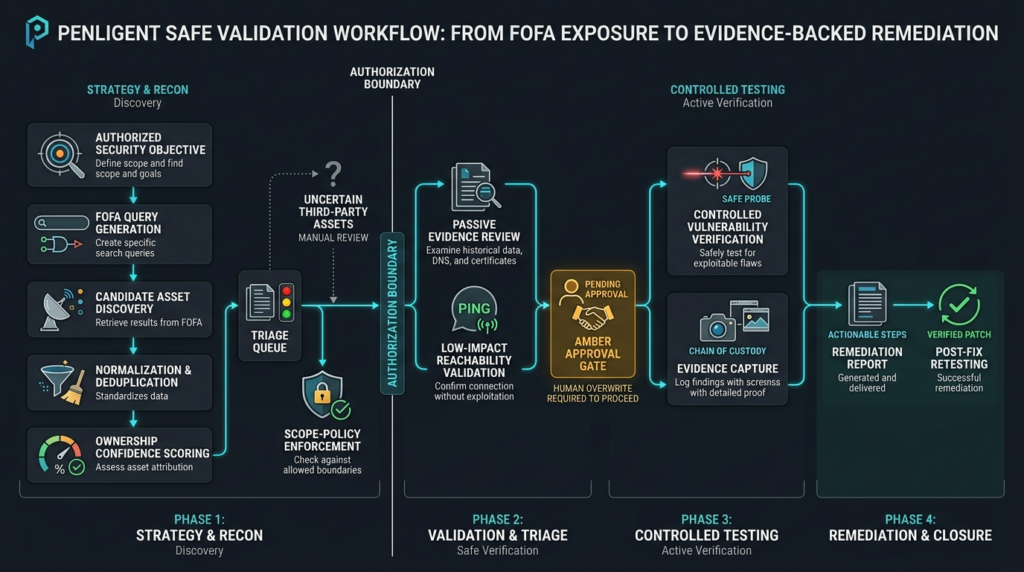
Penligent’s built-in paid FOFA capability is designed to connect these stages within one task context.
A security team can begin with an authorized objective such as:
Identify Internet-facing assets associated with example.com,
prioritize unknown administrative services,
and perform only non-destructive validation.
The workflow can then:
- Formulate focused FOFA queries.
- Retrieve candidate external assets.
- Correlate domains, IPs, certificates and service characteristics.
- Compare the candidates with the approved target scope.
- Reject or quarantine uncertain third-party results.
- Run low-impact reachability and fingerprint checks.
- Prioritize meaningful exposures.
- Ask for approval before higher-impact actions.
- Preserve the commands, responses and evidence.
- Generate remediation-ready findings.
- Retest after the team applies fixes.
Penligent publicly positions its platform around automated asset profiling, attack-surface mapping, more than 200 supported security tools, evidence-first findings, editable scope controls and reports aligned with SOC 2 and ISO 27001 workflows. It also states that the product is intended only for authorized security testing. (Penligente)on does not change the legal boundary of testing. Paid FOFA access does not grant permission to test FOFA results.
What it changes is the operational continuity between discovery and validation.
FOFA Search as an Agent Tool
An AI agent can reduce the manual work involved in FOFA search, but only when the agent is constrained by clear rules.
A useful agent can translate an analyst’s intention into structured queries.
Por ejemplo:
Find confirmed or likely public assets related to example.com.
Prioritize certificate-backed relationships.
Exclude results supported only by a generic brand keyword.
Do not actively test any newly discovered asset until scope is confirmed.
The agent can produce a query plan:
1. domain="example.com"
2. cert="example.com"
3. cert="example.com" && cert.is_valid=true
4. cert="example.com" && cert.is_match=false
5. Review distinctive titles and body markers from confirmed results
6. Expand only from clues with sufficient ownership confidence
It can then explain why each query exists.
This is better than letting an agent improvise broad Internet searches without a model of ownership, authorization or business relevance.
The agent’s role should be to reduce uncertainty, not to maximize the number of targets.
From FOFA Result to Verified Finding
Consider a FOFA result showing:
Host: admin-old.example.com
Port: 443
Title: Infrastructure Management
Certificate: example.com
Observed product: Management Platform
Observation date: 2026-07-20
A weak workflow produces:
Critical: Vulnerable management platform exposed.
A defensible workflow asks a sequence of questions.
Is the asset owned?
The domain is within the approved zone, and the certificate is related. Internal DNS and cloud inventory confirm ownership.
Is it currently reachable?
An approved TLS connection and normal HTTP request confirm the service is still online.
Is the FOFA product fingerprint accurate?
The current response contains product-specific assets, but the visible version is not conclusive.
Is the exposure expected?
The infrastructure team confirms that the interface should only be available through a private management network.
Is vulnerability testing necessary?
The exposure-policy violation is already established. The team can restrict access immediately. Product-version and patch checks can be completed through authenticated configuration review rather than public exploitation.
What is the final finding?
Verified exposure: An organizational infrastructure-management
interface was reachable from the public Internet, contrary to the
approved architecture. Ownership, current reachability and interface
function were confirmed. No authentication bypass was attempted.
This finding is narrower than “critical RCE,” but it is more accurate and immediately actionable.
Scenario One: Forgotten Staging Portal
FOFA finds a hostname matching the corporate domain:
staging-checkout.example.com
The service displays a staging title and uses a valid organizational certificate.
The asset is absent from the CMDB.
A low-impact request confirms that it is reachable and presents a login page. Client-side resources reference a deprecated frontend build, but no vulnerability testing is performed.
The application team initially denies ownership. Certificate records and a cloud load balancer tag eventually identify a former project account.
The most important findings are:
- The asset was missing from inventory.
- The project had no active owner.
- The staging environment was publicly reachable.
- The certificate remained under organizational control.
- The system was outside normal patching and monitoring.
FOFA did not prove a vulnerability. It revealed an asset-management failure that could have allowed vulnerabilities to persist unnoticed.
Scenario Two: Public Management Interface
FOFA identifies a management product through its title and fingerprint.
The IP belongs to a cloud provider, so IP ownership alone is weak. A related hostname and certificate connect the service to the organization.
Penligent performs an approved normal HTTP request and TLS review. The interface is current, reachable and not protected by the expected access gateway.
The team does not attempt password guessing or authentication bypass.
The verified conclusion is that an administrative service is exposed outside the approved network boundary. The organization restricts access and later performs authenticated patch verification.
This is a successful security outcome even without exploit execution.
Scenario Three: Emergency CVE Triage
A critical vulnerability is disclosed in a widely deployed enterprise product.
The security team has only a partial inventory.
FOFA is used to search for the product’s observable fingerprint. The global search indicates broad Internet exposure, but those results are not tested.
The results are filtered through the organization’s confirmed domains, certificate indicators and known infrastructure.
Three candidate systems remain:
- One current production system
- One retired hostname that no longer resolves
- One third-party demonstration system using company branding
The production system is confirmed through internal inventory. The security team checks its exact version and configuration through approved administrative access.
The system is not vulnerable because the affected feature is disabled and the patched release is installed.
The FOFA fingerprint was valuable for discovery, but it was not the final vulnerability evidence.
Scenario Four: Remediation and Retesting
An exposed development dashboard is removed from public access.
A direct validation confirms that the hostname no longer resolves externally. The firewall configuration and cloud inventory show that the public listener has been deleted.
FOFA may continue displaying the previous observation until its index refreshes.
The report records:
Original FOFA observation: Public HTTPS service
Original direct validation: Service reachable
Remediation: Public listener removed
Retest: DNS no longer resolves publicly
FOFA status at retest: Historical observation still visible
Final security state: Remediated
This avoids delaying closure merely because an external index has not yet refreshed.
Common FOFA Mistakes
Mistake 1: Treating Every Result as an Owned Asset
Brand words, certificates, hosting relationships and shared IP addresses can all create false associations.
Use multiple independent ownership signals.
Mistake 2: Treating a Fingerprint as a Confirmed Version
Fingerprints may be based on titles, headers, favicons, body content or protocol responses. Products can be customized, proxied or configured to hide their actual version.
Confirm the current product and affected condition.
Mistake 3: Treating Product Detection as Vulnerability Proof
A product can be present without the vulnerable version, module, configuration or code path.
CVE validation requires more than product presence.
Mistake 4: Ignoring Observation Time
A historical result may no longer represent the current service.
Preserve both the FOFA observation time and direct validation time.
Mistake 5: Expanding Through Shared Infrastructure
A shared IP, CDN edge or cloud provider is not an organizational boundary.
Preserve the hostname and tenant relationship.
Mistake 6: Running Broad Active Tests
A global FOFA result set does not create authorization.
Filter to approved assets before active testing.
Mistake 7: Exporting Data Without Provenance
A spreadsheet without the original query, timestamp and evidence loses investigative value.
Store provenance with every record.
Mistake 8: Reporting Search Results as Live Findings
A FOFA result should be labeled as externally observed intelligence until directly validated.
Mistake 9: Ignoring Third-Party Dependencies
A vendor-hosted portal may not be owned by the company but may still process company data and credentials.
Classify it as a third-party dependency.
Mistake 10: Measuring Success by Asset Count
Finding 50,000 weakly related assets is not necessarily better than finding 200 high-confidence assets.
Measure confirmed coverage, unknown-asset reduction and remediation outcomes.
Operational Metrics That Matter
A FOFA program should be measured using security outcomes rather than query volume.
Useful metrics include:
| Métrica | Significado |
|---|---|
| Confirmed external assets | Number of assets with validated ownership |
| Unknown-asset discovery rate | Percentage of confirmed assets absent from the original inventory |
| False-association rate | Percentage of candidates determined to be unrelated |
| Ownership resolution time | Time needed to assign an owner |
| Exposure validation time | Time from discovery to current-state confirmation |
| Critical management exposures | Internet-facing administrative systems found |
| Unowned asset count | Confirmed assets without an accountable team |
| Remediation time | Time from verification to risk reduction |
| Recurrence rate | Assets or exposures that reappear after remediation |
| Retest completion rate | Percentage of remediated findings independently rechecked |
| Stale-data rate | Percentage of FOFA observations no longer current |
| Third-party dependency coverage | External services mapped to approved vendors |
These metrics reward precision and risk reduction.
Building a Continuous FOFA Workflow
Attack-surface discovery should not be a one-time project.
Infrastructure changes continuously, so the external view should be compared over time.
A recurring workflow can:
- Run a fixed set of approved FOFA queries.
- Compare the new results with the previous snapshot.
- Identify newly observed domains, IPs, certificates and services.
- Detect disappeared or changed services.
- Recalculate ownership confidence.
- Open review tasks for high-confidence unknown assets.
- Perform approved low-impact validation.
- Escalate meaningful exposure.
- Track remediation.
- Retest and close the finding.
The most valuable alert is not necessarily:
10,000 results matched.
It may be:
A new administrative interface appeared under a confirmed
organizational domain and is absent from the approved inventory.
That alert has context, ownership evidence and a clear next action.
Data Handling and Governance
FOFA results can contain sensitive operational information even when the data is publicly observable.
Exports may reveal:
- Public infrastructure structure
- Management interfaces
- Technology choices
- Geographic distribution
- Certificate relationships
- Historical services
- Potential vendor dependencies
- Unmanaged assets
- Security-control gaps
Organizations should define:
- Who may access FOFA data
- Which queries may be automated
- How API credentials are protected
- Where exports are stored
- How long historical results are retained
- Whether third-party assets may be included
- Which results can enter active testing
- How evidence is shared
- How disputed ownership is resolved
- When legal or privacy review is required
Paid or commercial FOFA access should also be used according to the applicable FOFA account terms and licensing conditions. FOFA’s current plan descriptions distinguish non-commercial registered access from paid plans offering broader syntax, API functionality and commercial-use rights. (FOFA)WASP Testing
FOFA is most relevant to the information-gathering and attack-surface identification stages of a web security assessment.
OWASP’s Web Security Testing Guide treats information gathering and entry-point identification as foundational activities. The guide emphasizes understanding application paths, endpoints, technologies and other externally observable characteristics before deeper testing. (Fundación OWASP)that idea beyond one application.
Instead of mapping only the routes inside a known website, a security team can use FOFA to identify other websites, services, certificates and infrastructure that may belong to the same organization.
Once the assets are confirmed, conventional application-testing methods can be applied within scope.
The sequence matters:
External discovery
    ↓
Ownership confirmation
    ↓
Application mapping
    ↓
Entry-point identification
    ↓
Security testing
    ↓
Evidence
    ↓
Remediation and retest
Skipping ownership confirmation turns application testing into uncontrolled Internet probing.
What a Good FOFA Finding Looks Like
A useful report should avoid exaggerated conclusions.
Weak finding
FOFA shows a vulnerable server.
This statement does not explain the query, evidence, ownership, current status, version, affected condition or validation method.
Better finding
FOFA observed an HTTPS service at admin-old.example.com on July 20,
2026. The result included an organizational certificate and a title
consistent with an infrastructure-management platform.

Internal DNS and cloud inventory confirmed that the service is owned
by Example Corporation and included in the authorized assessment.
A direct HTTPS request on August 1, 2026 confirmed that the management
interface remained publicly reachable.

The engagement did not attempt authentication bypass or exploit
execution. The verified issue is Internet exposure of an administrative
interface contrary to the approved management-network policy.
This version separates:
- Passive intelligence
- Ownership evidence
- Current validation
- Alcance
- Actions performed
- Actions not performed
- Verified security impact
That structure is easier for engineers, managers and auditors to trust.
Recommended FOFA-to-Validation Checklist
Before escalating a FOFA result, confirm:
| Consulte | Required question |
|---|---|
| Query provenance | Which query produced the result? |
| Observation time | When did FOFA observe it? |
| Ownership | What evidence connects it to the organization? |
| Alcance | Is active validation authorized? |
| Current reachability | Is the service still available? |
| Fingerprint confidence | How reliable is the product identification? |
| Exposure meaning | Why does public reachability matter? |
| Vulnerability conditions | Are version, feature and configuration requirements met? |
| Compensating controls | Do network or application controls reduce risk? |
| Validation level | What is the least invasive sufficient test? |
| Pruebas | Can another engineer reproduce the conclusion? |
| Remediación | Who owns the fix? |
| Retest | How will closure be confirmed? |
Why the Penligent Integration Matters
FOFA is powerful because it makes the external Internet searchable.
The difficult part begins after the search.
A security team must decide which results are relevant, which assets are owned, which services are still live, which exposures matter, what testing is authorized, how much validation is necessary, and how the evidence should be reported.
That decision chain is where an agentic platform can create value.
With paid FOFA capability built into Penligent, the discovery result can remain connected to:
- The original analyst objective
- The approved target scope
- Ownership evidence
- Asset relationships
- Follow-up tool calls
- Validation decisions
- Human approval gates
- Raw outputs
- Screenshots and artifacts
- Remediation recommendations
- Retest results
- Final reports
Penligent’s public product materials emphasize scope control, traceable evidence, repeatable validation and report generation rather than treating raw scanner output as a finished finding. (Penligente)t previously had to buy separate FOFA access, maintain API scripts, export results and manually transfer them into their testing environment, the integrated workflow reduces both tool friction and evidence loss.
The integration should still be governed by three principles:
Discovery does not grant authorization
A FOFA result remains a candidate until scope is confirmed.
Fingerprinting does not prove vulnerability
The affected version, configuration and reachable code path must be established.
Automation does not remove accountability
The security engineer remains responsible for target selection, test impact and final conclusions.
PREGUNTAS FRECUENTES
What is FOFA used for?
FOFA is used to search publicly observable Internet assets based on domains, IP addresses, ports, protocols, certificates, titles, body content, headers, fingerprints and related characteristics. Security teams use it for external asset discovery, attack-surface review, exposure research, incident investigation and vulnerability-impact triage. FOFA officially describes public asset inventory and cyberspace mapping as core use cases. (GitHub) vulnerability scanner?
No. FOFA primarily indexes and searches observable asset information. A product fingerprint or banner may suggest that a weakness is relevant, but it does not prove that the affected version and configuration are present.
Can FOFA find an organization’s forgotten assets?
Yes, FOFA can help identify candidate assets through domains, certificates, titles, body markers, network information and product fingerprints. Each candidate must still be checked for ownership and current relevance.
Does a FOFA result mean an asset is currently online?
Not necessarily. The result reflects an observation made at a particular time. The service may have changed, moved or gone offline since then. Direct, authorized validation should confirm the current state.
Does a certificate match prove ownership?
No. A certificate is a useful ownership clue, but certificates can be shared, expired, copied, retained on old systems or presented through shared infrastructure. Combine certificate evidence with DNS, cloud inventory, internal records and owner confirmation.
Can a security team test every host returned by FOFA?
No. Search visibility does not create testing authorization. Active testing should be limited to systems the team owns or has explicit permission to assess.
Is it safe to search FOFA for a CVE?
Searching for observable product characteristics can support defensive impact analysis. The unsafe step is using global search results as an unsolicited exploitation list. Restrict validation to authorized assets and confirm the affected conditions before drawing conclusions.
How should FOFA results be prioritized?
Prioritize confirmed organizational ownership, unknown assets, public management interfaces, unsupported products, exposed development environments, weak access controls, critical business systems and assets associated with high-impact vulnerabilities.
How does Penligent use FOFA?
Penligent includes paid FOFA capability within its AI pentesting workflow. FOFA-backed results can be correlated with target scope, enriched through additional tools, reviewed for ownership, validated under controlled policies, preserved as evidence and converted into remediation-ready reports.
Does the Penligent integration allow unlimited testing of FOFA results?
No. FOFA access and active testing are different issues. Product entitlements, usage controls, legal authorization and target scope still apply. A discovered asset should not be actively tested until permission is established.
What is the safest first validation step?
Begin with ownership confirmation and current reachability. DNS resolution, a TLS handshake and a normal HTTP request are often sufficient to determine whether an observed service is still present. Higher-impact testing should require stronger justification and approval.
Should a remediated asset disappear from FOFA immediately?
Not necessarily. FOFA may retain historical observations until the asset is scanned or refreshed again. Confirm remediation through direct technical evidence and record the FOFA observation as historical data. FOFA documents an ownership-verification process for requesting a forced asset refresh. (GitHub)seful for third-party risk?
Yes. FOFA may reveal vendor-hosted portals, branded SaaS tenants and external dependencies. These systems should be classified as third-party services rather than organizational infrastructure, and testing permission should not be assumed.
What should be included in a FOFA-based security report?
Include the query, observation timestamp, relevant result fields, ownership evidence, scope decision, current validation, actions performed, actions deliberately avoided, risk reasoning, remediation guidance and retest evidence.
Conclusión
FOFA gives security teams something their internal tools cannot always provide: an external view of their own organization.
That view can reveal domains that were never registered in the asset inventory, certificates deployed on forgotten infrastructure, staging portals that became permanent, management interfaces exposed outside approved networks, vendor systems carrying organizational identities, and services associated with urgent vulnerability investigations.
But visibility is only the beginning.
A FOFA result is not automatically an asset, a vulnerability, an authorization or a verified finding. It is a piece of evidence that should enter a controlled decision process.
The strongest workflow is:
FOFA discovery
    ↓
Asset normalization
    ↓
Ownership confirmation
    ↓
Scope enforcement
    ↓
Exposure classification
    ↓
Least-invasive validation
    ↓
Controlled security testing
    ↓
Evidence preservation
    ↓
Remediation
    ↓
Retesting
Penligent’s built-in paid FOFA capability connects this discovery layer to a broader AI-assisted penetration-testing workflow. Security teams can search for external assets, reason about relationships, apply scope policies, invoke appropriate tools, preserve evidence and generate reports without losing the context that explains how each asset was found.
That is the real value of combining FOFA with an agentic security workflow.
It is not about searching more of the Internet or launching more tests.
It is about finding the part of your own attack surface that everyone else may already be able to see—and validating it before an attacker does.
 Spanish
  English
  German
  French
  Portuguese
  Japanese
  Korean
  Hindi
Hindi  Arabic
  Turkish
  Hebrew