
1. Executive Summary: The “Infrastructure Injection” Era
Sur February 6, 2026, GitLab released security patches for CVE-2026-1868, a critical (CVSS 9.9) vulnerability in the self-hosted GitLab AI Gateway. The issue is in the Duo Workflow Service component and is described as insecure template expansion of user supplied data via crafted Duo Agent Platform Flow definitions; exploitation requires authenticated access and “could be used to cause Denial of Service or gain code execution on the Gateway.” (about.gitlab.com)
This is not the classic “prompt injection” story (tricking a model into leaking secrets). CVE-2026-1868 sits below the model layer: it is a workflow/orchestration parsing problem that turns the AI gateway’s infrastructure into the execution surface.
Why leadership should care
AI gateways increasingly act as a high-trust routing layer between developers, code, and external/internal model endpoints. A compromise here can amplify impact beyond one service: it can expose sensitive code context, influence AI-assisted development flows, and become a pivot point into adjacent infrastructure (especially when deployed inside Kubernetes and permitted broad egress). GitLab’s advisory explicitly frames the impact as DoS or code execution on the gateway. (about.gitlab.com)

2. The AI Gateway Architecture: Where the Flaw Lives and Why It’s Dangerous
2.1 What “AI Gateway” means in GitLab’s world
GitLab’s docs describe the AI Gateway as a standalone service that provides access to AI-native GitLab Duo features. GitLab runs a hosted gateway for GitLab.com and also supports self-hosted AI Gateway for self-managed customers via GitLab Duo Self-Hosted. (GitLab Docs)
This distinction matters: the vulnerability is specifically relevant to deployments where you operate and maintain the gateway yourself—often in internal clusters and security-sensitive networks.
2.2 Why workflows and “flows” exist and why templating sneaks in
Agentic workflows inevitably need parameterization:
- “Open file X, summarize, then generate a patch”
- “Read issue Y, propose changes, then open an MR”
- “Use repository variables to compose context”
So platforms introduce flow definitions (structured YAML/JSON-like documents) and then perform template expansion to render variables into strings (step instructions, prompt assembly, routing directives). That’s where a simple convenience feature can become a dangerous trust boundary violation.
2.3 Why AI gateways are “blast-radius multipliers”
An AI gateway is not just an API proxy. It often has:
- access to source context and internal metadata
- credentials for upstream model providers and internal services
- network routes into internal subnets/clusters
- logs and caches containing sensitive development artifacts
This is exactly why “gateway compromise” is fundamentally different from “one endpoint bug.”
3. Root Cause: Insecure Template Expansion CWE-1336
GitLab and NIST National Vulnerability Database describe CVE-2026-1868 as insecure template expansion of user supplied data via crafted Duo flow definitions. (about.gitlab.com)
This maps cleanly to CWE-1336: Improper Neutralization of Special Elements Used in a Template Engine, which occurs when a product processes externally influenced input with a template engine but fails to neutralize template syntax that can be interpreted as expressions or directives. (CWE)
Defender’s translation: If untrusted input can reach a template renderer, you must assume it can become code-like at render time unless proven otherwise. GitLab’s statement that this can cause DoS or code execution reflects the reality that template engines are frequently capable of invoking powerful operations depending on runtime context. (about.gitlab.com)
4. Affected Versions and Fix Matrix
GitLab’s patch advisory states CVE-2026-1868 is fixed in:
- 18.6.2
- 18.7.1
- 18.8.1 (about.gitlab.com)
NVD describes the affected ranges including versions such as 18.1.6 / 18.2.6 / 18.3.1 through 18.6.1, plus 18.7.0 et 18.8.0, and repeats the impact statement (DoS or code execution). (NVD)
External national-level advisories echo the same remediation guidance for GitLab Duo Self-Hosted AI Gateway versions prior to those patched releases. (Canadian Centre for Cyber Security)
5. Threat Modeling CVE-2026-1868: The Realistic Attack Paths
This section is written to help security teams model risk without providing weaponized steps.
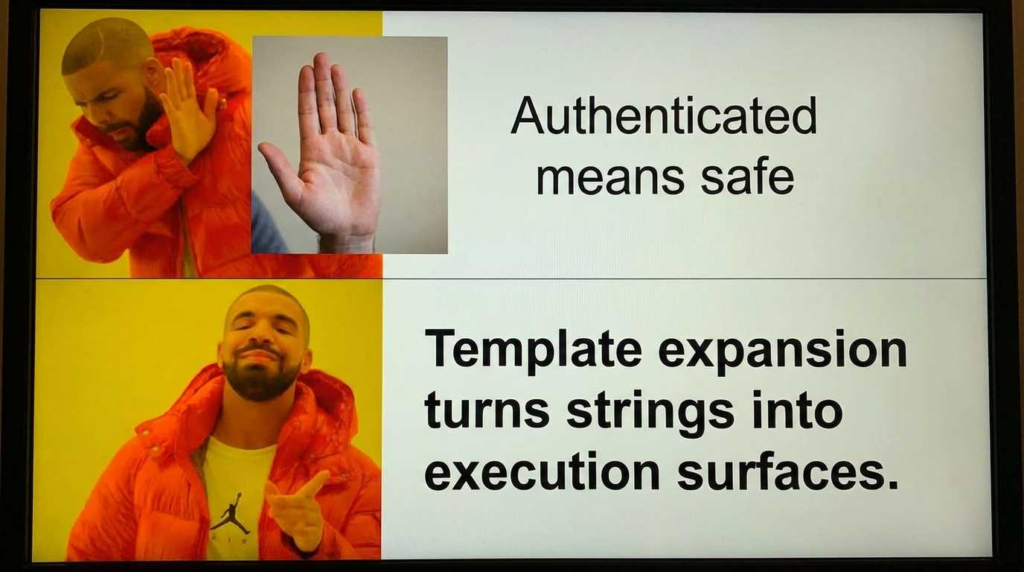
5.1 Preconditions: authenticated access ≠ “safe”
GitLab explicitly notes that authenticated access to the GitLab instance is required. (about.gitlab.com)
In practice, that can mean:
- compromised developer credentials
- a malicious insider
- leaked personal access tokens
- a stolen CI job token or a vulnerable SSO integration
- lateral movement from an adjacent system
If your organization has 1,000+ engineers, “authenticated attacker” is not a rare threat model—it’s a baseline.
5.2 The kill-chain (in infrastructure terms)
A defender-friendly abstraction:
- Workflow influence: attacker can submit or modify agent flow definitions (or an object that the gateway treats as a flow).
- Render step: gateway expands strings using a template engine.
- Context exposure: rendering occurs with access to runtime context (config, helpers, objects).
- Impact: DoS (resource exhaustion) or code execution (worst case per GitLab). (about.gitlab.com)
5.3 “Supply chain poisoning” in AI workflows (the subtle risk)
Even when attackers can’t persist on the gateway, control at the workflow layer can enable:
- intercepting code context sent for review/suggestions
- altering suggestion content that developers copy-paste
- biasing “agent actions” (which files to touch, what patches to propose)
That’s the AI-era version of CI runner compromise: you don’t need to own the repo—just the place where code transformations are proposed.
5.4 Severity drivers: why this scores as critical
GitLab’s CVSS 9.9 indicates the vendor believes exploitation is highly impactful and broadly applicable across typical deployments. (about.gitlab.com)
From a risk standpoint, the driver is not only the bug class, but the typical privilege placement of AI gateways: they are frequently deployed with broad network access and secrets for upstream model calls.
6. Detection Engineering: How to Hunt, Not Just Alert
If you ran a vulnerable version, do not stop at patching. Treat it as: “patch + hunt + rotate secrets + validate controls.”
6.1 What telemetry you must have (minimum viable)
You need correlation across four planes:
(A) Application layer
- requests to workflow/agent endpoints
- payload sizes, render duration
- template render exceptions/timeouts
- user identity + source IP + token type
(B) Container/runtime layer
- unexpected process spawn
- file writes in unusual paths
- outbound DNS lookups not tied to model providers
(C) Kubernetes control plane
- service account used by the gateway pod
- RBAC bindings
- exec into pod events (audit logs)
(D) Network egress
- destinations (IP/domain), bytes out
- unusual new endpoints
- calls to metadata endpoints in cloud environments
6.2 High-signal log hunting queries (SIEM-ready)
Hunt 1: render errors + workflow actions + same principal
index=ai_gateway (workflow OR duo OR agent OR flow)
("template" OR "render" OR "expansion" OR "jinja")
(error OR exception OR traceback OR timeout)
| stats count as hits min(_time) as first max(_time) as last values(request_path) as paths by user, src_ip, user_agent
| sort -hits
Hunt 2: sudden spike in workflow render duration
index=ai_gateway (workflow OR duo OR agent OR flow)
| eval render_ms=coalesce(render_time_ms, duration_ms)
| where render_ms > 2000
| stats count avg(render_ms) max(render_ms) by user, src_ip, request_path
| sort -max(render_ms)
Hunt 3: template markers in payloads (only if your org shouldn’t use templating)
index=ai_gateway (workflow OR duo OR agent OR flow)
("{{" OR "}}" OR "{%" OR "%}")
| stats count values(user) values(src_ip) values(request_path) by trace_id
| sort -count
These aren’t “signature-of-exploit” rules; they are signals of anomalous template execution. That’s what survives attacker adaptation.
6.3 Sigma rule (more robust than string matching)
A stronger Sigma approach is to combine:
- endpoints associated with flow creation/updates
- unusually large payloads
- render errors/timeouts
- template markers (optional)
Sigma skeleton:
title: GitLab AI Gateway - Suspicious Flow Rendering Behavior
id: 2f2c8c7e-xxxx-xxxx-xxxx-xxxxxxxxxxxx
status: experimental
description: Detects suspicious flow/template rendering behavior consistent with CVE-2026-1868 abuse (errors, latency spikes, suspicious markers).
logsource:
  product: gitlab
  service: ai-gateway
detection:
  selection_endpoints:
    request_path|contains:
      - "workflow"
      - "duo"
      - "agent"
      - "flow"
  selection_errors:
    message|contains:
      - "template"
      - "render"
      - "expansion"
      - "exception"
      - "timeout"
  selection_markers:
    request_body|contains:
      - "{{"
      - "}}"
      - "{%"
      - "%}"
  condition: selection_endpoints and (selection_errors or selection_markers)
falsepositives:
  - Legitimate advanced workflows with templating and occasional render errors
level: high
6.4 Runtime detection: treat “process spawn” as a crisis
GitLab’s advisory includes potential code execution impact. (about.gitlab.com)
If your gateway container should not spawn shells or package managers, enforce that invariant:
- Alert on any new executable not in baseline
- Alert on unexpected child process creation
- Alert on writes to
/tmpbursts or unknown persistence paths - Alert on outbound connections to new domains
This is where runtime tools (Falco-like policies) excel—because they alert on outcomes, not payloads.
7. Remediation: Patch, Then Prove It’s Really Fixed
7.1 Patch guidance (non-negotiable)
GitLab states fixed versions are 18.6.2 / 18.7.1 / 18.8.1. (about.gitlab.com)
National advisories urge applying these updates quickly for Duo Self-Hosted AI Gateway. (Canadian Centre for Cyber Security)
7.2 Post-patch validation checklist (what auditors actually want)
Functional validation
- gateway health endpoints OK
- normal AI features operate as expected
- flow creation/update still works for legitimate workflows
Security validation
- template markers in user-supplied fields are treated as data (not executed)
- render execution time remains bounded under load
- gateway can’t reach cloud metadata endpoints
- egress constrained to approved domains/IPs
- no unexpected child processes spawned
Operational validation
- new version recorded in CMDB/inventory
- detection rules deployed + tuned (Sigma/SIEM/runtime)
- secrets rotated + logged
8. Hardening Beyond the Patch: Make the Gateway a Bad Place to Compromise
Patching is reactive; hardening is how you survive the next vulnerability class.
8.1 Network policies: “default deny egress”
Treat the gateway like a production identity provider:
- allow egress only to approved LLM endpoints (and only the required ports)
- block access to cloud metadata endpoints (common pivot path in cloud)
- prevent direct connectivity to databases/Redis unless explicitly required
8.2 Kubernetes lockdown
If you run in Kubernetes, enforce:
- runAsNonRoot, drop capabilities
- read-only root filesystem where possible
- seccomp/apparmor profiles
- strict resource limits (DoS mitigation)
- minimal RBAC for the gateway service account (no “list secrets,” no “create pods,” no wildcard verbs)
8.3 Secrets: assume the gateway is a “key custodian”
- use short-lived tokens when possible
- store secrets in a dedicated secret manager
- rotate provider keys on any suspected abuse window
- segment keys by environment (prod vs staging) and by service identity
9. Secure Template Design Patterns: How This Class of Bug Should Be Prevented
CVE-2026-1868 is a textbook example of why “templating” must be treated like executing code unless proven otherwise.
9.1 Rule #1: avoid expression-capable template engines for untrusted input
If your workflow system only needs variable substitution, use data-only mechanisms:
- strict placeholder substitution with allowlisted keys
- Mustache-style “logic-less” templates
- structured prompt assembly that never interprets user content as executable syntax
9.2 Rule #2: render with explicit allowlists, not implicit context
Don’t render against a global object that includes helpers, request objects, or runtime internals. Use:
- explicit dictionary of safe scalar values
- length limits and type checks
- strict escaping rules
9.3 Rule #3: treat flow definitions like code (governance + SDLC controls)
If flows can influence execution:
- require approvals for flow changes
- store flows in version control with code review
- sign flow artifacts (or at minimum log immutably)
- implement policy checks (deny template markers unless explicitly allowed)
10. Broader Context: Why AI Security Still Means Classic AppSec
CWE-1336 exists because template engines are inherently risky when mixed with externally influenced input. (CWE)
CVE-2026-1868 is the AI-era reminder that:
- “agentic” systems still depend on parsers, renderers, and orchestrators
- feature velocity often outruns input-neutralization discipline
- the most damaging failures happen in the glue code between systems, not inside the model
En d'autres termes : AI is software, and software has bugs—especially where convenient abstractions (like templating) blur trust boundaries.
11. References
- GitLab patch release notes (impact statement, affected versions, fixed versions). (about.gitlab.com)
- NVD entry for CVE-2026-1868 (affected ranges, description, remediation versions). (NVD)
- MITRE CWE-1336 (template engine special-element neutralization definition). (CWE)
- GitLab Docs: AI Gateway overview and self-hosted positioning. (GitLab Docs)
- Canadian Centre for Cyber Security advisory referencing GitLab’s Feb 2026 AI Gateway patches. (Canadian Centre for Cyber Security)

 French
  English
  German
  Spanish
  Portuguese
  Japanese
  Korean
  Hindi
Hindi  Arabic
  Turkish
  Hebrew