
CVE-2026-14191 is a heap memory corruption vulnerability in the RAR5 recovery-volume parser used by WinRAR, RAR, and UnRAR. The bug is not triggered by every ordinary archive extraction. It sits in the recovery-volume path, the code that handles .rev files used to reconstruct missing or damaged parts of a multi-volume RAR set. That detail matters because it changes both the exploit path and the defensive response.
The public record is unusually specific for a fresh CVE. NVD describes an out-of-bounds heap write in RecVolumes5::ReadHeader à l'intérieur recvol5.cpp. The issue is tied to the way a RecItems vector is sized when the first .rev file in a set is processed, while later .rev files can supply their own RecNum value. That value is checked against the current file’s TotalCount, but not against the actual size of RecItems. As a result, a crafted set of two or more recovery volumes can make the parser write an attacker-controlled 32-bit RevCRC value out of bounds, corrupting adjacent heap objects. NVD also states that triggering requires the victim to run a recovery, test, or auto-recovery operation on attacker-supplied .rev files, such as unrar t x.part1.rev, WinRAR’s “Repair archive” flow, or automatic recovery when extracting a volume set with a missing .rar part. (NVD)
RARLAB’s WinRAR 7.23 release confirms the practical fix: version 7.23 resolves a heap overflow vulnerability in the code responsible for reconstructing data from RAR5 recovery volumes. The same vendor notice says the issue affects WinRAR, RAR, and UnRAR, and adds an important component boundary: UnRAR.dll does not process recovery volumes and is therefore not affected according to the vendor’s statement. (WinRAR download free and support)
That is the short version. The useful defender version is more nuanced: CVE-2026-14191 is a user-interaction archive parser bug with high impact potential, a clear fixed version, a narrow trigger path, and a realistic delivery model through social engineering, file exchange, support workflows, malware triage, and automated archive processing. It should be patched quickly, but it should also be triaged accurately. Calling it “instant remote code execution from any RAR file” is sloppy. Calling it “just a local bug” is also sloppy.
The immediate facts defenders need
| Champ d'application | Practical answer |
|---|---|
| CVE | CVE-2026-14191 |
| Affected parser path | RAR5 recovery-volume .rev manipulation |
| Vulnerable function named in public record | RecVolumes5::ReadHeader en recvol5.cpp |
| Weakness classes | CWE-129, improper validation of array index, and CWE-787, out-of-bounds write |
| Public severity | CNA Securin CVSS 3.1 score 7.8 HIGH |
| NVD status | NIST has not yet provided its own CVSS assessment on the page |
| CVSS vector from CNA | AV:L/AC:L/PR:N/UI:R/S:U/C:H/I:H/A:H |
| Main affected tools per vendor notice | WinRAR, RAR, and UnRAR |
| Version corrigée | WinRAR and RAR 7.23, with UnRAR update expected through current vendor packages |
| Déclencheur | Recovery, test, repair, or auto-recovery processing of crafted .rev dossiers |
| Exploitation status in CISA-ADP SSVC | The NVD change record shows exploitation as aucun |
| Priorité opérationnelle | Patch quickly, verify version, and review untrusted .rev handling in human and automated workflows |
NVD currently shows the NIST CVSS score as not assessed, while the CNA-provided score is 7.8 HIGH with local attack vector, low attack complexity, no privileges required, required user interaction, unchanged scope, and high confidentiality, integrity, and availability impact. The same page lists CWE-129 and CWE-787, and its CISA-ADP SSVC entry marks exploitation as none. (NVD)
That means two things can be true at once. First, this is a serious memory corruption bug in a widely used archive tool. Second, the available public record does not support claiming active exploitation of CVE-2026-14191 at the time of writing. Security teams should patch based on exposure and workflow risk, not on exaggerated claims.
Pourquoi .rev files deserve attention
A .rev file is a RAR recovery volume. In normal use, recovery volumes help reconstruct damaged or missing parts of a multi-volume archive. If someone sends a large dataset split into archive.part1.rar, archive.part2.rar, and so on, recovery volumes can provide redundancy so missing data can be rebuilt. That is useful for legitimate archival workflows, especially where large files are moved over unreliable storage or transfer channels.
The security problem is that recovery is still parsing. It is not a passive metadata operation. It reads structured input, tracks volume counts, maps recovery items, computes or checks fields, and writes internal state. When recovery-volume metadata comes from an attacker, the recovery path becomes a parser attack surface.
Many organizations underestimate this because .rev files are not as familiar as .zip, .rar, .7z, .isoou .docx. But unfamiliar does not mean irrelevant. The most exposed systems are often not ordinary user laptops. They are machines and services that handle untrusted files because that is their job:
| Workflow | Pourquoi .rev risk matters |
|---|---|
| Help desk ticket attachments | Users and customers send archives to support teams, often with little validation before opening. |
| Finance and procurement email | Invoice, quote, order, tax, and shipping lures often arrive as compressed files. |
| HR and recruiting | Resume and job-application archive lures have been used in real WinRAR exploitation campaigns. |
| SOC and malware triage | Analysts often open or test archives that normal users should never touch. |
| File ingestion services | Upload scanners and conversion services may automatically inspect archive contents. |
| Backup validation | Recovery workflows may process .rev files as part of archive integrity checks. |
| CI and build artifact handling | Build systems may unpack third-party or supplier artifacts under service accounts. |
| Legal and e-discovery | Large evidence bundles often arrive as compressed multi-volume archives. |
CVE-2026-14191 sits exactly at this boundary between untrusted content and trusted tooling. The user may be a person clicking “Repair archive.” The user may also be an automation account running unrar t against uploaded files to confirm they are readable. In the second case, “user interaction required” becomes less comforting because the interaction is already built into the workflow.
The root cause in plain language
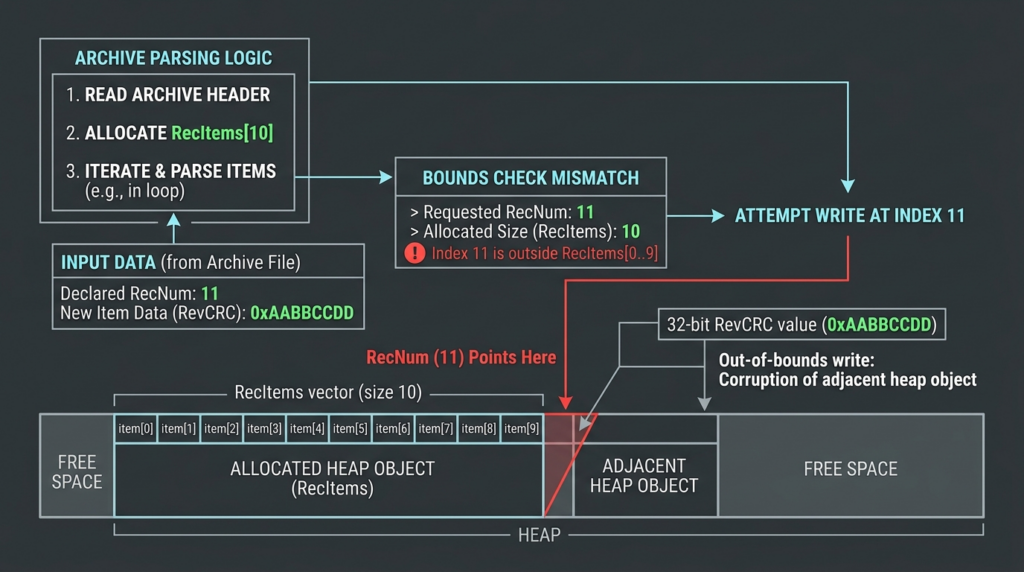
The core bug is an index validation failure. The public description names three important fields or objects: RecItems, RecNumet TotalCount.
A safe parser should make sure that every index used to write into an array or vector is checked against the actual size of that array or vector at the moment of use. CVE-2026-14191 violates that basic rule in the RAR5 recovery-volume path.
A simplified, non-exploit model looks like this:
// Non-exploit illustration only.
// This is not WinRAR source code.

if (first_recovery_volume) {
    RecItems.resize(total_items_from_first_volume);
}

rec_num = current_rev_header.RecNum;
total_count = current_rev_header.TotalCount;

// Bug shape described by public advisories:
// rec_num is validated against the current file's TotalCount,
// but not against RecItems.size().

if (rec_num < total_count) {
    RecItems[rec_num].RevCRC = current_rev_header.RevCRC;
}
The problem is not that RecNum exists. Recovery volumes need identifiers. The problem is that the validation boundary is wrong. A later .rev file can provide a RecNum that makes sense relative to that file’s own TotalCount, but does not fit the RecItems vector allocated from the first file’s state.
NVD’s description is more precise: a crafted set of two or more .rev files can write an attacker-controlled 32-bit RevCRC field to RecItems[RecNum] at an attacker-controlled offset up to 65534 * sizeof(RecVolItem) bytes past the allocation. That corrupts adjacent heap objects. (NVD)
Heap corruption is not automatically reliable code execution. Real exploitability depends on allocator behavior, target platform, binary build, memory layout, mitigations, the exact corrupted object, crash handling, and the attacker’s ability to shape surrounding heap state. But a controlled out-of-bounds heap write in a popular file parser is serious enough to treat as more than a crash bug.
What has to happen for exploitation
The trigger path is narrower than “open any RAR archive.” Based on the public CVE description, the victim or workflow must process an attacker-supplied recovery-volume set. NVD gives examples: unrar t x.part1.rev, WinRAR’s “Repair archive,” or auto-recovery while extracting a volume set with a missing .rar part. (NVD)
That gives defenders a useful model:
| Exigence | Signification |
|---|---|
Attacker controls .rev entrée | The recovery-volume set must be crafted, not merely present. |
Two or more .rev files may matter | The public record describes a crafted set of two or more .rev files. |
| Recovery/test/repair path is reached | Ordinary viewing of unrelated files is not the stated trigger. |
| User interaction is required in CVSS | A person or automated workflow must initiate processing. |
| No privileges are required from the attacker | The attacker does not need an account on the victim system if delivery is through a file lure. |
| Impact can be high | The CNA vector lists high confidentiality, integrity, and availability impact. |
A realistic attack would likely start with delivery, not with a network exploit. A target receives a multi-volume archive and recovery files through email, chat, a file-sharing platform, a support ticket, a supplier portal, or a compromised business partner. The lure asks the target to repair or test the archive because “one part is missing,” “the transfer was corrupted,” or “the archive must be verified before processing.” In an enterprise pipeline, no human lure may be necessary if an automated system already tests or repairs incoming archives.
That does not mean every organization should panic-block all archives. It means the most relevant exposure is where untrusted .rev files are likely to be processed by vulnerable tools.
Affected components and the UnRAR.dll ambiguity
The vendor statement and the NVD change history are not perfectly aligned on every component. That is worth handling honestly.
RARLAB’s WinRAR 7.23 release says the heap overflow affects WinRAR, RAR, and UnRAR, and explicitly says UnRAR.dll does not process recovery volumes and is not affected. (WinRAR download free and support)
NVD’s change history, reflecting the CNA submission, includes an affected block that lists WinRAR, RAR, UnRAR, and UnRAR.dll. The same NVD entry’s main description, however, describes the issue in WinRAR and UnRAR, and its references point to the RARLAB download page and the related CVE-2023-40477 entry. (NVD)
For defenders, the right response is practical:
| Composant | Ce qu'il faut faire |
|---|---|
| WinRAR desktop application | Upgrade to 7.23 or later. This is the most obvious exposure on Windows workstations. |
| RAR command-line utility | Upgrade to 7.23 or later anywhere scripts or automation use it. |
| UnRAR executable | Upgrade through the current RARLAB release or vendor-maintained package. Pay special attention to Linux/macOS servers that process uploads. |
| UnRAR.dll | Vendor release says it does not process recovery volumes and is not affected, but inventory and update it anyway if bundled in third-party software because stale archive libraries often coexist with patched desktop tools. |
| Third-party software using RARLAB code or binaries | Do not assume the desktop patch fixes embedded copies. Ask the vendor, inspect bundled binaries, or sandbox the workflow. |
This is not a case where a single desktop patch dashboard is enough. WinRAR is often installed manually. RAR and UnRAR may sit in scripts, tool folders, portable app directories, malware lab VMs, backup tooling, forensic toolkits, and build images. A clean enterprise response requires file-level inventory, not just software-center status.
Fixed versions and version verification
The most important remediation step is to move to WinRAR/RAR 7.23 or later. RARLAB published WinRAR 7.23 with the RAR5 recovery-volume heap overflow fix and an additional security fix involving symbolic links that could point outside the destination folder during extraction. (WinRAR download free and support)
On a single Windows endpoint, PowerShell can help verify installed RARLAB binaries:
$paths = @(
    "$env:ProgramFiles\WinRAR\WinRAR.exe",
    "$env:ProgramFiles\WinRAR\Rar.exe",
    "$env:ProgramFiles\WinRAR\UnRAR.exe",
    "${env:ProgramFiles(x86)}\WinRAR\WinRAR.exe",
    "${env:ProgramFiles(x86)}\WinRAR\Rar.exe",
    "${env:ProgramFiles(x86)}\WinRAR\UnRAR.exe"
)

$paths |
    Where-Object { Test-Path $_ } |
    ForEach-Object {
        $item = Get-Item $_
        [PSCustomObject]@{
            Path           = $item.FullName
            FileVersion    = $item.VersionInfo.FileVersion
            ProductVersion = $item.VersionInfo.ProductVersion
            LastWriteTime  = $item.LastWriteTime
        }
    } |
    Format-Table -AutoSize
That checks common install locations. It does not catch every portable copy. For broader hunting, search known user-writable and tool directories:
$searchRoots = @(
    "$env:ProgramFiles",
    "${env:ProgramFiles(x86)}",
    "$env:USERPROFILE\Downloads",
    "$env:USERPROFILE\Desktop",
    "$env:USERPROFILE\Tools",
    "C:\Tools",
    "C:\ProgramData"
)

$names = @("WinRAR.exe", "Rar.exe", "UnRAR.exe", "UnRAR.dll")

foreach ($root in $searchRoots) {
    if (Test-Path $root) {
        Get-ChildItem -Path $root -Recurse -ErrorAction SilentlyContinue -Include $names |
            ForEach-Object {
                [PSCustomObject]@{
                    Path           = $_.FullName
                    FileVersion    = $_.VersionInfo.FileVersion
                    ProductVersion = $_.VersionInfo.ProductVersion
                    LastWriteTime  = $_.LastWriteTime
                }
            }
    }
}
For Linux or macOS systems where rar ou unrar may be installed, start with the executable output and package manager metadata:
command -v rar && rar | head -n 3
command -v unrar && unrar | head -n 3

# Debian or Ubuntu style systems
dpkg -l | grep -Ei '(^ii\s+)(rar|unrar|unrar-free)'

# RHEL, Fedora, or similar systems
rpm -qa | grep -Ei '^(rar|unrar)'

# macOS with Homebrew, if applicable
brew list --versions | grep -Ei 'rar|unrar'
Be careful with Linux distribution packages. A distro may backport a fix without using the same upstream version number. Conversely, a server may use a manually downloaded binary that package management cannot see. For compliance evidence, record both binary path and vendor package source.
A simple evidence table for remediation can look like this:
| Champ d'application | Exemple |
|---|---|
| ID de l'actif | SOC-WKS-014 |
| Business owner | Security operations |
| Binary path | C:\Program Files\WinRAR\WinRAR.exe |
| Previous version | 7.21 |
| Current version | 7.23 |
| Update source | Manual installer, software deployment, package manager, vendor image |
.rev processing allowed | No, blocked from external email |
| Validation method | File version plus controlled test of legitimate archive handling |
| Evidence owner | Endpoint engineering |
| Date verified | 2026-07-03 |
Do not treat CVSS as the whole story
The CNA CVSS vector for CVE-2026-14191 is AV:L/AC:L/PR:N/UI:R/S:U/C:H/I:H/A:H, with a 7.8 HIGH score. (NVD)
That vector tells you the attacker cannot simply connect to a listening service and trigger the bug remotely. It also tells you exploitation does not require the attacker to already have privileges on the target. The missing bridge is user interaction, which is common in archive-based intrusions.
The business risk changes based on who or what performs the interaction:
| Scénario | Risk interpretation |
|---|---|
Home user manually repairs unknown .rev dossiers | User-level compromise or program crash is plausible if exploitation succeeds. |
| Employee receives archive through phishing | The archive becomes an initial access delivery vehicle. |
| Help desk processes customer uploads | Repeated exposure to untrusted archives increases probability of unsafe handling. |
| SOC analyst tests suspicious archive on primary workstation | High-risk because security workstations often hold sensitive tools, tokens, and network access. |
Automated pipeline runs unrar t on inbound archives | User interaction becomes automated, and the service account’s privileges define blast radius. |
Malware sandbox processes .rev files inside strong isolation | Risk exists but is contained if isolation, snapshots, and egress controls are sound. |
The most dangerous phrase in vulnerability management is “requires user interaction” used as an excuse to delay. Many real intrusions start exactly there: a file sent to a user, a decoy that looks legitimate, a tool that opens it, and a parser that trusts too much.
Why this issue echoes CVE-2023-40477
NVD explicitly calls CVE-2026-14191 the RAR5-path sibling of CVE-2023-40477. That comparison is useful because it tells defenders this is not a random one-off parser mistake. It belongs to a known family of recovery-volume boundary issues. (NVD)
CVE-2023-40477 was a WinRAR recovery-volume improper validation of array index vulnerability. ZDI described it as allowing remote attackers to execute arbitrary code on affected WinRAR installations, with user interaction required because the target had to visit a malicious page or open a malicious file. ZDI also stated that the flaw existed in recovery-volume processing and resulted from insufficient validation of user-supplied data, which could lead to memory access past the end of an allocated buffer. (zerodayinitiative.com)
The key relationship is this:
| CVE | Parser area | Core weakness | User interaction | Defensive lesson |
|---|---|---|---|---|
| CVE-2023-40477 | WinRAR recovery volumes, RAR3 path according to later CVE context | Improper validation of array index | Required | Recovery-volume processing is attacker-reachable through file lures. |
| CVE-2026-14191 | WinRAR, RAR, UnRAR RAR5 .rev recovery-volume path | Out-of-bounds heap write through mismatched RecNum et RecItems validation | Required | Fixing one parser path does not guarantee the same pattern is gone from adjacent format paths. |
This is a useful engineering lesson. Archive formats evolve. Code paths fork. Fixing RAR3 recovery handling in one release does not automatically fix RAR5 recovery handling unless the underlying validation pattern is audited across related code.
WinRAR’s recent history shows why archive bugs get weaponized
CVE-2026-14191 should be understood alongside the broader pattern of WinRAR and archive-handling exploitation. The point is not that this specific CVE is already exploited. The point is that archive tools are attractive delivery surfaces because they combine user trust, file exchange, parser complexity, and inconsistent patching.
CVE-2023-38831 is the clearest example. NVD describes it as a WinRAR issue before 6.23 that allowed attackers to execute arbitrary code when a user attempted to view a benign file inside a ZIP archive. The bug involved a benign-looking file and a folder with the same name, causing contents in that folder to be processed when the user tried to access only the benign file. NVD notes exploitation in the wild from April through October 2023. (NVD)
Google’s Threat Analysis Group later observed multiple government-backed actors exploiting CVE-2023-38831. Google explained that a patch was available, but many users remained vulnerable, and warned that malicious actors continue to rely on n-days when patching is slow. TAG also described campaigns using CVE-2023-38831 against Ukrainian targets and Papua New Guinea-related targets, with payloads such as Rhadamanthys, IRONJAW, and BOXRAT. (blog.google)
Group-IB’s original reporting on CVE-2023-38831 showed the cybercrime angle. The company reported that threat actors crafted ZIP archives to deliver malware families including DarkMe, GuLoader, and Remcos RAT, distributed those archives on trading forums, and exploited the vulnerability since April 2023. (Group-IB)
CVE-2025-8088 added another warning. ESET reported a WinRAR zero-day exploited in the wild by RomCom, using path traversal with alternate data streams. The attack hid malicious files inside archives that looked benign to the user, and successful exploitation delivered backdoors including a SnipBot variant, RustyClaw, and Mythic agent. ESET also noted that WinRAR 7.13 fixed the issue after disclosure, and advised users to update immediately. (We Live Security)
Those cases explain why CVE-2026-14191 deserves attention even without public evidence of exploitation. WinRAR and similar archive tools are common, manually updated, heavily trusted, and frequently used to move files across organizational boundaries.
Why manual updates make the patch gap worse
One operational problem with WinRAR is update behavior. Malwarebytes noted that CVE-2026-14191 is fixed in WinRAR 7.23, but users must install the new version manually because WinRAR does not offer automatic updates. (Malwarebytes)
That is not a minor usability issue. It changes enterprise risk. Browsers, operating systems, and major productivity suites often have automatic update channels, forced update rings, or centralized patch telemetry. WinRAR is frequently installed outside those channels. Some users download it directly. Some teams carry portable copies. Some legacy workflows keep rar.exe ou unrar.exe in a tools directory for years.
A good patch plan should assume drift:
| Drift source | Pourquoi c'est important |
|---|---|
| Portable copies | They do not appear in normal installed software inventory. |
| User-installed WinRAR | Software deployment tools may not own the lifecycle. |
| Old forensic or malware-analysis images | Analysts may keep intentionally old tools in lab environments. |
| Build agents and CI images | Command-line tools may be baked into images and forgotten. |
| Third-party applications | Bundled archive tools may not update when desktop WinRAR updates. |
| Disconnected environments | Offline systems may miss manual update campaigns. |
For CVE-2026-14191, remediation should not stop at “the WinRAR installer was updated in the software catalog.” It should answer: where are WinRAR, RAR, UnRAR, and relevant RARLAB components actually present, and which workflows process .rev files from untrusted sources?
What defenders should hunt for
Detection should not assume every .rev file is malicious. Recovery volumes have legitimate uses. A good hunt looks for suspicious combinations: untrusted source, recent arrival, recovery/test command, vulnerable binary, crash, and suspicious follow-on activity.
Start with endpoint process telemetry. The following Microsoft Defender XDR-style KQL is a hunting pattern, not a guaranteed exploit detector:
DeviceProcessEvents
| where FileName in~ ("WinRAR.exe", "Rar.exe", "UnRAR.exe")
| where ProcessCommandLine has ".rev"
   or ProcessCommandLine has_any ("repair", "recovery", " t ")
| project Timestamp,
          DeviceName,
          AccountName,
          FileName,
          FolderPath,
          ProcessCommandLine,
          InitiatingProcessFileName,
          InitiatingProcessCommandLine
| order by Timestamp desc
Useful questions for the analyst:
| Question | Pourquoi c'est important |
|---|---|
Did the .rev file arrive from email, chat, browser download, or a ticket system? | External provenance raises risk. |
| Was the tool version below 7.23? | Version determines exposure. |
| Was the command a test, repair, or recovery operation? | That aligns with the known trigger path. |
| Did WinRAR, RAR, or UnRAR crash? | Crashes near suspicious .rev processing deserve review. |
| Did a suspicious child process launch afterward? | Memory corruption exploitation often aims at execution. |
| Did execution occur from Temp, Downloads, extraction folders, or ticket attachment directories? | Archive-delivered malware often runs from user-writable paths. |
A Splunk-style starting point might look like this:
index=edr
(process_name="WinRAR.exe" OR process_name="Rar.exe" OR process_name="UnRAR.exe")
(command_line="*.rev*" OR command_line="*repair*" OR command_line="*recovery*" OR command_line="* t *")
| table _time host user process_name process_path command_line parent_process_name parent_command_line
For file creation or file arrival telemetry:
index=edr
(file_name="*.rev" OR file_path="*.rev")
| table _time host user file_name file_path process_name parent_process_name
| sort - _time
For Windows endpoints without full EDR coverage, a basic local triage can locate recent .rev files in user-accessible paths:
$roots = @(
    "$env:USERPROFILE\Downloads",
    "$env:USERPROFILE\Desktop",
    "$env:USERPROFILE\Documents",
    "$env:TEMP"
)

foreach ($root in $roots) {
    if (Test-Path $root) {
        Get-ChildItem -Path $root -Recurse -Filter *.rev -ErrorAction SilentlyContinue |
            Where-Object { $_.LastWriteTime -gt (Get-Date).AddDays(-30) } |
            Select-Object FullName, Length, CreationTime, LastWriteTime
    }
}
This does not prove exploitation. It helps locate candidate files for provenance review.
Watch for crash and post-processing signals
Memory corruption bugs often show up as application instability before anyone confirms exploitability. A crash alone is not proof of attack, but a crash near suspicious .rev processing is worth investigating.
Useful signals include:
| Signal | Interpretation |
|---|---|
WinRAR, RAR, or UnRAR crash after .rev processing | Possible malformed recovery-volume trigger, benign corruption, or exploitation attempt. |
.rev files arriving with decoy documents or missing archive parts | Potential social-engineering setup to encourage repair or recovery. |
Command-line unrar t against externally supplied .rev dossiers | Automated test workflows may be exposed. |
| Execution from extraction folders after archive handling | Possible payload chain, even if unrelated to this CVE. |
| New persistence after archive processing | Startup folder entries, Run keys, scheduled tasks, or service installs should be reviewed. |
| Security tool alerts on archive contents followed by user execution | Could indicate a broader archive-based intrusion attempt. |
A Sigma-like hunting rule can capture suspicious process behavior without pretending to be a complete detector:
title: Suspicious RAR Recovery Volume Processing
status: experimental
description: Detects WinRAR, RAR, or UnRAR processing .rev recovery volumes from potentially suspicious workflows.
logsource:
  category: process_creation
  product: windows
detection:
  selection_img:
    Image|endswith:
      - '\WinRAR.exe'
      - '\Rar.exe'
      - '\UnRAR.exe'
  selection_rev:
    CommandLine|contains:
      - '.rev'
      - 'repair'
      - 'recovery'
  condition: selection_img and selection_rev
fields:
  - Image
  - CommandLine
  - ParentImage
  - ParentCommandLine
  - User
  - CurrentDirectory
falsepositives:
  - Legitimate archive repair by IT, backup, forensic, or data recovery teams
level: medium
Treat this as triage logic. A true investigation still needs file source, binary version, user action, crash evidence, and follow-on behavior.
Safer handling for untrusted archives
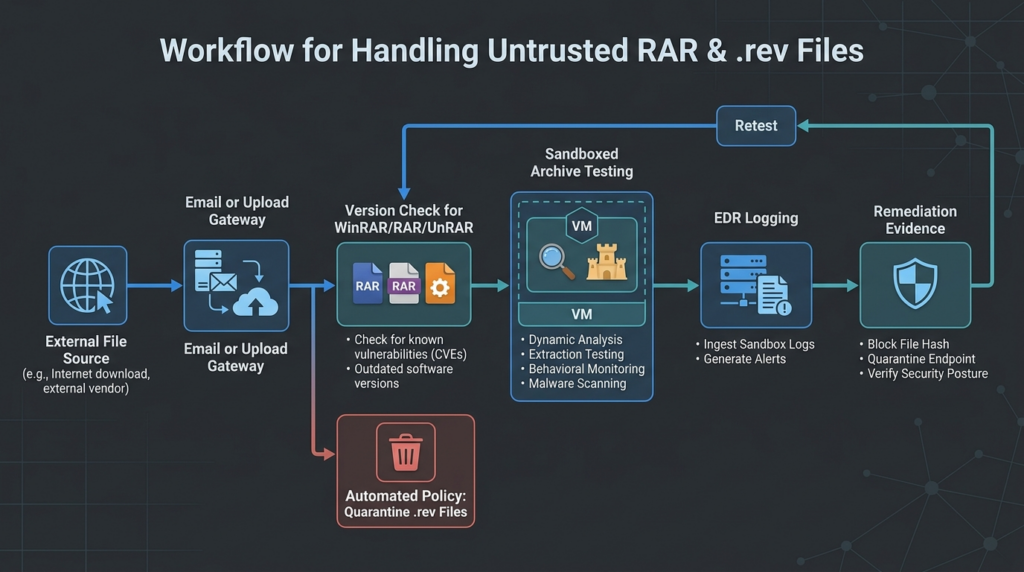
CVE-2026-14191 is a good reason to tighten archive handling policy, especially around recovery volumes. The safest controls are boring and effective.
| Contrôle | Why it helps |
|---|---|
| Upgrade WinRAR, RAR, and UnRAR to fixed versions | Removes the known vulnerable code path. |
Block or quarantine .rev files from external email | Reduces direct exposure to recovery-volume lures. |
Restrict multi-volume RAR plus .rev sets from unknown senders | Attackers may need a set, not a single file. |
| Disable automatic repair or recovery in ingestion workflows | Prevents automation from entering the trigger path. |
| Process unknown archives in disposable sandboxes | Contains crashes and potential code execution. |
| Run archive tools as low-privilege users | Limits impact if parser exploitation succeeds. |
| Prevent execution from extraction directories | Breaks common archive-to-payload chains. |
| Preserve file provenance and Mark-of-the-Web metadata | Helps downstream controls and investigations. |
| Log archive tool command lines | Gives defenders a timeline when a suspicious archive appears. |
| Document exceptions | Recovery workflows may be legitimate, but they need owners and controls. |
Blocking every archive format forever is unrealistic. Blocking .rev files from untrusted external sources is much more realistic for many organizations. Most employees do not need to receive RAR recovery volumes by email. Teams that do need them, such as digital forensics, support, data recovery, or malware analysis, should process them in controlled environments.
Handling automated archive pipelines
The highest-risk CVE-2026-14191 scenarios involve automated processing. A pipeline that runs unrar t on every uploaded archive to validate it may accidentally turn a user-interaction bug into a service-side parser exposure.
Review these pipeline questions:
| Question | Safe answer |
|---|---|
| Does the system automatically test, repair, or recover RAR sets? | Disable recovery on untrusted input unless there is a strong business reason. |
Does it accept .rev files from users or customers? | Quarantine or route to manual review. |
| What user runs the archive tool? | Use a low-privilege dedicated account. |
| Is the tool inside a container or VM? | Prefer disposable isolation with no sensitive mounts. |
| Can extracted files execute? | No. Extraction and execution should be separated by policy. |
| Is egress allowed from the processing environment? | Restrict it. Parser exploitation often needs outbound control. |
| Are crashes logged? | Yes, with input file hash, source, tool version, and job ID. |
| Are uploaded files retained for investigation? | Keep retention long enough for incident review, subject to privacy and legal requirements. |
A minimal Linux isolation pattern for testing archive integrity might look like this:
# Example pattern for an isolated containerized validation job.
# Do not run this as a privileged container.
# Do not mount sensitive host paths.

docker run --rm \
  --network none \
  --user 1000:1000 \
  --read-only \
  --tmpfs /tmp:rw,noexec,nosuid,size=256m \
  -v "$PWD/inbound:/inbound:ro" \
  -v "$PWD/out:/out:rw" \
  archive-validator:latest \
  /usr/local/bin/validate-archive /inbound/sample.rar
The exact image and validation script depend on your environment. The point is the boundary: no network, non-root user, read-only container filesystem, no sensitive mounts, and a temporary directory that is not executable.
If a business process truly requires recovery-volume repair, split it from routine ingestion:
# Safer policy shape:
# 1. Routine validation rejects .rev files.
# 2. Exception workflow requires analyst approval.
# 3. Recovery runs only in a disposable environment.

find /inbound -type f -name '*.rev' -print -quit | grep -q . && {
  echo "Recovery volumes require manual review"
  exit 2
}
This is not an exploit mitigation by itself. It is a workflow guardrail that keeps vulnerable or risky parser paths from being reached automatically.
Prioritization by asset type
Not every endpoint has the same exposure. Use workflow-based prioritization rather than patching only by department size.
| Priorité | Asset type | Why it should move early |
|---|---|---|
| Critique | SOC, malware analysis, IR, forensic workstations | These users intentionally handle suspicious archives. |
| Critique | Help desk and customer support machines | They process attachments from untrusted users and customers. |
| Critique | File ingestion and upload processing servers | Automatisé unrar usage may create repeatable exposure. |
| Haut | HR and recruiting | Resume and job-application lures are common archive-delivery paths. |
| Haut | Finance, procurement, legal | Invoice, contract, shipping, and evidence bundles often arrive compressed. |
| Haut | Build agents and CI workers | Artifact unpacking may run under powerful service accounts. |
| Moyen | Developer workstations | Developers often download tools, PoCs, datasets, and archives. |
| Moyen | General office endpoints | Exposure depends on email, download, and archive-use behavior. |
| Plus bas | Assets without RARLAB tools and no archive workflow | Confirm absence, then document. |
This is also a good time to look for related archive tooling risk. Penligent’s analysis of 7-Zip CVE-2026-48095 makes the same operational point for a different archive parser: archive tools are not just desktop utilities; they appear as installed applications, portable binaries, command-line helpers, bundled dependencies, container tools, malware-analysis utilities, and CI helpers. (Penligent)
For teams that run authorized validation programs, the practical job is to connect asset inventory, parser exposure, version evidence, test results, and remediation records. Penligent describes an agentic security-testing workflow that focuses on finding vulnerabilities, verifying findings, executing tools, and preserving evidence for reports; that kind of evidence-first workflow is useful when archive parser risk must be checked across many targets without turning the article’s subject into a product claim. (Penligent)
A remediation workflow that stands up to audit
A good remediation plan for CVE-2026-14191 has six steps.
First, identify where WinRAR, RAR, UnRAR, and related RARLAB components exist. Do not rely only on installed application inventory. Search for binaries and portable copies.
Second, identify where .rev files are accepted or processed. Email is only one path. Check ticket systems, support portals, file shares, upload services, backup validation, CI pipelines, malware sandboxes, and forensic labs.
Third, update WinRAR and RAR to 7.23 or later and update UnRAR through the appropriate vendor source. Where distribution packages backport fixes, capture vendor advisory evidence rather than assuming upstream version comparisons tell the whole story.
Fourth, verify binary versions. Record path, hash if possible, product version, package source, owner, and date.
Fifth, review telemetry for suspicious .rev processing during the exposure window. Prioritize crashes, external file sources, recovery/test commands, and follow-on execution.
Sixth, change the workflow. If untrusted .rev files do not need to be processed, block them. If they do need to be processed, move them into a controlled, low-privilege, disposable environment.
The following simple checklist can be used as a remediation ticket template:
CVE: CVE-2026-14191
Asset:
Owner:
RARLAB binaries found:
  - Path:
  - Version:
  - Hash:
  - Source:
Processes that handle .rev files:
External .rev files allowed: Yes / No
Automated recovery or repair enabled: Yes / No
Updated to fixed version: Yes / No
Verification method:
Telemetry reviewed:
Suspicious .rev processing found:
Exceptions:
Next review date:
For enterprise evidence, do not stop at “patch installed.” A better closure statement is:
The organization identified RARLAB WinRAR, RAR, and UnRAR installations and portable copies across managed assets; updated affected tools to fixed vendor versions; restricted untrusted .rev recovery-volume processing; reviewed endpoint telemetry for suspicious recovery/test/repair activity involving .rev files; and documented exceptions where archive recovery remains a business requirement.
That wording is specific enough for security leadership, audit, and incident response notes.
Common mistakes to avoid
The first mistake is overstating exploitation. The public CISA-ADP SSVC record shown on NVD marks exploitation as none. Unless that changes, do not write incident tickets or public advisories that claim CVE-2026-14191 is already being exploited in the wild. (NVD)
The second mistake is understating impact because the vector is local and requires user interaction. Archive-based exploitation routinely crosses that gap through phishing, file sharing, and automated processing.
The third mistake is patching only the GUI application. rar.exe et unrar.exe matter because scripts and back-end jobs often use command-line tools.
The fourth mistake is trusting file extension filtering alone. A policy that blocks .rev helps, but archive workflows often involve multi-file sets and renamed files. Provenance, sandboxing, and command-line telemetry are stronger controls.
The fifth mistake is using exploit code as a production test. Do not run public PoCs on business endpoints to “confirm” exposure. Version verification, workflow review, and controlled lab reproduction under written authorization are the safer path.
The sixth mistake is ignoring recovery features. Some teams block extraction of risky formats but still allow “test” or “repair” operations. CVE-2026-14191 lives in the recovery/test/repair path, so those operations must be included in policy.
Related CVEs that help explain the risk
CVE-2026-14191 is easier to understand when placed next to related archive vulnerabilities. These are not the same bug, and their technical triggers differ. They are useful because they show how archive tools become initial-access and post-delivery attack surfaces.
| CVE | Produit | Question centrale | Why it is relevant | Fix or mitigation |
|---|---|---|---|---|
| CVE-2026-14191 | WinRAR, RAR, UnRAR | RAR5 .rev recovery-volume out-of-bounds heap write | Current issue, triggered through recovery/test/repair of crafted .rev sets | Update WinRAR/RAR to 7.23 or later, update UnRAR, restrict untrusted .rev handling. |
| CVE-2023-40477 | WinRAR | Recovery-volume improper validation of array index | NVD calls CVE-2026-14191 its RAR5-path sibling; both involve recovery-volume validation problems | Fixed in WinRAR 6.23 for the earlier RAR3 path, according to the later CVE context and ZDI advisory. (NVD) |
| CVE-2023-38831 | WinRAR | ZIP archive handling could execute code when viewing a benign file | Demonstrates real-world exploitation of archive UI and parsing behavior | Update to WinRAR 6.23 or later; Google TAG emphasized fast patching because n-days remain useful. (blog.google) |
| CVE-2025-8088 | WinRAR | Path traversal using alternate data streams | Demonstrates modern WinRAR zero-day use in spear-phishing archive lures | Update to WinRAR 7.13 or later for that issue; continue patching to current versions. (We Live Security) |
| CVE-2026-48095 | 7-Zip | NTFS archive handler heap buffer overflow | Different product, same operational category: archive parser handles untrusted content | Update to fixed 7-Zip versions and inventory bundled or portable archive tools. (Penligent) |
The common thread is not “all archive bugs are the same.” The common thread is that archive tools sit near trust boundaries. They receive files from strangers, suppliers, customers, employees, malware feeds, and automated systems. They parse complex formats. They sometimes run with more privilege than expected. They often fall outside strict patch management. That is enough to make them recurring attack surfaces.
Practical hardening for Windows environments
On Windows, combine patching with execution control. Archive parsing bugs often become useful when an attacker can move from parser control to payload execution. You can reduce the blast radius even when a parser bug exists.
Good controls include:
| Contrôle | Exemple |
|---|---|
| Keep WinRAR current | Deploy 7.23 or later and verify binary versions. |
| Block risky inbound archive types where practical | Quarantine .rev and unknown multi-volume RAR sets from external email. |
| Preserve Mark-of-the-Web | Avoid tools and workflows that strip internet-origin metadata from extracted files. |
| Restrict execution from user-writable folders | Use WDAC, AppLocker, or EDR policy to block execution from Downloads, Temp, and extraction folders. |
| Force archive inspection into sandboxes | SOC and help desk machines should not process unknown archives on primary desktops. |
| Monitor process chains | Watch archive tools spawning scripts, command shells, PowerShell, rundll32, regsvr32, mshta, wscript, or unknown binaries. |
| Limit local admin rights | User-context exploitation has less impact when users are not local admins. |
| Apply least privilege to service accounts | Upload processors should not run as domain users with broad access. |
A Windows Defender Application Control or AppLocker policy design is environment-specific, but the idea is simple: files extracted into %USERPROFILE%\Downloads, %TEMP%, browser cache, chat attachment directories, or ticket-system staging paths should not be allowed to execute by default.
Practical hardening for Linux and macOS environments
Linux and macOS exposure often comes from command-line rar ou unrar usage. The desktop-phishing story is less central, but automation can matter more.
Review these locations:
which rar unrar 2>/dev/null

find /usr/local /opt /srv /home -type f \( -name 'rar' -o -name 'unrar' \) 2>/dev/null

grep -R "unrar\|rar " /etc/cron* /opt /srv /usr/local/bin 2>/dev/null | head -n 100
For servers, ask what the binary does:
| Use case | Safer pattern |
|---|---|
| Web upload scanning | Reject .rev from untrusted users or send to isolated manual review. |
| Backup verification | Only process recovery volumes from trusted internal backup jobs. |
| Malware triage | Use disposable VMs or containers, no shared credentials, no broad network access. |
| CI artifact unpacking | Pin archive tool versions in images and rebuild images after security releases. |
| Customer file conversion | Use format allowlists and low-privilege workers. |
Si unrar is installed only because another package suggested it years ago, remove it. Reducing parser footprint is often easier than trying to monitor every possible parser path.
Incident response when suspicious .rev processing is found
If telemetry shows suspicious .rev processing on a vulnerable version, treat it as a lead, not a conclusion.
A practical response flow:
- Preserve the input files, hashes, source, and timestamps.
- Record the exact WinRAR, RAR, or UnRAR binary path and version.
- Pull process telemetry around the recovery/test/repair operation.
- Check for crashes, Windows Error Reporting entries, application logs, EDR alerts, and dump files.
- Review child processes and nearby execution from extraction or temporary directories.
- Check persistence locations such as Startup folders, Run keys, scheduled tasks, services, WMI subscriptions, and login items.
- Review credential access and reconnaissance commands after the archive event.
- Determine whether the archive came from email, browser download, chat, removable media, file share, or a business portal.
- Reimage or isolate if there is credible post-exploitation activity.
- Patch and restrict the workflow before restoring normal processing.
Windows triage commands can help with local context:
# Recent WinRAR-related application errors from Windows event logs
Get-WinEvent -FilterHashtable @{
    LogName='Application'
    StartTime=(Get-Date).AddDays(-14)
} -ErrorAction SilentlyContinue |
Where-Object {
    $_.Message -match 'WinRAR|Rar.exe|UnRAR.exe'
} |
Select-Object TimeCreated, ProviderName, Id, LevelDisplayName, Message |
Format-List
And for common persistence review:
# Common user startup locations
Get-ChildItem "$env:APPDATA\Microsoft\Windows\Start Menu\Programs\Startup" -ErrorAction SilentlyContinue |
    Select-Object FullName, CreationTime, LastWriteTime

# Common Run keys
Get-ItemProperty "HKCU:\Software\Microsoft\Windows\CurrentVersion\Run" -ErrorAction SilentlyContinue
Get-ItemProperty "HKLM:\Software\Microsoft\Windows\CurrentVersion\Run" -ErrorAction SilentlyContinue
These commands are not specific proof of CVE-2026-14191 exploitation. They are part of a broader archive-delivery investigation.
Guidance for security researchers
Researchers should be careful with this class of bug. A controlled heap write can be enough to produce dangerous exploit material if weaponized. Public writeups should focus on root cause, patch diffing at a high level, version detection, crash-safe reproduction in private labs, and defensive telemetry. Avoid publishing crafted .rev generation code that turns the bug into a copy-paste weapon.
Responsible validation should include:
| Practice | Pourquoi c'est important |
|---|---|
| Use isolated lab machines | Parser crashes and exploit attempts should not touch production systems. |
| Avoid real user data | Test archives should not contain sensitive files. |
| Keep samples private | Crafted recovery sets may be weaponizable. |
| Report to vendors if new variants appear | Recovery-volume parsing may have adjacent code paths. |
| Publish defensive details first | Version checks, detection logic, and safe mitigations help more people. |
The right public contribution is not an exploit video. It is a better understanding of where the vulnerable code path is reachable and how defenders can reduce exposure.
FAQ
What is CVE-2026-14191?
- CVE-2026-14191 is an out-of-bounds heap write vulnerability in the RAR5 recovery-volume
.revparser used by WinRAR, RAR, and UnRAR. - NVD names
RecVolumes5::ReadHeaderenrecvol5.cppas the affected function. - The bug involves incorrect validation of a
RecNumvalue against the actual size of theRecItemsvecteur. - RARLAB fixed the issue in WinRAR/RAR 7.23. (NVD)
Is CVE-2026-14191 remote code execution?
- The public CVSS vector uses local attack vector and required user interaction, not unauthenticated network attack.
- That does not make it harmless. Archive parser bugs often become remote delivery attacks through phishing, file sharing, customer uploads, or automated processing.
- A successful exploit could potentially execute code in the context of the vulnerable process, depending on platform, mitigations, and exploit reliability.
- The safest phrasing is: CVE-2026-14191 is a high-impact user-interaction memory corruption vulnerability in archive recovery processing.
What versions should be updated?
- Update WinRAR and RAR to 7.23 or later.
- Update UnRAR through the current vendor or distribution-supported package.
- Search for portable or bundled copies, not only installed desktop applications.
- If a Linux distribution backports the fix, use the distribution’s advisory and package changelog as evidence rather than relying only on upstream version numbers.
Does UnRAR.dll need to be patched for CVE-2026-14191?
- RARLAB’s WinRAR 7.23 release says UnRAR.dll does not process recovery volumes and is therefore not affected. (WinRAR download free and support)
- NVD’s change history includes a CNA affected block that lists UnRAR.dll, creating some public-record ambiguity. (NVD)
- The practical enterprise answer is to update and inventory all RARLAB-related components anyway, especially if they are bundled in third-party applications.
- For strict risk statements, cite the vendor’s component boundary: UnRAR.dll does not process recovery volumes according to RARLAB.
Has CVE-2026-14191 been exploited in the wild?
- The public NVD change record includes a CISA-ADP SSVC entry with exploitation marked as
aucun. - That means public authoritative data available here does not support calling it actively exploited.
- This could change, so defenders should monitor NVD, CISA, vendor updates, and trusted security reporting.
- Lack of known exploitation is not a reason to delay patching on systems that process untrusted archives.
How can I check whether I am vulnerable?
- On Windows, check the file version of
WinRAR.exe,Rar.exeetUnRAR.exe. - On Linux or macOS, run
rarouunrarfrom the command line and check package manager metadata. - Look for portable copies in
Downloads,Desktop,C:\Tools, forensic tool folders, build images, and malware lab VMs. - Exposure is highest where vulnerable tools process untrusted
.revfiles through repair, test, recovery, or auto-recovery workflows.
Should organizations block .rev files?
- Many organizations can safely block
.revfiles from external email because ordinary users rarely need RAR recovery volumes. - A blanket block may not work for forensic, support, data recovery, or engineering teams.
- A better policy is to quarantine external
.revfiles by default and require controlled review for business exceptions. - Si
.revprocessing is required, use a patched tool in a disposable, low-privilege, network-restricted environment.
How is CVE-2026-14191 different from CVE-2023-40477?
- CVE-2023-40477 was a WinRAR recovery-volume improper validation issue disclosed earlier and described by ZDI as allowing code execution with user interaction.
- NVD calls CVE-2026-14191 the RAR5-path sibling of CVE-2023-40477.
- The practical difference is parser path: the earlier issue is associated with the RAR3 recovery path, while CVE-2026-14191 affects the RAR5 recovery-volume path.
- The shared lesson is that recovery-volume parsing needs consistent bounds checks across archive format generations.
Arrêt de clôture
CVE-2026-14191 is not a reason to claim every RAR file is a live exploit. It is also not a bug to wave away because the CVSS vector requires user interaction. The vulnerable path handles attacker-supplied recovery-volume metadata, the impact class is heap memory corruption, the affected tools are common, and the patch requires real verification because WinRAR and command-line RAR tools are often installed outside strict update channels.
The right response is straightforward: update WinRAR, RAR, and UnRAR; verify actual binary versions; restrict untrusted .rev handling; review automated archive repair or test workflows; hunt for suspicious recovery-volume processing; and keep evidence that the fix reached the systems that matter. Archive parsers are not background utilities anymore. They are part of the file-delivery attack surface, and they deserve the same disciplined patch and validation workflow as browsers, document readers, and endpoint agents.

 French
  English
  German
  Spanish
  Portuguese
  Japanese
  Korean
  Hindi
Hindi  Arabic
  Turkish
  Hebrew