
CVE-2026-6726 is a high-severity vulnerability in the Trusted Computing Group’s TPM 2.0 reference implementation that challenges one of the most important assumptions behind hardware-backed identity: that a key certified as TPM-protected is actually protected by the TPM.
The issue was publicly disclosed on August 11, 2026, as TCGVRT0010, TPM 2.0 Improper Object Slot Reuse. It affects TCG TPM 2.0 reference-code revisions up to and including v184. TCG assigns the vulnerability a CVSS v3.1 score of 7.9 High and a CVSS v4.0 score of 8.5 High. The advisory associates the flaw with CWE-704, Incorrect Type Conversion or Cast, and CWE-226, Sensitive Information in Resource Not Removed Before Reuse.
The phrase “information leakage” does not fully communicate the security consequence.
CVE-2026-6726 does not primarily behave like a conventional secret-dumping vulnerability in which an attacker simply reads TPM memory. Instead, stale object state can survive the reuse of an internal TPM object slot. That stale state can then become part of a later TPM operation, allowing an attacker to make an externally generated key appear as though it were legitimately protected by the TPM.
That distinction matters because TPMs frequently sit underneath device identity, remote attestation, secure onboarding, Zero Trust access decisions, certificate issuance, measured boot validation, and other trust systems.
If an attacker can successfully cross that boundary, the problem is no longer merely:
“The attacker learned something from the TPM.”
The more important problem becomes:
“A relying party may trust something that was never protected by the TPM in the first place.”
According to CERT/CC, a privileged local attacker may be able to obtain a credential from a TPM-aware Certificate Authority for a falsified TPM key, including an Attestation Key, DevID key, or TLS authentication key, and then use that credential to create fraudulent TPM 2.0 attestations. (Centre de coordination CERT)
This makes CVE-2026-6726 particularly relevant to organizations using TPM-backed device trust rather than merely organizations that happen to have TPM-equipped laptops.
CVE-2026-6726 at a Glance
| Property | CVE-2026-6726 |
|---|---|
| CVE | CVE-2026-6726 |
| TCG advisory | TCGVRT0010 |
| Official title | TPM 2.0 Improper Object Slot Reuse |
| Composant | TCG TPM 2.0 reference code |
| Affected reference revisions | Up to and including v184 |
| CVSS v3.1 | 7.9 High |
| CVSS v4.0 | 8.5 High |
| Primary weakness | Improper separation and reuse of TPM object slots |
| Vecteur d'attaque | Local |
| Privileges required | Haut |
| User interaction | Aucun |
| Primary consequence | Credentials for falsified TPM keys |
| Attestation impact | Fraudulent TPM 2.0 attestations |
| Examples of affected keys | AK, DevID, TLS authentication key |
| Related disclosure | CVE-2026-6727 |
| Public disclosure | August 11, 2026 |
TCG’s CVSS v3.1 vector is:
CVSS:3.1/AV:L/AC:L/PR:H/UI:N/S:C/C:H/I:H/A:N
Its CVSS v4.0 vector is:
CVSS:4.0/AV:L/AC:L/AT:P/PR:H/UI:N/VC:H/VI:H/VA:N/SC:H/SI:H/SA:N
The local attack requirement and high privileges are important constraints. CVE-2026-6726 should therefore not be described as a remotely exploitable TPM takeover vulnerability.
At the same time, the high integrity impact explains why the vulnerability still receives a High rating: an attacker who has already compromised a host may be able to undermine a separate trust domain that is supposed to remain meaningful even when host software cannot be trusted.
Understanding the TPM Trust Model
To understand why CVE-2026-6726 matters, it helps to understand what a TPM is expected to prove.
A Trusted Platform Module is designed to provide cryptographic operations and protected key storage through a hardware or hardware-backed security boundary. Depending on the platform, the TPM may be a discrete chip, integrated component, firmware TPM, or virtual/software implementation.
CERT/CC notes that TPM implementations can include discrete TPMs, integrated hardware, firmware TPMs and software implementations used in cloud and virtualized environments. (Centre de coordination CERT)
One of the TPM’s most important properties is not simply that it can generate signatures.
Ordinary software can generate signatures.
The value comes from what the signature is supposed to represent.
A verifier may want assurance that:
- a particular cryptographic key belongs to a particular TPM;
- the corresponding private material is protected by that TPM;
- particular Platform Configuration Register values were signed by a trustworthy Attestation Key;
- the measurements represented by those PCR values correspond to an expected platform state.
That sequence creates a chain of trust.
A simplified model looks like this:
TPM Endorsement Key
        |
        v
Attestation Key validated as TPM-bound
        |
        v
TPM signs PCR state
        |
        v
Remote attestation evidence
        |
        v
Verifier / CA / device-trust platform
        |
        v
Access or certificate decision
CVE-2026-6726 attacks an assumption near the middle of that chain.
It can cause a key that is not genuinely TPM-protected to be represented as one that is.
EK, AK and TPM Attestation
Les Endorsement Key, or EK, represents a foundational TPM identity mechanism. Depending on the attestation architecture, a TPM-aware CA can use the EK and associated protocols to establish confidence that another key belongs to the TPM.
Un Attestation Key, or AK, is then commonly used to sign attestation structures such as TPM quotes.
A TPM quote can include values derived from PCRs. Those registers can represent measurements accumulated during platform startup or other security-sensitive operations.
The relying party does not simply ask:
Does this quote have a mathematically valid signature?
It effectively asks something closer to:
Does this signature come from a key that I trust to be protected
inside the expected TPM?
The second question is much harder.
That is precisely the trust relationship CVE-2026-6726 can weaken.
The Root Cause: TPM Object Slot Reuse
TCG describes CVE-2026-6726 as a failure to adequately separate two types of structures stored in the same area of TPM memory:
key/data objects, including objects loaded through operations such as:
TPM2_Load
TPM2_LoadExternal
et hash context objects, including sequences created using:
TPM2_HashSequenceStart
The reference implementation reused storage between these object types.
That alone is not necessarily a vulnerability. Reusing memory can be perfectly legitimate if the previous object’s security-relevant state is completely invalidated.
The problem is that this cleanup was incomplete.
TCG’s extended guidance describes the underlying condition as a use-after-free-style bug in which stale object state—specifically the object’s Nom—could remain after the memory was repurposed for a Hash Context. TPM2_Certify also failed to ensure that the handle being certified was actually an appropriate object rather than a Hash Context. (Trusted Computing Group)
Conceptually:
Object slot
    |
    | External key object loaded
    v
+---------------------------+
| External Object           |
| Name = attacker_key_name  |
+---------------------------+

          Flush

             |
             v

Slot becomes reusable
but stale Name remains

             |
             v

+---------------------------+
| Hash Context              |
| stale Name still present  |
+---------------------------+

             |
             v

TPM operation incorrectly
uses stale object identity
This is why calling CVE-2026-6726 simply an “information disclosure vulnerability” risks hiding the most interesting part of the bug.
The stale information changes the meaning of subsequent security operations.
How the CVE-2026-6726 Attack Chain Works
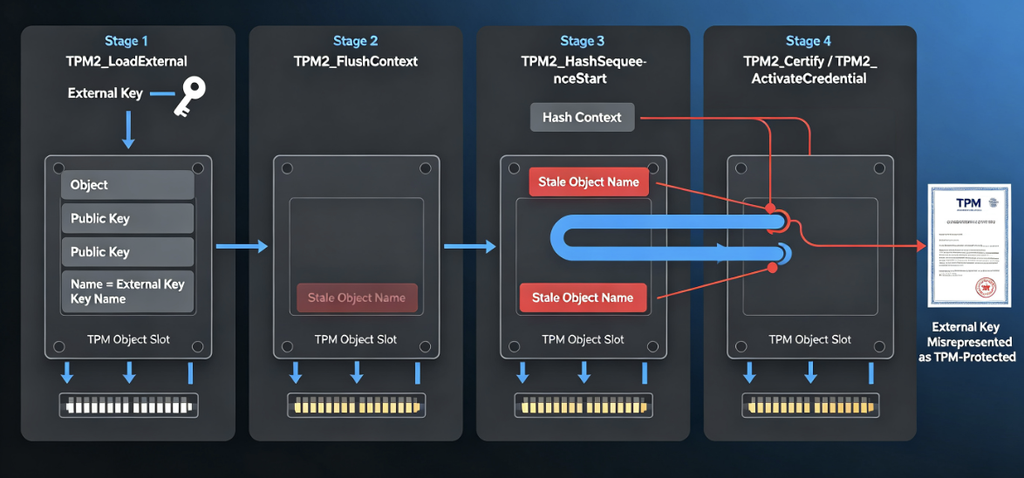
TCG documents the essential vulnerability sequence at a high level.
An attacker with sufficient local privileges and TPM command-interface access can first load an external object into an object slot. The attacker then flushes the object and creates a hash sequence that causes the same slot to be reused.
A subsequent TPM2_ActivateCredential ou TPM2_Certify operation can interact with the slot.
Because previous object information was not completely erased, the Name associated with the earlier external object can incorrectly participate in the later operation.
The conceptual attack chain is therefore:
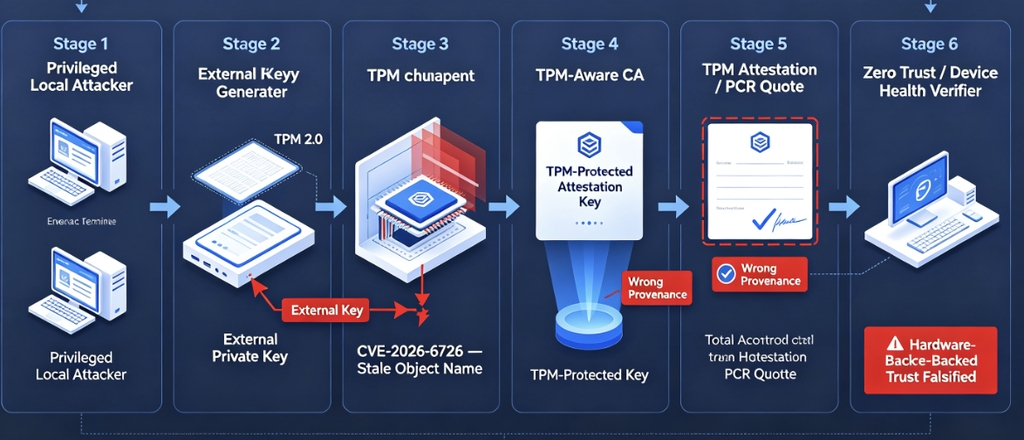
Privileged local compromise
        |
        v
Create attacker-controlled external key
        |
        v
Load key using TPM2_LoadExternal
        |
        v
Object receives TPM object slot
        |
        v
Flush external object
        |
        v
Reuse same slot as Hash Context
        |
        v
Stale object Name survives
        |
        v
TPM2_Certify / ActivateCredential
interprets stale state incorrectly
        |
        v
External key appears TPM-protected
        |
        v
TPM-aware CA may issue credential
        |
        v
Attacker possesses credential for
non-TPM-protected private key
        |
        v
Forged TPM-backed identity or attestation
The crucial security transition happens at the point where the externally controlled key becomes credible to another component.
The attacker does not need to extract a legitimate TPM AK private key.
They may instead arrange for a key whose private part they already control to receive trust that should only have been granted to a TPM-protected key.
That is a fundamentally different—and potentially more useful—attack.
Why an External TPM Object Matters
TPM terminology can make this vulnerability sound more abstract than it is.
An external object may contain public-key material supplied to the TPM from outside the protected TPM environment.
The existence of a public key in a TPM object structure does not imply that the corresponding private key is securely held inside the TPM.
That distinction is essential.
Suppose an attacker generates:
attacker_private_key
attacker_public_key
entirely outside the TPM.
If the attacker merely loads attacker_public_key into the TPM, they still retain attacker_private_key.
Normally, a verifier should not mistake that object for a TPM-generated or TPM-protected key.
CVE-2026-6726 can break that distinction.
TCG’s extended guidance summarizes the consequence directly: an attacker can get a TPM to certify an external object while misrepresenting it as internally stored in the TPM. (Trusted Computing Group)
This is where the forged-attestation risk comes from.
From Stale Metadata to a Forged Attestation Key
Consider a TPM-aware Certificate Authority issuing a credential to an Attestation Key.
The CA wants confidence that:
AK private key
      |
      v
protected by TPM
rather than:
AK private key
      |
      v
stored in attacker-controlled software
If CVE-2026-6726 causes the CA’s validation procedure to accept an externally controlled key, the attacker may receive a legitimate credential for that key.
The resulting key can now carry two properties at the same time:
Private key controlled by attacker
+
Credential asserting TPM-related trust
That combination is dangerous.
The attacker can perform cryptographic operations without needing the legitimate TPM to protect the key while still presenting evidence to systems that may believe the key represents TPM-backed identity.
CERT/CC specifically identifies Attestation Keys, DevID keys and TLS authentication keys as examples of keys that could be involved. (Centre de coordination CERT)
Why PCR Quotes Become Relevant
TCG warns that credentials obtained through the vulnerability could then be used to falsify device attestations, including PCR quotes used for health attestation.
PCRs are often discussed as if they themselves create trust.
They do not.
A remote verifier ultimately depends on the authenticity of the signed evidence containing the PCR values.
Conceptually:
PCR values
   +
nonce
   +
other attestation data
        |
        v
signed using AK
        |
        v
quote
If the verifier has correctly established that the AK belongs to the expected TPM, the signature creates meaningful evidence.
But if an attacker can substitute a credentialed key whose private material they control, the semantics change dramatically.
A cryptographically valid signature is not enough.
The question becomes whether the signing key truly enjoys the hardware protection and provenance assumed by the verifier.
CVE-2026-6726 demonstrates why attestation protocols must validate that property explicitly.
Forged Attestation Does Not Mean Breaking Cryptography
An important misconception should be avoided here.
CVE-2026-6726 does not require breaking RSA, ECC, SHA-256 or the fundamental mathematics of digital signatures.
The signatures involved may all be mathematically correct.
Instead, the bug corrupts the relationship between:
Key
and:
Claim about where the key is protected
This is a classic trust-semantics failure.
The verifier may receive a valid signature from the wrong category of key.
Security systems frequently fail this way: not because the cryptographic primitive is weak, but because the metadata, lifecycle or protocol surrounding the primitive incorrectly assigns meaning to an otherwise valid cryptographic result.
CVE-2026-6726 Is a Trust-Boundary Vulnerability
This also explains an unusual feature of the CVSS v3.1 score.
The vulnerability requires:
AV:L
PR:H
meaning local access and high privileges.
At first glance, that can make the vulnerability appear relatively unimportant. If an attacker is already highly privileged, why care about another vulnerability?
Because TPMs exist partly to establish trust beyond the compromised host operating system.
For example, an organization may treat host software as potentially malicious but still trust evidence produced through its TPM.
Remote attestation only makes sense if the verifier can distinguish between:
compromised software says "I'm healthy"
and:
hardware-backed mechanism proves expected state
A bug that allows compromised privileged software to manipulate the second category undermines the reason for having the attestation boundary in the first place.
That is why local exploitation can have consequences in another security authority such as a remote CA or attestation service.
What CVE-2026-6726 Does Not Do
The vulnerability should not be exaggerated.
It Is Not a Remote TPM RCE
The disclosed attack requires privileged local access to the TPM command interface. CERT/CC explicitly identifies this prerequisite. (Centre de coordination CERT)
An unauthenticated attacker on the Internet cannot simply send a packet to an arbitrary workstation and exploit CVE-2026-6726.
An initial compromise or another mechanism for acquiring privileged TPM access would normally be required.
It Is Not Automatically a Secure Boot Bypass
TCG states that the vulnerability can affect systems relying on TPM-based trust, including secure boot-related scenarios.
That should not be interpreted as:
CVE-2026-6726 directly disables Secure Boot
The more precise problem is that attestation about platform state can become untrustworthy.
An endpoint may still enforce its firmware Secure Boot policy locally.
The vulnerability affects what another party can safely infer from TPM-backed evidence.
It Is Not a BitLocker Decryption Vulnerability
CVE-2026-6726 should also not be described as a generic BitLocker key-extraction vulnerability.
The flaw concerns object-slot reuse and the integrity of TPM key certification.
The simultaneously disclosed CVE-2026-6727 addresses a separate RSA-OAEP timing side channel that can potentially expose plaintext encrypted to affected TPM-managed RSA keys.
Conflating the two vulnerabilities produces an inaccurate threat model.
It Does Not Automatically Extract Existing TPM Private Keys
The core CVE-2026-6726 attack does not require extracting an existing legitimate AK private key.
Instead, it creates a route by which an attacker-controlled external key can receive trust it should not receive.
That distinction is central to understanding the vulnerability.
CVE-2026-6726 vs CVE-2026-6727
CVE-2026-6726 and CVE-2026-6727 were coordinated and disclosed together, but they are technically different vulnerabilities.
| Property | CVE-2026-6726 | CVE-2026-6727 |
|---|---|---|
| Question centrale | Improper object slot reuse | RSA-OAEP timing side channel |
| TCG advisory | VRT0010 | VRT0011 |
| Primary primitive | TPM object lifecycle | RSA decryption |
| Attack technique | Stale state / object confusion | Timing measurements |
| Main consequence | Falsified TPM key certification | Potential RSA-OAEP plaintext recovery |
| Attestation impact | Direct | Possible under certain conditions |
| Privileged TPM access | Required | Required |
TCG’s extended guidance explains that VRT0010 involves inadequate separation between Objects and Hash Contexts, whereas VRT0011 results from RSA-OAEP decryption not executing in secret-independent time. (Trusted Computing Group)
CERT/CC likewise treats CVE-2026-6726 as the information-leakage/falsified-key issue and CVE-2026-6727 as the RSA-OAEP timing vulnerability. (Centre de coordination CERT)
Security teams should therefore patch for both when their TPM implementation is affected, but should not describe their technical mechanics interchangeably.
Which TPM Versions Are Affected?
The TCG advisory states that the vulnerable reference code includes all revisions up to and including v184 from 2025.
Google Cloud’s GCP-2026-054 bulletin is more explicit about published reference versions, identifying:
v1.16
v1.38
v1.59
v1.83
v184
as affected revisions of the TCG reference implementation. Google classified CVE-2026-6726 as High severity. (Documentation de Google Cloud)
However, this does pas mean:
Every TPM 2.0 implementation in existence is vulnerable.
TCG publishes reference code that vendors can incorporate, modify or independently implement.
Exposure must therefore be determined at the actual vendor, TPM implementation and firmware-version level.
AMD, Intel and Other Implementations
CERT/CC’s coordinated vendor information identified AMD’s fTPM as affected. AMD’s statement says that it produces an fTPM impacted by the issue.
Intel is also listed as affected in the CERT/CC coordination data. (Centre de coordination CERT)
At the same time, implementations that do not rely on the vulnerable reference-code behavior may not be affected.
For example, CERT/CC records libtpms as not affected by CVE-2026-6726 for at least the cited 0.8.5, 0.9.0 and 0.10.0 lines because an earlier change had already resolved the relevant behavior. (Centre de coordination CERT)
That is an important operational lesson.
Do not perform vulnerability management with a query as broad as:
TPM 2.0 present = vulnerable
Instead, inventory:
platform vendor
TPM vendor
TPM implementation
firmware revision
platform BIOS/UEFI revision
operating-system remediation
cloud-provider status
and correlate those values against vendor advisories.
Google Cloud Exposure
Google published GCP-2026-054 on August 11, 2026.
The cloud provider confirmed that the vulnerability affects the TCG TPM 2.0 reference implementation and stated that no customer action is required for its affected Compute Engine environment because Google would proactively update systems during standard planned maintenance windows. (Documentation de Google Cloud)
This illustrates another reason administrators should not assume that TPM patching always behaves like an ordinary package upgrade.
TPMs may be:
physical
firmware-based
virtualized
cloud-managed
and remediation ownership changes accordingly.
Why TPM Firmware Patching Is Harder Than OS Patching
Updating TPMs at enterprise scale can be operationally difficult.
TCG’s extended remediation guidance explicitly notes that TPM firmware updates tend to be both implementation-dependent and platform-dependent. The TPM vendor may need to supply the firmware while the platform vendor provides an updater appropriate for a particular machine. TPM firmware releases also tend to occur less frequently than ordinary operating-system software updates. (Trusted Computing Group)
That makes fleet remediation more complicated than:
apt upgrade
or:
Install-WindowsUpdate
A real deployment may depend on combinations of:
OEM BIOS update
+
TPM firmware payload
+
vendor update mechanism
+
reboot
+
post-update attestation validation
The situation becomes harder when thousands of endpoints are remote.
TPM attestation would normally be a natural mechanism for proving that firmware updates actually reached those devices.
But with CVE-2026-6726, the attestation mechanism itself is part of the trust problem.
TCG therefore recommends firmware-version-aware attestation strategies rather than blindly assuming that a successful TPM attestation proves the TPM has already received the fix. (Trusted Computing Group)
How to Inventory TPMs on Windows
For defensive inventory, Windows administrators can begin with built-in TPM information.
PowerShell provides:
Get-Tpm
Another useful Windows utility is:
tpmtool getdeviceinformation
These commands can help identify whether the device has a TPM and collect implementation-related information.
They should not be treated as a universal CVE-2026-6726 scanner.
The correct workflow is:
Inventory TPM
       |
       v
Determine manufacturer / firmware
       |
       v
Identify platform model
       |
       v
Check OEM and TPM vendor advisory
       |
       v
Determine fixed firmware/BIOS version
       |
       v
Deploy update
       |
       v
Revalidate attestation
A security scanner that merely checks whether TPM 2.0 exists would generate large numbers of false positives.
How to Inventory TPMs on Linux
Systems using the tpm2-tools ecosystem can obtain TPM properties using commands such as:
tpm2_getcap properties-fixed
For a more focused inventory:
tpm2_getcap properties-fixed | \
grep -E 'TPM2_PT_MANUFACTURER|TPM2_PT_FIRMWARE_VERSION'
Exact output and supported properties vary by TPM implementation and tool version.
Again, this is asset discovery rather than exploitation testing.
Security teams should take the resulting manufacturer and firmware information and compare it with authoritative platform-vendor remediation data.
Why Traditional Vulnerability Scanners May Struggle
CVE-2026-6726 is not naturally suited to ordinary network scanning.
A typical unauthenticated vulnerability scanner is designed to discover things such as:
open services
software banners
HTTP versions
TLS configuration
remote protocol behavior
None of those necessarily reveal the exact TPM implementation and firmware inside the endpoint.
Even authenticated scanners may only know:
machine model
BIOS version
TPM vendor
TPM firmware
and must then map those values to vendor-specific advisories.
That means reliable detection is likely to depend heavily on inventory intelligence rather than remote active exploitation.
For enterprise security teams, endpoint asset management, firmware inventory and device-attestation telemetry may be more useful than an Internet-facing CVE scanner.
Detecting Actual Exploitation Is Even Harder
Detecting whether CVE-2026-6726 was successfully exploited is fundamentally difficult because the attack targets trust semantics.
The end product may be a perfectly valid-looking credential.
A CA could have signed it.
The cryptographic signature might validate correctly.
The key itself might behave normally.
The problem is that the private key is not actually protected by the TPM as expected.
Endpoint EDR therefore cannot necessarily identify compromise simply by looking for a malformed certificate or invalid signature.
More useful telemetry may exist at several layers:
TPM command activity
credential issuance
attestation enrollment
firmware inventory
device identity lifecycle
certificate issuance logs
attestation-service decisions
Organizations operating TPM-aware CAs should pay particular attention to certificates or credentials issued from vulnerable TPM versions during the exposure window.
The CA Is Part of the Security Boundary
One of the most important lessons from CVE-2026-6726 is that remediation does not end at the TPM.
Les Certificate Authority and attestation verifier are part of the vulnerability boundary.
TCG provides explicit recommendations for CA implementers rather than treating firmware patching as the sole solution.
That matters because enterprise TPM deployments may take weeks or months to update completely.
During that transition, relying parties need a way to avoid trusting forged objects even when some endpoints remain vulnerable.
TPM2_CertifyCreation as a Stronger Validation Path
TCG recommends that implementers consider an attestation design involving an imported restricted HMAC key and either:
TPM2_Certify
or:
TPM2_CertifyCreation
The key distinction is that TPM2_CertifyCreation requires valid creation data.
According to TCG’s extended guidance, TPM2_CertifyCreation is not affected by VRT0010 because the operation requires valid creation information corresponding to the key. (Trusted Computing Group)
This lets the verifier establish stronger evidence that the object was actually created in the expected TPM context instead of merely accepting an externally supplied public key that has been misrepresented.
The tradeoff is operational complexity.
The creation data for the AK must be retained from the time the AK is created, which may not match every existing deployment architecture.
The Critical name != qualifiedName Check
TCG also provides a mitigation for environments continuing to use TPM2_Certify.
The verifier can inspect the resulting TPMS_CERTIFY_INFO and ensure:
name != qualifiedName
for the relevant object.
TCG states that, within the relevant structure, the Name and Qualified Name relationship can distinguish an internal object from the external-object case exploited by CVE-2026-6726. Its advisory emphasizes checking that the certified TPM key is not external.
The full advisory includes additional structure validation around the hash algorithm and buffer sizes rather than recommending that implementations blindly perform a single string comparison.
The important architectural point is this:
A CA should not infer TPM protection merely because the TPM returned some attestation structure.
It needs to validate properties showing that the certified object has the provenance required by the security policy.
Firmware-Aware Attestation
TCG additionally recommends verifying that the TPM’s reported firmware version corresponds to a vendor firmware version known to contain the CVE-2026-6726 fix.
This turns attestation policy into something closer to:
Is this the expected device?
+
Is this key genuinely TPM-protected?
+
Is the TPM firmware itself trustworthy?
rather than:
Did a TPM sign something?
For large organizations, this implies that firmware versions should become first-class attributes of device-trust policy.
An attestation service may maintain policy such as:
Vendor A:
  firmware >= fixed revision X

Vendor B:
  firmware >= fixed revision Y

Vendor C:
  unaffected implementation
rather than relying solely on a binary TPM=true propriété.
Firmware Rollback Matters
Another subtle operational concern is firmware rollback.
TCG notes that rollback protection is implementation-dependent. If an organization cannot guarantee that every TPM prevents downgrading to vulnerable firmware, it may be unsafe to assume that a device remains permanently trusted simply because it once successfully demonstrated a patched firmware version. (Trusted Computing Group)
In such environments, the verifier should periodically reassess TPM firmware state.
That is an important difference between:
patch verification
and:
continuous trust verification
The first proves that the device was patched at one point.
The second continues validating the assumption upon which future trust decisions depend.
What Enterprises Should Patch First
Organizations should prioritize CVE-2026-6726 according to how much security depends on TPM-backed identity.
A workstation with a TPM that is never used for remote trust decisions is not equivalent to a TPM acting as the foundation for an enterprise device-authentication system.
High-priority environments include:
| Environnement | Why CVE-2026-6726 Matters |
|---|---|
| Remote device attestation | Forged AK trust can undermine attestation |
| Zero Trust device access | Device-health decisions may rely on TPM evidence |
| TPM-backed onboarding | Falsified identity may affect enrollment |
| DevID infrastructures | Device identity credentials may be targeted |
| TPM-backed client TLS | External authentication keys may receive inappropriate trust |
| Large managed endpoint fleets | Patch consistency and firmware verification are difficult |
| Cloud/vTPM environments | Trust may cross VM and orchestration boundaries |
| Sensitive workstation fleets | Device integrity frequently feeds access policy |
Conversely, exposure should not be inflated merely because an endpoint contains a TPM chip.
Risk depends on what the organization asks that TPM to prove.
A Practical CVE-2026-6726 Remediation Strategy
The first step is to determine the actual TPM implementation instead of assuming every TPM 2.0 platform is vulnerable.
Collect:
device manufacturer
device model
BIOS / UEFI revision
TPM manufacturer
TPM firmware revision
TPM type
operating system
attestation architecture
CA / verifier architecture
Next, correlate that inventory with the OEM and TPM vendor’s CVE-2026-6726 advisory.
Apply vendor-provided TPM firmware, BIOS, operating-system or platform updates as appropriate. CERT/CC recommends installing applicable TPM firmware updates, OS updates or software patches supplied by the platform or TPM vendor. (Centre de coordination CERT)
Organizations operating a TPM-aware CA should not wait for every endpoint to be updated before improving the verification layer.
Where appropriate, adopt the protocol protections recommended by TCG:
TPM2_CertifyCreation
or carefully validated:
TPM2_Certify
with checks designed to reject external objects.
Add firmware-version verification to attestation decisions where possible.
Finally, examine credentials issued to potentially vulnerable devices before remediation. Where the security impact justifies it, organizations should consider re-attesting devices, reissuing affected credentials and revoking credentials whose TPM-backed provenance can no longer be established confidently.
Why Credential Re-Issuance May Matter
Patching the firmware prevents future exploitation.
It does not necessarily answer this question:
Were fraudulent credentials issued before the fix?
Suppose a vulnerable TPM was used to convince a CA to issue a certificate for an attacker-controlled key.
The TPM is then patched.
The attacker still possesses:
attacker private key
+
previously issued credential
unless the credential is independently invalidated.
This creates an important incident-response distinction between:
vulnerability remediation
and:
trust remediation.
For high-assurance deployments, security teams should evaluate whether previously issued TPM-backed credentials need to be:
revalidated
re-attested
reissued
or revoked
depending on their exposure window and the strength of the original enrollment protocol.
CVE-2026-6726 and Zero Trust
Zero Trust architectures frequently treat device identity as one signal among several.
TPM-backed attestation can strengthen that design because it can provide evidence that is more difficult for ordinary malware to forge than a software-only assertion.
CVE-2026-6726 demonstrates the danger of compressing that complex evidence into a Boolean attribute:
hardware_trusted = true
A more resilient architecture considers:
Which TPM?
Which firmware?
Which key?
How was the key created?
How was the key certified?
Which verifier validated it?
Which attestation protocol was used?
Was the TPM implementation vulnerable when the credential was issued?
Hardware-backed trust is only as strong as the protocol that proves the hardware relationship.
Why CVE-2026-6726 Matters Beyond TPM
The vulnerability illustrates a broader pattern in hardware-backed security.
The strongest cryptographic boundary can still be undermined by object lifecycle mistakes.
Similar classes of security failure appear whenever systems reuse:
handles
slots
object IDs
memory buffers
security contexts
credentials
capabilities
and later operations infer security meaning from stale metadata.
CVE-2026-6726 is particularly instructive because the stale property was not simply confidential data.
It was identity metadata.
That metadata helped answer the question:
What object is this?
Once that answer became detached from the actual object occupying the slot, later security operations could authenticate the wrong thing.
The “Information Leakage” Label Can Be Misleading
The official CVE description calls the flaw an information-leakage vulnerability.
That description is technically defensible because sensitive object information survives resource reuse.
But defenders should think about its impact primarily as an attestation-integrity failure.
The progression is:
Resource reuse
     |
     v
stale sensitive metadata
     |
     v
object identity confusion
     |
     v
incorrect TPM certification
     |
     v
credential for falsified key
     |
     v
forged attestation
Calling only the first step “the vulnerability” misses most of the security significance.
Is CVE-2026-6726 Being Exploited in the Wild?
As of August 20, 2026, the authoritative TCG and CERT/CC disclosures reviewed for this analysis describe the vulnerability, remediation and coordinated vendor response but do not report active exploitation in the wild. The available public searches reviewed for this article also did not surface a confirmed public exploitation campaign.
That should not be interpreted as proof that exploitation has never occurred.
The vulnerability requires high local privileges, and successful abuse may ultimately manifest as a legitimate-looking credential rather than an obvious crash or malware artifact. Both characteristics make exploitation less straightforward to observe than a conventional remotely exploited RCE.
The safer defensive conclusion is therefore:
No confirmed public exploitation
≠
No security risk
Does CVE-2026-6726 Have a Public PoC?
The TCG advisory provides enough technical detail to understand the object-slot sequence that triggers the vulnerable behavior, but the coordinated disclosures reviewed here do not present CVE-2026-6726 as a mass-exploitable remote attack.
The TCG documentation identifies the relevant object lifecycle:
Load external object
Flush object
Create hash sequence in reused slot
Invoke certification / credential operation
and explains the resulting stale-Name condition.
For enterprise defense, reproducing that internal sequence is usually less important than validating whether the deployed TPM firmware incorporates the vendor fix and whether the organization’s attestation protocol rejects external objects.
How Security Teams Should Validate the Fix
A responsible verification workflow should avoid equating “machine patched successfully” with “attestation trust restored.”
A stronger workflow is:
1. Identify affected TPM implementation
2. Record current TPM firmware
3. Obtain vendor-approved patched firmware
4. Apply update
5. Reboot where required
6. Re-query TPM firmware
7. Confirm firmware matches known-fixed version
8. Validate attestation protocol
9. Confirm external-key condition is rejected
10. Re-establish trust for previously issued credentials
In heterogeneous fleets, maintain the mapping between:
TPM vendor
firmware version
platform model
fix status
as security inventory.
TCG specifically recommends keeping track of TPM firmware versions as a broader best practice, even though such an inventory is not strictly required for every mitigation path. (Trusted Computing Group)
Defense in Depth for TPM Attestation
The strongest response to CVE-2026-6726 is not a single patch.
It is layered validation.
At the endpoint layer:
Install corrected TPM/platform firmware
At the key-provisioning layer:
Prefer flows that prove key creation/protection
At the CA layer:
Reject external objects
At the verifier layer:
Validate TPM firmware version
At the credential layer:
Re-evaluate credentials issued during exposure
At the fleet-management layer:
Continuously inventory TPM implementations
At the access-control layer:
Do not rely on one attestation signal alone
That architecture treats hardware-backed trust as an evidence chain rather than a magic property inherited from the word “TPM.”
Frequently Asked Questions
What is CVE-2026-6726?
CVE-2026-6726 is a High-severity vulnerability in the TCG TPM 2.0 reference implementation caused by improper reuse of internal object slots. Stale state associated with an external object can survive when the slot is reused as a hash context, potentially allowing an external key to be incorrectly represented as TPM-protected.
What is TCGVRT0010?
TCGVRT0010 is the Trusted Computing Group security advisory corresponding to CVE-2026-6726. Its official title is TPM 2.0 Improper Object Slot Reuse. (Trusted Computing Group)
What is the CVSS score?
TCG assigns CVE-2026-6726 a CVSS v3.1 score of 7.9 High and a CVSS v4.0 score of 8.5 High.
Can CVE-2026-6726 be exploited remotely?
Not directly according to the disclosed attack model. Exploitation requires local elevated privileges and access to the TPM command interface. (Centre de coordination CERT)
Can the vulnerability forge TPM attestations?
Yes. TCG and CERT/CC state that exploitation can result in credentials being issued for falsified TPM keys, which can then be used to produce fraudulent TPM 2.0 attestations.
Does it steal an Attestation Key private key?
That is not the core CVE-2026-6726 attack. A more important scenario is that an attacker-controlled external key can receive trust normally intended for a TPM-protected key.
Does the vulnerability affect PCR quotes?
It can affect the trust placed in PCR quotes. TCG specifically cites falsified PCR quotes used for health attestation as a potential consequence of forged TPM key credentials.
Is every TPM 2.0 device vulnerable?
No. The vulnerability exists in affected implementations of the TCG reference code. Product-level exposure depends on the vendor implementation and firmware. Some implementations, including cited libtpms versions, were reported as not affected because relevant behavior had already been corrected. (Centre de coordination CERT)
Does CVE-2026-6726 bypass Secure Boot?
It should not be described as a direct Secure Boot bypass. The vulnerability can undermine remote confidence in TPM-backed platform-state assertions, which can affect systems where Secure Boot or measured-boot state feeds attestation decisions.
Is CVE-2026-6726 the RSA timing attack?
No. The RSA-OAEP timing-side-channel vulnerability is CVE-2026-6727 / TCGVRT0011. CVE-2026-6726 is the object-slot reuse issue. (Trusted Computing Group)
What is the best mitigation?
Deploy patched TPM/platform firmware supplied by the relevant vendor and strengthen the attestation protocol so a verifier proves that a certified key is genuinely TPM-internal. TCG provides specific guidance involving TPM2_CertifyCreation, carefully validated TPM2_Certify, firmware-version checks and updated key-attestation flows.
Final Assessment
CVE-2026-6726 is a good example of why hardware-backed security cannot be reduced to the phrase “the key is in the TPM.”
The security property that actually matters is much more precise:
Can the verifier cryptographically establish that the private key corresponding to the credential really possesses the TPM protection and provenance that the verifier assumes?
TCGVRT0010 exposed a gap in that chain.
Because key/data objects and hash contexts could reuse the same TPM memory without sufficient separation and cleanup, stale object state could survive beyond the object’s intended lifetime. Combined with insufficient validation during subsequent TPM operations, this allowed an attacker-controlled external key to be treated as though it were internally protected by the TPM.
For ordinary attackers, the high-privilege local prerequisite substantially limits opportunistic exploitation.
For organizations whose security architecture depends on TPM attestation, however, the vulnerability deserves serious attention precisely because the attacker may already control the operating system. The TPM is supposed to provide a security signal that remains meaningful despite that compromise.
CVE-2026-6726 can weaken that assumption.
The correct response is therefore broader than installing a firmware update. Enterprises should identify affected implementations, update TPM and platform firmware, make attestation services firmware-aware, ensure TPM-aware CAs reject external keys, reassess credentials issued from vulnerable devices where necessary, and treat hardware-backed identity as a continuously verified trust chain rather than a static device attribute.
The authoritative technical starting points are the TCG TCGVRT0010 advisory, le TCG extended VRT0010 and VRT0011 guidanceet le CERT/CC VU#431093 vulnerability note. Google Cloud customers can additionally consult the provider’s GCP-2026-054 guidance, which states that affected Compute Engine systems are being updated through Google’s planned maintenance process. (Documentation de Google Cloud)


 French
  English
  German
  Spanish
  Portuguese
  Japanese
  Korean
  Hindi
Hindi  Arabic
  Turkish
  Hebrew