

CVE-2026-111943 is a Go certificate-trust update with an operational consequence that is easy to miss: installing a newer Go compiler does not establish that the application you are running has changed its certificate verification behavior. The Go team’s security issue describes blocking a small set of intermediate certificates because of concerns about their operation and recommends upgrading immediately. Its release history lists Go 1.26.10 and Go 1.27.3 as the October 19, 2026 releases containing the crypto/x509 security fix.
For an application owner, the useful response is to connect that announcement to a specific executable, its certificate-validation path, and the services it contacts. For someone using a Go-based command-line tool, the response may be simpler: obtain an updated build from its maintainer. Neither reader should turn off TLS verification to make an affected connection work. That substitutes a much broader loss of authentication for a narrow compatibility problem.
What is confirmed about CVE-2026-111943
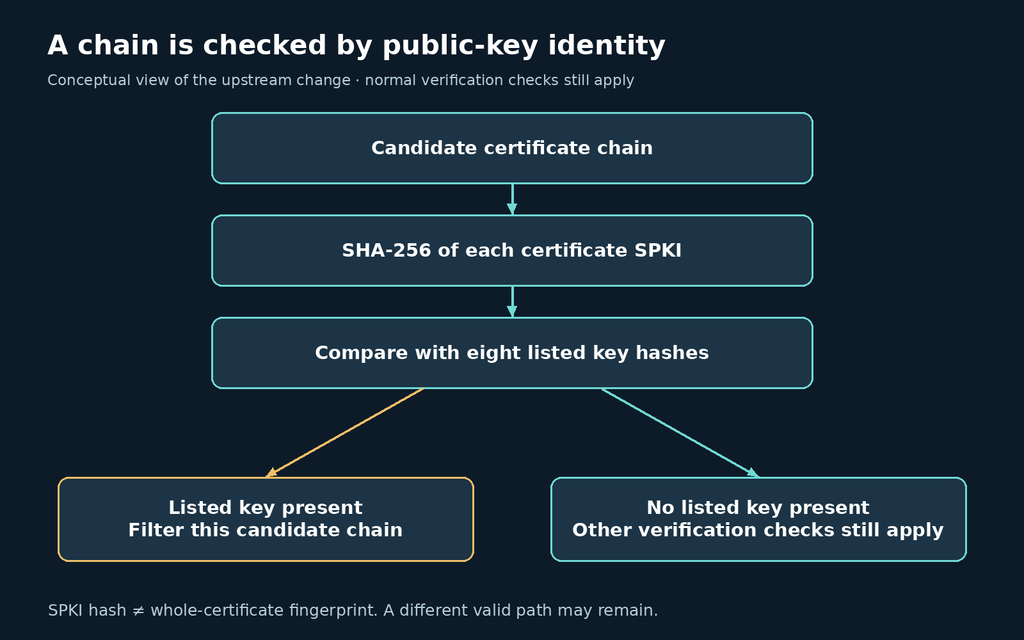
The official description is deliberately limited. It identifies a set of intermediates to be excluded from verification results; it does not provide a full public incident narrative. The upstream change implements filtering using eight SHA-256 hashes of SubjectPublicKeyInfo, or SPKI. The issue discussion associates the intermediate identities with eMudhra and emSign. The implementation is the more precise reference when checking how a key is matched.
This distinction matters when interpreting headlines. Distrust of selected intermediate keys is not evidence that every certificate from a named organization is rejected, that every root operated by that organization has been removed, or that a particular user’s traffic was intercepted. Those are different claims requiring different evidence. This article does not infer a private-key compromise, a confirmed exploitation campaign, or a universal browser policy from the Go update.
Treat the advisory as an instruction to repair the relevant trust decision while keeping the investigation proportional to what is known. If a deployment has separate evidence of interception or unexpected certificate changes, investigate that evidence. If it only has a dependency inventory match, begin with software provenance and controlled validation. Combining those situations into one incident label makes both prioritization and communication less accurate.
Which Go versions should you use
Les official release entries identify Go 1.26.10 and 1.27.3 as the supported-line updates for this change. Use the relevant fixed release or a later supported release whose provenance you can verify. A distribution or software vendor may deliver a backport under its own package version; retain that vendor’s advisory and build evidence rather than guessing from a shortened version string.
| What you operate | Immediate decision | Evidence to retain |
|---|---|---|
| Source built on the Go 1.26 line | Rebuild with 1.26.10 or a suitable later supported fixed toolchain | Toolchain identity, build record, and resulting artifact digest |
| Source built on the Go 1.27 line | Rebuild with 1.27.3 or a suitable later supported fixed toolchain | The same evidence for the actual release artifact |
| An older unsupported toolchain | Plan a supported upgrade and check the distributor’s security guidance | Migration result and any documented backport status |
| A downloaded Go-based application | Request or install the maintainer’s updated application build | Application version, vendor statement, and executable identity |
| A container containing a Go executable | Replace the executable through the application build and rollout process | Image digest, contained executable, and deployed image identity |
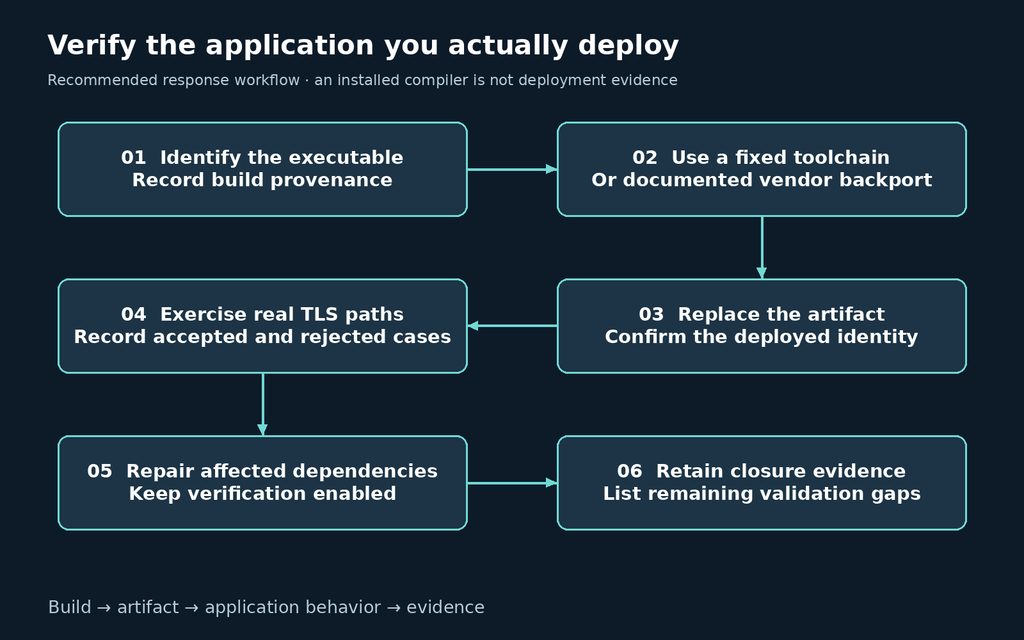
There are two separate inventories here. One records the toolchain available to a developer or build runner. The other records the executable shipped to a user, image registry, server, or workstation. A screenshot of an updated development machine answers the first question. It does not answer the second. Keep the release ticket tied to the artifact that actually processes the connection.
A container base-image refresh deserves the same scrutiny. If the application executable was copied from an earlier build stage or retrieved from a release archive, updating unrelated files in the final image need not replace it. Review the build steps that produce or obtain that executable. The practical acceptance condition is a known repaired application running in the intended environment, rather than a new image creation timestamp.
What the patch matches and why a certificate fingerprint can mislead
Certificate identification has several layers. A subject name is descriptive text. A certificate fingerprint hashes the encoded certificate. An SPKI hash identifies the encoded public-key information. These are not interchangeable identifiers. Two certificates can carry the same public key while differing in serial number or other certificate fields, so comparing only their whole-certificate fingerprints can answer the wrong question.
Les Go patch hashes RawSubjectPublicKeyInfo and checks certificates throughout candidate chains. Chains containing a listed key are filtered out. The change touches the Go verifier and the macOS and Windows verification paths. It does not follow that every possible chain to a root is rejected: the relevant question is whether an acceptable path remains after filtering.
| Identifier or observation | What it helps establish | What it cannot establish alone |
|---|---|---|
| Subject or issuer display name | A readable identity to investigate | Equality of public keys or the result of Go’s filter |
| SHA-256 of the full certificate DER | The identity of one encoded certificate | Whether a different certificate carries the same SPKI |
| SHA-256 of SPKI DER | The public-key identity used by this patch | Full certificate validity, hostname authorization, or deployment exposure |
| A successful browser connection | That browser’s result for that connection | The result of a separately built Go application |
| A failed application handshake | That a connection did not complete | That this CVE, rather than another TLS problem, caused the failure |
For analysis, keep each fingerprint labeled with its input bytes. A record containing only “SHA-256” is incomplete: a teammate needs to know whether it was computed over the certificate, SPKI, a downloaded file, or something else. Preserve the certificate source and collection time as well. This makes a later comparison reproducible without turning a human-readable issuer name into a security decision.
The boundary between an intermediate and a trust anchor is also worth preserving in an inventory. Go’s VerifyOptions documentation distinguishes the intermediate pool used to form a chain from the root pool. A leaf certificate shown by a website is only part of that construction. Reviewing the leaf in isolation can miss the intermediate key that matters to the policy.
Try Penligent for Authorized Security Testing →
An offline example of SPKI identity
The following local demonstration makes the fingerprint distinction observable. It creates two self-signed test certificates with different serial numbers but the same generated public key, then a third with a different key. Nothing connects to a network, installs a trust anchor, changes a trust store, or uses real eMudhra certificates. It requires Python with the cryptography package already available.
from datetime import datetime, timedelta, timezone
from hashlib import sha256
from cryptography import x509
from cryptography.hazmat.primitives import hashes, serialization
from cryptography.hazmat.primitives.asymmetric import ec
from cryptography.x509.oid import NameOID

now = datetime.now(timezone.utc)

def certificate(key, serial):
    name = x509.Name([x509.NameAttribute(NameOID.COMMON_NAME,
                                       "offline.example.test")])
    return (x509.CertificateBuilder()
            .subject_name(name).issuer_name(name)
            .public_key(key.public_key()).serial_number(serial)
            .not_valid_before(now - timedelta(minutes=1))
            .not_valid_after(now + timedelta(days=1))
            .sign(key, hashes.SHA256()))

def cert_hash(cert):
    der = cert.public_bytes(serialization.Encoding.DER)
    return sha256(der).hexdigest()

def spki_hash(cert):
    der = cert.public_key().public_bytes(
        serialization.Encoding.DER,
        serialization.PublicFormat.SubjectPublicKeyInfo)
    return sha256(der).hexdigest()

key = ec.generate_private_key(ec.SECP256R1())
a, b = certificate(key, 1), certificate(key, 2)
c = certificate(ec.generate_private_key(ec.SECP256R1()), 3)

assert cert_hash(a) != cert_hash(b)
assert spki_hash(a) == spki_hash(b)
assert spki_hash(a) != spki_hash(c)

toy_blocked_keys = {spki_hash(a)}
def toy_rejected(chain):
    return any(spki_hash(cert) in toy_blocked_keys for cert in chain)

assert toy_rejected([c, b])
assert not toy_rejected([c])
print("Five offline identity checks passed.")
The fourth assertion is the important chain example: a certificate absent from the toy blocked-key set does not make the entire list acceptable when another entry matches. The fifth assertion shows the opposite case for this one test. Both are deliberately narrower than production certificate verification. The function does not build chains, validate signatures, enforce certificate policies, check hostnames, or implement the Go patch.
Do not turn this snippet into a replacement TLS verifier. Its purpose is to prevent a measurement error during investigation: comparing a full-certificate digest with a public-key digest and concluding that a match is absent. Real remediation uses the supported software update and its normal verification behavior. Recreating a vendor’s security policy in an application adds a separate maintenance obligation and can introduce differences the demonstration never tests.
Check the executable before testing the connection
On a machine with the Go command available, these inventory commands distinguish the selected toolchain from a specific application binary. Replace the placeholder path with a local executable you own or administer. They do not send a request to an external server.
# Toolchain selected in this shell
go version
go env GOVERSION GOTOOLCHAIN GOOS GOARCH

# Build metadata for one existing local application binary
go version -m ./path/to/your-application
Les Go module reference documents build information available through go version -m. Treat the output as one part of provenance, together with the release source and artifact identity. If the binary is not inspectable, has unusual packaging, or comes from a vendor with backported changes, record that uncertainty and request its security statement. Absence of convenient metadata is not evidence that the executable is safe or unsafe.
For a team maintaining source, record the build toolchain selected inside the actual release job. A developer’s shell and a CI runner can choose different toolchains. Check what the job used, then associate the output artifact with the release that was deployed. Keep the comparison small and concrete: previous artifact, replacement artifact, build provenance, and rollout destination.
For a person using a downloaded CLI or desktop utility, avoid an unnecessary source-build project. Check the maintainer’s release notes, install the verified replacement through the normal channel, and confirm which copy your shell or launcher starts. Multiple copies are common enough to deserve an explicit check. An application downloaded to one folder does not replace another copy invoked through a different path.
Where a vendor offers a backported package, keep its exact package release rather than translating it into an upstream version by intuition. A build can include a fix without adopting the entire upstream minor release. Conversely, a marketing release number can change while its embedded runtime remains old. The vendor’s documented mapping is what resolves that ambiguity.
Validate the path your application actually uses
Start with an owned staging application or an authorized test environment. Identify which component opens the outbound TLS connection, whether a proxy terminates it, and which verifier decides whether the peer is acceptable. An inbound website check and a server’s outbound dependency call can exercise different software. A browser, a system utility, and a Go application are not interchangeable witnesses.
Go’s Certificate.Verify documentation explains chain building and notes that platform verification may be used when Roots is nil. It also states that Verify does not perform revocation checking. Those API boundaries help interpret a result, but they do not eliminate the need to test the application’s real configuration. A custom TLS transport or wrapper can change what is actually enforced.
Use at least two controlled cases in the rollout plan. One should exercise a dependency expected to remain accepted under the intended policy. Another should exercise the rejection condition where an authorized fixture and a defensible test procedure are available. Record the certificate inputs and expected result before running the test. A generic failed handshake is not a meaningful negative case unless you know why it failed.
When a real distrust fixture is unavailable, be explicit about the validation gap. You can still confirm the repaired build, normal dependency behavior, and the application’s verification configuration. You cannot claim to have reproduced the exact rejection condition merely because a toy hash test passed. Separate those evidence levels in the ticket so another engineer can complete the missing test later.
For applications deployed across operating systems, run representative checks on the operating systems you support. The platform paths in the upstream change make a single-platform result insufficient evidence for a whole fleet. This does not require testing every machine by hand; it requires a release matrix that reflects materially different validation paths and a rollout mechanism that reliably installs the tested artifact.
Try Penligent for Authorized Security Testing →
Build a test record another person can repeat
A small test matrix is more useful than a folder of unlabeled screenshots. Give each case a stable name and record four inputs: the executable digest, operating system, application configuration, and certificate fixture or controlled endpoint. Add the expected outcome before testing. A later reviewer can then distinguish a software change from a changed service certificate, proxy route, or test environment.
For example, a team might define one case for a required staging API through its normal proxy and another for a direct connection permitted only inside the lab. These are different cases even if the hostname is identical. The point is to make the trust decision attributable to a specific path. Do not invent a direct route in production just to simplify a test, and do not claim a proxy observation proves how an application behaves when no proxy is present.
Separate a test failure from an inconclusive test. A failure means a specified input produced an outcome that contradicts the expected security or business behavior. An inconclusive result means the fixture, application path, or provenance was not established well enough to make that comparison. Inconclusive work needs an owner and a missing input; repeating the same command without fixing that input rarely adds evidence.
Keep the test artifact alongside the release decision, with a short explanation of what it establishes. A successful allowed-path case supports compatibility. A correctly attributed rejection supports the intended trust boundary. A build record supports implementation provenance. These pieces complement one another, but combining them does not justify a claim about unobserved historical traffic. Investigation of past activity still requires its own evidence and scope.
If TLS starts failing after the update
A trust update can expose a dependency on a chain that the repaired client no longer accepts. Diagnose that change without weakening the client. Capture the exact application error, executable identity, requested hostname, time, and the chain available to the controlled test. Store only what the investigation needs, and keep private keys, session credentials, and unrelated request bodies out of shared reports.
| Observed symptom | First distinction to make | Appropriate next action |
|---|---|---|
| The repaired application fails while a browser succeeds | Are both using the same peer, route, and verification policy? | Reproduce with the actual application path and retain both results |
| A certificate with a familiar issuer name is rejected | Does a chain entry match the relevant SPKI identity? | Compare labeled inputs against the upstream implementation |
| Failure happens only behind an enterprise proxy | Which component terminates and reissues TLS? | Review the proxy’s chain and trust policy with its owner |
| Failure affects one operating system or package build | Is the tested artifact and verifier path different? | Compare release provenance and platform-specific results |
| The error is an expired certificate or wrong hostname | Is this independent of the new distrust policy? | Repair the certificate or endpoint configuration responsible |
| A replacement certificate is installed but the problem remains | What chain does the application now receive or build? | Retest the complete path instead of checking only the new leaf |
If you operate the service presenting the affected chain, work with its certificate provider on a replacement chain accepted under the required client policies. Validate the actual result delivered to clients, not just a successful certificate issuance message. A new leaf may still lead through an unwanted intermediate. Keep the old and new chain identities available to explain what changed.
If you consume someone else’s service, send its operator a bounded report with the failing client build, hostname, time, and relevant public certificate evidence. Avoid attributing an incident beyond what those observations establish. A concrete interoperability report is easier to act on than a claim that an entire CA ecosystem is broken.
Do not use insecure verification settings, an accept-all callback, or a silent fallback to plaintext as a workaround. That changes the security contract of the application and can hide the condition the update was designed to reject. A useful recovery plan preserves authentication while moving the dependency to an acceptable chain or software configuration.
What counts as a completed remediation
Les Go vulnerability management documentation describes govulncheck as a tool for identifying known vulnerabilities affecting Go code. Use available analysis as supporting evidence, with its database state and analysis mode recorded. A new issue can be visible in an upstream advisory before every downstream database or scanner reflects it. A clean result should not override an explicit vendor update instruction without understanding that timing.
| Closure item | Question the evidence should answer | Insufficient substitute |
|---|---|---|
| Release provenance | Which repaired toolchain or documented vendor backport produced this binary? | A new compiler installed on an unrelated machine |
| Artifact rollout | Is the intended executable running at each relevant destination? | A successful build with no deployment evidence |
| Verification configuration | Does the application enforce the intended TLS authentication path? | A success result obtained with verification disabled |
| Compatibility check | Do required dependencies still work with that policy? | A browser-only check of the public frontend |
| Rejection check | Was the relevant negative condition tested, or is the gap recorded? | An unrelated TLS error or the offline toy demonstration |
| Investigation boundary | Is there separate evidence that warrants an incident review? | Assuming compromise solely from a CVE identifier |
For automated security assessments, make these evidence boundaries part of the scope. A finding should identify the component tested, the prerequisite it observed, and the retest that could close it. A public web scan alone cannot establish the build provenance of an internal Go client. When evaluating Penligent or another testing workflow, ask for evidence within the access actually granted rather than inferring visibility into an application’s build pipeline.
Keep operational restoration and security closure visible as separate outcomes. The service may become reachable again after a certificate replacement while an older executable still remains deployed elsewhere. Equally, the repaired executable can be fully rolled out while a dependent service’s certificate migration is still open. Assign an owner and next action to each remaining item instead of compressing both into a single green status.
Questions about the Go x509 update
Is CVE-2026-111943 a remote code execution vulnerability in Go
The official material reviewed here describes a certificate-trust mitigation, not an RCE mechanism. Do not infer code execution, an exploit payload, or a compromise campaign from the CVE number. Use the upstream description and the actual application exposure to frame the response.
Does this reject every eMudhra or emSign certificate
The implementation matches a specific set of SPKI hashes. A company name, a root display name, or the presence of the word emSign is not an equivalent technical match. Review the relevant chain and public-key identities rather than broadening the policy by name.
Is upgrading the Go compiler enough for a downloaded application
Confirm the application build itself. Installing a compiler does not establish that an existing executable was rebuilt. Obtain the maintainer’s repaired release or rebuild the application through its controlled source workflow, then verify which executable is actually launched.
Can an OpenSSL or browser result verify the Go fix
It can provide useful comparison evidence, but it exercises another software and trust-policy path. The acceptance test must include the relevant Go application. Differences are a reason to inspect the chain, route, platform, and configuration, not to choose whichever client reports success.
Does the offline Python example reproduce the CVE
No. It demonstrates that certificate fingerprints and SPKI hashes identify different inputs and that a matching chain entry can be detected in a toy list. It does not reproduce a real vendor trust failure, validate a production chain, or establish that a deployment is patched.
What should I do first if I own a small service
Identify the Go application and its maintainer, obtain the repaired build, and test its required outbound connections in a controlled environment. Keep verification enabled. Record the artifact and test result so a successful upgrade is more than an assumption about the machine’s installed tools.
The repair is complete when the deployed application makes the intended trust decision with a known repaired implementation and its required dependencies work under that policy. Preserve the distinction between key identity, certificate identity, and executable identity. Those three checks turn an urgent announcement into a verifiable change without inventing an incident or trading away TLS authentication.


 French
 English
 German
 Spanish
 Portuguese
 Japanese
 Korean
 Hindi
 Arabic
 Turkish
 Hebrew